

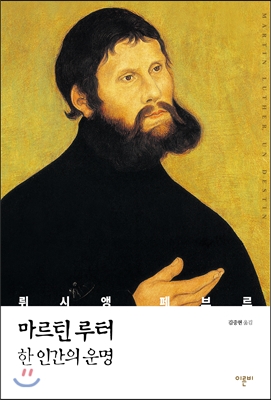
Martin Luther, the fate of a man
 |
Description
Book Introduction
How is a person's fate refracted?
Lucien Febvre's famous book, "The Man Luther" from a New Historical Perspective of the Annales School
Reflecting on the eventful life and turbulent history of the religious reformer Martin Luther.
A truly free human being who takes control of his own destiny
『Martin Luther, the Fate of a Man』 is a study of 'Luther' by Lucien Febvre, the founder of the French Annales School, which pioneered a new type of historiography in the 20th century.
However, Febvre said, “It is a popularization work aimed at the general public, but at the same time, it is a work of reflection.”
This book, made famous by historian Fernand Braudel, reflects on the eventful life of a 16th-century German religious reformer and the turbulent political and social history of Europe under the Holy Roman Empire.
Braudel, in his Treatise on History, considered it the best of Febvre's works, and commented that it portrayed "a truly free man who directs his own destiny and the destiny of history."
It was also the first book of his that became known to English-speaking readers during his lifetime, and it was such a popular work that he rewrote the preface to the third edition in 1951.
Lucien Febvre's famous book, "The Man Luther" from a New Historical Perspective of the Annales School
Reflecting on the eventful life and turbulent history of the religious reformer Martin Luther.
A truly free human being who takes control of his own destiny
『Martin Luther, the Fate of a Man』 is a study of 'Luther' by Lucien Febvre, the founder of the French Annales School, which pioneered a new type of historiography in the 20th century.
However, Febvre said, “It is a popularization work aimed at the general public, but at the same time, it is a work of reflection.”
This book, made famous by historian Fernand Braudel, reflects on the eventful life of a 16th-century German religious reformer and the turbulent political and social history of Europe under the Holy Roman Empire.
Braudel, in his Treatise on History, considered it the best of Febvre's works, and commented that it portrayed "a truly free man who directs his own destiny and the destiny of history."
It was also the first book of his that became known to English-speaking readers during his lifetime, and it was such a popular work that he rewrote the preface to the third edition in 1951.
- You can preview some of the book's contents.
Preview
index
Preface to the First Edition 11
Preface to the Second Edition 13
Preface to the Third Edition 19
Part 1: Efforts in Solitude
Chapter 1: From Köstlin to Denifle 27
28 before the trip to Rome
From Rome to Indulgences 34
Spoiler Alert 39
Denifle's Argument 43
Chapter 2: Revisiting: Before Discovery 51
Luther as a monk 53
58 from Gabriel to Staupitz
Chapter 3: Revisiting: Discovery 69
Discovery 70
His conclusions 76
Luther 81 in 1516
Part 2: Enlightenment
Chapter 1: The Case of the Indulgence 93
Albrecht, Fugger, and Tetzel 94
Luther's Rebellion 101
95 Theses, 108
Chapter 2: Germany and Luther in 1517 113
Political instability 114
Social Unrest 122
Luther before Germany 128
Chapter 3: Erasmus, Hutton, Rome 135
You are not godly 136
Huttenists 146
Do you believe it or not? 154
Chapter 4: The Idealist of 1520 163
Statement to the Nobility 164
Building a New Church 171
Courage at Worms 179
Chapter 5: A Few Months at Wartburg 195
Germany in turmoil 196
The Amazing Labor at Wartburg 202
Forge of Style 207
Idealism comes first 211
Violence, or Words 218
223 As a Believer, Not a Leader
Part 3: Trapped in One's Own World
Chapter 1: Anabaptists and Peasants 229
Zwickau 231
Preaching or Action 237
Church, State 242
Farmers 247
Two Cities 254
Chapter 2: Idealism and Lutheranism after 1525 259
For Faith: Erasmus, He is Reason 260
Laughing at the World: Marriage to Katharina 266
Submission to Power 270
Lutheranism and Lutheranism 281
Conclusion 289
Week 303
Reference Note 335
Review 345
Release | Historians, Seeing Luther as a Man 349
Finishing editing 357
Preface to the Second Edition 13
Preface to the Third Edition 19
Part 1: Efforts in Solitude
Chapter 1: From Köstlin to Denifle 27
28 before the trip to Rome
From Rome to Indulgences 34
Spoiler Alert 39
Denifle's Argument 43
Chapter 2: Revisiting: Before Discovery 51
Luther as a monk 53
58 from Gabriel to Staupitz
Chapter 3: Revisiting: Discovery 69
Discovery 70
His conclusions 76
Luther 81 in 1516
Part 2: Enlightenment
Chapter 1: The Case of the Indulgence 93
Albrecht, Fugger, and Tetzel 94
Luther's Rebellion 101
95 Theses, 108
Chapter 2: Germany and Luther in 1517 113
Political instability 114
Social Unrest 122
Luther before Germany 128
Chapter 3: Erasmus, Hutton, Rome 135
You are not godly 136
Huttenists 146
Do you believe it or not? 154
Chapter 4: The Idealist of 1520 163
Statement to the Nobility 164
Building a New Church 171
Courage at Worms 179
Chapter 5: A Few Months at Wartburg 195
Germany in turmoil 196
The Amazing Labor at Wartburg 202
Forge of Style 207
Idealism comes first 211
Violence, or Words 218
223 As a Believer, Not a Leader
Part 3: Trapped in One's Own World
Chapter 1: Anabaptists and Peasants 229
Zwickau 231
Preaching or Action 237
Church, State 242
Farmers 247
Two Cities 254
Chapter 2: Idealism and Lutheranism after 1525 259
For Faith: Erasmus, He is Reason 260
Laughing at the World: Marriage to Katharina 266
Submission to Power 270
Lutheranism and Lutheranism 281
Conclusion 289
Week 303
Reference Note 335
Review 345
Release | Historians, Seeing Luther as a Man 349
Finishing editing 357
Publisher's Review
How is a person's fate refracted?
Lucien Febvre's famous book, "The Man Luther" from a New Historical Perspective of the Annales School
Reflecting on the eventful life and turbulent history of the religious reformer Martin Luther.
“A certain deep conviction was constantly taking root in my mind.
“Only Luther himself could rightfully grant such assurance.” (p. 67)
“What comes from the soul of that passionate Christian is
“It was a poem, not a plan of action.” (p. 226)
“There is something Luther did not see.
His idealism captivated people so much.
“The point is how conservative it made my former self.” (p. 267)
“His goal was not to take control of the situation.
He is like an actor performing on stage.
I lived in the midst of circumstances.
“His soul was peaceful and detached within him.” (p. 293)
A truly free human being who takes control of his own destiny
『Martin Luther, the Fate of a Man』 is a study of 'Luther' by Lucien Febvre, the founder of the French Annales School, which pioneered a new type of historiography in the 20th century.
However, Febvre said, “It is a popularization work aimed at the general public, but at the same time, it is a work of reflection.”
This book, made famous by historian Fernand Braudel, reflects on the eventful life of a 16th-century German religious reformer and the turbulent political and social history of Europe under the Holy Roman Empire.
Braudel, in his Treatise on History, considered it the best of Febvre's works, and commented that it portrayed "a truly free man who directs his own destiny and the destiny of history."
It was also the first book of his that became known to English-speaking readers during his lifetime, and it was such a popular work that he rewrote the preface to the third edition in 1951.
Performing the dynamic role of a revealed prophet
2017 marks the 500th anniversary of the Reformation.
So, the year 1917 of the last century was the 400th anniversary of the Reformation, and just ten years later, in 1927, Febvre completed writing this book.
As stated in the “Bibliography Note,” even at that time, the literature related to Luther was like an “ocean” (in 1906, theologian Heinrich Böhmer estimated the number at around 2,000 volumes, excluding theses and pamphlets).
What kind of portrait of Luther did Febvre try to salvage from that ocean of literature?
Febvre illuminates Luther's early years, in his 30s and 40s, when he was brimming with reformative and creative energy.
That is, from 1517 to 1525, Luther “dynamically performed the heroic role of a prophet who received revelation” on the world stage.
This period was seen as “the period that explains everything about Luther.”
Neither the uncertain Luther of his youth before that, nor the weary and disillusioned Luther of his decline from 1525 to 1545, are the subjects.
Later, “looking back, one cannot understand, explain, or make Luther understandable.” The so-called “Table Talks” written by young people who followed him in his later years were frequently published based on freely revised and revised words (Luther also often fictionalized the distant past with good intentions).
“No matter how pious the content, it is of no use to historians.”
"The Human Luther" from a New Historical Perspective of the Annales School
Luther of that period speaks, writes, preaches, attacks, and defends himself.
That is why theologians find doctrine in his passionate actions and speeches, and historians find a man.
Regarding Luther, Febvre is, of course, not a theologian, apologist, or detractor, but a historian.
He was also the one who criticized the 19th century German Rankeian historiography based on positivism and gave birth to the Annales School, which emphasized a new historical perspective centered on society, groups, and structures.
He aims to “show a simple yet tragic arc of destiny” by presenting a new perspective that overturns existing perceptions of Luther.
We will examine several key points in how a person's life intertwines with society and the nation, drawing a curve of rise and fall within the group.
“To raise the question of the relationship between the individual and the community, or between individual initiative and social necessity, a subject of paramount importance in history, by applying it to a single human being of remarkable vitality.
“That was exactly what we were planning to do.”
Germany in 1517, Luther, and his twisted fate
Did Luther dream of a revolutionary reform that would change the world? He never had such a goal.
When he nailed the Ninety-Five Theses to the door of the Castle Church in Wittenberg on October 31, 1517, Luther was more concerned with his own personal faith and salvation and simply wanted to engage in dialogue and debate with the Catholic Church.
But the church failed to embrace Luther.
Rather, it was 'Germany' that provided the answer.
“He who cries does not know what echo his voice will bring.” Febvre devotes a separate chapter to the “Germany of 1517,” a subject that people usually do not talk about.
Unlike other European countries that were organized around a king, Germany had no ruler in the strict sense of the word.
“It was an emperor in name only, an empire in name only.” The princes who ruled each territory were much more powerful.
Divided and unstable, Germany had been waiting for “one signal, one person” to change its situation.
The so-called Luther spoke of 'salvation', but the Germans heard it as liberation from Rome (the Papacy), and Luther spoke of 'freedom of conscience' (the 'great refusal' at the Diet of Worms in 1521), but the Germans heard it as freedom from external constraints.
Luther wanted to remain within the Catholic Church, but the church expelled him as a heretic.
Germany accepted him not as a religious Luther, but as a social Luther, a political Luther.
Luther's fate is distorted in this misunderstanding.
The essence of critical historiography that overturns conventional wisdom
In the preface, Febvre states that this book is neither a biography nor an evaluation of a person.
But it is not easy to avoid both sides when dealing with a human life.
However, it cannot be a rhetorical expression intended to emphasize the originality of the author's perspective.
The intention is confirmed in the conclusion.
“I don’t judge Luther.
(…) We, who are not ready to evaluate calmly, simply postpone judgment until the last moment.” However, this is not an expression of reservation or insecurity, but a warning against simplification.
As a historian, Febvre consistently thinks intensely about and judges the fate of a human being.
In his masterpiece, “The Problem of Atheism in the Sixteenth Century,” he criticized the literary scholar Abel Lefranc for labeling humanist François Rabelais an atheist, and argued that people in the 16th century were trapped in the structure of “faith,” and that even an intellectually brilliant person like Rabelais could not escape that framework.
Likewise, this book critically dismantles the conventional wisdom about Luther and the Reformation, unraveling the threads of the controversy sparked by the distinguished Catholic historian Father Denifle, who sought to "discredit Luther."
Febvre welcomed Denifle's radical overturning of the laudatory image of Luther that Protestant biographers had built up over centuries, but criticized him for writing a pre-Freudian novel by emphasizing Luther's carnal and selfish desires.
Of course, Febvre does not forget that he has no intention of paying homage to or defending Luther's chastity.
The deep and unchanging unity of Luther's thought
In this way, Febvre resists all judgments and interpretations that impoverish a person.
So, it is difficult to find in this book either a full praise or a blind criticism of Luther.
“Let’s not become a laughing stock while running to help this side and that side” is not a joke to him.
He wants to stand firm on facts and originals.
There is no Luther who is divided or disconnected from such a Febvre at every period.
The Luther in the monastery before 1517, the Luther who posted the Ninety-Five Theses in 1517, the Luther who appealed to the German people through his great theses of 1520 and countless other writings and speeches thereafter, and the Luther who treated the rebellious peasants like mad dogs, are all different people.
Despite Luther's actions and statements, which many call betrayal and contradictory, Febvre seeks to "demonstrate the profound and unwavering unity of Luther's thought."
Meanwhile, Febvre saw Luther not only as “one of the founders of modern society and the modern spirit,” but also as “one of the founders of Germanic society and the German spirit.”
When Hitler came to power in 1933, he must have been right when he saw that they issued coins with Luther's portrait on them.
Even today, in our hope for change, we may be yearning for one person who will change history.
Reform is said to be more difficult than revolution. What determines whether it will succeed or fail, and what can be the basis for such a claim?
Febvre's insight, which deeply and broadly examines the relationship between the great flow of history and the fate of an individual, makes us deeply reflect on Luther's thoughts and the meaning of reform as we mark the 500th anniversary of the Reformation.
Lucien Febvre's famous book, "The Man Luther" from a New Historical Perspective of the Annales School
Reflecting on the eventful life and turbulent history of the religious reformer Martin Luther.
“A certain deep conviction was constantly taking root in my mind.
“Only Luther himself could rightfully grant such assurance.” (p. 67)
“What comes from the soul of that passionate Christian is
“It was a poem, not a plan of action.” (p. 226)
“There is something Luther did not see.
His idealism captivated people so much.
“The point is how conservative it made my former self.” (p. 267)
“His goal was not to take control of the situation.
He is like an actor performing on stage.
I lived in the midst of circumstances.
“His soul was peaceful and detached within him.” (p. 293)
A truly free human being who takes control of his own destiny
『Martin Luther, the Fate of a Man』 is a study of 'Luther' by Lucien Febvre, the founder of the French Annales School, which pioneered a new type of historiography in the 20th century.
However, Febvre said, “It is a popularization work aimed at the general public, but at the same time, it is a work of reflection.”
This book, made famous by historian Fernand Braudel, reflects on the eventful life of a 16th-century German religious reformer and the turbulent political and social history of Europe under the Holy Roman Empire.
Braudel, in his Treatise on History, considered it the best of Febvre's works, and commented that it portrayed "a truly free man who directs his own destiny and the destiny of history."
It was also the first book of his that became known to English-speaking readers during his lifetime, and it was such a popular work that he rewrote the preface to the third edition in 1951.
Performing the dynamic role of a revealed prophet
2017 marks the 500th anniversary of the Reformation.
So, the year 1917 of the last century was the 400th anniversary of the Reformation, and just ten years later, in 1927, Febvre completed writing this book.
As stated in the “Bibliography Note,” even at that time, the literature related to Luther was like an “ocean” (in 1906, theologian Heinrich Böhmer estimated the number at around 2,000 volumes, excluding theses and pamphlets).
What kind of portrait of Luther did Febvre try to salvage from that ocean of literature?
Febvre illuminates Luther's early years, in his 30s and 40s, when he was brimming with reformative and creative energy.
That is, from 1517 to 1525, Luther “dynamically performed the heroic role of a prophet who received revelation” on the world stage.
This period was seen as “the period that explains everything about Luther.”
Neither the uncertain Luther of his youth before that, nor the weary and disillusioned Luther of his decline from 1525 to 1545, are the subjects.
Later, “looking back, one cannot understand, explain, or make Luther understandable.” The so-called “Table Talks” written by young people who followed him in his later years were frequently published based on freely revised and revised words (Luther also often fictionalized the distant past with good intentions).
“No matter how pious the content, it is of no use to historians.”
"The Human Luther" from a New Historical Perspective of the Annales School
Luther of that period speaks, writes, preaches, attacks, and defends himself.
That is why theologians find doctrine in his passionate actions and speeches, and historians find a man.
Regarding Luther, Febvre is, of course, not a theologian, apologist, or detractor, but a historian.
He was also the one who criticized the 19th century German Rankeian historiography based on positivism and gave birth to the Annales School, which emphasized a new historical perspective centered on society, groups, and structures.
He aims to “show a simple yet tragic arc of destiny” by presenting a new perspective that overturns existing perceptions of Luther.
We will examine several key points in how a person's life intertwines with society and the nation, drawing a curve of rise and fall within the group.
“To raise the question of the relationship between the individual and the community, or between individual initiative and social necessity, a subject of paramount importance in history, by applying it to a single human being of remarkable vitality.
“That was exactly what we were planning to do.”
Germany in 1517, Luther, and his twisted fate
Did Luther dream of a revolutionary reform that would change the world? He never had such a goal.
When he nailed the Ninety-Five Theses to the door of the Castle Church in Wittenberg on October 31, 1517, Luther was more concerned with his own personal faith and salvation and simply wanted to engage in dialogue and debate with the Catholic Church.
But the church failed to embrace Luther.
Rather, it was 'Germany' that provided the answer.
“He who cries does not know what echo his voice will bring.” Febvre devotes a separate chapter to the “Germany of 1517,” a subject that people usually do not talk about.
Unlike other European countries that were organized around a king, Germany had no ruler in the strict sense of the word.
“It was an emperor in name only, an empire in name only.” The princes who ruled each territory were much more powerful.
Divided and unstable, Germany had been waiting for “one signal, one person” to change its situation.
The so-called Luther spoke of 'salvation', but the Germans heard it as liberation from Rome (the Papacy), and Luther spoke of 'freedom of conscience' (the 'great refusal' at the Diet of Worms in 1521), but the Germans heard it as freedom from external constraints.
Luther wanted to remain within the Catholic Church, but the church expelled him as a heretic.
Germany accepted him not as a religious Luther, but as a social Luther, a political Luther.
Luther's fate is distorted in this misunderstanding.
The essence of critical historiography that overturns conventional wisdom
In the preface, Febvre states that this book is neither a biography nor an evaluation of a person.
But it is not easy to avoid both sides when dealing with a human life.
However, it cannot be a rhetorical expression intended to emphasize the originality of the author's perspective.
The intention is confirmed in the conclusion.
“I don’t judge Luther.
(…) We, who are not ready to evaluate calmly, simply postpone judgment until the last moment.” However, this is not an expression of reservation or insecurity, but a warning against simplification.
As a historian, Febvre consistently thinks intensely about and judges the fate of a human being.
In his masterpiece, “The Problem of Atheism in the Sixteenth Century,” he criticized the literary scholar Abel Lefranc for labeling humanist François Rabelais an atheist, and argued that people in the 16th century were trapped in the structure of “faith,” and that even an intellectually brilliant person like Rabelais could not escape that framework.
Likewise, this book critically dismantles the conventional wisdom about Luther and the Reformation, unraveling the threads of the controversy sparked by the distinguished Catholic historian Father Denifle, who sought to "discredit Luther."
Febvre welcomed Denifle's radical overturning of the laudatory image of Luther that Protestant biographers had built up over centuries, but criticized him for writing a pre-Freudian novel by emphasizing Luther's carnal and selfish desires.
Of course, Febvre does not forget that he has no intention of paying homage to or defending Luther's chastity.
The deep and unchanging unity of Luther's thought
In this way, Febvre resists all judgments and interpretations that impoverish a person.
So, it is difficult to find in this book either a full praise or a blind criticism of Luther.
“Let’s not become a laughing stock while running to help this side and that side” is not a joke to him.
He wants to stand firm on facts and originals.
There is no Luther who is divided or disconnected from such a Febvre at every period.
The Luther in the monastery before 1517, the Luther who posted the Ninety-Five Theses in 1517, the Luther who appealed to the German people through his great theses of 1520 and countless other writings and speeches thereafter, and the Luther who treated the rebellious peasants like mad dogs, are all different people.
Despite Luther's actions and statements, which many call betrayal and contradictory, Febvre seeks to "demonstrate the profound and unwavering unity of Luther's thought."
Meanwhile, Febvre saw Luther not only as “one of the founders of modern society and the modern spirit,” but also as “one of the founders of Germanic society and the German spirit.”
When Hitler came to power in 1933, he must have been right when he saw that they issued coins with Luther's portrait on them.
Even today, in our hope for change, we may be yearning for one person who will change history.
Reform is said to be more difficult than revolution. What determines whether it will succeed or fail, and what can be the basis for such a claim?
Febvre's insight, which deeply and broadly examines the relationship between the great flow of history and the fate of an individual, makes us deeply reflect on Luther's thoughts and the meaning of reform as we mark the 500th anniversary of the Reformation.
GOODS SPECIFICS
- Publication date: November 16, 2016
- Page count, weight, size: 360 pages | 152*225*30mm
- ISBN13: 9791195552320
- ISBN10: 1195552327
You may also like
카테고리
korean


korean

![GQ KOREA Mark (Monthly): December [2025]](http://librairie.coreenne.fr/cdn/shop/files/8ef265dbbfbf186523ed75ba7319009d.jpg?v=1765340328&width=3840)


