

Saimdang
 |
Description
Book Introduction
A wise wife and mother? A heroine of the Joseon Dynasty?
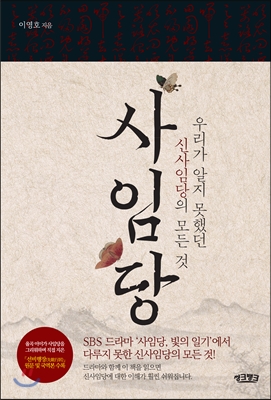
"Saimdang, Everything We Didn't Know About Shin Saimdang" stands out above all else for its unique sense of problem.
These are topics not easily found in other books, and the author sheds new light on them from a 21st-century perspective.
The meaning of the nickname 'Saimdang' is to follow in the footsteps of King Wen of Zhou's mother, 'Taim (太任)'.
So, what was Taeim's actual situation, and how did the history of the struggle for power between the Zhou and Shang dynasties unfold? Why did the names of the four brothers, including Yi Yulgok, include the character "king" (王) in their names? Saimdang is said to have begun studying painting from a young age, using An Gyeon's landscape paintings as textbooks. If so, why are only a handful of her landscape paintings extant today? Was the "Dumun-ri" recorded by Song Si-yeol as the location of Shin Saimdang's tomb the current location of Mt. Jawoon? Or was it somewhere else? Did Saimdang learn anything from the lives of extraordinary women of her time? Do the arrangements of her clothes and the gestures of her hands in Shin Saimdang's portrait reflect the attire of a 16th-century noblewoman?
Author Lee Young-ho searches for answers to these questions by visiting relevant records and contacting relevant people.
As a result, a new image of Saimdang, completely different from previous Saimdang images, is being created, one fit for the 21st century. Above all, this book is written in a conversational style, making it enjoyable for anyone to read.
Additionally, the book is filled with a wealth of illustrations, including Saimdang's landscape paintings, insect paintings, calligraphy, and various field photos, so readers can feel like they are participating in the author's exploration.
Was Saimdang a virtuous wife or a heroine of the Joseon Dynasty?
Let's go on a field trip together, guided by the author.
"Saimdang, Everything We Didn't Know About Shin Saimdang" stands out above all else for its unique sense of problem.
These are topics not easily found in other books, and the author sheds new light on them from a 21st-century perspective.
The meaning of the nickname 'Saimdang' is to follow in the footsteps of King Wen of Zhou's mother, 'Taim (太任)'.
So, what was Taeim's actual situation, and how did the history of the struggle for power between the Zhou and Shang dynasties unfold? Why did the names of the four brothers, including Yi Yulgok, include the character "king" (王) in their names? Saimdang is said to have begun studying painting from a young age, using An Gyeon's landscape paintings as textbooks. If so, why are only a handful of her landscape paintings extant today? Was the "Dumun-ri" recorded by Song Si-yeol as the location of Shin Saimdang's tomb the current location of Mt. Jawoon? Or was it somewhere else? Did Saimdang learn anything from the lives of extraordinary women of her time? Do the arrangements of her clothes and the gestures of her hands in Shin Saimdang's portrait reflect the attire of a 16th-century noblewoman?
Author Lee Young-ho searches for answers to these questions by visiting relevant records and contacting relevant people.
As a result, a new image of Saimdang, completely different from previous Saimdang images, is being created, one fit for the 21st century. Above all, this book is written in a conversational style, making it enjoyable for anyone to read.
Additionally, the book is filled with a wealth of illustrations, including Saimdang's landscape paintings, insect paintings, calligraphy, and various field photos, so readers can feel like they are participating in the author's exploration.
Was Saimdang a virtuous wife or a heroine of the Joseon Dynasty?
Let's go on a field trip together, guided by the author.
- You can preview some of the book's contents.
Preview
index
Introduction_
Saimdang: Everything We Never Knew About Her
Part 1: Becoming Saimdang
My name is 'Shin In-seon'
⇒ New stories about Saimdang's family
Become Saimdang
⇒ Saimdang will follow Taeim's example
The "Gimiosahwa" incident, a historical event that determined fate
⇒ Shin Myeong-hwa begins educating the women in her household.
Father 'Shin Myeong-hwa' and mother 'Yong-in Lee'
⇒ Preparing for the future under parental care
Studying Dongmong Seonseup, Myeongsimbogam, the Four Books and Six Classics, and Zhu Xi
⇒ Learn to see the world from a different perspective
Learn virtue, elementary learning, prenatal education, and family etiquette
⇒ The path of womanly virtue
Part 2: Following in Saimdang's footsteps
Tug-of-war with husband Lee Won-su
⇒ You have to become stronger
Tracing Lee Yulgok's state of mind
⇒ Third son 'Lee Lee' born at age 33
In-laws' home, Yulgok-ri, Paju-gun, Gyeonggi-do
⇒ Hwaseokjeong and Paju Yulgok Historic Site
My parents' home, Bukpyeong Village, Jukheon-ri, Gangneung-bu, Gangwon-do
⇒ Why you must visit Ojukheon
Stay for a while, Baekokpo-ri, Bongpyeong-myeon, Pyeongchang-gun, Gangwon-do
⇒ Stop between one's feet and another's head
Part 3: Saimdang and the Four Women
Queen Munjeong's regency
⇒ The chain of fate gradually revealed
Jeong Nan-jeong, the daughter of a concubine, abolished the caste system.
⇒ The meaning of husband
A reevaluation of entertainer Hwang Jin-i
⇒ Status is innate, but learning is something you make.
Jang Nok-su's downfall due to abuse of power
⇒ The End of Politics and Vain Power
Part 4: Recording Saimdang
Lee Yulgok writes about his mother, Saimdang.
⇒ The only story of the family that recorded Shin Saimdang
Song Si-yeol remembers Saimdang
⇒ A story first revealed in the records of Shin Saimdang
In closing_
Questions about Shin Saimdang's portrait
As the text comes out_
Why Saimdang Needs a New Perspective
Saimdang: Everything We Never Knew About Her
Part 1: Becoming Saimdang
My name is 'Shin In-seon'
⇒ New stories about Saimdang's family
Become Saimdang
⇒ Saimdang will follow Taeim's example
The "Gimiosahwa" incident, a historical event that determined fate
⇒ Shin Myeong-hwa begins educating the women in her household.
Father 'Shin Myeong-hwa' and mother 'Yong-in Lee'
⇒ Preparing for the future under parental care
Studying Dongmong Seonseup, Myeongsimbogam, the Four Books and Six Classics, and Zhu Xi
⇒ Learn to see the world from a different perspective
Learn virtue, elementary learning, prenatal education, and family etiquette
⇒ The path of womanly virtue
Part 2: Following in Saimdang's footsteps
Tug-of-war with husband Lee Won-su
⇒ You have to become stronger
Tracing Lee Yulgok's state of mind
⇒ Third son 'Lee Lee' born at age 33
In-laws' home, Yulgok-ri, Paju-gun, Gyeonggi-do
⇒ Hwaseokjeong and Paju Yulgok Historic Site
My parents' home, Bukpyeong Village, Jukheon-ri, Gangneung-bu, Gangwon-do
⇒ Why you must visit Ojukheon
Stay for a while, Baekokpo-ri, Bongpyeong-myeon, Pyeongchang-gun, Gangwon-do
⇒ Stop between one's feet and another's head
Part 3: Saimdang and the Four Women
Queen Munjeong's regency
⇒ The chain of fate gradually revealed
Jeong Nan-jeong, the daughter of a concubine, abolished the caste system.
⇒ The meaning of husband
A reevaluation of entertainer Hwang Jin-i
⇒ Status is innate, but learning is something you make.
Jang Nok-su's downfall due to abuse of power
⇒ The End of Politics and Vain Power
Part 4: Recording Saimdang
Lee Yulgok writes about his mother, Saimdang.
⇒ The only story of the family that recorded Shin Saimdang
Song Si-yeol remembers Saimdang
⇒ A story first revealed in the records of Shin Saimdang
In closing_
Questions about Shin Saimdang's portrait
As the text comes out_
Why Saimdang Needs a New Perspective
Into the book
This book, “Saimdang, Everything We Didn’t Know About Shin Saimdang,” is an attempt at something different.
While basing the book on historical facts related to Saimdang, I did my best to capture everything about Saimdang by looking at the history of Joseon before and after her life, including Yi Yulgok, Lee Sa-on, Shin Myeong-hwa, the Yongin Yi clan, King Wen of Zhou, Neo-Confucianism, Song Si-yeol, and the factional strife of Joseon.
In particular, it records Saimdang's footsteps by visiting Seoul, Gangneung, Paju, and Pyeongchang in detail, and follows the path that Saimdang and Yi Yulgok took to meet her husband and father, Yi Wonsu, and contains the background of Saimdang's heartbreaking compassion and filial piety toward her mother, her deep respect for her father, Shin Myeonghwa, and the story of the husband and wife's fidelity.
It explains the reason for the name Saimdang, the historical background of the Zhou Dynasty, the cultural transformation that occurred during Saimdang's time due to the mixing of ancestral rites and wedding rites, Saimdang's actions as recorded by Yi Yulgok himself, the background of Yi Yulgok's temporary stay in a temple in Geumgangsan during the Joseon Dynasty, which revered Confucianism, and the reason for his return.
It focuses on the relationship between Yi Yulgok and Song Siyeol, and the political situation at the time, and also covers Saimdang's children's upbringing and married life.
---From "Introduction"
“……Anyway, the meaning of the nickname Saimdang is to emulate King Wen of Zhou’s mother, ‘Taim (太任)’, but why did Shin Saimdang choose that nickname?”
“I wanted to emulate the father of King Wu, who founded the Zhou Dynasty, and the father of King Wen of Zhou (who was honored posthumously).
So, rather than wanting to be known only as a famous calligrapher or a virtuous wife, I wonder if Saimdang wanted to be the mother who gave birth to the king of Joseon, or if not, the father of the king.
Saimdang is not just the virtuous wife and mother we have known so far, she is more than that.”
"The King of Joseon? Or the mother who gave birth to the father of the King of Joseon? Isn't that a stretch of the imagination based on a simple nickname, Saimdang? If you assume that, the image we've known of Saimdang will be completely turned upside down. Isn't she a far cry from the image of a virtuous wife and wise mother? Then, what should I say? The mother who gave birth to the leader of a nation? In any case, doesn't that make her seem like an ambitious woman with her eyes set on the throne?"
The owner of the bookstore looked at me with an expression that said, "Don't make such ridiculous assumptions."
It seemed like she secretly wanted to maintain the existing image of Saimdang.
--- p.36
“Shin Saimdang’s family is a family of descendants of the founding fathers of the Goryeo Dynasty.
But the country at that time was Joseon.
But Shin In-seon says she will take the name Saimdang and emulate the Chinese goddess Tai Im?
“…….”
“Look, doesn’t the history of China’s Yin and Zhou dynasties match between Goryeo and Joseon?”
Kim Young-soo observed my expression.
So, what Kim Young-soo was saying was that just as the vassal state of Zhou defeated the superior state of Shang and truly established the Zhou Dynasty, Saimdang's family must have also had the goal of opening the Goryeo Dynasty again in Joseon by inheriting the spirit(?) of the founding fathers of Goryeo.
But that was also a guess that was too far ahead of its time.
Rather than saying that he re-established the Goryeo Dynasty in Joseon, it would be more realistic to assume that he gained the king's trust and expanded his power in Joseon.
--- p.55
“I thought that Saimdang might have been a victim of gifted education.”
"yes?"
“No, why is it still a problem these days? There are so many families that are in chaos because parents send their children to various academies, saying they are raising their children to be gifted and such, but can’t bother the children who want to play? I heard a story about an elementary school student who goes to bed at 2 a.m. because he’s doing homework and academy work. And there was a story about a child who goes to an English academy and a music academy, and when the piano teacher asked the child why he plays the piano, he said, ‘I just do it because mom makes me do it.’ And what did he say again? The child goes to a musical academy, and when asked why he does that, he said, ‘Mom likes it when I do it.’
Mr. Author, don't you know what's going on in the world these days? I know everything.
“Even though we run a used bookstore, we can’t help but be unaware of how the world works, right?”
The owner of the bookstore always had a smiling expression on his face.
It was a signal that he had made his own judgment about Saimdang and would make it known.
The story of the bookstore owner was that gifted education was the problem.
For example, there was a story that Saimdang had been learning to draw and write since she was young, all because of the nagging of her father, Shin Myeong-hwa.
It was argued that gifted education certainly existed during the Joseon Dynasty, although it was a bit different from private education, which is a problem these days.
--- p.60
“Saimdang imitated her mother, Lady Yongin Lee, who embroidered from a young age.
There is a record that Isaon, seeing his granddaughter's talent, taught her painting from the age of seven around 1510, and bought her landscape paintings by An Gyeon as teaching materials.
“An Gyeon was a famous painter representing Joseon since the time of King Sejong.”
"okay?"
“Then it is true that Saimdang developed her painting skills by first painting landscapes.”
“Oh, right! That’s right.
“Because I studied painting while drawing landscape paintings.”
“However, most of Saimdang’s paintings that have been passed down to this day are paintings of grass and insects.
And there are some letters too.
“He must have painted many landscape paintings, but only a few of his landscape paintings have been passed down to this day, which can be counted on one hand.”
CEO Jang Min-seok whetted his appetite.
It was a habit that appeared when I thought something was unfortunate.
--- pp.95-97
“Then, let’s start explaining Taeim’s prenatal education in detail.
… …
First of all, it says this in the Book of Songs.
'Taim's character was upright, consistent, and dignified, and he practiced only virtue.
After becoming pregnant with King Wen
The eyes did not see the evil light
The ears did not hear obscene sounds.
He didn't say anything arrogant.
When standing, don't miss your step
When walking, walk slowly
If the seat is not right, don't sit down
I don't eat meat unless it's cut properly.
At night, he made the blind man read and memorize poetry.
It brought joy to my heart.'
Also, similar content is included in 'Biographies of Virtuous Women' and 'Elementary Learning' written by Liu Xiang of the Han Dynasty in China.
It says that Taeim was strict about prenatal education.
Saimdang probably mastered books of this caliber during her teenage years.” --- pp.139-140
It is fortunate that the record of Saimdang's tomb in Dumun-ri, Paju is clearly recorded in the 'Shin Saimdang Epitaph' written by Song Si-yeol.
The place name hasn't changed.
The first phrase of Shin Saimdang's epitaph clearly indicates the location as 'Dumun-ri, Paju.'
But the problem is that the old and current place names are different.
So it's important to figure out what place the old place name refers to these days.
--- p.151
'Later, Song Si-yeol also came here and saw it.
I'm talking about Ojukheon, the place where his teacher, Lee Yulgok, was born and raised.
However, as I was recording academic achievements and establishing theories on interest rate curves, I felt like I needed more data.
Why was Yi Yulgok able to devote himself to academics from a young age? Song Siyeol investigated Yi Yulgok's father, Yi Wonsu, and found nothing remarkable.
So, I would have traced my lineage back to my maternal grandfather, Shin Myeong-hwa, and naturally, I would have come to know the Yong-in Lee clan, a typical mother figure.
Of course, it would be natural for the story to come down to Saimdang, their daughter and mother of Yi Yulgok.
In the end, Song Si-yeol must have realized that his mother, Saimdang, played a crucial role in raising Yi Yulgok to become a great scholar.
The benefit gained from visiting Ojukheon was not only Saimdang's maternal love.
The place where Saimdang was born and raised, and where she gave birth to and raised Yi Yulgok, gave rise to a sense of the goals of child education that Saimdang felt and thought about, as well as her own role and mission.
--- p.236
“I think that outstanding women like Hwang Jin-i should at least be given a promotion in status.
"This is no longer the Goryeo or Joseon dynasties, is it? So, I think women like Hwang Jini should at least be given a status resembling entertainers, rather than continuing to be treated as gisaeng, even in this day and age."
What Dr. Kim wanted to say is that if we continue to only think of them as gisaeng or concubine's daughters, as we do now when we tell the stories of outstanding female figures of the time, like Hwang Jini, then things will not get much better for future generations.
The argument is that we should elevate the status of women who have developed their talents and devoted themselves to academics and the arts to escape the reality they face, even at this point in time.
--- p.281
My mother always missed her home in Gangneung, and there were days when she spent the night crying and couldn't sleep until dawn after night fell and there was no sign of people.
One day, a concubine (Sihee) brought by a relative with the surname Sim played the geomungo. Saimdang shed tears and said, “The sound of the geomungo makes those who miss it cry.” Others also felt sad, but no one understood Saimdang’s true intentions.
--- pp.303-304
“So I think it’s time to look at the Saimdang we knew from a new perspective.
Saimdang, the wise wife and wise mother? That's right.
But was that all? We need to look at the bigger picture.
Saimdang can be said to be a true mother who devoted her life to raising great figures for the country, and she is a mother of this era who personally practiced the principle that children learn from their parents by setting an example for their children in all aspects of life.
Saimdang also came from a family of founding contributors to the Goryeo Dynasty, didn't she? Just looking at the fact that she included the meaning of "king" (王) next to her sons' names, you can see her grand ambitions.
It can be seen that he hoped that his sons would grow up to be great figures like King Wen and King Wu of the Zhou Dynasty and achieve his own goals in Joseon.
So, I think we should view Saimdang as a heroine of the times.”
"yes.
“That makes sense.”
“Isn’t it wonderful? That there is a heroine like Saimdang in our history.
King Sejong is on the 10,000 won bill, right? So, it wouldn't be at all strange if Saimdang were on the 50,000 won bill.
Saimdang is the mother and heroine of this era.” --- pp.322-323
As the story unfolds with these questions about Saimdang in mind, new facts begin to emerge one by one.
The Saimdang we knew so far was only a very small part of us, and I began to feel a renewed sense that perhaps Saimdang was more than just the virtuous wife and wise mother we thought she was; she was a heroine who foresaw the times and prepared for the future, a heroine we should remember in our country's history.
The more I learned about Saimdang, the more I felt a sense of awe and respect for her profound nobility.
This is why the subtitle of this book is 'Everything We Didn't Know About Shin Saimdang'.
While basing the book on historical facts related to Saimdang, I did my best to capture everything about Saimdang by looking at the history of Joseon before and after her life, including Yi Yulgok, Lee Sa-on, Shin Myeong-hwa, the Yongin Yi clan, King Wen of Zhou, Neo-Confucianism, Song Si-yeol, and the factional strife of Joseon.
In particular, it records Saimdang's footsteps by visiting Seoul, Gangneung, Paju, and Pyeongchang in detail, and follows the path that Saimdang and Yi Yulgok took to meet her husband and father, Yi Wonsu, and contains the background of Saimdang's heartbreaking compassion and filial piety toward her mother, her deep respect for her father, Shin Myeonghwa, and the story of the husband and wife's fidelity.
It explains the reason for the name Saimdang, the historical background of the Zhou Dynasty, the cultural transformation that occurred during Saimdang's time due to the mixing of ancestral rites and wedding rites, Saimdang's actions as recorded by Yi Yulgok himself, the background of Yi Yulgok's temporary stay in a temple in Geumgangsan during the Joseon Dynasty, which revered Confucianism, and the reason for his return.
It focuses on the relationship between Yi Yulgok and Song Siyeol, and the political situation at the time, and also covers Saimdang's children's upbringing and married life.
---From "Introduction"
“……Anyway, the meaning of the nickname Saimdang is to emulate King Wen of Zhou’s mother, ‘Taim (太任)’, but why did Shin Saimdang choose that nickname?”
“I wanted to emulate the father of King Wu, who founded the Zhou Dynasty, and the father of King Wen of Zhou (who was honored posthumously).
So, rather than wanting to be known only as a famous calligrapher or a virtuous wife, I wonder if Saimdang wanted to be the mother who gave birth to the king of Joseon, or if not, the father of the king.
Saimdang is not just the virtuous wife and mother we have known so far, she is more than that.”
"The King of Joseon? Or the mother who gave birth to the father of the King of Joseon? Isn't that a stretch of the imagination based on a simple nickname, Saimdang? If you assume that, the image we've known of Saimdang will be completely turned upside down. Isn't she a far cry from the image of a virtuous wife and wise mother? Then, what should I say? The mother who gave birth to the leader of a nation? In any case, doesn't that make her seem like an ambitious woman with her eyes set on the throne?"
The owner of the bookstore looked at me with an expression that said, "Don't make such ridiculous assumptions."
It seemed like she secretly wanted to maintain the existing image of Saimdang.
--- p.36
“Shin Saimdang’s family is a family of descendants of the founding fathers of the Goryeo Dynasty.
But the country at that time was Joseon.
But Shin In-seon says she will take the name Saimdang and emulate the Chinese goddess Tai Im?
“…….”
“Look, doesn’t the history of China’s Yin and Zhou dynasties match between Goryeo and Joseon?”
Kim Young-soo observed my expression.
So, what Kim Young-soo was saying was that just as the vassal state of Zhou defeated the superior state of Shang and truly established the Zhou Dynasty, Saimdang's family must have also had the goal of opening the Goryeo Dynasty again in Joseon by inheriting the spirit(?) of the founding fathers of Goryeo.
But that was also a guess that was too far ahead of its time.
Rather than saying that he re-established the Goryeo Dynasty in Joseon, it would be more realistic to assume that he gained the king's trust and expanded his power in Joseon.
--- p.55
“I thought that Saimdang might have been a victim of gifted education.”
"yes?"
“No, why is it still a problem these days? There are so many families that are in chaos because parents send their children to various academies, saying they are raising their children to be gifted and such, but can’t bother the children who want to play? I heard a story about an elementary school student who goes to bed at 2 a.m. because he’s doing homework and academy work. And there was a story about a child who goes to an English academy and a music academy, and when the piano teacher asked the child why he plays the piano, he said, ‘I just do it because mom makes me do it.’ And what did he say again? The child goes to a musical academy, and when asked why he does that, he said, ‘Mom likes it when I do it.’
Mr. Author, don't you know what's going on in the world these days? I know everything.
“Even though we run a used bookstore, we can’t help but be unaware of how the world works, right?”
The owner of the bookstore always had a smiling expression on his face.
It was a signal that he had made his own judgment about Saimdang and would make it known.
The story of the bookstore owner was that gifted education was the problem.
For example, there was a story that Saimdang had been learning to draw and write since she was young, all because of the nagging of her father, Shin Myeong-hwa.
It was argued that gifted education certainly existed during the Joseon Dynasty, although it was a bit different from private education, which is a problem these days.
--- p.60
“Saimdang imitated her mother, Lady Yongin Lee, who embroidered from a young age.
There is a record that Isaon, seeing his granddaughter's talent, taught her painting from the age of seven around 1510, and bought her landscape paintings by An Gyeon as teaching materials.
“An Gyeon was a famous painter representing Joseon since the time of King Sejong.”
"okay?"
“Then it is true that Saimdang developed her painting skills by first painting landscapes.”
“Oh, right! That’s right.
“Because I studied painting while drawing landscape paintings.”
“However, most of Saimdang’s paintings that have been passed down to this day are paintings of grass and insects.
And there are some letters too.
“He must have painted many landscape paintings, but only a few of his landscape paintings have been passed down to this day, which can be counted on one hand.”
CEO Jang Min-seok whetted his appetite.
It was a habit that appeared when I thought something was unfortunate.
--- pp.95-97
“Then, let’s start explaining Taeim’s prenatal education in detail.
… …
First of all, it says this in the Book of Songs.
'Taim's character was upright, consistent, and dignified, and he practiced only virtue.
After becoming pregnant with King Wen
The eyes did not see the evil light
The ears did not hear obscene sounds.
He didn't say anything arrogant.
When standing, don't miss your step
When walking, walk slowly
If the seat is not right, don't sit down
I don't eat meat unless it's cut properly.
At night, he made the blind man read and memorize poetry.
It brought joy to my heart.'
Also, similar content is included in 'Biographies of Virtuous Women' and 'Elementary Learning' written by Liu Xiang of the Han Dynasty in China.
It says that Taeim was strict about prenatal education.
Saimdang probably mastered books of this caliber during her teenage years.” --- pp.139-140
It is fortunate that the record of Saimdang's tomb in Dumun-ri, Paju is clearly recorded in the 'Shin Saimdang Epitaph' written by Song Si-yeol.
The place name hasn't changed.
The first phrase of Shin Saimdang's epitaph clearly indicates the location as 'Dumun-ri, Paju.'
But the problem is that the old and current place names are different.
So it's important to figure out what place the old place name refers to these days.
--- p.151
'Later, Song Si-yeol also came here and saw it.
I'm talking about Ojukheon, the place where his teacher, Lee Yulgok, was born and raised.
However, as I was recording academic achievements and establishing theories on interest rate curves, I felt like I needed more data.
Why was Yi Yulgok able to devote himself to academics from a young age? Song Siyeol investigated Yi Yulgok's father, Yi Wonsu, and found nothing remarkable.
So, I would have traced my lineage back to my maternal grandfather, Shin Myeong-hwa, and naturally, I would have come to know the Yong-in Lee clan, a typical mother figure.
Of course, it would be natural for the story to come down to Saimdang, their daughter and mother of Yi Yulgok.
In the end, Song Si-yeol must have realized that his mother, Saimdang, played a crucial role in raising Yi Yulgok to become a great scholar.
The benefit gained from visiting Ojukheon was not only Saimdang's maternal love.
The place where Saimdang was born and raised, and where she gave birth to and raised Yi Yulgok, gave rise to a sense of the goals of child education that Saimdang felt and thought about, as well as her own role and mission.
--- p.236
“I think that outstanding women like Hwang Jin-i should at least be given a promotion in status.
"This is no longer the Goryeo or Joseon dynasties, is it? So, I think women like Hwang Jini should at least be given a status resembling entertainers, rather than continuing to be treated as gisaeng, even in this day and age."
What Dr. Kim wanted to say is that if we continue to only think of them as gisaeng or concubine's daughters, as we do now when we tell the stories of outstanding female figures of the time, like Hwang Jini, then things will not get much better for future generations.
The argument is that we should elevate the status of women who have developed their talents and devoted themselves to academics and the arts to escape the reality they face, even at this point in time.
--- p.281
My mother always missed her home in Gangneung, and there were days when she spent the night crying and couldn't sleep until dawn after night fell and there was no sign of people.
One day, a concubine (Sihee) brought by a relative with the surname Sim played the geomungo. Saimdang shed tears and said, “The sound of the geomungo makes those who miss it cry.” Others also felt sad, but no one understood Saimdang’s true intentions.
--- pp.303-304
“So I think it’s time to look at the Saimdang we knew from a new perspective.
Saimdang, the wise wife and wise mother? That's right.
But was that all? We need to look at the bigger picture.
Saimdang can be said to be a true mother who devoted her life to raising great figures for the country, and she is a mother of this era who personally practiced the principle that children learn from their parents by setting an example for their children in all aspects of life.
Saimdang also came from a family of founding contributors to the Goryeo Dynasty, didn't she? Just looking at the fact that she included the meaning of "king" (王) next to her sons' names, you can see her grand ambitions.
It can be seen that he hoped that his sons would grow up to be great figures like King Wen and King Wu of the Zhou Dynasty and achieve his own goals in Joseon.
So, I think we should view Saimdang as a heroine of the times.”
"yes.
“That makes sense.”
“Isn’t it wonderful? That there is a heroine like Saimdang in our history.
King Sejong is on the 10,000 won bill, right? So, it wouldn't be at all strange if Saimdang were on the 50,000 won bill.
Saimdang is the mother and heroine of this era.” --- pp.322-323
As the story unfolds with these questions about Saimdang in mind, new facts begin to emerge one by one.
The Saimdang we knew so far was only a very small part of us, and I began to feel a renewed sense that perhaps Saimdang was more than just the virtuous wife and wise mother we thought she was; she was a heroine who foresaw the times and prepared for the future, a heroine we should remember in our country's history.
The more I learned about Saimdang, the more I felt a sense of awe and respect for her profound nobility.
This is why the subtitle of this book is 'Everything We Didn't Know About Shin Saimdang'.
---From "As the Writing Comes Out"
Publisher's Review
The joy of originality
Original problem awareness and unique perspectives always entertain us.
When everything is mired in the monotony of uniformity, this originality serves as a wake-up call to our complacency.
Author Lee Young-ho's critical awareness is not only unique, but it also leaves one with the impression that it is almost mysterious how he came to have such a unique critical awareness and create a completely different image of Saimdang.
This book is based on unique questions such as the dispute between the Zhou and Shang dynasties over the name of 'Saimdang', the meaning of the character 'king' (王) in the names of the Yi Yulgok brothers, the whereabouts of Saimdang's landscape paintings, the current location of 'Dumun-ri', the site of Saimdang's tomb, a study on the lives of extraordinary women of the time, and questions about the portrait of Shin Saimdang.
Additionally, this book frequently features novel concepts that are in keeping with the author's unique problem awareness.
“The heroine Saimdang,” “The political significance of prenatal education,” “Both her paternal and maternal sides are descendants of Goryeo’s founding fathers,” “Saimdang was a victim of gifted education,” “Hwang Jini, the original Hallyu star,” and so on will shake the minds of readers who have been stuck in stereotypical ways of thinking.
Readers will be content to enjoy all these explorations along with the author, as if they were reading an exciting storybook.
What modern place name does 'Dumun-ri', the site of Shin Saimdang's tomb, refer to?
From an academic perspective, the question surrounding the location of Shin Saimdang's tomb, Dumun-ri, can be considered the highlight of this book.
People commonly believe that the location of 'Dumun-ri' is the current location of Mt. Jawoon, but the author raises serious questions about this common belief and seeks an answer.
The results are vividly depicted on modern maps.
This conclusion is so simple and clear that, on the one hand, it's a mystery why such a simple problem has escaped the keen eyes of specialists until now, and on the other, it makes me realize the power of the Internet age, where all information is public.
In short, it is a wonderfully simple and clear conclusion.
Easy, fun, and colorful mosaics
This book is filled with pictures reminiscent of field trips.
Not only are Saimdang's major paintings and calligraphy a delight to the eyes, but also photos of Ojukheon and Yulgok Seonsaeng Historic Site, the original text of Yi Yulgok's 'Seonbihangjang (先?行狀)', and even photos of some of the filming locations of the Saimdang drama are also a delight to the eyes.
It is truly a colorful mosaic.
Readers will enjoy a sumptuous feast, along with easy and entertaining interactive stories, the author's unique perspectives and concerns, and a photo collection that feels like a journey together.
Thus, breaking the mold of conventional thinking and reconstructing Shin Saimdang's image from a 21st-century perspective will be a unique pleasure in reading this book.
Isn’t this “everything we didn’t know about Shin Saimdang”?
Original problem awareness and unique perspectives always entertain us.
When everything is mired in the monotony of uniformity, this originality serves as a wake-up call to our complacency.
Author Lee Young-ho's critical awareness is not only unique, but it also leaves one with the impression that it is almost mysterious how he came to have such a unique critical awareness and create a completely different image of Saimdang.
This book is based on unique questions such as the dispute between the Zhou and Shang dynasties over the name of 'Saimdang', the meaning of the character 'king' (王) in the names of the Yi Yulgok brothers, the whereabouts of Saimdang's landscape paintings, the current location of 'Dumun-ri', the site of Saimdang's tomb, a study on the lives of extraordinary women of the time, and questions about the portrait of Shin Saimdang.
Additionally, this book frequently features novel concepts that are in keeping with the author's unique problem awareness.
“The heroine Saimdang,” “The political significance of prenatal education,” “Both her paternal and maternal sides are descendants of Goryeo’s founding fathers,” “Saimdang was a victim of gifted education,” “Hwang Jini, the original Hallyu star,” and so on will shake the minds of readers who have been stuck in stereotypical ways of thinking.
Readers will be content to enjoy all these explorations along with the author, as if they were reading an exciting storybook.
What modern place name does 'Dumun-ri', the site of Shin Saimdang's tomb, refer to?
From an academic perspective, the question surrounding the location of Shin Saimdang's tomb, Dumun-ri, can be considered the highlight of this book.
People commonly believe that the location of 'Dumun-ri' is the current location of Mt. Jawoon, but the author raises serious questions about this common belief and seeks an answer.
The results are vividly depicted on modern maps.
This conclusion is so simple and clear that, on the one hand, it's a mystery why such a simple problem has escaped the keen eyes of specialists until now, and on the other, it makes me realize the power of the Internet age, where all information is public.
In short, it is a wonderfully simple and clear conclusion.
Easy, fun, and colorful mosaics
This book is filled with pictures reminiscent of field trips.
Not only are Saimdang's major paintings and calligraphy a delight to the eyes, but also photos of Ojukheon and Yulgok Seonsaeng Historic Site, the original text of Yi Yulgok's 'Seonbihangjang (先?行狀)', and even photos of some of the filming locations of the Saimdang drama are also a delight to the eyes.
It is truly a colorful mosaic.
Readers will enjoy a sumptuous feast, along with easy and entertaining interactive stories, the author's unique perspectives and concerns, and a photo collection that feels like a journey together.
Thus, breaking the mold of conventional thinking and reconstructing Shin Saimdang's image from a 21st-century perspective will be a unique pleasure in reading this book.
Isn’t this “everything we didn’t know about Shin Saimdang”?
GOODS SPECIFICS
- Date of issue: September 1, 2016
- Page count, weight, size: 336 pages | 618g | 152*225*20mm
- ISBN13: 9788992969512
- ISBN10: 8992969511
You may also like
카테고리
korean


korean

![GQ KOREA Mark (Monthly): December [2025]](http://librairie.coreenne.fr/cdn/shop/files/8ef265dbbfbf186523ed75ba7319009d.jpg?v=1765340328&width=3840)


