

Joseon art journalist Kim Hong-do
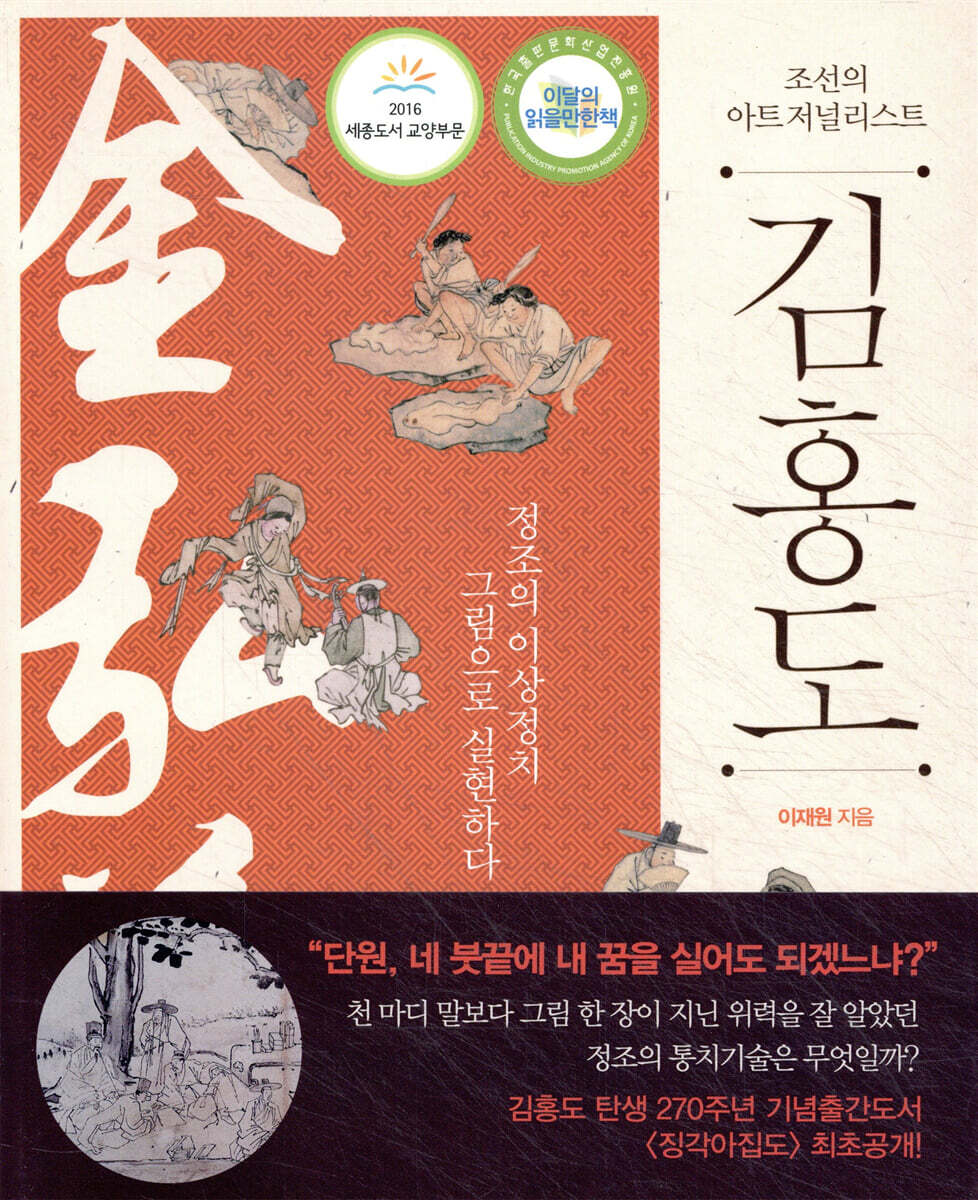 |
Description
Book Introduction
It is a report on the people's livelihood for the King.
Danwon genre paintings used as national reference materials
Danwon Kim Hong-do (1745-1806, born in Ansan, Gyeonggi Province), the greatest painter of Joseon, is well known as a genre painter who depicted the lives of the common people with humor and satire.
He was a court painter directly under the king who enjoyed the favor of King Jeongjo (1752-1800, reign: 1776-1800, 22nd king of the Joseon Dynasty) throughout his life, but only three lines of records about him are recorded in the Annals of the Joseon Dynasty.
Although he enjoyed King Jeongjo's favor and painted the king's portrait three times, he was not given the honor of being called a 'royal painter' (御用畵師), which means he painted the king's face.
However, it is said that he could only paint 'this' of King Jeongjo... ... Kim Hong-do's name is not even on the list of the Jabi Daeryung painters, who were selected from the top 10 painters of Dohwaseo and received the highest treatment as painters.
So was he really the greatest painter in Joseon?
Kim Hong-do's genre paintings, which were popular with everyone from the king to the common people, contain a secret.
Beyond mere painting, his genre paintings served another purpose... … In fact, his genre paintings were commissioned by King Jeongjo, serving as reports on the people's livelihoods presented to the king! Kim Hong-do, by royal command, carried out his mission as a top elite reporter, closely covering and reporting on the lives of the people.
This is why the subtitle of this book includes the words 'Art Journalist'.
Kim Hong-do, who served as the eyes and ears of King Jeongjo, who was trying to find the path of a true king among the people during the 18th century Joseon Dynasty, through his paintings.
The loyalty between these two men is probably the most beautiful of the various relationships created by the warp and weft of the times.
Kim Hong-do painted the most meaningful days of King Jeongjo's reign (pp. 74-79, pp. 347-365).
*1764 was the 40th year of King Yeongjo's reign and the year he turned 70, so they tried to throw a feast, but King Yeongjo refused, saying that he was a father who put his children first.
In 1765, after the year had passed, he reluctantly accepted the cup at the request of Crown Prince Jeongjo.
At this time, Kim Hong-do painted the folding screen [Gyeonghyeondang Sujakdo], which was part of the Sujak Yeonhui ritual.
In 1795, the procession to move Crown Prince Sado's tomb to Hwaseong Fortress in Suwon was held as an event to be enjoyed by the people.
At this time, King Jeongjo personally met with the people and resolved their grievances, and Kim Hong-do personally commanded the painters in charge of and performing the royal protocols and painted [Banchado].
This book introduces many outstanding figures who were active alongside Kim Hong-do during his time.
You can meet many eccentrics and artists, including Chae Je-gong and Jeong Yak-yong, who showed the meaning of loyalty between a ruler and his subjects while working alongside King Jeongjo, who promoted reforms with the people; Kang Se-hwang and Sim Sa-jeong, teachers of Kim Hong-do, who cherished the relationship formed through the tip of the brush; and Jeong Ran, a mountaineer; and his seniors and juniors, Jang Hon, Kim Eung-hwan, and Yi In-mun.
This book cannot be viewed simply as a history book dealing with the bittersweet loyalty between rulers and their subjects in the past, or as a biography of a single person.
Through the life of an artist who willingly sacrificed his talents for a lord who understood him and sought to realize a politics that loved the people, this will be an opportunity to reflect on today's political reality and righteousness.
- You can preview some of the book's contents.
Preview
index
About this book - A journey through the lives of the people of the late Joseon Dynasty with Danwon Kim Hong-do
Recommendation: A Look into the Life and Thoughts of a Distinguished Painter of the Late Joseon Dynasty
Part 1: Asking Kim Hong-do.
Who are you?
Falling into the swamp of fate 1752~
Meeting with an ink master
Painting with hemp thread
Hanji (Korean paper) workshop
Another teacher
Tell the world about the king's lineage. 1762
King Yeongjo scolds a dog in a painting, 1763
Chae Je-gong, a loyal subject of the inheritance of ties (1755-1772)
Going to the Gyunwa Ajip (筠窩雅集) 1763
Go beyond me
Tigers live on their canvases.
First steps into the Dohwaseo (painting studio) 1765-1775
The beginning of a relationship, the four friends of the stationery store
Drawing [Gyeonghyeondangsujakdo, Painting of the Crown Prince of Gyeonghyeon Hall, Gye-byeong], 1765
Kim Eung-hwan, who drew [Geumgangsan Jeondo] in 1772
Kang Se-hwang's bizarre entry into politics (1773–1776)
[Gunseondo] (Painting of a Group of Immortals) 1776
[Gyujanggakdo], containing the future of Joseon, 1776
Ask Kim Hong-do.
Who are you? 1777~1778.
autumn
A Political Connection of Loyalty: King Jeongjo and Chae Je-gong (1776-1786)
Part 2: Can I put my dream on the tip of your brush?
A gift from Crown Prince Sado, Jeong Yak-yong, 1782
Kang Se-hwang, entering Kinosoe (1782-1783)
Draw the Breath of the Common People, 1783-1786
Kim Hong-do, the Inspector General of Angi, enjoyed the pleasures of the world with the famous scholars (1784-1786).
Reminiscing about old memories in [Danwondo] (1781-1784)
Draw the beautiful mountains and rivers of Korea 1788
Jeong Yak-yong's Doctrine of the Mean and the Bridge 1789
Hey, Danwon! Get up quickly! 1789~1790
Construction of Hwaseong New City (1790-1791)
A lotus fan bestowed upon Jeong Yak-yong
Part 3: I've Been With You My Whole Life
Discussing the wind and moon at the foot of Inwangsan Mountain, 1791.
summer
Adding the grace of the Holy Spirit to the autumn mood1791.
autumn
Drawing a portrait of King Jeongjo in 1791.
late autumn
Secret Mission, Unraveling the Golden Lantern? 1792-1793
Kim Hong-do, magistrate of Yeonpung County, Chungcheong Province (1792-1794)
1794: Prepare a 60th birthday party based on public sentiment
Let the 60th birthday party be recorded in rituals and paintings (1794)
Three drumbeats1795.2.9.~2.16.
Painting the eight-panel folding screen for the Nakseongyeon banquet (1796)
The ball must die before the fruit. 1798-1799
I have been with you all my life1800
Part 4: I wanted to be buried in the snow with the stamens still on.
Jang Hon's "Lifelong Story" was captured in [Samgongbulhwando] (1801).
Leaving the palace and returning to his hometown in 1802
Drawing a red plum blossom (1804)
The picture smells like yeast. 1804.12.20.
Three friends of the same age held a 60th birthday party in January 1805.
Responding to a Friend 1805
Son Yeonrok! Look at 1805.
60th birthday
Who is trying to spoil my interest? 1805
The magpie closes its eyes and mouth. 1805. Yoon 6.
[Autumn Voice Painting] 1805, painted as if the soul was leaving.
late autumn
I wanted to be buried in the snow with the flowers still in bloom (1806)
Part 5: Yang-gi, the Ugly Son, Carefully Decorated
Danwon's son Yanggi (1816)
Books referenced
Kim Hong-do's major chronology
[Jingak Ajipdo] Research Notes
In closing - A relationship formed through painting, Kim Hong-do
Into the book
Yeongjo: “Politics is a situation where bloodshed occurs when one side leans to the other, so only when the balance of power is achieved can the country be said to be stable.
If the dog in the first picture were to run wild and run wild outside, wouldn't it be a disaster for the house and thieves? Therefore, as the owner, I must keep it tightly restrained and disciplined to prevent it from neglecting its duties.
In the second picture, you may have seen a full dog scratching itself.
It's a story of being satisfied with oneself, and the people are no different.
“Everyone is content with their own life without any need, so in such a case, the monarch has no business interfering.”
Crown Prince (Jeongjo): “I will engrave the profound meaning of my Majesty, Grandson, deep in my heart.” --- p.46 From “Yeongjo scolds the dog in the painting” (1763)
King Jeongjo, keeping in mind the friendly Noron Sipa faction, continued the Tangpyeong policy of equally employing the Noron Byeokpa and the Soron Namin faction, and sought political stability.
What we should pay attention to these days is Jeongjo's people.
He selected Chae Je-gong, a member of the Nam-in faction who had been in charge of educating the crown prince since 1772, and placed him at his side to play a key role in Gyujanggak. He also invited painter Kim Hong-do to paint the [View of Gyujanggak], in an attempt to engrave the meaning of the politics of the people that Jeongjo had been trying to pursue.
Kim Hong-do, who had witnessed Jeongjo's agony and political capabilities from the side, was troubled by the thought of what to do for his lord who favored him.
--- p.98 From “[Gunseondo] Salute” (1763)
Jeongjo: “These are the paintings I wanted to see.
It seems like I can see the surprised expression on their faces right up close, and I can vividly hear the hearty laughter of those satisfied with a spoonful of rice and a bowl of takju.
In the scene where a lawsuit is filed on the street, I feel like I want to watch and see what kind of verdict is reached.
There is a leader who lives together with the people, supporting each other like this, which is what I have been hoping for.
And how he reads and depicts the movements of the people around him in such detail, it's as if the people have walked into the painting.
Moreover, since Pyoam wrote his feelings in a flowing style, his critiques are sharply satirical and very enjoyable to read.”
Kang Se-hwang: “I don’t know what to do with myself when I see Your Majesty so delighted by the genre painting.
The core of this roadside lawsuit lies in the criminal law.
Judging by the way the hat is worn crookedly, it seems that the height is somewhat high.
“The attendants are carrying things in front and behind the palanquin in which the magistrate is riding, so his appearance is not shabby, but the judge writing the verdict seems to be drunk, so I am worried that he may not be able to carry out his assigned duty of writing the verdict, so I gave him a bit of a harsh review.” --- p.154 From “Draw the Breath of the Common People” (1783~1786)
King Jeongjo said, “If the paintings drawn by the government office depict humorous scenes that occurred in the palace, it was Kim Hong-do who depicted realistic scenes of the lives of common people.
The widow was curious about how the people lived and what they were thinking.
However, since I cannot freely go outside the palace, I was worried about how I could naturally meet the people, and today I finally found the answer.
(……) It makes us think again through the painting whether the government of the people who suffered injustice is indeed right, taking into account the suffering of the people who suffered injustice.” --- pp.156-157 From “Draw the Breath of the Common People” (1783~1786)
Jeongjo: "How can you be the ruler of a nation if you ignore how your people live? Painting is the art of satirizing wrongdoings and conveying their meaning through a culture that is not misunderstood. Couldn't it be called a social revolution?
“It will be a great weapon for the people, as they can become peaceful opponents without having to protest with a spear or defend with a shield.” (……)
Kim Hong-do: “I fully understand Your Majesty’s profound intentions.
But isn't there a limit to the power of communication between the artist and the viewer? Your Majesty, when I paint, I strictly adhere to my own standards and values.
“This is because a painting is imbued with life and must convey a story to the viewer in order to be called a living painting.” (……)
Jeongjo: “This is a painting that tells a story.
The secret in the picture of the unit was here.
Unit! I want to practice virtuous governance by observing the lives of the people, reading their hearts, and striving to understand their lives, even if only a little.
May I put my dream on the tip of your brush? The connection between you and Danwon began with the common people, and I believe this is precisely why Heaven sent you to me.
So, draw the breath of the people of this country.
“Depict the lives of the common people in their entirety, without hiding anything.” --- pp. 156-157 from “Draw the Breath of the Common People” (1783-1786)
Jeongjo: "Danwon! This year holds special meaning for me.
In line with my late father's 90th birthday, my mother, Queen Hyegyeong, will hold a grand 60th birthday party in Hwaseong.
And we will compile a ritual book by creating type and drawing illustrations to record the related contents.
Wouldn't it be possible to grasp the entire event at a glance only with illustrations depicting key scenes? I know that a picture is worth a thousand words, and you, more than anyone else, know my love for documenting culture. Therefore, I believe you should take on this task.
“The procession will last for eight days, so draw the main scenes while performing.” --- pp.360-361 From “Make the 60th birthday party recorded in rituals and paintings” (1794)
The big dreams I had when I was young and first enrolled at Dohwaseo and the tireless efforts I made to become the best painter flashed through my mind like a kaleidoscope.
The warm smile of the late King Jeongjo, who did not spare encouragement while looking at the [Gunseondo] in the Gangnyeongjeon Hall of Gyeongbokgung Palace, still lingers in my heart, and the curious eyes and bright smile of my lord, who sharply captured the humor and satire contained in each genre painting as he turned the pages, still seemed to cut through the air.
The years have settled on Kim Hong-do's head, which is white as he looks back at every corner of the palace with longing eyes in search of the scent of King Jeongjo, whom he had respected and respected.
--- p.416 From “Drawing the Red Plum Blossoms” (1804)
Kim Yang-gi: “I understand that you had many exchanges with your father.
“Could you tell me something about your father’s accomplishments that I might not know?”
Hong Seok-ju: "How can I so easily say I know everything about him? I've always felt this way when dealing with your father: his appearance was as beautiful as if he had descended from the immortal realm, and his brush strokes were clean and pure.
In particular, I would like to say that genre paintings that vividly depict the lives of the common people are a divine harmony.
Moreover, he was a man skilled in many fields, including landscape painting, Taoist painting, royal portraits, flower and bird paintings, and Gyehoe painting.
“Having met the concubine today, I have come to realize that Danwon’s calligraphy was not limited to just his paintings, but was also elegant.”
--- pp.477~478 From “Yanggi, the Son of Danwon” (1816)
Publisher's Review
Kim Hong-do, the painter who portrayed the breath of the common people!
Depicting the most meaningful day in King Jeongjo's life
Author Lee Jae-won, who was always interested in and studying King Jeongjo's ideal politics and his image as a literary monarch, became curious about the people around him.
I was deeply moved by the etiquette, righteousness, and loyalty of the ruler and his subjects that were intertwined among those characters, and I wanted to compile them into a book.
Among them, I was drawn to Jeongjo and Kim Hong-do because I was captivated by a painting I happened to come across by chance.
This is because, while I was studying old texts and paintings with great interest, I became certain that the painting was [Jingak Ajipdo] by Danwon Kim Hong-do.
The author felt that the process of putting into words the teachers, fellow scholars, and countless others who were looking in the same direction and walking the same path, centering on Kim Hong-do and King Jeongjo, was somewhat difficult and arduous, but he believed that it was a small part of creating history that someone had to do.
I wrote this book with the hope that perhaps, through a single piece of [Ajipdo] that I had an unexpected connection with, it would open the floodgates for a new wave of humanities.
In addition, Kim Hong-do's life and works were arranged in chronological order, and his life from childhood to after his death was written in the form of a conversation (so-called faction) that could have occurred with writers and artists active during the Jeongjo era.
Jeongjo, who actively utilized images in politics
What do you think about Korean society today?
What kind of life did Kim Hong-do lead? Most books published about him so far have focused on fragmentary paintings or taken a pictorial approach.
In 1805, Uijae Nam Ju-heon asked Kim Hong-do to write his biography.
However, Kim Hong-do refused, saying, "I am not worthy of that," and painted a six-panel folding screen and gave it to Uijae.
Was he reluctant to have his story shared with the world? Or was there another reason? It's too disappointing to dismiss it as his humility.
Perhaps that is why the “Danwonpyeon” is missing from “Uijaejip,” which contains biographies of many people.
If King Jeongjo were alive today, how would he view Korean politics today? During election season, what's called image politics is simply concerned with how to best display their party's colors on the board, with no real concern for how the people's lives are being managed.
I hope that this book will provide an opportunity to reflect on how much effort the rulers of this era, often called an age of communication breakdown, are making to understand the people's livelihood and public sentiment through the genre paintings of Danwon.
At the end of the book, there is a chronology of Kim Hong-do's life (pp. 479-484) and the author's research on [Jingak Ajipdo], which is introduced for the first time in this book (pp. 485-493).
Recommendation
When Korean painting was heavily influenced by Chinese painting, there were several pioneers who tried to break away from it, and they were Kim Hong-do, a painter of Gyeomjae and Danwon.
Kim Hong-do was blessed with a good teacher at a young age and met the wise King Jeongjo, allowing him to fully display his skills.
He sat in the palace and drew a picture of the people's lives to the king, who was curious about the outside world.
It became a special style in the history of Joseon art, which is called ‘genre painting’ today.
Danwon, the painter who so authentically captured the reality of Joseon people's lives through art! Reviving his beautiful artistic career, Lee Jae-won vividly portrays events from 250 years ago as if they happened yesterday.
- Choi Jong-tae (Professor Emeritus, Seoul National University)
Long ago, about 230 years ago, Danwon Kim Hong-do was a guest at the Gangneung mission station.
It was a fateful encounter where I stopped by Gyeongpodae for a while on my royal pilgrimage to Geumgangsan, capturing it on the tip of my brush.
And after countless hours, I come across the name of the unit like this.
At the end of the eaves of the old house where his gaze passed each time, it seems as if the breath of the master of the wind and moon, playing with the clear wind and bright moon, remains.
They say time waits for no one, but it is deeply moving to encounter the time of Danwon, reborn through the fingertips of this writer.
Thank you.
Today, we must open the missionary gates wide for him.
- Lee Kang-baek (Director of Gangneung Gotaek Mission Center)
What does it mean to be obsessed with someone?
What does it mean to be captivated by a historical figure you've never met before, to devote time, money, and passion to tracking down their traces? It means seeing yourself in that person, and learning about yourself through that person.
Mr. Lee Jae-won was possessed by Kim Hong-do for a long time.
Why? That's what this book is about.
- Lee Ju-hyang (Professor, Department of Philosophy, Suwon University)
This extensive writing began with a passage from the Annals of King Jeongjo, which states, "He wore a gonryongpo at Ikseon-gwan and had Kim Hong-do draw a rough sketch of his portrait."
It's so precise that it could be called a documentary.
The author's persistence in fact-checking is evident as even recently excavated historical materials are included.
The story is solid and realistic as it is rooted in fact.
It leaves no room for the reader to doubt the plausibility.
The life and thoughts of an outstanding painter of the late Joseon Dynasty are sometimes combined with the political history of the time and theories on painting.
So, it was possible to three-dimensionalize the suffering Kim Hong-do, who lived and moved in a specific time and space.
The bonus of this book is that you can look closely at each of Kim Hong-do's various paintings and hear a persuasive explanation of them.
- Jang Young-ju (KBS PD, former executive producer of history specials)
GOODS SPECIFICS
- Date of issue: April 10, 2016
- Page count, weight, size: 496 pages | 922g | 170*210*28mm
- ISBN13: 9788952233608
- ISBN10: 8952233603
You may also like
카테고리
korean


korean


