

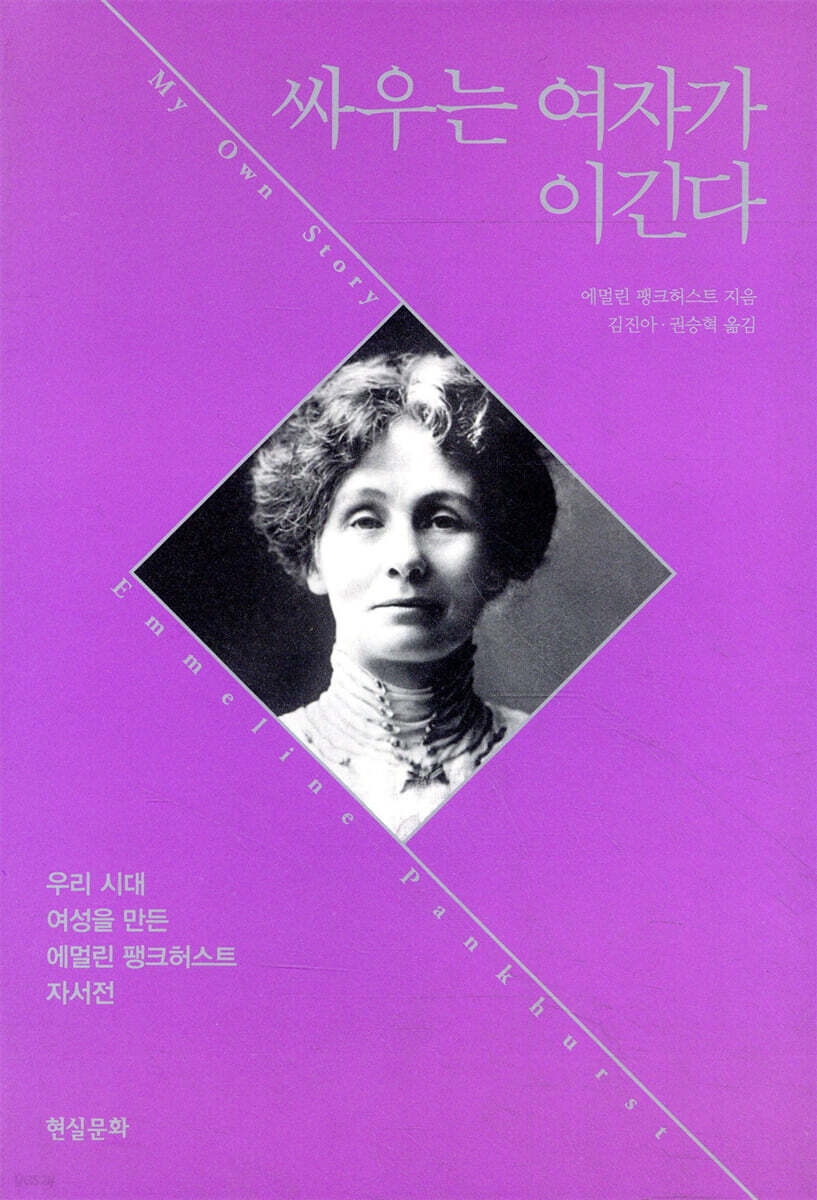
The woman who fights wins
 |
Description
Book Introduction
★ Selected as one of the '100 Most Important People of the 20th Century' by Time magazine
★ Selected by CNN as one of the '7 Women Who Changed World History'
★ Ranked 27th on the BBC's '100 Greatest Britons' list
★ Ranked 5th among the 'Most Influential Women of the Past 200 Years' by Scottish Widows
“Our film was inspired by the true story of the suffragettes who risked everything in the fight for women’s rights.” - Sarah Gavron, director of the film [Suffragette]
“We dream of peace in the midst of battle.”
The 'godmother' of the women's movement, who transformed half of humanity into revolutionaries.
Creating a world where those who were looked down upon win
The autobiography of Emmeline Pankhurst, who led the militant women's suffrage movement known as the "suffragette" in early 20th-century Britain, has been translated into Korean for the first time in 100 years.
Emmeline Pankhurst is credited with making the issue of women's suffrage, which had been stagnant for decades, a major social issue, and for creating the image of a modern 'woman' who has the same number of votes as men.
This book, like a triumphant report from fighting women, provides a valid reference point for Korean society today regarding strategies for changing an unequal society.
Emmeline Pankhurst conveys the message that if the oppressed want to secure equal rights, they must fight for it themselves, not rely on the goodwill of those in power.
This book reminds us of the oppression and discrimination that persist even today, and provides clues to understanding why those who fight against injustice often employ radical strategies.
★ Selected by CNN as one of the '7 Women Who Changed World History'
★ Ranked 27th on the BBC's '100 Greatest Britons' list
★ Ranked 5th among the 'Most Influential Women of the Past 200 Years' by Scottish Widows
“Our film was inspired by the true story of the suffragettes who risked everything in the fight for women’s rights.” - Sarah Gavron, director of the film [Suffragette]
“We dream of peace in the midst of battle.”
The 'godmother' of the women's movement, who transformed half of humanity into revolutionaries.
Creating a world where those who were looked down upon win
The autobiography of Emmeline Pankhurst, who led the militant women's suffrage movement known as the "suffragette" in early 20th-century Britain, has been translated into Korean for the first time in 100 years.
Emmeline Pankhurst is credited with making the issue of women's suffrage, which had been stagnant for decades, a major social issue, and for creating the image of a modern 'woman' who has the same number of votes as men.
This book, like a triumphant report from fighting women, provides a valid reference point for Korean society today regarding strategies for changing an unequal society.
Emmeline Pankhurst conveys the message that if the oppressed want to secure equal rights, they must fight for it themselves, not rely on the goodwill of those in power.
This book reminds us of the oppression and discrimination that persist even today, and provides clues to understanding why those who fight against injustice often employ radical strategies.
- You can preview some of the book's contents.
Preview
index
introduction
Part 1: The Birth of the Fighter Faction
Chapter 1: "It's Too Bad I Wasn't Born a Man"
Chapter 2: Women and Children in the Almshouse
Chapter 3 Requests answers to questions
Chapter 4: The Suffragettes Arrive
Part 2: Four Years of Nonviolent Struggle
Chapter 1 I'd rather go to jail than pay a fine
Chapter 2: The Whole City Is With Us
Chapter 3: The Lawmaker
Chapter 4 Treat them as political prisoners
Chapter 5: Hunger Strike and 'Hospital Treatment'
Chapter 6 If the Liberty Party is not on our side
Chapter 7: Black Friday
Chapter 8: No Voting, No Census
Part 3: Women's Revolution
Chapter 1: The Most Traditional Method of Protest
Chapter 2 Whose Conspiracy Is It?
Chapter 3: "Then, I will incite."
Chapter 4: Human Rights Against Property Rights
Chapter 5: The Trial of April 2, 1913
Chapter 6: The Cat and the Mouse
Chapter 7: Women have no Senate or House of Representatives
Chapter 8 How can you remain silent about a government that is killing people?
Chapter 9 Four Solutions
Translator's Note
annual report
Part 1: The Birth of the Fighter Faction
Chapter 1: "It's Too Bad I Wasn't Born a Man"
Chapter 2: Women and Children in the Almshouse
Chapter 3 Requests answers to questions
Chapter 4: The Suffragettes Arrive
Part 2: Four Years of Nonviolent Struggle
Chapter 1 I'd rather go to jail than pay a fine
Chapter 2: The Whole City Is With Us
Chapter 3: The Lawmaker
Chapter 4 Treat them as political prisoners
Chapter 5: Hunger Strike and 'Hospital Treatment'
Chapter 6 If the Liberty Party is not on our side
Chapter 7: Black Friday
Chapter 8: No Voting, No Census
Part 3: Women's Revolution
Chapter 1: The Most Traditional Method of Protest
Chapter 2 Whose Conspiracy Is It?
Chapter 3: "Then, I will incite."
Chapter 4: Human Rights Against Property Rights
Chapter 5: The Trial of April 2, 1913
Chapter 6: The Cat and the Mouse
Chapter 7: Women have no Senate or House of Representatives
Chapter 8 How can you remain silent about a government that is killing people?
Chapter 9 Four Solutions
Translator's Note
annual report
Into the book
“The current law encourages men to take advantage of women’s weakness.
Many women would feel the same way.
We often hear that women can exert real power and influence over men even without political power.
So we've been trying for a long time to use that influence we have to try to change the law.
But such influence produced no results.
Even when we go to the House of Representatives and persistently make our demands, the members of Congress say they have no responsibility to women, only to their constituents.
So, while they acknowledged that the law needed reform, I often heard people say they were too busy to spend time on it.”
--- p.173~174
Mounted police were called in with orders to disperse the women.
But these determined women feared neither the horseshoes nor the overwhelming violence of the police, and they remained unwavering in their purpose.
Then the crowd started to intervene.
People asked why women were being beaten and why they were not arrested if they were breaking the law.
And if the women were not breaking the law, why weren't they allowed to march peacefully?
--- p.235
Since the struggle took the form of property damage, the general public, both here and abroad, has been curious about the logical relationship between breaking windows and setting mailboxes on fire and voting.
Such curiosity only shows that they have no knowledge of history.
Because human political progress has always been possible only through acts of violence and destruction of property.
Progress has often been achieved through war, and these wars have been considered glorious.
And progress was often made by riots, which, though considered less glorious than war, were at least considered effective.
--- p.276
“I would like to say that in no prosecution in the past has a national trial been so degraded in such a trivial manner.
You cannot deny that this case is a matter of national importance.
In fact, it is not women who are on trial now.
It's the men.
The very system of government is being put on trial.
“It is a trial that was held in a rudimentary manner without fairly showing what the evidence presented in the indictment really is based on.”
--- p.
318
“You are not my legal equal.
Therefore, you have no right, in the interests of human justice and according to the Constitution of our country—if the Constitution is properly interpreted—to hold me guilty.
You know very well that if I had the same rights that you have, if I had the right to vote for the people who make the laws I uphold, if I had the right to oversee how my taxes are spent, I wouldn't be standing here and I wouldn't be breaking the law."
Many women would feel the same way.
We often hear that women can exert real power and influence over men even without political power.
So we've been trying for a long time to use that influence we have to try to change the law.
But such influence produced no results.
Even when we go to the House of Representatives and persistently make our demands, the members of Congress say they have no responsibility to women, only to their constituents.
So, while they acknowledged that the law needed reform, I often heard people say they were too busy to spend time on it.”
--- p.173~174
Mounted police were called in with orders to disperse the women.
But these determined women feared neither the horseshoes nor the overwhelming violence of the police, and they remained unwavering in their purpose.
Then the crowd started to intervene.
People asked why women were being beaten and why they were not arrested if they were breaking the law.
And if the women were not breaking the law, why weren't they allowed to march peacefully?
--- p.235
Since the struggle took the form of property damage, the general public, both here and abroad, has been curious about the logical relationship between breaking windows and setting mailboxes on fire and voting.
Such curiosity only shows that they have no knowledge of history.
Because human political progress has always been possible only through acts of violence and destruction of property.
Progress has often been achieved through war, and these wars have been considered glorious.
And progress was often made by riots, which, though considered less glorious than war, were at least considered effective.
--- p.276
“I would like to say that in no prosecution in the past has a national trial been so degraded in such a trivial manner.
You cannot deny that this case is a matter of national importance.
In fact, it is not women who are on trial now.
It's the men.
The very system of government is being put on trial.
“It is a trial that was held in a rudimentary manner without fairly showing what the evidence presented in the indictment really is based on.”
--- p.
318
“You are not my legal equal.
Therefore, you have no right, in the interests of human justice and according to the Constitution of our country—if the Constitution is properly interpreted—to hold me guilty.
You know very well that if I had the same rights that you have, if I had the right to vote for the people who make the laws I uphold, if I had the right to oversee how my taxes are spent, I wouldn't be standing here and I wouldn't be breaking the law."
--- p.380
Publisher's Review
★ Selected as one of the '100 Most Important People of the 20th Century' by Time magazine
★ Selected by CNN as one of the '7 Women Who Changed World History'
★ Ranked 27th on the BBC's '100 Greatest Britons' list
★ Ranked 5th among the 'Most Influential Women of the Past 200 Years' by Scottish Widows
“Our film was inspired by the true story of the suffragettes who risked everything in the fight for women’s rights.” - Sarah Gavron, director of the film [Suffragette]
“We dream of peace in the midst of battle.”
The 'godmother' of the women's movement, who transformed half of humanity into revolutionaries.
Creating a world where those who were looked down upon win
The autobiography of Emmeline Pankhurst, who led the militant women's suffrage movement known as the "suffragette" in early 20th-century Britain, has been translated into Korean for the first time in 100 years.
Emmeline Pankhurst is credited with making the issue of women's suffrage, which had been stagnant for decades, a major social issue, and for creating the image of a modern 'woman' who has the same number of votes as men.
This book, like a triumphant report from fighting women, provides a valid reference point for Korean society today regarding strategies for changing an unequal society.
Emmeline Pankhurst conveys the message that if the oppressed want to secure equal rights, they must fight for it themselves, not rely on the goodwill of those in power.
This book reminds us of the oppression and discrimination that persist even today, and provides clues to understanding why those who fight against injustice often employ radical strategies.
“There can be no true peace when half of humanity is not free.”
Every woman in the world wanted change.
Until the 1910s, British women were in a peculiar position: they could join political parties but could not vote.
So, even though women joined and worked for the political parties they supported, whether the Conservative, Progressive, or Labour parties, they could not actually elect them as members of parliament or become members of parliament themselves.
The law had to change for women to have equal voting rights with men.
Established activists, such as the National Society for Women's Suffrage, formed in 1872, focused their efforts on persuading male politicians in the hope that they would introduce a women's suffrage bill.
However, no lawmakers have proposed any bills, only vaguely stating that they sympathize with women and will pay attention to the issue.
Emmeline Pankhurst, with the justification that “there can be no true peace in this world unless one half of the human family, women, can be freed” (p. 18), made it her mission to “liberate one half of humanity, women, and by freeing them, save the other half of humanity” (p. 343).
In an effort to break the long-standing impasse, Pankhurst founded the Women's Social and Political Union in 1903, creating a women's body that "spanned all classes and races, from working women to British royalty and Indian princesses" (p. 473) with the sole purpose of winning women's suffrage.
For the first four years after its founding, they fought by holding rallies and propaganda activities, attending public hearings to pressure the legislature, and campaigning to unseat hypocritical members of parliament.
“We often hear that women can exert real power and influence over men, even without political power.
But no matter how hard I tried, such influence produced no results.
Members of Congress say they are only responsible to their constituents and not to women.
(…) Still, we will continue this movement.
Because our honor is at stake.
“We also believe that it is our duty, as our male ancestors did, to make this world a better place for women to live than it is now.” (pp. 173-174)
“Every woman and child I met at the almshouse taught me.”
An activist born from women and children abandoned by the state
Emmeline Pankhurst's experience as a poor relief commissioner played a large part in her growing conviction about the importance of women's suffrage and her dedication to the movement.
The Liberal Party demanded that women who wanted the right to vote prove that they had public capacity, and many women served without pay on local government posts such as poor relief committees and school boards.
While serving as the only female member of the Poor Relief Committee, Pankhurst painfully witnessed the misery and unhappiness of a world created by men, and she became even more acutely aware of the bleak political reality for women.
The relief center was mainly attended by women who had devoted their lives to their husbands and children but were left penniless after their husbands died, and by girls who had been forced to become pregnant while working as maids.
At the relief center, food distribution was inadequate, and children were working long hours without appropriate clothing for the season.
Pregnant girls, in particular, were forced to work until just before giving birth, and two weeks after giving birth, they had no place to take their babies and had to either leave the shelter or be separated from them.
If a baby was sent elsewhere, the law provided that the "baby farmer" (p. 53) who took the baby in was free from supervision if the father paid 20 pounds to the place.
Babies in unsupervised settings could easily die, and the 'baby farmer' could continue to make money that way.
The law needed to be changed to address several issues, but only women who did not have the right to vote saw this as a problem.
Women tried to change a small piece of legislation that would fundamentally prevent the poverty and violence that are structurally built into society, but to no avail.
Through this experience, Pankhurst came to believe that voting was not only a right for women, but also a duty.
“Every woman I met at the almshouse educated me.” (p. 54)
“When we fight by breaking windows, we achieve more.”
Why did the 'Angels in the House' have to pick up stones?
The Women's Social and Political Union, led by Emmeline Pankhurst, changed its campaign strategy and adopted militant tactics after the Liberal government of Prime Minister Herbert Henry Asquith came to power in 1908.
Women had been demanding women's suffrage in every peaceful and legal way possible, but had received no response from male politicians.
Instead, after being repeatedly arrested and imprisoned by the police, he felt that “the time had come where he had to choose between two options” (p. 158): either quit the movement altogether or continue his activism.
The Women's Social and Political Union declared itself a "militant group" after two women threw stones and broke a window at the Prime Minister's residence during a protest that was suppressed by the police.
As a result, windows of public institutions and stores were broken every day, and mailboxes full of letters were set on fire.
Pankhurst explains that this tactic was inevitably adopted because, looking back at history, “human political progress has always been possible only through acts of violence and destruction of property” (p. 276).
"Why should women be beaten and abused in Parliament Square when throwing stones would be more effective? We have patiently endured years of constant insults and attacks.
Our women's health was damaged, and some lost their lives. (...) We made more progress by breaking windows than by fighting with our bodies.
“After all, aren’t women’s lives, women’s health, and women’s bodies more precious than glass windows?” (pp. 274-275)
In reality, until then, women had no effective 'weapons' to make their voices heard, let alone 'protective gear' to ward off counterattacks.
The women's bodies were bruised as they stood up to the government and riot police with their bare hands, went on hunger strikes while imprisoned to raise their voices, and were force-fed, which was almost torture.
There were even cases of death.
Emily Wilding Davison, a member of the Women's Social and Political Union, persistently demanded women's suffrage, but when no institutional progress was made, she threw herself in front of the King's horse at the Epsom Derby racecourse on June 4, 1913, as a sign of protest, and lost her life.
In this way, the traditional Victorian image of a 'gentle, cautious, and obedient' woman, nicknamed the 'angel in the house', was also broken.
The radical and militant women's movement continues to this day around the world.
From Russia's Pussy Riot, to Femen, which originated in Ukraine and has branches in France, Italy, and Turkey, to South Korea's Megalian, women are crossing borders, taking off their shirts, and defying power to wage militant resistance movements against various oppressions and discriminations, including sexism, sexual violence, sex tourism, religious violence, dictatorship, and homophobia.
Even if you don't agree with this movement's approach, and even if historical assessments of each movement differ, it would be socially important to hear directly from those who are determined to defend their beliefs to the end.
Recommendation
“Pankhurst sparked a heated debate about women’s status and social inequality, and she made women speak out louder, no longer being trampled on like rugs.
Without them, the Woman's Suffrage Act of 1918 would not have been passed.” - June Purvis (gender historian)
“The sixty-year-old Pankhurst, whom I met while staying in London, was a lively, good-natured old woman who lived alone.
'Women should dress well, eat delicious food, and save money in the bank.
I can't forget her words: 'This is the first step in finding women's rights.' - Na Hye-seok (artist)
“Pankhurst’s greatest achievement was to instill in women a new sense of power and responsibility, to lead them to forge their own destinies in ways different from those dictated to them by men since time immemorial.” - Ethel Smythe (composer, member of the Women’s Social and Political Union)
“I think British women are doing the right thing.
Mrs. Pankhurst is a great leader.
If American women followed Mrs. Pankhurst's example, they would gain the right to vote much sooner.
You can't get anything unless you fight and suffer.
“I am a militant suffragette.” - Helen Keller (author, social activist)
“Pankhurst gave her body and soul to liberty, equality, and fraternity, and she won the victory.” - Rebecca West (author, critic)
“Our film was inspired by the true story of the suffragettes who risked everything in the fight for women’s rights.” - Sarah Gavron, director of the film [Suffragette]
★ Selected by CNN as one of the '7 Women Who Changed World History'
★ Ranked 27th on the BBC's '100 Greatest Britons' list
★ Ranked 5th among the 'Most Influential Women of the Past 200 Years' by Scottish Widows
“Our film was inspired by the true story of the suffragettes who risked everything in the fight for women’s rights.” - Sarah Gavron, director of the film [Suffragette]
“We dream of peace in the midst of battle.”
The 'godmother' of the women's movement, who transformed half of humanity into revolutionaries.
Creating a world where those who were looked down upon win
The autobiography of Emmeline Pankhurst, who led the militant women's suffrage movement known as the "suffragette" in early 20th-century Britain, has been translated into Korean for the first time in 100 years.
Emmeline Pankhurst is credited with making the issue of women's suffrage, which had been stagnant for decades, a major social issue, and for creating the image of a modern 'woman' who has the same number of votes as men.
This book, like a triumphant report from fighting women, provides a valid reference point for Korean society today regarding strategies for changing an unequal society.
Emmeline Pankhurst conveys the message that if the oppressed want to secure equal rights, they must fight for it themselves, not rely on the goodwill of those in power.
This book reminds us of the oppression and discrimination that persist even today, and provides clues to understanding why those who fight against injustice often employ radical strategies.
“There can be no true peace when half of humanity is not free.”
Every woman in the world wanted change.
Until the 1910s, British women were in a peculiar position: they could join political parties but could not vote.
So, even though women joined and worked for the political parties they supported, whether the Conservative, Progressive, or Labour parties, they could not actually elect them as members of parliament or become members of parliament themselves.
The law had to change for women to have equal voting rights with men.
Established activists, such as the National Society for Women's Suffrage, formed in 1872, focused their efforts on persuading male politicians in the hope that they would introduce a women's suffrage bill.
However, no lawmakers have proposed any bills, only vaguely stating that they sympathize with women and will pay attention to the issue.
Emmeline Pankhurst, with the justification that “there can be no true peace in this world unless one half of the human family, women, can be freed” (p. 18), made it her mission to “liberate one half of humanity, women, and by freeing them, save the other half of humanity” (p. 343).
In an effort to break the long-standing impasse, Pankhurst founded the Women's Social and Political Union in 1903, creating a women's body that "spanned all classes and races, from working women to British royalty and Indian princesses" (p. 473) with the sole purpose of winning women's suffrage.
For the first four years after its founding, they fought by holding rallies and propaganda activities, attending public hearings to pressure the legislature, and campaigning to unseat hypocritical members of parliament.
“We often hear that women can exert real power and influence over men, even without political power.
But no matter how hard I tried, such influence produced no results.
Members of Congress say they are only responsible to their constituents and not to women.
(…) Still, we will continue this movement.
Because our honor is at stake.
“We also believe that it is our duty, as our male ancestors did, to make this world a better place for women to live than it is now.” (pp. 173-174)
“Every woman and child I met at the almshouse taught me.”
An activist born from women and children abandoned by the state
Emmeline Pankhurst's experience as a poor relief commissioner played a large part in her growing conviction about the importance of women's suffrage and her dedication to the movement.
The Liberal Party demanded that women who wanted the right to vote prove that they had public capacity, and many women served without pay on local government posts such as poor relief committees and school boards.
While serving as the only female member of the Poor Relief Committee, Pankhurst painfully witnessed the misery and unhappiness of a world created by men, and she became even more acutely aware of the bleak political reality for women.
The relief center was mainly attended by women who had devoted their lives to their husbands and children but were left penniless after their husbands died, and by girls who had been forced to become pregnant while working as maids.
At the relief center, food distribution was inadequate, and children were working long hours without appropriate clothing for the season.
Pregnant girls, in particular, were forced to work until just before giving birth, and two weeks after giving birth, they had no place to take their babies and had to either leave the shelter or be separated from them.
If a baby was sent elsewhere, the law provided that the "baby farmer" (p. 53) who took the baby in was free from supervision if the father paid 20 pounds to the place.
Babies in unsupervised settings could easily die, and the 'baby farmer' could continue to make money that way.
The law needed to be changed to address several issues, but only women who did not have the right to vote saw this as a problem.
Women tried to change a small piece of legislation that would fundamentally prevent the poverty and violence that are structurally built into society, but to no avail.
Through this experience, Pankhurst came to believe that voting was not only a right for women, but also a duty.
“Every woman I met at the almshouse educated me.” (p. 54)
“When we fight by breaking windows, we achieve more.”
Why did the 'Angels in the House' have to pick up stones?
The Women's Social and Political Union, led by Emmeline Pankhurst, changed its campaign strategy and adopted militant tactics after the Liberal government of Prime Minister Herbert Henry Asquith came to power in 1908.
Women had been demanding women's suffrage in every peaceful and legal way possible, but had received no response from male politicians.
Instead, after being repeatedly arrested and imprisoned by the police, he felt that “the time had come where he had to choose between two options” (p. 158): either quit the movement altogether or continue his activism.
The Women's Social and Political Union declared itself a "militant group" after two women threw stones and broke a window at the Prime Minister's residence during a protest that was suppressed by the police.
As a result, windows of public institutions and stores were broken every day, and mailboxes full of letters were set on fire.
Pankhurst explains that this tactic was inevitably adopted because, looking back at history, “human political progress has always been possible only through acts of violence and destruction of property” (p. 276).
"Why should women be beaten and abused in Parliament Square when throwing stones would be more effective? We have patiently endured years of constant insults and attacks.
Our women's health was damaged, and some lost their lives. (...) We made more progress by breaking windows than by fighting with our bodies.
“After all, aren’t women’s lives, women’s health, and women’s bodies more precious than glass windows?” (pp. 274-275)
In reality, until then, women had no effective 'weapons' to make their voices heard, let alone 'protective gear' to ward off counterattacks.
The women's bodies were bruised as they stood up to the government and riot police with their bare hands, went on hunger strikes while imprisoned to raise their voices, and were force-fed, which was almost torture.
There were even cases of death.
Emily Wilding Davison, a member of the Women's Social and Political Union, persistently demanded women's suffrage, but when no institutional progress was made, she threw herself in front of the King's horse at the Epsom Derby racecourse on June 4, 1913, as a sign of protest, and lost her life.
In this way, the traditional Victorian image of a 'gentle, cautious, and obedient' woman, nicknamed the 'angel in the house', was also broken.
The radical and militant women's movement continues to this day around the world.
From Russia's Pussy Riot, to Femen, which originated in Ukraine and has branches in France, Italy, and Turkey, to South Korea's Megalian, women are crossing borders, taking off their shirts, and defying power to wage militant resistance movements against various oppressions and discriminations, including sexism, sexual violence, sex tourism, religious violence, dictatorship, and homophobia.
Even if you don't agree with this movement's approach, and even if historical assessments of each movement differ, it would be socially important to hear directly from those who are determined to defend their beliefs to the end.
Recommendation
“Pankhurst sparked a heated debate about women’s status and social inequality, and she made women speak out louder, no longer being trampled on like rugs.
Without them, the Woman's Suffrage Act of 1918 would not have been passed.” - June Purvis (gender historian)
“The sixty-year-old Pankhurst, whom I met while staying in London, was a lively, good-natured old woman who lived alone.
'Women should dress well, eat delicious food, and save money in the bank.
I can't forget her words: 'This is the first step in finding women's rights.' - Na Hye-seok (artist)
“Pankhurst’s greatest achievement was to instill in women a new sense of power and responsibility, to lead them to forge their own destinies in ways different from those dictated to them by men since time immemorial.” - Ethel Smythe (composer, member of the Women’s Social and Political Union)
“I think British women are doing the right thing.
Mrs. Pankhurst is a great leader.
If American women followed Mrs. Pankhurst's example, they would gain the right to vote much sooner.
You can't get anything unless you fight and suffer.
“I am a militant suffragette.” - Helen Keller (author, social activist)
“Pankhurst gave her body and soul to liberty, equality, and fraternity, and she won the victory.” - Rebecca West (author, critic)
“Our film was inspired by the true story of the suffragettes who risked everything in the fight for women’s rights.” - Sarah Gavron, director of the film [Suffragette]
GOODS SPECIFICS
- Date of issue: March 8, 2016
- Format: Hardcover book binding method guide
- Page count, weight, size: 480 pages | 580g | 128*188*30mm
- ISBN13: 9788965641780
- ISBN10: 8965641780
You may also like
카테고리
korean


korean

![GQ KOREA Mark (Monthly): December [2025]](http://librairie.coreenne.fr/cdn/shop/files/8ef265dbbfbf186523ed75ba7319009d.jpg?v=1765340328&width=3840)


