

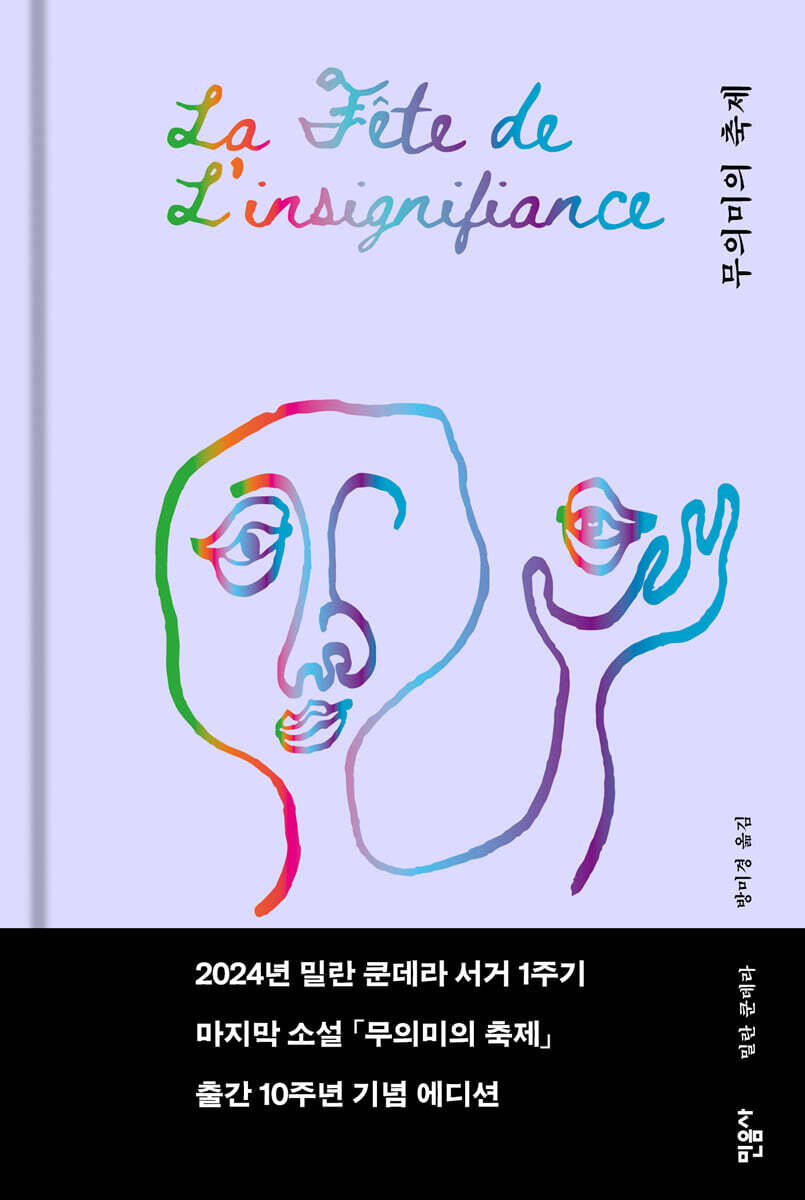
Festival of Nothingness
 |
Description
Book Introduction
Captivating readers around the world with “The Unbearable Lightness of Being”
Milan Kundera's last novel
Recovered edition commemorating the 10th anniversary of the Korean version
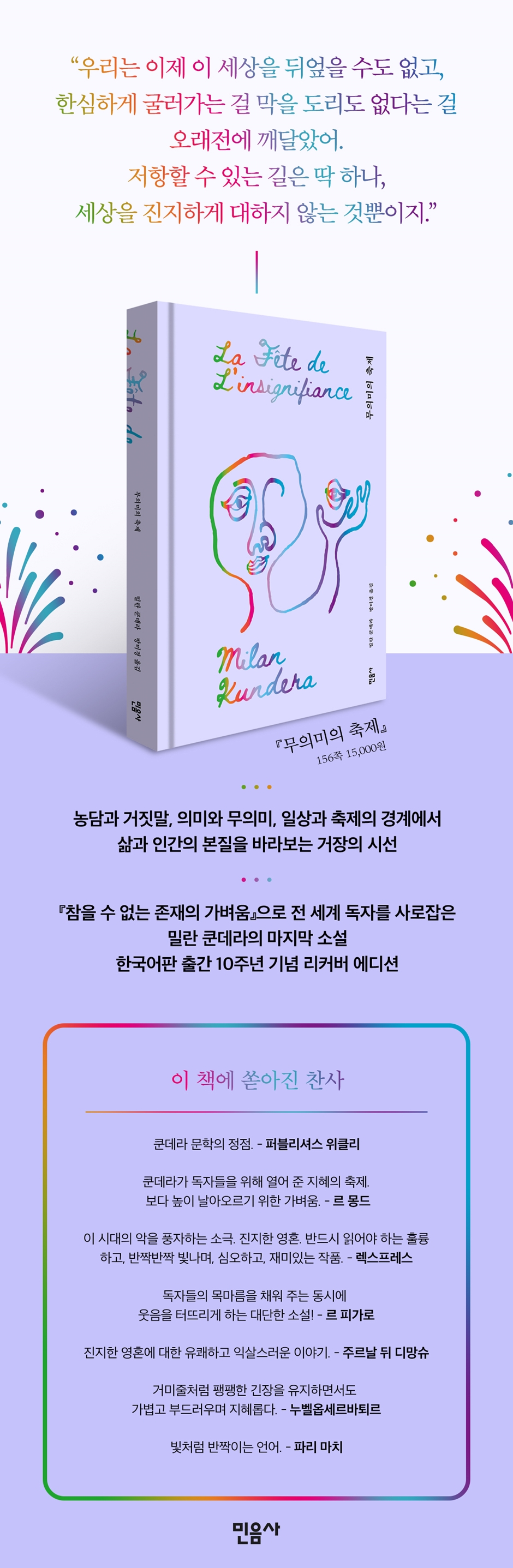
Milan Kundera, the master who received love from readers all over the world beyond Europe with works such as 『The Unbearable Lightness of Being』, 『The Joke』, 『Immortalism』, and 『The Art of the Novel』, has published his last novel 『Festival of Insignificance』 in Korean as a cover edition to commemorate the 10th anniversary of its publication.
This final novel, published in 2000, 14 years after the publication of Perfume in Spain, marks the pinnacle of Kundera's literature.
This novel, which unfolds through a series of tightly woven stories centered around the four main characters, Alain, Caliban, Charles, and Ramon, explores the essence of humanity and human life through a continuous flow of thought, from the navel of a woman, which has become a new symbol of eroticism, to the angel who was not born from the navel and therefore has no sex, to the feathers of that angel that float lightly and meaninglessly, to Stalin and Stalin's jokes, and the puppet show that derived from them.
Milan Kundera's last novel
Recovered edition commemorating the 10th anniversary of the Korean version
Milan Kundera, the master who received love from readers all over the world beyond Europe with works such as 『The Unbearable Lightness of Being』, 『The Joke』, 『Immortalism』, and 『The Art of the Novel』, has published his last novel 『Festival of Insignificance』 in Korean as a cover edition to commemorate the 10th anniversary of its publication.
This final novel, published in 2000, 14 years after the publication of Perfume in Spain, marks the pinnacle of Kundera's literature.
This novel, which unfolds through a series of tightly woven stories centered around the four main characters, Alain, Caliban, Charles, and Ramon, explores the essence of humanity and human life through a continuous flow of thought, from the navel of a woman, which has become a new symbol of eroticism, to the angel who was not born from the navel and therefore has no sex, to the feathers of that angel that float lightly and meaninglessly, to Stalin and Stalin's jokes, and the puppet show that derived from them.
- You can preview some of the book's contents.
Preview
index
Part 1: The main characters appear 7
Part 2 Puppet Show 27
Part 3 Alain and Charles often think of their mother 47
Part 4: They All Set Out to Find Good Feelings 67
Part 5: A Feather Whirls Beneath the Ceiling 93
Part 6: The Fall of Angels 111
Part 7: The Festival of Meaninglessness 133
Part 2 Puppet Show 27
Part 3 Alain and Charles often think of their mother 47
Part 4: They All Set Out to Find Good Feelings 67
Part 5: A Feather Whirls Beneath the Ceiling 93
Part 6: The Fall of Angels 111
Part 7: The Festival of Meaninglessness 133
Detailed image
Into the book
Dardello also asked himself this question directly, but he still did not know the answer.
It's not that I was ashamed of lying.
What was puzzling was that he himself didn't know why he had lied.
Lying is usually done to deceive someone or gain some advantage.
But what could he possibly gain by fabricating a cancer that never existed? Strangely, he couldn't help but laugh as he realized the pointlessness of his lies.
This laughter was also incomprehensible.
Why did he laugh? Did he find his own actions funny? No.
A sense of humor was not his strong suit.
For some reason, the cancer of the imagination amused him.
He kept smiling as he walked along.
He laughed and felt good.
--- p.19
“But who is this Khrushchev guy?”
“A few years after Stalin’s death, he became the supreme leader of the Soviet empire.”
Caliban was silent for a moment and then said.
“The only thing I find unbelievable about this story is that no one realized Stalin was joking.”
“Yes,” said Charles, putting the book down on the table.
“Because no one around him knows what a joke is.
I believe that from here on out, a new, great era in history has begun.”
--- p.31
A small object fluttering under the ceiling.
A very, very small white feather that slowly rises and falls and floats.
As Charles stood motionless before a long table filled with plates, bottles, and glasses, his head tilted back slightly, the other guests, one by one, began to follow his gaze, wondering why he was doing so.
--- p.51
The sound of Stalin's fist rang in their heads for a long time.
Brezhnev looks out the window and doesn't know what to do.
What you see is not what you believe.
An angel spreads its wings and floats above the roof.
He says, getting up from his chair.
“Angel, angel!”
Other people wake up too.
“Angel? I can’t see it!”
“No, I said I can see it! Up there!”
“Oh my goodness, another one! It’s falling again!” Beria sighs.
“You fools, you will see many more of these falling angels,” Stalin whispers.
“An angel, what a sign!” Khrushchev cries.
“A sign? No, what sign?” Brezhnev sighed, completely frozen in fear.
It's not that I was ashamed of lying.
What was puzzling was that he himself didn't know why he had lied.
Lying is usually done to deceive someone or gain some advantage.
But what could he possibly gain by fabricating a cancer that never existed? Strangely, he couldn't help but laugh as he realized the pointlessness of his lies.
This laughter was also incomprehensible.
Why did he laugh? Did he find his own actions funny? No.
A sense of humor was not his strong suit.
For some reason, the cancer of the imagination amused him.
He kept smiling as he walked along.
He laughed and felt good.
--- p.19
“But who is this Khrushchev guy?”
“A few years after Stalin’s death, he became the supreme leader of the Soviet empire.”
Caliban was silent for a moment and then said.
“The only thing I find unbelievable about this story is that no one realized Stalin was joking.”
“Yes,” said Charles, putting the book down on the table.
“Because no one around him knows what a joke is.
I believe that from here on out, a new, great era in history has begun.”
--- p.31
A small object fluttering under the ceiling.
A very, very small white feather that slowly rises and falls and floats.
As Charles stood motionless before a long table filled with plates, bottles, and glasses, his head tilted back slightly, the other guests, one by one, began to follow his gaze, wondering why he was doing so.
--- p.51
The sound of Stalin's fist rang in their heads for a long time.
Brezhnev looks out the window and doesn't know what to do.
What you see is not what you believe.
An angel spreads its wings and floats above the roof.
He says, getting up from his chair.
“Angel, angel!”
Other people wake up too.
“Angel? I can’t see it!”
“No, I said I can see it! Up there!”
“Oh my goodness, another one! It’s falling again!” Beria sighs.
“You fools, you will see many more of these falling angels,” Stalin whispers.
“An angel, what a sign!” Khrushchev cries.
“A sign? No, what sign?” Brezhnev sighed, completely frozen in fear.
--- p.124
Publisher's Review
On the border between jokes and lies, meaning and meaninglessness, everyday life and celebration
A master's perspective on life and the essence of humanity
In June, while walking down the streets of Paris, Alain encounters women wearing crop tops and thinks that in this day and age, the navel is the power that seduces men.
Thighs, buttocks, and breasts.
Each of these female body parts that have attracted men so far has its own 'meaning'.
The thighs, “the long and fascinating journey that leads to the fulfillment of Eros,” the buttocks, “the wildness, the cheerfulness, the shortest path to the target,” and the breasts, “the deification of woman, the Virgin Mary suckling Jesus, kneeling before the noble mission of womanhood.”
But how should we define this eroticism, this meaningless, round hole in the middle of the body?
“Thighs, breasts, and buttocks are all shaped differently for each woman.
So, these three golden points not only arouse excitement, but at the same time, they represent a woman's individuality.
I can't say that this woman is the woman I love just because she has a belly button.
All belly buttons are the same.
So what is the erotic message that the belly button is telling us?” - From the work
Meanwhile, Dardello, who was worried that he might have cancer, is relieved to hear from the doctor that he is in good health.
However, he accidentally runs into his former co-worker Ramon on the street and, without realizing it, tells him that he has cancer, and he feels a strange sense of elation.
I wasn't ashamed of lying, but I couldn't figure out why I lied.
What good does fabricating cancer actually do? Don't people only lie when it benefits them? So why does Dardello feel so good about it?
Meaning and Meaninglessness - Excellence and Meaninglessness, and Their Characteristics
Dardello is a man who attracts attention with his flowery speech.
Meanwhile, Kaklik remains silent.
But the beautiful women he meets at the party choose Kaklik over Dardello.
Excellence is a burden to those around you.
It gives you the burden of feeling like you have to excel together and give it special meaning.
But being insignificant makes those around you feel comfortable.
Because it allows you to be yourself and gives you freedom.
“It’s useless to be outstanding, right? Okay, I get it.” “It’s not just useless.
Because it's harmful.
When a great man tries to seduce a woman, she feels like she is in competition with him.
I think I have to excel too.
It seems like you shouldn't just give yourself away without holding on.
But just being insignificant sets a woman free.
It lets you not have to be careful.
“There is absolutely no need to be witty.” - From the work
The Tale of Stalin's Twenty-Four Birds: On the "Post-Play" Era
Kundera, who delves into the lightness of human existence, thrown into the vast flow of history, skillfully weaves together anecdotes about Stalin and Kalinin in this novel.
Stalin goes hunting and finds twenty-four magpies, but only twelve magazines.
After shooting twelve of them, he goes back and forth 13 kilometers to get the magazine, and when he returns, the remaining twelve are still there.
Stalin tells this experience to his comrades.
But all the comrades who hear this story do not laugh and keep their mouths shut.
Everyone thinks that Stalin's story was not a 'joke' but a 'disgusting lie'.
Stalin's jokes become "jokes that no one laughs at."
“Jokes have become dangerous.
Hey, you should know better! Remember the story about the magpie Stalin told his friends! And Khrushchev, who screamed in the bathroom! The great hero of truth, the one who spewed out words of contempt.
That scene was prophetic! That scene truly ushered in a new era.
"The Twilight of Jokes! The Post-Jokes Era!" - From the work
And among these comrades, Stalin and his masked comrades, facing each other, there is the only person Stalin cares about, and that is Kalinin.
The main character of 'Kaliningrad', 'Kalinin', suffers from an enlarged prostate, so he has to get up from his seat every now and then to urinate, even while giving a speech.
But the only thing he can't do is leave the room while Stalin is talking, so he poops in his pants. Stalin knows this, but he deliberately speaks slowly and enjoys the situation.
But why on earth did Stalin choose to name his city not after Catherine the Great, nor Pushkin, nor Tchaikovsky, nor Tolstoy, but after an “insignificant figure”? The reason is that, in the midst of such a serious history, Kalinin “endured suffering so as not to soil his panties,” “struggled against urine that was born, that grew, that pushed, that threatened, that attacked, that killed,” for whom “there could be no more vulgar and more human heroism”—the only one “who will long be remembered as a memorial to the sufferings of all mankind, as a memorial to a desperate struggle that harmed no one but himself.”
We can no longer turn this world upside down,
I realized a long time ago that there was no way to stop this pathetic roll.
There is only one way to resist,
It's just that you don't take the world seriously.
If Kundera's first novel, "The Joke," tells the story of a man whose life was ruined because his jokes weren't taken as jokes, this anecdote about Stalin in his last novel, "The Festival of Insignificance," speaks of an era in which jokes are no longer just taken as jokes, but are now accepted as "lies."
Through this historical anecdote, which may seem odd among the stories of four men living in the modern era, Kundera speaks of 'meaninglessness' as an attitude toward facing the weight and tragedy of an era that gives serious and special meaning to even a single joke.
The navel that opens a new era of eroticism that denies individual identity, the heart that is delighted by lies that have no reason and bring no benefit, today when jokes can only be accepted as lies, the feathers (of an angel without a navel) that float on the ceiling without any weight or meaning at a party where everyone is gathered, Kalinin's bladder that gives only purely physical and human pain - through all these stories that appear in the novel, Kundera says that in the end, the life of our human existence is nothing but a festival of meaninglessness and insignificance, and that it is this 'festival of meaninglessness' that we must accept and cherish.
That's our time.
“There’s something I’ve wanted to tell you for a long time.
About the value of the trivial and meaningless.
(Omitted) That it is trivial and meaningless is the essence of existence.
Always with us, wherever and whenever.
Even where no one wants to see it, in the midst of fear, in the midst of a terrible battle, in the midst of the worst misfortune.
It takes a lot of courage to admit that in such a dramatic situation, and to call it meaningless.
But it's not just a matter of acknowledging it, you have to love it, you have to learn how to love.
Here, in this park, before us, meaninglessness exists absolutely clearly, absolutely innocently, absolutely beautifully.
is it so.
“Beautifully.” - From the work
A master's perspective on life and the essence of humanity
In June, while walking down the streets of Paris, Alain encounters women wearing crop tops and thinks that in this day and age, the navel is the power that seduces men.
Thighs, buttocks, and breasts.
Each of these female body parts that have attracted men so far has its own 'meaning'.
The thighs, “the long and fascinating journey that leads to the fulfillment of Eros,” the buttocks, “the wildness, the cheerfulness, the shortest path to the target,” and the breasts, “the deification of woman, the Virgin Mary suckling Jesus, kneeling before the noble mission of womanhood.”
But how should we define this eroticism, this meaningless, round hole in the middle of the body?
“Thighs, breasts, and buttocks are all shaped differently for each woman.
So, these three golden points not only arouse excitement, but at the same time, they represent a woman's individuality.
I can't say that this woman is the woman I love just because she has a belly button.
All belly buttons are the same.
So what is the erotic message that the belly button is telling us?” - From the work
Meanwhile, Dardello, who was worried that he might have cancer, is relieved to hear from the doctor that he is in good health.
However, he accidentally runs into his former co-worker Ramon on the street and, without realizing it, tells him that he has cancer, and he feels a strange sense of elation.
I wasn't ashamed of lying, but I couldn't figure out why I lied.
What good does fabricating cancer actually do? Don't people only lie when it benefits them? So why does Dardello feel so good about it?
Meaning and Meaninglessness - Excellence and Meaninglessness, and Their Characteristics
Dardello is a man who attracts attention with his flowery speech.
Meanwhile, Kaklik remains silent.
But the beautiful women he meets at the party choose Kaklik over Dardello.
Excellence is a burden to those around you.
It gives you the burden of feeling like you have to excel together and give it special meaning.
But being insignificant makes those around you feel comfortable.
Because it allows you to be yourself and gives you freedom.
“It’s useless to be outstanding, right? Okay, I get it.” “It’s not just useless.
Because it's harmful.
When a great man tries to seduce a woman, she feels like she is in competition with him.
I think I have to excel too.
It seems like you shouldn't just give yourself away without holding on.
But just being insignificant sets a woman free.
It lets you not have to be careful.
“There is absolutely no need to be witty.” - From the work
The Tale of Stalin's Twenty-Four Birds: On the "Post-Play" Era
Kundera, who delves into the lightness of human existence, thrown into the vast flow of history, skillfully weaves together anecdotes about Stalin and Kalinin in this novel.
Stalin goes hunting and finds twenty-four magpies, but only twelve magazines.
After shooting twelve of them, he goes back and forth 13 kilometers to get the magazine, and when he returns, the remaining twelve are still there.
Stalin tells this experience to his comrades.
But all the comrades who hear this story do not laugh and keep their mouths shut.
Everyone thinks that Stalin's story was not a 'joke' but a 'disgusting lie'.
Stalin's jokes become "jokes that no one laughs at."
“Jokes have become dangerous.
Hey, you should know better! Remember the story about the magpie Stalin told his friends! And Khrushchev, who screamed in the bathroom! The great hero of truth, the one who spewed out words of contempt.
That scene was prophetic! That scene truly ushered in a new era.
"The Twilight of Jokes! The Post-Jokes Era!" - From the work
And among these comrades, Stalin and his masked comrades, facing each other, there is the only person Stalin cares about, and that is Kalinin.
The main character of 'Kaliningrad', 'Kalinin', suffers from an enlarged prostate, so he has to get up from his seat every now and then to urinate, even while giving a speech.
But the only thing he can't do is leave the room while Stalin is talking, so he poops in his pants. Stalin knows this, but he deliberately speaks slowly and enjoys the situation.
But why on earth did Stalin choose to name his city not after Catherine the Great, nor Pushkin, nor Tchaikovsky, nor Tolstoy, but after an “insignificant figure”? The reason is that, in the midst of such a serious history, Kalinin “endured suffering so as not to soil his panties,” “struggled against urine that was born, that grew, that pushed, that threatened, that attacked, that killed,” for whom “there could be no more vulgar and more human heroism”—the only one “who will long be remembered as a memorial to the sufferings of all mankind, as a memorial to a desperate struggle that harmed no one but himself.”
We can no longer turn this world upside down,
I realized a long time ago that there was no way to stop this pathetic roll.
There is only one way to resist,
It's just that you don't take the world seriously.
If Kundera's first novel, "The Joke," tells the story of a man whose life was ruined because his jokes weren't taken as jokes, this anecdote about Stalin in his last novel, "The Festival of Insignificance," speaks of an era in which jokes are no longer just taken as jokes, but are now accepted as "lies."
Through this historical anecdote, which may seem odd among the stories of four men living in the modern era, Kundera speaks of 'meaninglessness' as an attitude toward facing the weight and tragedy of an era that gives serious and special meaning to even a single joke.
The navel that opens a new era of eroticism that denies individual identity, the heart that is delighted by lies that have no reason and bring no benefit, today when jokes can only be accepted as lies, the feathers (of an angel without a navel) that float on the ceiling without any weight or meaning at a party where everyone is gathered, Kalinin's bladder that gives only purely physical and human pain - through all these stories that appear in the novel, Kundera says that in the end, the life of our human existence is nothing but a festival of meaninglessness and insignificance, and that it is this 'festival of meaninglessness' that we must accept and cherish.
That's our time.
“There’s something I’ve wanted to tell you for a long time.
About the value of the trivial and meaningless.
(Omitted) That it is trivial and meaningless is the essence of existence.
Always with us, wherever and whenever.
Even where no one wants to see it, in the midst of fear, in the midst of a terrible battle, in the midst of the worst misfortune.
It takes a lot of courage to admit that in such a dramatic situation, and to call it meaningless.
But it's not just a matter of acknowledging it, you have to love it, you have to learn how to love.
Here, in this park, before us, meaninglessness exists absolutely clearly, absolutely innocently, absolutely beautifully.
is it so.
“Beautifully.” - From the work
GOODS SPECIFICS
- Date of issue: June 24, 2024
- Format: Hardcover book binding method guide
- Page count, weight, size: 156 pages | 127*188*20mm
- ISBN13: 9788937456749
- ISBN10: 8937456745
You may also like
카테고리
korean


korean

![ELLE 엘르 스페셜 에디션 A형 : 12월 [2025]](http://librairie.coreenne.fr/cdn/shop/files/b8e27a3de6c9538896439686c6b0e8fb.jpg?v=1766436872&width=3840)


