

Chun-gok Goh-hee-dong
 |
Description
Book Introduction
“Have you ever seen anything like this? I’m going to take my sketchbook and go out and draw something.
They say they're making fun of cigarette sellers and candy sellers.
Is that all?
They make fun of me by saying things like, "It's better to apply ointment than to smear it with poop."
Anyway, at that time, society had no appreciation for Western paintings.
Yeah, I didn't find it fun to draw, so I played around."
This is a story told by Chun-gok Go Hui-dong (1886-1965), known as Korea's first Western-style painter.
When he first painted Western paintings, the reactions of those around him who watched him were interesting.
It's as if I can hear a voice saying, "Isn't that a candy box? Give me some candy," as I look at the box containing the paintbrush, and it's as if I can see a person standing right next to me innocently asking, "Why are you smearing chicken droppings on it?" as I look at the canvas.
This is a story from just over 100 years ago.
Go Hee-dong is recorded in art history as the first painter to introduce Western painting.
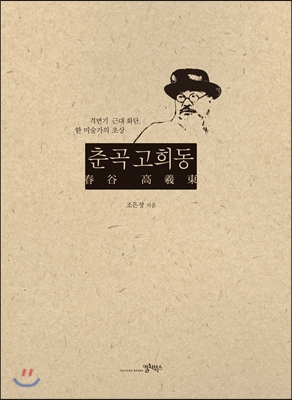
Chun-gok Go Hui-dong, Portrait of an Artist in a Turbulent Modern Art World
At the end of the Joseon Dynasty, the country's fortunes declined due to invasion by foreign powers, and it was finally annexed by Japan and the country was lost.
During this turbulent time, there was a ‘first Western painter’ who went to Japan to study Western painting and introduced Western painting for the first time. He was Go Hui-dong, the son of Chun-gok.
This book is the first to research and reveal from an art historical perspective the family lineage of Go Hee-dong, who was a member of the middle class in the late Joseon Dynasty, his childhood education, the process of going to Japan to study Western painting as an official of the Korean Empire and his painting classes, his activities in the modern art world during the turbulent times after returning to Korea, the founding of the Calligraphy and Painting Association and the operation of the Calligraphy and Painting Association Exhibition, artists during the chaos of liberation and the Korean War, the founding of the Republic of Korea Art Exhibition (abbreviated as 'National Art Exhibition'), and the founding of the National Academy of Arts.
We trace the personal history of Goh Hee-dong from birth to death, his social activities and interactions, especially those in the art world.
In particular, his family lineage, which was not well known until then, his time at Hansung Law School, and his painting classes while studying abroad in Japan are being intensively studied.
This book calmly portrays the portrait of an artist who braved the turbulent waves of history with his whole body during the turbulent modern art world.
They say they're making fun of cigarette sellers and candy sellers.
Is that all?
They make fun of me by saying things like, "It's better to apply ointment than to smear it with poop."
Anyway, at that time, society had no appreciation for Western paintings.
Yeah, I didn't find it fun to draw, so I played around."
This is a story told by Chun-gok Go Hui-dong (1886-1965), known as Korea's first Western-style painter.
When he first painted Western paintings, the reactions of those around him who watched him were interesting.
It's as if I can hear a voice saying, "Isn't that a candy box? Give me some candy," as I look at the box containing the paintbrush, and it's as if I can see a person standing right next to me innocently asking, "Why are you smearing chicken droppings on it?" as I look at the canvas.
This is a story from just over 100 years ago.
Go Hee-dong is recorded in art history as the first painter to introduce Western painting.
Chun-gok Go Hui-dong, Portrait of an Artist in a Turbulent Modern Art World
At the end of the Joseon Dynasty, the country's fortunes declined due to invasion by foreign powers, and it was finally annexed by Japan and the country was lost.
During this turbulent time, there was a ‘first Western painter’ who went to Japan to study Western painting and introduced Western painting for the first time. He was Go Hui-dong, the son of Chun-gok.
This book is the first to research and reveal from an art historical perspective the family lineage of Go Hee-dong, who was a member of the middle class in the late Joseon Dynasty, his childhood education, the process of going to Japan to study Western painting as an official of the Korean Empire and his painting classes, his activities in the modern art world during the turbulent times after returning to Korea, the founding of the Calligraphy and Painting Association and the operation of the Calligraphy and Painting Association Exhibition, artists during the chaos of liberation and the Korean War, the founding of the Republic of Korea Art Exhibition (abbreviated as 'National Art Exhibition'), and the founding of the National Academy of Arts.
We trace the personal history of Goh Hee-dong from birth to death, his social activities and interactions, especially those in the art world.
In particular, his family lineage, which was not well known until then, his time at Hansung Law School, and his painting classes while studying abroad in Japan are being intensively studied.
This book calmly portrays the portrait of an artist who braved the turbulent waves of history with his whole body during the turbulent modern art world.
index
Recommendation │ Kim Hong-nam
Author's Preface │ Eunjeong Jo
1.
Bipa-dong Goh's house
2.
Government-run Hanseong Law School
3.
Drawing Management
4.
Studying abroad in Tokyo
5.
The first Western painter
6.
New house in Wonseo-dong
7.
The era of the Calligraphy and Painting Association
8.
The last Western painting
9.
cruel times
10.
Rules of Power
Author's chronology
References
Author's Preface │ Eunjeong Jo
1.
Bipa-dong Goh's house
2.
Government-run Hanseong Law School
3.
Drawing Management
4.
Studying abroad in Tokyo
5.
The first Western painter
6.
New house in Wonseo-dong
7.
The era of the Calligraphy and Painting Association
8.
The last Western painting
9.
cruel times
10.
Rules of Power
Author's chronology
References
Into the book
I believe that the art historical study of a person as an artist should be an act of weaving together biographies and histories.
This is because I believe that if we only defend the position of the subject or only use widely known facts as sources, we may end up in a deadlock with the truth.
We need to embrace a person's life with a strictly balanced perspective, while also meaningfully viewing the turbulent history through which he navigated.
In this study of Goh Hee-dong, we attempted to weave his personal history from birth to death within the larger framework of social activities and interactions.
There is something I realized early on while conducting research on Chun-gok Goh-hee-dong.
The fact is that, other than the phrase 'Korea's first Western painter' that always precedes his name, there are extremely limited expressions that describe him.
Compared to the considerable amount of documentation available about his complex and multifaceted life in the art world, very little is known about his personal life.
This is precisely why this study was conducted while moving back and forth between the epithets “first” and “Western painter” that followed his activities like a shadow, and ignorance about his personal life.
That is why his family lineage was given great importance in the beginning, and why his father, Go Yeong-cheol, and his brothers, as well as Go Hee-dong and his brothers, were covered extensively.
In this study, the author embarked on a journey into modern times to understand the figure of Go Hee-dong.
From the travels of Isabella Bird Bishop during the Enlightenment period, I followed the itinerary of Go Hee-dong's father, Go Yeong-cheol, to the Yeongseonsa and Bobingsa, and even had a vision of standing in front of Niagara Falls with Go Hee-dong.
Although Go Hee-dong's life was not affluent, his love for his family was extraordinary.
He was also fortunate to associate with his good friend Lee Do-young, his benevolent teachers Jo Seok-jin and Ahn Jung-sik, Oh Se-chang, his father's friend and comrade, and Choi Nam-seon, an eccentric figure of the time.
Having grown into a modern painter through his encounters with them, he had to open up the field of modern art entirely on his own.
As with everything, there are pros and cons to his work in the field of modern art.
- Jo Eun-jeong (art critic)
This is because I believe that if we only defend the position of the subject or only use widely known facts as sources, we may end up in a deadlock with the truth.
We need to embrace a person's life with a strictly balanced perspective, while also meaningfully viewing the turbulent history through which he navigated.
In this study of Goh Hee-dong, we attempted to weave his personal history from birth to death within the larger framework of social activities and interactions.
There is something I realized early on while conducting research on Chun-gok Goh-hee-dong.
The fact is that, other than the phrase 'Korea's first Western painter' that always precedes his name, there are extremely limited expressions that describe him.
Compared to the considerable amount of documentation available about his complex and multifaceted life in the art world, very little is known about his personal life.
This is precisely why this study was conducted while moving back and forth between the epithets “first” and “Western painter” that followed his activities like a shadow, and ignorance about his personal life.
That is why his family lineage was given great importance in the beginning, and why his father, Go Yeong-cheol, and his brothers, as well as Go Hee-dong and his brothers, were covered extensively.
In this study, the author embarked on a journey into modern times to understand the figure of Go Hee-dong.
From the travels of Isabella Bird Bishop during the Enlightenment period, I followed the itinerary of Go Hee-dong's father, Go Yeong-cheol, to the Yeongseonsa and Bobingsa, and even had a vision of standing in front of Niagara Falls with Go Hee-dong.
Although Go Hee-dong's life was not affluent, his love for his family was extraordinary.
He was also fortunate to associate with his good friend Lee Do-young, his benevolent teachers Jo Seok-jin and Ahn Jung-sik, Oh Se-chang, his father's friend and comrade, and Choi Nam-seon, an eccentric figure of the time.
Having grown into a modern painter through his encounters with them, he had to open up the field of modern art entirely on his own.
As with everything, there are pros and cons to his work in the field of modern art.
- Jo Eun-jeong (art critic)
---From the author's preface
Publisher's Review
Chun-gok Go-hee-dong
He was born in Seoul in 1886 as the third son of interpreter Go Yeong-cheol and Jeonju Lee.
His pen name is Chun-gok (春谷).
He entered the government-run Hanseong Law School and learned French, and in December 1904, he became an official of the Korean Empire, becoming an officer in the Office of the Prime Minister.
From 1907, he studied painting under the tutelage of Solim Jo Seok-jin and Simjeon An Jung-sik, the last painters of the Dohwaseo, and in February 1909, he went on a business trip to Tokyo for the purpose of studying painting.
In September of that year, he entered the Western Painting Department of Tokyo Art School as a senior and graduated in March 1915.
You can see three Western paintings, including [Self-portrait with a Fan], because he was active as an Oriental painter after the mid-1920s.
He participated as a founding member of the Calligraphy and Painting Association and served as general manager and secretary.
He was active in the Sanbyeok Poetry Society and the Handong Art Collection along with Oh Se-chang, Lee Gi, Choi Nam-seon, Park Han-young, and Lee Do-young, and led the new art movement, including the improvement of oriental painting.
After liberation, he led the Korean Fine Arts Association, the Korean Federation of Arts and Culture Associations, and served as the first director of the Arts Council and a judge for the Korean National Art Exhibition.
He was elected to the House of Councilors in 1960 through the Democratic Party's nomination, and took office as the president of Munhwa Broadcasting Corporation in 1961.
He passed away on October 22, 1965, at the age of 80, and his funeral was held at the Yejongjang Hall.
The influence of the Bipa-dong Go clan and his father, Go Yeong-cheol
Go Hui-dong was born on March 11, 1886 (April 13, 1886 in the lunar calendar) in Bipa-dong (present-day Gwansu-dong) as the third of Go Yeong-cheol's four sons.
Goh Hee-dong's family is known as a prominent family with many interpreters who passed the civil service examination.
In particular, his father, Go Yeong-cheol, was an elite who broadened his perspective on the world by interacting with contemporary cultural figures and artists and enlightenment thinkers, and who visited China as a student of Yeongseonsa and, after the Korean Empire established diplomatic relations with the United States, as a member of the Bobingsa.
Go Young-cheol must have had a great influence on his son, Go Hee-dong, based on his unique sense of reality as a middle-class person and the wealth of knowledge about the new world he acquired through his work as an interpreter.
Go Hui-dong's pen name, Chun-gok (春谷), was also given to him by his father, Go Yeong-cheol.
His father, Go Yeong-cheol, was a member of the Yukgyo Poetry Society and interacted with them, most of whom were reformist thinkers from families of interpreters and physicians.
These interactions with his father seem to have influenced Go Hee-dong's growth as an artist, and Go Hee-dong continued to interact with the children of those who participated in the Yukgyo Shisa.
This is especially true of his friendship with Oh Se-chang (1864-1953), the son of Oh Gyeong-seok.
Admission to the government-run Hanseong Law School and introduction to art
It is known that Go Hee-dong met a Frenchman named Leopold Remion, learned about Western painting, and eventually decided to study abroad in Japan, thus taking the path of a painter.
In times when foreign powers were pushing in, learning a foreign language would have been a shortcut to success.
His father, Go Young-cheol, who was an interpreter, would have known this better than anyone else.
Instead of sending his son to an ordinary elementary school, his father, Go Yeong-cheol, enrolled him in the government-run Hanseong Law School, which was one of the most powerful schools at the time, where he studied French.
Go Hee-dong entered school in 1899 (at the age of 14) to learn French and completed his studies with excellent grades.
Goh Hee-dong says that he saw Lemion, who was known as the art teacher of this school, painting a portrait of the school principal, Emile Martel, and that this decisive moment was the turning point that led him to pursue the path of an artist.
This book reveals for the first time the establishment and operation of the government-run Hanseong Law School, the content of Goh Hee-dong's classes, and especially the fact that Goh Hee-dong took art classes.
Painting manager Go Hee-dong goes on a painting research trip to Tokyo.
Go Hee-dong began his career as an official in the Optical Bureau in December 1904.
It was upon the recommendation of Conseilles Deleoigue, who was an advisor to the Korean Empire's cabinet.
Goh Hee-dong demonstrated his fluency in French by demonstrating his skills in interpretation and administrative work.
In 1907, with the administrative reorganization, Goh Hee-dong appears to have worked as a funeral director at the funeral home, which was part of the Dohwaseo.
In 1908, he studied Japanese at the private Janghoon School's night school, and on February 15, 1909, he received an imperial decree from the Imperial Household Ministry ordering him to "go on a business trip to Tokyo, Japan for art research."
However, Go Hui-dong was already studying calligraphy and painting under the tutelage of Jo Seok-jin of Shaolin and An Jung-sik of Simjeon, the court painters who painted the face of Emperor Gojong.
First, Go Hee-dong, who entered the Tokyo Art School through an 'entry course', recalls his first day of class, saying, "I had no idea how to study art and had no elementary school preparatory knowledge whatsoever." He said, "I had never seen or heard of them drawing on plaster statues, propping them up with charcoal on a frame."
(Page 111) In 1915, Go Hee-dong became the first Korean to graduate from the Tokyo School of Fine Arts.
He was the first Western painter, but he started the new art movement as a traditional calligrapher.
Around the time of his graduation in 1915, Go Hee-dong left behind three Western-style self-portraits.
These include [Self-portrait wearing a cap], which is my graduation work, [Self-portrait holding a fan], and [Self-portrait wearing a durumagi].
However, Go Hee-dong, the 'first Western painter', gave up Western painting and started a new art movement that introduced Western painting into Eastern painting.
Go Hee-dong is expected to be a figure who can combine tradition and innovation, straddling both fields, and who can integrate the two fields of Eastern and Western painting.
I was given such expectations simply because I had studied traditional and Western painting.
He contributed to the establishment of the Calligraphy and Painting Association in June 1918 and played a major role in its operation until the end of the Calligraphy and Painting Association Exhibition in 1936.
Go Hee-dong also exhibited at the Joseon Art Exhibition, participated in the founding of the Dong-A Ilbo as an art reporter, and engaged in various activities such as drawing illustrations.
Just as his father, Go Yeong-cheol, had exchanged ideas at the Yukgyo Poetry Society, Go Hee-dong participated in various poetry societies and poetry clubs, wrote poetry and drew pictures, never missed a calligraphy club, and took a place in various cultural social gatherings.
In the mid-1920s, Go Hui-dong's social circle was represented by the 'Handong Ajip' and 'Sanbyeoksisa', which left behind a collection of calligraphy and paintings.
After liberation, he became prominent in the art and political world.
Go Hee-dong, who avoided the controversy surrounding pro-Japanese collaboration during the final days of Japanese colonial rule, rose to the center of the art world by holding the “Liberation Commemorative Art Exhibition” with the liberation.
The title of Secretary General of the first and only Calligraphy and Painting Association in our country must have played a significant role.
Go Hee-dong is considered a representative figure among artists, capable of embracing both Eastern and Western painting.
It is said that Go Hee-dong's speaking skills, logical reasoning, and ability to control an audience were so outstanding that they rivaled those of politicians. He eventually entered the political world and began to be very active.
In February 1946, Syngman Rhee, who returned to Korea, was appointed as chairman, Kim Kyu-sik as vice-chairman, Kim Gu as prime minister, Yun Chi-young as secretary-general, and Go Hee-dong as secretary-general of the South Korean National Representative Democratic Assembly.
Go Hee-dong became a member of the top leadership of the Democratic Party.
In addition, Go Hee-dong, as the president of the Joseon Art Association, became the founder of the 'Korea-China Cultural Association', which was formed by cultural figures and politicians as a representative of artists.
It is said that Go Hee-dong served as a moderator at many political rallies and events with his overwhelming charisma.
The tragedy of the Korean War, a fellow artist being tried as a collaborator
During the Korean War, when Seoul, which had suffered under the People's Army for three months, was recaptured on September 28, private retaliatory killings of collaborators and the confiscation of property were rampant.
Go Hee-dong is the chairman of the Cultural Association, also known as the Cultural Association, and is the main body in charge of evaluating the cultural workers' assistants.
After the literary association established the principles, they held a committee to review artists who had collaborated with the association. This committee arbitrarily classified artists into A, B, and C categories based on the principles they had established, and referred them to the police investigation committee for their level of collaboration, on the grounds that they had remained in Seoul and gone out to the alliance to paint.
The majority of artists who remained in Seoul were forced to join the art alliance, either semi-forcibly or for survival, and participated in creating portraits of Kim Il-sung, posters, and leaflets.
Most of those accused of having participated in forced labor were women or commoners who did not have the power to escape forced labor.
Most of the powerful people were exempt from forced labor, and it was not uncommon for them to frame those who could testify to their own forced labor in order to hide it.
Ultimately, the stigma of being a collaborator could be nothing more than a stigma of being weak in power relations.
This is because the voluntary collaborators usually went up north with the People's Army at this time.
Go Hee-dong also suffered during the war.
His second grandson was taken away by the People's Army and died, and there was even a story that among the artists, he instructed, "Even if Comrade Kim Il-sung forgives all South Koreans, among the artists, he will never forgive Go Hee-dong and Jang Bal."
Kim Jin-woo, who worked with Go Hee-dong in the Calligraphy and Painting Association, was accused of being a collaborator and died in Seodaemun Prison.
It was in the prison where he was imprisoned for participating in the independence movement under Japanese colonial rule.
Go Hee-dong is once again armed with anti-communist ideology.
He leads the creation of the Ministry of National Defense's Military Artist Corps.
He led the National Art Exhibition, founded the Arts Academy, and became a politician.
After the war ended and the National Art Exhibition era began, Go Hee-dong emerged as a powerful figure in the art world.
Artists who had collaborated with the Japanese colonial government were rejected, and artists with socialist leanings all went to the North, leaving their place for national art and anti-communist art. At the center of this was Go Hee-dong.
In March 1954, an election was held in accordance with the 'Academy of Arts Election Ordinance', and Go Hee-dong became a lifelong member.
Jang Bal, Lee Sang-beom, Son Jae-hyeong, Kim Hwan-ki, Yun Hyo-jung, and Bae Ryeom were elected as members of the art department.
Goh Hee-dong also had excellent political sense and maintained a smooth cooperative relationship with the Syngman Rhee regime. However, he quickly realized the limitations of the Syngman Rhee regime's dictatorship of the Liberal Party, and in 1957 he participated in the founding of the Democratic Party and was appointed as an advisor.
Go Hee-dong was in charge of the cover of Dr. Cho Byeong-ok's (1894-1960) collection of political essays, Democracy and I, which reflected his political standing.
When the Syngman Rhee regime collapsed in the April 1960 student revolution, Go Hee-dong ran for election as a Democratic Party candidate and was elected to the House of Councilors in August.
A painter who was a man of culture was born as a politician representing the people.
After the May 16 military coup and the failure to enter the broadcasting industry, he returned to being an artist.
On January 28, 1961, shortly after being elected to the House of Councilors, Goh Hee-dong received a license.
It was a ‘private radio broadcasting license.’
This broadcasting license became the foundation of today's MBC Cultural Broadcasting Corporation.
It is said that Go Hee-dong heard his son-in-law's words and asked Prime Minister Jang Myeon for a favor and received it in advance.
At that time, Kim Ji-tae, the president of Busan MBC, was pushing for the establishment of a broadcasting station in Seoul, but when he was unable to obtain permission, he persuaded Go Hee-dong, who was appointed as the first president of Seoul MBC.
The broadcasting station that was founded through the combination of Kim Ji-tae's capital and Go Hee-dong's license became the current MBC Munhwa Broadcasting Corporation.
Go Hee-dong transforms into a politician and the first president of a private broadcasting station.
But all of this was ruined by the May 16 military coup in 1961.
Moreover, all shares of the broadcasting station are forcibly donated to the May 16 Scholarship Foundation.
Through this process, Munhwa Broadcasting Station will become the current owner of the Jeongsu Scholarship Foundation.
Go Hee-dong returns to being a painter.
Go Hee-dong started out as an official in the Korean Empire and became a painter. In his later years, he attempted to become a politician and broadcaster, but failed. He eventually returned to being a painter and ended his turbulent life in October 1965.
Celebrating the 50th anniversary of Chun-gok's death, a bust was unveiled, a special exhibition was held, and a lecture commemorating the publication was held.
On October 22nd at 5 PM, the 50th anniversary of Chun-gok's death was successfully held at the 'Gohee-dong House' with the participation of bereaved family members and figures from the cultural and artistic community.
There was also an opening ceremony for the special exhibition of the 50th anniversary of Go Hee-dong, Chun-gok, titled “The Pioneer of Modern Korean Painting,” and a dedication ceremony for related research books, “Chun-gok Go Hee-dong - A Portrait of an Artist in the Modern Painting World in Turbulent Times” (written by Jo Eun-jeong), and “Biography of Chun-gok Go Hee-dong - Korea’s First Western Painter” written by novelist Choi Il-ok, Go Hee-dong’s grandson.
There was also an unveiling ceremony for the ‘Bust of Goh Hee-dong’ created by sculptor Jeong Hyeon (Hongik University).
The Gohwi-dong House, where the event and exhibition were held that day, was designed and built by Mr. Gohwi-dong Chun-gok himself, and was where he lived for 41 years. The National Trust Cultural Heritage Fund, a cultural heritage preservation organization, is in charge of preserving the house, which was in danger of being damaged, as a historical house museum and operating the exhibition.
The exhibition runs from October 22nd to December 27th, and there will also be two lectures.
first
Date: 14:00, Tuesday, October 27th, Location: Gohui-dong House, Topic: 'My Grandfather, Gohui-dong', Instructor: Choi Il-ok (novelist)
second
Date: 12.
Thursday, March 3rd, 7:00 PM, Location: Jeongdok Library, Topic: 'Go Hee-dong, the Leader of the Modern Art World,' Instructor: Jo Eun-jeong (Art Critic)
Recommendation
The author begins from the perspective that Chun-gok Go Hui-dong was not an isolated individual active in the vacuum of reality, but rather a product of the society and environment in which he lived, and thus serves as a touchstone for examining his era and art.
We set out to find answers to the questions about how he became Korea's first Western painter and why he chose not to remain a Western painter but instead turned to Eastern painting.
Based on that understanding, we are trying to understand his artistic characteristics and delve into the reality of modern Korean art and culture.
In particular, the efforts to understand unknown family and friendship relationships clearly demonstrate the effort researchers must make to understand a person, not just what appears on the surface.
From personal writings and diaries from the modern era to literature, newspapers, and magazines, the author went through a selection process to excavate as much relevant material as possible, providing rational explanations and interpretations, and revealing the interrelationships of situational causes and causal relationships, while also thoroughly trying to elucidate achievements, motivations for actions, and the causes of success and failure. This is evident throughout the manuscript.
The results are excellent.
With this, the author has not only made a mark on the study of modern Korean art history, but has also created an example of the vivid narrative of art history that can be achieved through a biographical approach.
In that respect, I have no doubt that this book will become a fundamental text on the history of modern art.
In this book, characters who lived through the same era appear and disappear on stage like a play.
On an autumn day like today in 1924, the laughter of Wichang Oh Se-chang, Nanta Lee Gi, Seokjeon Park Han-yeong, Seongdang Kim Don-hee, Gwanjae Lee Do-yeong, and Yukdang Choi Nam-seon, sitting around the Sarangbang in Gohui-dong, seemed to break through 100 years of time and space and go over the walls of Gohui-dong's house.
This book will serve as a springboard for developing the in-depth content necessary to officially register and operate the Goh Hee-dong House as the Goh Hee-dong Memorial Art Museum.
- Kim Hong-nam (Professor Emeritus of Ewha Womans University, former Director of the National Museum of Korea, and Director General of the National Trust Cultural Heritage Fund Historic House Museum)
He was born in Seoul in 1886 as the third son of interpreter Go Yeong-cheol and Jeonju Lee.
His pen name is Chun-gok (春谷).
He entered the government-run Hanseong Law School and learned French, and in December 1904, he became an official of the Korean Empire, becoming an officer in the Office of the Prime Minister.
From 1907, he studied painting under the tutelage of Solim Jo Seok-jin and Simjeon An Jung-sik, the last painters of the Dohwaseo, and in February 1909, he went on a business trip to Tokyo for the purpose of studying painting.
In September of that year, he entered the Western Painting Department of Tokyo Art School as a senior and graduated in March 1915.
You can see three Western paintings, including [Self-portrait with a Fan], because he was active as an Oriental painter after the mid-1920s.
He participated as a founding member of the Calligraphy and Painting Association and served as general manager and secretary.
He was active in the Sanbyeok Poetry Society and the Handong Art Collection along with Oh Se-chang, Lee Gi, Choi Nam-seon, Park Han-young, and Lee Do-young, and led the new art movement, including the improvement of oriental painting.
After liberation, he led the Korean Fine Arts Association, the Korean Federation of Arts and Culture Associations, and served as the first director of the Arts Council and a judge for the Korean National Art Exhibition.
He was elected to the House of Councilors in 1960 through the Democratic Party's nomination, and took office as the president of Munhwa Broadcasting Corporation in 1961.
He passed away on October 22, 1965, at the age of 80, and his funeral was held at the Yejongjang Hall.
The influence of the Bipa-dong Go clan and his father, Go Yeong-cheol
Go Hui-dong was born on March 11, 1886 (April 13, 1886 in the lunar calendar) in Bipa-dong (present-day Gwansu-dong) as the third of Go Yeong-cheol's four sons.
Goh Hee-dong's family is known as a prominent family with many interpreters who passed the civil service examination.
In particular, his father, Go Yeong-cheol, was an elite who broadened his perspective on the world by interacting with contemporary cultural figures and artists and enlightenment thinkers, and who visited China as a student of Yeongseonsa and, after the Korean Empire established diplomatic relations with the United States, as a member of the Bobingsa.
Go Young-cheol must have had a great influence on his son, Go Hee-dong, based on his unique sense of reality as a middle-class person and the wealth of knowledge about the new world he acquired through his work as an interpreter.
Go Hui-dong's pen name, Chun-gok (春谷), was also given to him by his father, Go Yeong-cheol.
His father, Go Yeong-cheol, was a member of the Yukgyo Poetry Society and interacted with them, most of whom were reformist thinkers from families of interpreters and physicians.
These interactions with his father seem to have influenced Go Hee-dong's growth as an artist, and Go Hee-dong continued to interact with the children of those who participated in the Yukgyo Shisa.
This is especially true of his friendship with Oh Se-chang (1864-1953), the son of Oh Gyeong-seok.
Admission to the government-run Hanseong Law School and introduction to art
It is known that Go Hee-dong met a Frenchman named Leopold Remion, learned about Western painting, and eventually decided to study abroad in Japan, thus taking the path of a painter.
In times when foreign powers were pushing in, learning a foreign language would have been a shortcut to success.
His father, Go Young-cheol, who was an interpreter, would have known this better than anyone else.
Instead of sending his son to an ordinary elementary school, his father, Go Yeong-cheol, enrolled him in the government-run Hanseong Law School, which was one of the most powerful schools at the time, where he studied French.
Go Hee-dong entered school in 1899 (at the age of 14) to learn French and completed his studies with excellent grades.
Goh Hee-dong says that he saw Lemion, who was known as the art teacher of this school, painting a portrait of the school principal, Emile Martel, and that this decisive moment was the turning point that led him to pursue the path of an artist.
This book reveals for the first time the establishment and operation of the government-run Hanseong Law School, the content of Goh Hee-dong's classes, and especially the fact that Goh Hee-dong took art classes.
Painting manager Go Hee-dong goes on a painting research trip to Tokyo.
Go Hee-dong began his career as an official in the Optical Bureau in December 1904.
It was upon the recommendation of Conseilles Deleoigue, who was an advisor to the Korean Empire's cabinet.
Goh Hee-dong demonstrated his fluency in French by demonstrating his skills in interpretation and administrative work.
In 1907, with the administrative reorganization, Goh Hee-dong appears to have worked as a funeral director at the funeral home, which was part of the Dohwaseo.
In 1908, he studied Japanese at the private Janghoon School's night school, and on February 15, 1909, he received an imperial decree from the Imperial Household Ministry ordering him to "go on a business trip to Tokyo, Japan for art research."
However, Go Hui-dong was already studying calligraphy and painting under the tutelage of Jo Seok-jin of Shaolin and An Jung-sik of Simjeon, the court painters who painted the face of Emperor Gojong.
First, Go Hee-dong, who entered the Tokyo Art School through an 'entry course', recalls his first day of class, saying, "I had no idea how to study art and had no elementary school preparatory knowledge whatsoever." He said, "I had never seen or heard of them drawing on plaster statues, propping them up with charcoal on a frame."
(Page 111) In 1915, Go Hee-dong became the first Korean to graduate from the Tokyo School of Fine Arts.
He was the first Western painter, but he started the new art movement as a traditional calligrapher.
Around the time of his graduation in 1915, Go Hee-dong left behind three Western-style self-portraits.
These include [Self-portrait wearing a cap], which is my graduation work, [Self-portrait holding a fan], and [Self-portrait wearing a durumagi].
However, Go Hee-dong, the 'first Western painter', gave up Western painting and started a new art movement that introduced Western painting into Eastern painting.
Go Hee-dong is expected to be a figure who can combine tradition and innovation, straddling both fields, and who can integrate the two fields of Eastern and Western painting.
I was given such expectations simply because I had studied traditional and Western painting.
He contributed to the establishment of the Calligraphy and Painting Association in June 1918 and played a major role in its operation until the end of the Calligraphy and Painting Association Exhibition in 1936.
Go Hee-dong also exhibited at the Joseon Art Exhibition, participated in the founding of the Dong-A Ilbo as an art reporter, and engaged in various activities such as drawing illustrations.
Just as his father, Go Yeong-cheol, had exchanged ideas at the Yukgyo Poetry Society, Go Hee-dong participated in various poetry societies and poetry clubs, wrote poetry and drew pictures, never missed a calligraphy club, and took a place in various cultural social gatherings.
In the mid-1920s, Go Hui-dong's social circle was represented by the 'Handong Ajip' and 'Sanbyeoksisa', which left behind a collection of calligraphy and paintings.
After liberation, he became prominent in the art and political world.
Go Hee-dong, who avoided the controversy surrounding pro-Japanese collaboration during the final days of Japanese colonial rule, rose to the center of the art world by holding the “Liberation Commemorative Art Exhibition” with the liberation.
The title of Secretary General of the first and only Calligraphy and Painting Association in our country must have played a significant role.
Go Hee-dong is considered a representative figure among artists, capable of embracing both Eastern and Western painting.
It is said that Go Hee-dong's speaking skills, logical reasoning, and ability to control an audience were so outstanding that they rivaled those of politicians. He eventually entered the political world and began to be very active.
In February 1946, Syngman Rhee, who returned to Korea, was appointed as chairman, Kim Kyu-sik as vice-chairman, Kim Gu as prime minister, Yun Chi-young as secretary-general, and Go Hee-dong as secretary-general of the South Korean National Representative Democratic Assembly.
Go Hee-dong became a member of the top leadership of the Democratic Party.
In addition, Go Hee-dong, as the president of the Joseon Art Association, became the founder of the 'Korea-China Cultural Association', which was formed by cultural figures and politicians as a representative of artists.
It is said that Go Hee-dong served as a moderator at many political rallies and events with his overwhelming charisma.
The tragedy of the Korean War, a fellow artist being tried as a collaborator
During the Korean War, when Seoul, which had suffered under the People's Army for three months, was recaptured on September 28, private retaliatory killings of collaborators and the confiscation of property were rampant.
Go Hee-dong is the chairman of the Cultural Association, also known as the Cultural Association, and is the main body in charge of evaluating the cultural workers' assistants.
After the literary association established the principles, they held a committee to review artists who had collaborated with the association. This committee arbitrarily classified artists into A, B, and C categories based on the principles they had established, and referred them to the police investigation committee for their level of collaboration, on the grounds that they had remained in Seoul and gone out to the alliance to paint.
The majority of artists who remained in Seoul were forced to join the art alliance, either semi-forcibly or for survival, and participated in creating portraits of Kim Il-sung, posters, and leaflets.
Most of those accused of having participated in forced labor were women or commoners who did not have the power to escape forced labor.
Most of the powerful people were exempt from forced labor, and it was not uncommon for them to frame those who could testify to their own forced labor in order to hide it.
Ultimately, the stigma of being a collaborator could be nothing more than a stigma of being weak in power relations.
This is because the voluntary collaborators usually went up north with the People's Army at this time.
Go Hee-dong also suffered during the war.
His second grandson was taken away by the People's Army and died, and there was even a story that among the artists, he instructed, "Even if Comrade Kim Il-sung forgives all South Koreans, among the artists, he will never forgive Go Hee-dong and Jang Bal."
Kim Jin-woo, who worked with Go Hee-dong in the Calligraphy and Painting Association, was accused of being a collaborator and died in Seodaemun Prison.
It was in the prison where he was imprisoned for participating in the independence movement under Japanese colonial rule.
Go Hee-dong is once again armed with anti-communist ideology.
He leads the creation of the Ministry of National Defense's Military Artist Corps.
He led the National Art Exhibition, founded the Arts Academy, and became a politician.
After the war ended and the National Art Exhibition era began, Go Hee-dong emerged as a powerful figure in the art world.
Artists who had collaborated with the Japanese colonial government were rejected, and artists with socialist leanings all went to the North, leaving their place for national art and anti-communist art. At the center of this was Go Hee-dong.
In March 1954, an election was held in accordance with the 'Academy of Arts Election Ordinance', and Go Hee-dong became a lifelong member.
Jang Bal, Lee Sang-beom, Son Jae-hyeong, Kim Hwan-ki, Yun Hyo-jung, and Bae Ryeom were elected as members of the art department.
Goh Hee-dong also had excellent political sense and maintained a smooth cooperative relationship with the Syngman Rhee regime. However, he quickly realized the limitations of the Syngman Rhee regime's dictatorship of the Liberal Party, and in 1957 he participated in the founding of the Democratic Party and was appointed as an advisor.
Go Hee-dong was in charge of the cover of Dr. Cho Byeong-ok's (1894-1960) collection of political essays, Democracy and I, which reflected his political standing.
When the Syngman Rhee regime collapsed in the April 1960 student revolution, Go Hee-dong ran for election as a Democratic Party candidate and was elected to the House of Councilors in August.
A painter who was a man of culture was born as a politician representing the people.
After the May 16 military coup and the failure to enter the broadcasting industry, he returned to being an artist.
On January 28, 1961, shortly after being elected to the House of Councilors, Goh Hee-dong received a license.
It was a ‘private radio broadcasting license.’
This broadcasting license became the foundation of today's MBC Cultural Broadcasting Corporation.
It is said that Go Hee-dong heard his son-in-law's words and asked Prime Minister Jang Myeon for a favor and received it in advance.
At that time, Kim Ji-tae, the president of Busan MBC, was pushing for the establishment of a broadcasting station in Seoul, but when he was unable to obtain permission, he persuaded Go Hee-dong, who was appointed as the first president of Seoul MBC.
The broadcasting station that was founded through the combination of Kim Ji-tae's capital and Go Hee-dong's license became the current MBC Munhwa Broadcasting Corporation.
Go Hee-dong transforms into a politician and the first president of a private broadcasting station.
But all of this was ruined by the May 16 military coup in 1961.
Moreover, all shares of the broadcasting station are forcibly donated to the May 16 Scholarship Foundation.
Through this process, Munhwa Broadcasting Station will become the current owner of the Jeongsu Scholarship Foundation.
Go Hee-dong returns to being a painter.
Go Hee-dong started out as an official in the Korean Empire and became a painter. In his later years, he attempted to become a politician and broadcaster, but failed. He eventually returned to being a painter and ended his turbulent life in October 1965.
Celebrating the 50th anniversary of Chun-gok's death, a bust was unveiled, a special exhibition was held, and a lecture commemorating the publication was held.
On October 22nd at 5 PM, the 50th anniversary of Chun-gok's death was successfully held at the 'Gohee-dong House' with the participation of bereaved family members and figures from the cultural and artistic community.
There was also an opening ceremony for the special exhibition of the 50th anniversary of Go Hee-dong, Chun-gok, titled “The Pioneer of Modern Korean Painting,” and a dedication ceremony for related research books, “Chun-gok Go Hee-dong - A Portrait of an Artist in the Modern Painting World in Turbulent Times” (written by Jo Eun-jeong), and “Biography of Chun-gok Go Hee-dong - Korea’s First Western Painter” written by novelist Choi Il-ok, Go Hee-dong’s grandson.
There was also an unveiling ceremony for the ‘Bust of Goh Hee-dong’ created by sculptor Jeong Hyeon (Hongik University).
The Gohwi-dong House, where the event and exhibition were held that day, was designed and built by Mr. Gohwi-dong Chun-gok himself, and was where he lived for 41 years. The National Trust Cultural Heritage Fund, a cultural heritage preservation organization, is in charge of preserving the house, which was in danger of being damaged, as a historical house museum and operating the exhibition.
The exhibition runs from October 22nd to December 27th, and there will also be two lectures.
first
Date: 14:00, Tuesday, October 27th, Location: Gohui-dong House, Topic: 'My Grandfather, Gohui-dong', Instructor: Choi Il-ok (novelist)
second
Date: 12.
Thursday, March 3rd, 7:00 PM, Location: Jeongdok Library, Topic: 'Go Hee-dong, the Leader of the Modern Art World,' Instructor: Jo Eun-jeong (Art Critic)
Recommendation
The author begins from the perspective that Chun-gok Go Hui-dong was not an isolated individual active in the vacuum of reality, but rather a product of the society and environment in which he lived, and thus serves as a touchstone for examining his era and art.
We set out to find answers to the questions about how he became Korea's first Western painter and why he chose not to remain a Western painter but instead turned to Eastern painting.
Based on that understanding, we are trying to understand his artistic characteristics and delve into the reality of modern Korean art and culture.
In particular, the efforts to understand unknown family and friendship relationships clearly demonstrate the effort researchers must make to understand a person, not just what appears on the surface.
From personal writings and diaries from the modern era to literature, newspapers, and magazines, the author went through a selection process to excavate as much relevant material as possible, providing rational explanations and interpretations, and revealing the interrelationships of situational causes and causal relationships, while also thoroughly trying to elucidate achievements, motivations for actions, and the causes of success and failure. This is evident throughout the manuscript.
The results are excellent.
With this, the author has not only made a mark on the study of modern Korean art history, but has also created an example of the vivid narrative of art history that can be achieved through a biographical approach.
In that respect, I have no doubt that this book will become a fundamental text on the history of modern art.
In this book, characters who lived through the same era appear and disappear on stage like a play.
On an autumn day like today in 1924, the laughter of Wichang Oh Se-chang, Nanta Lee Gi, Seokjeon Park Han-yeong, Seongdang Kim Don-hee, Gwanjae Lee Do-yeong, and Yukdang Choi Nam-seon, sitting around the Sarangbang in Gohui-dong, seemed to break through 100 years of time and space and go over the walls of Gohui-dong's house.
This book will serve as a springboard for developing the in-depth content necessary to officially register and operate the Goh Hee-dong House as the Goh Hee-dong Memorial Art Museum.
- Kim Hong-nam (Professor Emeritus of Ewha Womans University, former Director of the National Museum of Korea, and Director General of the National Trust Cultural Heritage Fund Historic House Museum)
GOODS SPECIFICS
- Date of publication: November 9, 2015
- Page count, weight, size: 360 pages | 174*228*30mm
- ISBN13: 9788992074704
- ISBN10: 8992074700
You may also like
카테고리
korean


korean

![GQ KOREA Mark (Monthly): December [2025]](http://librairie.coreenne.fr/cdn/shop/files/8ef265dbbfbf186523ed75ba7319009d.jpg?v=1765340328&width=3840)


