

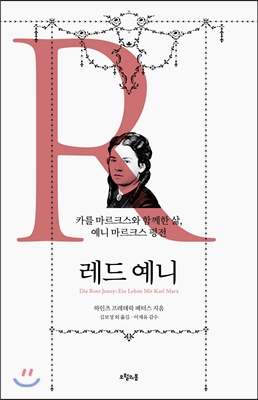
Red Yennie
 |
Description
Book Introduction
The fiery life of Jenny, Marx's colleague and wife
“Without Jenny, Marx’s ideas could not have been born!”
“Half of Karl Marx sleeps here.” - Jenny Marx’s epitaph
Half of Karl Marx, the Life of Jenny Marx
Eleanor, the youngest daughter of Jenny and Karl Marx, wrote of her mother:
“Without Jenny von Westphalen, Karl Marx could never have lived as he did.”
While the name Karl Marx and the ideas he put forth have shaken the world throughout the 20th century, the name Jenny Marx (1814-1881) remains only as a faint echo.
It is no exaggeration to say that we know very little about Jenny Marx, as objective biographies of her are rare.
Perhaps because of this, there was a misunderstanding that she was a woman of noble birth who enjoyed a bourgeois life, and she was also portrayed as an image that tormented Marx.
[Red Jenny] is a full-fledged biography that revives the fiery life of Jenny Marx.
The author vividly reconstructs Jenny Marx's life based on numerous sources.
Jenny was a devoted wife who stayed by Marx's side throughout his life, and she was also a comrade who fought fiercely with Marx against the world for the sake of world revolution.
Even when she was in exile for years and faced almost insurmountable hardships due to agonizing poverty, Jenny always stood up with unwavering determination as a wife and activist.
He also assisted Marx in his writing activities by writing down works of the century such as [Communist Manifesto] and [Das Kapital].
Soon, Jenny Marx would be with Karl Marx for over 40 years, a revolutionary activist, a wife who had to lead the household, and a mother of seven children (four of whom died in infancy).
This book, which records her unwavering love and indomitable spirit in supporting Marx's revolutionary struggle for socialism, reveals a side of Jenny we never knew existed.
In addition, the human side and activities of Karl Marx are vividly recorded, so it can be read as a biography of Marx.
“Without Jenny, Marx’s ideas could not have been born!”
“Half of Karl Marx sleeps here.” - Jenny Marx’s epitaph
Half of Karl Marx, the Life of Jenny Marx
Eleanor, the youngest daughter of Jenny and Karl Marx, wrote of her mother:
“Without Jenny von Westphalen, Karl Marx could never have lived as he did.”
While the name Karl Marx and the ideas he put forth have shaken the world throughout the 20th century, the name Jenny Marx (1814-1881) remains only as a faint echo.
It is no exaggeration to say that we know very little about Jenny Marx, as objective biographies of her are rare.
Perhaps because of this, there was a misunderstanding that she was a woman of noble birth who enjoyed a bourgeois life, and she was also portrayed as an image that tormented Marx.
[Red Jenny] is a full-fledged biography that revives the fiery life of Jenny Marx.
The author vividly reconstructs Jenny Marx's life based on numerous sources.
Jenny was a devoted wife who stayed by Marx's side throughout his life, and she was also a comrade who fought fiercely with Marx against the world for the sake of world revolution.
Even when she was in exile for years and faced almost insurmountable hardships due to agonizing poverty, Jenny always stood up with unwavering determination as a wife and activist.
He also assisted Marx in his writing activities by writing down works of the century such as [Communist Manifesto] and [Das Kapital].
Soon, Jenny Marx would be with Karl Marx for over 40 years, a revolutionary activist, a wife who had to lead the household, and a mother of seven children (four of whom died in infancy).
This book, which records her unwavering love and indomitable spirit in supporting Marx's revolutionary struggle for socialism, reveals a side of Jenny we never knew existed.
In addition, the human side and activities of Karl Marx are vividly recorded, so it can be read as a biography of Marx.
index
Introduction
1.
Yennie, born
2.
Jenny Meets Marx
3.
I'll always write 'Yeni' there
4.
The road to a new world
5.
The loud crowing of the Gallic rooster
6.
Our time is coming
7.
Year of Decision: 1848–1849
8.
Hellish life in London
9.
Street of Death
10.
Lonely and deep winter
11.
The Road to a Communist Society
12.
The Vanished Revolutionaries
Reviews
Translator's Note
Reviewer's Note
Americas
1.
Yennie, born
2.
Jenny Meets Marx
3.
I'll always write 'Yeni' there
4.
The road to a new world
5.
The loud crowing of the Gallic rooster
6.
Our time is coming
7.
Year of Decision: 1848–1849
8.
Hellish life in London
9.
Street of Death
10.
Lonely and deep winter
11.
The Road to a Communist Society
12.
The Vanished Revolutionaries
Reviews
Translator's Note
Reviewer's Note
Americas
Into the book
The British people knew little about her during her lifetime, or even afterward.
Even when the name of the Red Messiah roten Messias aroused positive or negative reactions all over the world, even in the midst of the war surrounding the name of Karl Marx, her name remained only a faint echo.
--- p.5
Yennie was touched by these words.
Compared to the eternal uncertainty of the bourgeois world, with its greedy pursuit of profit on one side and poverty and hunger on the other, a struggle of all against all, communist society seemed to embody the ideal of true humanity.
--- p.109
In Trier she lived as the wife of a famous leader of a revolutionary movement that never left the world alone.
It was interesting and exciting.
Even people she didn't know at all came to Yennie and asked what to do in this dizzying situation.
Should I choose republican or democrat? What will happen to the king? If communists take power, won't there be murder and bloodshed? Everyone seems to be concerned only with protecting their own property.
Jenny, in the spirit of her husband, explained that we stand at a great historical turning point, and that the coming social order will be determined not by the pocketbooks of the capitalists, but by the will of the workers.
--- p.142
It was not easy to juggle the roles of mother and party secretary, and it was especially difficult now that reactionary forces were openly trying to destroy the freedom of speech and assembly, the fruits of the revolution.
--- p.146
During this period of ceaseless political struggle, the situation of individual leaders of the communist movement was largely hopeless.
During this period, Marx lived in a rented house on Dean Street with his three children (the fourth, Paxchen, died shortly after birth), Jenny, and Lenchen.
Seven people lived in two cramped rooms with no bathroom or running water.
--- p.170
People often try to avoid and dislike all things political.
I wish we could look at this political arena as pure 'amateurs', but unfortunately for us, politics is always a matter of life and death.
--- p.228
Whenever these struggles arise, the hard work falls on us women because it is trivial.
Men gain strength by struggling with the outside world, and become stronger by facing their enemies.
Yet, even though the number of enemies is countless, we sit at home and sew socks.
This doesn't make my worries go away.
And the little worries of everyday life slowly but surely eat away at your will to live.
I speak from over 30 years of experience.
Even when the name of the Red Messiah roten Messias aroused positive or negative reactions all over the world, even in the midst of the war surrounding the name of Karl Marx, her name remained only a faint echo.
--- p.5
Yennie was touched by these words.
Compared to the eternal uncertainty of the bourgeois world, with its greedy pursuit of profit on one side and poverty and hunger on the other, a struggle of all against all, communist society seemed to embody the ideal of true humanity.
--- p.109
In Trier she lived as the wife of a famous leader of a revolutionary movement that never left the world alone.
It was interesting and exciting.
Even people she didn't know at all came to Yennie and asked what to do in this dizzying situation.
Should I choose republican or democrat? What will happen to the king? If communists take power, won't there be murder and bloodshed? Everyone seems to be concerned only with protecting their own property.
Jenny, in the spirit of her husband, explained that we stand at a great historical turning point, and that the coming social order will be determined not by the pocketbooks of the capitalists, but by the will of the workers.
--- p.142
It was not easy to juggle the roles of mother and party secretary, and it was especially difficult now that reactionary forces were openly trying to destroy the freedom of speech and assembly, the fruits of the revolution.
--- p.146
During this period of ceaseless political struggle, the situation of individual leaders of the communist movement was largely hopeless.
During this period, Marx lived in a rented house on Dean Street with his three children (the fourth, Paxchen, died shortly after birth), Jenny, and Lenchen.
Seven people lived in two cramped rooms with no bathroom or running water.
--- p.170
People often try to avoid and dislike all things political.
I wish we could look at this political arena as pure 'amateurs', but unfortunately for us, politics is always a matter of life and death.
--- p.228
Whenever these struggles arise, the hard work falls on us women because it is trivial.
Men gain strength by struggling with the outside world, and become stronger by facing their enemies.
Yet, even though the number of enemies is countless, we sit at home and sew socks.
This doesn't make my worries go away.
And the little worries of everyday life slowly but surely eat away at your will to live.
I speak from over 30 years of experience.
--- p.259
Publisher's Review
The unwavering love between Jenny and Marx
“I close my eyes and picture your eyes smiling happily.
And I'm glad that I'm everything to you and nothing to anyone else." (Yeni's letter) "Look! I could fill a thousand books.
And I will always write only 'Jeni' there.” (Marx's poem to Jeni)
Living as neighbors since childhood, Jenny and Marx remained 'husband and wife, friends, and comrades' throughout their lives.
Despite countless hardships, their love remained unwavering until death, making it a prime example of one of the most romantic relationships in history.
Born the daughter of a noble Baron of Westphalia, Jenny was a beautiful, educated, and talented girl.
At the age of seventeen, she was known in Trier as the 'Queen of the Ball' and was courted by numerous men.
She actually got engaged to one man, but soon realized the man's foolishness and broke off the engagement.
And she fell in love with Marx, who was four years younger than her and whom she had known since childhood.
The two fell in love without saying a word and got engaged in secret.
It took seven years for the two to become engaged and marry, and the letters and poems they exchanged during this period are famous in themselves.
During this period, Marx wrote many poems and even compiled two volumes of poetry for Jenny (The Book of Love and The Book of Songs).
“Dear Karl.
I feel like I'm going back home to you completely empty-handed, with my heart torn to pieces, and with the fear and pain of death in my heart." The couple wrote many letters throughout their lives, even exchanging letters during their brief separation after their marriage.
And the letters were always filled with affection and love for each other.
Jenny died in Marx's arms in 1881.
Marx wrote about that moment in a letter to Engels:
“When I felt death coming, she said,
'Carl, I'm so tired.' Those were the last words she could clearly hear.
On December 5th she was buried in the section for the lost in Highgate Cemetery.”
Activist Jenny, Marx's comrade
“People often try to avoid everything political by abhorring it.
“I wish we could look at this political field as pure ‘amateurs,’ but unfortunately for us politics is always a matter of life and death.” (Jenny’s letter to Liebknecht)
The married life of Jenny and Marx is intertwined with the history of 19th-century revolution.
This book vividly reveals how the two men worked in 19th-century European political history, including the Paris Commune.
Traveling between Germany, France, Belgium, and England, the two men were active in the revolution.
At that time, signs of revolution were appearing everywhere in Europe.
Marx was active in the Communist League and others, and Jenny was also a comrade who worked with Marx, including transcribing the [Communist Manifesto].
In fact, Jenny was involved in almost all of Marx's writings and helped him formulate his views.
When Marx was away, he responded to numerous letters sent to him and made decisions in consultation with other colleagues, including Engels.
He also socialized and discussed with exiles from various countries.
A Shakespeare fan from a young age, she wrote theater criticism for the Frankfurter Zeitung in her later years.
This book vividly depicts the activities of Marx and Jenny in the 19th century.
It also contains the figures of intellectuals active at the time, such as Engels, Heine, Liebknecht, and Herbeck, who were with them.
The sorrow and pain of a lifetime of poverty
“My wife says every day that she wants to die with the children.
But really, I can never blame my wife.
Because the humiliation, pain and horror she must endure in this situation are truly indescribable.” (Marx’s letter to Engels)
After marrying Marx, Jenny suffered from poverty throughout her life.
Her wish was for Marx to earn enough royalties to live without worry.
But that wish never came true.
Instead, he lived a life of visiting countless pawn shops and taking responsibility for his family's livelihood.
There were even times when there was no money to buy a coffin for a dead child.
Engels helped me every time, but I had to go through the recurring pain of running out of money.
Yennie gave birth to seven children, but four of them died early.
When his third son, Edgar, died, he felt despair and wrote this:
“They took away my one and only Edgar, the one I love most in this world.
It was a pain that could never be healed or cured.
“This wound is engraved deep in the heart, a wound that will never grow old or stop bleeding.”
In the midst of such pain and despair, Yennie always stood up resolutely.
Because of her, her family was able to survive decades of exile, agonizing poverty, vicious slander, humiliation, and persecution.
Because of Jenny, Marx could exist and Marx's ideas could be born.
“I close my eyes and picture your eyes smiling happily.
And I'm glad that I'm everything to you and nothing to anyone else." (Yeni's letter) "Look! I could fill a thousand books.
And I will always write only 'Jeni' there.” (Marx's poem to Jeni)
Living as neighbors since childhood, Jenny and Marx remained 'husband and wife, friends, and comrades' throughout their lives.
Despite countless hardships, their love remained unwavering until death, making it a prime example of one of the most romantic relationships in history.
Born the daughter of a noble Baron of Westphalia, Jenny was a beautiful, educated, and talented girl.
At the age of seventeen, she was known in Trier as the 'Queen of the Ball' and was courted by numerous men.
She actually got engaged to one man, but soon realized the man's foolishness and broke off the engagement.
And she fell in love with Marx, who was four years younger than her and whom she had known since childhood.
The two fell in love without saying a word and got engaged in secret.
It took seven years for the two to become engaged and marry, and the letters and poems they exchanged during this period are famous in themselves.
During this period, Marx wrote many poems and even compiled two volumes of poetry for Jenny (The Book of Love and The Book of Songs).
“Dear Karl.
I feel like I'm going back home to you completely empty-handed, with my heart torn to pieces, and with the fear and pain of death in my heart." The couple wrote many letters throughout their lives, even exchanging letters during their brief separation after their marriage.
And the letters were always filled with affection and love for each other.
Jenny died in Marx's arms in 1881.
Marx wrote about that moment in a letter to Engels:
“When I felt death coming, she said,
'Carl, I'm so tired.' Those were the last words she could clearly hear.
On December 5th she was buried in the section for the lost in Highgate Cemetery.”
Activist Jenny, Marx's comrade
“People often try to avoid everything political by abhorring it.
“I wish we could look at this political field as pure ‘amateurs,’ but unfortunately for us politics is always a matter of life and death.” (Jenny’s letter to Liebknecht)
The married life of Jenny and Marx is intertwined with the history of 19th-century revolution.
This book vividly reveals how the two men worked in 19th-century European political history, including the Paris Commune.
Traveling between Germany, France, Belgium, and England, the two men were active in the revolution.
At that time, signs of revolution were appearing everywhere in Europe.
Marx was active in the Communist League and others, and Jenny was also a comrade who worked with Marx, including transcribing the [Communist Manifesto].
In fact, Jenny was involved in almost all of Marx's writings and helped him formulate his views.
When Marx was away, he responded to numerous letters sent to him and made decisions in consultation with other colleagues, including Engels.
He also socialized and discussed with exiles from various countries.
A Shakespeare fan from a young age, she wrote theater criticism for the Frankfurter Zeitung in her later years.
This book vividly depicts the activities of Marx and Jenny in the 19th century.
It also contains the figures of intellectuals active at the time, such as Engels, Heine, Liebknecht, and Herbeck, who were with them.
The sorrow and pain of a lifetime of poverty
“My wife says every day that she wants to die with the children.
But really, I can never blame my wife.
Because the humiliation, pain and horror she must endure in this situation are truly indescribable.” (Marx’s letter to Engels)
After marrying Marx, Jenny suffered from poverty throughout her life.
Her wish was for Marx to earn enough royalties to live without worry.
But that wish never came true.
Instead, he lived a life of visiting countless pawn shops and taking responsibility for his family's livelihood.
There were even times when there was no money to buy a coffin for a dead child.
Engels helped me every time, but I had to go through the recurring pain of running out of money.
Yennie gave birth to seven children, but four of them died early.
When his third son, Edgar, died, he felt despair and wrote this:
“They took away my one and only Edgar, the one I love most in this world.
It was a pain that could never be healed or cured.
“This wound is engraved deep in the heart, a wound that will never grow old or stop bleeding.”
In the midst of such pain and despair, Yennie always stood up resolutely.
Because of her, her family was able to survive decades of exile, agonizing poverty, vicious slander, humiliation, and persecution.
Because of Jenny, Marx could exist and Marx's ideas could be born.
GOODS SPECIFICS
- Date of publication: May 28, 2015
- Page count, weight, size: 292 pages | 362g | 135*210*20mm
- ISBN13: 9788997889624
- ISBN10: 8997889621
You may also like
카테고리
korean


korean

![GQ KOREA Mark (Monthly): December [2025]](http://librairie.coreenne.fr/cdn/shop/files/8ef265dbbfbf186523ed75ba7319009d.jpg?v=1765340328&width=3840)


