

Tough choices
 |
Description
Book Introduction
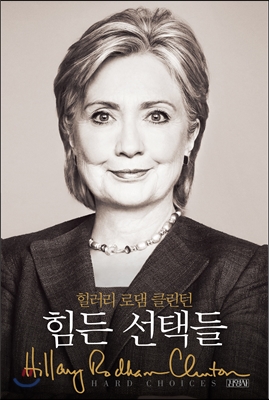
√ The most influential woman in the world √ Overwhelming approval rating in the 2016 US presidential election √ Hillary Rodham Clinton's autobiography "We all face difficult choices in life." The moments of crisis, choice, and challenge faced by US Secretary of State Hillary Rodham Clinton, and a new perspective on the future from the center of the world. The special and historic story of Hillary, America's number one diplomat who changed history at the center of the world, traveling 1.6 million kilometers to 112 countries for 4 years. Moments of difficult choices made by her, President Obama, and other world leaders. How do the choices made by the world's greatest leaders impact our lives? Why do nations with divergent interests sometimes cooperate and how do they sometimes clash? What universal values has Hillary Clinton upheld amidst difficult yet realistic strategic choices? Hillary, who has witnessed countless political upheavals and observed decades of social change at the center of the world, sharply identifies the reality hidden behind superficial phenomena. A powerful message from Hillary, the most influential woman in the world. What should the 21st century we want to see look like? |
- You can preview some of the book's contents.
Preview
index
prolog
PART 1 A New Beginning
1.
2008: From rivals to team
2.
Foggy Land: Smart Power
PART 2 Crossing the Pacific
3.
Asia: The Pivot
4.
China: Uncharted Seas
5.
Beijing: Dissidents
6.
Burma: Ladies and Generals
PART 3 WAR AND PEACE
7.
Afghanistan-Pakistan: Additional Troop Deployments
8.
Afghanistan: The End of the War
9.
Pakistan: National Honor
PART 4 Between Hope and History
10.
Europe: Tight Knot
11.
Russia: Reset and Retreat
12.
Latin America: Democracy and Popular Leaders
13.
Africa: Conflict or Development
PART 5 Cataclysm
14.
The Middle East: The Perilous Path to Peace
15.
Arab Spring: Revolutions
16.
Libya: By any means necessary
17.
Benghazi: Attacks
18.
Iran: Sanctions and Negotiations
19.
Syria: A Wicked Conundrum
20.
Let's Go: Dissecting the Truce
PART 6 THE FUTURE WE DESIRE
21.
Climate Change: We're All in This Together
22.
Jobs and Energy: A Fair Play
23.
Haiti: Disaster and Development
24.
21st Century Statecraft: Digital Diplomacy in a Networked World
25.
Human Rights: An Unfinished Business
Epilogue
Acknowledgements
Search
PART 1 A New Beginning
1.
2008: From rivals to team
2.
Foggy Land: Smart Power
PART 2 Crossing the Pacific
3.
Asia: The Pivot
4.
China: Uncharted Seas
5.
Beijing: Dissidents
6.
Burma: Ladies and Generals
PART 3 WAR AND PEACE
7.
Afghanistan-Pakistan: Additional Troop Deployments
8.
Afghanistan: The End of the War
9.
Pakistan: National Honor
PART 4 Between Hope and History
10.
Europe: Tight Knot
11.
Russia: Reset and Retreat
12.
Latin America: Democracy and Popular Leaders
13.
Africa: Conflict or Development
PART 5 Cataclysm
14.
The Middle East: The Perilous Path to Peace
15.
Arab Spring: Revolutions
16.
Libya: By any means necessary
17.
Benghazi: Attacks
18.
Iran: Sanctions and Negotiations
19.
Syria: A Wicked Conundrum
20.
Let's Go: Dissecting the Truce
PART 6 THE FUTURE WE DESIRE
21.
Climate Change: We're All in This Together
22.
Jobs and Energy: A Fair Play
23.
Haiti: Disaster and Development
24.
21st Century Statecraft: Digital Diplomacy in a Networked World
25.
Human Rights: An Unfinished Business
Epilogue
Acknowledgements
Search
Detailed image
Into the book
Tough choices
At Ewha Womans University in Seoul, South Korea, we've discovered that reaching out to young people can reach far beyond traditional foreign policy issues.
When I went up on stage at Ewha Womans University, cheers erupted from the audience.
The young women took turns taking the microphone and asking very personal questions politely but enthusiastically.
“Is it difficult to deal with world leaders who don’t respect women?”
I replied that I think many leaders have decided not to think of themselves as dealing with women when dealing with me.
But I tried to keep them from getting carried away with the issue of disrespecting women.
“Can you tell me about your daughter Chelsea?” I could talk about that question for hours.
But suffice it to say, Chelsea is an amazing person and I am very proud of her.
“How would you describe what love is?” I laughed and said I felt like I was a counseling columnist rather than the Secretary of State.
I thought for a moment and then said.
“Who can truly describe love? Poets have been writing about it for thousands of years.
Psychologists and writers from many fields do the same.
If you can describe love, you may not be experiencing it enough.
Because love is a very personal relationship.
“My husband is my best friend, and I consider myself very lucky that the two of us have been together for a very long time, before most of you were born.”
These women seemed to feel a personal connection with me, and to my surprise, they spoke with ease and confidence, as if I were a friend or mentor, not a government official from a faraway land.
I wanted to be someone worthy of their respect.
_p.86~87
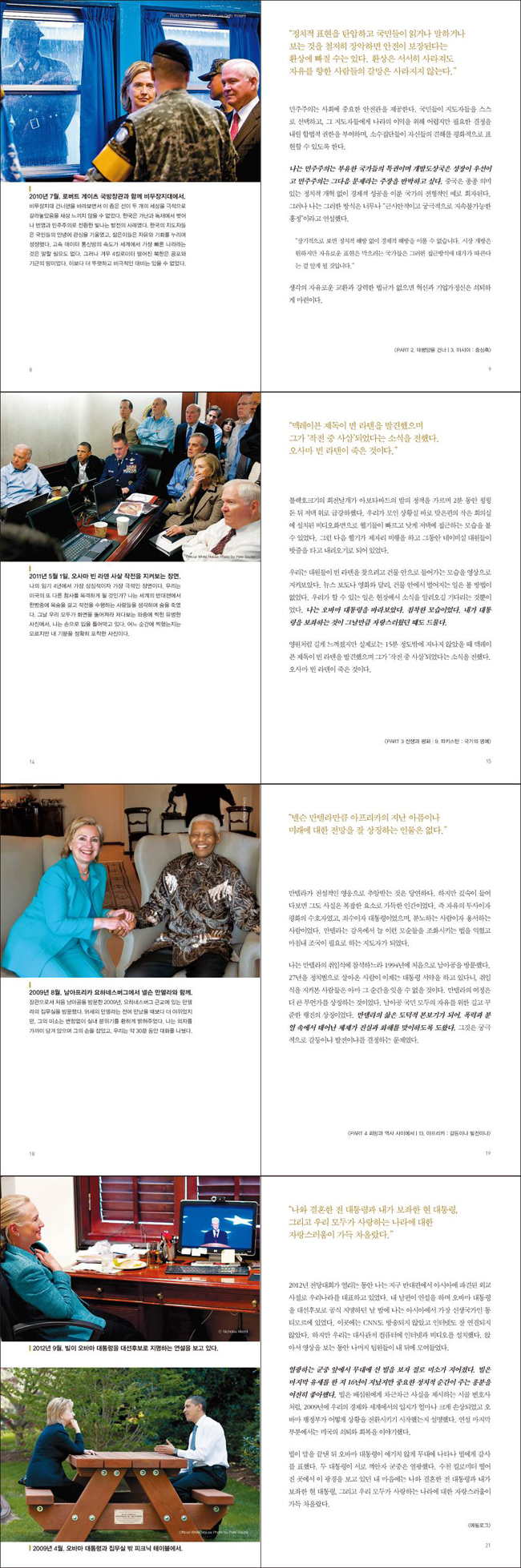
Looking across the DMZ, I couldn't help but feel anew how this narrow line dramatically divides two worlds.
South Korea was a shining example of progress, successfully transitioning from poverty and dictatorship to prosperity and democracy.
Korea's leaders cared about the well-being of its people, and young people grew up enjoying freedom and opportunity.
It goes without saying that the country has the fastest download speeds on its high-speed data network in the world.
But North Korea, just four kilometers away, was a land of fear and famine.
There could not have been a more stark and tragic contrast.
Gates and I went with the South Korean ministers to the nearby UN headquarters for a military briefing.
We also toured the square Military Armistice Commission building, which sits half in the south and half in the north of the Military Demarcation Line.
It was designed this way for negotiations between the two sides under the armistice agreement.
The long conference table was also placed exactly on the border line.
As we walked, a North Korean soldier stood just beyond the window, glaring at us with a cold expression.
Maybe he was just curious.
But if he was trying to scare me, he failed.
I continued to focus on the briefing, and Gates smiled pleasantly.
A photographer captured this rare moment, and the photo made the front page of the New York Times.
_p.95~96
I explained why a democratic future is the right choice for Asia.
Opponents of democracy in China and elsewhere argue that it would unleash unruly popular power and threaten stability.
But there is ample evidence from around the world that democracy actually promotes stability.
It's tempting to fantasize that suppressing political expression and tightly controlling what people read, say, and see will guarantee their safety.
But even as the illusion slowly fades, people's yearning for freedom does not disappear.
On the other hand, democracy provides an important safety net for society.
The people choose their leaders, granting them the legitimate authority to make difficult but necessary decisions for the good of the nation, and allowing minorities to express their views peacefully.
I also want to refute the claim that democracy is the privilege of wealthy countries and that developing countries prioritize growth over democracy.
China is often cited as a classic example of a country that achieved economic success without meaningful political reform.
But I said in my speech that such an approach was too “short-sighted and ultimately unsustainable”.
“In the long run, economic liberation cannot be achieved without political liberation.
Countries that want to open their markets but stifle free expression will find that such an approach comes at a cost.” Without the free exchange of ideas and strong laws, innovation and entrepreneurship will inevitably decline.
_p.104~105
I've often asked myself how I take criticism aimed at me.
And I got three answers.
First, if you choose to pursue a career in public life, you should heed Eleanor Roosevelt's advice and become as thick-skinned as a rhinoceros.
Second, take criticism seriously, but don't let your personal feelings get in the way.
Critics can teach you lessons that your friends can't or won't teach you.
I tried to analyze the motivations behind such criticism, whether they were partisan, ideological, commercial, or sexist, to see what I could learn from them, and then discard the rest.
Third, the political world persistently imposes double standards on women, including their clothing, body type, and of course, hairstyles.
Don't be discouraged here.
Keep going with a smile.
These tips are the result of years of trial and error and countless mistakes, but they have helped me immensely, not only at home but around the world.
_p.
260~261
The Black Hawk's rotors whirred through the stillness of the Abbottabad night for two minutes before diving down over the mansion.
On the video screen set up in a small conference room directly across from the situation room where we were gathered, we could see helicopters approaching the mansion quickly and low.
The helicopter was then scheduled to hover while the Navy SEALs descended on a rope.
However, contrary to plan, one of the helicopters began to rapidly lose lift.
The pilot attempted a 'hard landing' and the helicopter's tail struck the wall of the mansion.
As if that weren't surprising enough, the second helicopter that was supposed to drop the team off on the roof of the mansion flew past its stop point and landed on the ground outside the mansion, forcing them to come up with a plan on the fly.
It was the most nerve-wracking moment I can remember.
The specter of the infamous Black Hawk Down incident in Mogadishu, Somalia in 1993, which killed 18 American soldiers, was also raised, as was the tragic incident in Iran, which Robert had been concerned about from the beginning.
Are we about to witness another American disaster? I held my breath, thinking of those on the other side of the world risking their lives in the dead of night on operations.
In the famous photo taken that day while we were all staring intently at the screen, I have my hand over my mouth.
I don't know when this photo was taken, but it captures my mood exactly.
(…)
After what felt like an eternity but was actually only about 15 minutes, Admiral McRaven announced that bin Laden had been found and that he had been “killed in action.”
Osama bin Laden is dead.
_p.
282~283
No one symbolizes Africa's past pain or its future prospects as well as Nelson Mandela.
It is no wonder that Mandela is revered as a legendary hero.
But if you look deeper, you will see that he was actually a human being full of complex elements.
That is, he was a freedom fighter and a peacemaker, a prisoner and a president, a man of rage and a man of forgiveness.
Madiba (as his tribe, family, and friends called him) learned to reconcile these contradictions in prison and eventually became the leader his country needed.
I first visited South Africa in 1994 to attend Mandela's inauguration.
Those who witnessed the inauguration will probably never forget the moment when a man who lived as a political prisoner for 27 years is now taking the presidential oath.
And Mandela's journey symbolized something bigger.
In other words, it was a symbol of the long and steady march for freedom for all South Africans.
Mandela's life served as a moral example, helping a system born of violence and division find truth and reconciliation.
It was ultimately a question of conflict or progress.
_p.
415~416
While traveling through the United States again last year, I was asked one question particularly often.
It was about whether or not he would run for president in 2016.
My answer is that I haven't made a decision yet.
But every time someone brought it up, I felt honored.
It was the energy and passion of those who encouraged me to run, and their belief that I could provide the leadership our country needs.
(…)
Having run for president before, I know firsthand how challenging that challenge can be, not only for the candidate but also for their family.
Having experienced defeat in 2008, I also knew that nothing was guaranteed and nothing could be taken for granted.
I also knew that the most important question for anyone considering a run for office to answer was not, “Do you want to be president?” or “Can you win?” but rather, “What is your vision for America?” and “Can you lead us toward that vision?”
The challenge is to bring us back together and lead the American dream to a new beginning.
This is the threshold that must be crossed, and this threshold is very high.
_p.819~820
At Ewha Womans University in Seoul, South Korea, we've discovered that reaching out to young people can reach far beyond traditional foreign policy issues.
When I went up on stage at Ewha Womans University, cheers erupted from the audience.
The young women took turns taking the microphone and asking very personal questions politely but enthusiastically.
“Is it difficult to deal with world leaders who don’t respect women?”
I replied that I think many leaders have decided not to think of themselves as dealing with women when dealing with me.
But I tried to keep them from getting carried away with the issue of disrespecting women.
“Can you tell me about your daughter Chelsea?” I could talk about that question for hours.
But suffice it to say, Chelsea is an amazing person and I am very proud of her.
“How would you describe what love is?” I laughed and said I felt like I was a counseling columnist rather than the Secretary of State.
I thought for a moment and then said.
“Who can truly describe love? Poets have been writing about it for thousands of years.
Psychologists and writers from many fields do the same.
If you can describe love, you may not be experiencing it enough.
Because love is a very personal relationship.
“My husband is my best friend, and I consider myself very lucky that the two of us have been together for a very long time, before most of you were born.”
These women seemed to feel a personal connection with me, and to my surprise, they spoke with ease and confidence, as if I were a friend or mentor, not a government official from a faraway land.
I wanted to be someone worthy of their respect.
_p.86~87
Looking across the DMZ, I couldn't help but feel anew how this narrow line dramatically divides two worlds.
South Korea was a shining example of progress, successfully transitioning from poverty and dictatorship to prosperity and democracy.
Korea's leaders cared about the well-being of its people, and young people grew up enjoying freedom and opportunity.
It goes without saying that the country has the fastest download speeds on its high-speed data network in the world.
But North Korea, just four kilometers away, was a land of fear and famine.
There could not have been a more stark and tragic contrast.
Gates and I went with the South Korean ministers to the nearby UN headquarters for a military briefing.
We also toured the square Military Armistice Commission building, which sits half in the south and half in the north of the Military Demarcation Line.
It was designed this way for negotiations between the two sides under the armistice agreement.
The long conference table was also placed exactly on the border line.
As we walked, a North Korean soldier stood just beyond the window, glaring at us with a cold expression.
Maybe he was just curious.
But if he was trying to scare me, he failed.
I continued to focus on the briefing, and Gates smiled pleasantly.
A photographer captured this rare moment, and the photo made the front page of the New York Times.
_p.95~96
I explained why a democratic future is the right choice for Asia.
Opponents of democracy in China and elsewhere argue that it would unleash unruly popular power and threaten stability.
But there is ample evidence from around the world that democracy actually promotes stability.
It's tempting to fantasize that suppressing political expression and tightly controlling what people read, say, and see will guarantee their safety.
But even as the illusion slowly fades, people's yearning for freedom does not disappear.
On the other hand, democracy provides an important safety net for society.
The people choose their leaders, granting them the legitimate authority to make difficult but necessary decisions for the good of the nation, and allowing minorities to express their views peacefully.
I also want to refute the claim that democracy is the privilege of wealthy countries and that developing countries prioritize growth over democracy.
China is often cited as a classic example of a country that achieved economic success without meaningful political reform.
But I said in my speech that such an approach was too “short-sighted and ultimately unsustainable”.
“In the long run, economic liberation cannot be achieved without political liberation.
Countries that want to open their markets but stifle free expression will find that such an approach comes at a cost.” Without the free exchange of ideas and strong laws, innovation and entrepreneurship will inevitably decline.
_p.104~105
I've often asked myself how I take criticism aimed at me.
And I got three answers.
First, if you choose to pursue a career in public life, you should heed Eleanor Roosevelt's advice and become as thick-skinned as a rhinoceros.
Second, take criticism seriously, but don't let your personal feelings get in the way.
Critics can teach you lessons that your friends can't or won't teach you.
I tried to analyze the motivations behind such criticism, whether they were partisan, ideological, commercial, or sexist, to see what I could learn from them, and then discard the rest.
Third, the political world persistently imposes double standards on women, including their clothing, body type, and of course, hairstyles.
Don't be discouraged here.
Keep going with a smile.
These tips are the result of years of trial and error and countless mistakes, but they have helped me immensely, not only at home but around the world.
_p.
260~261
The Black Hawk's rotors whirred through the stillness of the Abbottabad night for two minutes before diving down over the mansion.
On the video screen set up in a small conference room directly across from the situation room where we were gathered, we could see helicopters approaching the mansion quickly and low.
The helicopter was then scheduled to hover while the Navy SEALs descended on a rope.
However, contrary to plan, one of the helicopters began to rapidly lose lift.
The pilot attempted a 'hard landing' and the helicopter's tail struck the wall of the mansion.
As if that weren't surprising enough, the second helicopter that was supposed to drop the team off on the roof of the mansion flew past its stop point and landed on the ground outside the mansion, forcing them to come up with a plan on the fly.
It was the most nerve-wracking moment I can remember.
The specter of the infamous Black Hawk Down incident in Mogadishu, Somalia in 1993, which killed 18 American soldiers, was also raised, as was the tragic incident in Iran, which Robert had been concerned about from the beginning.
Are we about to witness another American disaster? I held my breath, thinking of those on the other side of the world risking their lives in the dead of night on operations.
In the famous photo taken that day while we were all staring intently at the screen, I have my hand over my mouth.
I don't know when this photo was taken, but it captures my mood exactly.
(…)
After what felt like an eternity but was actually only about 15 minutes, Admiral McRaven announced that bin Laden had been found and that he had been “killed in action.”
Osama bin Laden is dead.
_p.
282~283
No one symbolizes Africa's past pain or its future prospects as well as Nelson Mandela.
It is no wonder that Mandela is revered as a legendary hero.
But if you look deeper, you will see that he was actually a human being full of complex elements.
That is, he was a freedom fighter and a peacemaker, a prisoner and a president, a man of rage and a man of forgiveness.
Madiba (as his tribe, family, and friends called him) learned to reconcile these contradictions in prison and eventually became the leader his country needed.
I first visited South Africa in 1994 to attend Mandela's inauguration.
Those who witnessed the inauguration will probably never forget the moment when a man who lived as a political prisoner for 27 years is now taking the presidential oath.
And Mandela's journey symbolized something bigger.
In other words, it was a symbol of the long and steady march for freedom for all South Africans.
Mandela's life served as a moral example, helping a system born of violence and division find truth and reconciliation.
It was ultimately a question of conflict or progress.
_p.
415~416
While traveling through the United States again last year, I was asked one question particularly often.
It was about whether or not he would run for president in 2016.
My answer is that I haven't made a decision yet.
But every time someone brought it up, I felt honored.
It was the energy and passion of those who encouraged me to run, and their belief that I could provide the leadership our country needs.
(…)
Having run for president before, I know firsthand how challenging that challenge can be, not only for the candidate but also for their family.
Having experienced defeat in 2008, I also knew that nothing was guaranteed and nothing could be taken for granted.
I also knew that the most important question for anyone considering a run for office to answer was not, “Do you want to be president?” or “Can you win?” but rather, “What is your vision for America?” and “Can you lead us toward that vision?”
The challenge is to bring us back together and lead the American dream to a new beginning.
This is the threshold that must be crossed, and this threshold is very high.
_p.819~820
--- From the text
Publisher's Review
Tough choices
* National bestseller immediately after publication
* New York Times and Amazon bestseller
* Exported to 24 countries worldwide
01
"Now is the time to read Hillary Rodham Clinton's 'Tough Choices.'" - Entertainment Weekly
U.S. Secretary of State Hillary Clinton: Her Four Years
Traveling 1.6 million kilometers across 112 countries, changing history at the center of the world.
“I quickly realized that the Secretary of State was three jobs rolled into one.
The nation's highest-ranking diplomat, a key advisor to the president on foreign policy,
“I had to do all the work of a CEO who oversaw departments that spread out in all directions.” (p.48)
“We all face difficult choices in life.
(…) Life is a series of choices.
“The choices we make and how we deal with them become who we are.” (p.8) This is how Hillary Rodham Clinton begins her story of her days at the center of world history.
After her rival in the 2008 presidential election, Barack Obama, was elected president, Hillary was expected to return to her New York state Senate seat.
But surprisingly, Obama offers Hillary the position of Secretary of State, and after much deliberation, she accepts.
Hillary had to decide how to mend the shattered alliance with her rival, President Obama, how to defuse the wars in Afghanistan and Iraq, and how to navigate the global financial crisis.
The emergence of China as a new competitor, the growing threats from Iran and North Korea, and the Middle East being swept by a wave of revolution were also problems.
In particular, the decision to deploy American troops across a vast and dangerous region from Afghanistan to Libya to capture Osama bin Laden was not easy.
The United States faces a dilemma in how to conduct its foreign policy in this situation.
This book contains the extraordinary and historic story of Hillary Clinton, America's top diplomat who changed history at the center of the world while traveling 1.6 million kilometers across 112 countries over four years from 2009 to 2013, and the difficult choices made by world leaders, including her and President Obama.
02
How do the choices made by the world's greatest leaders affect our lives?
Moments of difficult choices that determine war and peace, poverty and prosperity.
“I have traveled the world and met at least three types of leaders.
Leaders who share our values and worldview and collaborate naturally;
Leaders who want to do the right thing but lack the political will or capacity;
“These are leaders who believe that their country’s interests and values are fundamentally in conflict with ours and who oppose us.” (p.175)
How will the economic collapse in Athens, Greece, affect businesses in Athens, Georgia? How will the revolution in Cairo, Egypt, impact life in Cairo, Illinois? What will tense diplomatic relations in St. Petersburg, Russia, mean for families in St. Petersburg, Florida? We all face difficult choices in life.
The choices leaders and nations make can mean the difference between war and peace, poverty and prosperity.
This book tells the story of the choices Hillary made as Secretary of State, and the choices made by President Obama and other leaders around the world.
President Obama asked each of us around the table for advice.
Should we really send more troops to the eight-year-old war in Afghanistan? If so, how many should we send? What missions should they be assigned? And how long should they remain there? These were tough choices the president had to make.
His choice would have profound implications for the future of Afghanistan, our men and women, their families, and our national security.
(p.191)
Myanmar's Aung San Suu Kyi, revered as a living saint, was freed from seven years of house arrest and was reconciling and forging new ties with her old rival Thein Sein.
However, the political situation has become complicated by the possibility that both Thein Sein and Suu Kyi will run in the 2015 presidential election.
Behind-the-scenes operations, constantly shifting coalition structures, and intense political competition.
Can the figures, in cooperation with the static Thein Sein, help to alleviate divisions in Myanmar and take the first step toward national reconciliation?
Hillary, who was present at the moment of the 'tough choice' that Aung San Suu Kyi faced, recalls it this way:
Having experienced the push and pull of political life myself, I sympathized with the numbers.
Because I knew from years of painful experience how difficult it was to even get along with a political opponent, let alone cooperate with him.
(…) I said I also know it is not easy.
'You are now in a position where you are doing something that will never be easy.
We must find ways to continue to cooperate until an alternative emerges, and we must continue to cooperate until an alternative emerges.
All of this is part of politics…' (p.183)
03
The reality hidden behind the superficial appearance is revealed.
The complex and tangled web of interests behind political, economic, cultural, and military issues
The world as seen from the center of the world by Hillary Clinton, America's top diplomat.
“Leaders of both countries calculated that the political benefits outweighed the risks.
“Even today, we make similar calculations when we deal with countries whose policies the United States disagrees with but whose cooperation we need, or when we want to prevent differences and competition from escalating into conflict.” (pp. 106-107)
As President Obama deploys US troops to fight the Taliban, news has emerged that the US is attempting to reconcile with some of the Taliban rebels.
During an interview in January 2010, I was asked if the American people would be confused by this news.
“You can’t get one without giving the other.
If we only deploy military forces without political effort, the chances of success are slim.
If you try to reconcile with your enemy without the ability to support them, you will not succeed.
So, this is actually a very rational combination strategy.” (…) I also knew that even if it was a wise strategy, it might be difficult to accept.
So I added.
“The point of your question is, so to speak, why do you want to talk to ‘bad guys’?” (p.224-225)
The Arab Spring, the Israeli-Palestinian conflict, the leak of classified documents by Weeekreaks... What was behind these events? Why do leaders and countries with conflicting interests sometimes cooperate and how do they sometimes clash? The sophisticated strategies and elaborate conspiracies unfolding among the world's top leaders.
The complex and tangled web of interests behind political, economic, cultural, and military issues.
Hillary, who has observed social change for decades at the center of the world, sharply points out the reality hidden behind superficial phenomena.
Hillary's exceptional diplomatic skills can be seen in the process of combining diplomatic, economic, military, political, and cultural tools to suit each situation.
Just reading Hillary Clinton's top-level diplomatic conversations with world leaders provides a compelling perspective on international relations.
A book for anyone who wants to understand our rapidly changing world.
04
“Hillary’s voice and worldview are genuine.” _Evening Standard
The delicate art of balancing universal values and strategic interests;
Beyond that, a profound insight into human reality,
A powerful message from Hillary Clinton, the world's most influential woman.
“What does it mean to think about the distant future rather than the immediate tomorrow?
Now is the decisive moment.
“The choice is ours.” (p.750)
In 2009, Afghanistan's President Karzai approved a horrific law restricting the rights of Shiite women.
The law, which effectively legalized spousal rape and included provisions requiring Shiite women to seek their husbands' permission before leaving home, was in blatant violation of the Afghan constitution.
Hillary told President Karzai of her dire situation.
I called Karzai three times in two days, urging him to withdraw the law.
He warned that if the Constitution is ignored and the rights of minorities are undermined, no one, whether woman or man, will be guaranteed their rights.
It also undermined the moral foundation of the Karzai regime's fight against the Taliban.
(…) Then he also began to agree.
So Karzai decided to put the law on hold and leave it to the judiciary to review.
Eventually, change happened.
It's not enough yet, but it's a step in the right direction.
(p.223)
In 2002, George W.
As a New York senator during the Bush administration, Hillary Clinton voted for the Iraq resolution.
The Bush administration, convinced that Saddam Hussein possessed weapons of mass destruction, proposed formally authorizing military operations in Iraq if UN weapons inspections failed.
At that time, Bush launched the Iraq War under the judgment that the UN's weapons inspection deadline had expired.
Hillary Clinton frankly admits her mistake, saying that voting for the Iraq resolution was "probably the hardest decision I've ever made."
I felt I acted with conviction and believed I made the best choice possible with the information I had.
I wasn't the only one who made a wrong judgment, but I was wrong anyway.
That was really wrong.
In our political sensibilities, admitting mistakes is often seen as a sign of weakness, but in fact, it can be a sign that the people and the nation are growing stronger and more mature.
This is another lesson I personally learned while serving as Secretary of State.
(p.202)
As Secretary of State, Hillary gained a global perspective on the trends that will reshape the 21st century landscape in areas such as economic inequality, human rights, climate change, energy innovation, and the environment and health.
What universal values did Hillary defend amid difficult and realistic strategic choices?
She is a passionate advocate for human rights and the full social participation of women, youth, and sexual minorities.
The 21st century must create a world with more allies and fewer adversaries, a world with greater shared responsibility and less conflict, a world with more good jobs and less poverty, a world where the environment is preserved and prosperity prevails.
We must encourage marginalized groups to participate in politics, advocate for universal human rights, and enforce common traffic rules on the economic highway.
The ability to accomplish these things is the measure of national power.
Hillary speaks with leaders and experts from around the world, sharing her thoughts on what individuals and nations must do to seize the opportunities presented by an increasingly interconnected world.
* National bestseller immediately after publication
* New York Times and Amazon bestseller
* Exported to 24 countries worldwide
01
"Now is the time to read Hillary Rodham Clinton's 'Tough Choices.'" - Entertainment Weekly
U.S. Secretary of State Hillary Clinton: Her Four Years
Traveling 1.6 million kilometers across 112 countries, changing history at the center of the world.
“I quickly realized that the Secretary of State was three jobs rolled into one.
The nation's highest-ranking diplomat, a key advisor to the president on foreign policy,
“I had to do all the work of a CEO who oversaw departments that spread out in all directions.” (p.48)
“We all face difficult choices in life.
(…) Life is a series of choices.
“The choices we make and how we deal with them become who we are.” (p.8) This is how Hillary Rodham Clinton begins her story of her days at the center of world history.
After her rival in the 2008 presidential election, Barack Obama, was elected president, Hillary was expected to return to her New York state Senate seat.
But surprisingly, Obama offers Hillary the position of Secretary of State, and after much deliberation, she accepts.
Hillary had to decide how to mend the shattered alliance with her rival, President Obama, how to defuse the wars in Afghanistan and Iraq, and how to navigate the global financial crisis.
The emergence of China as a new competitor, the growing threats from Iran and North Korea, and the Middle East being swept by a wave of revolution were also problems.
In particular, the decision to deploy American troops across a vast and dangerous region from Afghanistan to Libya to capture Osama bin Laden was not easy.
The United States faces a dilemma in how to conduct its foreign policy in this situation.
This book contains the extraordinary and historic story of Hillary Clinton, America's top diplomat who changed history at the center of the world while traveling 1.6 million kilometers across 112 countries over four years from 2009 to 2013, and the difficult choices made by world leaders, including her and President Obama.
02
How do the choices made by the world's greatest leaders affect our lives?
Moments of difficult choices that determine war and peace, poverty and prosperity.
“I have traveled the world and met at least three types of leaders.
Leaders who share our values and worldview and collaborate naturally;
Leaders who want to do the right thing but lack the political will or capacity;
“These are leaders who believe that their country’s interests and values are fundamentally in conflict with ours and who oppose us.” (p.175)
How will the economic collapse in Athens, Greece, affect businesses in Athens, Georgia? How will the revolution in Cairo, Egypt, impact life in Cairo, Illinois? What will tense diplomatic relations in St. Petersburg, Russia, mean for families in St. Petersburg, Florida? We all face difficult choices in life.
The choices leaders and nations make can mean the difference between war and peace, poverty and prosperity.
This book tells the story of the choices Hillary made as Secretary of State, and the choices made by President Obama and other leaders around the world.
President Obama asked each of us around the table for advice.
Should we really send more troops to the eight-year-old war in Afghanistan? If so, how many should we send? What missions should they be assigned? And how long should they remain there? These were tough choices the president had to make.
His choice would have profound implications for the future of Afghanistan, our men and women, their families, and our national security.
(p.191)
Myanmar's Aung San Suu Kyi, revered as a living saint, was freed from seven years of house arrest and was reconciling and forging new ties with her old rival Thein Sein.
However, the political situation has become complicated by the possibility that both Thein Sein and Suu Kyi will run in the 2015 presidential election.
Behind-the-scenes operations, constantly shifting coalition structures, and intense political competition.
Can the figures, in cooperation with the static Thein Sein, help to alleviate divisions in Myanmar and take the first step toward national reconciliation?
Hillary, who was present at the moment of the 'tough choice' that Aung San Suu Kyi faced, recalls it this way:
Having experienced the push and pull of political life myself, I sympathized with the numbers.
Because I knew from years of painful experience how difficult it was to even get along with a political opponent, let alone cooperate with him.
(…) I said I also know it is not easy.
'You are now in a position where you are doing something that will never be easy.
We must find ways to continue to cooperate until an alternative emerges, and we must continue to cooperate until an alternative emerges.
All of this is part of politics…' (p.183)
03
The reality hidden behind the superficial appearance is revealed.
The complex and tangled web of interests behind political, economic, cultural, and military issues
The world as seen from the center of the world by Hillary Clinton, America's top diplomat.
“Leaders of both countries calculated that the political benefits outweighed the risks.
“Even today, we make similar calculations when we deal with countries whose policies the United States disagrees with but whose cooperation we need, or when we want to prevent differences and competition from escalating into conflict.” (pp. 106-107)
As President Obama deploys US troops to fight the Taliban, news has emerged that the US is attempting to reconcile with some of the Taliban rebels.
During an interview in January 2010, I was asked if the American people would be confused by this news.
“You can’t get one without giving the other.
If we only deploy military forces without political effort, the chances of success are slim.
If you try to reconcile with your enemy without the ability to support them, you will not succeed.
So, this is actually a very rational combination strategy.” (…) I also knew that even if it was a wise strategy, it might be difficult to accept.
So I added.
“The point of your question is, so to speak, why do you want to talk to ‘bad guys’?” (p.224-225)
The Arab Spring, the Israeli-Palestinian conflict, the leak of classified documents by Weeekreaks... What was behind these events? Why do leaders and countries with conflicting interests sometimes cooperate and how do they sometimes clash? The sophisticated strategies and elaborate conspiracies unfolding among the world's top leaders.
The complex and tangled web of interests behind political, economic, cultural, and military issues.
Hillary, who has observed social change for decades at the center of the world, sharply points out the reality hidden behind superficial phenomena.
Hillary's exceptional diplomatic skills can be seen in the process of combining diplomatic, economic, military, political, and cultural tools to suit each situation.
Just reading Hillary Clinton's top-level diplomatic conversations with world leaders provides a compelling perspective on international relations.
A book for anyone who wants to understand our rapidly changing world.
04
“Hillary’s voice and worldview are genuine.” _Evening Standard
The delicate art of balancing universal values and strategic interests;
Beyond that, a profound insight into human reality,
A powerful message from Hillary Clinton, the world's most influential woman.
“What does it mean to think about the distant future rather than the immediate tomorrow?
Now is the decisive moment.
“The choice is ours.” (p.750)
In 2009, Afghanistan's President Karzai approved a horrific law restricting the rights of Shiite women.
The law, which effectively legalized spousal rape and included provisions requiring Shiite women to seek their husbands' permission before leaving home, was in blatant violation of the Afghan constitution.
Hillary told President Karzai of her dire situation.
I called Karzai three times in two days, urging him to withdraw the law.
He warned that if the Constitution is ignored and the rights of minorities are undermined, no one, whether woman or man, will be guaranteed their rights.
It also undermined the moral foundation of the Karzai regime's fight against the Taliban.
(…) Then he also began to agree.
So Karzai decided to put the law on hold and leave it to the judiciary to review.
Eventually, change happened.
It's not enough yet, but it's a step in the right direction.
(p.223)
In 2002, George W.
As a New York senator during the Bush administration, Hillary Clinton voted for the Iraq resolution.
The Bush administration, convinced that Saddam Hussein possessed weapons of mass destruction, proposed formally authorizing military operations in Iraq if UN weapons inspections failed.
At that time, Bush launched the Iraq War under the judgment that the UN's weapons inspection deadline had expired.
Hillary Clinton frankly admits her mistake, saying that voting for the Iraq resolution was "probably the hardest decision I've ever made."
I felt I acted with conviction and believed I made the best choice possible with the information I had.
I wasn't the only one who made a wrong judgment, but I was wrong anyway.
That was really wrong.
In our political sensibilities, admitting mistakes is often seen as a sign of weakness, but in fact, it can be a sign that the people and the nation are growing stronger and more mature.
This is another lesson I personally learned while serving as Secretary of State.
(p.202)
As Secretary of State, Hillary gained a global perspective on the trends that will reshape the 21st century landscape in areas such as economic inequality, human rights, climate change, energy innovation, and the environment and health.
What universal values did Hillary defend amid difficult and realistic strategic choices?
She is a passionate advocate for human rights and the full social participation of women, youth, and sexual minorities.
The 21st century must create a world with more allies and fewer adversaries, a world with greater shared responsibility and less conflict, a world with more good jobs and less poverty, a world where the environment is preserved and prosperity prevails.
We must encourage marginalized groups to participate in politics, advocate for universal human rights, and enforce common traffic rules on the economic highway.
The ability to accomplish these things is the measure of national power.
Hillary speaks with leaders and experts from around the world, sharing her thoughts on what individuals and nations must do to seize the opportunities presented by an increasingly interconnected world.
GOODS SPECIFICS
- Date of issue: April 30, 2015
- Format: Hardcover book binding method guide
- Page count, weight, size: 860 pages | 1,430g | 152*225*50mm
- ISBN13: 9788934970361
- ISBN10: 8934970367
You may also like
카테고리
korean


korean

![GQ KOREA Mark (Monthly): December [2025]](http://librairie.coreenne.fr/cdn/shop/files/8ef265dbbfbf186523ed75ba7319009d.jpg?v=1765340328&width=3840)


