

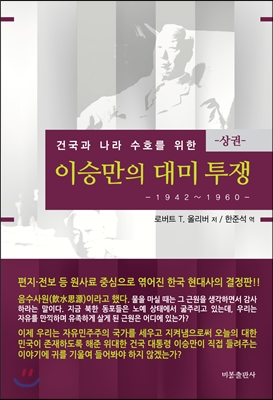
Syngman Rhee's struggle against the United States
 |
Description
Book Introduction
This book provides a glimpse into modern Korean history, compiled primarily from original materials such as letters and telegrams from that time.
It contains the story of President Syngman Rhee, the founding president of the Republic of Korea, who established and defended a liberal democratic nation, thereby making the Republic of Korea what it is today.
He speaks of his dream, knowledge, conviction, and stubbornness in building a free democratic market economy despite numerous oppositions, pressures, and misunderstandings, and persuasively argues that his dictatorship was intended to prevent communism and preserve the free democratic system.
It contains the story of President Syngman Rhee, the founding president of the Republic of Korea, who established and defended a liberal democratic nation, thereby making the Republic of Korea what it is today.
He speaks of his dream, knowledge, conviction, and stubbornness in building a free democratic market economy despite numerous oppositions, pressures, and misunderstandings, and persuasively argues that his dictatorship was intended to prevent communism and preserve the free democratic system.
- You can preview some of the book's contents.
Preview
index
commercial district
Chapter 1: The Dark Years in Washington (1942–1946)
Chapter 2 Summer 1946: Seoul
Chapter 3: Disappointment, Disagreement, and Confrontation (Winter, 1946–47)
Chapter 4: A Shift in Policy Through Growing Pains - A Painful Policy Shift (Autumn 1947)
Chapter 5: The Korean Lobby in Washington (1946–1950)
Chapter 6: The UN's Opaque Mandate (Winter 1947-48)
Chapter 7: A Government Born from the Darkness (Spring 1948)
Chapter 8: Creating a Free but Not Yet Self-Reliant Government (Summer 1948)
Chapter 9: From Agitation to Administration (August–December 1948)
Chapter 10: The Republic of Korea on the Test (Spring 1949)
Chapter 11: The Iron Curtain Rises (July–December 1949)
Chapter 1: The Dark Years in Washington (1942–1946)
Chapter 2 Summer 1946: Seoul
Chapter 3: Disappointment, Disagreement, and Confrontation (Winter, 1946–47)
Chapter 4: A Shift in Policy Through Growing Pains - A Painful Policy Shift (Autumn 1947)
Chapter 5: The Korean Lobby in Washington (1946–1950)
Chapter 6: The UN's Opaque Mandate (Winter 1947-48)
Chapter 7: A Government Born from the Darkness (Spring 1948)
Chapter 8: Creating a Free but Not Yet Self-Reliant Government (Summer 1948)
Chapter 9: From Agitation to Administration (August–December 1948)
Chapter 10: The Republic of Korea on the Test (Spring 1949)
Chapter 11: The Iron Curtain Rises (July–December 1949)
Into the book
I highly recommend that the next generation read this book.
The reason is that many historians in our society, contaminated by the epidemic that was prevalent in Japan after World War II, have become the mainstream in the historical academia, and are teaching incorrect knowledge in textbooks based on a materialistic view of history and dogmatic narratives that are not supported by facts.
They praise Kim Il-sung, the mastermind of a brutal and thoroughgoing one-man dictatorship, as the leader of a progressive and democratic nation, and denounce Syngman Rhee as a backward, dictatorial leader.
Recently, a video has been circulating on the Internet spewing out false and fabricated insults about the “Hundred Days War.” This is said to be the result of research by a leftist historical research institute that even received government subsidies.
When the Communist Party completely failed after 70 years of testing and gave up its name in Russia, the Communist Party in Europe also gave up its name.
But strangely enough, the country that has not yet taken down its sign is Japan.
In Korea, similar to Japan, the Korean Teachers and Education Workers Union is alive and well, and in the media, articles with an easily explainable historical materialism dominate.
This book is the perfect way to awaken us to this misconception.
The reason is that many historians in our society, contaminated by the epidemic that was prevalent in Japan after World War II, have become the mainstream in the historical academia, and are teaching incorrect knowledge in textbooks based on a materialistic view of history and dogmatic narratives that are not supported by facts.
They praise Kim Il-sung, the mastermind of a brutal and thoroughgoing one-man dictatorship, as the leader of a progressive and democratic nation, and denounce Syngman Rhee as a backward, dictatorial leader.
Recently, a video has been circulating on the Internet spewing out false and fabricated insults about the “Hundred Days War.” This is said to be the result of research by a leftist historical research institute that even received government subsidies.
When the Communist Party completely failed after 70 years of testing and gave up its name in Russia, the Communist Party in Europe also gave up its name.
But strangely enough, the country that has not yet taken down its sign is Japan.
In Korea, similar to Japan, the Korean Teachers and Education Workers Union is alive and well, and in the media, articles with an easily explainable historical materialism dominate.
This book is the perfect way to awaken us to this misconception.
---From the translator's preface
Publisher's Review
He was the true leader of our people and the founding hero of our nation.
Syngman Rhee was neither a dictator nor pro-American.
His dream was to build a country where each citizen's freedom and human rights were guaranteed and where the country had the ability to maintain independence, self-reliance, and self-reliance.
He fought resolutely against the communist forces that obstructed the construction of this country.
He had no intention of becoming a dictator, but he was not afraid of being accused of being a dictator for this purpose. 4 .
19 After visiting the hospital, he praised the injured students for their courage in resisting injustice, and after returning to his private residence, he smiled with satisfaction as he saw citizens fighting for freedom over the fence, thinking that his dream had come true.
Syngman Rhee was neither a dictator nor pro-American.
His dream was to build a country where each citizen's freedom and human rights were guaranteed and where the country had the ability to maintain independence, self-reliance, and self-reliance.
He fought resolutely against the communist forces that obstructed the construction of this country.
He had no intention of becoming a dictator, but he was not afraid of being accused of being a dictator for this purpose. 4 .
19 After visiting the hospital, he praised the injured students for their courage in resisting injustice, and after returning to his private residence, he smiled with satisfaction as he saw citizens fighting for freedom over the fence, thinking that his dream had come true.
GOODS SPECIFICS
- Date of issue: November 8, 2013
- Page count, weight, size: 420 pages | 651g | 153*224*30mm
- ISBN13: 9788937604027
- ISBN10: 8937604027
You may also like
카테고리
korean


korean

![GQ KOREA Mark (Monthly): December [2025]](http://librairie.coreenne.fr/cdn/shop/files/8ef265dbbfbf186523ed75ba7319009d.jpg?v=1765340328&width=3840)


