

I am Imasako, the last crown princess of the Korean Empire.
 |
Description
Book Introduction
Who is Imasako? "I am Imasako, the last crown princess of the Korean Empire," narrated by a foreigner and written by Kang Yong-ja. This is the memoir of Lee Bang-ja, the last crown princess of the Korean Empire, who became a victim of a political marriage between Korea and Japan at the age of sixteen, a woman's memory that lived through turbulent history. With the fall of the Korean Empire, he was taken to Japan as a hostage at the age of eleven, and as a companion of Prince Yeong (Prince Yeongchin), he lived a turbulent life from a member of the royal family to a commoner, amidst the conflict between the two countries and the jealousy of the public. It vividly depicts her social welfare activities in her later years, known only as the 'Lady of Nakseonjae', and her heartbreaking story with her only son, Lee Gu, who was the heir to the royal family. It will be the most important direct testimony and record of the history of the Korean Empire's imperial family, of which there are not many autobiographical records. This book is divided into seven parts. Part 1 deals with the situation of the fallen nation when King Yeongwang Yi Eun becomes the successor of Sunjong and is taken to Japan as a hostage at the Nakseonjae Pebble. Part 2 deals with the inside story of the political marriage led by Japan and the meeting of King Yeongwang and his wife. Parts 3 and 4 cover the death of the first son Yi Jin, the independence movement of Emperor Gojong, the death of Sunjong, King Yeongwang's overseas trip, and the unknown story of his fiancée, Lady Min Gap-wan. Part 5 depicts the death of Yi Woo-gong of Unhyeongung Palace and the agony of King Yeongwang's life in Japan. King Yeong's actions, which were criticized for being passive and not participating in the independence movement, are different from rumors and require reevaluation. Based on the serialized work “Time and Dynasty” in the Kyunghyang Shinmun in 1984, it was supplemented by organizing the current state of the Joseon royal family up until 2005, when the grandson Lee Gu met his tragic death. In addition, to make it easier for the general public to understand the unfamiliar royal family of the Korean Empire, we have carefully organized the Joseon royal family tree, maps of the palaces of both countries at the time, a chronological table of foreigners, and references. Records testifying to the imperial family in the final years of the Korean Empire are rare to count on one hand, and this book is significant in that it honestly records the stories of the last crown princess of the Korean Empire, as well as the imperial family figures who were caught in the whirlwind of history, such as Emperor Gojong, Emperor Sunjong, and Empress Sunmyeong (Bi Yun). As the last imperial research material of Joseon, it will correct errors in various memoirs published so far and serve as an opportunity to think about human beings in history through the vivid confessions of a human stranger. Watch the video "I am Imasako, the last crown princess of the Korean Empire." *Click* The audiobook is available for listening, and the full audiobook will be available for sale in the future. |
- You can preview some of the book's contents.
Preview
index
preface
Joseon royal family tree
Related maps
1 Nakseonjae Pebble
A Moment in the Universe
The emperor is dead
16 years old, morning newspaper
Execute Jeonui
Raindrops on bamboo leaves
The girl cries
News from Seoul
prostrate people
A barrage of phone calls
Take care
2 Deep May
The swaying white peony
Korean words that made His Majesty laugh
Hamnyeongjeon's disinfectant
Single-faced Suzuki
I want to eat noodle soup
Mongyang goes to the tiger's den
Offer gray hair
138 pairs of pheasants
3 White Premonition
Unbelievable news
Cheongnyangni is over there
Third tear
September 1, 1923
frozen tomb
Escape to Shanghai
Kim Si-jong's Secret
Radio and silk cushions
Queen with her hair down
4 Indian Ocean Black Waves
Rain falling on the garden
Attach the beauty and cervical vertebrae
Min Gyu-su's opposition
French Concession Murder Case
Call this the Count and Countess
Letters from Koreans in the Netherlands
Walking in the dark
5 Seeds in Tokyo
persistent disease
Lee Woo, risk your life
Memories of a dazzling day
Who called?
It's Korea, Korea
Crane dance and buckwheat flour
It's called Sookmyung Girls' High School.
Why are you there
6 Borderline Choice
Pangpang Girl and Sweet Red Bean Porridge
If you want to come, come
Korean language books for UN forces
Empty the house
American woman Julia
Burned documents
The hospitality of a young soldier
7 Oh, Namsan
Thank you, Omoni
Dialogue of the Heart
Tens of thousands of eyes
Go away, go away
Blood, sweat, patience and perseverance
Orphan King Without a Homeland
In the front yard of Nakseonjae
Conclusion
Main characters
Stranger Chronology
References
Photo source
Detailed image
Into the book
On the morning of August 3, 1916, I was in my villa, casually picking up a newspaper, and I was startled.
There was no doubt that my photo was next to His Highness the Crown Prince's.
A fist-sized letter hit my forehead: "His Highness the Crown Prince and I are engaged."
“How can this be?” “I’m engaged to His Highness the Crown Prince!” “I found out about my engagement in the newspaper!”
My head was spinning and my eyes were dizzy from the fact that I couldn't understand at all, and the letters kept getting bigger and smaller.
The hands and legs holding the newspaper were trembling.
---From "Part 1: Naksunjae Pebbles"
I sat in Jin's deathbed until we left Deoksugung Palace to catch the 8:15 p.m. train to Seoul.
I felt a lump in my throat as I thought that we had come together, but now I am leaving alone.
As we passed Yongsan, His Majesty pointed to the east and said, “Cheongnyangni is over there…”
It is said that somewhere in the dark mountains beyond, there is a Sunginwon where Jin, who cannot be seen anymore, sleeps.
I made no reply to His Majesty's words.
When we came here, did we ever imagine that we would lose our beloved son and leave so sadly?
When I crossed this sea, I suffered from high waves and seasickness, but Jin was in my arms, and I was filled with joy. Now, the sea is calm and quiet, but the waves that crash into my chest are darker and heavier than the depth of the Genkai Strait. --- From "White Premonition, Part 3"
While His Majesty was speaking, the students, who had been as quiet as if water had been poured over them, began to sob again.
“…Even though Lee Eun is always here, she never forgets her homeland… Since you are all students, I hope you learn at least one more thing and become great wives and mothers in the future….”
His Majesty's voice began to gradually subside.
The students were now all sobbing.
I couldn't help but shed tears.
I wiped my tears with a handkerchief and looked at His Majesty, and saw that His Majesty also had tears in his eyes.
Her face was red from trying not to show her tears.
---From "Part 5: Seeds in Tokyo"
When the government of the Republic of Korea was established in 1948 and Syngman Rhee became president, he said that he now wanted to return to his country.
President Lee, a member of the Jeonju Lee clan and a patriot who dedicated his life to the independence movement, believed that if he became president and implemented democratic politics, the country would develop greatly, and so he expressed his hope of returning to Korea several times through the Japanese mission.
But the president had no response.
Rather, they sent an order to give up the house we live in, which is Korean national property, to be used as a building for the Japanese mission.
We're barely surviving on the rent in this house, so if we give it up, where are we supposed to go?
---From "The Choice of the Borderline Person, Part 6"
Mrs. Yuk Young-soo, knowing of our circumstances, repeatedly asked the President to raise our living expenses to 600,000 won per month in 1971.
It was truly a groundbreaking impression at the time.
Mrs. Yuk was also very interested in the work of the self-help group and encouraged and helped me.
The number of mentally retarded children in the community was increasing, but there were no facilities to accommodate them.
Schools and training facilities were needed for them.
In 1971, Mrs. Yuk donated 10 million won to the foundation of the Jahae School, an affiliate of the Jahaenghoe.
10 million won was a lot of money, equivalent to over 100 million won today.
Using this fund and a loan of 15 million won from the bank, Ja-Hye School was built in October 1972 in Tap-dong, Suwon-si, Gyeonggi-do.
It was truly a tearful joy to see dozens of mentally retarded children who had nowhere else to go running, playing, studying, and training in the newly built school.
Mrs. Yuk continued to participate in our events and try to help us.
I still respect and cannot forget the kindness and gentle heart of Mrs. Yuk, who always cared for underprivileged children and those with mental disabilities and embraced us with warm and gentle hands.
---From "Part 7, Oh, Namsan"
Publisher's Review
The definitive edition of the memoirs of a stranger
Rich annotations, telling the story of the Joseon royal family after the death of Lee Bang-ja.
Any factual inaccuracies or parts that are difficult to read today have been corrected and supplemented with annotations to make it easier to understand the testimony of the time.
The abundant photographs also allow us to look into the heart of modern and contemporary history.
From 1984, when the memoir ends, to 1989, when Mrs. Lee Bang-ja passed away, and to 2005, when the grandson Lee Gu met his tragic death, the book provides readers with an overview of the current situation of the descendants of the Joseon royal family.
Book structure
This book is divided into seven parts. Part 1 deals with the situation of the fallen nation when King Yeongwang Yi Eun becomes the successor of Sunjong and is taken to Japan as a hostage at the Nakseonjae Pebble. Part 2 deals with the inside story of the political marriage led by Japan and the meeting of King Yeongwang and his wife. Parts 3 and 4 cover the death of the first son Yi Jin, the independence movement of Emperor Gojong, the death of Sunjong, King Yeongwang's overseas trip, and the unknown story of his fiancée, Lady Min Gap-wan. Part 5 depicts the death of Yi Woo-gong of Unhyeongung Palace and the agony of King Yeongwang's life in Japan.
King Yeong's actions, which were criticized for being passive and not participating in the independence movement, are different from rumors and require reevaluation.
Part 6 depicts the story of his son, Igu, and his wife, Julia, the whereabouts of the former imperial property, President Syngman Rhee's refusal to return to the country, his meeting with Chairman Park Chung-hee, and the extreme hardships of life and the cold treatment of his country.
Part 7 movingly records the arduous efforts of the founder, who, after the death of King Yeongjo in 1970, cared for the disabled in Korean society and pioneered social welfare work, striving for self-reliance and education.
In fact, she returned to Korea in 1963 at the age of 63 and lived for 26 years until her death in 1989, serving only as the last crown princess of the Joseon Dynasty, the owner of Nakseonjae, and the mother of a disabled person.
Through an interview with editorial writer Kang Yong-ja, who finished his serial in the Kyunghyang Shinmun, we can get a glimpse of the frugal and simple Lee Bang-ja in his later years.
Lastly, it helps readers understand by adding information on Lee Gu's activities since 1985, the activities of the social welfare corporation Myeonghwiwon, which continues the legacy of the King and Queen Yeongwang, the whereabouts of the former royal property, and the current status of the royal descendants of Prince Ui.
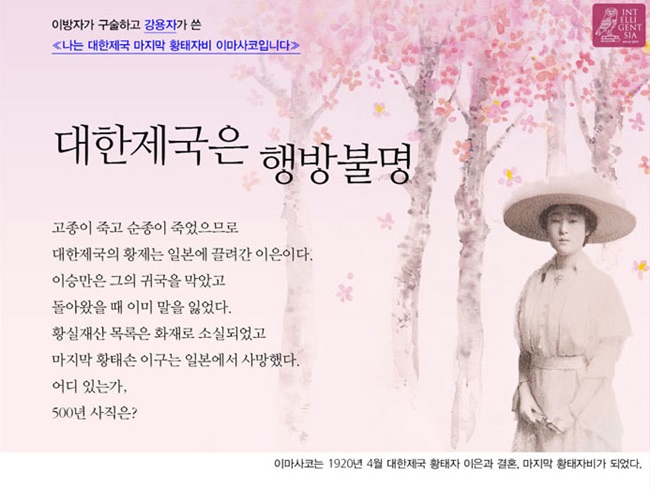
"I am Imasako, the last crown princess of the Korean Empire," narrated by a foreigner and written by Kang Yong-ja.
The Korean Empire disappeared. After Emperor Gojong and Emperor Sunjong died, the emperor of the Korean Empire was Yi Eun, who was taken to Japan.
Syngman Rhee prevented his return, and when he returned, he was already speechless.
The imperial estate was destroyed in a fire, and the last crown prince, Yi Gu, died in Japan.
Where is the 500-year-old temple?
On the morning of August 3, 1916, I absentmindedly picked up a newspaper at my villa and was startled. Next to His Highness the Crown Prince's photo was undoubtedly my own. The fist-sized letters that read, "His Highness the Crown Prince and I are engaged," slapped me in the face. "How can this be?" "I'm engaged to His Highness the Crown Prince!" "And I found out about my engagement in the newspaper!" My mind was spinning with the incomprehensible truth, and my vision was dizzy, the letters growing and shrinking.
The hands and legs holding the newspaper trembled. - Page 19
Who is Imasako?
The woman we call a stranger is the daughter of the Japanese imperial family member, Nashimotomiya Morimasa.
She was also considered as a candidate to become the Japanese Crown Princess, but was eventually chosen as the wife of Emperor Gojong's third son, Prince Yeongwang Yi Eun.
She is a woman who became a victim of a political marriage between Korea and Japan at the age of sixteen.
In April 1920, she married Crown Prince Yi Eun of the Korean Empire and became the last crown princess.
Why is Lee Eun called 'King Yeong' and not 'Prince Yeongchin'?
Yi Eun was crowned King Yeong of the Korean Empire by Emperor Gojong in 1900.
There is a claim that calling him Prince Yeongchin with the character 'chin (親)' is a Japanese-style title, but this is not certain.
Mrs. Lee Bang-ja left a will stating, “I prefer the original title of ‘Yeongwang’ rather than the Japanese title of Prince Yeongchin,” and this book calls him Yeongwang.
What happened to the life of Min Gap-wan, who was chosen as the queen of the king?
This is the woman that Emperor Gojong had chosen as the wife of the King of Yeong in advance to prevent a political marriage with Japan.
She was the daughter of Min Yeong-don, who served as the British ambassador, and was chosen as the crown princess at the age of eleven, but was forcibly broken off from the engagement by Japan.
It was a custom in Joseon that once a woman was chosen as the crown princess, she could not marry anyone else even if the engagement was broken off and had to live alone for the rest of her life.
Due to the shock of this incident, his father Min Yeong-don died suddenly and his family went bankrupt, forcing him to go into exile in Shanghai, where he spent many years in suffering.
After liberation, he returned to Korea and lived alone until he died of laryngeal cancer in 1968.
Is Lee Eun and Lee Bang-ja's married life happy or unhappy?
“Seeing him struggling, reminiscing about the sorrow of a lost nation, I wanted to be his warm friend in his loneliness rather than promote Korea-Japan reconciliation.
“I was able to endure the rough and bleak road of life because I had deep affection as a human being,” says Lee Bang-ja.
Was Jin, the first son of the King and Queen of Yeongwang, poisoned when he came to Korea?
The King and Queen, who held their wedding ceremony in Japan in 1920, returned to Korea two years later in 1922 with their seven-month-old first son, Jin, and held a Korean-style wedding ceremony.
Two weeks after returning home, Jin suddenly died of acute indigestion.
There were rumors of poisoning leading to his sudden death, but most of the court officials denied it, saying, “No one would commit such a heinous act to avenge Emperor Gojong.”
What are the stranger's thoughts on his son's sudden death?
“I still don’t believe that,” he said clearly.
He claimed that his son Jin was killed because he had Japanese blood.
Is it true that King Yeongjo was uncooperative with Joseon's independence?
The King of the Underworld is known as the 'Silent Prince'.
He was a Korean king and a Japanese soldier who was brought here as a hostage.
Little is known about his complex psychology and behavior.
His attitude toward Korean independence was uncertain and could not be certain.
In this book, you can examine the observations of the person closest to you, a stranger.
Why didn't the King and Queen return to their country immediately after liberation?
He expressed his intention to return home, but was unable to do so due to concerns about the restoration of the royal family.
The Syngman Rhee regime attempted to sever the lineage of the Joseon royal family by nationalizing royal property.
When did they set foot on Korean soil again?
He returned to his country in 1963.
The King returned to his homeland in a wheelchair after 56 years, but was unable to speak due to a cerebral hemorrhage.
After battling illness for six years and six months, he passed away on May 1, 1970, at the age of 73.
How did you live in Japan after the defeat and before returning home?
When the Japanese constitution was changed in 1947, the Japanese royal family lost their privileges and became commoners.
The King and Queen also became commoners and registered as Koreans in Japan, and all support from the Japanese government was cut off overnight.
From then on, he had no income at all, so he lived by selling cars, antiques, and other items, and barely managed to make a living with the help of people around him who learned of his plight.
Mrs. Lee Bang-ja was deeply sorry that she could not bring the three pieces of the Empress's ceremonial attire, which she had cherished until the end, to the museum in our country and had no choice but to entrust them to the Ueno National Museum.
Where are all the Joseon royal family's assets?
After the Korean War, the Imperial Property Office was established and a list of properties was compiled in 1960.
However, on June 6th of that year, the second floor of the Secretariat building was completely destroyed by a fire of unknown cause, and all documents were lost.
So does that mean the Joseon royal family's assets are missing?
According to the words of Deputy Director Lee Chang-seok, who was in charge of the organization, a huge amount of real estate, including forests and land, ended up in the hands of those in power at the time.
It is claimed that not only hundreds of thousands of pyeong of land in the outskirts of Seoul, but even the land of royal tombs has changed hands.
Why was life in Korea not smooth for Lee Gu, the second son and only son?
Born in Japan in 1931, Igu was the son of Mrs. Lee Bang-ja, who suffered from several miscarriages after losing her first son, Jin, nine years later.
He majored in architecture at MIT and married an American woman, Julia Mullock.
In 1963, when the King and Queen returned to Korea, he returned with them and lived at Nakseonjae.
Although he taught architectural design at Seoul National University and Yonsei University and ran an aerial surveying company, his life in Korea was not easy.
Why did Igu and Ibangja fight?
The royal family urged him to separate from Julia, who was Western and childless.
The business that Lee Gu was running also failed.
Eventually, he divorces Julia and moves to Japan, where he lives with a Japanese shaman.
The foreigner tried to persuade Igu to return to his country, but failed.
How does this book differ from other records of the Korean Empire?
Neither King Yun Bi nor King Yeong, who witnessed the fall of the Korean Empire, left any records.
This book honestly records the experiences of the last crown princess of the Korean Empire, who personally experienced Emperor Gojong, Emperor Sunjong, and Empress Sunmyeong.
As the last imperial research material of Joseon, it corrects errors in various memoirs that have been published so far.
This will be an opportunity to think about humans in history through the vivid confessions of human strangers.
Who is the author Kang Yong-ja?
He was a novelist and reporter for the Kyunghyang Shinmun, serving as head of the culture department and editorial writer.
From May 14 to October 24, 1984, he serialized his memoir, “Time and Dynasty,” in the Kyunghyang Shinmun.
What was the reader response at the time of serialization? Some responded, "Why are you writing about that Japanese woman?" and "Isn't she the daughter of the Japanese imperial family, the monster who defiled our blood and ruined the King of Yeong?"
But as the series continued, people began to say, “We didn’t know much about our history,” and “We learned a lot about history.”
Who are you?
The person who compiled this book is Kim Jeong-hee.
What did you do?
I corrected Kang Yong-ja's text and organized and supplemented the current situation of the Joseon royal family.
This book includes annotations, a genealogy of the Joseon royal family, maps of the palaces of both countries at the time, a chronology of foreigners, and references.
GOODS SPECIFICS
- Date of issue: August 1, 2013
- Page count, weight, size: 406 pages | 513g | 153*224*30mm
- ISBN13: 9788966809721
- ISBN10: 8966809723
You may also like
카테고리
korean


korean


