

Why? People Why People Stephen Hawking
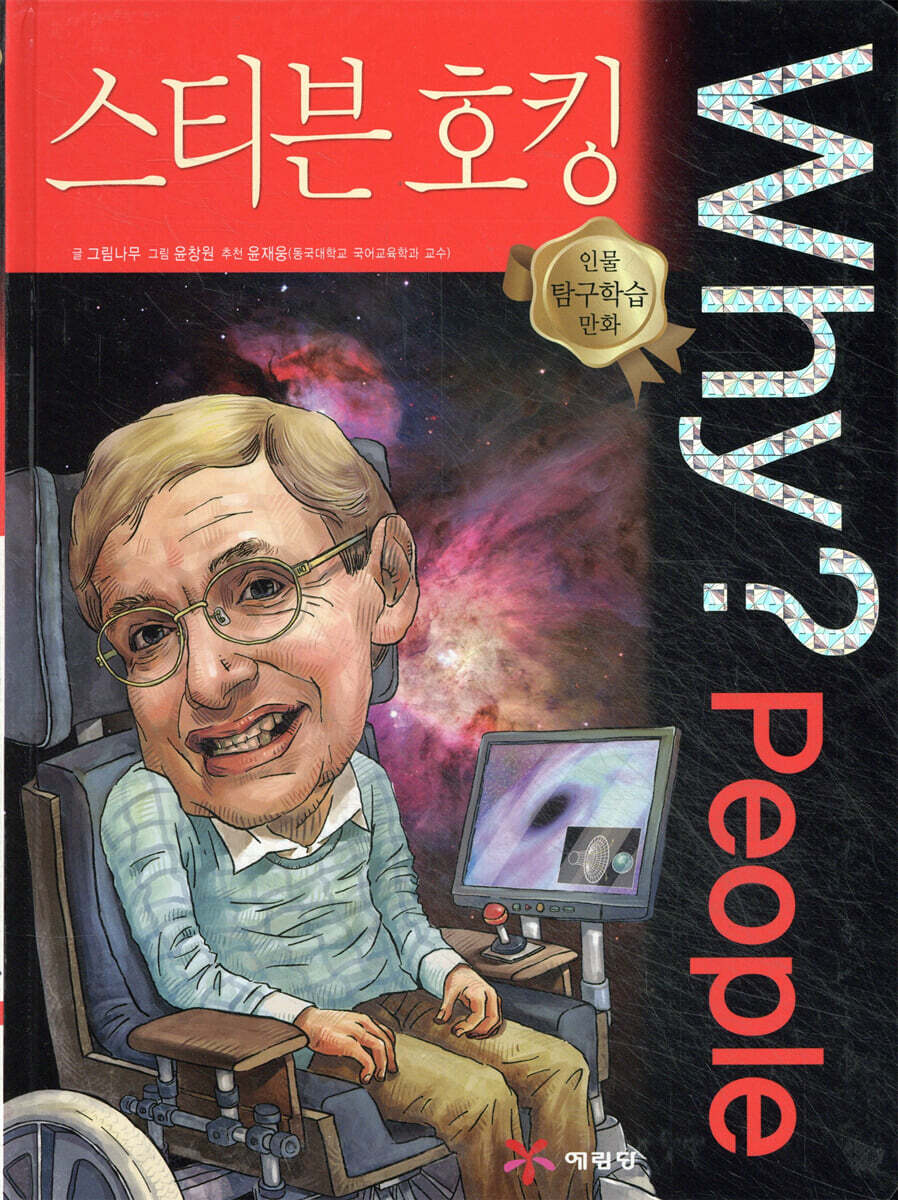 |
Description
Book Introduction
The body has lost its freedom, but the spirit transcends the universe!
British theoretical physicist Stephen Hawking is considered today a physicist who follows in the footsteps of Galileo Galilei, Isaac Newton, and Albert Einstein.
Born in England on January 8, 1942, Stephen Hawking was a somewhat eccentric boy who enjoyed daydreaming, even believing he had his own home somewhere.
He showed considerable interest in science during his teenage years, experimenting with supernatural powers and building computers. At the age of 17, he chose to study physics at Oxford University, and three years later, he entered the field of cosmology when he entered the University of Cambridge.
But at the age of 22, he was diagnosed with a terminal illness and given a life sentence.
However, his academic achievements became more active after he was given a terminal diagnosis.
He devoted himself to his research despite being unable to write properly, and as his condition worsened, he had to breathe with a tube inserted into his chest and communicate through a speech synthesizer attached to his wheelchair, but he never gave up his passion for learning.
A shining example of human triumph, overcoming the limitations of the physical body to achieve dazzling scientific achievements, such as operating a computer and writing lectures using the only two fingers in the body that move.
Let's learn about Stephen Hawking together.
- You can preview some of the book's contents.
Preview
index
Era and People
The Boy Who Lives in Space
Memories of St. Albans
Freeman of Oxford
Genius trapped in space
Black hole that is not black
A time of glory and trial
A giant who never gives up
eternal child
Reverse Thinking┃Rivals & Supporters┃Character Sketches┃
Glossary of Terms┃Curriculum Linkage Table
The Boy Who Lives in Space
Memories of St. Albans
Freeman of Oxford
Genius trapped in space
Black hole that is not black
A time of glory and trial
A giant who never gives up
eternal child
Reverse Thinking┃Rivals & Supporters┃Character Sketches┃
Glossary of Terms┃Curriculum Linkage Table
Detailed image

Publisher's Review
Planning intent
Emulate and learn from Power People!
It is important to have a role model that you want to emulate as a child.
Just as a book read by chance can determine a person's life.
In childhood, the role of those around us, especially parents, is emphasized.
Childhood is a time when children yearn for their parents and imitate their behavior, so parents must demonstrate good character through their words and actions.
During the growth period, children choose and focus on role models based on their dreams and ideals. At this time, it is most important to come into contact with role models from various fields.
Looking back at history, we come across great figures who changed the world in their fields.
The world calls them Power People.
It means a person who changed the world and influenced our lives.
The "Why? People" series offers a deep and broad introduction to the lives of powerful people from Korea and abroad, living and breathing in history and the present, who have served as role models for countless people. It allows readers to learn about the will to live and the wisdom embedded in their experiences of frustration and overcoming, failure and success.
Content structure and special features
1.
Basic concept
Each character was portrayed from an objective perspective, excluding clichéd praise or beautification.
The principle was to deal with the characters' merits and demerits without reservation and leave the judgment to the readers.
The character's human suffering and doubts, as well as his will and wisdom to live, from frustration and overcoming to failure and success, were presented as role models.
2.
Power People Inside and Outside the Textbook
You can meet a variety of role models by selecting leading domestic and international figures from various fields, including politics/leadership, economics/management, culture/arts, science/technology, and environment/human rights, who are alive and breathing in history and the present.
3.
Rich learning information and background knowledge
We've organized learning information and background knowledge into separate sections to allow you to delve deeper into the character's life.
*[Era and People]: Explore the historical background of each field, including politics and society, including the major ideas and events of the era that influenced the lives of the people!
*[Sudden Interview]: Learn about the cooperative and conflicting relationships between people surrounding a character and hear their perspectives and inner thoughts through interviews!
*[Put yourself in someone else's shoes]: Try to see things from another person's perspective.
Experience the agony and decisive moments a character experiences, such as how they make important decisions or act in a sudden crisis!
*[Rivals & Supporters]: Find out who helped the character, or who pushed the character further through confrontation and competition, just like the symbiotic and natural enemies of nature!
*[Character Sketch]: A comprehensive overview of a person's life at a glance! The character's major achievements, illustrative quotes, and key chronological charts are presented with photographs and illustrations to highlight key points.
*[Glossary of Terms and Curriculum Links]: Explains difficult terms related to the lives and achievements of individuals, and indicates content linked to elementary school curriculum to assist with practical learning!
4.
Rich photographic data and detailed pictorial aids for understanding
The character's history is presented in an easy and fun way through comics, and the key information is clearly organized in a tip box.
It is rich in vivid photographs and depicts the person's peak period or major achievements in detail, allowing for an intuitive understanding of the core of the person's history.
Publisher's Review
The body has lost its freedom, but the spirit transcends the universe!
Stephen Hawking, British theoretical physicist.
Today, he is considered a physicist who follows in the footsteps of Galileo Galilei, Isaac Newton, and Albert Einstein.
He held the Lucasian Chair in Mathematics at the University of Cambridge until 2009, and has published several popular science books on his own theories and cosmology in general.
Among them, 『A Brief History of Time』 was on the London Sunday Times bestseller list for a record-breaking 237 weeks.
Together with mathematician and physicist Roger Penrose, he proved several theorems about general relativistic singularities and discovered that black holes emit thermal radiation, making important contributions to modern physics.
Hawking was born on January 8, 1942, in England.
Coincidentally, this day also marked the 300th anniversary of Galileo Galilei's death.
As a boy, he was a somewhat eccentric child who enjoyed daydreaming, such as believing that he had his own home somewhere.
As a teenager, he showed considerable interest in science, experimenting with superpowers and building computers with his friends.
By the time he became a high school student, he had already considered physics to be the 'foundation of all sciences' and had decided to pursue a career as a physicist. However, because he also had a great love for mathematics, he had a hard time deciding on his career path.
Finally, in 1959, at the age of 17, he chose to study physics at Oxford University, and three years later, he entered the Cambridge University Graduate School, where he entered the field of cosmology.
At the age of 22, he was more interested in campus culture, such as sports, than in academics, and was diagnosed with an incurable disease, which was as deadly as a stroke of genius, and was given a limited life span.
However, his academic achievements blossomed after he was given a terminal diagnosis.
He devoted himself to his research despite his body being unable to walk or even write properly.
The more unnatural the body, the more brilliant the mind became.
However, his condition worsened, and in 1985, he underwent tracheotomy surgery due to pneumonia, and now breathes through a tube inserted into his chest and communicates only through a speech synthesizer attached to his wheelchair.
He uses his two fingers, the only two fingers on his body, to operate the computer, lecture, and write.
Stephen Hawking is a prime example of human triumph, having overcome the limitations of his limited physical body and achieved scientific success.
Through him, I learn about an indomitable will to live and an overflowing passion for academics.
GOODS SPECIFICS
- Date of issue: October 10, 2012
- Format: Hardcover book binding method guide
- Page count, weight, size: 176 pages | 761g | 188*250*20mm
- ISBN13: 9788930232159
- ISBN10: 8930232159
You may also like
카테고리
korean


korean


