

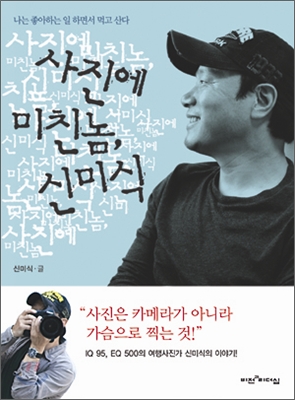
Shin Mi-sik, a photography enthusiast
 |
Description
Book Introduction
Shin Mi-sik, known as the first generation of travel photographers
Hear the story of his photography-obsessed life.
Shin Mi-sik, known as the first generation of travel photographers.
When I think of him, I think of Madagascar.
This is because his photos warmly capture the rich colors of Africa and the daily lives of the people there.
He says, "Photos are taken with the heart, not with the camera," so his photos have a human touch.
Now, let's smell the real 'smell' of photographer Shin Mi-sik, who exudes the scent of people.
Shin Mi-sik was born the youngest of 13 children in a poor family and never had the chance to make a lunchbox during his elementary school years. After graduating from college, he was unable to find a job for a while and lived with bad credit for 10 years. His resident registration was canceled for 5 years and he even went to a hospital to sell his organs due to the pressure of debt.
The 'taste of photography' he discovered while editing pictorials at a magazine completely changed his life.
I have finally realized my dream of making a living by doing what I love.
He is crazy about photography and has achieved many dreams.
He built his own photography in Madagascar, Africa, and shared his dreams by showing films to children in remote areas without electricity.
Since then, he has also earned the title of ‘Africa specialist photographer.’
We also run a gallery cafe where poor photographers can hold exhibitions for free.
This book contains the story of his life and the process of achieving his dream.
He also shares how he established his identity as a photographer when his identity was shaken, and tells those preparing to take photos what the best photos are and how to take your photography to the next level.
Hear the story of his photography-obsessed life.
Shin Mi-sik, known as the first generation of travel photographers.
When I think of him, I think of Madagascar.
This is because his photos warmly capture the rich colors of Africa and the daily lives of the people there.
He says, "Photos are taken with the heart, not with the camera," so his photos have a human touch.
Now, let's smell the real 'smell' of photographer Shin Mi-sik, who exudes the scent of people.
Shin Mi-sik was born the youngest of 13 children in a poor family and never had the chance to make a lunchbox during his elementary school years. After graduating from college, he was unable to find a job for a while and lived with bad credit for 10 years. His resident registration was canceled for 5 years and he even went to a hospital to sell his organs due to the pressure of debt.
The 'taste of photography' he discovered while editing pictorials at a magazine completely changed his life.
I have finally realized my dream of making a living by doing what I love.
He is crazy about photography and has achieved many dreams.
He built his own photography in Madagascar, Africa, and shared his dreams by showing films to children in remote areas without electricity.
Since then, he has also earned the title of ‘Africa specialist photographer.’
We also run a gallery cafe where poor photographers can hold exhibitions for free.
This book contains the story of his life and the process of achieving his dream.
He also shares how he established his identity as a photographer when his identity was shaken, and tells those preparing to take photos what the best photos are and how to take your photography to the next level.
- You can preview some of the book's contents.
Preview
index
Recommendation
Prologue _“Have you ever regretted becoming a photographer?”
Chapter 1 I never thought I'd become a photographer!
When I was in college, I hated photography class because I didn't have a camera.
After three years of working all night, I became skilled at drawing.
A European trip with a will written, "Let's go even if we die."
"I guess I should call him a new writer now."
Chapter 2: Poverty Was My Weapon
IQ is 95, EQ is 500
The power of 'ten thousand won' that changed my life
From bad credit to successful celebrity photojournalist
Become a delinquent again
If you don't have a camera, take pictures with your heart.
A dream realized in 3 photos
Madagascar, the fairytale island with baobabs
Share your dreams with the angels of Madagascar
A space for communication, Gallery Cafe Madagascar
Rediscovering Africa through Photography
Chewing up Korean land along National Highway 1
A story I want to tell to people preparing for Chapter 4 photos
Are you a real photographer?
Take pictures of your friends, not models.
How to take your photos to the next level
Things you can do with photos
I stamp hope
Epilogue _Photography is the reason I live
Prologue _“Have you ever regretted becoming a photographer?”
Chapter 1 I never thought I'd become a photographer!
When I was in college, I hated photography class because I didn't have a camera.
After three years of working all night, I became skilled at drawing.
A European trip with a will written, "Let's go even if we die."
"I guess I should call him a new writer now."
Chapter 2: Poverty Was My Weapon
IQ is 95, EQ is 500
The power of 'ten thousand won' that changed my life
From bad credit to successful celebrity photojournalist
Become a delinquent again
If you don't have a camera, take pictures with your heart.
A dream realized in 3 photos
Madagascar, the fairytale island with baobabs
Share your dreams with the angels of Madagascar
A space for communication, Gallery Cafe Madagascar
Rediscovering Africa through Photography
Chewing up Korean land along National Highway 1
A story I want to tell to people preparing for Chapter 4 photos
Are you a real photographer?
Take pictures of your friends, not models.
How to take your photos to the next level
Things you can do with photos
I stamp hope
Epilogue _Photography is the reason I live
Into the book
I was spending some leisurely time on the beach of Nice, intoxicated by the beautiful scenery outside the window, when I discovered a poster at the hotel entrance.
It was none other than an F1 car racing poster.
The event, known as the "major league" of automobiles, was held the next day in Monaco, near Nice! I took a train to Monaco.
As soon as I unpacked my bags at the hotel, I ran to the stadium.
But the entrance fee for the game alone was 400,000 won.
I went straight to the venue.
I was stopped by the security guard.
I asked to be admitted as a Korean reporter, but was firmly refused.
“Because this is an international competition, the participant list is submitted several months in advance.”
I didn't give up and just stood there and waited.
After about an hour, I saw a group of Japanese reporters coming from over there.
I quickly joined the group.
However, he was stopped again in front of the press center.
I gave my name at the entrance, but there was no way my name was on the list.
“I am only Korean photographer.”
I kept pleading in my broken English, saying that I was busy and couldn't make a reservation, but it didn't work.
In fact, not a single Korean reporter came at that time.
I didn't back down and begged them to let me in.
The person in charge thought for a while, then motioned for me to come over.
“From now on, you must make a reservation.”
As soon as I returned to Korea, I called a famous domestic automobile magazine.
“I took pictures of the F1 race.”
“What? F1?”
The person in charge didn't believe me and kept asking, "Did you really take the picture?"
It was only when he saw my picture that his mouth dropped open.
“Wow, this is awesome!”
The photos taken there, where there were no Korean reporters, were eventually published in a magazine.
That was the impetus for me to be scouted as the head of the design team at that magazine a few months later.
--- From Chapter 1, “I Am the Only Korean Photographer”
Economic difficulties continued for some time.
It was around 2000, when I was suffering from debt collection every day.
The amount of money that had to be repaid to the bank was about 30 million won.
In the midst of my struggle to dry my blood, I discovered the only way to repay my debt.
It was selling body organs.
At the bus terminal, I happened to see a small sticker that said 'long-term trading' and called a broker.
He said he would give me 30 million won if I sold my kidney.
It was a huge amount of money for me and I was desperate, so I went to the hospital he recommended and got a comprehensive checkup.
Why did I cry so much while waiting for my turn… … .
Fortunately or unfortunately, the test results were good.
When I met the broker again and asked when I could have the surgery and receive the money, he said that out of the 30 million won, he would deduct 15 million won as an introduction fee and I could only receive the remaining 15 million won.
I had to repay 30 million won, but I thought I wouldn't be able to repay it all even if I sold my organs, so I left that place.
I felt wronged at the thought of being deceived, and at the same time, I felt sad that my situation had come to this.
--- From Chapter 2, “All Misfortunes Come Like a Tsunami”
I wanted to travel, but it was something I couldn't even dream of.
But traveling was like lovesickness to me.
As I lay there, the travel destination and the airplanes would come into my mind and I thought I was going to get sick.
Then, when I couldn't stand it any longer, I put my backpack on my shoulder, left the house, and ran to the airport.
I went to the airport and used my departure card like I was really going on a trip, then went to the bank and exchanged about ten thousand won.
Not only that, I sat in the waiting room and chatted with the person next to me while drinking coffee, like a traveler waiting for the plane to take off.
“Where are you going?”
“Oh, yes, I’m going to England.”
When I heard the sound of planes taking off and landing at the airport and saw the excited travelers and stewardesses busily going back and forth, I felt like I was really going on a trip.
After being at the airport for three or four hours, I went out to the arrivals hall and took the airport bus again.
Just as I can't relieve my longing for someone I love, even if it's just through a photo, I felt like I'd go crazy if I didn't do something like this when I wanted to travel.
--- From Chapter 2, “Traveling in My Own Way”
Finally, we arrived at Chinggi, the last course and the highlight of this trip.
It was a remote village without electricity, a place where I promised to show the movie “Madagascar” to the people who could not even watch a movie.
The movie was finally shown.
Every time their village, which they had always seen in Madagascar, appeared and familiar scenes such as monkeys and baobab trees appeared, everyone was amazed and screamed with joy.
It was the first movie they had ever seen in their lives.
The next day after the film screening, we filmed a video for children at an elementary school.
When I got to school, there were about 700 students waiting.
I had all the students sit on chairs and took individual photos of them one by one.
And then we ran the generator all night and printed the photos.
I went to school with clothespins and a rope.
They all said they couldn't be happier when they thought about the children's joy as they hung their photos one by one on a rope in the classroom with wooden clips.
--- From Chapter 3, “Movie Screening on a Starry Night”
“Please take a picture of your parents at least twice a year.”
This is what I emphasize most whenever I teach photography classes.
If you take pictures of your parents every year, you will see them growing older.
I hope the photos start here.
If you take pictures like that every year, at some point one person will disappear.
When one person passes away, don't stop and continue taking pictures of the remaining person.
As you take a picture of one person, you will think about that empty space.
'Who will fill the void left by my father's absence?'
And then you start to wonder who will fill that void.
“Oh, I guess I should fill that empty spot.”
If you don't take pictures, you won't feel this.
There is a big difference between keeping a record and not keeping one.
If you take pictures twice a year for 20 years, you will have a total of 40 pictures.
If you exhibit these photos, it will become a true documentary of the past 20 years.
Maybe I'm emphasizing this more because it's something I've never done before.
It was none other than an F1 car racing poster.
The event, known as the "major league" of automobiles, was held the next day in Monaco, near Nice! I took a train to Monaco.
As soon as I unpacked my bags at the hotel, I ran to the stadium.
But the entrance fee for the game alone was 400,000 won.
I went straight to the venue.
I was stopped by the security guard.
I asked to be admitted as a Korean reporter, but was firmly refused.
“Because this is an international competition, the participant list is submitted several months in advance.”
I didn't give up and just stood there and waited.
After about an hour, I saw a group of Japanese reporters coming from over there.
I quickly joined the group.
However, he was stopped again in front of the press center.
I gave my name at the entrance, but there was no way my name was on the list.
“I am only Korean photographer.”
I kept pleading in my broken English, saying that I was busy and couldn't make a reservation, but it didn't work.
In fact, not a single Korean reporter came at that time.
I didn't back down and begged them to let me in.
The person in charge thought for a while, then motioned for me to come over.
“From now on, you must make a reservation.”
As soon as I returned to Korea, I called a famous domestic automobile magazine.
“I took pictures of the F1 race.”
“What? F1?”
The person in charge didn't believe me and kept asking, "Did you really take the picture?"
It was only when he saw my picture that his mouth dropped open.
“Wow, this is awesome!”
The photos taken there, where there were no Korean reporters, were eventually published in a magazine.
That was the impetus for me to be scouted as the head of the design team at that magazine a few months later.
--- From Chapter 1, “I Am the Only Korean Photographer”
Economic difficulties continued for some time.
It was around 2000, when I was suffering from debt collection every day.
The amount of money that had to be repaid to the bank was about 30 million won.
In the midst of my struggle to dry my blood, I discovered the only way to repay my debt.
It was selling body organs.
At the bus terminal, I happened to see a small sticker that said 'long-term trading' and called a broker.
He said he would give me 30 million won if I sold my kidney.
It was a huge amount of money for me and I was desperate, so I went to the hospital he recommended and got a comprehensive checkup.
Why did I cry so much while waiting for my turn… … .
Fortunately or unfortunately, the test results were good.
When I met the broker again and asked when I could have the surgery and receive the money, he said that out of the 30 million won, he would deduct 15 million won as an introduction fee and I could only receive the remaining 15 million won.
I had to repay 30 million won, but I thought I wouldn't be able to repay it all even if I sold my organs, so I left that place.
I felt wronged at the thought of being deceived, and at the same time, I felt sad that my situation had come to this.
--- From Chapter 2, “All Misfortunes Come Like a Tsunami”
I wanted to travel, but it was something I couldn't even dream of.
But traveling was like lovesickness to me.
As I lay there, the travel destination and the airplanes would come into my mind and I thought I was going to get sick.
Then, when I couldn't stand it any longer, I put my backpack on my shoulder, left the house, and ran to the airport.
I went to the airport and used my departure card like I was really going on a trip, then went to the bank and exchanged about ten thousand won.
Not only that, I sat in the waiting room and chatted with the person next to me while drinking coffee, like a traveler waiting for the plane to take off.
“Where are you going?”
“Oh, yes, I’m going to England.”
When I heard the sound of planes taking off and landing at the airport and saw the excited travelers and stewardesses busily going back and forth, I felt like I was really going on a trip.
After being at the airport for three or four hours, I went out to the arrivals hall and took the airport bus again.
Just as I can't relieve my longing for someone I love, even if it's just through a photo, I felt like I'd go crazy if I didn't do something like this when I wanted to travel.
--- From Chapter 2, “Traveling in My Own Way”
Finally, we arrived at Chinggi, the last course and the highlight of this trip.
It was a remote village without electricity, a place where I promised to show the movie “Madagascar” to the people who could not even watch a movie.
The movie was finally shown.
Every time their village, which they had always seen in Madagascar, appeared and familiar scenes such as monkeys and baobab trees appeared, everyone was amazed and screamed with joy.
It was the first movie they had ever seen in their lives.
The next day after the film screening, we filmed a video for children at an elementary school.
When I got to school, there were about 700 students waiting.
I had all the students sit on chairs and took individual photos of them one by one.
And then we ran the generator all night and printed the photos.
I went to school with clothespins and a rope.
They all said they couldn't be happier when they thought about the children's joy as they hung their photos one by one on a rope in the classroom with wooden clips.
--- From Chapter 3, “Movie Screening on a Starry Night”
“Please take a picture of your parents at least twice a year.”
This is what I emphasize most whenever I teach photography classes.
If you take pictures of your parents every year, you will see them growing older.
I hope the photos start here.
If you take pictures like that every year, at some point one person will disappear.
When one person passes away, don't stop and continue taking pictures of the remaining person.
As you take a picture of one person, you will think about that empty space.
'Who will fill the void left by my father's absence?'
And then you start to wonder who will fill that void.
“Oh, I guess I should fill that empty spot.”
If you don't take pictures, you won't feel this.
There is a big difference between keeping a record and not keeping one.
If you take pictures twice a year for 20 years, you will have a total of 40 pictures.
If you exhibit these photos, it will become a true documentary of the past 20 years.
Maybe I'm emphasizing this more because it's something I've never done before.
--- From Chapter 4, “Things You Can Do with Photos”
Publisher's Review
“Photos are taken with the heart, not with the camera!”
The story of Shin Mi-sik, a travel photographer with an IQ of 95 and an EQ of 500.
The story of Shin Mi-sik, a travel photographer with an IQ of 95 and an EQ of 500.
Shin Mi-sik, a photographer known as the first generation of travel photographers.
He is a person who is living the dream of every office worker: making a living doing what he loves.
After majoring in graphic design in college, he discovered the 'taste of photography' while editing pictorials at a magazine.
He left a will with only 190,000 won and went on a trip to Europe. He loved traveling so much that when he didn't have money, he had to go to the airport to live his daily life.
He was crazy about traveling, so he started taking pictures to console himself after his trips, and from then on, he became a 'photographer'.
Although he never received formal training in photography, his passion for photography was unstoppable.
At the age of 30, I bought my first camera with a 36-month installment plan. After that, I practiced composition by looking at magazines and took pictures diligently.
Poverty was my weapon
Over the past 20 years, author Shin Mi-sik has traveled to over 80 countries.
My wish to travel has been completely fulfilled.
He is a successful photographer who has published 16 photo essays and held 15 solo exhibitions as a freelance photographer.
But the path he chose to give up a stable life to do what he loved was not smooth.
Born as the youngest of 13 children in a poor family, he never once packed a lunch during his elementary school years, and after graduating from college, he was unable to find a job for a while, so he did everything from being homeless to working as a DJ at a cafe, a waiter at a bar, and working on construction sites.
He lived with bad credit for 10 years, had his resident registration cancelled for 5 years, and even went to the hospital to sell his organs due to the pressure of debt.
But he has never regretted becoming a photographer.
A dream achieved while doing what I love
His photos, with an IQ of 95 and an EQ of 500, have power.
Prisoners in prison found hope after seeing his photo, and a man who had cancer and underwent multiple surgeries found hope for life.
Because the painful experiences he went through were used as fertilizer for his photographs.
He is crazy about photography and has achieved many dreams.
He built his own photography in Madagascar, Africa, and shared his dreams by showing films to children in remote areas without electricity.
Since then, he has also earned the title of ‘Africa specialist photographer.’
We also run a gallery cafe where poor photographers can hold exhibitions for free.
"Photo-mad Shin Mi-sik" encourages those who are doing what they love but are hesitating due to difficulties and wondering, "Is this path I am walking really the right path for me?" to continue on that path.
Honest stories that could not be included in the author's previous essays are introduced along with rich, emotionally stimulating photographs.
The author shares how he established his identity as a photographer when it was shaken, and also shares with those preparing to take photos what the best photos are and how to take them to the next level.
Not only professional photographers, but also ordinary people interested in photography will be able to learn the 'mind' and methods of photography through this book.
The story of Shin Mi-sik, a travel photographer with an IQ of 95 and an EQ of 500.
The story of Shin Mi-sik, a travel photographer with an IQ of 95 and an EQ of 500.
Shin Mi-sik, a photographer known as the first generation of travel photographers.
He is a person who is living the dream of every office worker: making a living doing what he loves.
After majoring in graphic design in college, he discovered the 'taste of photography' while editing pictorials at a magazine.
He left a will with only 190,000 won and went on a trip to Europe. He loved traveling so much that when he didn't have money, he had to go to the airport to live his daily life.
He was crazy about traveling, so he started taking pictures to console himself after his trips, and from then on, he became a 'photographer'.
Although he never received formal training in photography, his passion for photography was unstoppable.
At the age of 30, I bought my first camera with a 36-month installment plan. After that, I practiced composition by looking at magazines and took pictures diligently.
Poverty was my weapon
Over the past 20 years, author Shin Mi-sik has traveled to over 80 countries.
My wish to travel has been completely fulfilled.
He is a successful photographer who has published 16 photo essays and held 15 solo exhibitions as a freelance photographer.
But the path he chose to give up a stable life to do what he loved was not smooth.
Born as the youngest of 13 children in a poor family, he never once packed a lunch during his elementary school years, and after graduating from college, he was unable to find a job for a while, so he did everything from being homeless to working as a DJ at a cafe, a waiter at a bar, and working on construction sites.
He lived with bad credit for 10 years, had his resident registration cancelled for 5 years, and even went to the hospital to sell his organs due to the pressure of debt.
But he has never regretted becoming a photographer.
A dream achieved while doing what I love
His photos, with an IQ of 95 and an EQ of 500, have power.
Prisoners in prison found hope after seeing his photo, and a man who had cancer and underwent multiple surgeries found hope for life.
Because the painful experiences he went through were used as fertilizer for his photographs.
He is crazy about photography and has achieved many dreams.
He built his own photography in Madagascar, Africa, and shared his dreams by showing films to children in remote areas without electricity.
Since then, he has also earned the title of ‘Africa specialist photographer.’
We also run a gallery cafe where poor photographers can hold exhibitions for free.
"Photo-mad Shin Mi-sik" encourages those who are doing what they love but are hesitating due to difficulties and wondering, "Is this path I am walking really the right path for me?" to continue on that path.
Honest stories that could not be included in the author's previous essays are introduced along with rich, emotionally stimulating photographs.
The author shares how he established his identity as a photographer when it was shaken, and also shares with those preparing to take photos what the best photos are and how to take them to the next level.
Not only professional photographers, but also ordinary people interested in photography will be able to learn the 'mind' and methods of photography through this book.
GOODS SPECIFICS
- Date of issue: November 11, 2010
- Page count, weight, size: 264 pages | 448g | 148*210*20mm
- ISBN13: 9788990984791
- ISBN10: 8990984793
You may also like
카테고리
korean


korean

![GQ KOREA Mark (Monthly): December [2025]](http://librairie.coreenne.fr/cdn/shop/files/8ef265dbbfbf186523ed75ba7319009d.jpg?v=1765340328&width=3840)


