

It's about value investing
 |
Description
Book Introduction
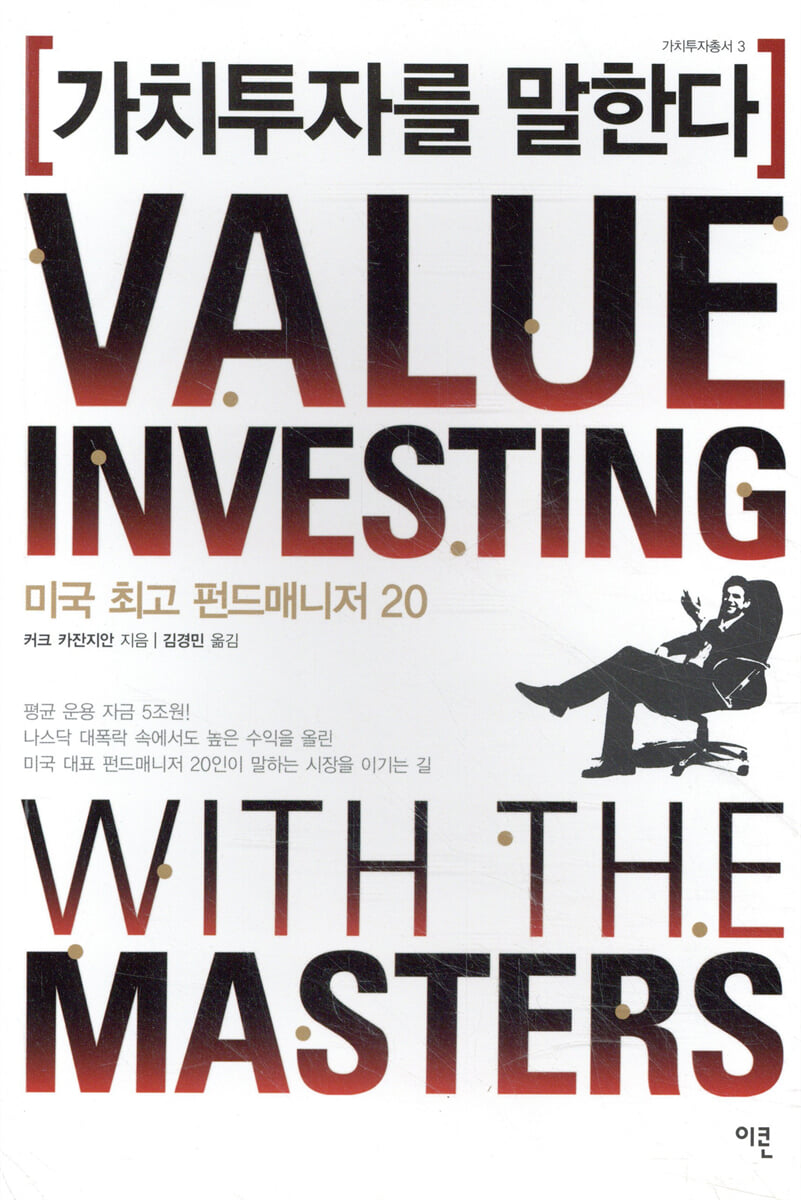
This book is about American fund managers who, although not as famous as Buffett, have beaten the market with their own principles of value investing. Each fund manager speaks confidently about value investing and their own investment methods.
Buffett's argument broadens our perspective on the diversity of value investing, suggesting that even Amazon, depending on price, can be considered a value investment, not just for Coca-Cola and Gillette, presents a puzzling yet entertaining concept.
Through this book, you can discover the secrets of the masters who are directly investing in Korea, such as the First Eagle Overseas Fund, which attempted to take advantage of Nexans Korea, and the Oakmark Fund, which is investing in Lotte Chilsung and Hite Brewery.
- You can preview some of the book's contents.
Preview
index
Ⅰ Masters of Value Investing
01 Christopher Brown
02 David Dreman
Chapter 3 Marie Eveillard
04 William Fries
05 James Gilligan
06 James Gibson
07 John Goode
08 William Miller
09 Ronald Mullencamp
10 William Nygren
11 Kevin O'Boyle
12 Robert Allstein
13 Robert Perkins
14 Charles Royce
15 Kent Simmons
16 Brett Stanley
17 Richard Weiss
18 Wallace Waits
19 Martin Whitman
20 David Williams
II The Investment Methods of Masters
What 21 Masters Have in Common
22 Ten Key Elements for Successful Value Investing
Terms frequently used in value investing
About the Author
Search
Into the book
“People buy everything in life, whether it’s a house, a car, or clothes, based on value.
I try to buy things on sale because I know how much they are worth.
In fact, people are not satisfied with a 10% sale.
When it reaches 20%, people start looking into it, and when it reaches 30%, they become interested.
But when it comes to buying stocks, we're like teenagers buying clothes.
“I buy whatever is trendy.”
Robert Mullencamp (Chairman and Portfolio Manager, Mullencamp & Company)
“We divest stocks when they become too expensive, not growing, or become ‘barbers.’
Being a barber means that your prices will go up to 90% of what a sole proprietor would pay for your business.
If the company continues to grow while we hold it, we may hold it for a longer period of time.
And if the stock is trading at a price higher than the company's private market value, we sell it.”
Christopher Brown (Director of Operations, Tweedy Brown Company)
“The first thing we do is to have a projection of what companies would survive if the New York Stock Exchange were to close tomorrow for the next 10 years.
The company is 1.
We know very well and 2.
I am doing good business and 3.
It must be traded at a significant discount to what a reasonable person would be willing to pay to become a partner in the business.”
James Gibson (President and Portfolio Manager, Pacific Financial Research)
“The dentist complained to me, ‘I don’t know how Cisco got down there.’
I asked him for his healing tools.
He was confused.
When I told him, 'The odds of you outperforming me in the stock market are about the same as the odds of me getting my teeth fixed,' he laughed.
If you don't understand what you're doing, it's best to leave it to the experts.”
Robert Allstein (CIO, Allstein Financial Alert Fund)
--- From the text
Publisher's Review
If it's not Buffett's style, then it's not value investing?
Average operating funds of 5 trillion won!
High returns even during the NASDAQ crash
How to Beat the Market: 20 Leading US Fund Managers
20 Hidden Masters of Value Investing Reveal Their Investment Secrets!
Value investing is a long-term investment in undervalued, high-quality companies based on their intrinsic value.
Although value investing is gaining popularity in Korea, when people think of value investors, they tend to think of only Benjamin Graham and Warren Buffett, and their investment methods are considered the only ones.
However, there are some famous investors who achieved high returns even during the Nasdaq crash by using a sound value investing methodology.
In 2004, when the first edition of this book was published, they were virtually unknown in Korea.
But now, five years later, most of the protagonists have already become famous for their successful investments.
In this book, you can hear the investment secrets of 20 hidden masters of value investing, told through their vivid voices.
Part 1 of the book consists of 20 chapters, each containing interviews with a different master.
They discuss the investment process, mentioning their background and motivations for entering the investment market, and explain in detail, including specific examples, how to find value stocks in the market.
In Part 2, we list the key characteristics shared by most masters.
Finally, terms frequently used by value investors are added.
The True Meaning of Investment and Value
Investors who have adhered to traditional value investing methods for over 30 years, investors who own technology stocks like Amazon.com and AOL Time Warner, and even those who are called vulture investors.
The 20 masters featured in the book are clearly at the forefront of value investing, running mutual funds that are currently outperforming their peers and the market.
While they share the philosophy of value investing, their backgrounds are diverse, and their definitions of value and specific methodologies are all different.
But by following their conversations, you can discover more fundamental principles about what investing is and what value means.
You can also find commonalities that lead to successful investments.
They all faithfully follow Benjamin Graham and Warren Buffett, possessing boundless love and passion for their work, the will to stick to their investment methods even when external circumstances change, and the courage not to succumb to criticism from others.
For those whose value investing philosophy is deeply ingrained in their lives, investing means more than just a job.
10 Key Elements of Successful Investing, According to Value Investing Masters
1.
Stay at the market
In order not to miss the opportunity, we do not leave the market and just watch, nor do we try to get ahead of the market.
2.
Think like the owner of a company
As Warren Buffett taught, rather than focusing on temporary stock prices, we should focus on the long-term development of the company by thinking of it as a long-term business partner.
3.
Price is important
They all define it differently, but they only buy stocks that they think are trading at a cheap price.
And respond flexibly depending on the situation.
4.
Buy unpopular stocks
Find stocks that others are not interested in or have lost their way.
5.
Prioritize stocks over price movements
We take a bottom-up approach, examining individual companies rather than the economic or market environment.
6.
Make the disposal period clear
Clarify the criteria for disposing of stocks and set a target selling price from the time of purchase.
7.
Have patience
Stick to your own style with the patience and willpower that others might think you're stupid.
8.
Be wary of Wall Street's picks
We consult Wall Street research, but are wary of recommended stocks.
9.
Get to know the company's management
Before buying stocks, thoroughly understand what drives a company and what kind of people its management is.
10.
Minimize risk
The most important thing is to manage risks and reduce losses.
GOODS SPECIFICS
- Date of issue: July 27, 2009
- Page count, weight, size: 480 pages | 712g | 153*224*30mm
- ISBN13: 9788990831705
- ISBN10: 8990831709
You may also like
카테고리
korean


korean


