

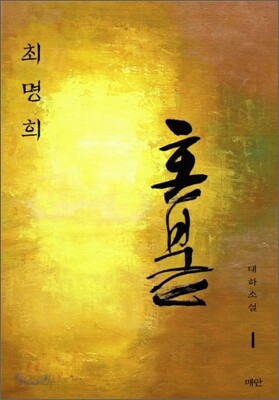
Soul Fire 1
 |
Description
Book Introduction
A complete restoration of our people's fundamental emotions and protoplasm!
Choi Myung-hee's historical novel "Soul Fire"
Late 1930s.
This is a story about three generations of the eldest daughter of a long-standing clan in Jeolla Province who fiercely fought to protect the collapsing ancestral home, and the sorrows and joys that the lowly and shabby commoners had to endure.
Dark history, gloomy times.
This work, which depicts the lives of people who were miserably broken, wounded, overturned, in agony, and endlessly struggling, yet beautiful, in a dualistic era where the country had outwardly lost its sovereignty and suffered severe oppression by the Japanese, but internally still maintained the Korean language's spiritual structure and culture, totals 12,000 pages of manuscript paper.
The humble wife of the deceased, Lady Cheongam, sits on a white mat and makes a vow while performing her rituals, vowing that she alone will raise her bones.
He straightens the collapsing pillar, pays tribute to his father-in-law, and adopts his nephew, Gi-chae, as his son.
He single-handedly revived his family, which was on the verge of collapse, and his son, Gi-chae, produced a grandson, Gang-mo, continuing the family lineage. He also completed the great work of building a reservoir, but the annexed country disappeared, and the family faced a crisis of preservation due to the forced adoption of Japanese names.
Grandson Kang Mo is frustrated with his marriage to Hyo Won and approaches his cousin Kang Sil with a longing love for her, but the sadness of not being able to achieve her leads him to wander, abandoning himself and running away, and turning to decadent romanticism.
Chunbok, an abandoned orphan born into lowly society, is pessimistic about the limitations of his innate fate and waits for the time when he can change his status and overcome it...
Choi Myung-hee's historical novel "Soul Fire"
Late 1930s.
This is a story about three generations of the eldest daughter of a long-standing clan in Jeolla Province who fiercely fought to protect the collapsing ancestral home, and the sorrows and joys that the lowly and shabby commoners had to endure.
Dark history, gloomy times.
This work, which depicts the lives of people who were miserably broken, wounded, overturned, in agony, and endlessly struggling, yet beautiful, in a dualistic era where the country had outwardly lost its sovereignty and suffered severe oppression by the Japanese, but internally still maintained the Korean language's spiritual structure and culture, totals 12,000 pages of manuscript paper.
The humble wife of the deceased, Lady Cheongam, sits on a white mat and makes a vow while performing her rituals, vowing that she alone will raise her bones.
He straightens the collapsing pillar, pays tribute to his father-in-law, and adopts his nephew, Gi-chae, as his son.
He single-handedly revived his family, which was on the verge of collapse, and his son, Gi-chae, produced a grandson, Gang-mo, continuing the family lineage. He also completed the great work of building a reservoir, but the annexed country disappeared, and the family faced a crisis of preservation due to the forced adoption of Japanese names.
Grandson Kang Mo is frustrated with his marriage to Hyo Won and approaches his cousin Kang Sil with a longing love for her, but the sadness of not being able to achieve her leads him to wander, abandoning himself and running away, and turning to decadent romanticism.
Chunbok, an abandoned orphan born into lowly society, is pessimistic about the limitations of his innate fate and waits for the time when he can change his status and overcome it...
index
Part 5, Volume 10
Part 1: The Swaying Wind, Volume 1
Building 1 lantern
Even if you plant two hundred herbs, you will not plant a large one.
Even if my heart is dyed green
4th month
5 A gloomy Sunday
6. Blue lantern seen alone
7 The Swaying Wind
8-window shutter
Part 1: The Swaying Wind, Volume 2
9th Battle
10 Indifferent mother, I'm just now writing a few words.
11 Net and Cloud
12 Manghonje
13 Chains of Darkness
14My soul is buried in you
15 chest epi
Part 2, Swaying Wind, Volume 3
1 Dark clouds
2 People leaving
3 Wet sleeves
4Come back, soul
5 beautiful white roots
No matter how many times I go, there's a road I can't take
7Please go to that land
8 Geomenggul Worries Rock
9-ring saddle
Part 2, Swaying Wind, Volume 4
10 noble and base
11What to throw away
12 Soot Fire Flower
13 Sad wishes
14 shooting stars
15 Parkmo
16 Changing World
17th floor
18th Pyeongtoje
19 Winter and Nampyeong
Part 3 Aso, Nimha Volume 5
Sky at 1 o'clock
Just two footsteps, just the sound of footsteps
3 Seotapgeori
4 small nests
5 Suspicious Years
6 Deokseokmal
I saw you for 7 months
Swamp of 8 Relationships
9 evil spirits
10 Lower Mall Department Network
11 If I die, please bury me.
12 Ah, why is the moon so bright?
Part 3 Aso, Nimha Volume 6
13. The Ultimate Emotion and No Text
It would be even better if there were 14 plum blossom hills.
15 That day
16-year-old shadow
17 Bamboo flowers
18 stains
19I see, that's why.
20-year-old man
21st degree
22 The heart is warmer than the fog
23 o'clock
24 pulse
25 Amy Abby
Part 4: The Land with a Flower Heart, Volume 7
1 black veil
2 You who are sinful
3 shots
4th scar
5 How come
6When I come back again
7 Blue Claws
8 kidnappings
9 dark-eyed owl
10 I will avenge this blood
News from afar
12 Cliffs of the Void
13th question
14Now is the time
The Land with a Flower Heart, Volume 8
15 I'm happy even if the world falls apart
16 The path of meaning
17 Land with a Flower Heart
18 Even if the name changes
19 Resistance and Surrender
20 The old land I long for
21 Naviduo
22 signs
23 o'clock palace is in the jade
I caught a pheasant and offered it so that I wouldn't miss the 24th one.
25 Yut points
26 Graduation Cry
27 Flower viewing on a spring day, Hwajeon-ga
Part 5 There are 9 people there
1 paper flower shade
2Cherryam (滯離巖)
3 The Last Door of Darkness
4 It is frustrating not to know this news.
5 Beautiful Four Heavenly Kings
6 mandalas
The Wings of the Seven Sins
8th place of mind, dream
9 No, no, no
10 That flower blooms here too
11 Rather, fly
12 A miserable life
Part 5 There are 10 people there
13Where am I?
14 bruises
15 Nomads
16 breaths
17 It's so trivial that it's great
18I don't know
19 Sad Oyuki
20 sand rings
Spring in Bongcheon
22 Scales of Tears
Part 1: The Swaying Wind, Volume 1
Building 1 lantern
Even if you plant two hundred herbs, you will not plant a large one.
Even if my heart is dyed green
4th month
5 A gloomy Sunday
6. Blue lantern seen alone
7 The Swaying Wind
8-window shutter
Part 1: The Swaying Wind, Volume 2
9th Battle
10 Indifferent mother, I'm just now writing a few words.
11 Net and Cloud
12 Manghonje
13 Chains of Darkness
14My soul is buried in you
15 chest epi
Part 2, Swaying Wind, Volume 3
1 Dark clouds
2 People leaving
3 Wet sleeves
4Come back, soul
5 beautiful white roots
No matter how many times I go, there's a road I can't take
7Please go to that land
8 Geomenggul Worries Rock
9-ring saddle
Part 2, Swaying Wind, Volume 4
10 noble and base
11What to throw away
12 Soot Fire Flower
13 Sad wishes
14 shooting stars
15 Parkmo
16 Changing World
17th floor
18th Pyeongtoje
19 Winter and Nampyeong
Part 3 Aso, Nimha Volume 5
Sky at 1 o'clock
Just two footsteps, just the sound of footsteps
3 Seotapgeori
4 small nests
5 Suspicious Years
6 Deokseokmal
I saw you for 7 months
Swamp of 8 Relationships
9 evil spirits
10 Lower Mall Department Network
11 If I die, please bury me.
12 Ah, why is the moon so bright?
Part 3 Aso, Nimha Volume 6
13. The Ultimate Emotion and No Text
It would be even better if there were 14 plum blossom hills.
15 That day
16-year-old shadow
17 Bamboo flowers
18 stains
19I see, that's why.
20-year-old man
21st degree
22 The heart is warmer than the fog
23 o'clock
24 pulse
25 Amy Abby
Part 4: The Land with a Flower Heart, Volume 7
1 black veil
2 You who are sinful
3 shots
4th scar
5 How come
6When I come back again
7 Blue Claws
8 kidnappings
9 dark-eyed owl
10 I will avenge this blood
News from afar
12 Cliffs of the Void
13th question
14Now is the time
The Land with a Flower Heart, Volume 8
15 I'm happy even if the world falls apart
16 The path of meaning
17 Land with a Flower Heart
18 Even if the name changes
19 Resistance and Surrender
20 The old land I long for
21 Naviduo
22 signs
23 o'clock palace is in the jade
I caught a pheasant and offered it so that I wouldn't miss the 24th one.
25 Yut points
26 Graduation Cry
27 Flower viewing on a spring day, Hwajeon-ga
Part 5 There are 9 people there
1 paper flower shade
2Cherryam (滯離巖)
3 The Last Door of Darkness
4 It is frustrating not to know this news.
5 Beautiful Four Heavenly Kings
6 mandalas
The Wings of the Seven Sins
8th place of mind, dream
9 No, no, no
10 That flower blooms here too
11 Rather, fly
12 A miserable life
Part 5 There are 10 people there
13Where am I?
14 bruises
15 Nomads
16 breaths
17 It's so trivial that it's great
18I don't know
19 Sad Oyuki
20 sand rings
Spring in Bongcheon
22 Scales of Tears
Into the book
The weather wasn't very clear.
In addition, there was a lot of wind noise in the bamboo forest.
Well, the sound of the wind blowing in the bamboo grove couldn't necessarily be attributed to the weather.
Even on clear, sunny days, a gentle breeze always blew through the bamboo grove.
It made a faint rustling sound as the leaves of the bamboo grove were rustling, and at times it made the sound of water as it was pushed to one side, and at other times it became calm and seemed to be calling out to someone by raising the blades of the green leaves.
--- Volume 1, p.7
The joy of the clan was that much greater because the main house did not simply mean the eldest son's family for generations.
Needless to say, the first offering of alcohol to the gods during a ancestral rite is always made by the eldest son.
Regarding the position at the ancestral rites, the head of the clan, who is the eldest adult in the clan, sits in the middle of the table, but the eldest son sits alone in the center of the front row.
The clan meeting is not held at the house of the eldest son in the clan, but at the head of the clan's family, and all records of the clan must be kept at the head of the clan and passed down from generation to generation.
That's not all.
In the family council, the eldest son sits in the upper seat than the elder son.
Even though the eldest son is a red-faced boy not yet twenty, he must sit above the white-bearded scholar.
“The eldest son is the pillar of the clan.
We have to go.
“The eldest son must preserve the right bloodline for generations to continue our family line.”
The sentence is repeated to the young grandson several times.
--- Volume 1, p.89
The work that started last year changed to the 5th year of King Sunjong's reign, Gyeongsul (庚戌), summer of 1910 in the Western calendar.
As construction nears its end.
Like a bolt from the blue, like a bolt from the blue, unexpectedly, on the twentieth day of August,
“Joseon has fallen.”
Did.
It means that the 'Japan-Korea Annexation' took place.
Before I could even realize what I was saying, the Maean Reservoir was completed.
Maean, who finally obtained the reservoir he had longed for after a long construction period, instead of wailing, waved his white twelve-foot hat in a Taegeuk pattern under the deep blue sky, and beat the drum, janggu, and gong in unison to the sound of the gong, offering a heartfelt ancestral rite to the heavens and embracing his overflowing joy.
And I cried.
“People say the country is ruined, it is ruined, but as long as I do not perish, the country will never perish.
For example, I think the relationship between a country and its people is like a bean pod and a bean grain.
Even if the bean hull dries, twists, and withers, if the bean inside is not dead but alive, the bean will fall into the darkness for a while to breathe new life, and then sprout again, producing countless fruits that fill the bean field.”
Who would dare to say that another country is ruined when the people are alive and well?
--- Volume 1, p.155
The smooth, thick silk like persimmon leaves and the starched, white, ivory-colored silk fold and unfold, making a rustling sound.
The room was quiet, as still as the bottom of the water, and only the sound of the blanket being spread out could be heard, like the sound of falling leaves.
The sound of dry leaves rustling in time can be heard on the branches of the persimmon tree behind the house.
Some of the leaves fall, making a rustling sound in the yard.
Is it because the mountain is nearby?
The sound of oak, maple, and zelkova leaves rustling against each other can be heard right under your ears.
Wow.
Suddenly, the sound of the wind blowing from the main room of her parents' house comes to Hyo-won's ears like waves.
The large leaves of the sacred bamboo forest sway in the wind, turning the day blue.
iced coffee.
--- Volume 1, p.166
Absorbing the moon refers to the act of standing facing the rising moon and taking a deep breath during the five days from the tenth day of the lunar calendar to the full moon when the moon swells like a full-term pregnancy, thereby absorbing the moon's energy, which generates the yin energy of the universe, into one's body.
By doing so, the yin energy of the moon is absorbed into the woman's body, and her blood strength increases.
The power to condense the infinite universe into a single dot of the moon and draw it into one's body.
People believed that with that blood power, they could have a son.
Volume 1, p.242
(Water does not have a fixed shape depending on the container.
If you pour it into a narrow tube, it becomes narrow, and if you pour it into a wide ocean, it becomes wide.
If it's high, it falls down, and if it's low, it stays in place.
When it's hot, it evaporates and becomes clouds, and when it's cold, it freezes.
(Although it never rebels, never fights, and conforms to the vessel, its position, and its heat and coolness, doesn't the nature of water itself remain the same?)
Appearance and vessel are only temporary phenomena.
The water that has seeped into the ground may seem to disappear, but it becomes groundwater and forms springs, and the water that has evaporated into the sky eventually becomes clouds and forms rain that wets the plants.
What does it mean to be obsessed with the basic format?
If you are obsessed with the superficial and fail to understand the truth of the invisible, you will end up sacrificing the essence for the form.
--- Volume 2, p.66
(Kang Sil-ah…….)
Why is that name so sad and tearful?
That faint, faint sparkle, like a thin gold thread, in the darkest part of the chest.
How can I possibly put into words how earnest I am?
It would occasionally pop its head out like the wick of a candle.
When her name comes to mind, it sparks like flint and ignites the wick.
It couldn't be stopped even with the power of the steel wool.
No matter how much I tried to put out the flame by taking a deep breath, it was useless, and no matter how much I tried to extinguish the flame by curling my chest, it was all in vain.
The wick embedded in the flesh burns the flesh and fades away.
--- Volume 2, p.96
The thought that I had nowhere to rely on in heaven and earth ran down my spine and my body trembled.
At that moment, Lady Cheongam unconsciously clenched her fist.
(I alone will raise up my bones.)
If you have the best talent, you can avoid genius.
If these bones stand tall and spread their roots, can they not become pillars?
If the branches spread out lushly, how could they not become a roof?
She straightened her back.
And he looked at the quantum machine, which was playing without a second thought, with frosty eyes.
--- Volume 2, p.237
Just as the underground roots alone draw up the rich sap from the darkness and send it to the far end of the apricot tree branch, the branch seemed to be sucking up the darkness of the twilight falling on the heavens and earth with its entire body and sending it down to the underground roots.
If that stump is a root, then the branches with roots upside down would be it.
--- Volume 4, p.155
The full moon on the full moon day is a full moon that is perfectly clear to anyone who sees it, but what kind of moon rises on a pitch-black night like a black hole and is called a full moon?
However, the full moon is the Ondal that rises above the ground, and the waning moon is the Ondal that is buried underground.
What are the human eyes?
If you can see it, you say it exists, and if you can't see it, you say it doesn't exist, but on a night so dark and black that not even the tip of the blue moonlight's eyebrows can be seen, the moon is full all alone in the underground, an area that cannot even be guessed at.
--- Volume 5, p.158
Ki-eung cut all the strings and pushed them to one side, then folded the clean string paper once horizontally and once vertically, and cut out a circle in the middle of the folded corners as if he had drawn it with a knife.
The once neat and perfect white paper was suddenly torn apart and pierced with a piercing wound.
It could be said that the five internal organs of paper have been cruelly cut out. What could a kite possibly be thinking? It dyes the very thing that painfully cut out of its heart beautifully and attaches it to its forehead, and shows off its appearance with a more splendid color than any other kite, and even gives it a name, and carries a wish and drives away evil spirits, and flies far away to the high, high sky.
How sad and beautiful it is.
Is that the case with people too?
--- Vol. 5, pp. 225-227
There is nothing in the world more precious than life.
Just because you're alive doesn't mean you have life.
To be dead while alive is to deceive myself.
There are countless people in the world who believe they are alive but are actually dead.
“If you put all your heart into it and preserve it like a spark, without killing it, it will flourish on its own.”
Life is soul.
Life is possible only when there is a soul.
“Okay, I understand.”
“You have to protect your heart no matter what.
“The heart of man is his life.”
“I will keep that in mind.”
“If you lose your heart, your life is wasted.”
"Yes." --- Vol. 6, p.119
“Oh, by the way, monk.
“Is the location of the directional letters for each rank not east, west, south, and north, but east, south, west, and north?”
"yes.
The directions of this world are seen as circular.
If east, west, south, and north are opposite concepts of direction, that is, they are symmetrical, then east, south, west, and north are circles.
So, if you look at the directions of east, south, west, and north, wouldn't you classify and divide them into categories like sun rise, sun set, cold, hot, bright, and dark? However, the directions of east, south, west, and north start in the east, where the sun rises, move south, where the sun gradually grows longer and brighter, and then go west, where the sun sets.
And then night comes.
It's the North.
And the North is parallel to the East.
When darkness quietly embraces the universe and all things, the morning sun will eventually rise.
So, moving east, south, west, and north is in accordance with the natural order and peace of the universe.
It is a sense of direction that suits our body.
In this defense, there is peace where everything is next to each other, equal, and infinitely circulating.”
"okay…….
I didn't know."
A hand that can feel the universe even when pointing the direction.
In addition, there was a lot of wind noise in the bamboo forest.
Well, the sound of the wind blowing in the bamboo grove couldn't necessarily be attributed to the weather.
Even on clear, sunny days, a gentle breeze always blew through the bamboo grove.
It made a faint rustling sound as the leaves of the bamboo grove were rustling, and at times it made the sound of water as it was pushed to one side, and at other times it became calm and seemed to be calling out to someone by raising the blades of the green leaves.
--- Volume 1, p.7
The joy of the clan was that much greater because the main house did not simply mean the eldest son's family for generations.
Needless to say, the first offering of alcohol to the gods during a ancestral rite is always made by the eldest son.
Regarding the position at the ancestral rites, the head of the clan, who is the eldest adult in the clan, sits in the middle of the table, but the eldest son sits alone in the center of the front row.
The clan meeting is not held at the house of the eldest son in the clan, but at the head of the clan's family, and all records of the clan must be kept at the head of the clan and passed down from generation to generation.
That's not all.
In the family council, the eldest son sits in the upper seat than the elder son.
Even though the eldest son is a red-faced boy not yet twenty, he must sit above the white-bearded scholar.
“The eldest son is the pillar of the clan.
We have to go.
“The eldest son must preserve the right bloodline for generations to continue our family line.”
The sentence is repeated to the young grandson several times.
--- Volume 1, p.89
The work that started last year changed to the 5th year of King Sunjong's reign, Gyeongsul (庚戌), summer of 1910 in the Western calendar.
As construction nears its end.
Like a bolt from the blue, like a bolt from the blue, unexpectedly, on the twentieth day of August,
“Joseon has fallen.”
Did.
It means that the 'Japan-Korea Annexation' took place.
Before I could even realize what I was saying, the Maean Reservoir was completed.
Maean, who finally obtained the reservoir he had longed for after a long construction period, instead of wailing, waved his white twelve-foot hat in a Taegeuk pattern under the deep blue sky, and beat the drum, janggu, and gong in unison to the sound of the gong, offering a heartfelt ancestral rite to the heavens and embracing his overflowing joy.
And I cried.
“People say the country is ruined, it is ruined, but as long as I do not perish, the country will never perish.
For example, I think the relationship between a country and its people is like a bean pod and a bean grain.
Even if the bean hull dries, twists, and withers, if the bean inside is not dead but alive, the bean will fall into the darkness for a while to breathe new life, and then sprout again, producing countless fruits that fill the bean field.”
Who would dare to say that another country is ruined when the people are alive and well?
--- Volume 1, p.155
The smooth, thick silk like persimmon leaves and the starched, white, ivory-colored silk fold and unfold, making a rustling sound.
The room was quiet, as still as the bottom of the water, and only the sound of the blanket being spread out could be heard, like the sound of falling leaves.
The sound of dry leaves rustling in time can be heard on the branches of the persimmon tree behind the house.
Some of the leaves fall, making a rustling sound in the yard.
Is it because the mountain is nearby?
The sound of oak, maple, and zelkova leaves rustling against each other can be heard right under your ears.
Wow.
Suddenly, the sound of the wind blowing from the main room of her parents' house comes to Hyo-won's ears like waves.
The large leaves of the sacred bamboo forest sway in the wind, turning the day blue.
iced coffee.
--- Volume 1, p.166
Absorbing the moon refers to the act of standing facing the rising moon and taking a deep breath during the five days from the tenth day of the lunar calendar to the full moon when the moon swells like a full-term pregnancy, thereby absorbing the moon's energy, which generates the yin energy of the universe, into one's body.
By doing so, the yin energy of the moon is absorbed into the woman's body, and her blood strength increases.
The power to condense the infinite universe into a single dot of the moon and draw it into one's body.
People believed that with that blood power, they could have a son.
Volume 1, p.242
(Water does not have a fixed shape depending on the container.
If you pour it into a narrow tube, it becomes narrow, and if you pour it into a wide ocean, it becomes wide.
If it's high, it falls down, and if it's low, it stays in place.
When it's hot, it evaporates and becomes clouds, and when it's cold, it freezes.
(Although it never rebels, never fights, and conforms to the vessel, its position, and its heat and coolness, doesn't the nature of water itself remain the same?)
Appearance and vessel are only temporary phenomena.
The water that has seeped into the ground may seem to disappear, but it becomes groundwater and forms springs, and the water that has evaporated into the sky eventually becomes clouds and forms rain that wets the plants.
What does it mean to be obsessed with the basic format?
If you are obsessed with the superficial and fail to understand the truth of the invisible, you will end up sacrificing the essence for the form.
--- Volume 2, p.66
(Kang Sil-ah…….)
Why is that name so sad and tearful?
That faint, faint sparkle, like a thin gold thread, in the darkest part of the chest.
How can I possibly put into words how earnest I am?
It would occasionally pop its head out like the wick of a candle.
When her name comes to mind, it sparks like flint and ignites the wick.
It couldn't be stopped even with the power of the steel wool.
No matter how much I tried to put out the flame by taking a deep breath, it was useless, and no matter how much I tried to extinguish the flame by curling my chest, it was all in vain.
The wick embedded in the flesh burns the flesh and fades away.
--- Volume 2, p.96
The thought that I had nowhere to rely on in heaven and earth ran down my spine and my body trembled.
At that moment, Lady Cheongam unconsciously clenched her fist.
(I alone will raise up my bones.)
If you have the best talent, you can avoid genius.
If these bones stand tall and spread their roots, can they not become pillars?
If the branches spread out lushly, how could they not become a roof?
She straightened her back.
And he looked at the quantum machine, which was playing without a second thought, with frosty eyes.
--- Volume 2, p.237
Just as the underground roots alone draw up the rich sap from the darkness and send it to the far end of the apricot tree branch, the branch seemed to be sucking up the darkness of the twilight falling on the heavens and earth with its entire body and sending it down to the underground roots.
If that stump is a root, then the branches with roots upside down would be it.
--- Volume 4, p.155
The full moon on the full moon day is a full moon that is perfectly clear to anyone who sees it, but what kind of moon rises on a pitch-black night like a black hole and is called a full moon?
However, the full moon is the Ondal that rises above the ground, and the waning moon is the Ondal that is buried underground.
What are the human eyes?
If you can see it, you say it exists, and if you can't see it, you say it doesn't exist, but on a night so dark and black that not even the tip of the blue moonlight's eyebrows can be seen, the moon is full all alone in the underground, an area that cannot even be guessed at.
--- Volume 5, p.158
Ki-eung cut all the strings and pushed them to one side, then folded the clean string paper once horizontally and once vertically, and cut out a circle in the middle of the folded corners as if he had drawn it with a knife.
The once neat and perfect white paper was suddenly torn apart and pierced with a piercing wound.
It could be said that the five internal organs of paper have been cruelly cut out. What could a kite possibly be thinking? It dyes the very thing that painfully cut out of its heart beautifully and attaches it to its forehead, and shows off its appearance with a more splendid color than any other kite, and even gives it a name, and carries a wish and drives away evil spirits, and flies far away to the high, high sky.
How sad and beautiful it is.
Is that the case with people too?
--- Vol. 5, pp. 225-227
There is nothing in the world more precious than life.
Just because you're alive doesn't mean you have life.
To be dead while alive is to deceive myself.
There are countless people in the world who believe they are alive but are actually dead.
“If you put all your heart into it and preserve it like a spark, without killing it, it will flourish on its own.”
Life is soul.
Life is possible only when there is a soul.
“Okay, I understand.”
“You have to protect your heart no matter what.
“The heart of man is his life.”
“I will keep that in mind.”
“If you lose your heart, your life is wasted.”
"Yes." --- Vol. 6, p.119
“Oh, by the way, monk.
“Is the location of the directional letters for each rank not east, west, south, and north, but east, south, west, and north?”
"yes.
The directions of this world are seen as circular.
If east, west, south, and north are opposite concepts of direction, that is, they are symmetrical, then east, south, west, and north are circles.
So, if you look at the directions of east, south, west, and north, wouldn't you classify and divide them into categories like sun rise, sun set, cold, hot, bright, and dark? However, the directions of east, south, west, and north start in the east, where the sun rises, move south, where the sun gradually grows longer and brighter, and then go west, where the sun sets.
And then night comes.
It's the North.
And the North is parallel to the East.
When darkness quietly embraces the universe and all things, the morning sun will eventually rise.
So, moving east, south, west, and north is in accordance with the natural order and peace of the universe.
It is a sense of direction that suits our body.
In this defense, there is peace where everything is next to each other, equal, and infinitely circulating.”
"okay…….
I didn't know."
A hand that can feel the universe even when pointing the direction.
--- Volume 9, p.166
Publisher's Review
While republishing Choi Myeong-hee's epic novel, Soul Fire,
Korea, the land of flowers, has a soul fire.
Koreans read the soul.
“What makes me use ‘Soul Fire’ so constantly?
There may be several reasons for this,
First and foremost, the most important foundation would be my ‘longing for my roots.’
Another way to put it is, 'longing for myself'.
I have always longed for the secrets of the soul hidden in the essence of humans, nature, the universe, and things.
And the phenomenon in which these secrets interact with each other in an inevitable relationship
“I wanted to restore it delicately through the microscope and telescope of language.”
-From an invited lecture at the University of Chicago in the United States-
The turbulent world history of the early 20th century
Aggressive wars driven by the hegemony of imperialist powers
It was a time of chaos and turmoil, with changes such as the reorganization of social order due to the emergence of a new citizen class.
This turbulent flow is shaking the pulse of our traditional society and culture.
The country disappears, bringing the shame of losing its sovereignty.
The head family of a family that should have preserved the upright spirit of its ancestors wandered.
Author Choi Myeong-hee, with this era as the background,
Reviving our souls that are wavering, wandering, and fading away,
In this land of flowers,
Dreaming of an era where the bright and shining soul flame lives on
I devoted 17 long years to writing Honbuljip.
Where did the origin of my mind and body begin?
The writer has a longing for the origin, or in other words, a longing for himself.
He said that it was an important basis for writing the Honbul,
We sought to restore the original essence of our spirit, everything our ancestors had accomplished.
The secrets of the soul hidden in the essence of human nature, the universe, and things,
So that we can feel vividly and exist alive,
In order for the pattern of our soul to be connected with my life today,
It is like bringing back to life the voices of one's mother and grandmother in the soul.
Among the many ideas the author included in his novel,
It is said that the darkness of the full moon and the waning moon is never darker than the light,
The peace that the universe gives by its endlessly circulating nature, explaining the symmetrical east, west, south, and north directions,
It is described as a concept of the east, south, west, and north that are adjacent, equal, and circulating.
Lady Cheongam, the wife of the head of the household, vowed to raise her own bones by herself and built a strong frame of frost.
Filled with a warm maternal feeling, it is a body that combines yin and yang.
It showed great femininity as a hermaphrodite.
Language is the fingerprint of the mind, and the mother tongue is the soul of the motherland.
How can we carelessly manipulate the pattern that is imprinted with our soul, my soul, my spirit?
As the seed of our language that contains the true light-like kernel, we use our narrative method rather than the introduction, development, turn, and conclusion.
Our ancestors' way of life and way of thinking are revealed through various stories, history, and ceremonial rituals.
By showing the reality and restoring the feeling of a living, breathing being rather than a stuffed historical document,
By depicting a social landscape that overcomes the times, we can see the life that exists today and the direction of tomorrow.
It is implied.
The epic novel Soul Fire and its author Choi Myung-hee
.......The humble wife of the deceased, Lady Cheongam, sat on a white cloth and performed the ritual.
I vow to raise my bones alone.
He straightens the collapsing pillar, pays tribute to his father-in-law, and adopts his nephew, Gi-chae, as his son.
He single-handedly revived the family that was on the verge of collapse, and his son, Gi-chae, produced a grandson, Gang-mo, to continue the family line.
The great history of reservoir construction was completed, but the annexed country disappeared, and the family was put in danger of being forgotten due to the forced change of name.
Grandson Kang Mo is frustrated with his marriage to Hyowon and approaches his cousin Kang Sil with his deep love for her, but the sadness of not being able to achieve it leads to self-abandonment, indifference, and escape.
He wanders, driving himself into decadent romanticism.
Chunbok, an abandoned orphan born into low birth,
While pessimistic about the limitations of one's innate destiny, one waits for the time when one can change one's status and overcome it...
The novel “Soul Fire” is set in the late 1930s.
This is a story about three generations of the eldest daughter of a long-standing clan in Jeolla Province who fiercely fought to protect the collapsing ancestral home, and the sorrows and joys that the lowly and shabby commoners had to endure.
Dark history, gloomy times.
Outwardly, they lost their sovereignty and suffered severe oppression from the Japanese.
Internally, in the dualistic era that still supported the mental structure and culture of the Korean language, it was miserably broken, hurt, overturned, in agony, and endlessly struggling, but it was beautiful.
This work, which embodies people's lives, totals 12,000 pages of manuscript paper.
Choi Myeong-hee, the author of “Soul Fire,” was born on October 10, 1947, in Pungnam-dong, Jeonju-si, Jeollabuk-do, with her father, Seong Mu.
She was born as the eldest daughter among two sons and four daughters of her mother, Myosun (Yangcheon Heo).
Choi Myeong-hee graduated from Jeonju Pungnam Elementary School and Jeonju Teachers' Middle School, and then Jeonju Gijeon Girls' High School.
Graduated from the Department of Korean Language and Literature at Jeonbuk National University.
From 1972 to 1974, he worked as a Korean language teacher at his alma mater, Jeonju Gijeon Girls' High School, and from the spring of 1974 to February 1981, he worked as a Korean language teacher at Seoul Boseong Girls' High School, where he raised many students and was called 'the most
He was also respected as an 'unforgettable teacher'.
Since childhood, he has never once paid attention to anything other than literature.
He was recognized for his literary prowess with his outstanding sensibility and outstanding writing skills, sweeping national literary contests since his school days. He made his literary debut in 1980 when his short story "Falling Light" won the JoongAng Ilbo New Year's Literary Contest.
The following year, in 1981, the Dong-A Ilbo held a contest to select a long novel to commemorate its 60th anniversary.
'Honbul' (Part 1) attracted public attention when it was selected.
I started writing the first sentence, “It wasn’t a very clear day,” in April of 1980, and the last one,
This epic novel, “Soul Fire,” took 17 years to write, including the sentence “Tears well up all over his body.”
The first part was serialized in the Dong-A Ilbo, and parts 2 through 5 were serialized in the monthly current affairs magazine “Shin Dong-A” for 7 years and 2 months from August 1988 to October 1995, and then compiled into ten volumes.
When the epic novel Honbul was published in 10 volumes in 5 parts in December 1996, the response from readers was so enthusiastic that it immediately became a million-seller. It was selected as the best book of the late 20th century and 1990s by 100 experts, and was evaluated as the greatest achievement of Korean literature.
The reading world has fallen into a syndrome of epic novels.
This work, which took an unimaginable amount of time, 17 years, to create, is now evaluated as a monumental work that will remain in the history of Korean literature.
What author Choi Myeong-hee wanted to say through her novel “Soul Fire” was the perfect restoration of our people’s fundamental emotions and original plasm.
There are many different characters in this novel.
The author, through the protagonists of this class, has lived for only 60 years.
It depicts the landscapes in which our ancestors lived, wore, and ate, as if we were seeing them with our own eyes.
However, the author believes that the reason why the story, which takes place only about 60 years ago, feels like a story from a very distant time is because of the modernization process in our society that has carved out that gap.
The logic of an era that is so ruthless and simple that it eliminates those who cannot keep up with the incredible speed and uncontrollable acceleration.
However, modern society is changing so rapidly
Ultimately, the author believed that the dismantling of the mother tongue would mean the transformation of national sentiment.
“Without darkness, none of us can be born into life.
Darkness is the god of all things and the mother of life.
For light to shine brightly, there must be darkness.
So, the fire of the spirit, the fire of the soul, may actually burn brighter in times of chaos.”
His efforts have borne fruit, winning him several prestigious awards.
In July 1997, he won the 11th Danjae Award in Literature, and in August of the same year, he received an honorary doctorate in literature from Jeonbuk National University, and in October, he received the 16th Sejong Cultural Award hosted by the Ministry of Culture, Sports and Tourism.
The following year, in January 1998, she received the 15th Women's Dong-A Grand Prize hosted by the Dong-A Ilbo, and in June, she received the 5th Ho-Am Prize in the Arts category hosted by the Ho-Am Foundation, and the government posthumously awarded her the Order of Cultural Merit.
In addition to “Honbul,” which she devoted herself to for 17 years, author Choi Myeong-hee left behind other exquisite works.
The short stories "Je-mang-mae-ga" and "Byeol-byeol (袂別)", "Jeong-ok-i", "Man-jong", and "Address" contain stories about pansori singers.
Similar short stories have already been highly regarded for their literary value.
He was invited to lecture at several prestigious universities in the United States from 1994 to 1996, and the Department of Korean Studies at the State University of New York at Stony Brook adopted his lecture, “My Soul, My Literature,” as an advanced Korean language textbook.
Now a legend, with a beautiful writing style that no one can imitate and a noble belief in the mother tongue.
The writer Choi Myeong-hee, who had been absorbed in her work, left this land with a flower heart, the world she loved, on December 11, 1998, with the last words, “I hope you live well in this beautiful world.”
He is fifty-one years old.
How can I express that sorrow in words?
He now rests in the 'Choi Myeong-hee Literature Park' in his hometown of Jeonju.
But the bright and shining world he dreamed of, where the soul fire was alive, will be remembered forever in people's hearts.
Korea, the land of flowers, has a soul fire.
Koreans read the soul.
“What makes me use ‘Soul Fire’ so constantly?
There may be several reasons for this,
First and foremost, the most important foundation would be my ‘longing for my roots.’
Another way to put it is, 'longing for myself'.
I have always longed for the secrets of the soul hidden in the essence of humans, nature, the universe, and things.
And the phenomenon in which these secrets interact with each other in an inevitable relationship
“I wanted to restore it delicately through the microscope and telescope of language.”
-From an invited lecture at the University of Chicago in the United States-
The turbulent world history of the early 20th century
Aggressive wars driven by the hegemony of imperialist powers
It was a time of chaos and turmoil, with changes such as the reorganization of social order due to the emergence of a new citizen class.
This turbulent flow is shaking the pulse of our traditional society and culture.
The country disappears, bringing the shame of losing its sovereignty.
The head family of a family that should have preserved the upright spirit of its ancestors wandered.
Author Choi Myeong-hee, with this era as the background,
Reviving our souls that are wavering, wandering, and fading away,
In this land of flowers,
Dreaming of an era where the bright and shining soul flame lives on
I devoted 17 long years to writing Honbuljip.
Where did the origin of my mind and body begin?
The writer has a longing for the origin, or in other words, a longing for himself.
He said that it was an important basis for writing the Honbul,
We sought to restore the original essence of our spirit, everything our ancestors had accomplished.
The secrets of the soul hidden in the essence of human nature, the universe, and things,
So that we can feel vividly and exist alive,
In order for the pattern of our soul to be connected with my life today,
It is like bringing back to life the voices of one's mother and grandmother in the soul.
Among the many ideas the author included in his novel,
It is said that the darkness of the full moon and the waning moon is never darker than the light,
The peace that the universe gives by its endlessly circulating nature, explaining the symmetrical east, west, south, and north directions,
It is described as a concept of the east, south, west, and north that are adjacent, equal, and circulating.
Lady Cheongam, the wife of the head of the household, vowed to raise her own bones by herself and built a strong frame of frost.
Filled with a warm maternal feeling, it is a body that combines yin and yang.
It showed great femininity as a hermaphrodite.
Language is the fingerprint of the mind, and the mother tongue is the soul of the motherland.
How can we carelessly manipulate the pattern that is imprinted with our soul, my soul, my spirit?
As the seed of our language that contains the true light-like kernel, we use our narrative method rather than the introduction, development, turn, and conclusion.
Our ancestors' way of life and way of thinking are revealed through various stories, history, and ceremonial rituals.
By showing the reality and restoring the feeling of a living, breathing being rather than a stuffed historical document,
By depicting a social landscape that overcomes the times, we can see the life that exists today and the direction of tomorrow.
It is implied.
The epic novel Soul Fire and its author Choi Myung-hee
.......The humble wife of the deceased, Lady Cheongam, sat on a white cloth and performed the ritual.
I vow to raise my bones alone.
He straightens the collapsing pillar, pays tribute to his father-in-law, and adopts his nephew, Gi-chae, as his son.
He single-handedly revived the family that was on the verge of collapse, and his son, Gi-chae, produced a grandson, Gang-mo, to continue the family line.
The great history of reservoir construction was completed, but the annexed country disappeared, and the family was put in danger of being forgotten due to the forced change of name.
Grandson Kang Mo is frustrated with his marriage to Hyowon and approaches his cousin Kang Sil with his deep love for her, but the sadness of not being able to achieve it leads to self-abandonment, indifference, and escape.
He wanders, driving himself into decadent romanticism.
Chunbok, an abandoned orphan born into low birth,
While pessimistic about the limitations of one's innate destiny, one waits for the time when one can change one's status and overcome it...
The novel “Soul Fire” is set in the late 1930s.
This is a story about three generations of the eldest daughter of a long-standing clan in Jeolla Province who fiercely fought to protect the collapsing ancestral home, and the sorrows and joys that the lowly and shabby commoners had to endure.
Dark history, gloomy times.
Outwardly, they lost their sovereignty and suffered severe oppression from the Japanese.
Internally, in the dualistic era that still supported the mental structure and culture of the Korean language, it was miserably broken, hurt, overturned, in agony, and endlessly struggling, but it was beautiful.
This work, which embodies people's lives, totals 12,000 pages of manuscript paper.
Choi Myeong-hee, the author of “Soul Fire,” was born on October 10, 1947, in Pungnam-dong, Jeonju-si, Jeollabuk-do, with her father, Seong Mu.
She was born as the eldest daughter among two sons and four daughters of her mother, Myosun (Yangcheon Heo).
Choi Myeong-hee graduated from Jeonju Pungnam Elementary School and Jeonju Teachers' Middle School, and then Jeonju Gijeon Girls' High School.
Graduated from the Department of Korean Language and Literature at Jeonbuk National University.
From 1972 to 1974, he worked as a Korean language teacher at his alma mater, Jeonju Gijeon Girls' High School, and from the spring of 1974 to February 1981, he worked as a Korean language teacher at Seoul Boseong Girls' High School, where he raised many students and was called 'the most
He was also respected as an 'unforgettable teacher'.
Since childhood, he has never once paid attention to anything other than literature.
He was recognized for his literary prowess with his outstanding sensibility and outstanding writing skills, sweeping national literary contests since his school days. He made his literary debut in 1980 when his short story "Falling Light" won the JoongAng Ilbo New Year's Literary Contest.
The following year, in 1981, the Dong-A Ilbo held a contest to select a long novel to commemorate its 60th anniversary.
'Honbul' (Part 1) attracted public attention when it was selected.
I started writing the first sentence, “It wasn’t a very clear day,” in April of 1980, and the last one,
This epic novel, “Soul Fire,” took 17 years to write, including the sentence “Tears well up all over his body.”
The first part was serialized in the Dong-A Ilbo, and parts 2 through 5 were serialized in the monthly current affairs magazine “Shin Dong-A” for 7 years and 2 months from August 1988 to October 1995, and then compiled into ten volumes.
When the epic novel Honbul was published in 10 volumes in 5 parts in December 1996, the response from readers was so enthusiastic that it immediately became a million-seller. It was selected as the best book of the late 20th century and 1990s by 100 experts, and was evaluated as the greatest achievement of Korean literature.
The reading world has fallen into a syndrome of epic novels.
This work, which took an unimaginable amount of time, 17 years, to create, is now evaluated as a monumental work that will remain in the history of Korean literature.
What author Choi Myeong-hee wanted to say through her novel “Soul Fire” was the perfect restoration of our people’s fundamental emotions and original plasm.
There are many different characters in this novel.
The author, through the protagonists of this class, has lived for only 60 years.
It depicts the landscapes in which our ancestors lived, wore, and ate, as if we were seeing them with our own eyes.
However, the author believes that the reason why the story, which takes place only about 60 years ago, feels like a story from a very distant time is because of the modernization process in our society that has carved out that gap.
The logic of an era that is so ruthless and simple that it eliminates those who cannot keep up with the incredible speed and uncontrollable acceleration.
However, modern society is changing so rapidly
Ultimately, the author believed that the dismantling of the mother tongue would mean the transformation of national sentiment.
“Without darkness, none of us can be born into life.
Darkness is the god of all things and the mother of life.
For light to shine brightly, there must be darkness.
So, the fire of the spirit, the fire of the soul, may actually burn brighter in times of chaos.”
His efforts have borne fruit, winning him several prestigious awards.
In July 1997, he won the 11th Danjae Award in Literature, and in August of the same year, he received an honorary doctorate in literature from Jeonbuk National University, and in October, he received the 16th Sejong Cultural Award hosted by the Ministry of Culture, Sports and Tourism.
The following year, in January 1998, she received the 15th Women's Dong-A Grand Prize hosted by the Dong-A Ilbo, and in June, she received the 5th Ho-Am Prize in the Arts category hosted by the Ho-Am Foundation, and the government posthumously awarded her the Order of Cultural Merit.
In addition to “Honbul,” which she devoted herself to for 17 years, author Choi Myeong-hee left behind other exquisite works.
The short stories "Je-mang-mae-ga" and "Byeol-byeol (袂別)", "Jeong-ok-i", "Man-jong", and "Address" contain stories about pansori singers.
Similar short stories have already been highly regarded for their literary value.
He was invited to lecture at several prestigious universities in the United States from 1994 to 1996, and the Department of Korean Studies at the State University of New York at Stony Brook adopted his lecture, “My Soul, My Literature,” as an advanced Korean language textbook.
Now a legend, with a beautiful writing style that no one can imitate and a noble belief in the mother tongue.
The writer Choi Myeong-hee, who had been absorbed in her work, left this land with a flower heart, the world she loved, on December 11, 1998, with the last words, “I hope you live well in this beautiful world.”
He is fifty-one years old.
How can I express that sorrow in words?
He now rests in the 'Choi Myeong-hee Literature Park' in his hometown of Jeonju.
But the bright and shining world he dreamed of, where the soul fire was alive, will be remembered forever in people's hearts.
GOODS SPECIFICS
- Date of issue: July 17, 2009
- Page count, weight, size: 278 pages | 580g | 148*210*20mm
- ISBN13: 9788993607017
- ISBN10: 899360701X
You may also like
카테고리
korean


korean

![GQ KOREA Mark (Monthly): December [2025]](http://librairie.coreenne.fr/cdn/shop/files/8ef265dbbfbf186523ed75ba7319009d.jpg?v=1765340328&width=3840)


