

PHILO DESIGN
 |
Description
Book Introduction
A new design book published five years later by the author, who was reinstated to his original position at the Department of Design at Seoul National University in 2005 after six and a half years of struggle and litigation to be reinstated.
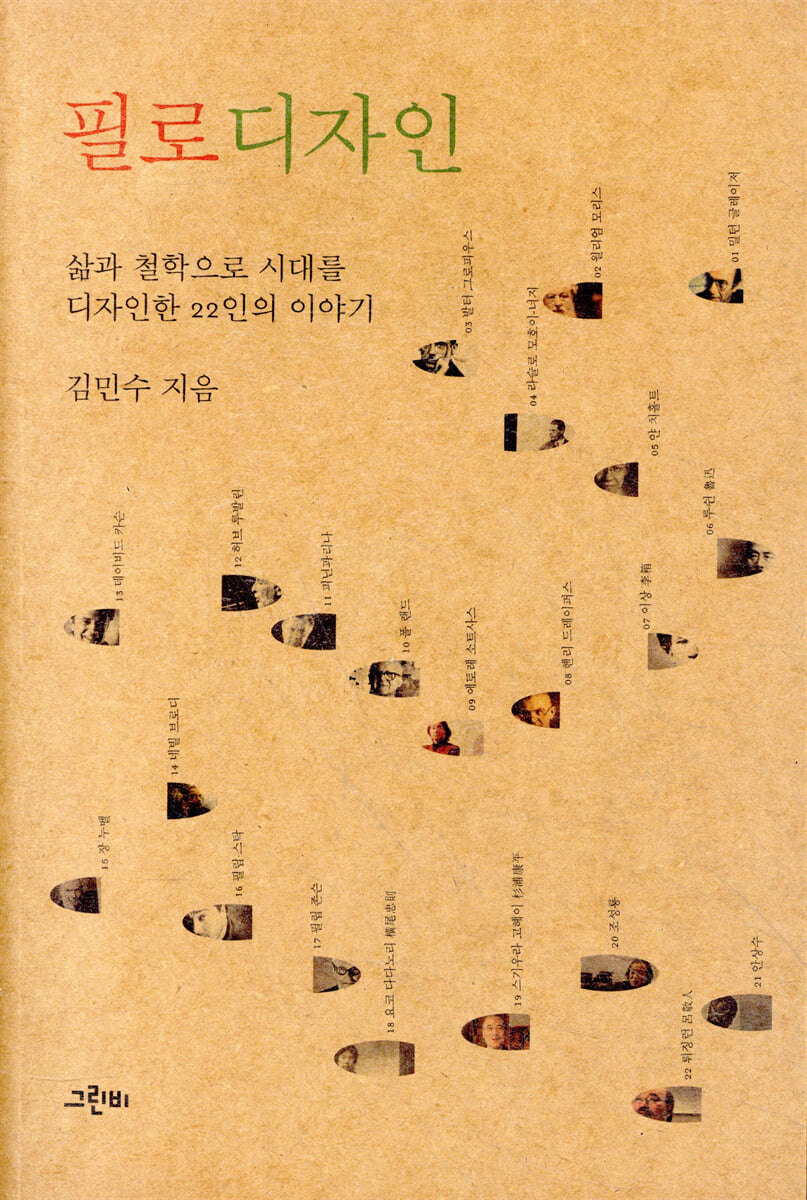
This is an art-humanities essay that shows how design and philosophy meet through the life of a designer.
The author, who has consistently discussed the social significance, role, and reflective function of design since his previous works, continues to push forward his previous awareness of the problem and talks about design that enables reflection on human life and the future.
And to talk about this design, we hear about the lives, works, and philosophies of 22 designers who designed the times.
From figures from over 100 years ago to those of our time, we can see the power of 22 designers who changed the times and provided reflection on human life through their design work based on their own philosophies, and the power that only design combined with philosophy can have to 'change lives and change society.'
This is an art-humanities essay that shows how design and philosophy meet through the life of a designer.
The author, who has consistently discussed the social significance, role, and reflective function of design since his previous works, continues to push forward his previous awareness of the problem and talks about design that enables reflection on human life and the future.
And to talk about this design, we hear about the lives, works, and philosophies of 22 designers who designed the times.
From figures from over 100 years ago to those of our time, we can see the power of 22 designers who changed the times and provided reflection on human life through their design work based on their own philosophies, and the power that only design combined with philosophy can have to 'change lives and change society.'
- You can preview some of the book's contents.
Preview
index
Preface: Why We Focus on Designers
Prologue: Civic Consciousness and Designers
01 'I ♥ Truth': Milton Glaser, the Great Citizen Designer
.1.
The Blood and Truth of 9/11 .2.
'I ♥ Truth' .3.
Great citizen designer!
Part 1: Thinking Beyond Modernity at the Beginning of Modernity
02 Modern Design and the First Self-Consciousness: William Morris
.1.
The modern meaning of Morris.2.
Background .3.
Arts and Crafts Movement and Aftermath
03 In Search of the Bauhaus Ark: Walter Gropius
.1.
Bauhaus in the sunset.2.
Desperate life, new art. 3.
Gropius's Sorrow
04 The First Totalist Artist of the 20th Century: László Moholy-Nagy
.1.
Predicting Image Illiteracy.2.
Life and Journey.3.
The New Vision
05 The Creation and Deconstruction of New Typography: Jan Tschichold
.1.
The privilege of letters. 2.
Life .3.
Light and Shadow of New Typography
06 The Spirit of Chinese Design Culture: Lu Xun
.1.
Behind 'Dancing Beijing' .2.
Life .3.
Thought and practice.4.
Lu Xun's Lessons
07 Wings Spread in Virtual Space - The First Multimedia Human: Lee Sang
.1.
Into the Matrix .2.
Colonial City Geijo Blues.3.
Korea's first multimedia designer
Part 2: Thinking Beyond Technology with Technology
08 The Archetype of American Industrial Designers: Henry Dreyfuss
.1.
Reasons for pride. 2.
Henry's Dream .3.
From styling to ergonomics
09 Memories of Memphis: Ettore Sottsass
.1.
2 superstars.2.
On the way to Memphis. 3.
The true meaning of jewels
10 Modern Art by Graphic Designers: Paul Rand
.1.
Last new book .2.
From Lascaux to Brooklyn. 3.
From Brooklyn to Yale. 4.
The perfection of experiential aesthetics
11 Galloping Sculpture: The Myth of Pininfarina
.1.
Wine and Cisitalia.2.
Carrozzeria, Pininfarina.3.
From Pininfarina to Mythos
12 Letters Carrying Love: Herb Lubalin
.1.
The noise and daily life of the square. 2.
In the name of love. 3.
The expression of the letters
Paganini in 13 Types: David Carson
.1.
The End of Printing.2.
Paganini of the type.3.
Paganini style
14. The Digital Age: The World of Typography by Neville Brody
.1.
Digital Galaxy .2.
Brody Boogie Woogie .3.
Law beyond the law
15 Beyond Architecture, The Poetics of Architecture: Jean Nouvel
.1.
The Aesthetics of Tolerance .2.
The Poetics of Architecture.3.
Beyond Architecture
Part 3: Thinking Beyond History Through History
16 The Insatiable Instinct of Resistance and Invention: Philippe Starck
.1.
Star Starck .2.
Stockton's humor and imagination.3.
Resistance + Invention + Innovation
17 The Godfather of 20th-Century American Architecture: Light and Shadow by Philip Johnson
.1.
Memories of the Building .2.
Success Myth .3.
From Modern to Deconstruction
18 Spiritual Mediums in Japanese Culture: The Graphic World of Yoko Tadanori
.1.
Roppongi Blues.2.
Birth and Declaration .3.
Nishiki (Silver) Pop's Shaman
19 Architecture of Meditation, Book Designer: Kohei Sugiura
.1.
When the skin becomes inflamed. 2.
The Path of the Performer.3.
Architecture of Cosmic Meditation
20 Vessels Containing Landscapes: Architect Jo Seong-ryong
.1.
Architecture of Landscape.2.
Between life and architecture.3.
Friendly Infiltrator
21 Imagination and Fulfillment of Korean Font Design: Sangsoo Ahn
.1.
Folk painting and Hangul.2.
The Path of Experimentation.3.
Imagination and movement of Hangul
22 Classic Innovations in Chinese Book Design: Lu Jingren
.1.
East Asian landscapes seen from Paju Book City. 2.
Life Process.3.
Lujingrun style
Prologue: Civic Consciousness and Designers
01 'I ♥ Truth': Milton Glaser, the Great Citizen Designer
.1.
The Blood and Truth of 9/11 .2.
'I ♥ Truth' .3.
Great citizen designer!
Part 1: Thinking Beyond Modernity at the Beginning of Modernity
02 Modern Design and the First Self-Consciousness: William Morris
.1.
The modern meaning of Morris.2.
Background .3.
Arts and Crafts Movement and Aftermath
03 In Search of the Bauhaus Ark: Walter Gropius
.1.
Bauhaus in the sunset.2.
Desperate life, new art. 3.
Gropius's Sorrow
04 The First Totalist Artist of the 20th Century: László Moholy-Nagy
.1.
Predicting Image Illiteracy.2.
Life and Journey.3.
The New Vision
05 The Creation and Deconstruction of New Typography: Jan Tschichold
.1.
The privilege of letters. 2.
Life .3.
Light and Shadow of New Typography
06 The Spirit of Chinese Design Culture: Lu Xun
.1.
Behind 'Dancing Beijing' .2.
Life .3.
Thought and practice.4.
Lu Xun's Lessons
07 Wings Spread in Virtual Space - The First Multimedia Human: Lee Sang
.1.
Into the Matrix .2.
Colonial City Geijo Blues.3.
Korea's first multimedia designer
Part 2: Thinking Beyond Technology with Technology
08 The Archetype of American Industrial Designers: Henry Dreyfuss
.1.
Reasons for pride. 2.
Henry's Dream .3.
From styling to ergonomics
09 Memories of Memphis: Ettore Sottsass
.1.
2 superstars.2.
On the way to Memphis. 3.
The true meaning of jewels
10 Modern Art by Graphic Designers: Paul Rand
.1.
Last new book .2.
From Lascaux to Brooklyn. 3.
From Brooklyn to Yale. 4.
The perfection of experiential aesthetics
11 Galloping Sculpture: The Myth of Pininfarina
.1.
Wine and Cisitalia.2.
Carrozzeria, Pininfarina.3.
From Pininfarina to Mythos
12 Letters Carrying Love: Herb Lubalin
.1.
The noise and daily life of the square. 2.
In the name of love. 3.
The expression of the letters
Paganini in 13 Types: David Carson
.1.
The End of Printing.2.
Paganini of the type.3.
Paganini style
14. The Digital Age: The World of Typography by Neville Brody
.1.
Digital Galaxy .2.
Brody Boogie Woogie .3.
Law beyond the law
15 Beyond Architecture, The Poetics of Architecture: Jean Nouvel
.1.
The Aesthetics of Tolerance .2.
The Poetics of Architecture.3.
Beyond Architecture
Part 3: Thinking Beyond History Through History
16 The Insatiable Instinct of Resistance and Invention: Philippe Starck
.1.
Star Starck .2.
Stockton's humor and imagination.3.
Resistance + Invention + Innovation
17 The Godfather of 20th-Century American Architecture: Light and Shadow by Philip Johnson
.1.
Memories of the Building .2.
Success Myth .3.
From Modern to Deconstruction
18 Spiritual Mediums in Japanese Culture: The Graphic World of Yoko Tadanori
.1.
Roppongi Blues.2.
Birth and Declaration .3.
Nishiki (Silver) Pop's Shaman
19 Architecture of Meditation, Book Designer: Kohei Sugiura
.1.
When the skin becomes inflamed. 2.
The Path of the Performer.3.
Architecture of Cosmic Meditation
20 Vessels Containing Landscapes: Architect Jo Seong-ryong
.1.
Architecture of Landscape.2.
Between life and architecture.3.
Friendly Infiltrator
21 Imagination and Fulfillment of Korean Font Design: Sangsoo Ahn
.1.
Folk painting and Hangul.2.
The Path of Experimentation.3.
Imagination and movement of Hangul
22 Classic Innovations in Chinese Book Design: Lu Jingren
.1.
East Asian landscapes seen from Paju Book City. 2.
Life Process.3.
Lujingrun style
Into the book
I believe that in order to heal a consumer society dominated by trends and desires, we need to understand designers who value their own identity and subjective style.
The antidote to the severe material civilization lies within those who sowed its seeds: the designers.
By understanding the lives and philosophies of designers, we hope to break free from the passivity of consumerism, a tendency to rely on others, and to regulate our own seething "pleasure imperatives."
… … If other-oriented people could enjoy the joy of constant discovery about their own identity and life like a true designer, they would not need to rely on trends or peer groups to reduce their loneliness in the crowd.
Just as the creative selves of designers are, every human being has potential within them, like a well that never runs dry no matter how much you draw from it.
Anyone who can discern the depth of this well will be able to live a life of self-reliance, without sacrificing their desires to manipulated marketing.
If such a state could be achieved, humans would be able to see the world anew, with a sense of fullness and anticipation for the future, like a plump bunch of grapes.
The antidote to the severe material civilization lies within those who sowed its seeds: the designers.
By understanding the lives and philosophies of designers, we hope to break free from the passivity of consumerism, a tendency to rely on others, and to regulate our own seething "pleasure imperatives."
… … If other-oriented people could enjoy the joy of constant discovery about their own identity and life like a true designer, they would not need to rely on trends or peer groups to reduce their loneliness in the crowd.
Just as the creative selves of designers are, every human being has potential within them, like a well that never runs dry no matter how much you draw from it.
Anyone who can discern the depth of this well will be able to live a life of self-reliance, without sacrificing their desires to manipulated marketing.
If such a state could be achieved, humans would be able to see the world anew, with a sense of fullness and anticipation for the future, like a plump bunch of grapes.
--- From the preface
Publisher's Review
Design meets life and philosophy!!
The lives and philosophies of great designers that offer reflections on life and the future.
And their work!
『Philodesign』 is a new design book published by Professor Kim Min-soo, who was reinstated to his original position at the Department of Design at Seoul National University in 2005 after six and a half years of struggle and lawsuits to be reinstated.
Professor Kim Min-soo, who has consistently discussed the social significance and role of design and its reflective function in his previous works, continues to push forward his previous critical thinking in "Philodesign" and discusses design that enables reflection on human life and the future.
And what he looks at to talk about this design is the lives and works of 22 designers who designed the times, and their philosophies.
The author, who had suffered for a long time because he tried to live in harmony with his design philosophy, began writing about 22 designers during the period when he was holding a sit-in protest in a tent at Seoul National University and giving non-credit lectures to students and citizens.
Through the work of 22 designers, from figures from over 100 years ago to contemporary figures, who changed the times and gave reflection on human life through their design work according to their own philosophy, Kim Min-soo wanted to talk about the power that only design combined with philosophy can have to 'change life and society.'
This book, "Philodesign," examines the lives and works of designers who pondered "beyond" modernity at the dawn of the new era of "modernity," designers who pondered beyond technology amidst technological advancements, and contemporary designers who think beyond history with imagination and a deep understanding of history, within the historical context of their thoughts and lives. It is a new art-humanities essay that shows how design and philosophy meet through the lives of designers.
Therefore, unlike previous introductions to designers that were centered on their works or biographies, this book goes beyond simply introducing each designer and presents a three-dimensional view of the organic relationship between their lives, philosophies, and design works.
Thus, it will present a new role model to aspiring designers by showing them that 'good design', with its imagination and creativity, ultimately comes from reflection on life and society. It will also provide general readers with a starting point for a 'subjective' and 'autonomous' life that breaks free from passive consumption of culture.
Thinking Beyond Modernity at the Beginning of Modernity—From Morris to Yi Sang
The figures covered in Part 1 of this book, Philodesign, include William Morris, who attempted to escape the uniformity of industrial capitalism through the Arts and Crafts Movement; Walter Gropius, who completed the standard of modern design called the Bauhaus; László Moholy-Nagy, the first totalitarian artist of the 20th century; Jan Tschichold, who created new typography; Lu Xun, the father of Chinese design culture; and Yi Sang, the first multimedia human being.
These are all figures from the late 19th and early 20th centuries, a time when capitalism was stabilizing as a socioeconomic system, scientific and technological development was accelerating, and pre-modern lifestyles and new lifestyles coexisted in everyday life. They are figures who considered design beyond the formative dimension and into the realm of social reform.
In that respect, it is significant that Kim Min-su chose William Morris (1834-1896) as the first character in Part 1.
Morris understood art not as high-class art for the few, but as a "democratization of art into a living art." He sought to rescue human life and art from industrial slavery and express communal values through labor.
So, he worked with like-minded friends to achieve the goal of receiving design orders and producing products covering all areas of life.
Some say that Morris's Arts and Crafts movement failed because it faced the contradiction of producing expensive handicrafts in a mass production system, but Kim Min-soo thinks differently.
Kim Min-su argues that today's reality, where design is being reduced to a high-value-added means for maximizing capital's profits, is raising Morris's question again: "What should design do for human society?" and, in that respect, Morris's spirit of "liberation of human freedom and democratization of art" is not outdated but needs to be reexamined.
Thinking Beyond Technology with Technology—From Dreyfuss to Jean Nouvel
Part 2 of "Philodesign" covers designers who, from the mid-20th century to the present day, utilized cutting-edge technology amidst the rapid advancement of science and technology, yet demonstrated artistic realms beyond technology.
The designers we meet in Part 2 include Henry Dreyfuss, who is called the prototype of American industrial designers; Ettore Sottsass, the founder of the design culture movement group Memphis; Paul Rand, who presented constantly new graphic designs; Pininfarina, who sublimated cars into racing sculptures; Herb Lubalin, who gave emotion to type; Neville Brody, who showed type in the digital age; and Jean Nouvel, who elevated the energy of architecture to the level of poetic emotion.
These figures were all the first to embrace technological advancements and utilize them in their own creations, but they never lost sight of the "joys and sorrows of life" and ultimately presented creative works that could not be achieved through "technology" alone.
Sottsass (1917~ ) of the Memphis Group, who criticized the industrial design of the time that only valued the function of objects and reduced them to parts of industrial enterprises, and presented experimental designs in emotional, aesthetic, and human aspects, thereby bringing about innovation in the design world in the 1980s, or the 'Cartier Foundation d'Art Moderne' by French architect Jean Nouvel (1945~ ) that was created using metal and glass materials, looks as if it was originally planted and grew among the surrounding cedar trees that were planted in the 19th century. These are examples that clearly show where the gaze should be directed even when 'design' meets industry or technology.
Thinking Beyond History Through History—From Philippe Starck to Lu Jingren
The protagonists of Part 3, which deals with creators who have thought beyond history and tradition while reflecting on them, are Philippe Starck, famous for his spectacular design works; Philip Johnson, the godfather of 20th-century American architecture; Yoko Tadanori, who expressed a self-portrait of post-war Japan in Nishiki-e pop; Kohei Sugiura, a book designer who embodies the architecture of cosmic meditation in books; Jo Seong-ryong, who captures our traditional architecture in landscapes; Ahn Sang-soo, who captures the spirit of Hangeul in new typography; and Lü Jingren, who harmonizes the tradition and innovation of Chinese book art.
Often, 'contemporary' and 'modern' designs are implemented by excluding traditional elements and taking on abstract 'futuristic' forms (but paradoxically, this often results in a result that is content with the present).
However, the characters in Part 3 do not exclude the history and traditions of the society they belong to, but rather are designers who are inspired by them and simultaneously implement the 'past and future' in the 'present'.
Architect Cho Sung-ryong's Uijae Art Museum, which revives the excitement of the unity of material and self in traditional Korean pavilions and pavilions at the foot of Mudeungsan Mountain in Gwangju; Yoko Tadanori's posters, which capture the reality of post-war Japanese popular culture in the popularity of American pop art using the traditional Japanese art of nishiki-e and collage techniques; and Lu Jingren's books, which revive the binding technique of ancient Chinese woodblock prints in a modern context to realize new material properties, remind us that history and tradition are not 'the end, but the path toward the future', and fully demonstrate the realm of achievement that designers can achieve when they work with a deep understanding of tradition.
Good design comes from civic consciousness.
In our daily lives, design has become a word no different from life itself.
Because we encounter design in the spaces we live in, the things we use, and everything we wear or eat.
But unfortunately, in Korean society, design is still perceived as a matter of 'currency' represented as a 'luxury product' rather than a matter of 'life'.
The reason I try to design a product more beautifully is to charge a higher price, and the reason I decorate a space beautifully is because I believe that it reveals the value of the 'me' who lives in it.
It would be difficult to say that a member of a society who feels a sense of security that he or she must wear a certain color or style that is in vogue in order to not be left behind is a "subjective" and solid individual.
Author Kim Min-su says that the lives of designers covered in this book, "Philo Design," can serve as a reference point for correcting this distorted society and envisioning our future.
For the 22 designers featured in this book, design was the result of thorough consideration of ‘society’ and ‘human life.’
They did not consciously design to change 'society', nor did they work to stand out from the desire to be one step ahead of the times.
However, their extraordinary love and philosophy for human life and society ultimately made their works into 'works of the century' and made them people who designed the times.
American designer Milton Glaser, famous for creating the 'I♥NY' logo, created a poster with the words 'I♥NY More Than Ever' about a week after the 9/11 attacks to soothe the wounds of New Yorkers (there is a stain on the lower left of the heart in 'I♥NY More Than Ever', symbolizing the collapsed World Trade Center building in the southwest corner of New York).
Glaser, who has been soothing the wounds of members of society through design, said this about the role of designers in an interview.
“The role of a designer is no different from that of any good citizen.
A good citizen is someone who participates in democracy, expresses his or her views, and recognizes his or her role in the times.
This doesn't mean that being a designer means you have more responsibility.
“We all have a responsibility to be good citizens.”
As Glaser said, if more designers recognize the role they must play in a given era, design in our society will transcend the issue of "currency" and be recognized as a true "life" issue and companion.
And when we can understand these designers, we too, as Kim Min-soo says, will be able to “live independent lives without sacrificing our own desires to manipulated marketing.”
The lives and philosophies of great designers that offer reflections on life and the future.
And their work!
『Philodesign』 is a new design book published by Professor Kim Min-soo, who was reinstated to his original position at the Department of Design at Seoul National University in 2005 after six and a half years of struggle and lawsuits to be reinstated.
Professor Kim Min-soo, who has consistently discussed the social significance and role of design and its reflective function in his previous works, continues to push forward his previous critical thinking in "Philodesign" and discusses design that enables reflection on human life and the future.
And what he looks at to talk about this design is the lives and works of 22 designers who designed the times, and their philosophies.
The author, who had suffered for a long time because he tried to live in harmony with his design philosophy, began writing about 22 designers during the period when he was holding a sit-in protest in a tent at Seoul National University and giving non-credit lectures to students and citizens.
Through the work of 22 designers, from figures from over 100 years ago to contemporary figures, who changed the times and gave reflection on human life through their design work according to their own philosophy, Kim Min-soo wanted to talk about the power that only design combined with philosophy can have to 'change life and society.'
This book, "Philodesign," examines the lives and works of designers who pondered "beyond" modernity at the dawn of the new era of "modernity," designers who pondered beyond technology amidst technological advancements, and contemporary designers who think beyond history with imagination and a deep understanding of history, within the historical context of their thoughts and lives. It is a new art-humanities essay that shows how design and philosophy meet through the lives of designers.
Therefore, unlike previous introductions to designers that were centered on their works or biographies, this book goes beyond simply introducing each designer and presents a three-dimensional view of the organic relationship between their lives, philosophies, and design works.
Thus, it will present a new role model to aspiring designers by showing them that 'good design', with its imagination and creativity, ultimately comes from reflection on life and society. It will also provide general readers with a starting point for a 'subjective' and 'autonomous' life that breaks free from passive consumption of culture.
Thinking Beyond Modernity at the Beginning of Modernity—From Morris to Yi Sang
The figures covered in Part 1 of this book, Philodesign, include William Morris, who attempted to escape the uniformity of industrial capitalism through the Arts and Crafts Movement; Walter Gropius, who completed the standard of modern design called the Bauhaus; László Moholy-Nagy, the first totalitarian artist of the 20th century; Jan Tschichold, who created new typography; Lu Xun, the father of Chinese design culture; and Yi Sang, the first multimedia human being.
These are all figures from the late 19th and early 20th centuries, a time when capitalism was stabilizing as a socioeconomic system, scientific and technological development was accelerating, and pre-modern lifestyles and new lifestyles coexisted in everyday life. They are figures who considered design beyond the formative dimension and into the realm of social reform.
In that respect, it is significant that Kim Min-su chose William Morris (1834-1896) as the first character in Part 1.
Morris understood art not as high-class art for the few, but as a "democratization of art into a living art." He sought to rescue human life and art from industrial slavery and express communal values through labor.
So, he worked with like-minded friends to achieve the goal of receiving design orders and producing products covering all areas of life.
Some say that Morris's Arts and Crafts movement failed because it faced the contradiction of producing expensive handicrafts in a mass production system, but Kim Min-soo thinks differently.
Kim Min-su argues that today's reality, where design is being reduced to a high-value-added means for maximizing capital's profits, is raising Morris's question again: "What should design do for human society?" and, in that respect, Morris's spirit of "liberation of human freedom and democratization of art" is not outdated but needs to be reexamined.
Thinking Beyond Technology with Technology—From Dreyfuss to Jean Nouvel
Part 2 of "Philodesign" covers designers who, from the mid-20th century to the present day, utilized cutting-edge technology amidst the rapid advancement of science and technology, yet demonstrated artistic realms beyond technology.
The designers we meet in Part 2 include Henry Dreyfuss, who is called the prototype of American industrial designers; Ettore Sottsass, the founder of the design culture movement group Memphis; Paul Rand, who presented constantly new graphic designs; Pininfarina, who sublimated cars into racing sculptures; Herb Lubalin, who gave emotion to type; Neville Brody, who showed type in the digital age; and Jean Nouvel, who elevated the energy of architecture to the level of poetic emotion.
These figures were all the first to embrace technological advancements and utilize them in their own creations, but they never lost sight of the "joys and sorrows of life" and ultimately presented creative works that could not be achieved through "technology" alone.
Sottsass (1917~ ) of the Memphis Group, who criticized the industrial design of the time that only valued the function of objects and reduced them to parts of industrial enterprises, and presented experimental designs in emotional, aesthetic, and human aspects, thereby bringing about innovation in the design world in the 1980s, or the 'Cartier Foundation d'Art Moderne' by French architect Jean Nouvel (1945~ ) that was created using metal and glass materials, looks as if it was originally planted and grew among the surrounding cedar trees that were planted in the 19th century. These are examples that clearly show where the gaze should be directed even when 'design' meets industry or technology.
Thinking Beyond History Through History—From Philippe Starck to Lu Jingren
The protagonists of Part 3, which deals with creators who have thought beyond history and tradition while reflecting on them, are Philippe Starck, famous for his spectacular design works; Philip Johnson, the godfather of 20th-century American architecture; Yoko Tadanori, who expressed a self-portrait of post-war Japan in Nishiki-e pop; Kohei Sugiura, a book designer who embodies the architecture of cosmic meditation in books; Jo Seong-ryong, who captures our traditional architecture in landscapes; Ahn Sang-soo, who captures the spirit of Hangeul in new typography; and Lü Jingren, who harmonizes the tradition and innovation of Chinese book art.
Often, 'contemporary' and 'modern' designs are implemented by excluding traditional elements and taking on abstract 'futuristic' forms (but paradoxically, this often results in a result that is content with the present).
However, the characters in Part 3 do not exclude the history and traditions of the society they belong to, but rather are designers who are inspired by them and simultaneously implement the 'past and future' in the 'present'.
Architect Cho Sung-ryong's Uijae Art Museum, which revives the excitement of the unity of material and self in traditional Korean pavilions and pavilions at the foot of Mudeungsan Mountain in Gwangju; Yoko Tadanori's posters, which capture the reality of post-war Japanese popular culture in the popularity of American pop art using the traditional Japanese art of nishiki-e and collage techniques; and Lu Jingren's books, which revive the binding technique of ancient Chinese woodblock prints in a modern context to realize new material properties, remind us that history and tradition are not 'the end, but the path toward the future', and fully demonstrate the realm of achievement that designers can achieve when they work with a deep understanding of tradition.
Good design comes from civic consciousness.
In our daily lives, design has become a word no different from life itself.
Because we encounter design in the spaces we live in, the things we use, and everything we wear or eat.
But unfortunately, in Korean society, design is still perceived as a matter of 'currency' represented as a 'luxury product' rather than a matter of 'life'.
The reason I try to design a product more beautifully is to charge a higher price, and the reason I decorate a space beautifully is because I believe that it reveals the value of the 'me' who lives in it.
It would be difficult to say that a member of a society who feels a sense of security that he or she must wear a certain color or style that is in vogue in order to not be left behind is a "subjective" and solid individual.
Author Kim Min-su says that the lives of designers covered in this book, "Philo Design," can serve as a reference point for correcting this distorted society and envisioning our future.
For the 22 designers featured in this book, design was the result of thorough consideration of ‘society’ and ‘human life.’
They did not consciously design to change 'society', nor did they work to stand out from the desire to be one step ahead of the times.
However, their extraordinary love and philosophy for human life and society ultimately made their works into 'works of the century' and made them people who designed the times.
American designer Milton Glaser, famous for creating the 'I♥NY' logo, created a poster with the words 'I♥NY More Than Ever' about a week after the 9/11 attacks to soothe the wounds of New Yorkers (there is a stain on the lower left of the heart in 'I♥NY More Than Ever', symbolizing the collapsed World Trade Center building in the southwest corner of New York).
Glaser, who has been soothing the wounds of members of society through design, said this about the role of designers in an interview.
“The role of a designer is no different from that of any good citizen.
A good citizen is someone who participates in democracy, expresses his or her views, and recognizes his or her role in the times.
This doesn't mean that being a designer means you have more responsibility.
“We all have a responsibility to be good citizens.”
As Glaser said, if more designers recognize the role they must play in a given era, design in our society will transcend the issue of "currency" and be recognized as a true "life" issue and companion.
And when we can understand these designers, we too, as Kim Min-soo says, will be able to “live independent lives without sacrificing our own desires to manipulated marketing.”
GOODS SPECIFICS
- Date of issue: March 15, 2007
- Page count, weight, size: 455 pages | 847g | 153*224*30mm
- ISBN13: 9788976829771
- ISBN10: 8976829778
You may also like
카테고리
korean


korean

![GQ KOREA Mark (Monthly): December [2025]](http://librairie.coreenne.fr/cdn/shop/files/8ef265dbbfbf186523ed75ba7319009d.jpg?v=1765340328&width=3840)


