

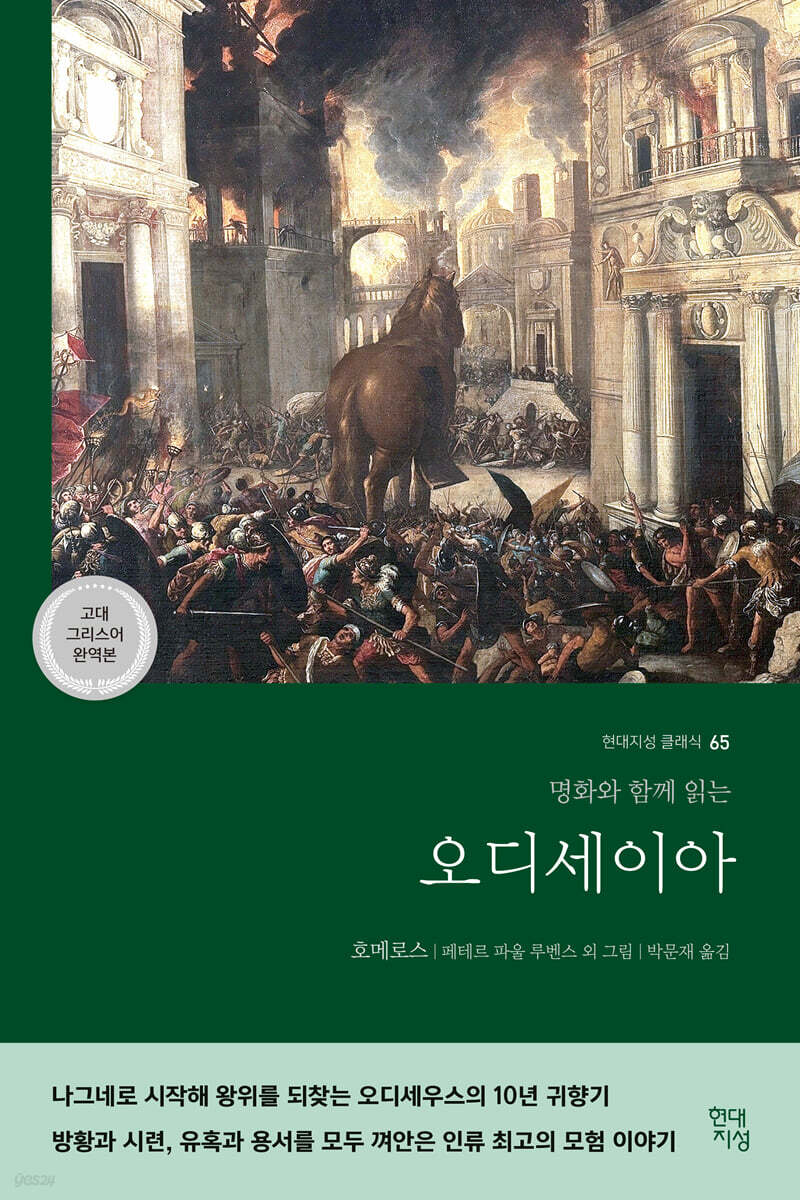
The Odyssey (Complete Ancient Greek Version)
 |
Description
Book Introduction
* A sophisticated translation that preserves the rhythm of ancient Greek.
* The only complete translation of the original text in Korea, accompanied by 104 masterpieces by masters.
* 43 pages of in-depth commentary, 303 detailed footnotes included
Odysseus's ten-year journey home, from wanderer to reclaiming the throne.
A tale of human adventure, embracing wandering, trials, temptations, and forgiveness.
Synopsis
The story begins with the ten-year Trojan War finally coming to an end, and the victorious Greek forces returning home with their spoils of war.
Odysseus, the king of Ithaca, also sets out from Troy with twelve ships and his comrades.
However, his journey home is not smooth from the start as he offends the sea god Poseidon.
It took another ten years to return home after the war.
Along the way, he encounters fierce storms, cannibalistic monsters and tribes, and the supernatural temptations of sirens and wizards, all of which he confronts with wisdom and courage.
Meanwhile, in his hometown of Ithaca, unruly suitors have taken over the palace and are holding a banquet under the pretense of courting Queen Penelope, aiming for the throne.
Will Odysseus, who has returned after 20 years, be able to reunite with his family and reclaim his throne?
A record of humanity's wisdom and courage as it navigates an uncertain world.
Odysseus, the hero of the Trojan War, tries to return to his hometown of Ithaca after winning the war, but his journey is by no means smooth.
Poseidon's wrath, the mischief of the gods, and human arrogance and weakness block his journey, and he wanders the seas for ten long years, struggling against the limits of humanity.
Through this great wandering, Homer reveals the truth about the world where gods and humans are intertwined.
The Odyssey is a work that condenses the worldview of the ancient Greeks, the values of life, and the meaning of a human life into a simple story structure of 'return'.
Through his confrontation with the one-eyed giant Polyphemus, the seduction of the witch Circe, his time with the sea nymph Calypso, and the constant intervention of the sea gods and sky gods, Odysseus is portrayed not as a simple hero, but as a being possessing both human weakness and strength.
The complete translation of the modern intellectual classic is a delicate and faithful translation of this epic poem, which has been passed down orally for 3,000 years, so that today's readers can fully savor it.
104 famous paintings and images stimulate the imagination and vividly portray the circumstances of the time and the lives of heroes, while 303 detailed footnotes and commentaries provide a three-dimensional portrayal of the geography, mythology, and cultural context of ancient Greece.
In particular, it meticulously traces the genealogy of major figures and events, as well as their historical background, enabling deeper insight beyond simple reading.
One step deeper
This adventure is ultimately not a battle with mythical beings, but a battle with one's inner self, and with wisdom and perseverance he ultimately overcomes his fate.
After his return after 20 years, what awaited him were suitors who harassed his wife Penelope.
The process of punishing them and establishing justice together with his son Telemachus symbolizes the restoration of order and morality in human society.
The Odyssey reminds us that humans are beings who move forward without giving up even in the face of suffering and temptation, and that home is not just a physical destination, but a journey to rediscover the meaning of life.
This immortal story, in which even the fate of the gods is reversed by human will, deeply resonates with readers today, living in a lost age.
* The only complete translation of the original text in Korea, accompanied by 104 masterpieces by masters.
* 43 pages of in-depth commentary, 303 detailed footnotes included
Odysseus's ten-year journey home, from wanderer to reclaiming the throne.
A tale of human adventure, embracing wandering, trials, temptations, and forgiveness.
Synopsis
The story begins with the ten-year Trojan War finally coming to an end, and the victorious Greek forces returning home with their spoils of war.
Odysseus, the king of Ithaca, also sets out from Troy with twelve ships and his comrades.
However, his journey home is not smooth from the start as he offends the sea god Poseidon.
It took another ten years to return home after the war.
Along the way, he encounters fierce storms, cannibalistic monsters and tribes, and the supernatural temptations of sirens and wizards, all of which he confronts with wisdom and courage.
Meanwhile, in his hometown of Ithaca, unruly suitors have taken over the palace and are holding a banquet under the pretense of courting Queen Penelope, aiming for the throne.
Will Odysseus, who has returned after 20 years, be able to reunite with his family and reclaim his throne?
A record of humanity's wisdom and courage as it navigates an uncertain world.
Odysseus, the hero of the Trojan War, tries to return to his hometown of Ithaca after winning the war, but his journey is by no means smooth.
Poseidon's wrath, the mischief of the gods, and human arrogance and weakness block his journey, and he wanders the seas for ten long years, struggling against the limits of humanity.
Through this great wandering, Homer reveals the truth about the world where gods and humans are intertwined.
The Odyssey is a work that condenses the worldview of the ancient Greeks, the values of life, and the meaning of a human life into a simple story structure of 'return'.
Through his confrontation with the one-eyed giant Polyphemus, the seduction of the witch Circe, his time with the sea nymph Calypso, and the constant intervention of the sea gods and sky gods, Odysseus is portrayed not as a simple hero, but as a being possessing both human weakness and strength.
The complete translation of the modern intellectual classic is a delicate and faithful translation of this epic poem, which has been passed down orally for 3,000 years, so that today's readers can fully savor it.
104 famous paintings and images stimulate the imagination and vividly portray the circumstances of the time and the lives of heroes, while 303 detailed footnotes and commentaries provide a three-dimensional portrayal of the geography, mythology, and cultural context of ancient Greece.
In particular, it meticulously traces the genealogy of major figures and events, as well as their historical background, enabling deeper insight beyond simple reading.
One step deeper
This adventure is ultimately not a battle with mythical beings, but a battle with one's inner self, and with wisdom and perseverance he ultimately overcomes his fate.
After his return after 20 years, what awaited him were suitors who harassed his wife Penelope.
The process of punishing them and establishing justice together with his son Telemachus symbolizes the restoration of order and morality in human society.
The Odyssey reminds us that humans are beings who move forward without giving up even in the face of suffering and temptation, and that home is not just a physical destination, but a journey to rediscover the meaning of life.
This immortal story, in which even the fate of the gods is reversed by human will, deeply resonates with readers today, living in a lost age.
- You can preview some of the book's contents.
Preview
index
Book 1: Athena Visits Telemachus
Book 2: Telemachus Sets Off on a Voyage
Book 3: Nestor of Pylos
Book 4: Menelaus of Lacedaemon
Book 5: Calypso and the Shipwreck of Odysseus
Book 6: Princess Nausicaä and Odysseus
Book 7: The Land of the Phaeacians
Book 8: Odysseus's Farewell Game and Banquet
Book 9: The Cyclops, the One-Eyed Giants
Book 10: Aeolus, Antiphates, and Circe
Volume 11: Hades, the Land of the Dead
Book 12: The Siren Sisters, Scylla and Charybdis, and the Cattle of Helios
Book 13: Odysseus Returns to Ithaca
Book 14: Odysseus Meets the Swineherd
Book 15: Telemachus on his way home
Book 16: The Meeting of Odysseus and Telemachus
Volume 17: The Old Beggar Appears Before the Suitors
The Beggar Old Man Among the Suitors, Volume 18
Book 19: Penelope and the Guest Odysseus
Volume 20: Omens
Book 21: Odysseus Strings His Bow
Book 22: Executing the Suitors
Book 23: The Secret of Odysseus and Penelope's Bed
Volume 24: The Souls of the Suitors Who Descended to Hades and Peace
Commentary | Park Moon-jae
Main characters
Book 2: Telemachus Sets Off on a Voyage
Book 3: Nestor of Pylos
Book 4: Menelaus of Lacedaemon
Book 5: Calypso and the Shipwreck of Odysseus
Book 6: Princess Nausicaä and Odysseus
Book 7: The Land of the Phaeacians
Book 8: Odysseus's Farewell Game and Banquet
Book 9: The Cyclops, the One-Eyed Giants
Book 10: Aeolus, Antiphates, and Circe
Volume 11: Hades, the Land of the Dead
Book 12: The Siren Sisters, Scylla and Charybdis, and the Cattle of Helios
Book 13: Odysseus Returns to Ithaca
Book 14: Odysseus Meets the Swineherd
Book 15: Telemachus on his way home
Book 16: The Meeting of Odysseus and Telemachus
Volume 17: The Old Beggar Appears Before the Suitors
The Beggar Old Man Among the Suitors, Volume 18
Book 19: Penelope and the Guest Odysseus
Volume 20: Omens
Book 21: Odysseus Strings His Bow
Book 22: Executing the Suitors
Book 23: The Secret of Odysseus and Penelope's Bed
Volume 24: The Souls of the Suitors Who Descended to Hades and Peace
Commentary | Park Moon-jae
Main characters
Detailed image

Into the book
Tell me, O goddess of the Muses, the sacred city of Troy.
About a man of many tricks who wandered for a long time after the destruction.
He saw the cities of many people and knew their thoughts,
At sea, to save one's life and bring home one's comrades
I have been through all kinds of trials.
But even in the midst of all those hardships
They failed to save their comrades, so they were reckless and reckless.
Because you brought ruin upon yourself through your actions.
Those foolish people
They ate the herd of cattle belonging to the sun god Hyperion, and Hyperion killed them.
It took away the day of homecoming.
O goddess, daughter of Zeus,
Please tell us about this matter from any point of view.
--- From "Book 1: Athena Visits Telemachus"
Calypso, the noblest of the goddesses, spoke thus and quickly went ahead.
Odysseus followed in the goddess's footsteps.
The goddess and the man arrived at the hollow cave,
The man sat down on the chair where Hermes had sat and stood.
Fairies eat all the food that mortals eat.
After setting it before the man, the god-like Odysseus
We sat facing each other.
Then the maids came before the fairy
Ambrosia and nectar were prepared.
The two reached out to the food served in front of them.
After they had enjoyed eating and drinking to their heart's content,
Among the goddesses, the noble Calypso spoke first.
--- From "Book 5, The Shipwreck of Odysseus"
Among our comrades, those who have eaten the sweet lotus fruit
Without any intention of reporting the situation or returning home,
Eating Lotus, completely forgetting about my hometown
I wanted to stay among the Lothopagos.
I dragged them there, crying and screaming.
After tying them up under the rowing seats in the hollow ship,
Eating Lotus and completely forgetting about returning home
To my other trustworthy comrades, so that it doesn't happen again.
He ordered everyone to hurry and board the fast ships.
They immediately boarded the ship and took their places at the rowers.
We sat in an orderly manner and paddled the gray sea.
I approached and pulled the stake out of the fire, and my comrades gathered around me.
They stood around.
What god has given us great courage?
The comrades held on to sharp olive tree stakes.
He pushed it into his eyes, and I hung on to it and turned the stake.
When drilling a hole in a tree to make a boat,
When people turn the leather straps from below with both hands,
As the awl rotates endlessly, we drive the red-hot stake
He gripped it tightly and turned it with all his might in his eyes.
Then, blood spurted out around the stake like hot molten iron.
The eyelids and eyebrows around the eyes are all burned,
The eyeballs were also burned, and the roots of the eyes were also torn off and burned.
A blacksmith uses a forge to harden iron for felling.
If you soak an axe or a large woodworking chisel in cold water,
There was a loud noise, and just like that, his eyes widened.
It made a sizzling sound around the olive tree stake.
--- From "Volume 9: The Cyclops, the One-Eyed Giants"
He grabbed one of his comrades by the hand and started preparing a meal.
started, and the other comrades ran away and returned to the ships.
When Antiphates shouted to the whole city, they heard him.
Powerful Laestrygonians came in countless numbers from all directions,
They looked like giants, not humans.
They are barely liftable by a person on the rock face.
They threw big rocks.
There was a terrible noise above the ships,
Comrades were dying and ships were destroyed.
Soon they were terrible
To hold a banquet, they took away their dead comrades, skewered like fish.
I assure you that you will not return, and you too will not be separated from your fellow soldiers.
You will be stuck in the same place.
But now, I will save you from disaster
I will save you.
Take this elixir and go to Circe's palace.
This is an elixir that will prevent the day of disaster from coming upon you.
I will tell you Circe's deadly trick.
She mixes various ingredients to make a drink.
I'll put some medicine in there, but it won't cast a spell on you.
This elixir I give you will prevent you from being enchanted.
Let me elaborate.
When Circe was about to strike you with her very long staff, she struck you in the thigh.
Draw your sharp sword and attack her with the determination to kill her.
Then she will get scared and ask you to sleep with her.
--- From "Book 10: Aeolus, Antiphates, and Circe"
First of all, she heard the heavenly, extremely sweet voice of the Siren sisters.
He warned them to avoid the flowery meadows where they were sitting.
And the siren's voice said only I could hear it.
So I stand upright in the wooden barrel where I put the mast and don't move.
You guys tied me up with painful ropes
Tie the end of the rope to the mast.
And I asked him to untie the rope
If you ask or command, you'll have to tie me up with more rope.
About a man of many tricks who wandered for a long time after the destruction.
He saw the cities of many people and knew their thoughts,
At sea, to save one's life and bring home one's comrades
I have been through all kinds of trials.
But even in the midst of all those hardships
They failed to save their comrades, so they were reckless and reckless.
Because you brought ruin upon yourself through your actions.
Those foolish people
They ate the herd of cattle belonging to the sun god Hyperion, and Hyperion killed them.
It took away the day of homecoming.
O goddess, daughter of Zeus,
Please tell us about this matter from any point of view.
--- From "Book 1: Athena Visits Telemachus"
Calypso, the noblest of the goddesses, spoke thus and quickly went ahead.
Odysseus followed in the goddess's footsteps.
The goddess and the man arrived at the hollow cave,
The man sat down on the chair where Hermes had sat and stood.
Fairies eat all the food that mortals eat.
After setting it before the man, the god-like Odysseus
We sat facing each other.
Then the maids came before the fairy
Ambrosia and nectar were prepared.
The two reached out to the food served in front of them.
After they had enjoyed eating and drinking to their heart's content,
Among the goddesses, the noble Calypso spoke first.
--- From "Book 5, The Shipwreck of Odysseus"
Among our comrades, those who have eaten the sweet lotus fruit
Without any intention of reporting the situation or returning home,
Eating Lotus, completely forgetting about my hometown
I wanted to stay among the Lothopagos.
I dragged them there, crying and screaming.
After tying them up under the rowing seats in the hollow ship,
Eating Lotus and completely forgetting about returning home
To my other trustworthy comrades, so that it doesn't happen again.
He ordered everyone to hurry and board the fast ships.
They immediately boarded the ship and took their places at the rowers.
We sat in an orderly manner and paddled the gray sea.
I approached and pulled the stake out of the fire, and my comrades gathered around me.
They stood around.
What god has given us great courage?
The comrades held on to sharp olive tree stakes.
He pushed it into his eyes, and I hung on to it and turned the stake.
When drilling a hole in a tree to make a boat,
When people turn the leather straps from below with both hands,
As the awl rotates endlessly, we drive the red-hot stake
He gripped it tightly and turned it with all his might in his eyes.
Then, blood spurted out around the stake like hot molten iron.
The eyelids and eyebrows around the eyes are all burned,
The eyeballs were also burned, and the roots of the eyes were also torn off and burned.
A blacksmith uses a forge to harden iron for felling.
If you soak an axe or a large woodworking chisel in cold water,
There was a loud noise, and just like that, his eyes widened.
It made a sizzling sound around the olive tree stake.
--- From "Volume 9: The Cyclops, the One-Eyed Giants"
He grabbed one of his comrades by the hand and started preparing a meal.
started, and the other comrades ran away and returned to the ships.
When Antiphates shouted to the whole city, they heard him.
Powerful Laestrygonians came in countless numbers from all directions,
They looked like giants, not humans.
They are barely liftable by a person on the rock face.
They threw big rocks.
There was a terrible noise above the ships,
Comrades were dying and ships were destroyed.
Soon they were terrible
To hold a banquet, they took away their dead comrades, skewered like fish.
I assure you that you will not return, and you too will not be separated from your fellow soldiers.
You will be stuck in the same place.
But now, I will save you from disaster
I will save you.
Take this elixir and go to Circe's palace.
This is an elixir that will prevent the day of disaster from coming upon you.
I will tell you Circe's deadly trick.
She mixes various ingredients to make a drink.
I'll put some medicine in there, but it won't cast a spell on you.
This elixir I give you will prevent you from being enchanted.
Let me elaborate.
When Circe was about to strike you with her very long staff, she struck you in the thigh.
Draw your sharp sword and attack her with the determination to kill her.
Then she will get scared and ask you to sleep with her.
--- From "Book 10: Aeolus, Antiphates, and Circe"
First of all, she heard the heavenly, extremely sweet voice of the Siren sisters.
He warned them to avoid the flowery meadows where they were sitting.
And the siren's voice said only I could hear it.
So I stand upright in the wooden barrel where I put the mast and don't move.
You guys tied me up with painful ropes
Tie the end of the rope to the mast.
And I asked him to untie the rope
If you ask or command, you'll have to tie me up with more rope.
--- From "Book 12: The Siren Sisters, Scylla and Charybdis, and the Cattle of Helios"
Publisher's Review
The first story in which Western literature found its way,
A narrative of adventure and growth that began with Odysseus
The Odyssey is an epic poem based on Greek mythology written by Homer around the 8th century BC.
Along with the Iliad, it is known as the oldest surviving Western work.
'Odyssey' means 'the story of Odysseus', and today it has become a synonym for a long and arduous journey or journey.
In this epic poem, spanning 12,110 lines and 24 volumes, we meet an indomitable man who, despite enduring countless hardships to the point of being called "the most unfortunate of all men," learns the values of courage, patience, and humility along the way, and ultimately returns home to wreak splendid retribution on the villains.
If the Iliad is a magnificent work that depicts the suffering and sorrow of humans who are forced to die in the midst of the turmoil of war, the Odyssey is a fascinating portrayal of how an individual survives hardship and achieves his goals.
The unknown seas and islands that appear in each volume, the humans who live there, gods who appear in human form, and half-human, half-beast monsters contain almost every character and narrative that ancient mankind could imagine, moving between reality and the supernatural.
If the one-eyed giant Polyphemus, the witch Circe who turns people into beasts with her magic potion, the Sirens who seduce sailors with their beautiful songs, the sea monsters Scylla and Charybdis, the nymph Calypso of a remote island, and Athena who appears as a guardian deity are one axis that form the surreal imagination, then the diverse group of realistic humans forms another axis.
The protagonist's young son grows up after leaving, a wife waiting for her husband who left without a promise, parents grieving over the loss of their child, greedy and shameless suitors, opportunists who cling to them, and servants who are loyal to their masters—they all show different sides of themselves depending on their values even in the same situation.
Between God and Man,
The life questions left behind by Odysseus
The Odyssey is not simply an adventure story or a revenge drama.
During his journey across the sea and wandering from island to island, he constantly asks, “How should humans live?”
The strength that allowed Odysseus to overcome numerous crises and return home was not simply his wisdom or martial arts.
He always seeks the will of the gods, sometimes restraining himself, and sometimes testing and confirming those around him.
It was an attitude to maintain the order of ‘justice’ and ‘piety’ even in the midst of suffering.
For the ancient Greeks, 'justice' was the principle of the human world, and 'piety' was the basic attitude toward the gods.
And the two were one inseparable mass.
Welcoming strangers, offering sacrifices with sincerity, and discerning the omens of the gods were not mere etiquette; they were ethics that protected life.
These scenes, repeated throughout the Odyssey, show that Odysseus is not just a man who survives, but a man who constantly ponders and practices 'how to survive.'
In ancient times, the worship of gods governed all human life.
If you mistreat a stranger or offer a sacrifice incorrectly, thereby ignoring and despising the gods, you will be subject to the wrath of the gods and their retribution.
So after killing the suitors, Odysseus says:
“Grandma, just be happy inside and don’t shout out loud.
Because it is disrespectful to cheer in front of the dead.
“The fate that the gods had decreed and the cruelty that he had committed killed him” (Book 22, lines 411-414).
It was thought that going against the fate and will of the gods was tantamount to inviting destruction.
That is why the ‘omens’ sent by the gods are very important.
He does not accept his wife, father, or even servants hastily.
That's why it was important to restore trust so carefully and deeply.
Just as Agamemnon met his death due to carelessness, Odysseus also knew that a momentary mistake could lead to disaster.
So he checks everything, bides his time, and finally punishes justly.
And even at that moment, he fears the gods and is restrained.
For today's readers, the Odyssey is not just an old classic.
For us who must cross the seas of unpredictable times, this is the oldest story that asks about the direction and attitude of life, and it is still the most effective story.
A complete translation that preserves the rhythm of ancient Greek has been revived.
Humanity's first adventure epic
The Odyssey, a modern intellectual classic, is a complete translation of Homer's ancient Greek original, vividly reviving Odysseus' ten-year journey home.
The rhyme, word order, and rhythm of the ancient writing style are preserved to the fullest extent possible, while the sentences are refined to allow today's readers to naturally immerse themselves in the text, completely conveying the essence of the original text.
In particular, the translation captures the grand scale of the ancient epic, its delicate emotional lines, its lyricism, and even its dramatic scenes, allowing modern readers to fully experience the Odyssey, which is considered the archetype of the story.
104 famous paintings and illustrations visually introduce the various supernatural beings and legendary scenes that Odysseus encounters, such as the one-eyed giant Polyphemus, the witch Circe, the Sirens, Scylla and Charybdis, and Calypso, stimulating the reader's imagination and vividly bringing the ancient world to life.
Descriptions, paired with rich color images, enhance the reader's understanding of the narrative and help them naturally develop myths, legends, and character relationships within the flow of the story.
The 303 footnotes and 43 pages of commentary broadly explain the history and culture of ancient Greece, its religious and cosmological views, names of people and places, the genealogy of the gods, and even the political and social implications.
In particular, since the Odyssey is not linear in its time structure but is written in a way that the past and present intersect, it is difficult to read without background knowledge, so this explanation and footnotes are of great help to the reader's understanding and immersion.
This book is not simply an adventure story of an ancient hero.
This is a story for all those who stand on the edge of life, a text that illuminates the wisdom and restraint of human beings who strive to maintain their balance in the midst of chaos, and the inner strength to pursue justice.
For readers new to The Odyssey, this book will serve as an introductory guide into the rich world of the story, while for those who have already read it, it will be a life classic that will rediscover new insights and deep reflections.
A narrative of adventure and growth that began with Odysseus
The Odyssey is an epic poem based on Greek mythology written by Homer around the 8th century BC.
Along with the Iliad, it is known as the oldest surviving Western work.
'Odyssey' means 'the story of Odysseus', and today it has become a synonym for a long and arduous journey or journey.
In this epic poem, spanning 12,110 lines and 24 volumes, we meet an indomitable man who, despite enduring countless hardships to the point of being called "the most unfortunate of all men," learns the values of courage, patience, and humility along the way, and ultimately returns home to wreak splendid retribution on the villains.
If the Iliad is a magnificent work that depicts the suffering and sorrow of humans who are forced to die in the midst of the turmoil of war, the Odyssey is a fascinating portrayal of how an individual survives hardship and achieves his goals.
The unknown seas and islands that appear in each volume, the humans who live there, gods who appear in human form, and half-human, half-beast monsters contain almost every character and narrative that ancient mankind could imagine, moving between reality and the supernatural.
If the one-eyed giant Polyphemus, the witch Circe who turns people into beasts with her magic potion, the Sirens who seduce sailors with their beautiful songs, the sea monsters Scylla and Charybdis, the nymph Calypso of a remote island, and Athena who appears as a guardian deity are one axis that form the surreal imagination, then the diverse group of realistic humans forms another axis.
The protagonist's young son grows up after leaving, a wife waiting for her husband who left without a promise, parents grieving over the loss of their child, greedy and shameless suitors, opportunists who cling to them, and servants who are loyal to their masters—they all show different sides of themselves depending on their values even in the same situation.
Between God and Man,
The life questions left behind by Odysseus
The Odyssey is not simply an adventure story or a revenge drama.
During his journey across the sea and wandering from island to island, he constantly asks, “How should humans live?”
The strength that allowed Odysseus to overcome numerous crises and return home was not simply his wisdom or martial arts.
He always seeks the will of the gods, sometimes restraining himself, and sometimes testing and confirming those around him.
It was an attitude to maintain the order of ‘justice’ and ‘piety’ even in the midst of suffering.
For the ancient Greeks, 'justice' was the principle of the human world, and 'piety' was the basic attitude toward the gods.
And the two were one inseparable mass.
Welcoming strangers, offering sacrifices with sincerity, and discerning the omens of the gods were not mere etiquette; they were ethics that protected life.
These scenes, repeated throughout the Odyssey, show that Odysseus is not just a man who survives, but a man who constantly ponders and practices 'how to survive.'
In ancient times, the worship of gods governed all human life.
If you mistreat a stranger or offer a sacrifice incorrectly, thereby ignoring and despising the gods, you will be subject to the wrath of the gods and their retribution.
So after killing the suitors, Odysseus says:
“Grandma, just be happy inside and don’t shout out loud.
Because it is disrespectful to cheer in front of the dead.
“The fate that the gods had decreed and the cruelty that he had committed killed him” (Book 22, lines 411-414).
It was thought that going against the fate and will of the gods was tantamount to inviting destruction.
That is why the ‘omens’ sent by the gods are very important.
He does not accept his wife, father, or even servants hastily.
That's why it was important to restore trust so carefully and deeply.
Just as Agamemnon met his death due to carelessness, Odysseus also knew that a momentary mistake could lead to disaster.
So he checks everything, bides his time, and finally punishes justly.
And even at that moment, he fears the gods and is restrained.
For today's readers, the Odyssey is not just an old classic.
For us who must cross the seas of unpredictable times, this is the oldest story that asks about the direction and attitude of life, and it is still the most effective story.
A complete translation that preserves the rhythm of ancient Greek has been revived.
Humanity's first adventure epic
The Odyssey, a modern intellectual classic, is a complete translation of Homer's ancient Greek original, vividly reviving Odysseus' ten-year journey home.
The rhyme, word order, and rhythm of the ancient writing style are preserved to the fullest extent possible, while the sentences are refined to allow today's readers to naturally immerse themselves in the text, completely conveying the essence of the original text.
In particular, the translation captures the grand scale of the ancient epic, its delicate emotional lines, its lyricism, and even its dramatic scenes, allowing modern readers to fully experience the Odyssey, which is considered the archetype of the story.
104 famous paintings and illustrations visually introduce the various supernatural beings and legendary scenes that Odysseus encounters, such as the one-eyed giant Polyphemus, the witch Circe, the Sirens, Scylla and Charybdis, and Calypso, stimulating the reader's imagination and vividly bringing the ancient world to life.
Descriptions, paired with rich color images, enhance the reader's understanding of the narrative and help them naturally develop myths, legends, and character relationships within the flow of the story.
The 303 footnotes and 43 pages of commentary broadly explain the history and culture of ancient Greece, its religious and cosmological views, names of people and places, the genealogy of the gods, and even the political and social implications.
In particular, since the Odyssey is not linear in its time structure but is written in a way that the past and present intersect, it is difficult to read without background knowledge, so this explanation and footnotes are of great help to the reader's understanding and immersion.
This book is not simply an adventure story of an ancient hero.
This is a story for all those who stand on the edge of life, a text that illuminates the wisdom and restraint of human beings who strive to maintain their balance in the midst of chaos, and the inner strength to pursue justice.
For readers new to The Odyssey, this book will serve as an introductory guide into the rich world of the story, while for those who have already read it, it will be a life classic that will rediscover new insights and deep reflections.
GOODS SPECIFICS
- Date of issue: April 18, 2025
- Page count, weight, size: 672 pages | 150*225mm
- ISBN13: 9791139721973
- ISBN10: 1139721976
You may also like
카테고리
korean


korean

![GQ KOREA Mark (Monthly): December [2025]](http://librairie.coreenne.fr/cdn/shop/files/8ef265dbbfbf186523ed75ba7319009d.jpg?v=1765340328&width=3840)


