

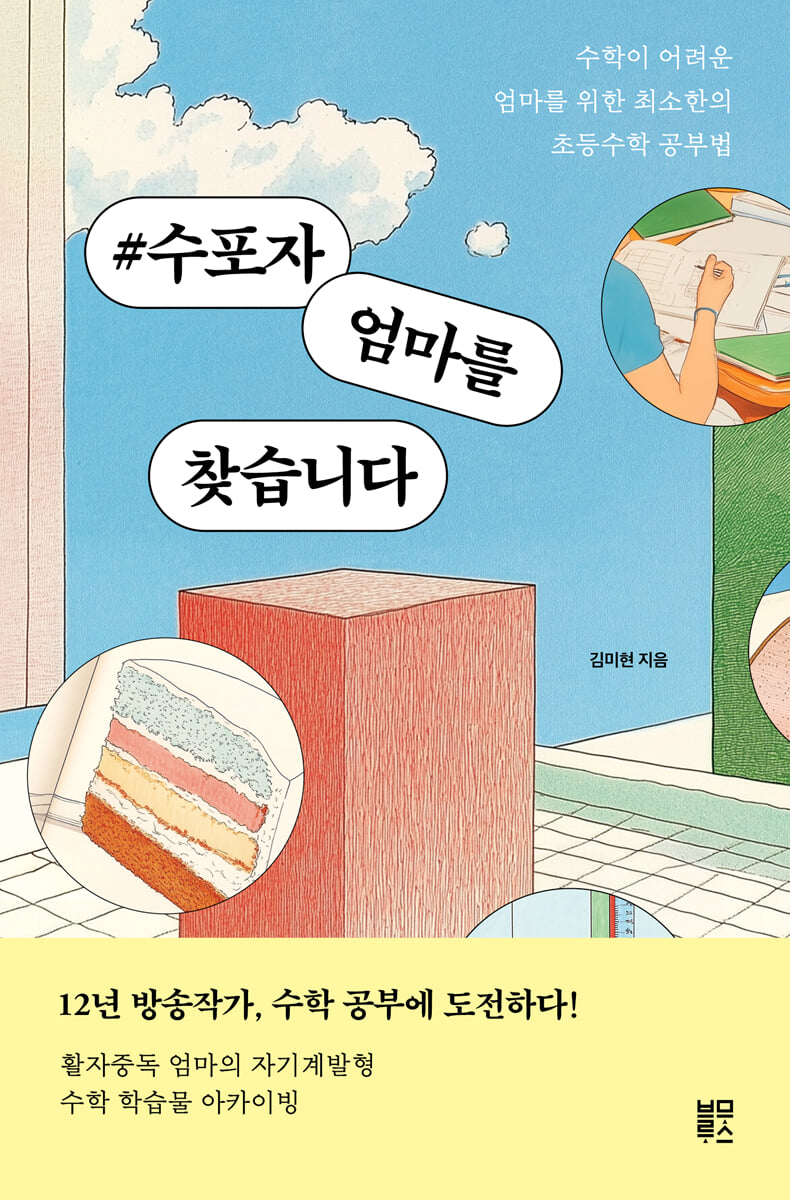
#Looking for a mother who has been diagnosed with a water disease
 |
Description
Book Introduction
From studying math for children
Discover unexpected fun
This book does not contain any introductions to math study methods or workbooks, which are commonly found in parenting books.
I just recommend finding a mom friend to talk math with.
Because raising a mother's math self-esteem is the best way to teach math to a mother.
What would happen if a mother in her forties opened her math book again?
Surprisingly, the answer was 'grow with the child.'
What started as a way to help my child with his studies has become a journey that has taken me on a journey of discovery, bringing with it changes in my relationships and the joy of new learning.
To mothers who are worried about their children's math, the author confidently recommends, "Why not try studying math on your own?"
And for those who don't believe in its effectiveness, he meticulously documented his challenge process and compiled it into a book.
This book is divided into Part 1 and Part 2.
In Part 1, the children gather together to study math with their mothers and share their ups and downs growing up in an honest and humorous way.
As you follow the story of crying and laughing in front of math, you will find empathy and comfort in thinking, “I could do that too.”
Of course, these are basic tips on how to guide your child to learn the true joy of math.
There is even a sense of joy in the scene where the author's child confesses, "I don't think I'll ever be a dropout."
Part 2 unfolds interesting mathematical stories that were actually discussed in math clubs.
It covers the principles of mathematics that can help you solve everyday questions, such as the probability of winning the lottery or calculating the price of a cream bun.
As you read, you will find yourself exclaiming, “Oh, so that’s what it was like?” and you will begin to like math, which you previously disliked.
Readers who have avoided math, parents struggling with their children, or adults dreaming of a new learning experience can all find courage and joy in this book.
Discover unexpected fun
This book does not contain any introductions to math study methods or workbooks, which are commonly found in parenting books.
I just recommend finding a mom friend to talk math with.
Because raising a mother's math self-esteem is the best way to teach math to a mother.
What would happen if a mother in her forties opened her math book again?
Surprisingly, the answer was 'grow with the child.'
What started as a way to help my child with his studies has become a journey that has taken me on a journey of discovery, bringing with it changes in my relationships and the joy of new learning.
To mothers who are worried about their children's math, the author confidently recommends, "Why not try studying math on your own?"
And for those who don't believe in its effectiveness, he meticulously documented his challenge process and compiled it into a book.
This book is divided into Part 1 and Part 2.
In Part 1, the children gather together to study math with their mothers and share their ups and downs growing up in an honest and humorous way.
As you follow the story of crying and laughing in front of math, you will find empathy and comfort in thinking, “I could do that too.”
Of course, these are basic tips on how to guide your child to learn the true joy of math.
There is even a sense of joy in the scene where the author's child confesses, "I don't think I'll ever be a dropout."
Part 2 unfolds interesting mathematical stories that were actually discussed in math clubs.
It covers the principles of mathematics that can help you solve everyday questions, such as the probability of winning the lottery or calculating the price of a cream bun.
As you read, you will find yourself exclaiming, “Oh, so that’s what it was like?” and you will begin to like math, which you previously disliked.
Readers who have avoided math, parents struggling with their children, or adults dreaming of a new learning experience can all find courage and joy in this book.
- You can preview some of the book's contents.
Preview
index
Part 1: Math Study for a Mother Who Fails to Study
1.
I do arithmetic, you do math
2.
Settings
3.
Looking for a water blisters
4.
Latte Math
5.
A world reunited after 30 years
6.
Math, Chat, and Class
7.
See you on Tuesday
8.
Multi-level mathematics
9.
By chance, Bingyi
10.
Where do you learn this kind of thing?
11.
That's not the end, it's the beginning
12.
That's not the square's dream
13.
The language of mathematics
14.
Today too, Woo Sang-hyang
15.
Everything is math
16.
Almost got street casted
17.
How to deal with the wrong problem
18.
Knowledge is the power to wait
19.
The Taste of Math
20.
It can't be a triangle for nothing
21.
privilege
22.
Inner feelings
23.
Mom doesn't know either
24.
Where there are children, there are workbooks.
25.
Book of the Month
26.
Mother's care
27.
Good job, growing up
28.
Dreams are also wild
29.
The mathematics that made me, the mathematics that I made
Part 2: Dehydration Spore Mom's Math Play
What percentage discount is 10% + 10%? (Change and Relationship)
The Secret of Numbers Hidden in the Multiplication Table (Numbers and Operations)
Why is pure gold 24K instead of 100K? (Change and Relationships)
How to Make a Half-Width Square with Paper (Shapes and Measurements)
Which is larger, A4 or A6 paper? (Change and Relationship)
What is π (pi), which appears in every circle formula? (Shapes and Measurement)
How to mentally calculate 45×45 (numbers and operations)
Why is a negative number times a negative number positive? (Numbers and Operations)
Is inverse proportion the opposite of direct proportion? (Change and Relationships)
What 12÷3 Means (Numbers and Operations)
Why 0÷5 works but 5÷0 doesn't (Numbers and Operations)
Cream Puff Prices: Expensive or Reasonable? (Shapes and Measurements)
What's the bigger deal? 10 cups of coffee + 1 free vs. 10% points (change and relationship)
Why don't ladder games have duplicate outcomes? (Change and Relationships)
Your odds of winning the lottery (data and probability)
Why are manhole covers circular? (Shapes and Measurement)
Can you figure out how many there are without counting them one by one? (Numbers and Operations)
1.
I do arithmetic, you do math
2.
Settings
3.
Looking for a water blisters
4.
Latte Math
5.
A world reunited after 30 years
6.
Math, Chat, and Class
7.
See you on Tuesday
8.
Multi-level mathematics
9.
By chance, Bingyi
10.
Where do you learn this kind of thing?
11.
That's not the end, it's the beginning
12.
That's not the square's dream
13.
The language of mathematics
14.
Today too, Woo Sang-hyang
15.
Everything is math
16.
Almost got street casted
17.
How to deal with the wrong problem
18.
Knowledge is the power to wait
19.
The Taste of Math
20.
It can't be a triangle for nothing
21.
privilege
22.
Inner feelings
23.
Mom doesn't know either
24.
Where there are children, there are workbooks.
25.
Book of the Month
26.
Mother's care
27.
Good job, growing up
28.
Dreams are also wild
29.
The mathematics that made me, the mathematics that I made
Part 2: Dehydration Spore Mom's Math Play
What percentage discount is 10% + 10%? (Change and Relationship)
The Secret of Numbers Hidden in the Multiplication Table (Numbers and Operations)
Why is pure gold 24K instead of 100K? (Change and Relationships)
How to Make a Half-Width Square with Paper (Shapes and Measurements)
Which is larger, A4 or A6 paper? (Change and Relationship)
What is π (pi), which appears in every circle formula? (Shapes and Measurement)
How to mentally calculate 45×45 (numbers and operations)
Why is a negative number times a negative number positive? (Numbers and Operations)
Is inverse proportion the opposite of direct proportion? (Change and Relationships)
What 12÷3 Means (Numbers and Operations)
Why 0÷5 works but 5÷0 doesn't (Numbers and Operations)
Cream Puff Prices: Expensive or Reasonable? (Shapes and Measurements)
What's the bigger deal? 10 cups of coffee + 1 free vs. 10% points (change and relationship)
Why don't ladder games have duplicate outcomes? (Change and Relationships)
Your odds of winning the lottery (data and probability)
Why are manhole covers circular? (Shapes and Measurement)
Can you figure out how many there are without counting them one by one? (Numbers and Operations)
Detailed image

Into the book
The first thought that maybe math could be fun began on this day.
The math I learned and the math you will learn are completely different.
But, with my shallow and poor math skills, would it be okay for me to rashly teach you math?
What if we create a second generation of dropouts with our long experience and know-how of pretending to be good with fake skills and then failing in high school?
I was afraid that my child would approach math in the wrong way because of me.
I guess I need to learn math properly.
But where can I learn math at this age, approaching forty?
There is no math academy in the world that accepts adults.
But I don't want to solve the "Essentials of Mathematics".
What I want to know is not how to solve such advanced problems, but the basics of mathematics.
Where should I start and how?
Is it even possible to study math at this age?
I wonder if it's too late.
--- p.13~14, from the text “#1 I am arithmetic, you are mathematics”
Math is not easy these days.
Shin Jae-pyeong, a member of the band Peppertones, also appeared on a YouTube channel and said that he saw a math workbook his daughter was working on and there was a problem that asked, "How many numbers from 1 to 100 do not contain the number 5?" He wondered how a second grader could solve this and said that the level was different from when we were kids.
If this is the case for KAIST graduates, the perceived difficulty level for mothers like us who failed in school is bound to be much higher.
So we will study.
Step by step from elementary school
From the basics, step by step
From the concept, step by step.
--- p.24~25, from the text “#4 Latte Math”
The most dramatic change that happened to me while studying math was my reliance on answer sheets.
I stopped thinking of the workbook solutions as the only solution.
That is the valuable opinion of Mr. ○○○, who wrote the book.
This is an opinion that is not true.
After grading, I always check the solution. This is to check whether Mr. ○○○'s solution is the same as mine, if different, how it is different, and which method is more beautiful.
It feels good when we have the same thoughts, and it's thrilling when we have different thoughts.
--- p.66, from the text “#19 The Taste of Mathematics”
The reason I found math fun so late in life might be because I let go of the burden of always having to do well in front of my child.
If he had tried to be a doctor, he would have been kicked out long ago or would have been kicked out long ago.
When you don't know, it's fun to admit that you don't know and think about it together.
The reason I study math is not to teach children.
To have a conversation.
If you know, you know. If you don't know, you don't know.
--- p.81, from the text “#23 Even Mom Doesn’t Know”
“At first, it was for my child, but now I come to the meetings for myself, who was a dropout.
“I feel like I’m becoming a better person.”
As M said, the math study that I started for my child unexpectedly ended up satisfying my mother's ego.
We learn from mathematics the precious sense of self-improvement.
And each of them is growing little by little in their own field in their own way.
--- p.98, from the text “#29 Mathematics that Made Me, Mathematics that I Made”
'Carat' refers to the gold content.
It indicates how much gold is contained.
The most expensive type of gold is 24K, which is pure gold.
At this point, I'm starting to wonder.
Why is it that pure gold is called 24K when it would be more convenient to call it 100K?
The word "carat" comes from the Middle Eastern plant called "carob."
Carob fruit looks like a bean.
It looks ordinary, but there is something special about it.
Although the shape of each carob nut is different, the weight of one carob nut is always the same at 0.2g.
In those days when there were no scales, weight was measured with carob.
For this reason, carob played a very important role in trade activities in the Middle East.
The most popular theory is that an adult can hold up to 24 carob berries in one hand, and that this is why 100% pure gold was called 24K.
--- p.123~124, from the text “Why is pure gold 24K and not 100K?”
In everyday life, when do we use the words "directly proportional" and "inversely proportional"? For example, if you lose weight proportional to the amount of exercise you do, you might say, "I lost weight in direct proportion to the amount of exercise I do."
On the other hand, I think the inverse proportion is used this much.
“If you look at your phone for too long, you won’t be able to study.
“The time you spend looking at your phone is inversely proportional to your grades.”
The terms direct and inverse proportion, which we have been using without thinking.
But do we understand and use the concept correctly?
--- p.184, from the text “Is inverse proportion the opposite of direct proportion?”
Does buying multiple lottery tickets increase your odds of winning? Yes, that's right.
Buying additional lottery tickets with different combinations increases your odds.
If I had bought just one ticket, my odds of winning first prize would have been 1 in 8.14 million.
But if you buy 2, it becomes 2 in 8.14 million (1 in 4.07 million).
If you buy 5 cards, it becomes 5 in 8.14 million (1 in 1.62 million), and if you buy 10 cards, it becomes 10 in 8.14 million (1 in 810,000).
So, what if you bought 8,145,060 tickets, one for each of the six possible combinations? Yes, your odds of winning first prize would be 100%.
That's the surest way.
But you have to spend more than 8.1 billion won to buy lottery tickets.
I would like to receive all the money by myself, but if there are multiple first prize winners, I have to divide it by n.
Also, did you know that if it's over 300 million won, you have to pay a 33% tax?
The math I learned and the math you will learn are completely different.
But, with my shallow and poor math skills, would it be okay for me to rashly teach you math?
What if we create a second generation of dropouts with our long experience and know-how of pretending to be good with fake skills and then failing in high school?
I was afraid that my child would approach math in the wrong way because of me.
I guess I need to learn math properly.
But where can I learn math at this age, approaching forty?
There is no math academy in the world that accepts adults.
But I don't want to solve the "Essentials of Mathematics".
What I want to know is not how to solve such advanced problems, but the basics of mathematics.
Where should I start and how?
Is it even possible to study math at this age?
I wonder if it's too late.
--- p.13~14, from the text “#1 I am arithmetic, you are mathematics”
Math is not easy these days.
Shin Jae-pyeong, a member of the band Peppertones, also appeared on a YouTube channel and said that he saw a math workbook his daughter was working on and there was a problem that asked, "How many numbers from 1 to 100 do not contain the number 5?" He wondered how a second grader could solve this and said that the level was different from when we were kids.
If this is the case for KAIST graduates, the perceived difficulty level for mothers like us who failed in school is bound to be much higher.
So we will study.
Step by step from elementary school
From the basics, step by step
From the concept, step by step.
--- p.24~25, from the text “#4 Latte Math”
The most dramatic change that happened to me while studying math was my reliance on answer sheets.
I stopped thinking of the workbook solutions as the only solution.
That is the valuable opinion of Mr. ○○○, who wrote the book.
This is an opinion that is not true.
After grading, I always check the solution. This is to check whether Mr. ○○○'s solution is the same as mine, if different, how it is different, and which method is more beautiful.
It feels good when we have the same thoughts, and it's thrilling when we have different thoughts.
--- p.66, from the text “#19 The Taste of Mathematics”
The reason I found math fun so late in life might be because I let go of the burden of always having to do well in front of my child.
If he had tried to be a doctor, he would have been kicked out long ago or would have been kicked out long ago.
When you don't know, it's fun to admit that you don't know and think about it together.
The reason I study math is not to teach children.
To have a conversation.
If you know, you know. If you don't know, you don't know.
--- p.81, from the text “#23 Even Mom Doesn’t Know”
“At first, it was for my child, but now I come to the meetings for myself, who was a dropout.
“I feel like I’m becoming a better person.”
As M said, the math study that I started for my child unexpectedly ended up satisfying my mother's ego.
We learn from mathematics the precious sense of self-improvement.
And each of them is growing little by little in their own field in their own way.
--- p.98, from the text “#29 Mathematics that Made Me, Mathematics that I Made”
'Carat' refers to the gold content.
It indicates how much gold is contained.
The most expensive type of gold is 24K, which is pure gold.
At this point, I'm starting to wonder.
Why is it that pure gold is called 24K when it would be more convenient to call it 100K?
The word "carat" comes from the Middle Eastern plant called "carob."
Carob fruit looks like a bean.
It looks ordinary, but there is something special about it.
Although the shape of each carob nut is different, the weight of one carob nut is always the same at 0.2g.
In those days when there were no scales, weight was measured with carob.
For this reason, carob played a very important role in trade activities in the Middle East.
The most popular theory is that an adult can hold up to 24 carob berries in one hand, and that this is why 100% pure gold was called 24K.
--- p.123~124, from the text “Why is pure gold 24K and not 100K?”
In everyday life, when do we use the words "directly proportional" and "inversely proportional"? For example, if you lose weight proportional to the amount of exercise you do, you might say, "I lost weight in direct proportion to the amount of exercise I do."
On the other hand, I think the inverse proportion is used this much.
“If you look at your phone for too long, you won’t be able to study.
“The time you spend looking at your phone is inversely proportional to your grades.”
The terms direct and inverse proportion, which we have been using without thinking.
But do we understand and use the concept correctly?
--- p.184, from the text “Is inverse proportion the opposite of direct proportion?”
Does buying multiple lottery tickets increase your odds of winning? Yes, that's right.
Buying additional lottery tickets with different combinations increases your odds.
If I had bought just one ticket, my odds of winning first prize would have been 1 in 8.14 million.
But if you buy 2, it becomes 2 in 8.14 million (1 in 4.07 million).
If you buy 5 cards, it becomes 5 in 8.14 million (1 in 1.62 million), and if you buy 10 cards, it becomes 10 in 8.14 million (1 in 810,000).
So, what if you bought 8,145,060 tickets, one for each of the six possible combinations? Yes, your odds of winning first prize would be 100%.
That's the surest way.
But you have to spend more than 8.1 billion won to buy lottery tickets.
I would like to receive all the money by myself, but if there are multiple first prize winners, I have to divide it by n.
Also, did you know that if it's over 300 million won, you have to pay a 33% tax?
--- p.247~248, from the text “Your Probability of Winning the Lotto”
Publisher's Review
When Mom becomes good at math
Math becomes doable for children too
There was a former math dropout who once cried because of math and was frustrated in front of his report card.
The author suffered successive setbacks in mathematics during high school and college, and decided to live a life that had nothing to do with mathematics, becoming a broadcast writer.
I lived in print and stories for 12 years, but after becoming a mother, I could no longer ignore math.
So I opened my math book again.
To teach math well to elementary school children.
Although it started out as a mother's math class, it ended up going in a completely unexpected direction.
While studying mathematics, I realized the pure fun of mathematics.
I've been learning a new way to think about the world through mathematics, and I've been completely absorbed in the fun of discovering how mathematics can be used in everyday life.
And that's not all. The mothers who studied together gradually began to transcend the status of "mother" and find their own paths.
Some mothers started working after obtaining a learning instructor certificate, while others enrolled in a correspondence university to continue their studies.
The study that started for my child has now turned into a journey to find myself.
This book records that fierce and brilliant process.
As you read the stories in Part 1 and follow the mothers as they grow, you will feel a sense of 'vicarious pride.'
Following Part 1, which recorded mothers' stories, Part 2 offers the pleasure of interpreting everyday curiosities through the lens of mathematics.
By examining the odds of winning the lottery, we reflect on the nature of 'luck', and by learning why gold is called 24K, we discover the hidden meaning of numbers and units.
Calculating the true discount rate of the '10% + 10% discount' that we often come across when shopping makes us reexamine the common sense we have unconsciously believed.
We also learn that the numbers we see sometimes deceive us.
In this way, Part 2 is not about math for exams, but math that helps children understand daily life more deeply and can be enjoyed with their children.
Through the experience of interpreting the principles of the world through mathematics, you can enjoy the pure fun of learning mathematics beyond its mere usefulness.
“That’s ridiculous.
For readers who question, “How can math be fun?”, this book provides a vivid answer.
Math becomes doable for children too
There was a former math dropout who once cried because of math and was frustrated in front of his report card.
The author suffered successive setbacks in mathematics during high school and college, and decided to live a life that had nothing to do with mathematics, becoming a broadcast writer.
I lived in print and stories for 12 years, but after becoming a mother, I could no longer ignore math.
So I opened my math book again.
To teach math well to elementary school children.
Although it started out as a mother's math class, it ended up going in a completely unexpected direction.
While studying mathematics, I realized the pure fun of mathematics.
I've been learning a new way to think about the world through mathematics, and I've been completely absorbed in the fun of discovering how mathematics can be used in everyday life.
And that's not all. The mothers who studied together gradually began to transcend the status of "mother" and find their own paths.
Some mothers started working after obtaining a learning instructor certificate, while others enrolled in a correspondence university to continue their studies.
The study that started for my child has now turned into a journey to find myself.
This book records that fierce and brilliant process.
As you read the stories in Part 1 and follow the mothers as they grow, you will feel a sense of 'vicarious pride.'
Following Part 1, which recorded mothers' stories, Part 2 offers the pleasure of interpreting everyday curiosities through the lens of mathematics.
By examining the odds of winning the lottery, we reflect on the nature of 'luck', and by learning why gold is called 24K, we discover the hidden meaning of numbers and units.
Calculating the true discount rate of the '10% + 10% discount' that we often come across when shopping makes us reexamine the common sense we have unconsciously believed.
We also learn that the numbers we see sometimes deceive us.
In this way, Part 2 is not about math for exams, but math that helps children understand daily life more deeply and can be enjoyed with their children.
Through the experience of interpreting the principles of the world through mathematics, you can enjoy the pure fun of learning mathematics beyond its mere usefulness.
“That’s ridiculous.
For readers who question, “How can math be fun?”, this book provides a vivid answer.
GOODS SPECIFICS
- Date of issue: October 24, 2025
- Page count, weight, size: 272 pages | 412g | 135*205*16mm
- ISBN13: 9791193407431
- ISBN10: 1193407435
You may also like
카테고리
korean


korean

![GQ KOREA Mark (Monthly): December [2025]](http://librairie.coreenne.fr/cdn/shop/files/8ef265dbbfbf186523ed75ba7319009d.jpg?v=1765340328&width=3840)


