

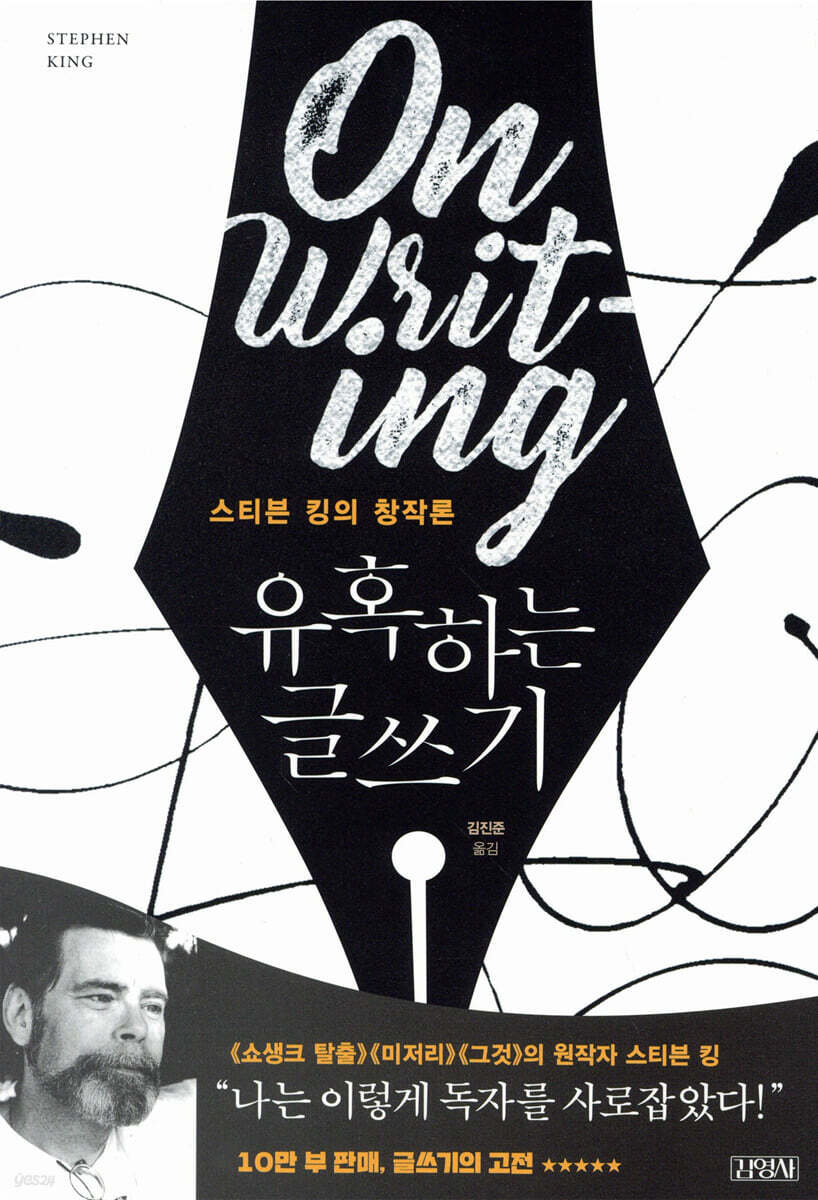
Seductive Writing
 |
Description
Book Introduction
I'm so envious of Stephen King, who so bluntly states that the road to hell is paved with adverbs.
And the part where he says that we shouldn't try to easily reveal a character's personality through physical descriptions makes us realize why his novels up to now have been able to avoid habitual clichés while focusing on storytelling.
Although it has a rather weighty subtitle, "On Creation," it is closer to Stephen King's humorous autobiography.
Although he talks seriously about writing, his novels are so clear and concise that you can read the book without getting bogged down in difficult words and sentences, keeping your mind fresh.
Even if you're not an aspiring writer, this will be a fun writing guide for those of us who have to think about writing and for students preparing for essay exams.
Isn't being able to write well a kind of 'bonus' in life?
And the part where he says that we shouldn't try to easily reveal a character's personality through physical descriptions makes us realize why his novels up to now have been able to avoid habitual clichés while focusing on storytelling.
Although it has a rather weighty subtitle, "On Creation," it is closer to Stephen King's humorous autobiography.
Although he talks seriously about writing, his novels are so clear and concise that you can read the book without getting bogged down in difficult words and sentences, keeping your mind fresh.
Even if you're not an aspiring writer, this will be a fun writing guide for those of us who have to think about writing and for students preparing for essay exams.
Isn't being able to write well a kind of 'bonus' in life?
- You can preview some of the book's contents.
Preview
index
Seductive Writing
Into the book
One night, we were eating Chinese food before a gig on Miami Beach.
At that time, I asked Amy if she had any questions that hadn't been asked before during the Q&A session that almost always ends with author meetings.
He stood there with a very solemn air, as if he were not an ordinary human who had to stand on one leg to put on his pants, and when answering fans, he asked if there was a question that had never been asked.
Amy thought very carefully and then finally answered:
“No one asked about the sentence.”---From “Preface”
Amy was right.
No one asks about the sentence.
Of course, you ask writers like Delillo, Updike, and Styron, but you don't ask popular novelists.
But even a fool like me has his own thoughts about sentences.
And I work hard to improve my skills at putting stories out on paper.
From now on, I will talk about the process of how I came to create, what I now know about creation, and my methods of creation.
This is a book about my main job and a book about sentences. ---From "Preface One"
Books about writing are usually full of nonsense.
So this book is rather short.
Novelists, myself included, don't know much about what they do.
If a novel is good or bad, you don't know what it is.
So I figured the shorter the book, the less nonsense there would be.
(……) What I want to say right now is that if you are an aspiring writer, you absolutely must read “Outline of Writing Style.”
In the chapter titled 'Principles of Writing' in that book, rule number 17 is written as 'Omit unnecessary words.'
I also intend to put that into practice here. --- From "Preface 2"
What I'm going to talk about from now on are memories from my childhood.
And I also included illustrations from a time when I remember it more clearly than then: adolescence and adolescence.
But it is not an autobiography.
You could say it's a kind of resume.
Anyway, I just wanted to show the growth process of an author.
(……) I believe that countless people have at least some talent as writers or novelists, and that this talent can be further refined and developed.
If you don't believe that, writing a book like this would be a waste of time. --- From "Resume"
The muse certainly exists, but she never flies into your writing room and sprinkles magic dust on your typewriter or computer to help you create.
The Muse dwells on the earth.
He lives in the basement.
Therefore, you should rather go down to where the muse is.
And while we're at it, we should make sure he gets a good place to stay.
In other words, all the hard, arduous labor is yours.
At that time, I asked Amy if she had any questions that hadn't been asked before during the Q&A session that almost always ends with author meetings.
He stood there with a very solemn air, as if he were not an ordinary human who had to stand on one leg to put on his pants, and when answering fans, he asked if there was a question that had never been asked.
Amy thought very carefully and then finally answered:
“No one asked about the sentence.”---From “Preface”
Amy was right.
No one asks about the sentence.
Of course, you ask writers like Delillo, Updike, and Styron, but you don't ask popular novelists.
But even a fool like me has his own thoughts about sentences.
And I work hard to improve my skills at putting stories out on paper.
From now on, I will talk about the process of how I came to create, what I now know about creation, and my methods of creation.
This is a book about my main job and a book about sentences. ---From "Preface One"
Books about writing are usually full of nonsense.
So this book is rather short.
Novelists, myself included, don't know much about what they do.
If a novel is good or bad, you don't know what it is.
So I figured the shorter the book, the less nonsense there would be.
(……) What I want to say right now is that if you are an aspiring writer, you absolutely must read “Outline of Writing Style.”
In the chapter titled 'Principles of Writing' in that book, rule number 17 is written as 'Omit unnecessary words.'
I also intend to put that into practice here. --- From "Preface 2"
What I'm going to talk about from now on are memories from my childhood.
And I also included illustrations from a time when I remember it more clearly than then: adolescence and adolescence.
But it is not an autobiography.
You could say it's a kind of resume.
Anyway, I just wanted to show the growth process of an author.
(……) I believe that countless people have at least some talent as writers or novelists, and that this talent can be further refined and developed.
If you don't believe that, writing a book like this would be a waste of time. --- From "Resume"
The muse certainly exists, but she never flies into your writing room and sprinkles magic dust on your typewriter or computer to help you create.
The Muse dwells on the earth.
He lives in the basement.
Therefore, you should rather go down to where the muse is.
And while we're at it, we should make sure he gets a good place to stay.
In other words, all the hard, arduous labor is yours.
---From "Theory of Creation"
Publisher's Review
A pioneer of fusion literature encompassing both classical and popular literature.
Stephen King's creative writing has captivated readers around the world!
“Writing is creative sleep.
Whether it's writing or sleeping, I try to regain physical stability while mentally trying to escape the logical and dull thinking of the day.
And just as the mind and body need a certain amount of sleep, the waking mind can also be trained to sleep creatively, producing vivid imaginative daydreams, and that is what makes a good novel.” - Stephen King
Stephen King is a novelist who has a powerful influence not only in the United States but also around the world, along with John Grisham and Tom Clancy.
His works have achieved great commercial and literary success, earning him the nickname "Stephen King Industry," with astronomical sales figures.
Also, almost all of his works, including his first full-length novel, Carrie, have been made into movies or television dramas.
Stephen King, who has made a name for himself with his novels, is better known to domestic readers as the original author of several films ([Misery], [The Shawshank Redemption], and [It]) than as the author of his novels.
Stephen King's talent, which spans a wide range of genres, is unrivaled in the fields of horror and fantasy.
The reason Stephen King's works attract the attention of Hollywood filmmakers is because they precisely embody the public's desire for fast-paced, visual novels.
Mystery novelist Jeong Seok-hwa evaluated Stephen King as a pioneer of fusion literature that encompasses both serious and popular literature.
Stephen King's novels have no plot.
Because plots are almost non-existent in our lives, and the naturalness of true creation is absolutely incompatible with plots.
In his novels, situations are presented and the characters move in their own way.
In this structure, the author is not only the creator of the novel, but also the first reader (Stephen King reveals that even the writer himself often does not know how the ending will turn out).
In other words, Stephen King's work can be said to be a model for what future novels should be like.
A writing textbook as clear and fast-paced as a novel
Few people buy novels because they are drawn to their literary excellence.
What they want is a funny story that they can take on a plane.
Just as you wouldn't ask Colonel Sanders (the inventor of KFC's recipe) about his process for selling a ton of fried chicken, no one seriously asked Stephen King, who is read by more readers than anyone else, about his writing process.
I asked authors like Updike and Styron, but not popular novelist Stephen King.
Stephen King sharply criticizes critics and scholars for being suspicious of a writer's popular success, citing the example of Charles Dickens, who was constantly attacked by critics for appealing to a lower-class readership.
Although their suspicions are often justified, I disagree with the view that "once a third-rate person, always a third-rate person."
The reason people like Stephen King, John Grisham, and Michael Crichton make so much money from their novels isn't because they're good at using some mystical or popular element, or because they have some true greatness that the stubborn, jealous literary establishment doesn't recognize.
To write well, you must let go of false consciousness and worries.
False consciousness is the attitude of defining certain writings as 'good' or 'bad', and this attitude stems from anxiety.
He advises that the purpose of writing is irrelevant, but one must be wary of a frivolous attitude (writing is not a popularity contest, not the moral Olympics, not a church.
But writing is definitely different from putting on eye makeup or washing a car).
In "On Writing," Stephen King talks about writing that is fast-paced, honest, and clear, like his novels.
The goal of a novel is not to be grammatically correct, but to warmly welcome the reader, to tell a story, and, if possible, to seduce them into forgetting that they are even reading a novel.
And contrary to popular belief, novels are 'excavated' like fossils from the ground.
There is no such thing as a storehouse of ideas, a treasure trove of novels, or a treasure island filled with best-sellers. Ideas seem to appear out of thin air and come to novelists.
Two things that were previously unrelated come together to create something entirely new.
Therefore, the novelist's job is not to come up with ideas, but to recognize that an idea is a good idea when it comes.
To reach that level, you have to read a lot and write a lot.
In the process, by coming into contact with jade, you set your own goals and experience the possibilities of creation.
Above all, reading is the best way to become familiar with the creative process and become comfortable with it.
Next, you need to write about what you know.
Just as Stephen King, who came from a lower-middle-class American family, was loved by the public for his vivid novels based on his own life, when you write about subjects you like and know well and mix in personal experiences about life, friendship, relationships, sex, work, etc. to make them unique, the novel comes to life.
Finally, you should always write with your virtual readers in mind.
Stephen King emphasizes that your virtual readers are made up of people around you, and their opinions should be given more weight than anyone else's.
In his case, it was his wife, Tabitha King, and Carrie, which was almost buried in the dust, came to light thanks to her.
From the most important context of writing to avoiding the overuse of passive voice and adverbs, to methods for effectively utilizing narration, description, and dialogue, to tips for writing good writing, this book provides detailed and entertaining explanations with abundant examples.
A coming-of-age story about a boy who unearthed a great fossil called a novel.
As a boy, Stephen King's mother gave him a quarter for every novel he completed, which laid the foundation for his career as one of America's best-selling authors.
Encouraged by his first novel, written in his early teens, being published in a small Alabama horror magazine, young Stephen steadily submitted his stories to various magazines and publishers.
Even after receiving so many rejections that he had to replace the special nail he used to pin rejection notes from publishers with a bigger and stronger one, he couldn't give up writing.
He recalls earning $9 for his first bestseller, The Pit and the Pendulum (25 cents per copy), in high school, and being punished for satirizing his school teachers in a newspaper called The Village Bommie.
He was ashamed of his work for a long time after his teacher criticized him for wasting his time on such rubbish.
He confesses that it was only when he was around forty, when he realized that anyone who published even a single line of poetry or a novel would inevitably hear someone criticizing him for wasting his God-given talent, that he was finally able to free himself from his guilt.
In addition, it contains the story of meeting his wife Tabitha, marriage and children, continuing creative work despite financial difficulties, and the success of his first novel, Carrie (the editor who discovered Stephen King also discovered John Grisham), and his rise to become one of America's top writers.
A near-fatal car accident in 1999 forced Stephen King to realize the most important truth of his life.
The real reason I write is because I want to write.
I paid off my mortgage and sent my kids to college by writing, but that's a bonus. I can't say that writing is life itself, but sometimes it can be a way to get your life back.
"Writing That Seduces" contains too much self-reflection to be dismissed as a simple practical book that aims to improve writing skills or teach easier writing techniques.
Because it contains the journey of an author who came to the profound realization that 'the purpose of writing is to survive, overcome, and rise up.'
Anyone can write well if they have the courage to start. Looking back on their own trials and errors, offering loving advice and a pat on the shoulder—that's the gentle resonance Stephen King wants to leave with his readers.
Stephen King's creative writing has captivated readers around the world!
“Writing is creative sleep.
Whether it's writing or sleeping, I try to regain physical stability while mentally trying to escape the logical and dull thinking of the day.
And just as the mind and body need a certain amount of sleep, the waking mind can also be trained to sleep creatively, producing vivid imaginative daydreams, and that is what makes a good novel.” - Stephen King
Stephen King is a novelist who has a powerful influence not only in the United States but also around the world, along with John Grisham and Tom Clancy.
His works have achieved great commercial and literary success, earning him the nickname "Stephen King Industry," with astronomical sales figures.
Also, almost all of his works, including his first full-length novel, Carrie, have been made into movies or television dramas.
Stephen King, who has made a name for himself with his novels, is better known to domestic readers as the original author of several films ([Misery], [The Shawshank Redemption], and [It]) than as the author of his novels.
Stephen King's talent, which spans a wide range of genres, is unrivaled in the fields of horror and fantasy.
The reason Stephen King's works attract the attention of Hollywood filmmakers is because they precisely embody the public's desire for fast-paced, visual novels.
Mystery novelist Jeong Seok-hwa evaluated Stephen King as a pioneer of fusion literature that encompasses both serious and popular literature.
Stephen King's novels have no plot.
Because plots are almost non-existent in our lives, and the naturalness of true creation is absolutely incompatible with plots.
In his novels, situations are presented and the characters move in their own way.
In this structure, the author is not only the creator of the novel, but also the first reader (Stephen King reveals that even the writer himself often does not know how the ending will turn out).
In other words, Stephen King's work can be said to be a model for what future novels should be like.
A writing textbook as clear and fast-paced as a novel
Few people buy novels because they are drawn to their literary excellence.
What they want is a funny story that they can take on a plane.
Just as you wouldn't ask Colonel Sanders (the inventor of KFC's recipe) about his process for selling a ton of fried chicken, no one seriously asked Stephen King, who is read by more readers than anyone else, about his writing process.
I asked authors like Updike and Styron, but not popular novelist Stephen King.
Stephen King sharply criticizes critics and scholars for being suspicious of a writer's popular success, citing the example of Charles Dickens, who was constantly attacked by critics for appealing to a lower-class readership.
Although their suspicions are often justified, I disagree with the view that "once a third-rate person, always a third-rate person."
The reason people like Stephen King, John Grisham, and Michael Crichton make so much money from their novels isn't because they're good at using some mystical or popular element, or because they have some true greatness that the stubborn, jealous literary establishment doesn't recognize.
To write well, you must let go of false consciousness and worries.
False consciousness is the attitude of defining certain writings as 'good' or 'bad', and this attitude stems from anxiety.
He advises that the purpose of writing is irrelevant, but one must be wary of a frivolous attitude (writing is not a popularity contest, not the moral Olympics, not a church.
But writing is definitely different from putting on eye makeup or washing a car).
In "On Writing," Stephen King talks about writing that is fast-paced, honest, and clear, like his novels.
The goal of a novel is not to be grammatically correct, but to warmly welcome the reader, to tell a story, and, if possible, to seduce them into forgetting that they are even reading a novel.
And contrary to popular belief, novels are 'excavated' like fossils from the ground.
There is no such thing as a storehouse of ideas, a treasure trove of novels, or a treasure island filled with best-sellers. Ideas seem to appear out of thin air and come to novelists.
Two things that were previously unrelated come together to create something entirely new.
Therefore, the novelist's job is not to come up with ideas, but to recognize that an idea is a good idea when it comes.
To reach that level, you have to read a lot and write a lot.
In the process, by coming into contact with jade, you set your own goals and experience the possibilities of creation.
Above all, reading is the best way to become familiar with the creative process and become comfortable with it.
Next, you need to write about what you know.
Just as Stephen King, who came from a lower-middle-class American family, was loved by the public for his vivid novels based on his own life, when you write about subjects you like and know well and mix in personal experiences about life, friendship, relationships, sex, work, etc. to make them unique, the novel comes to life.
Finally, you should always write with your virtual readers in mind.
Stephen King emphasizes that your virtual readers are made up of people around you, and their opinions should be given more weight than anyone else's.
In his case, it was his wife, Tabitha King, and Carrie, which was almost buried in the dust, came to light thanks to her.
From the most important context of writing to avoiding the overuse of passive voice and adverbs, to methods for effectively utilizing narration, description, and dialogue, to tips for writing good writing, this book provides detailed and entertaining explanations with abundant examples.
A coming-of-age story about a boy who unearthed a great fossil called a novel.
As a boy, Stephen King's mother gave him a quarter for every novel he completed, which laid the foundation for his career as one of America's best-selling authors.
Encouraged by his first novel, written in his early teens, being published in a small Alabama horror magazine, young Stephen steadily submitted his stories to various magazines and publishers.
Even after receiving so many rejections that he had to replace the special nail he used to pin rejection notes from publishers with a bigger and stronger one, he couldn't give up writing.
He recalls earning $9 for his first bestseller, The Pit and the Pendulum (25 cents per copy), in high school, and being punished for satirizing his school teachers in a newspaper called The Village Bommie.
He was ashamed of his work for a long time after his teacher criticized him for wasting his time on such rubbish.
He confesses that it was only when he was around forty, when he realized that anyone who published even a single line of poetry or a novel would inevitably hear someone criticizing him for wasting his God-given talent, that he was finally able to free himself from his guilt.
In addition, it contains the story of meeting his wife Tabitha, marriage and children, continuing creative work despite financial difficulties, and the success of his first novel, Carrie (the editor who discovered Stephen King also discovered John Grisham), and his rise to become one of America's top writers.
A near-fatal car accident in 1999 forced Stephen King to realize the most important truth of his life.
The real reason I write is because I want to write.
I paid off my mortgage and sent my kids to college by writing, but that's a bonus. I can't say that writing is life itself, but sometimes it can be a way to get your life back.
"Writing That Seduces" contains too much self-reflection to be dismissed as a simple practical book that aims to improve writing skills or teach easier writing techniques.
Because it contains the journey of an author who came to the profound realization that 'the purpose of writing is to survive, overcome, and rise up.'
Anyone can write well if they have the courage to start. Looking back on their own trials and errors, offering loving advice and a pat on the shoulder—that's the gentle resonance Stephen King wants to leave with his readers.
GOODS SPECIFICS
- Date of publication: December 11, 2017
- Page count, weight, size: 356 pages | 552g | 145*210*30mm
- ISBN13: 9788934977322
- ISBN10: 8934977329
You may also like
카테고리
korean


korean

![GQ KOREA Mark (Monthly): December [2025]](http://librairie.coreenne.fr/cdn/shop/files/8ef265dbbfbf186523ed75ba7319009d.jpg?v=1765340328&width=3840)


