

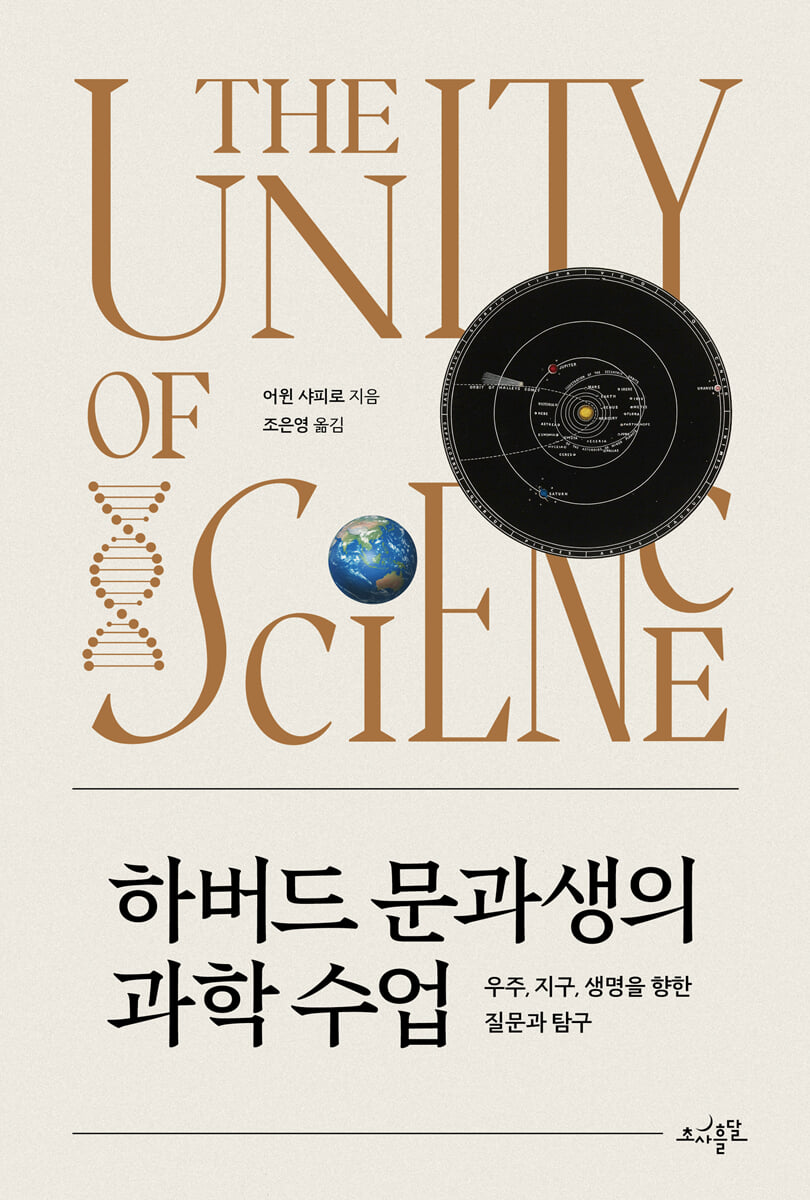
Science class for Harvard liberal arts students
 |
Description
Book Introduction
The 'science' lecture prepared for undergraduate students majoring in 'humanities and social sciences' at Harvard University was born as 'Science Class for Harvard Liberal Arts Students'.
As a course for students who are not majoring in science, this book, which takes the form of an introductory course, broadly examines the process by which humans have explored the natural world from ancient times to the present under the three major themes of space, Earth, and life.
The fact that the Earth orbits the Sun, that continents move, and that life has evolved may seem obvious at first glance based on today's knowledge, but when it was first discovered, it was a profound, world-changing insight.
The process of discovery was not smooth either, and scientists who jumped into solving nature's puzzles sometimes ended up wandering in the wrong direction or making the wrong choices, leaving behind a dark history of reaching dead ends.
"Science Class for Harvard Liberal Arts Students" follows this journey of inquiry, showing that science is not a complete knowledge but a process of continuous observation, questioning, and proof.
Additionally, the importance of asking questions is emphasized throughout the class.
Because science begins with a question, leads to exploration, reaches understanding, and then moves further with another question.
You can't learn everything about science in a one-semester introductory course.
But as we follow the scientific journey of observing natural phenomena, wondering how they work, and thinking based on evidence, our understanding of not only science but also the world expands.
As a course for students who are not majoring in science, this book, which takes the form of an introductory course, broadly examines the process by which humans have explored the natural world from ancient times to the present under the three major themes of space, Earth, and life.
The fact that the Earth orbits the Sun, that continents move, and that life has evolved may seem obvious at first glance based on today's knowledge, but when it was first discovered, it was a profound, world-changing insight.
The process of discovery was not smooth either, and scientists who jumped into solving nature's puzzles sometimes ended up wandering in the wrong direction or making the wrong choices, leaving behind a dark history of reaching dead ends.
"Science Class for Harvard Liberal Arts Students" follows this journey of inquiry, showing that science is not a complete knowledge but a process of continuous observation, questioning, and proof.
Additionally, the importance of asking questions is emphasized throughout the class.
Because science begins with a question, leads to exploration, reaches understanding, and then moves further with another question.
You can't learn everything about science in a one-semester introductory course.
But as we follow the scientific journey of observing natural phenomena, wondering how they work, and thinking based on evidence, our understanding of not only science but also the world expands.
- You can preview some of the book's contents.
Preview
index
introduction
Introduction: On the Integration of Science
Part 1.
Unveiling the Universe
Chapter 1.
Light moving in the sky
Chapter 2.
Model of celestial motion
Chapter 3.
Telescopes and the speed of light
Chapter 4.
Newton and Einstein's universe
Chapter 5.
Space Distance Ladder
Chapter 6.
cosmic microwave background radiation
Chapter 7.
Dark matter and dark energy
Part 2.
Earth and Fossils
Chapter 8.
The shape and size of the Earth
Chapter 9.
Exploring the Earth's Interior and Earthquakes
Chapter 10.
Evolution of the Earth's surface
Chapter 11.
Structure of matter
Chapter 12.
Age of the Earth
Chapter 13.
fossil record
Chapter 14.
The largest herbivore on earth
Chapter 15.
Asteroid impact and mass extinction
Part 3.
The Story of Life
Chapter 16.
Darwin, Wallace, and Mendel
Chapter 17.
Finding the Key Molecule of Genetics
Chapter 18. Unraveling the Structure of DNA
Chapter 19.
Genetic information and the central principle of life
Chapter 20.
The origin of life and the path of evolution
Chapter 21. Applications of DNA Research
Chapter 22.
In search of alien life
Image source
References
Search
Introduction: On the Integration of Science
Part 1.
Unveiling the Universe
Chapter 1.
Light moving in the sky
Chapter 2.
Model of celestial motion
Chapter 3.
Telescopes and the speed of light
Chapter 4.
Newton and Einstein's universe
Chapter 5.
Space Distance Ladder
Chapter 6.
cosmic microwave background radiation
Chapter 7.
Dark matter and dark energy
Part 2.
Earth and Fossils
Chapter 8.
The shape and size of the Earth
Chapter 9.
Exploring the Earth's Interior and Earthquakes
Chapter 10.
Evolution of the Earth's surface
Chapter 11.
Structure of matter
Chapter 12.
Age of the Earth
Chapter 13.
fossil record
Chapter 14.
The largest herbivore on earth
Chapter 15.
Asteroid impact and mass extinction
Part 3.
The Story of Life
Chapter 16.
Darwin, Wallace, and Mendel
Chapter 17.
Finding the Key Molecule of Genetics
Chapter 18. Unraveling the Structure of DNA
Chapter 19.
Genetic information and the central principle of life
Chapter 20.
The origin of life and the path of evolution
Chapter 21. Applications of DNA Research
Chapter 22.
In search of alien life
Image source
References
Search
Detailed image

Into the book
Science often seems like magic, but there is a big difference between science and magic, and between scientists and magicians.
Scientists are always willing and eager to talk about their research and discoveries in detail.
So perhaps I will babble endlessly, as I do in this book.
But the magician is the exact opposite.
The magician also demonstrates like I do in this book.
Now, I just put three pieces of colored cloth tied together in front of you into my pocket.
Then he recited the appropriate spell and took another piece of cloth out of his pocket.
Ta-da! All the fabrics that were tied together are now untied.
But I don't explain anything.
The magician uses his voice only to recite spells quickly.
By oath, they never reveal what tricks they have used to anyone other than fellow magicians.
They will take this secret to their graves, and so we eventually return to science.
--- From "Introductory Remarks"
The primary purpose of science is not to find out why, but to study the behavior of nature and build appropriate models.
For what purpose, and for what reason? Beyond satisfying humanity's innate curiosity, there was a far more practical purpose.
The most important of these is food.
When is the best time to plant crops? When is the best time to go hunting? And when, exactly, do you need to know the answers to these questions? --- Chapter 1.
From "Light Moving in the Sky"
Strictly speaking, Kepler's laws are not laws in the sense that they cannot be broken.
However, it provided a fairly good approximation to the behavior of nature, especially given the level of observation available in the early 1600s.
In particular, the predictions are in fairly good agreement with Tycho's records of observing the positions of the planets.
One important example is that when applied simultaneously to both Earth and Mars, the errors in predicting retrograde motion that had plagued past models disappeared without a trace.
Kepler's innovations marked a significant milestone in the development of modern science.
His law was independently posited and did not follow any other simple principle, but it was a great step forward.
From a modern perspective, this law may seem like a crude, ad hoc model, but as mentioned earlier, it was a remarkable leap forward in raising the level of modeling to the level of measurements available at the time, the first advance in 1,500 years of human effort to create a quantitative model of planetary motion.
--- Chapter 2.
From “Models of Celestial Motion”
Returning to Edwin Hubble, he estimated its distance to be millions of light-years based on observations of Cepheid variables in distant galaxies.
This was possible thanks to the use of much more powerful telescopes than ever before.
Hubble's results showed that the island universe was farther away than what was then believed to be the boundary of our galaxy, and led to the conclusion that it was a separate galaxy from our own, changing the course of astronomy.
In this way, our sense of superiority over our privileged position in the universe was further diminished, and we were confirmed to be far away from even the center of a single galaxy.
Finding definitive evidence that intelligent life exists somewhere in the universe would be the next and final step in dismantling the old belief that we occupy a privileged position in the universe.
--- Chapter 5.
From "Space Distance Ladder"
The discovery of the CMB (cosmic microwave background) is valuable in that it provides a solid observational foundation for the field of cosmology, which was previously purely speculative.
In fact, cosmology is the field that studies the origin and subsequent development of the universe on the largest spatial and temporal scales, ultimately drawing the 'big picture'.
Furthermore, many subsequent observations and theoretical studies of the CMB have transformed cosmology into a data-driven, cutting-edge field of astronomy, and indeed one that allows us to think about our origins on the largest scale possible.
--- Chapter 6.
From "Cosmic Microwave Background Radiation"
The important question here.
Does the fracking process itself cause earthquakes? Or is the process of pumping wastewater back into the ground the direct cause? (...) The answer to this question is of practical importance.
If fracking itself is the cause, then it should be banned.
Conversely, if wastewater is the cause, a solution can be found by changing the treatment method.
(……) One thing is certain: fracking clearly demonstrates that human activities can have a direct impact on the Earth's environment.
This issue also serves as an example of how citizens' voices can be reflected in policy, highlighting the importance of having even a minimal understanding of social issues related to science.
Of course, this isn't always the case, but having some background knowledge will help you make smarter choices.
--- Chapter 9.
From "Exploring the Earth's Interior and Earthquakes"
Based on these calculations, and taking into account some of the uncertainties inherent in these assumptions, Kelvin concluded in the early 1860s that the Earth was between about 40 million and 100 million years old.
Geologists, on the other hand, believed that the Earth was much older than that, but had no way to verify it, so they were paralyzed by Kelvin's quantitative approach.
Of course, there are skeptics who eloquently argue against the claims, but it is important to remember that scientific disputes should be resolved with evidence, not words.
--- 「Chapter 12.
From "The Age of the Earth"
So, the total length of DNA that a person has is the product of the length of DNA in one cell and the total number of cells, which is approximately 10 to the 14th square meter, and if this value is converted to astronomical units, it is 700 AU.
This length is equivalent to the diameter of the entire solar system.
Going a step further, if we calculate the total length of DNA of the 8 billion people living on Earth, it would be about 75 million light-years, more than 1,000 times the diameter of our galaxy.
Scientists are always willing and eager to talk about their research and discoveries in detail.
So perhaps I will babble endlessly, as I do in this book.
But the magician is the exact opposite.
The magician also demonstrates like I do in this book.
Now, I just put three pieces of colored cloth tied together in front of you into my pocket.
Then he recited the appropriate spell and took another piece of cloth out of his pocket.
Ta-da! All the fabrics that were tied together are now untied.
But I don't explain anything.
The magician uses his voice only to recite spells quickly.
By oath, they never reveal what tricks they have used to anyone other than fellow magicians.
They will take this secret to their graves, and so we eventually return to science.
--- From "Introductory Remarks"
The primary purpose of science is not to find out why, but to study the behavior of nature and build appropriate models.
For what purpose, and for what reason? Beyond satisfying humanity's innate curiosity, there was a far more practical purpose.
The most important of these is food.
When is the best time to plant crops? When is the best time to go hunting? And when, exactly, do you need to know the answers to these questions? --- Chapter 1.
From "Light Moving in the Sky"
Strictly speaking, Kepler's laws are not laws in the sense that they cannot be broken.
However, it provided a fairly good approximation to the behavior of nature, especially given the level of observation available in the early 1600s.
In particular, the predictions are in fairly good agreement with Tycho's records of observing the positions of the planets.
One important example is that when applied simultaneously to both Earth and Mars, the errors in predicting retrograde motion that had plagued past models disappeared without a trace.
Kepler's innovations marked a significant milestone in the development of modern science.
His law was independently posited and did not follow any other simple principle, but it was a great step forward.
From a modern perspective, this law may seem like a crude, ad hoc model, but as mentioned earlier, it was a remarkable leap forward in raising the level of modeling to the level of measurements available at the time, the first advance in 1,500 years of human effort to create a quantitative model of planetary motion.
--- Chapter 2.
From “Models of Celestial Motion”
Returning to Edwin Hubble, he estimated its distance to be millions of light-years based on observations of Cepheid variables in distant galaxies.
This was possible thanks to the use of much more powerful telescopes than ever before.
Hubble's results showed that the island universe was farther away than what was then believed to be the boundary of our galaxy, and led to the conclusion that it was a separate galaxy from our own, changing the course of astronomy.
In this way, our sense of superiority over our privileged position in the universe was further diminished, and we were confirmed to be far away from even the center of a single galaxy.
Finding definitive evidence that intelligent life exists somewhere in the universe would be the next and final step in dismantling the old belief that we occupy a privileged position in the universe.
--- Chapter 5.
From "Space Distance Ladder"
The discovery of the CMB (cosmic microwave background) is valuable in that it provides a solid observational foundation for the field of cosmology, which was previously purely speculative.
In fact, cosmology is the field that studies the origin and subsequent development of the universe on the largest spatial and temporal scales, ultimately drawing the 'big picture'.
Furthermore, many subsequent observations and theoretical studies of the CMB have transformed cosmology into a data-driven, cutting-edge field of astronomy, and indeed one that allows us to think about our origins on the largest scale possible.
--- Chapter 6.
From "Cosmic Microwave Background Radiation"
The important question here.
Does the fracking process itself cause earthquakes? Or is the process of pumping wastewater back into the ground the direct cause? (...) The answer to this question is of practical importance.
If fracking itself is the cause, then it should be banned.
Conversely, if wastewater is the cause, a solution can be found by changing the treatment method.
(……) One thing is certain: fracking clearly demonstrates that human activities can have a direct impact on the Earth's environment.
This issue also serves as an example of how citizens' voices can be reflected in policy, highlighting the importance of having even a minimal understanding of social issues related to science.
Of course, this isn't always the case, but having some background knowledge will help you make smarter choices.
--- Chapter 9.
From "Exploring the Earth's Interior and Earthquakes"
Based on these calculations, and taking into account some of the uncertainties inherent in these assumptions, Kelvin concluded in the early 1860s that the Earth was between about 40 million and 100 million years old.
Geologists, on the other hand, believed that the Earth was much older than that, but had no way to verify it, so they were paralyzed by Kelvin's quantitative approach.
Of course, there are skeptics who eloquently argue against the claims, but it is important to remember that scientific disputes should be resolved with evidence, not words.
--- 「Chapter 12.
From "The Age of the Earth"
So, the total length of DNA that a person has is the product of the length of DNA in one cell and the total number of cells, which is approximately 10 to the 14th square meter, and if this value is converted to astronomical units, it is 700 AU.
This length is equivalent to the diameter of the entire solar system.
Going a step further, if we calculate the total length of DNA of the 8 billion people living on Earth, it would be about 75 million light-years, more than 1,000 times the diameter of our galaxy.
--- Chapter 19.
From “Genetic Information and the Central Principle of Life”
From “Genetic Information and the Central Principle of Life”
Publisher's Review
“Always ask questions.
And be suspicious.
Is the evidence solid?
“Make sure your reasoning follows the evidence.”
“Being able to ask important questions is a pretty useful skill in all aspects of life.
Questions are a vital tool for stimulating progress in every area of our existence.
So, will there ever be a day when we run out of questions? One striking consequence of scientific progress is that the more we learn, the more questions we ask.
“It may seem paradoxical that the questions arising from the knowledge gained through the accumulation of knowledge increase rather than decrease, but as we learn more about the secrets of nature, the new questions that follow are endless, like an onion that never ends no matter how much you peel it.” - From ‘Introduction’
A broad and deep science class encompassing space, Earth, and life.
A journey of scientific inquiry through observation, questioning, and proof
An integrated science textbook born from Harvard lecture notes
Why does Harvard teach science to students studying literature, philosophy, politics, and economics? The core of Harvard's undergraduate education is "liberal arts."
In other words, it is about fostering the ability to understand the world in a three-dimensional way by transcending academic boundaries through a broad liberal arts education.
With this in mind, the introductory science course for students who are not majoring in science was transferred to "Science Class for Harvard Liberal Arts Students."
Led by Professor Irwin Shapiro, a world-renowned astrophysics expert, this class first looks up at the sky to unveil the universe, then looks at Earth, and finally discusses life.
Professor Shapiro unfolds humanity's journey of exploring the natural world under three major themes: space, Earth, and life.
This journey includes not only groundbreaking discoveries in the history of science, such as Newton's law of gravitation or Einstein's theory of relativity, but also outdated theories and hypotheses that have already been proven wrong, such as geocentrism and pangenesis.
Through this story, Professor Shapiro emphasizes that science is not an encyclopedia of truth, but rather a process of development through endless questioning, assumptions, and proof.
Science is a field where human mental activity takes place at the forefront, but the process of scientific development is filled with trial and error, such as incorrect inferences and failed experiments.
Not only is there a fierce debate over which hypothesis is correct, but there is also fierce competition to reap the fruits of discovery as soon as possible.
Moreover, science advances thanks to technological advancements, and technology also advances further thanks to the achievements of science.
In "Science Class for Harvard Liberal Arts Students," you will follow a multifaceted journey of scientific inquiry, learn the scientific method of evidence-based thinking, and broaden your horizons.
Professor Shapiro emphasizes that science begins with questions.
And he says the more you learn, the more questions you ask.
Because questions lead to exploration, which leads to understanding, which leads further into further questions.
Through "Science Classes for Harvard Liberal Arts Students," we begin with questions and examine the important scientific discoveries that have transformed humanity's perspective on nature. We also explore how these discoveries have expanded into new questions.
Science is another language for understanding the world!
A mere glance into the daily lives of modern people reveals how heavily all our activities depend on scientific achievements and advancements.
In modern society, where not a single day goes by without science, science is another language for understanding the world.
Of course, having a scientific background doesn't mean we can understand everything we encounter and make wise choices in every situation.
But the scientific method of inquiry can provide a path for us to answer important questions, critically examine those answers, and make wise choices.
Of course, science is not the exclusive domain of the sciences, and "Science Classes for Harvard Liberal Arts Students" is also open to everyone, regardless of whether they are in the arts or sciences.
And be suspicious.
Is the evidence solid?
“Make sure your reasoning follows the evidence.”
“Being able to ask important questions is a pretty useful skill in all aspects of life.
Questions are a vital tool for stimulating progress in every area of our existence.
So, will there ever be a day when we run out of questions? One striking consequence of scientific progress is that the more we learn, the more questions we ask.
“It may seem paradoxical that the questions arising from the knowledge gained through the accumulation of knowledge increase rather than decrease, but as we learn more about the secrets of nature, the new questions that follow are endless, like an onion that never ends no matter how much you peel it.” - From ‘Introduction’
A broad and deep science class encompassing space, Earth, and life.
A journey of scientific inquiry through observation, questioning, and proof
An integrated science textbook born from Harvard lecture notes
Why does Harvard teach science to students studying literature, philosophy, politics, and economics? The core of Harvard's undergraduate education is "liberal arts."
In other words, it is about fostering the ability to understand the world in a three-dimensional way by transcending academic boundaries through a broad liberal arts education.
With this in mind, the introductory science course for students who are not majoring in science was transferred to "Science Class for Harvard Liberal Arts Students."
Led by Professor Irwin Shapiro, a world-renowned astrophysics expert, this class first looks up at the sky to unveil the universe, then looks at Earth, and finally discusses life.
Professor Shapiro unfolds humanity's journey of exploring the natural world under three major themes: space, Earth, and life.
This journey includes not only groundbreaking discoveries in the history of science, such as Newton's law of gravitation or Einstein's theory of relativity, but also outdated theories and hypotheses that have already been proven wrong, such as geocentrism and pangenesis.
Through this story, Professor Shapiro emphasizes that science is not an encyclopedia of truth, but rather a process of development through endless questioning, assumptions, and proof.
Science is a field where human mental activity takes place at the forefront, but the process of scientific development is filled with trial and error, such as incorrect inferences and failed experiments.
Not only is there a fierce debate over which hypothesis is correct, but there is also fierce competition to reap the fruits of discovery as soon as possible.
Moreover, science advances thanks to technological advancements, and technology also advances further thanks to the achievements of science.
In "Science Class for Harvard Liberal Arts Students," you will follow a multifaceted journey of scientific inquiry, learn the scientific method of evidence-based thinking, and broaden your horizons.
Professor Shapiro emphasizes that science begins with questions.
And he says the more you learn, the more questions you ask.
Because questions lead to exploration, which leads to understanding, which leads further into further questions.
Through "Science Classes for Harvard Liberal Arts Students," we begin with questions and examine the important scientific discoveries that have transformed humanity's perspective on nature. We also explore how these discoveries have expanded into new questions.
Science is another language for understanding the world!
A mere glance into the daily lives of modern people reveals how heavily all our activities depend on scientific achievements and advancements.
In modern society, where not a single day goes by without science, science is another language for understanding the world.
Of course, having a scientific background doesn't mean we can understand everything we encounter and make wise choices in every situation.
But the scientific method of inquiry can provide a path for us to answer important questions, critically examine those answers, and make wise choices.
Of course, science is not the exclusive domain of the sciences, and "Science Classes for Harvard Liberal Arts Students" is also open to everyone, regardless of whether they are in the arts or sciences.
GOODS SPECIFICS
- Date of issue: November 11, 2025
- Page count, weight, size: 460 pages | 688g | 152*225*29mm
- ISBN13: 9791198965646
- ISBN10: 1198965649
You may also like
카테고리
korean


korean

![GQ KOREA Mark (Monthly): December [2025]](http://librairie.coreenne.fr/cdn/shop/files/8ef265dbbfbf186523ed75ba7319009d.jpg?v=1765340328&width=3840)


