

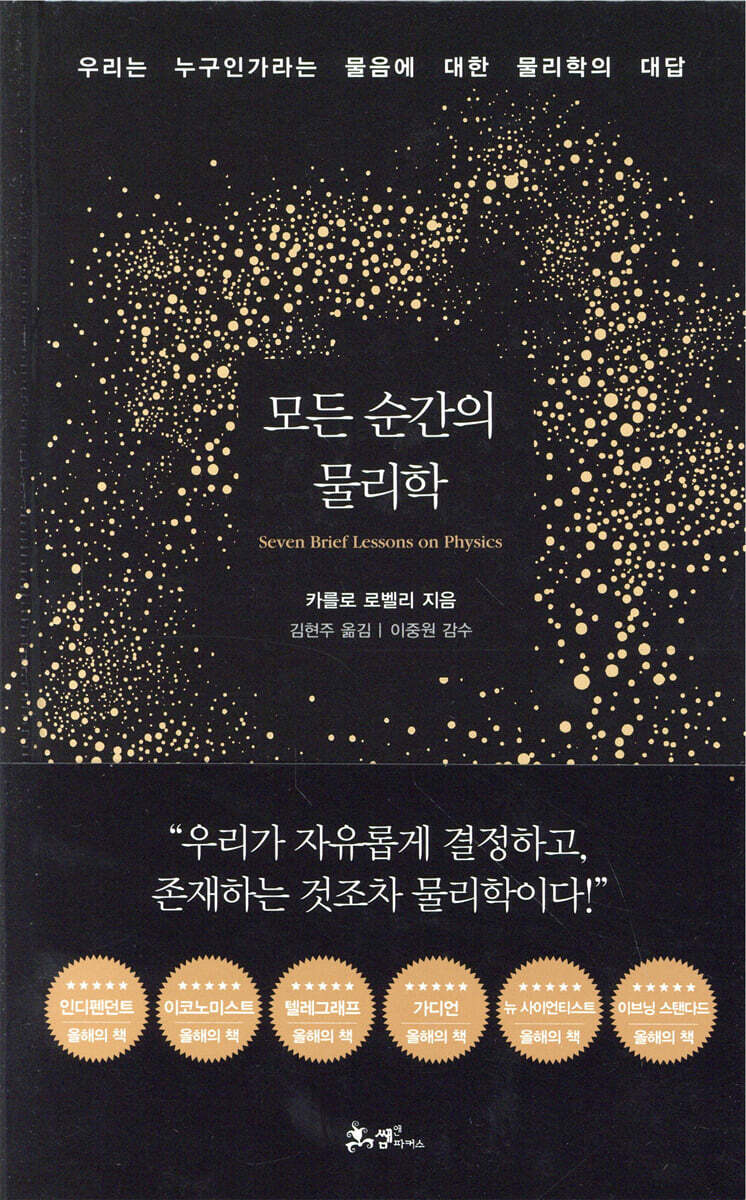
Physics of every moment
 |
Description
Book Introduction
“Easy, beautiful, clear!” World-renowned physicist Carlo Rovelli talks about the vast universe and humans living every moment. As the author states in the preface, “Physics of Every Moment” briefly examines the most notable features of the great revolution that has swept through physics since the 20th century (including, for example, the recently proven “gravitational waves”), the new problems that this revolution has opened up, and its mysteries.
The seven lectures concisely introduce not only the core theories that revolutionized 20th-century physics but also the most recent novel ideas, while providing a new understanding of the universe as a whole. Rather than a simple listing of various theories, it clearly shows how theories are born, influence each other, change, and ultimately combine to form new theories or ideas, like a dialectical process of change through thesis, antithesis, and synthesis, toward a new picture of the universe. Meanwhile, this book has another attractive advantage. It is explained very simply through analogies to everyday life, without equations and with extreme restraint in the use of technical terms, so that even those who know little or nothing about modern physics can understand it. For example, in general relativity, the gravitational field in the universe warps time and space like the waves of the ocean, or in quantum mechanics, the unstable microscopic world where particles are created and disappear is likened to a sea that appears very calm from a distance, but when seen up close, waves constantly crash and then disappear. Also, when mentioning the quantum of space, he compares the events that occur between quanta to the space of this world and the source of time itself, or explains that the heat of a black hole is like the Rosetta Stone written in three languages (quantum, gravity, and thermodynamics) and that we have to wait for the future decipherment to know its identity. This is an explanation that even experts find difficult to understand, but it is easy to explain in everyday language. |
- You can preview some of the book's contents.
Preview
index
To begin with
Lecture 1 | The Most Beautiful Theory in the World
Lecture 2 | Quantum Mechanics
Lecture 3 | The Structure of the Universe
Lecture Four | Particles
Lecture 5 | Space Particles
Lecture Six | Possibility, Time, and the Heat of Black Holes
The Last Lecture | We, Humans
Reviewer's note
Lecture 1 | The Most Beautiful Theory in the World
Lecture 2 | Quantum Mechanics
Lecture 3 | The Structure of the Universe
Lecture Four | Particles
Lecture 5 | Space Particles
Lecture Six | Possibility, Time, and the Heat of Black Holes
The Last Lecture | We, Humans
Reviewer's note
Into the book
“Of all the amazing leaps we have made in our knowledge over the course of history, the knowledge developed by Einstein is truly special.
Einstein's theory is incredibly simple once you understand how it works.
Einstein sees reality with a much clearer perspective than our dull, muddy perspectives in everyday life.
This reality also seems to be made of dream material, but it is much more real than the hazy dreams we have every day.” --- p.15
“If there were no quantum mechanics, there would be no transistors.
However, quantum physics theories do not explain what happens in physical systems; they only explain how one physical system is perceived by another.
What does this mean? Does it mean that the essential nature of a physical system cannot be explained? Does it simply mean that a crucial part of the history of physics is missing? Or does it mean that we must accept the notion that reality can only be explained through interactions? Personally, I think so." --- p.39
“Another leap forward came when Nicolaus Copernicus (1473-1543) initiated the so-called great scientific revolution.
Copernicus' world was not much different from Aristotle's.
But there was one thing fundamentally different.
Copernicus, inspired by an idea already conceived but abandoned in ancient times, discovered and proved that the Sun, not the Earth, was at the center of the planetary ball.
From this time on, our Earth became a planet no different from any other planet.
It rotates itself at a very fast speed and revolves around the sun.
“Copernicus’ world was not much different from Aristotle’s.” --- p.48
“If we observe the empty regions of space where there are no atoms, we can see that these particles are forming groups.
So, there is no such thing as truly empty space, a completely empty space.
Just as a very calm sea, when viewed up close, appears to have waves that are almost still and gently lapping, so too do the fields of particles that make up this world float in small layers.
If we imagine, all the fundamental particles of this world are constantly being created and destroyed, anxious about their short, mayfly lives.” --- p.61
Some philosophers, including Heidegger's most ardent followers, have concluded that physics cannot explain the most fundamental aspects of reality, and have relegated physics to a misleading knowledge.
But there have been countless instances since ancient times that prove that what is truly incredible is the fleeting instincts of human beings.
If we clung to this fleeting premonition, we might still be thinking that the Earth is flat and the Sun revolves around it.
These hunches, or intuitions, evolved based on limited experience.
That's why we have to look a little further to see that the world is not what it appears to be." --- p.104
“Being so human doesn’t make us distinct from nature.
This is also our nature.
Nature exists here on Earth, in a never-ending cycle of interconnected, intertwined, interdependent interactions, and information exchange.
Beyond that, we don't know how or how many unique complexities there are, but perhaps nature exists in the infinite space of space in forms we can't even imagine.
Up there in the vast expanse of space, it's foolish to think that there's anything special about this seemingly ordinary galaxy in the far corner of the universe.
Life on Earth is just a taste of what could happen in the universe.
So our souls are not so different from other people’s souls.”
Einstein's theory is incredibly simple once you understand how it works.
Einstein sees reality with a much clearer perspective than our dull, muddy perspectives in everyday life.
This reality also seems to be made of dream material, but it is much more real than the hazy dreams we have every day.” --- p.15
“If there were no quantum mechanics, there would be no transistors.
However, quantum physics theories do not explain what happens in physical systems; they only explain how one physical system is perceived by another.
What does this mean? Does it mean that the essential nature of a physical system cannot be explained? Does it simply mean that a crucial part of the history of physics is missing? Or does it mean that we must accept the notion that reality can only be explained through interactions? Personally, I think so." --- p.39
“Another leap forward came when Nicolaus Copernicus (1473-1543) initiated the so-called great scientific revolution.
Copernicus' world was not much different from Aristotle's.
But there was one thing fundamentally different.
Copernicus, inspired by an idea already conceived but abandoned in ancient times, discovered and proved that the Sun, not the Earth, was at the center of the planetary ball.
From this time on, our Earth became a planet no different from any other planet.
It rotates itself at a very fast speed and revolves around the sun.
“Copernicus’ world was not much different from Aristotle’s.” --- p.48
“If we observe the empty regions of space where there are no atoms, we can see that these particles are forming groups.
So, there is no such thing as truly empty space, a completely empty space.
Just as a very calm sea, when viewed up close, appears to have waves that are almost still and gently lapping, so too do the fields of particles that make up this world float in small layers.
If we imagine, all the fundamental particles of this world are constantly being created and destroyed, anxious about their short, mayfly lives.” --- p.61
Some philosophers, including Heidegger's most ardent followers, have concluded that physics cannot explain the most fundamental aspects of reality, and have relegated physics to a misleading knowledge.
But there have been countless instances since ancient times that prove that what is truly incredible is the fleeting instincts of human beings.
If we clung to this fleeting premonition, we might still be thinking that the Earth is flat and the Sun revolves around it.
These hunches, or intuitions, evolved based on limited experience.
That's why we have to look a little further to see that the world is not what it appears to be." --- p.104
“Being so human doesn’t make us distinct from nature.
This is also our nature.
Nature exists here on Earth, in a never-ending cycle of interconnected, intertwined, interdependent interactions, and information exchange.
Beyond that, we don't know how or how many unique complexities there are, but perhaps nature exists in the infinite space of space in forms we can't even imagine.
Up there in the vast expanse of space, it's foolish to think that there's anything special about this seemingly ordinary galaxy in the far corner of the universe.
Life on Earth is just a taste of what could happen in the universe.
So our souls are not so different from other people’s souls.”
--- p.128
Publisher's Review
A 2015 'Book of the Year' lauded by the international press!
The fastest-selling science book since Penguin Group's founding!
“Surprisingly, in this thin book,
“It contains almost everything about the ‘mystery of the universe.’”
If you were to pick the hottest book in the world of publishing in 2015, it would undoubtedly be Italian physicist Carlo Rovelli's Physics of Every Moment (original title: Seven Short Lectures in Physics).
This book, unusually, broke the stereotype that 'physics books don't sell' and sold over 300,000 copies in Italy alone and over 1 million copies across Europe, reaching number one on the overall bestseller list.
Moreover, E., who was sweeping the world of publishing at the time,
It also created more buzz by beating out L. James's Fifty Shades of Grey and rising to the top of the bestseller list.
Although some say that the explosive success of the movie 'Interstellar' played a part in the sales, it was a level of sales that even Carlo Rovelli, the author of the book, could not have predicted, saying, "I had no idea that a book that was published with only 2,000 copies in mind would sell so quickly."
But despite the author's humility in saying he 'expected 2,000 copies', Carlo Rovelli is actually a fairly well-known physicist worldwide.
He is credited with making significant progress in solving the mysteries of black holes and the universe by combining the theory of relativity and quantum mechanics to create a new concept called 'loop quantum gravity.'
He is also active in giving physics lectures to the public, and this book is part of his public lecture series.
“Easy, beautiful, clear!”
Carlo Rovelli, a world-renowned physicist,
Speaking of the vast universe and humans living every moment
As the author explains in the preface, "Physics of Every Moment" briefly examines the most prominent features of the great revolution that has swept through physics since the 20th century (including, for example, the recently proven "gravitational waves"), the new problems that this revolution has opened up, and its mysteries.
The seven lectures concisely introduce not only the core theories that revolutionized 20th-century physics but also the most recent novel ideas, while providing a new understanding of the universe as a whole.
Rather than a simple listing of various theories, it clearly shows how theories are born, influence each other, change, and ultimately combine to form new theories or ideas, like a dialectical process of change through thesis, antithesis, and synthesis, toward a new picture of the universe.
When we ask questions like, 'What is the flow of time?', time becomes the crux of the matter.
This problem was already mentioned in classical physics and attracted the attention of philosophers from the 19th to the 20th centuries, but it has become a rather sensitive problem in modern physics.
Physics describes the world with formulas that tell us how things change with the 'time variable'.
Meanwhile, we can write formulas that tell us how things change depending on the 'variable of location', or how the taste of risotto changes depending on the 'variable of the amount of butter'.
While time appears to 'flow', neither the amount of butter nor the location in space 'flows'.
-Pages 100-101 of the text
Meanwhile, this book has another attractive advantage.
It is explained very simply through analogies to everyday life, without equations and with extreme restraint in the use of technical terms, so that even those who know little or nothing about modern physics can understand it.
For example, in general relativity, the gravitational field in the universe warps time and space like the waves of the ocean, or in quantum mechanics, the unstable microscopic world where particles are created and disappear is likened to a sea that appears very calm from a distance, but when seen up close, waves constantly crash and then disappear.
The world described in quantum gravity theory is quite different from the world we are familiar with.
There is no space to 'accept' the world, nor is there a long period of time in which various events occur.
There is just a basic process where space quantum and matter continually interact with each other.
The illusions of space and time that swirl around us are faint glimpses of these fundamental processes occurring en masse.
So, a quiet, clear lake in a high altitude is actually made up of countless tiny water molecules dancing at high speeds.
-Pages 80-81
Also, when mentioning the quantum of space, he compares the events that occur between quanta to the space of this world and the source of time itself, or explains that the heat of a black hole is like the Rosetta Stone written in three languages (quantum, gravity, and thermodynamics) and that we have to wait for the future decipherment to know its identity. This is an explanation that even experts find difficult to understand, but it is easy to explain in everyday language.
The mystery of the vast space,
What is it that we, the human beings, are inside it?
Finally, this book raises meaningful questions for us living in the 21st century, a world of science and technology.
In that respect, the seventh lecture, "We, Humans," is deeply imbued with the core theme of this book and the concerns of modern physics today.
The questions the author himself asks speak volumes.
As human beings who feel, judge, cry, and laugh, where do we fit within this vast mural of the world offered by modern physics? (Omitted) Are we, too, simply made of quanta and particles? If so, why do we each exist individually and feel ourselves? What are our values, our dreams, our emotions, our knowledge? What exactly are we in this vast and dazzling world? (Main text, pp. 112-113)
This is a passage that allows us to glimpse the human anguish of a renowned scientist who has explored cosmology and the discussions at the cutting edge of modern physics.
Human curiosity about space has persisted for thousands of years, but never before have scientifically credible stories been so widely circulated among the population as they are today.
In that sense, this book will serve as a concise yet meaningful guide to exploring the universe for those unfamiliar with modern physics.
The fastest-selling science book since Penguin Group's founding!
“Surprisingly, in this thin book,
“It contains almost everything about the ‘mystery of the universe.’”
If you were to pick the hottest book in the world of publishing in 2015, it would undoubtedly be Italian physicist Carlo Rovelli's Physics of Every Moment (original title: Seven Short Lectures in Physics).
This book, unusually, broke the stereotype that 'physics books don't sell' and sold over 300,000 copies in Italy alone and over 1 million copies across Europe, reaching number one on the overall bestseller list.
Moreover, E., who was sweeping the world of publishing at the time,
It also created more buzz by beating out L. James's Fifty Shades of Grey and rising to the top of the bestseller list.
Although some say that the explosive success of the movie 'Interstellar' played a part in the sales, it was a level of sales that even Carlo Rovelli, the author of the book, could not have predicted, saying, "I had no idea that a book that was published with only 2,000 copies in mind would sell so quickly."
But despite the author's humility in saying he 'expected 2,000 copies', Carlo Rovelli is actually a fairly well-known physicist worldwide.
He is credited with making significant progress in solving the mysteries of black holes and the universe by combining the theory of relativity and quantum mechanics to create a new concept called 'loop quantum gravity.'
He is also active in giving physics lectures to the public, and this book is part of his public lecture series.
“Easy, beautiful, clear!”
Carlo Rovelli, a world-renowned physicist,
Speaking of the vast universe and humans living every moment
As the author explains in the preface, "Physics of Every Moment" briefly examines the most prominent features of the great revolution that has swept through physics since the 20th century (including, for example, the recently proven "gravitational waves"), the new problems that this revolution has opened up, and its mysteries.
The seven lectures concisely introduce not only the core theories that revolutionized 20th-century physics but also the most recent novel ideas, while providing a new understanding of the universe as a whole.
Rather than a simple listing of various theories, it clearly shows how theories are born, influence each other, change, and ultimately combine to form new theories or ideas, like a dialectical process of change through thesis, antithesis, and synthesis, toward a new picture of the universe.
When we ask questions like, 'What is the flow of time?', time becomes the crux of the matter.
This problem was already mentioned in classical physics and attracted the attention of philosophers from the 19th to the 20th centuries, but it has become a rather sensitive problem in modern physics.
Physics describes the world with formulas that tell us how things change with the 'time variable'.
Meanwhile, we can write formulas that tell us how things change depending on the 'variable of location', or how the taste of risotto changes depending on the 'variable of the amount of butter'.
While time appears to 'flow', neither the amount of butter nor the location in space 'flows'.
-Pages 100-101 of the text
Meanwhile, this book has another attractive advantage.
It is explained very simply through analogies to everyday life, without equations and with extreme restraint in the use of technical terms, so that even those who know little or nothing about modern physics can understand it.
For example, in general relativity, the gravitational field in the universe warps time and space like the waves of the ocean, or in quantum mechanics, the unstable microscopic world where particles are created and disappear is likened to a sea that appears very calm from a distance, but when seen up close, waves constantly crash and then disappear.
The world described in quantum gravity theory is quite different from the world we are familiar with.
There is no space to 'accept' the world, nor is there a long period of time in which various events occur.
There is just a basic process where space quantum and matter continually interact with each other.
The illusions of space and time that swirl around us are faint glimpses of these fundamental processes occurring en masse.
So, a quiet, clear lake in a high altitude is actually made up of countless tiny water molecules dancing at high speeds.
-Pages 80-81
Also, when mentioning the quantum of space, he compares the events that occur between quanta to the space of this world and the source of time itself, or explains that the heat of a black hole is like the Rosetta Stone written in three languages (quantum, gravity, and thermodynamics) and that we have to wait for the future decipherment to know its identity. This is an explanation that even experts find difficult to understand, but it is easy to explain in everyday language.
The mystery of the vast space,
What is it that we, the human beings, are inside it?
Finally, this book raises meaningful questions for us living in the 21st century, a world of science and technology.
In that respect, the seventh lecture, "We, Humans," is deeply imbued with the core theme of this book and the concerns of modern physics today.
The questions the author himself asks speak volumes.
As human beings who feel, judge, cry, and laugh, where do we fit within this vast mural of the world offered by modern physics? (Omitted) Are we, too, simply made of quanta and particles? If so, why do we each exist individually and feel ourselves? What are our values, our dreams, our emotions, our knowledge? What exactly are we in this vast and dazzling world? (Main text, pp. 112-113)
This is a passage that allows us to glimpse the human anguish of a renowned scientist who has explored cosmology and the discussions at the cutting edge of modern physics.
Human curiosity about space has persisted for thousands of years, but never before have scientifically credible stories been so widely circulated among the population as they are today.
In that sense, this book will serve as a concise yet meaningful guide to exploring the universe for those unfamiliar with modern physics.
GOODS SPECIFICS
- Date of publication: February 26, 2016
- Format: Hardcover book binding method guide
- Page count, weight, size: 148 pages | 290g | 124*200*13mm
- ISBN13: 9788965703112
- ISBN 10: 8965703115
You may also like
카테고리
korean


korean

![GQ KOREA Mark (Monthly): December [2025]](http://librairie.coreenne.fr/cdn/shop/files/8ef265dbbfbf186523ed75ba7319009d.jpg?v=1765340328&width=3840)


