

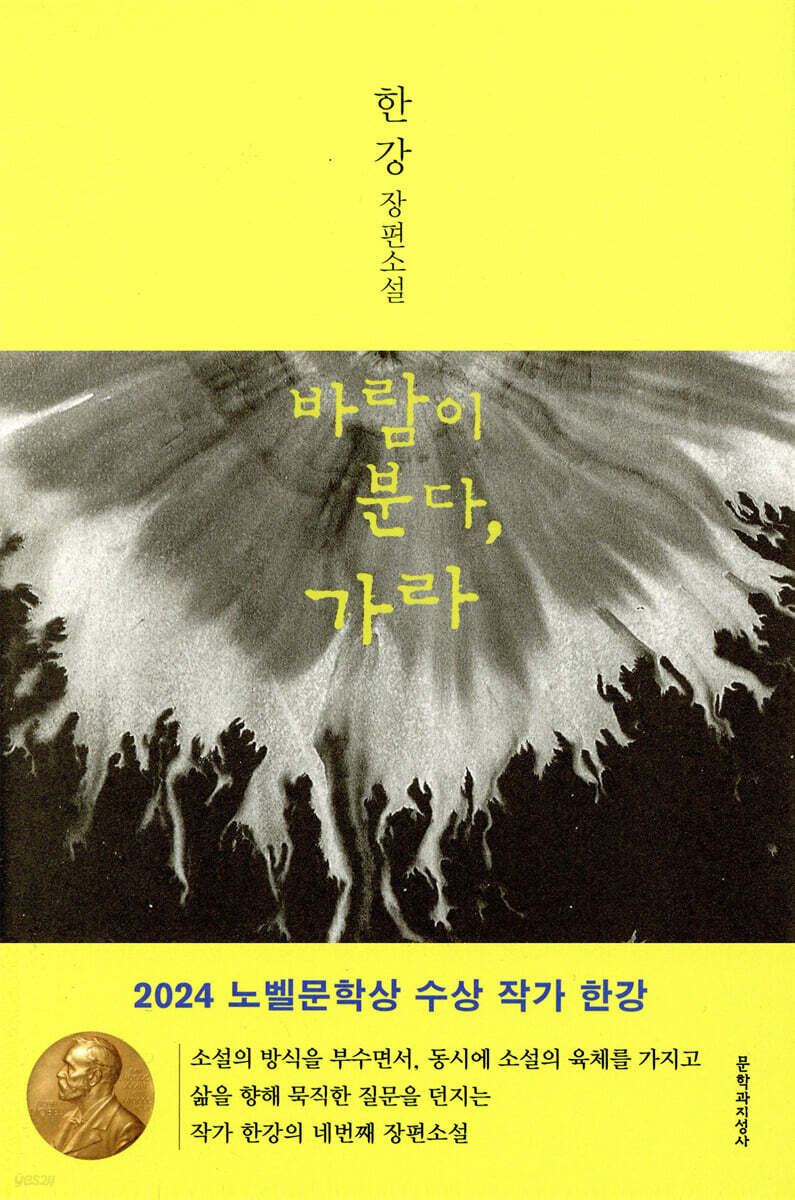
The wind blows, go away
 |
Description
Book Introduction
“The heavy snow that morning covered all traces.”
2024 Nobel Prize in Literature winner Han Kang
On the border between life and death
I had to breathe desperately
Their story
A writer who poses profound questions about life
Han Kang's fourth full-length novel
This is the fourth full-length novel published by Han Kang, who began her literary career in 1993 by publishing the poem “Winter of Seoul” and four other pieces in the winter edition of the quarterly magazine Literature and Society, and the following year when her short story “Red Anchor” was selected for the Seoul Shinmun New Year’s literary contest.
The author, who has persistently explored the essential human desires and truth of life latent in the comfortable daily life with soft but powerful sentences and a poetic style, has consistently received attention at home and abroad, winning the Korea Novel Literature Award (1999), Today's Young Artist Award (2000), Yi Sang Literature Award (2005), Dongni Literature Award (2010), Manhae Literature Award (2014), Hwang Sun-won Literature Award (2015), International Booker Prize (2016), Malaparte Literature Award (2017), Kim Yu-jeong Literature Award (2018), San Clemente Literature Award (2019), Daesan Literature Award (2022), Médicis Prize for Foreign Literature (2023), Émile Guimet Prize for Asian Literature (2024), and Nobel Prize in Literature (2024).
The author of 『The Wind Blows, Go Away』 began planning it around the fall of 2005, serialized the middle part of the story in the quarterly 『Literature and Society』 from the fall of 2007 to the fall of the following year, and then spent a little over a year revising and completing it from the beginning, making it a work that took a whopping 4 years and 6 months to complete.
The story of a promising female painter's mysterious death unfolds over 400 pages, with people fighting fiercely to prove the truth they believe in, colliding and getting hurt with their whole bodies.
The story unfolds through the memories and arduous journey of the narrator, Lee Jeong-hee, as she searches for the truth about two car accidents that occurred at dawn on the Misiryeong Pass, separated by a period of forty years, and the intimate stories of the people involved.
Through "The Wind Blows, Go Away," which constantly collides and clashes with the flow of the characters' emotions, their relationships, the way the novel unfolds and its style, and even the complex flow of time, the author poses a question, writhing with intense breath and narrative waves.
How should we live this life now, standing on the sharp edge of a life that is shaken and troubled at every moment?
Can we truly obtain true light by surviving?
In an interview around the time of the publication of the work, Han Kang said, “It is a novel that breaks the format of a novel, while at the same time having the body of a novel” (“This Writer: Han Kang - Writer Interview,” Literature and Society, Spring 2010, p.
He said he wanted to write (341).
The boundaries between life and death, as well as the origins of life, understanding and love for others, the possession and reconstruction of memory, the identity of the madness and dark desires within us, the intense will to live, and a vivid perspective on nature and art—all of these elements that have been dealt with in fragments in Han Kang's literature so far are now melted together in this full-length novel, shining brightly.
2024 Nobel Prize in Literature winner Han Kang
On the border between life and death
I had to breathe desperately
Their story
A writer who poses profound questions about life
Han Kang's fourth full-length novel
This is the fourth full-length novel published by Han Kang, who began her literary career in 1993 by publishing the poem “Winter of Seoul” and four other pieces in the winter edition of the quarterly magazine Literature and Society, and the following year when her short story “Red Anchor” was selected for the Seoul Shinmun New Year’s literary contest.
The author, who has persistently explored the essential human desires and truth of life latent in the comfortable daily life with soft but powerful sentences and a poetic style, has consistently received attention at home and abroad, winning the Korea Novel Literature Award (1999), Today's Young Artist Award (2000), Yi Sang Literature Award (2005), Dongni Literature Award (2010), Manhae Literature Award (2014), Hwang Sun-won Literature Award (2015), International Booker Prize (2016), Malaparte Literature Award (2017), Kim Yu-jeong Literature Award (2018), San Clemente Literature Award (2019), Daesan Literature Award (2022), Médicis Prize for Foreign Literature (2023), Émile Guimet Prize for Asian Literature (2024), and Nobel Prize in Literature (2024).
The author of 『The Wind Blows, Go Away』 began planning it around the fall of 2005, serialized the middle part of the story in the quarterly 『Literature and Society』 from the fall of 2007 to the fall of the following year, and then spent a little over a year revising and completing it from the beginning, making it a work that took a whopping 4 years and 6 months to complete.
The story of a promising female painter's mysterious death unfolds over 400 pages, with people fighting fiercely to prove the truth they believe in, colliding and getting hurt with their whole bodies.
The story unfolds through the memories and arduous journey of the narrator, Lee Jeong-hee, as she searches for the truth about two car accidents that occurred at dawn on the Misiryeong Pass, separated by a period of forty years, and the intimate stories of the people involved.
Through "The Wind Blows, Go Away," which constantly collides and clashes with the flow of the characters' emotions, their relationships, the way the novel unfolds and its style, and even the complex flow of time, the author poses a question, writhing with intense breath and narrative waves.
How should we live this life now, standing on the sharp edge of a life that is shaken and troubled at every moment?
Can we truly obtain true light by surviving?
In an interview around the time of the publication of the work, Han Kang said, “It is a novel that breaks the format of a novel, while at the same time having the body of a novel” (“This Writer: Han Kang - Writer Interview,” Literature and Society, Spring 2010, p.
He said he wanted to write (341).
The boundaries between life and death, as well as the origins of life, understanding and love for others, the possession and reconstruction of memory, the identity of the madness and dark desires within us, the intense will to live, and a vivid perspective on nature and art—all of these elements that have been dealt with in fragments in Han Kang's literature so far are now melted together in this full-length novel, shining brightly.
- You can preview some of the book's contents.
Preview
index
1..
450 kilometers
2..
Planck's time
3..
The flesh is red and the blood is black
4..
Sea of Magma
5..
The Paradox of the Black Sky
6..
The dark side of the moon
7..
ice volcano
8..
First Light
9..
blue stone
10..
The wind blows, go away
Author's Note
450 kilometers
2..
Planck's time
3..
The flesh is red and the blood is black
4..
Sea of Magma
5..
The Paradox of the Black Sky
6..
The dark side of the moon
7..
ice volcano
8..
First Light
9..
blue stone
10..
The wind blows, go away
Author's Note
Into the book
Before it got dark, I crossed the frozen river by train.
The middle of the river didn't freeze, so the water around the edge of the ice shone brightly.
Now it really feels like this novel is leaving my hands.
I spent four winters with this novel.
The season of wind, ice, and red-hot fists.
Because of this novel, I felt like my body was covered in ice even in the summer.
Sometimes, I should no longer look back on the times I put this novel down and wandered, the times I tossed and turned, the times I tried to move forward by breaking down what needed to be broken.
The middle of the river didn't freeze, so the water around the edge of the ice shone brightly.
Now it really feels like this novel is leaving my hands.
I spent four winters with this novel.
The season of wind, ice, and red-hot fists.
Because of this novel, I felt like my body was covered in ice even in the summer.
Sometimes, I should no longer look back on the times I put this novel down and wandered, the times I tossed and turned, the times I tried to move forward by breaking down what needed to be broken.
--- From the author's note
Publisher's Review
Around the fall of 2005, the author happened to hear a story about 'breath fighting'.
This term, which refers to the conflict that occurs when an unconscious patient on a respirator suddenly begins to breathe on their own, vividly conjures up the image of a woman on a respirator fighting for breath, and the author is seized with a strong urge to write her story.
Thus, the novel 『The Wind Blows, Go Away』 was written by the author over four cold winters.
As you follow the memories and consciousness of the characters, who go back and forth between the present and the past, like a tangled subway line with no clear beginning or end, and wander between astrophysics that conveys the mysteries of the universe and the origin of life that we cannot understand, and the ink drawings that dominate the inner selves of the characters (Lee Jeong-hee, Lee Dong-joo, and Seo In-joo) with overwhelming images, you finally reach a point where the author's breathless breathing reaches.
If life is filled with moments of intense agony and pain, standing on the sharp border between life and death, and moments of tense tension where breath clashes with breath, then how should we live this life given to us?
Lee Jeong-hee and Seo In-joo are friends from the same alley, Su-yuri, who attended middle school and high school together.
Seo In-ju, a former short-distance runner, lives alone with her sickly maternal uncle (Lee Dong-ju).
My maternal uncle, who was very interested in the secrets of the universe and scientific exploration, was obsessed with the task of drawing a huge ink painting on a piece of Korean paper.
The day she was invited to Inju's house, Lee Jeong-hee became fascinated by stars, the universe, the origin of life, and paintings covered in ink. From then on, she began to frequent the house, devouring books on astrophysics and drawing under her uncle's guidance, while also developing a passionate love for him.
However, before finishing high school, her maternal uncle, who had been suffering from a chronic illness, dies, and Inju eventually gives up track and field after sustaining a serious leg injury while pole vaulting. From then on, she chooses to live a life of isolation from the outside world for a long time.
When Inju contacted Jeonghee again, she was already drawing a picture in ink, following her uncle's style.
After that, Seo In-ju meets a man named Jeong Seon-gyu and gives birth to a son, Min-seo, but after the divorce, she lives alone with her child and devotes herself to arduous painting work. Lee Jeong-hee, who cannot escape the memories of her dead maternal uncle and is worn out both physically and mentally, meets K, who resembles him, and attempts suicide after having three children, continuing her turbulent life.
For a while, In-ju, Min-seo, and Jeong-hee spend a painful but happy time together.
However, Inju suddenly loses contact, and what follows is Inju's death in a car accident on a winter dawn road at Misiryeong Pass, buried in heavy snow.
Lee Jeong-hee, who was at a loss in the face of the death of her maternal uncle, whom she loved but could not be a family member or lover, and the disappearance of her friend, is once again left helpless in the face of the sudden death of her friend Seo In-ju, suffering heartbreaking pain.
After that, Jeong-hee's daily life, which had been settled in silence and tranquility, making a living through irregular translation work while suppressing the dark heat, is one day ignited by a situation that ignites a hot fire.
Because I came across an article about Inju, who died suddenly in Misiryeong during a heavy snowfall in the winter a year ago.
Art critic Kang Seok-won, who wrote the article, is concluding that In-ju's death was suicide and is trying to mythologize the death of a young female painter with both talent and beauty by revealing her life and paintings in detail.
However, because In-ju was a person who could never give up her own life due to her passion for life and her utmost love for her son, Min-seo, Lee Jeong-hee prevents the publication of Kang Seok-won's book and searches for the truth behind In-ju's death.
The story of "The Wind Blows, Go Away" begins again here.
Faced with the psychological and physical oppression of art critic Kang Seok-won, who loved Seo In-ju and believes he played a crucial role in bringing her paintings to the world, Lee Jeong-hee sets out to find people who can help her prove that In-ju's death was not suicide.
After packing up her life in Seoul, she remarried, and immigrated to Australia with her son Minseo. She sends unanswered emails to Inju's ex-husband, Jeong Seon-gyu. She also meets the directors of the art galleries and art academies where Inju's paintings were exhibited and introduced, the director of the art academy, and the sculptor Kim Young-shin, with whom she shared her artistic friendships and even her intimate personal pains. She investigates Inju's whereabouts just before her death, when she had cut off contact even with him.
And to counter Kang Seok-won's work of writing a biography that would be a lie and hurtful to In-ju and her remaining son, Min-seo, Jeong-hee wants to write a book about the story she knows about In-ju.
Amidst Kang Seok-won's persistent questioning, coaxing, and violence, Lee Jeong-hee discovers an old photograph by chance in the studio where In-ju and her maternal uncle's drawings and materials were left, and relies on a cryptic note written behind it to learn of the existence of Ryu In-seop, the director of the counseling center.
Ryu In-seop is the man who met and loved In-ju's mother, Lee Dong-seon, who also ended her life from alcoholism and schizophrenia forty years ago.
Just before he dies, Ryu In-seop leaves a letter to Jeong-hee, telling her about In-ju's sudden death at Misiryeong Pass, the ink painting that In-ju had been obsessed with until just before her death, the reason why In-ju had no choice but to go to Misiryeong Pass in the heavy snow that morning, and the secret story about In-ju's mother, Lee Dong-seon, that neither In-ju nor her maternal uncle had tacitly revealed.
Jeong-hee, who has come to know all these facts, is spurred on to write and publish a book about In-ju, but Kang Seok-won, who is crazy about his love and hate for Seo In-ju, his jealousy of Lee Jeong-hee, who is more than just a friend, and his passion for deifying Seo In-ju's life, commits terrorism against Jeong-hee and destroys the remaining paintings and materials in a fire.
Just as the dark blue ink lines on Hanji, which has a fine structure like the capillaries of the human body, stretch out with the force of repulsion against water, the Han River embraces the people who continue to live with subtle breaths through quiet but tenacious breathing and sentences.
They live 450 kilometers deep in the atmosphere, on a place called Earth, “fiercely in flatness, easygoingly in flatness, laughing, talking, getting sick, and dancing in flatness” (p. 39).
They, all of them who curse, are hurt, and desire, experience a fleeting moment called 'Planck's time', when "the long chaos split and heaven and earth were created, the universe expanded rapidly, and matter was created" (p. 44).
In this weathering earth, drying rivers, and the chaos of exploding stars in the thick darkness, the Han River explores the origins of the universe and life, and directs its questions solely at our present lives.
The slope is long, painful and also intense.
Just like the struggle of Lee Jeong-hee, who crawls on the floor, through the flames, and painfully follows the cracks of life with only one strong will to live, “I want to live, I want to live,” with her hands and feet not free at the end of the novel.
Furthermore, the refined language and stylistic aesthetics that Han Kang has implemented and perfected in her works over the past 16 years since her debut continue to capture the attention of readers in this novel.
“If all language were compressed into a single word, if such a word existed, what would happen when we opened our lips to pronounce it?” (p. 122) also touches on the author’s long-standing curiosity.
The italics that appear throughout the novel also reflect the characters' deep, unknown abysses, their anxieties and fears, their fierce resistance to external oppression, and their intense yearning for life.
“When this kind of wind blows.
If the wind carries this much moisture and blows with this much strength… …
It feels like wind is pushing into my blood vessels.
Everything is a big whole
I feel it.
At any moment, my legs... ... can be pierced to the point of death. Now, I live a life that can pierce my life in an instant.
“It feels frighteningly clear that I am alive.” (pp.
368~69)
Author's Note
Before it got dark, I crossed the frozen river by train.
The middle of the river didn't freeze, so the water around the edge of the ice shone brightly.
Now it really feels like this novel is leaving my hands.
I spent four winters with this novel.
The season of wind, ice, and red-hot fists.
Because of this novel, I felt like my body was covered in ice even in the summer.
Sometimes, I should no longer look back on the times I put this novel down and wandered, the times I tossed and turned, the times I tried to move forward by breaking down what needed to be broken.
I received valuable help from many people.
I bow my head in gratitude, and I will disclose this separately at the end of the book.
How should I say hello to those who have encouraged me with their hearts for so long, even though I haven't been able to reveal it yet?
This novel was serialized in the quarterly magazine 『Literature and Society』 for a year and a half, and then I rewrote it from the beginning again for about a year and a half.
I would like to thank all of you at Moonji for your warm support during this process, which was much slower than expected.
Early 2000, a snowy dawn
Korea River
This term, which refers to the conflict that occurs when an unconscious patient on a respirator suddenly begins to breathe on their own, vividly conjures up the image of a woman on a respirator fighting for breath, and the author is seized with a strong urge to write her story.
Thus, the novel 『The Wind Blows, Go Away』 was written by the author over four cold winters.
As you follow the memories and consciousness of the characters, who go back and forth between the present and the past, like a tangled subway line with no clear beginning or end, and wander between astrophysics that conveys the mysteries of the universe and the origin of life that we cannot understand, and the ink drawings that dominate the inner selves of the characters (Lee Jeong-hee, Lee Dong-joo, and Seo In-joo) with overwhelming images, you finally reach a point where the author's breathless breathing reaches.
If life is filled with moments of intense agony and pain, standing on the sharp border between life and death, and moments of tense tension where breath clashes with breath, then how should we live this life given to us?
Lee Jeong-hee and Seo In-joo are friends from the same alley, Su-yuri, who attended middle school and high school together.
Seo In-ju, a former short-distance runner, lives alone with her sickly maternal uncle (Lee Dong-ju).
My maternal uncle, who was very interested in the secrets of the universe and scientific exploration, was obsessed with the task of drawing a huge ink painting on a piece of Korean paper.
The day she was invited to Inju's house, Lee Jeong-hee became fascinated by stars, the universe, the origin of life, and paintings covered in ink. From then on, she began to frequent the house, devouring books on astrophysics and drawing under her uncle's guidance, while also developing a passionate love for him.
However, before finishing high school, her maternal uncle, who had been suffering from a chronic illness, dies, and Inju eventually gives up track and field after sustaining a serious leg injury while pole vaulting. From then on, she chooses to live a life of isolation from the outside world for a long time.
When Inju contacted Jeonghee again, she was already drawing a picture in ink, following her uncle's style.
After that, Seo In-ju meets a man named Jeong Seon-gyu and gives birth to a son, Min-seo, but after the divorce, she lives alone with her child and devotes herself to arduous painting work. Lee Jeong-hee, who cannot escape the memories of her dead maternal uncle and is worn out both physically and mentally, meets K, who resembles him, and attempts suicide after having three children, continuing her turbulent life.
For a while, In-ju, Min-seo, and Jeong-hee spend a painful but happy time together.
However, Inju suddenly loses contact, and what follows is Inju's death in a car accident on a winter dawn road at Misiryeong Pass, buried in heavy snow.
Lee Jeong-hee, who was at a loss in the face of the death of her maternal uncle, whom she loved but could not be a family member or lover, and the disappearance of her friend, is once again left helpless in the face of the sudden death of her friend Seo In-ju, suffering heartbreaking pain.
After that, Jeong-hee's daily life, which had been settled in silence and tranquility, making a living through irregular translation work while suppressing the dark heat, is one day ignited by a situation that ignites a hot fire.
Because I came across an article about Inju, who died suddenly in Misiryeong during a heavy snowfall in the winter a year ago.
Art critic Kang Seok-won, who wrote the article, is concluding that In-ju's death was suicide and is trying to mythologize the death of a young female painter with both talent and beauty by revealing her life and paintings in detail.
However, because In-ju was a person who could never give up her own life due to her passion for life and her utmost love for her son, Min-seo, Lee Jeong-hee prevents the publication of Kang Seok-won's book and searches for the truth behind In-ju's death.
The story of "The Wind Blows, Go Away" begins again here.
Faced with the psychological and physical oppression of art critic Kang Seok-won, who loved Seo In-ju and believes he played a crucial role in bringing her paintings to the world, Lee Jeong-hee sets out to find people who can help her prove that In-ju's death was not suicide.
After packing up her life in Seoul, she remarried, and immigrated to Australia with her son Minseo. She sends unanswered emails to Inju's ex-husband, Jeong Seon-gyu. She also meets the directors of the art galleries and art academies where Inju's paintings were exhibited and introduced, the director of the art academy, and the sculptor Kim Young-shin, with whom she shared her artistic friendships and even her intimate personal pains. She investigates Inju's whereabouts just before her death, when she had cut off contact even with him.
And to counter Kang Seok-won's work of writing a biography that would be a lie and hurtful to In-ju and her remaining son, Min-seo, Jeong-hee wants to write a book about the story she knows about In-ju.
Amidst Kang Seok-won's persistent questioning, coaxing, and violence, Lee Jeong-hee discovers an old photograph by chance in the studio where In-ju and her maternal uncle's drawings and materials were left, and relies on a cryptic note written behind it to learn of the existence of Ryu In-seop, the director of the counseling center.
Ryu In-seop is the man who met and loved In-ju's mother, Lee Dong-seon, who also ended her life from alcoholism and schizophrenia forty years ago.
Just before he dies, Ryu In-seop leaves a letter to Jeong-hee, telling her about In-ju's sudden death at Misiryeong Pass, the ink painting that In-ju had been obsessed with until just before her death, the reason why In-ju had no choice but to go to Misiryeong Pass in the heavy snow that morning, and the secret story about In-ju's mother, Lee Dong-seon, that neither In-ju nor her maternal uncle had tacitly revealed.
Jeong-hee, who has come to know all these facts, is spurred on to write and publish a book about In-ju, but Kang Seok-won, who is crazy about his love and hate for Seo In-ju, his jealousy of Lee Jeong-hee, who is more than just a friend, and his passion for deifying Seo In-ju's life, commits terrorism against Jeong-hee and destroys the remaining paintings and materials in a fire.
Just as the dark blue ink lines on Hanji, which has a fine structure like the capillaries of the human body, stretch out with the force of repulsion against water, the Han River embraces the people who continue to live with subtle breaths through quiet but tenacious breathing and sentences.
They live 450 kilometers deep in the atmosphere, on a place called Earth, “fiercely in flatness, easygoingly in flatness, laughing, talking, getting sick, and dancing in flatness” (p. 39).
They, all of them who curse, are hurt, and desire, experience a fleeting moment called 'Planck's time', when "the long chaos split and heaven and earth were created, the universe expanded rapidly, and matter was created" (p. 44).
In this weathering earth, drying rivers, and the chaos of exploding stars in the thick darkness, the Han River explores the origins of the universe and life, and directs its questions solely at our present lives.
The slope is long, painful and also intense.
Just like the struggle of Lee Jeong-hee, who crawls on the floor, through the flames, and painfully follows the cracks of life with only one strong will to live, “I want to live, I want to live,” with her hands and feet not free at the end of the novel.
Furthermore, the refined language and stylistic aesthetics that Han Kang has implemented and perfected in her works over the past 16 years since her debut continue to capture the attention of readers in this novel.
“If all language were compressed into a single word, if such a word existed, what would happen when we opened our lips to pronounce it?” (p. 122) also touches on the author’s long-standing curiosity.
The italics that appear throughout the novel also reflect the characters' deep, unknown abysses, their anxieties and fears, their fierce resistance to external oppression, and their intense yearning for life.
“When this kind of wind blows.
If the wind carries this much moisture and blows with this much strength… …
It feels like wind is pushing into my blood vessels.
Everything is a big whole
I feel it.
At any moment, my legs... ... can be pierced to the point of death. Now, I live a life that can pierce my life in an instant.
“It feels frighteningly clear that I am alive.” (pp.
368~69)
Author's Note
Before it got dark, I crossed the frozen river by train.
The middle of the river didn't freeze, so the water around the edge of the ice shone brightly.
Now it really feels like this novel is leaving my hands.
I spent four winters with this novel.
The season of wind, ice, and red-hot fists.
Because of this novel, I felt like my body was covered in ice even in the summer.
Sometimes, I should no longer look back on the times I put this novel down and wandered, the times I tossed and turned, the times I tried to move forward by breaking down what needed to be broken.
I received valuable help from many people.
I bow my head in gratitude, and I will disclose this separately at the end of the book.
How should I say hello to those who have encouraged me with their hearts for so long, even though I haven't been able to reveal it yet?
This novel was serialized in the quarterly magazine 『Literature and Society』 for a year and a half, and then I rewrote it from the beginning again for about a year and a half.
I would like to thank all of you at Moonji for your warm support during this process, which was much slower than expected.
Early 2000, a snowy dawn
Korea River
GOODS SPECIFICS
- Date of publication: February 26, 2010
- Page count, weight, size: 390 pages | 530g | 148*210*30mm
- ISBN13: 9788932020006
- ISBN10: 8932020000
You may also like
카테고리
korean


korean

![ELLE 엘르 스페셜 에디션 A형 : 12월 [2025]](http://librairie.coreenne.fr/cdn/shop/files/b8e27a3de6c9538896439686c6b0e8fb.jpg?v=1766436872&width=3840)


