

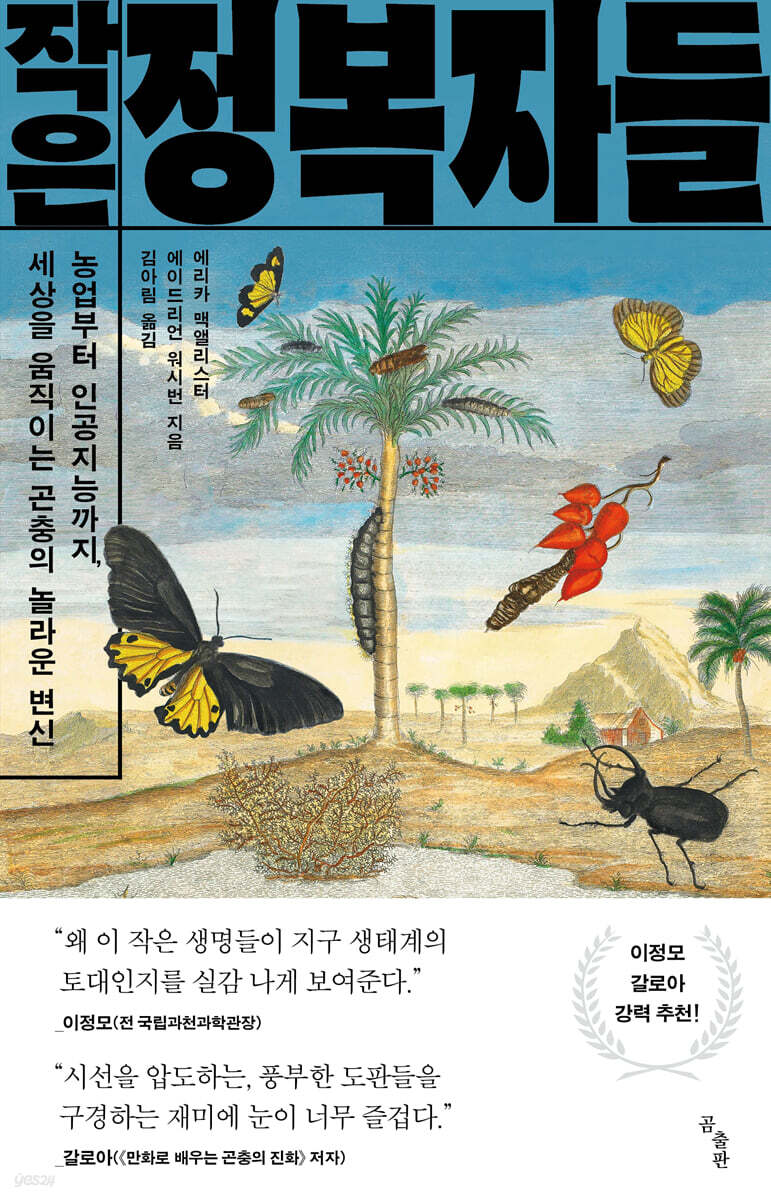
Little Conquerors
 |
Description
Book Introduction
“If this world is one where those who adapt survive,
“The true rulers of the Earth are insects!”
From agriculture to medicine, AI, aerospace, and even fashion.
The amazing transformation of insects that will rewrite human history!
For many people, insects are nothing more than disgusting, dirty, and negative objects.
But insects have been around long before humans set foot on Earth, and have contributed to the advancement of human culture and science for thousands of years.
Although we may not have looked into it with interest, they are the great conquerors of the Earth who have survived more fiercely than anyone else, ruled the world, and created human history.
"Little Conquerors" explores the diverse life cycles of insects, which can occupy nearly every ecological niche on Earth, and explores the potential for groundbreaking changes to human life.
In fact, insects, which outnumber humans by 200 million times, have been creating a colorful and wonderful world for us long before humans even left their mark on the planet, and we can draw inspiration from the ways they have evolved to survive to this day.
After reading this book, your perspective on fruit flies gathering on fruit or black flies chasing various scents might change a little.
Who knows, maybe you'll be the next to lead the charge in new developments with these amazing insects.
“The true rulers of the Earth are insects!”
From agriculture to medicine, AI, aerospace, and even fashion.
The amazing transformation of insects that will rewrite human history!
For many people, insects are nothing more than disgusting, dirty, and negative objects.
But insects have been around long before humans set foot on Earth, and have contributed to the advancement of human culture and science for thousands of years.
Although we may not have looked into it with interest, they are the great conquerors of the Earth who have survived more fiercely than anyone else, ruled the world, and created human history.
"Little Conquerors" explores the diverse life cycles of insects, which can occupy nearly every ecological niche on Earth, and explores the potential for groundbreaking changes to human life.
In fact, insects, which outnumber humans by 200 million times, have been creating a colorful and wonderful world for us long before humans even left their mark on the planet, and we can draw inspiration from the ways they have evolved to survive to this day.
After reading this book, your perspective on fruit flies gathering on fruit or black flies chasing various scents might change a little.
Who knows, maybe you'll be the next to lead the charge in new developments with these amazing insects.
- You can preview some of the book's contents.
Preview
index
Introduction
Chapter 1: The Jumping Flea's Legs
Chapter 2: The Strong Mouth
Chapter 3: Yellow Drosophila
Chapter 4: The Changing Life Cycle
Chapter 5: Black Flies Searching for the Culprit
Chapter 6: The Butterfly's Dazzling Wings
Chapter 7: Ultimate Recycling
Chapter 8: The Fog Harvester of the Namib Desert
Chapter 9: The Intelligence of Honeybees
Chapter 10: The Nerves of Cockroaches
Conclusion
Acknowledgements
Further Reading
Search
Photo source
Chapter 1: The Jumping Flea's Legs
Chapter 2: The Strong Mouth
Chapter 3: Yellow Drosophila
Chapter 4: The Changing Life Cycle
Chapter 5: Black Flies Searching for the Culprit
Chapter 6: The Butterfly's Dazzling Wings
Chapter 7: Ultimate Recycling
Chapter 8: The Fog Harvester of the Namib Desert
Chapter 9: The Intelligence of Honeybees
Chapter 10: The Nerves of Cockroaches
Conclusion
Acknowledgements
Further Reading
Search
Photo source
Detailed image

Into the book
Insects have meaning not just as a name or function, but as a form.
Insects come in a truly amazing variety of forms.
Their morphological diversity has allowed insects to occupy virtually every ecological niche on Earth.
The extraordinary diversity of insects is the heart of this book.
--- p.18 "Introductory Remarks"
It took three centuries for scientists to discover the true power of fleas.
The meticulous study of fleas' remarkable jumping abilities has inspired applications ranging from human medicine to engineering applications in microrobotics.
--- p.23 「1.
"The Jumping Flea's Legs"
The exact reason why insects (like the hawk moth) have such long proboscises may never be fully understood, but such species do exist, and scientists today are beginning to take notice of their proboscises for other reasons.
With people turning to nature for biological inspiration, the mechanisms by which these bendable, coiled straws evolved to access liquid food are intriguing enough to capture researchers' attention.
--- p.79 「2.
"Strong Mouth"
From the early stages of genetic exploration, Drosophila melanogaster has become highly sought after in a variety of fields.
Now, the uses of this insect have expanded dramatically, encompassing numerous research topics including neurodegeneration, cancer, and sleep.
With this, the yellow fruit fly became the first animal to be sent not only from Earth but also into space.
(…) Since then, it has been on several space missions, and NASA even has a ‘yellow fly laboratory.’
--- p.109~110 「3.
Yellow fruit fly
Investigating the life histories of individual animals has taken on new importance today as a precise tool for tracking environmental change around the world.
Hassel, a bioclimatologist, found that European hawksbill butterflies are appearing about eight days earlier than they did just 15 years ago.
Changes in insect populations, species distribution, and insect size are all indicators of a changing environment.
(…) Hassel is not the only scientist using insects to predict climate change, and several species of insects are used worldwide.
--- p.143~144 「4.
Changing Life Cycle
Today's forensic entomology builds on the work of numerous pioneering researchers, law enforcement officers, and legal representatives who, particularly over the past century, have sought to justify the use of entomology to aid in crime solving.
This field is increasingly being applied to accidental deaths, murders, and suicides, as well as archaeology and paleontology.
--- p.162 「5.
"Black fly looking for the culprit"
The color that changes depending on the angle is one of the most amazing colors we know in nature, and it has a unique property of deceiving predators, so it has attracted the attention of many people, not just entomologists.
For over 30 years, bioengineer Professor Andrew Parker has been reproducing the color-changing properties of Morpho butterfly wing cells, creating durable pigments for a variety of commercial products.
Examples include paint that keeps your car shiny forever or clothes that don't fade.
--- p.203 「6.
The Butterfly's Dazzling Wings
Using insect larvae as a protein source could help reduce today's unsustainable overfishing.
About 20 percent of the world's wild catch is processed into fishmeal and fish oil, which is then fed back to farmed fish.
Over the past 15 years, fish farming production has more than doubled, highlighting the urgent need to feed farmed fish sustainably.
--- p.233 「7.
"Ultimate Recycling"
Today, fog-collecting devices inspired by insect shells are becoming a major industry, providing freshwater to drought-stricken areas with the right combination of geography and climate.
However, as global warming worsens, the fog is gradually disappearing.
Accordingly, a significant number of animal species living in the Namib Desert are endangered.
Even as climate uncertainty intensifies and opportunities for long-term desert fog harvesting diminish, insects here have another trick for survival.
The solution lies in the design of the lower abdomen.
--- p.261 「8.
"Fog Harvest of the Namib Desert"
“Bees not only live in the present, but can also plan or anticipate the near future.
The pieces of evidence are piling up.
Maybe bees have feelings.
There is also some evidence emerging that leads us to conclude that bees may possess some kind of consciousness.” --- p.290~291 「9.
"The Intelligence of Honeybees"
Cockroaches are smart and can learn quite a bit, including navigating mazes and memorizing visual features of their surroundings to find their way back to their hiding places.
The cockroach's remarkable learning ability is crucial for exploring the cellular mechanisms that underlie its task performance, characteristics, and behavior.
Insects come in a truly amazing variety of forms.
Their morphological diversity has allowed insects to occupy virtually every ecological niche on Earth.
The extraordinary diversity of insects is the heart of this book.
--- p.18 "Introductory Remarks"
It took three centuries for scientists to discover the true power of fleas.
The meticulous study of fleas' remarkable jumping abilities has inspired applications ranging from human medicine to engineering applications in microrobotics.
--- p.23 「1.
"The Jumping Flea's Legs"
The exact reason why insects (like the hawk moth) have such long proboscises may never be fully understood, but such species do exist, and scientists today are beginning to take notice of their proboscises for other reasons.
With people turning to nature for biological inspiration, the mechanisms by which these bendable, coiled straws evolved to access liquid food are intriguing enough to capture researchers' attention.
--- p.79 「2.
"Strong Mouth"
From the early stages of genetic exploration, Drosophila melanogaster has become highly sought after in a variety of fields.
Now, the uses of this insect have expanded dramatically, encompassing numerous research topics including neurodegeneration, cancer, and sleep.
With this, the yellow fruit fly became the first animal to be sent not only from Earth but also into space.
(…) Since then, it has been on several space missions, and NASA even has a ‘yellow fly laboratory.’
--- p.109~110 「3.
Yellow fruit fly
Investigating the life histories of individual animals has taken on new importance today as a precise tool for tracking environmental change around the world.
Hassel, a bioclimatologist, found that European hawksbill butterflies are appearing about eight days earlier than they did just 15 years ago.
Changes in insect populations, species distribution, and insect size are all indicators of a changing environment.
(…) Hassel is not the only scientist using insects to predict climate change, and several species of insects are used worldwide.
--- p.143~144 「4.
Changing Life Cycle
Today's forensic entomology builds on the work of numerous pioneering researchers, law enforcement officers, and legal representatives who, particularly over the past century, have sought to justify the use of entomology to aid in crime solving.
This field is increasingly being applied to accidental deaths, murders, and suicides, as well as archaeology and paleontology.
--- p.162 「5.
"Black fly looking for the culprit"
The color that changes depending on the angle is one of the most amazing colors we know in nature, and it has a unique property of deceiving predators, so it has attracted the attention of many people, not just entomologists.
For over 30 years, bioengineer Professor Andrew Parker has been reproducing the color-changing properties of Morpho butterfly wing cells, creating durable pigments for a variety of commercial products.
Examples include paint that keeps your car shiny forever or clothes that don't fade.
--- p.203 「6.
The Butterfly's Dazzling Wings
Using insect larvae as a protein source could help reduce today's unsustainable overfishing.
About 20 percent of the world's wild catch is processed into fishmeal and fish oil, which is then fed back to farmed fish.
Over the past 15 years, fish farming production has more than doubled, highlighting the urgent need to feed farmed fish sustainably.
--- p.233 「7.
"Ultimate Recycling"
Today, fog-collecting devices inspired by insect shells are becoming a major industry, providing freshwater to drought-stricken areas with the right combination of geography and climate.
However, as global warming worsens, the fog is gradually disappearing.
Accordingly, a significant number of animal species living in the Namib Desert are endangered.
Even as climate uncertainty intensifies and opportunities for long-term desert fog harvesting diminish, insects here have another trick for survival.
The solution lies in the design of the lower abdomen.
--- p.261 「8.
"Fog Harvest of the Namib Desert"
“Bees not only live in the present, but can also plan or anticipate the near future.
The pieces of evidence are piling up.
Maybe bees have feelings.
There is also some evidence emerging that leads us to conclude that bees may possess some kind of consciousness.” --- p.290~291 「9.
"The Intelligence of Honeybees"
Cockroaches are smart and can learn quite a bit, including navigating mazes and memorizing visual features of their surroundings to find their way back to their hiding places.
The cockroach's remarkable learning ability is crucial for exploring the cellular mechanisms that underlie its task performance, characteristics, and behavior.
--- p.295~296 「10.
Cockroach nerves
Cockroach nerves
Publisher's Review
★★★Highly recommended by Lee Jeong-mo and Galoa!!★★★
“It vividly shows why these tiny creatures are the foundation of the Earth’s ecosystem.”
Lee Jeong-mo (former director of the National Science Museum in Gwacheon)
“It is a delight to the eyes to see the rich illustrations that overwhelm the gaze.”
_Galois (author of "Learning Insect Evolution through Comics")
Fleas, fruit flies, bees, cockroaches, grasshoppers, beetles, butterflies and moths, etc.
Discovering biological inspiration for human evolution in the life history of insects!
For many people, insects are nothing more than disgusting, dirty, and negative objects.
But insects have been around long before humans set foot on Earth, and have contributed to the advancement of human culture and science for thousands of years.
Although we may not have looked into it with interest, they are the great conquerors of the Earth who have survived more fiercely than anyone else, ruled the world, and created human history.
For example, the yellow fruit fly has become an important experimental subject, not only on Earth but now in space, replacing humans; the beetle has shown the possibility of surviving in harsh environments like the desert; and the cockroach has established itself as an important model organism, revealing surprising facts about the physiology of all kinds of animals.
The flea's wondrous jumping ability also gave elasticity to micro robots, and the fly, a synonym for disgust, became a detective who solved crime cases, giving modern forensic entomology a firm foothold.
《Little Conquerors》 explores the diverse life cycles of insects, which can occupy almost every ecological niche on Earth, and explores the potential for groundbreaking changes in human life.
In fact, insects, which outnumber humans by 200 million times, have been creating a colorful and wonderful world for us long before humans even left their mark on the planet, and we can draw inspiration from the ways they have evolved to survive to this day.
After reading this book, your perspective on fruit flies gathering on fruit or black flies chasing various scents might change a little.
Who knows, maybe you'll be the next to lead the charge in new developments with these amazing insects.
“Studying the life histories of insects is important because it helps us understand global environmental changes today, and at the same time, it allows many people to participate.
“Thanks to people who have been insect lovers since childhood, to determined and bold researchers, to scientists who study form, function, and habits, we have come to a point where we can understand how the environment is changing.” _Page 145
“In this world where only those who adapt survive, who is the true ruler?”
The "Little Conquerors": The Giant Axis That Support Earth's Life Order
Insects are the animal group that has survived the longest and in the largest numbers since they appeared on Earth about 300 million years ago.
Insects come in a surprising variety of sizes, shapes, and species, ranging from beetles smaller than a period, measuring 0.127 millimeters, to beetles that are over 55 centimeters long.
While there are about 6,500 species of mammals worldwide, the number of insect species reported to date is conservatively estimated at 1 million (the actual number is estimated to be between 5 million and 2.2 billion).
The reason they have been able to survive through the long history of evolving into various forms is because they knew how to utilize their simplest yet most perfect body structure in a way that is advantageous to their survival.
In this spirit, this book provides us with much inspiration by focusing on the survival strategies and life wisdom displayed by insects.
“Parimae has developed a kind of ‘zoom lens.’
The center of their eyes is occupied by a large lens with very important photoreceptor cells.
Measuring about 6 millimeters in length, this insect can see with great clarity from a distance of half a meter, and can chase its prey up to 30 centimeters in front of it, attacking with surprising accuracy.
(…) How can we develop a machine that is so small and lightweight yet incredibly accurate at measuring distances? We still have so much to learn from these tiny, wondrous insects.” _Page 321
Furthermore, this book should not be overlooked for its remarkable achievements not only of scientists who dedicated their lives to observing small insects and trying to make their discoveries known to the world, such as Charles Darwin, Margaret Fountain, Charles Valentine Riley, Maria Sibylla Merian, Gregor Mendel, Jan Svarmerdam, Thomas Hunt Morgan, and Charles Henry Turner, but also of countless others whose names have long been forgotten, hidden in the archives of academic journals.
From agriculture to medicine, aerospace, AI, and robotics
The amazing transformation of insects that move the world!
The blue-tailed dragonfly is being used as a 'macro-ecological indicator' to track future climate change.
A fruit fly sent into space to explore gravity response and aging genes in zero gravity space.
Natural moth straws used in the development of reusable medical syringes for mass vaccinations and other purposes.
American radish, which is rapidly emerging as an alternative food source to reduce carbon emissions.
Cockroaches helped uncover how neurochemicals influence crowd behavior.
Butterfly wing scales, a technology that does not fade even in sunlight, are used in high-tech mechanical engineering fields.
The intelligence and flight abilities of bees have inspired micro-robots to search for survivors in war situations, explore enemy territory, and more.
This book is full of scientific achievements inspired by various insects across various fields.
These tiny insects are driving extraordinary discoveries in fields ranging from robotics to genetics and forensics, and are advancing our knowledge of agriculture, aerospace, artificial intelligence, biodiversity, and even humanity.
In recent years, the worlds of medicine, space travel, and even fashion have taken an interest in and found inspiration in insects.
However, the number of insects studied is still small compared to the total number of species.
The author is confident that researchers in microelectronics, systems engineers, and food scientists, in particular, have much to learn from these little brothers who share our planet.
“Kyuchul Kenneth Park, an assistant professor of mechanical engineering at Northwestern University in the United States, is looking for ways to overcome the limitations of fog harvesting on a large scale that could be applied industrially.
Professor Park, who confesses to being a fan of the Star Wars series, has Luke Skywalker's Vaporator assembled from Legos on his desk.
Perhaps it was a source of inspiration for further developing future technologies! Professor Park adopted an approach inspired by various living organisms, drawing on the clever strategies employed by certain plants and animals in deserts and tropical rainforests.
An example is a fog harvesting device that utilizes the back shells of insects.” _Page 260
Over 90 rare insect photos
Adding imagination to the story as if you were in a museum!
This book keeps us entertained while earnestly tracing how the study of insects has led to astonishing discoveries from hundreds of years ago to the present.
That's because the author is an entomologist and chief curator at the Natural History Museum in London.
Fleas densely packed inside a chicken's eyelid, a moth with a proboscis up to eight times its own body length, dozens of yellow fruit flies stuffed into a cassette tape to be sent on a spaceship, maggots swarming inside a corpse (sculpture), maggots collected from an actual murder scene, Morpho butterflies with vivid colors that seem alive even after 100 years of collection, hundreds of American soldier fly larvae in captivity, Charles Darwin's beetle collection box that looks as if it's still alive and moving, etc. Thanks to bizarre, unique, and beautiful visual aids, you can see the detailed structures and forms of insects with your own eyes and gain an intuitive and three-dimensional understanding.
The 90 or so rare plates that cannot be seen anywhere else overwhelm our eyes as if we were in a museum.
This book is almost unique in that it presents a superb collection of specially maintained specimens, including rare insect specimens not readily available to the general public.
“On the day I visited the Norwich Castle Museum, Waterhouse presented a specimen of the Morpho butterfly (see photo, ‘Margaret Fountain Collection’, pp. 186-187).
Not only was it a beautiful and brilliant specimen with wings from South America, but it was also Waterhouse's favorite butterfly.
And indeed, these are probably the most complete biological specimens you've ever seen.
None of the wings were worn, torn, or stuck together, and none of the legs were missing at all.
(…) shows a woman who was not only a serious scientist all her life, but also completely devoted to collecting butterflies.” _Page 185
“It vividly shows why these tiny creatures are the foundation of the Earth’s ecosystem.”
Lee Jeong-mo (former director of the National Science Museum in Gwacheon)
“It is a delight to the eyes to see the rich illustrations that overwhelm the gaze.”
_Galois (author of "Learning Insect Evolution through Comics")
Fleas, fruit flies, bees, cockroaches, grasshoppers, beetles, butterflies and moths, etc.
Discovering biological inspiration for human evolution in the life history of insects!
For many people, insects are nothing more than disgusting, dirty, and negative objects.
But insects have been around long before humans set foot on Earth, and have contributed to the advancement of human culture and science for thousands of years.
Although we may not have looked into it with interest, they are the great conquerors of the Earth who have survived more fiercely than anyone else, ruled the world, and created human history.
For example, the yellow fruit fly has become an important experimental subject, not only on Earth but now in space, replacing humans; the beetle has shown the possibility of surviving in harsh environments like the desert; and the cockroach has established itself as an important model organism, revealing surprising facts about the physiology of all kinds of animals.
The flea's wondrous jumping ability also gave elasticity to micro robots, and the fly, a synonym for disgust, became a detective who solved crime cases, giving modern forensic entomology a firm foothold.
《Little Conquerors》 explores the diverse life cycles of insects, which can occupy almost every ecological niche on Earth, and explores the potential for groundbreaking changes in human life.
In fact, insects, which outnumber humans by 200 million times, have been creating a colorful and wonderful world for us long before humans even left their mark on the planet, and we can draw inspiration from the ways they have evolved to survive to this day.
After reading this book, your perspective on fruit flies gathering on fruit or black flies chasing various scents might change a little.
Who knows, maybe you'll be the next to lead the charge in new developments with these amazing insects.
“Studying the life histories of insects is important because it helps us understand global environmental changes today, and at the same time, it allows many people to participate.
“Thanks to people who have been insect lovers since childhood, to determined and bold researchers, to scientists who study form, function, and habits, we have come to a point where we can understand how the environment is changing.” _Page 145
“In this world where only those who adapt survive, who is the true ruler?”
The "Little Conquerors": The Giant Axis That Support Earth's Life Order
Insects are the animal group that has survived the longest and in the largest numbers since they appeared on Earth about 300 million years ago.
Insects come in a surprising variety of sizes, shapes, and species, ranging from beetles smaller than a period, measuring 0.127 millimeters, to beetles that are over 55 centimeters long.
While there are about 6,500 species of mammals worldwide, the number of insect species reported to date is conservatively estimated at 1 million (the actual number is estimated to be between 5 million and 2.2 billion).
The reason they have been able to survive through the long history of evolving into various forms is because they knew how to utilize their simplest yet most perfect body structure in a way that is advantageous to their survival.
In this spirit, this book provides us with much inspiration by focusing on the survival strategies and life wisdom displayed by insects.
“Parimae has developed a kind of ‘zoom lens.’
The center of their eyes is occupied by a large lens with very important photoreceptor cells.
Measuring about 6 millimeters in length, this insect can see with great clarity from a distance of half a meter, and can chase its prey up to 30 centimeters in front of it, attacking with surprising accuracy.
(…) How can we develop a machine that is so small and lightweight yet incredibly accurate at measuring distances? We still have so much to learn from these tiny, wondrous insects.” _Page 321
Furthermore, this book should not be overlooked for its remarkable achievements not only of scientists who dedicated their lives to observing small insects and trying to make their discoveries known to the world, such as Charles Darwin, Margaret Fountain, Charles Valentine Riley, Maria Sibylla Merian, Gregor Mendel, Jan Svarmerdam, Thomas Hunt Morgan, and Charles Henry Turner, but also of countless others whose names have long been forgotten, hidden in the archives of academic journals.
From agriculture to medicine, aerospace, AI, and robotics
The amazing transformation of insects that move the world!
The blue-tailed dragonfly is being used as a 'macro-ecological indicator' to track future climate change.
A fruit fly sent into space to explore gravity response and aging genes in zero gravity space.
Natural moth straws used in the development of reusable medical syringes for mass vaccinations and other purposes.
American radish, which is rapidly emerging as an alternative food source to reduce carbon emissions.
Cockroaches helped uncover how neurochemicals influence crowd behavior.
Butterfly wing scales, a technology that does not fade even in sunlight, are used in high-tech mechanical engineering fields.
The intelligence and flight abilities of bees have inspired micro-robots to search for survivors in war situations, explore enemy territory, and more.
This book is full of scientific achievements inspired by various insects across various fields.
These tiny insects are driving extraordinary discoveries in fields ranging from robotics to genetics and forensics, and are advancing our knowledge of agriculture, aerospace, artificial intelligence, biodiversity, and even humanity.
In recent years, the worlds of medicine, space travel, and even fashion have taken an interest in and found inspiration in insects.
However, the number of insects studied is still small compared to the total number of species.
The author is confident that researchers in microelectronics, systems engineers, and food scientists, in particular, have much to learn from these little brothers who share our planet.
“Kyuchul Kenneth Park, an assistant professor of mechanical engineering at Northwestern University in the United States, is looking for ways to overcome the limitations of fog harvesting on a large scale that could be applied industrially.
Professor Park, who confesses to being a fan of the Star Wars series, has Luke Skywalker's Vaporator assembled from Legos on his desk.
Perhaps it was a source of inspiration for further developing future technologies! Professor Park adopted an approach inspired by various living organisms, drawing on the clever strategies employed by certain plants and animals in deserts and tropical rainforests.
An example is a fog harvesting device that utilizes the back shells of insects.” _Page 260
Over 90 rare insect photos
Adding imagination to the story as if you were in a museum!
This book keeps us entertained while earnestly tracing how the study of insects has led to astonishing discoveries from hundreds of years ago to the present.
That's because the author is an entomologist and chief curator at the Natural History Museum in London.
Fleas densely packed inside a chicken's eyelid, a moth with a proboscis up to eight times its own body length, dozens of yellow fruit flies stuffed into a cassette tape to be sent on a spaceship, maggots swarming inside a corpse (sculpture), maggots collected from an actual murder scene, Morpho butterflies with vivid colors that seem alive even after 100 years of collection, hundreds of American soldier fly larvae in captivity, Charles Darwin's beetle collection box that looks as if it's still alive and moving, etc. Thanks to bizarre, unique, and beautiful visual aids, you can see the detailed structures and forms of insects with your own eyes and gain an intuitive and three-dimensional understanding.
The 90 or so rare plates that cannot be seen anywhere else overwhelm our eyes as if we were in a museum.
This book is almost unique in that it presents a superb collection of specially maintained specimens, including rare insect specimens not readily available to the general public.
“On the day I visited the Norwich Castle Museum, Waterhouse presented a specimen of the Morpho butterfly (see photo, ‘Margaret Fountain Collection’, pp. 186-187).
Not only was it a beautiful and brilliant specimen with wings from South America, but it was also Waterhouse's favorite butterfly.
And indeed, these are probably the most complete biological specimens you've ever seen.
None of the wings were worn, torn, or stuck together, and none of the legs were missing at all.
(…) shows a woman who was not only a serious scientist all her life, but also completely devoted to collecting butterflies.” _Page 185
GOODS SPECIFICS
- Date of issue: November 12, 2025
- Page count, weight, size: 340 pages | 430g | 135*210*21mm
- ISBN13: 9791189327477
- ISBN10: 1189327473
You may also like
카테고리
korean


korean

![GQ KOREA Mark (Monthly): December [2025]](http://librairie.coreenne.fr/cdn/shop/files/8ef265dbbfbf186523ed75ba7319009d.jpg?v=1765340328&width=3840)


