

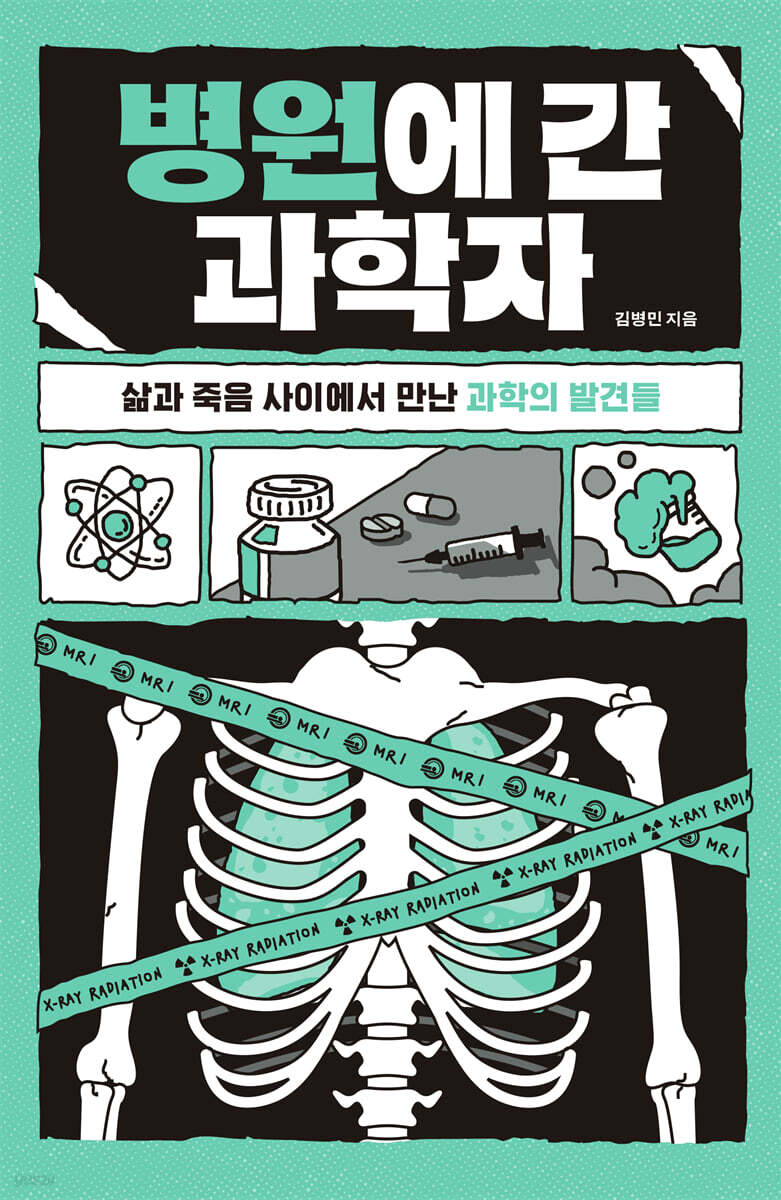
Scientists who went to the hospital
 |
Description
Book Introduction
This is a record of a scientist who entered the field of cancer.
A fascinating exploration of humanity and life.
A scientist discovers that he has cancer and is admitted to the hospital.
During a long treatment at the hospital, he experiences the light of modern science passing through his body - X-rays, MRI, CT - and suddenly a question arises.
"Why do humans get cancer, and how did we come to look into it?" This book, "The Scientist Who Went to the Hospital," is about a scientist who, upon learning that cancer, a disease that can happen to anyone, had also happened to him, did what he could to accept it: facing it through the eyes of a scientist.
The author is scientist Kim Byeong-min, who is an adjunct professor at Hallym University, product owner of the science content platform SsokSOAK, and director of KAOS, a foundation dedicated to sharing science with citizens, and is actively involved in various activities to popularize science.
The book begins with his personal experience of being diagnosed with cancer, but as he states in the introduction, it is not a story of his struggle with the disease.
Instead of expressing a sense of determination or resignation toward death, we explore cancer, death, and life from a scientist's perspective.
Because the beginning of the fear of death is the body and the events that occur in the body, and the discourse that can most accurately resolve it is science.
In short, this book is a story about the scientific discoveries a scientist made between life and death.
All the diagnostic and treatment processes performed in hospitals are based on basic scientific principles and modern medical technology.
The author delves into the scientific history behind the devices and technologies we often overlook in hospitals, from radiation and electromagnetic waves to film and digital imaging, cellulose and photochemical reactions.
The discoveries of that scientific history span the diagnosis and treatment of disease, liberation from suffering, the paradox of oxygen's two faces, and life and death.
This shows that science is life itself, and that it is our way of understanding the world and our attitude towards it.
A fascinating exploration of humanity and life.
A scientist discovers that he has cancer and is admitted to the hospital.
During a long treatment at the hospital, he experiences the light of modern science passing through his body - X-rays, MRI, CT - and suddenly a question arises.
"Why do humans get cancer, and how did we come to look into it?" This book, "The Scientist Who Went to the Hospital," is about a scientist who, upon learning that cancer, a disease that can happen to anyone, had also happened to him, did what he could to accept it: facing it through the eyes of a scientist.
The author is scientist Kim Byeong-min, who is an adjunct professor at Hallym University, product owner of the science content platform SsokSOAK, and director of KAOS, a foundation dedicated to sharing science with citizens, and is actively involved in various activities to popularize science.
The book begins with his personal experience of being diagnosed with cancer, but as he states in the introduction, it is not a story of his struggle with the disease.
Instead of expressing a sense of determination or resignation toward death, we explore cancer, death, and life from a scientist's perspective.
Because the beginning of the fear of death is the body and the events that occur in the body, and the discourse that can most accurately resolve it is science.
In short, this book is a story about the scientific discoveries a scientist made between life and death.
All the diagnostic and treatment processes performed in hospitals are based on basic scientific principles and modern medical technology.
The author delves into the scientific history behind the devices and technologies we often overlook in hospitals, from radiation and electromagnetic waves to film and digital imaging, cellulose and photochemical reactions.
The discoveries of that scientific history span the diagnosis and treatment of disease, liberation from suffering, the paradox of oxygen's two faces, and life and death.
This shows that science is life itself, and that it is our way of understanding the world and our attitude towards it.
- You can preview some of the book's contents.
Preview
index
preface
Before we begin
Chapter 1 What Doesn't Change
Chapter 2 Death on the Palm
Chapter 3 The Greatness of Small Things
Chapter 4 Sounds in the Silence
Chapter 5 Between Death and Life
Chapter 6: Freedom from Suffering
Chapter 7 The Oxygen Paradox
Chapter 8 The Boundaries of Ambiguity
References
Before we begin
Chapter 1 What Doesn't Change
Chapter 2 Death on the Palm
Chapter 3 The Greatness of Small Things
Chapter 4 Sounds in the Silence
Chapter 5 Between Death and Life
Chapter 6: Freedom from Suffering
Chapter 7 The Oxygen Paradox
Chapter 8 The Boundaries of Ambiguity
References
Into the book
In particular, physics and chemistry are the basis for all explanations of life activities.
At least as a patient with a scientist's perspective, it is a record of a rigorous experience, a record of research and observations where scientific knowledge is connected to a part of medicine.
Let's say it's a research note that observes medicine through the magnifying glass of science.
I hope this record will be helpful to someone who is just entering uncharted territory and is afraid.
At least, if the things that happen to our bodies can be brought out from tacit knowledge into explicit formality through the language of science, I hope it will help us protect ourselves with a little more strength.
--- From the "Preface"
There are things in the world that do not change.
Although the world appears complex on the surface, beautiful, flawless rules operate within it.
A stone or a blade of grass on the road wears away.
The stars in the night sky lose their appearance.
Cells of living organisms, including humans, become damaged and age.
And then it all vanishes into another time.
In fact, it seems to have disappeared, but it is true that it has returned to the small world.
A more fundamental world, that is, a small world that exists in the deepest part of this world.
And fill the world again.
--- From "Before We Begin"
Röntgen soon exposed the rays to the hands of his wife, Anna Bertha.
The result was the world's first medical X-ray and one of the most bizarre wedding gifts in history.
The image shocked the world at the time.
The distinct outline of her hand bones and even the wedding ring she was wearing were clearly visible.
It was like looking at the hand of a living skeleton.
Anna's comment when she saw the picture of her hand bones is quite famous.
“I think I saw my own death.” This was not a simple expression of shock, but a philosophical reflection on the moment when a human being first saw the inside of his own body.
--- From "Death in the Palm of Your Hand"
Understanding the smallest things that make up the world is a source of wonder.
It is amazing that tiny entities like atoms hold the vast secrets of the universe, and that even smaller electrons make all the changes in this world possible.
Science has been uncovering the secrets of these little things one by one, and that knowledge has led to advancements in medicine and technology.
Uncovering the secrets of the nuclear bomb gave rise to the disaster known as nuclear weapons, but it also gave rise to radiation therapy for treating cancer.
Small things are really small, but the secrets they contain are by no means small.
Rather, it is as vast and complex as the universe.
--- From "The Greatness of Small Things"
Starting with the Big Bang 13.8 billion years ago, hydrogen and helium fused in the cores of stars to create heavier elements, and when those stars died in supernova explosions, these elements were scattered into space, forming the Earth and life on Earth.
Iridium-192 was left behind on Earth by an asteroid that collided with the Earth 66 million years ago.
And now we're manipulating some of those cosmic fragments to fight the cancer that's killing us.
--- From "Between Death and Life"
Oxygen gives us life, but in the process it slowly oxidizes us.
Even knowing this, we breathe.
That's life.
To exist, we must accept what destroys us.
We need to be humble about the relationship between oxygen and life.
The paradox of oxygen teaches us something profound about the nature of life.
We are like fish swimming in a sea of oxygen.
Without it, we die, but with it, we grow old and eventually die.
Understanding and accepting this paradox is not simply a matter of scientific knowledge; it provides profound insight into the very nature of our existence.
What is life? Perhaps it is the courage to shine for a moment, even knowing its inevitable demise.
At least as a patient with a scientist's perspective, it is a record of a rigorous experience, a record of research and observations where scientific knowledge is connected to a part of medicine.
Let's say it's a research note that observes medicine through the magnifying glass of science.
I hope this record will be helpful to someone who is just entering uncharted territory and is afraid.
At least, if the things that happen to our bodies can be brought out from tacit knowledge into explicit formality through the language of science, I hope it will help us protect ourselves with a little more strength.
--- From the "Preface"
There are things in the world that do not change.
Although the world appears complex on the surface, beautiful, flawless rules operate within it.
A stone or a blade of grass on the road wears away.
The stars in the night sky lose their appearance.
Cells of living organisms, including humans, become damaged and age.
And then it all vanishes into another time.
In fact, it seems to have disappeared, but it is true that it has returned to the small world.
A more fundamental world, that is, a small world that exists in the deepest part of this world.
And fill the world again.
--- From "Before We Begin"
Röntgen soon exposed the rays to the hands of his wife, Anna Bertha.
The result was the world's first medical X-ray and one of the most bizarre wedding gifts in history.
The image shocked the world at the time.
The distinct outline of her hand bones and even the wedding ring she was wearing were clearly visible.
It was like looking at the hand of a living skeleton.
Anna's comment when she saw the picture of her hand bones is quite famous.
“I think I saw my own death.” This was not a simple expression of shock, but a philosophical reflection on the moment when a human being first saw the inside of his own body.
--- From "Death in the Palm of Your Hand"
Understanding the smallest things that make up the world is a source of wonder.
It is amazing that tiny entities like atoms hold the vast secrets of the universe, and that even smaller electrons make all the changes in this world possible.
Science has been uncovering the secrets of these little things one by one, and that knowledge has led to advancements in medicine and technology.
Uncovering the secrets of the nuclear bomb gave rise to the disaster known as nuclear weapons, but it also gave rise to radiation therapy for treating cancer.
Small things are really small, but the secrets they contain are by no means small.
Rather, it is as vast and complex as the universe.
--- From "The Greatness of Small Things"
Starting with the Big Bang 13.8 billion years ago, hydrogen and helium fused in the cores of stars to create heavier elements, and when those stars died in supernova explosions, these elements were scattered into space, forming the Earth and life on Earth.
Iridium-192 was left behind on Earth by an asteroid that collided with the Earth 66 million years ago.
And now we're manipulating some of those cosmic fragments to fight the cancer that's killing us.
--- From "Between Death and Life"
Oxygen gives us life, but in the process it slowly oxidizes us.
Even knowing this, we breathe.
That's life.
To exist, we must accept what destroys us.
We need to be humble about the relationship between oxygen and life.
The paradox of oxygen teaches us something profound about the nature of life.
We are like fish swimming in a sea of oxygen.
Without it, we die, but with it, we grow old and eventually die.
Understanding and accepting this paradox is not simply a matter of scientific knowledge; it provides profound insight into the very nature of our existence.
What is life? Perhaps it is the courage to shine for a moment, even knowing its inevitable demise.
--- From "The Paradox of Oxygen"
Publisher's Review
'Cancer is the fate of multicellular life in this world.
It's no one's fault'
This is a record of a scientist who entered the field of cancer.
A fascinating exploration of humanity and life.
“Disease doesn’t strike everyone the same way, but it doesn’t strike anyone the same way.” Despite the fact that cancer can strike anyone, no one ever thinks they’ll get it.
Even scientists who pursue objective facts live in the optimism that they will not be like that.
It is only when you are diagnosed with the disease that you realize it was an unrealistic illusion.
A scientist discovers that he has cancer and is admitted to the hospital.
During a long treatment at the hospital, he experiences the light of modern science passing through his body - X-rays, MRI, CT - and suddenly a question arises.
"Why do humans get cancer, and how did we come to look into it?" This book, "The Scientist Who Went to the Hospital," is about a scientist who, upon learning that cancer, a disease that can happen to anyone, had also happened to him, did what he could to accept it: facing it through the eyes of a scientist.
The author is scientist Kim Byeong-min, who is an adjunct professor at Hallym University, product owner of the science content platform SsokSOAK, and director of KAOS, a foundation dedicated to sharing science with citizens, and is actively involved in various activities to popularize science.
The book begins with his personal experience of being diagnosed with cancer, but as he states in the introduction, it is not a story of his struggle with the disease.
Instead of expressing a sense of determination or resignation toward death, we explore cancer, death, and life from a scientist's perspective.
Because the fear of death begins with the body and the events that occur within it, and the discourse that can most accurately unravel it is science.
In short, this book is a story about the scientific discoveries a scientist made between life and death.
All the diagnostic and treatment processes performed in hospitals are based on basic scientific principles and modern medical technology.
The author delves into the scientific history behind the devices and technologies we often overlook in hospitals, from radiation and electromagnetic waves to film and digital imaging, cellulose and photochemical reactions.
The discoveries of that scientific history span the diagnosis and treatment of disease, liberation from suffering, the paradox of oxygen's two faces, and life and death.
This shows that science is life itself, and that it is our way of understanding the world and our attitude towards it.
Health and disease, self and other,
Beyond the distinction between normal and abnormal
A record of a scientist exploring humanity and nature itself
What's interesting is that the author of this book is a chemist, not a doctor or life science researcher.
Chemistry may seem like a discipline that deals with dangerous and special substances, but it is much more deeply ingrained in our lives than we realize.
The fields of medicine and life sciences have also made remarkable progress along with the advancement of chemistry.
From Edward Jenner's smallpox vaccine to Alexander Fleming's penicillin to the achievements of modern pharmaceutical companies based on chemical research, chemistry has dramatically improved human health and longevity.
But the science covered in this book is not just chemistry.
It shows that the daily treatment of the sick is an amazing stage for physics, chemistry, and life sciences, and it fascinatingly reveals how science, which may seem distant to the general public, is closely intertwined with life.
Medicine, which diagnoses and treats people, can also be said to be a discipline that has expressed the results of knowledge from all scientific fields to humans.
Therefore, modern medicine is a place where not only basic sciences such as physical chemistry but also cutting-edge science and technology such as optics, semiconductors, and artificial intelligence are concentrated.
This book shows the history of how the relationship between disease and humans has changed. In the long history of the fight against disease, cancer is now entering a period of transition from an 'enemy' to a complex 'relationship'.
Most infectious diseases are caused by external invaders such as viruses or bacteria, and these are recognized as ‘foreign’ or ‘other’ to the human body.
Cancer cells, on the other hand, are mutated versions of our own cells, essentially part of our 'self'.
In other words, understanding cancer is understanding life itself.
Therefore, our efforts to treat cancer are not simply a fight against the disease, but require a deep understanding of the most fundamental processes of life.
Cancer is no one's fault.
That's the challenge we faced as we became complex multicellular organisms.
But we are facing this challenge through scientific understanding.
As cancer research advances, we get closer to unlocking the fundamental secrets of life.
Just as Henrietta Lacks' immortal cells, grown in labs around the world after her death from cervical cancer, have contributed to numerous medical discoveries, cancer research is providing deeper insights into the nature of life.
Ultimately, cancer is a part of our being, and understanding it is understanding ourselves.
What would the world of science look like when viewed from the midst of disease?
Science met at the hospital, humans met in science
The fear of being diagnosed with an unknown disease is completely different from the fear of encountering a being whose true nature you know.
The author says he wrote this book with the belief that if you are not afraid, you will be able to protect yourself more firmly.
It is our body that makes us afraid and causes us pain, but it is also the only thing that can eliminate the blind spot where that fear grows.
However, this book does not contain medical knowledge or treatment methods.
It talks about how diseases, which have been a part of human life since ancient times, have changed, how humans have dealt with them over time, and what the reality is beyond the difficult medical terms taught in hospitals, from a scientific perspective.
Humans are the only creatures that define, name, and classify.
However, this classification is only for the convenience of human life, and history has often witnessed it crumble in the face of the vastness and complexity of nature.
The author confesses that when he was diagnosed with cancer, he finally realized that illness is also a part of nature.
Aren't many people living in the arrogance of being able to protect themselves, and on a larger scale, ecological arrogance?
It's a cosmic humility to consider that humanity can only directly see a mere 0.0035% of the vast light spectrum.
Our understanding of disease and the body is moving from simple dichotomies of 'good cells' and 'bad cells' or 'me' and 'invaders' to a complex ecological understanding.
This shift in perspective gives us comfort.
The idea that some of my cells have 'revolted' makes me feel as if my body has betrayed me.
But viewing cancer as part of a complex ecosystem reframes the relationship as less antagonistic.
On this journey, we may have many more questions, and this book contains some of them.
Even though we may not know the answers, if we ask these questions, our lives will become richer and deeper.
It's no one's fault'
This is a record of a scientist who entered the field of cancer.
A fascinating exploration of humanity and life.
“Disease doesn’t strike everyone the same way, but it doesn’t strike anyone the same way.” Despite the fact that cancer can strike anyone, no one ever thinks they’ll get it.
Even scientists who pursue objective facts live in the optimism that they will not be like that.
It is only when you are diagnosed with the disease that you realize it was an unrealistic illusion.
A scientist discovers that he has cancer and is admitted to the hospital.
During a long treatment at the hospital, he experiences the light of modern science passing through his body - X-rays, MRI, CT - and suddenly a question arises.
"Why do humans get cancer, and how did we come to look into it?" This book, "The Scientist Who Went to the Hospital," is about a scientist who, upon learning that cancer, a disease that can happen to anyone, had also happened to him, did what he could to accept it: facing it through the eyes of a scientist.
The author is scientist Kim Byeong-min, who is an adjunct professor at Hallym University, product owner of the science content platform SsokSOAK, and director of KAOS, a foundation dedicated to sharing science with citizens, and is actively involved in various activities to popularize science.
The book begins with his personal experience of being diagnosed with cancer, but as he states in the introduction, it is not a story of his struggle with the disease.
Instead of expressing a sense of determination or resignation toward death, we explore cancer, death, and life from a scientist's perspective.
Because the fear of death begins with the body and the events that occur within it, and the discourse that can most accurately unravel it is science.
In short, this book is a story about the scientific discoveries a scientist made between life and death.
All the diagnostic and treatment processes performed in hospitals are based on basic scientific principles and modern medical technology.
The author delves into the scientific history behind the devices and technologies we often overlook in hospitals, from radiation and electromagnetic waves to film and digital imaging, cellulose and photochemical reactions.
The discoveries of that scientific history span the diagnosis and treatment of disease, liberation from suffering, the paradox of oxygen's two faces, and life and death.
This shows that science is life itself, and that it is our way of understanding the world and our attitude towards it.
Health and disease, self and other,
Beyond the distinction between normal and abnormal
A record of a scientist exploring humanity and nature itself
What's interesting is that the author of this book is a chemist, not a doctor or life science researcher.
Chemistry may seem like a discipline that deals with dangerous and special substances, but it is much more deeply ingrained in our lives than we realize.
The fields of medicine and life sciences have also made remarkable progress along with the advancement of chemistry.
From Edward Jenner's smallpox vaccine to Alexander Fleming's penicillin to the achievements of modern pharmaceutical companies based on chemical research, chemistry has dramatically improved human health and longevity.
But the science covered in this book is not just chemistry.
It shows that the daily treatment of the sick is an amazing stage for physics, chemistry, and life sciences, and it fascinatingly reveals how science, which may seem distant to the general public, is closely intertwined with life.
Medicine, which diagnoses and treats people, can also be said to be a discipline that has expressed the results of knowledge from all scientific fields to humans.
Therefore, modern medicine is a place where not only basic sciences such as physical chemistry but also cutting-edge science and technology such as optics, semiconductors, and artificial intelligence are concentrated.
This book shows the history of how the relationship between disease and humans has changed. In the long history of the fight against disease, cancer is now entering a period of transition from an 'enemy' to a complex 'relationship'.
Most infectious diseases are caused by external invaders such as viruses or bacteria, and these are recognized as ‘foreign’ or ‘other’ to the human body.
Cancer cells, on the other hand, are mutated versions of our own cells, essentially part of our 'self'.
In other words, understanding cancer is understanding life itself.
Therefore, our efforts to treat cancer are not simply a fight against the disease, but require a deep understanding of the most fundamental processes of life.
Cancer is no one's fault.
That's the challenge we faced as we became complex multicellular organisms.
But we are facing this challenge through scientific understanding.
As cancer research advances, we get closer to unlocking the fundamental secrets of life.
Just as Henrietta Lacks' immortal cells, grown in labs around the world after her death from cervical cancer, have contributed to numerous medical discoveries, cancer research is providing deeper insights into the nature of life.
Ultimately, cancer is a part of our being, and understanding it is understanding ourselves.
What would the world of science look like when viewed from the midst of disease?
Science met at the hospital, humans met in science
The fear of being diagnosed with an unknown disease is completely different from the fear of encountering a being whose true nature you know.
The author says he wrote this book with the belief that if you are not afraid, you will be able to protect yourself more firmly.
It is our body that makes us afraid and causes us pain, but it is also the only thing that can eliminate the blind spot where that fear grows.
However, this book does not contain medical knowledge or treatment methods.
It talks about how diseases, which have been a part of human life since ancient times, have changed, how humans have dealt with them over time, and what the reality is beyond the difficult medical terms taught in hospitals, from a scientific perspective.
Humans are the only creatures that define, name, and classify.
However, this classification is only for the convenience of human life, and history has often witnessed it crumble in the face of the vastness and complexity of nature.
The author confesses that when he was diagnosed with cancer, he finally realized that illness is also a part of nature.
Aren't many people living in the arrogance of being able to protect themselves, and on a larger scale, ecological arrogance?
It's a cosmic humility to consider that humanity can only directly see a mere 0.0035% of the vast light spectrum.
Our understanding of disease and the body is moving from simple dichotomies of 'good cells' and 'bad cells' or 'me' and 'invaders' to a complex ecological understanding.
This shift in perspective gives us comfort.
The idea that some of my cells have 'revolted' makes me feel as if my body has betrayed me.
But viewing cancer as part of a complex ecosystem reframes the relationship as less antagonistic.
On this journey, we may have many more questions, and this book contains some of them.
Even though we may not know the answers, if we ask these questions, our lives will become richer and deeper.
GOODS SPECIFICS
- Date of issue: November 25, 2025
- Page count, weight, size: 360 pages | 488g | 140*215*23mm
- ISBN13: 9788932324562
You may also like
카테고리
korean


korean

![GQ KOREA Mark (Monthly): December [2025]](http://librairie.coreenne.fr/cdn/shop/files/8ef265dbbfbf186523ed75ba7319009d.jpg?v=1765340328&width=3840)


