

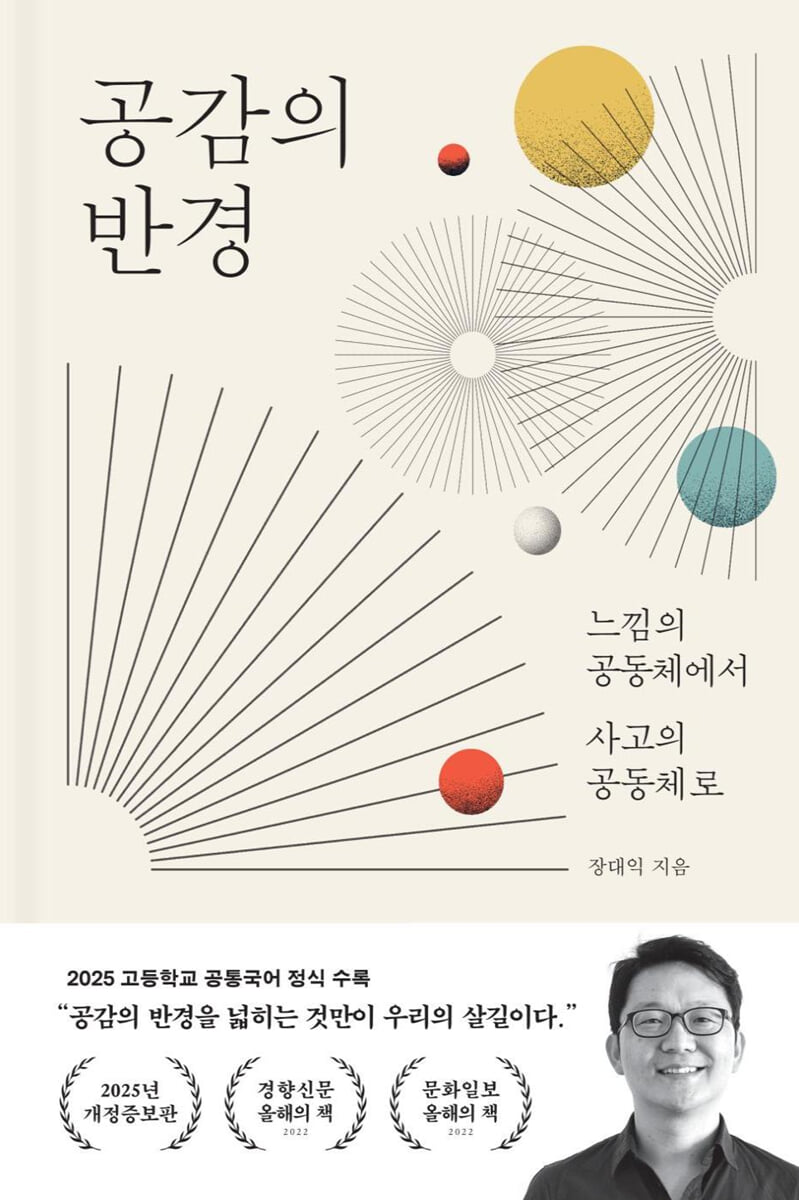
Radius of empathy
 |
Description
Book Introduction
The ongoing ideological conflict and out-group hatred in Korean society
What does it take to 'reconnect' within each other's radius?
It's a tragedy that in 2022, "Radius of Empathy," which pointed out that the polarization and division of thought in our society stem not from a "lack of empathy," but rather from an "excess of empathy," feels like a book that came out just the day before yesterday.
12.3 The movement of martial law and conspiracy theories about election fraud has sharpened the blade of empathy that only emotionally sympathizes with our own side and dehumanizes the other side.
In the midst of such intense ideological conflict, people still mistakenly believe that they lack emotional empathy for others.
Here, author Jang Dae-ik emphasizes once again that empathy is not a feeling but a cognitive attitude and an attitude that can be designed.
This revised and expanded edition goes beyond simple revisions, and includes two new sections: "Empathy Education for a New World" and "Politics: Organizing a Community of Thought." These new sections explore what innovations are needed to broaden the scope of cognitive empathy in the two most crucial axes of the future of the Republic of Korea: education and politics.
The author appeals.
“The only way to survive is to expand the radius of empathy!”
What does it take to 'reconnect' within each other's radius?
It's a tragedy that in 2022, "Radius of Empathy," which pointed out that the polarization and division of thought in our society stem not from a "lack of empathy," but rather from an "excess of empathy," feels like a book that came out just the day before yesterday.
12.3 The movement of martial law and conspiracy theories about election fraud has sharpened the blade of empathy that only emotionally sympathizes with our own side and dehumanizes the other side.
In the midst of such intense ideological conflict, people still mistakenly believe that they lack emotional empathy for others.
Here, author Jang Dae-ik emphasizes once again that empathy is not a feeling but a cognitive attitude and an attitude that can be designed.
This revised and expanded edition goes beyond simple revisions, and includes two new sections: "Empathy Education for a New World" and "Politics: Organizing a Community of Thought." These new sections explore what innovations are needed to broaden the scope of cognitive empathy in the two most crucial axes of the future of the Republic of Korea: education and politics.
The author appeals.
“The only way to survive is to expand the radius of empathy!”
- You can preview some of the book's contents.
Preview
index
Preface to the Revised and Expanded Edition | To Reconnect Within Each Other's Radius 7
Introduction | The Two Forces of Empathy: The Struggle Between Centripetal and Centrifugal Forces 11
Part 1: Empathy Creates Hate Empathy Creates Hate
Chapter 1: Exclusion and Discrimination Beginning with Feelings 25
Chapter 2: Tribal Instinct: They Are Not Human, They Are Not Us 41
Chapter 3: The COVID-19 Pandemic, the Pandemic of Hate 62
Chapter 4 Algorithms, "There's No One Else on Our Side" 95
Empathy beyond the feeling of part 2
Chapter 5: The Belief That My Hatred Is Morally Justified 121
Chapter 6: First Impressions Are Wrong 142
Chapter 7: From a Community of Feelings to a Community of Thought 153
Chapter 8: How Punishment Becomes Empathy 167
Chapter 9: The Boundaries of the Mind Are Collapsed 177
Part 3: Expand Your Circle of Empathy
Chapter 10: Instincts Change: Imagine a New Education 195
Chapter 11: If Everyone Could Wear a Bikini 216
Chapter 12: The Birth of a Narrow-minded Korean 228
Chapter 13: Korean Uniqueness Becomes a Shackle 240
Chapter 14: Skills for Reaching Out to Others 260
Chapter 15: Contact, Interaction, and Wider Affection 269
Part 4: Empathy Education for a New Generation
Chapter 16: My Baby's Supreme Being, the Path to Destruction 281
Chapter 17: What Makes a Child Grow? 290
Chapter 18: Demanding a Massive Transformation of Universities 305
Part 5: Politics: Organizing a Community of Thought
Chapter 19: Beyond the Politics of Emotions 333
Chapter 20: The Margin of Safety That Embraces Us All 350
Chapter 21: How Is Reconciliation Possible? 361
The End | The Path to Destruction and the Path to Survival 370
Acknowledgements 374
Week 376
Image source 393
Search 395
Introduction | The Two Forces of Empathy: The Struggle Between Centripetal and Centrifugal Forces 11
Part 1: Empathy Creates Hate Empathy Creates Hate
Chapter 1: Exclusion and Discrimination Beginning with Feelings 25
Chapter 2: Tribal Instinct: They Are Not Human, They Are Not Us 41
Chapter 3: The COVID-19 Pandemic, the Pandemic of Hate 62
Chapter 4 Algorithms, "There's No One Else on Our Side" 95
Empathy beyond the feeling of part 2
Chapter 5: The Belief That My Hatred Is Morally Justified 121
Chapter 6: First Impressions Are Wrong 142
Chapter 7: From a Community of Feelings to a Community of Thought 153
Chapter 8: How Punishment Becomes Empathy 167
Chapter 9: The Boundaries of the Mind Are Collapsed 177
Part 3: Expand Your Circle of Empathy
Chapter 10: Instincts Change: Imagine a New Education 195
Chapter 11: If Everyone Could Wear a Bikini 216
Chapter 12: The Birth of a Narrow-minded Korean 228
Chapter 13: Korean Uniqueness Becomes a Shackle 240
Chapter 14: Skills for Reaching Out to Others 260
Chapter 15: Contact, Interaction, and Wider Affection 269
Part 4: Empathy Education for a New Generation
Chapter 16: My Baby's Supreme Being, the Path to Destruction 281
Chapter 17: What Makes a Child Grow? 290
Chapter 18: Demanding a Massive Transformation of Universities 305
Part 5: Politics: Organizing a Community of Thought
Chapter 19: Beyond the Politics of Emotions 333
Chapter 20: The Margin of Safety That Embraces Us All 350
Chapter 21: How Is Reconciliation Possible? 361
The End | The Path to Destruction and the Path to Survival 370
Acknowledgements 374
Week 376
Image source 393
Search 395
Detailed image
.jpg)
Into the book
'My child's supremacy' ultimately leads to a vicious cycle that drastically reduces the radius of empathy in our society.
Empathy is the ability to understand and understand another person's situation, and it is the crucial glue that binds our society together.
However, if we pour all our attention and affection only into our own children, other people's children will naturally be pushed out of our range of empathy.
The longer this phenomenon persists, the greater the risk that children will grow up without learning how to coexist with others and how to acknowledge and care for each other's diversity.
--- p.284-285 "Chapter 16: My Child's Supremacy, the Path to Mutual Destruction"
So how should we raise our children? Unless we're taught by Mencius' mother.
Above all, we must calmly accept the fact that parents' extreme control over their children's environment or coercive selection of peer groups is ineffective.
Harris's theory serves to urge parents to clearly recognize the limits of their influence and the extent to which they can (and should) control their children's lives.
--- p.294-295 "Chapter 17: What Makes a Child Grow?"
These negative consequences surrounding evaluations are shaking the very reason for the existence of universities.
Universities should be run with a focus on the growth and happiness of their students, fostering creativity, empathy, entrepreneurship, and contributing to the community.
However, universities that are 'obsessed' with evaluation tend to pay more attention to quantitative indicators such as the number of papers, number of citations, and proportion of foreign professors.
Evaluations are merely feedback to make universities better, but universities hold themselves sacred.
This homogenizes the diversity and individuality of universities and moves them away from true educational value.
On campus, the question, “How are our students growing?” is a rare one.
If you go to any university across the country, you will see a lonely placard waving that reads, “Our goal is to be ranked in the top 10 in the world and in the country.”
Of course, the students have no feelings.
--- p.307 "Chapter 18: Demanding a Massive Transformation of Universities"
The world of negative emotions our leaders experience every day is far more complex.
The brain of a political leader is a veritable eve of an emotional storm.
A respected member of the National Assembly from a local district has a large emotional capacity.
Because when you meet the residents, you can't help but cry, get angry, and become anxious.
The people are merciless in criticizing the leaders when they fail to resonate with them emotionally (when the people are sad but the leaders only express anger).
Citizens who are concerned about the future are even more anxious about the unfounded optimism of the leadership.
The battle over the truth about the "rage" that the impeached former president is said to have frequently expressed is still not over.
At a hearing on the death of Marine Corps Private Chae, an official testified that “all of this was messed up because of one person’s rage,” but a presidential official denied the claim, saying, “I was never angry.”
There are also rumors that the former president was furious over the legitimate criticism by influential politicians regarding the former president's wife's acceptance of a luxury bag.
What does this outrage from a political leader mean?
--- p.348 "Chapter 19: Beyond the Politics of Emotions"
Let's say there's a minor mistake during heart surgery.
Can doctors and nurses immediately disclose this information and work together to find a solution, or are they forced to hide it out of fear? Research conducted by Amy Edmondson, an organizational psychologist at Harvard Business School, offers a surprising answer to this question.
A comparative analysis of cardiac surgery teams across the United States found that some hospital teams quickly learned new techniques and achieved high success rates, while others repeatedly failed with the same techniques.
The crucial difference between the two teams was the presence or absence of a “safe environment where team members can freely raise mistakes or issues without being criticized.”
In other words, the atmosphere in which the entire team can immediately take action to solve the problem, no matter who makes a mistake, affects the team's learning speed and performance. 4 Edmondson's study clearly shows that 'psychological safety' is a key driving force in driving innovation and growth in an organization.
--- p.357 "Chapter 20: The Margin of Safety That Embraces Us All"
Unfortunately, our political circles have been the most powerful source of social division.
In a time of extreme division, can they transform themselves into leaders who offer a vision of unity? What must be done to achieve this?
First, regardless of the pros and cons of one camp, the ruling of the judiciary must be respected and accepted.
Second, they must extend a helping hand of empathy beyond their own fandom to the pain and demands of the opposing camp.
Rather than reconciliation being merely a 'political show,' we need the courage to genuinely approach the other side's wounds.
When leaders take the lead and re-enter the "bath of empathy" and support the opposing camp, the people will also reach out to each other.
Empathy is the ability to understand and understand another person's situation, and it is the crucial glue that binds our society together.
However, if we pour all our attention and affection only into our own children, other people's children will naturally be pushed out of our range of empathy.
The longer this phenomenon persists, the greater the risk that children will grow up without learning how to coexist with others and how to acknowledge and care for each other's diversity.
--- p.284-285 "Chapter 16: My Child's Supremacy, the Path to Mutual Destruction"
So how should we raise our children? Unless we're taught by Mencius' mother.
Above all, we must calmly accept the fact that parents' extreme control over their children's environment or coercive selection of peer groups is ineffective.
Harris's theory serves to urge parents to clearly recognize the limits of their influence and the extent to which they can (and should) control their children's lives.
--- p.294-295 "Chapter 17: What Makes a Child Grow?"
These negative consequences surrounding evaluations are shaking the very reason for the existence of universities.
Universities should be run with a focus on the growth and happiness of their students, fostering creativity, empathy, entrepreneurship, and contributing to the community.
However, universities that are 'obsessed' with evaluation tend to pay more attention to quantitative indicators such as the number of papers, number of citations, and proportion of foreign professors.
Evaluations are merely feedback to make universities better, but universities hold themselves sacred.
This homogenizes the diversity and individuality of universities and moves them away from true educational value.
On campus, the question, “How are our students growing?” is a rare one.
If you go to any university across the country, you will see a lonely placard waving that reads, “Our goal is to be ranked in the top 10 in the world and in the country.”
Of course, the students have no feelings.
--- p.307 "Chapter 18: Demanding a Massive Transformation of Universities"
The world of negative emotions our leaders experience every day is far more complex.
The brain of a political leader is a veritable eve of an emotional storm.
A respected member of the National Assembly from a local district has a large emotional capacity.
Because when you meet the residents, you can't help but cry, get angry, and become anxious.
The people are merciless in criticizing the leaders when they fail to resonate with them emotionally (when the people are sad but the leaders only express anger).
Citizens who are concerned about the future are even more anxious about the unfounded optimism of the leadership.
The battle over the truth about the "rage" that the impeached former president is said to have frequently expressed is still not over.
At a hearing on the death of Marine Corps Private Chae, an official testified that “all of this was messed up because of one person’s rage,” but a presidential official denied the claim, saying, “I was never angry.”
There are also rumors that the former president was furious over the legitimate criticism by influential politicians regarding the former president's wife's acceptance of a luxury bag.
What does this outrage from a political leader mean?
--- p.348 "Chapter 19: Beyond the Politics of Emotions"
Let's say there's a minor mistake during heart surgery.
Can doctors and nurses immediately disclose this information and work together to find a solution, or are they forced to hide it out of fear? Research conducted by Amy Edmondson, an organizational psychologist at Harvard Business School, offers a surprising answer to this question.
A comparative analysis of cardiac surgery teams across the United States found that some hospital teams quickly learned new techniques and achieved high success rates, while others repeatedly failed with the same techniques.
The crucial difference between the two teams was the presence or absence of a “safe environment where team members can freely raise mistakes or issues without being criticized.”
In other words, the atmosphere in which the entire team can immediately take action to solve the problem, no matter who makes a mistake, affects the team's learning speed and performance. 4 Edmondson's study clearly shows that 'psychological safety' is a key driving force in driving innovation and growth in an organization.
--- p.357 "Chapter 20: The Margin of Safety That Embraces Us All"
Unfortunately, our political circles have been the most powerful source of social division.
In a time of extreme division, can they transform themselves into leaders who offer a vision of unity? What must be done to achieve this?
First, regardless of the pros and cons of one camp, the ruling of the judiciary must be respected and accepted.
Second, they must extend a helping hand of empathy beyond their own fandom to the pain and demands of the opposing camp.
Rather than reconciliation being merely a 'political show,' we need the courage to genuinely approach the other side's wounds.
When leaders take the lead and re-enter the "bath of empathy" and support the opposing camp, the people will also reach out to each other.
--- p.369 "Chapter 21: How Is Reconciliation Possible?"
Publisher's Review
The conflict and strife in Korean society are still not due to a "lack" of empathy, but rather an "excess" of it. The revised and expanded edition of "Radius of Empathy" begins with the tragic fact that in the three years since the first edition was published, conflict and division caused by an excess of empathy have not improved, but rather worsened.
Author Jang Dae-ik tells an episode that clearly demonstrates this.
“Professor Jang, I am reading “Radius of Empathy” with great interest.
It was a great help in understanding the recent political conflict in our country.
“Is this the book that came out this year?” “Oh… … No.
The book was published about three years ago.
If you felt that this book was published this year, it probably means that the conflicts in our society are repeating themselves in the same way now as they were then.
Haha.” Without going too far, the unprecedented martial law situation on December 3, 2024 was an incident where excessive empathy, favoring the in-group and hating the out-group, reached its extreme.
A leader who should be leading a country was so obsessed with conspiracy theories about election fraud that he silenced his opponents and resorted to violence.
YouTube channels fueled by hate spread fake news and gathered support.
Traditional media also abandoned fact-checking and neutral reporting, instead reproducing hatred along partisan lines.
Everyone was obsessed with figuring out whose side you were on.
Yet people still say that 'empathy is needed' to clear up this confusion.
Author Jang Dae-ik is uncomfortable with this solution.
He again bluntly states that the most excessive emotion in Korean society is empathy.
It's emotional empathy that only works with people who are in the same position as you.
What we lack is not empathy.
The problem lies in the fact that the 'radius' of empathy is narrow.
In other words, the question is how far can we expand our ability to put ourselves in someone else's shoes, beyond the ability to feel.
Jang Dae-ik wrote this revised and expanded edition, realizing that we still don't know enough about how to expand the radius of empathy.
According to him, empathy is a cognitive attitude that is structured, selective, and designable.
If we fail to expand the radius of empathy, the future of not only the Republic of Korea but also of humanity is bleak.
Accordingly, author Jang Dae-ik meticulously explores what transformations must occur and what structures must be established in the two most important axes of human life, 'education' and 'politics,' to expand cognitive empathy by putting oneself in another's shoes, and how I can reach out to you.
The issues raised in “Radius of Empathy” are still relevant in 2025.
Breaking free from the "my child supremacy" and educating the new generation to empathize, novelist Kim Hoon pointed out that "my child supremacy" has become the zeitgeist of the Republic of Korea.
Parents' inability to tolerate any pain or discomfort in their children's lives and their inability to protect them deprives them of the opportunity to learn cognitive empathy, which allows them to understand the perspectives of others.
However, author Jang Dae-ik points out that humans were not originally like this.
Primates, including humans, originally had a cooperative child-rearing system in which 'the whole village came together' to raise children.
Co-parenting involves a surrogate parent caring for and supporting young children.
Surrogate parents include not only grandmothers, but also older siblings, aunts, great-aunts, fathers, uncles, and even visitors from neighboring communities, all of whom assist women in childbirth and the child's chances of survival.
According to evolutionary biologist Sarah Blaffer Hrdy, the evolution of cooperative breeding is the reason why Homo sapiens, who were almost impossible to find anywhere on Earth 100,000 years ago, were able to spread so dramatically to cover the globe.
However, as childbirth and childrearing became separate lives, I was unable to realize that my child was not the only one who was precious, and that I was not the only one raising the child.
This has brought about bad consequences for both parents and children, as it erases the existence of others.
Therefore, a “social shift that allows us to open our hearts to other people’s children as we cherish our own” is the foundation necessary for the future of children and the continuation of humanity.
The author uses various scientific evidence to convincingly demonstrate that controlling parenting does not determine a child's personality or future path.
Parents must clearly recognize the limits of their influence and the extent to which they can protect their children's lives.
"You can't give your children a home for their souls." The author also demonstrates, through numerous pieces of evidence, how respecting children's innate individuality, providing opportunities for active interaction with others through exercise and sports, and fostering an environment that fosters curiosity can dramatically expand their radius of empathy.
The most important argument in the revised and expanded edition discussing the scope of education and empathy is the call for a "great transformation of universities."
Our university, which is obsessed with ranking universities through the so-called 'admission' process, is shaking the very reason for the existence of universities due to these side effects surrounding evaluation.
Universities are failing to achieve their ultimate goals of “student growth and happiness, fostering creativity, empathy, entrepreneurship, and contributing to the community.”
In today's world, where selection is the sole focus, rather than individual student growth, there is no room for adventurous individuals who stand in others' shoes and seek to uncover and solve real-world problems.
The author calls the university's great transformation an "entrepreneurial transformation" that nurtures young people who challenge, fail, and rise again, and discusses institutionally how this can be possible.
Beyond the politics of emotions, politics is about organizing a community of thought. Humans are biased creatures, and these biases are immediately based on powerful emotions.
Therefore, in politics, where mutual interests must be coordinated, emotional conflict and in-group bias are more prevalent than the exercise of reason and cognitive empathy.
Our task is to go beyond the politics of emotions.
But aren't our leaders complacent with those emotions? Surrounded by supporters who fuel their own moral narrow-mindedness and stubbornness, who believe only they are right, and who further narrow their horizons, they display inappropriate anger. This is a serious situation that threatens the very existence of the community.
Perhaps this emotional stubbornness may have been one of the reasons that triggered the December 3 martial law incident.
To organize a community of thought, politics must, above all, utilize knowledge of human beings.
In human relationships and political issues, there can never be any conflict.
Human bias is a fundamental condition of our society.
A community of thought begins on this foundation.
For example, even if two organizations have similar capabilities, their long-term performance will differ depending on the psychological mechanisms they have.
One of those factors is something called ‘psychological safety.’
If there is confidence within the organization that mistakes will not result in criticism or repercussions, each member can fully realize his or her potential.
Korean society is one where this psychological safety has disappeared.
The author believes that an unprecedented situation like the December 3 martial law cannot be explained solely by the arrogance of the president.
The power brokers who should have put the brakes on such decisions may have had such a lack of psychological security that they could not say it was wrong.
Ultimately, it is an organization that has trust and dialogue, not authority and silence, that can expand the radius of empathy to others.
This attitude is the first step toward reconciliation and resolution of conflict.
The author argues that humans have an instinct for reconciliation as well as an instinct for conflict.
If we did not have the ability to reconcile after conflict, humanity would have gone extinct long ago.
To bridge the gap between groups, we need to meet often.
However, common goals must be created based on psychological safety.
The Good Friday Agreement in Northern Ireland is a prime example.
An agreement was signed to end the conflict in Northern Ireland, where 3,600 people were killed and over 50,000 were injured due to bloody clashes between Catholics and Protestants for 30 years (April 10, 1998).
After that, youth from both camps studied at the same school and regularly participated in cultural exchanges and volunteer activities together.
Then, they gradually began to perceive each other not as enemies but as 'people no different from us'.
Reconciliation is possible.
Author Jang Dae-ik tells an episode that clearly demonstrates this.
“Professor Jang, I am reading “Radius of Empathy” with great interest.
It was a great help in understanding the recent political conflict in our country.
“Is this the book that came out this year?” “Oh… … No.
The book was published about three years ago.
If you felt that this book was published this year, it probably means that the conflicts in our society are repeating themselves in the same way now as they were then.
Haha.” Without going too far, the unprecedented martial law situation on December 3, 2024 was an incident where excessive empathy, favoring the in-group and hating the out-group, reached its extreme.
A leader who should be leading a country was so obsessed with conspiracy theories about election fraud that he silenced his opponents and resorted to violence.
YouTube channels fueled by hate spread fake news and gathered support.
Traditional media also abandoned fact-checking and neutral reporting, instead reproducing hatred along partisan lines.
Everyone was obsessed with figuring out whose side you were on.
Yet people still say that 'empathy is needed' to clear up this confusion.
Author Jang Dae-ik is uncomfortable with this solution.
He again bluntly states that the most excessive emotion in Korean society is empathy.
It's emotional empathy that only works with people who are in the same position as you.
What we lack is not empathy.
The problem lies in the fact that the 'radius' of empathy is narrow.
In other words, the question is how far can we expand our ability to put ourselves in someone else's shoes, beyond the ability to feel.
Jang Dae-ik wrote this revised and expanded edition, realizing that we still don't know enough about how to expand the radius of empathy.
According to him, empathy is a cognitive attitude that is structured, selective, and designable.
If we fail to expand the radius of empathy, the future of not only the Republic of Korea but also of humanity is bleak.
Accordingly, author Jang Dae-ik meticulously explores what transformations must occur and what structures must be established in the two most important axes of human life, 'education' and 'politics,' to expand cognitive empathy by putting oneself in another's shoes, and how I can reach out to you.
The issues raised in “Radius of Empathy” are still relevant in 2025.
Breaking free from the "my child supremacy" and educating the new generation to empathize, novelist Kim Hoon pointed out that "my child supremacy" has become the zeitgeist of the Republic of Korea.
Parents' inability to tolerate any pain or discomfort in their children's lives and their inability to protect them deprives them of the opportunity to learn cognitive empathy, which allows them to understand the perspectives of others.
However, author Jang Dae-ik points out that humans were not originally like this.
Primates, including humans, originally had a cooperative child-rearing system in which 'the whole village came together' to raise children.
Co-parenting involves a surrogate parent caring for and supporting young children.
Surrogate parents include not only grandmothers, but also older siblings, aunts, great-aunts, fathers, uncles, and even visitors from neighboring communities, all of whom assist women in childbirth and the child's chances of survival.
According to evolutionary biologist Sarah Blaffer Hrdy, the evolution of cooperative breeding is the reason why Homo sapiens, who were almost impossible to find anywhere on Earth 100,000 years ago, were able to spread so dramatically to cover the globe.
However, as childbirth and childrearing became separate lives, I was unable to realize that my child was not the only one who was precious, and that I was not the only one raising the child.
This has brought about bad consequences for both parents and children, as it erases the existence of others.
Therefore, a “social shift that allows us to open our hearts to other people’s children as we cherish our own” is the foundation necessary for the future of children and the continuation of humanity.
The author uses various scientific evidence to convincingly demonstrate that controlling parenting does not determine a child's personality or future path.
Parents must clearly recognize the limits of their influence and the extent to which they can protect their children's lives.
"You can't give your children a home for their souls." The author also demonstrates, through numerous pieces of evidence, how respecting children's innate individuality, providing opportunities for active interaction with others through exercise and sports, and fostering an environment that fosters curiosity can dramatically expand their radius of empathy.
The most important argument in the revised and expanded edition discussing the scope of education and empathy is the call for a "great transformation of universities."
Our university, which is obsessed with ranking universities through the so-called 'admission' process, is shaking the very reason for the existence of universities due to these side effects surrounding evaluation.
Universities are failing to achieve their ultimate goals of “student growth and happiness, fostering creativity, empathy, entrepreneurship, and contributing to the community.”
In today's world, where selection is the sole focus, rather than individual student growth, there is no room for adventurous individuals who stand in others' shoes and seek to uncover and solve real-world problems.
The author calls the university's great transformation an "entrepreneurial transformation" that nurtures young people who challenge, fail, and rise again, and discusses institutionally how this can be possible.
Beyond the politics of emotions, politics is about organizing a community of thought. Humans are biased creatures, and these biases are immediately based on powerful emotions.
Therefore, in politics, where mutual interests must be coordinated, emotional conflict and in-group bias are more prevalent than the exercise of reason and cognitive empathy.
Our task is to go beyond the politics of emotions.
But aren't our leaders complacent with those emotions? Surrounded by supporters who fuel their own moral narrow-mindedness and stubbornness, who believe only they are right, and who further narrow their horizons, they display inappropriate anger. This is a serious situation that threatens the very existence of the community.
Perhaps this emotional stubbornness may have been one of the reasons that triggered the December 3 martial law incident.
To organize a community of thought, politics must, above all, utilize knowledge of human beings.
In human relationships and political issues, there can never be any conflict.
Human bias is a fundamental condition of our society.
A community of thought begins on this foundation.
For example, even if two organizations have similar capabilities, their long-term performance will differ depending on the psychological mechanisms they have.
One of those factors is something called ‘psychological safety.’
If there is confidence within the organization that mistakes will not result in criticism or repercussions, each member can fully realize his or her potential.
Korean society is one where this psychological safety has disappeared.
The author believes that an unprecedented situation like the December 3 martial law cannot be explained solely by the arrogance of the president.
The power brokers who should have put the brakes on such decisions may have had such a lack of psychological security that they could not say it was wrong.
Ultimately, it is an organization that has trust and dialogue, not authority and silence, that can expand the radius of empathy to others.
This attitude is the first step toward reconciliation and resolution of conflict.
The author argues that humans have an instinct for reconciliation as well as an instinct for conflict.
If we did not have the ability to reconcile after conflict, humanity would have gone extinct long ago.
To bridge the gap between groups, we need to meet often.
However, common goals must be created based on psychological safety.
The Good Friday Agreement in Northern Ireland is a prime example.
An agreement was signed to end the conflict in Northern Ireland, where 3,600 people were killed and over 50,000 were injured due to bloody clashes between Catholics and Protestants for 30 years (April 10, 1998).
After that, youth from both camps studied at the same school and regularly participated in cultural exchanges and volunteer activities together.
Then, they gradually began to perceive each other not as enemies but as 'people no different from us'.
Reconciliation is possible.
GOODS SPECIFICS
- Date of issue: June 27, 2025
- Format: Hardcover book binding method guide
- Page count, weight, size: 399 pages | 604g | 146*218*27mm
- ISBN13: 9791166893575
You may also like
카테고리
korean


korean

![GQ KOREA Mark (Monthly): December [2025]](http://librairie.coreenne.fr/cdn/shop/files/8ef265dbbfbf186523ed75ba7319009d.jpg?v=1765340328&width=3840)


