

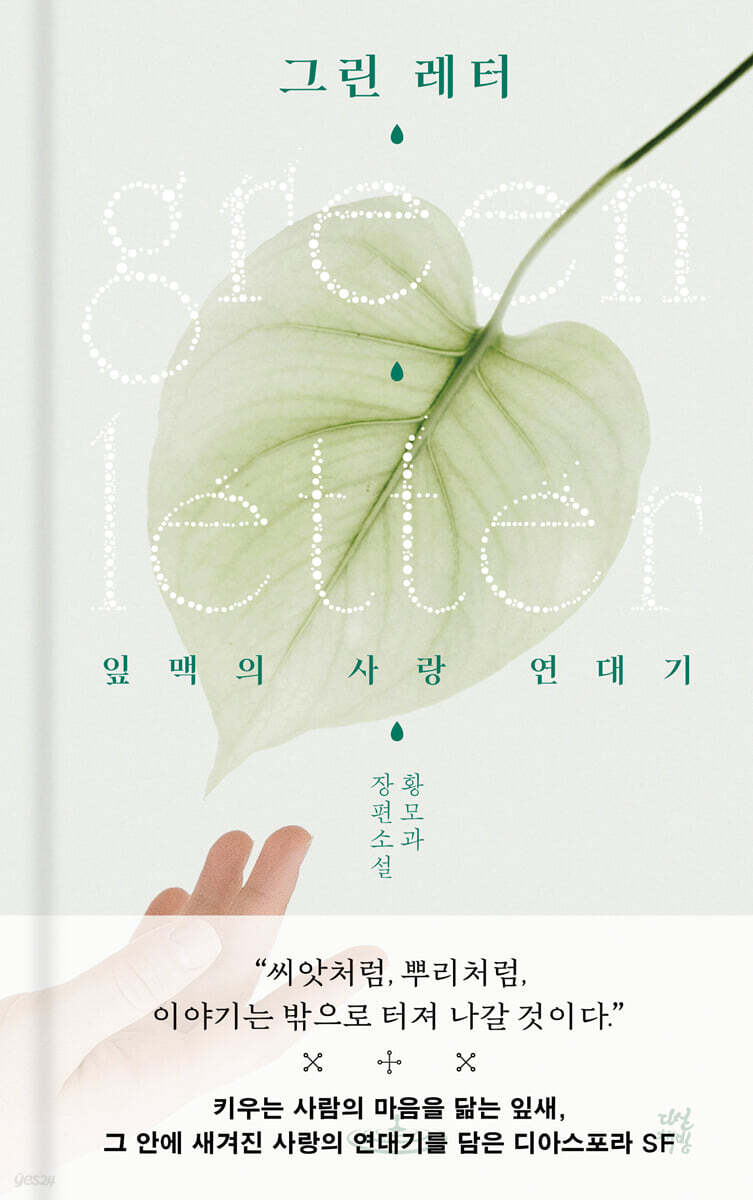
Green Letter
 |
Description
Book Introduction
Leaves that resemble the heart of the person who raises them,
Diaspora SF with a chronicle of love engraved within it
★2024 Seoul International Book Fair Summer, First Book Selection★
★New work by the author who won the Korea Science Literature Award Grand Prize and the SF Award★
Author Hwang Mo-gwa, who has consistently delved into the stories of those who have lost their language and country through history, presents a new diaspora SF novel, "Green Letter," at Dasan Bookstore.
"Green Letter" is a work that shares the same vein as "Green Letter" included in the short story collection "Ordinary Us" published by the Diaspora Film Festival, the only film festival in Korea that highlights the diaspora. It depicts the process of "Irun," a researcher in the Ice Mountain Country, deciphering the "Vitisdia" plant that engraves human messages into the veins of its leaves and following in the footsteps of the Kujin people, his roots.
Diaspora SF with a chronicle of love engraved within it
★2024 Seoul International Book Fair Summer, First Book Selection★
★New work by the author who won the Korea Science Literature Award Grand Prize and the SF Award★
Author Hwang Mo-gwa, who has consistently delved into the stories of those who have lost their language and country through history, presents a new diaspora SF novel, "Green Letter," at Dasan Bookstore.
"Green Letter" is a work that shares the same vein as "Green Letter" included in the short story collection "Ordinary Us" published by the Diaspora Film Festival, the only film festival in Korea that highlights the diaspora. It depicts the process of "Irun," a researcher in the Ice Mountain Country, deciphering the "Vitisdia" plant that engraves human messages into the veins of its leaves and following in the footsteps of the Kujin people, his roots.
- You can preview some of the book's contents.
Preview
index
Chapter 1: The Story of Purun
Chapter 2: The Story of Irun
Chapter 3: Romilya's Story
Chapter 4: Baloo's Story
Chapter 5: Another Story of Purun
Chapter 6 Everyone's Story
Epilogue
Author's Note
Chapter 2: The Story of Irun
Chapter 3: Romilya's Story
Chapter 4: Baloo's Story
Chapter 5: Another Story of Purun
Chapter 6 Everyone's Story
Epilogue
Author's Note
Detailed image
.jpg)
Into the book
The synagogue was where all the town's activities took place.
Among them, the rooftop conference room was special.
It was always a chaotic place, with people showing a warm tension on their faces.
My friends and I used to call that place, which you had to be an adult to climb, the 'secret staircase', and we used to tease our older brothers and sisters who went up there first.
That day, I set foot there for the first time.
To meet you.
--- p.9
Even though I screamed that it hurt and protested to them to stop, they didn't stop.
I was beaten so that my flesh was pierced by broken teeth and my internal organs were torn by broken bones.
Rather than confronting it, I tried my best to block it, and at best, to dodge it, but it was no use.
There was no hesitation in that violence.
I cried and begged so desperately.
I begged him to spare my life.
I begged miserably.
No words could be heard.
Even if I had used expressions that they probably would not have stopped.
I heard it later.
They say that in that city, a woman who dares to walk down the street without covering her hair is worth being beaten to death.
It wasn't that they couldn't communicate.
My hair was so exposed that it didn't fit their standards.
--- p.108
Cases of violence by remaining Kujin tribe members often made the news.
Recently, in a shabby back alley in the city, an argument between a fortune teller from Kujin and a customer of the Ice Mountain Restaurant resulted in a mutual assault.
But the fact that both parties were assaulting each other was not important.
The only thing that mattered was that Kujin was involved in the assault incident.
That's how it was in this city.
--- p.139
These days, I'm growing B. vitsis in my small yard.
I felt like leaving behind a story from the time I couldn't meet you.
I tell my story to the little tree every day. Where are you now? I hope you're living a healthy and happy life in a warm and comfortable place.
I firmly believe that you are alive.
I've always believed that I was living happily.
You're living the adventure you always wanted.
I hope the moments you didn't expect to happen pass you by in life.
I pray whenever I think of it.
Among them, the rooftop conference room was special.
It was always a chaotic place, with people showing a warm tension on their faces.
My friends and I used to call that place, which you had to be an adult to climb, the 'secret staircase', and we used to tease our older brothers and sisters who went up there first.
That day, I set foot there for the first time.
To meet you.
--- p.9
Even though I screamed that it hurt and protested to them to stop, they didn't stop.
I was beaten so that my flesh was pierced by broken teeth and my internal organs were torn by broken bones.
Rather than confronting it, I tried my best to block it, and at best, to dodge it, but it was no use.
There was no hesitation in that violence.
I cried and begged so desperately.
I begged him to spare my life.
I begged miserably.
No words could be heard.
Even if I had used expressions that they probably would not have stopped.
I heard it later.
They say that in that city, a woman who dares to walk down the street without covering her hair is worth being beaten to death.
It wasn't that they couldn't communicate.
My hair was so exposed that it didn't fit their standards.
--- p.108
Cases of violence by remaining Kujin tribe members often made the news.
Recently, in a shabby back alley in the city, an argument between a fortune teller from Kujin and a customer of the Ice Mountain Restaurant resulted in a mutual assault.
But the fact that both parties were assaulting each other was not important.
The only thing that mattered was that Kujin was involved in the assault incident.
That's how it was in this city.
--- p.139
These days, I'm growing B. vitsis in my small yard.
I felt like leaving behind a story from the time I couldn't meet you.
I tell my story to the little tree every day. Where are you now? I hope you're living a healthy and happy life in a warm and comfortable place.
I firmly believe that you are alive.
I've always believed that I was living happily.
You're living the adventure you always wanted.
I hope the moments you didn't expect to happen pass you by in life.
I pray whenever I think of it.
--- p.178
Publisher's Review
“Like a seed, like a root,
The story will explode out.”
A story that calls them to us and the past to the present
The world of the yellow moss, a world that is sure to be reached, even if a little slowly
People often say that pain dulls with time, but if we look closely at this saying, it implies that while the sensation of pain may dull with time, the wounds never disappear.
Because it is a pain that is still ongoing for us, Hwangmogwa's delicate approach shines even brighter.
Hwang Mo-gwa, who has consistently written science fiction, is particularly presenting science fiction that is firmly rooted in reality.
Rather than metaphorizing reality through stories of distant places or the distant future, it reveals us now through stories of the present or the near future.
It is in the same context that 『Green Letter』, set in a fictional country and fictional era, is read as our own story.
In fact, much of "Green Letter" is inspired by real events.
The practice of gifting leaves as letters was modified based on the culture of the Jingpo people in China, and the title 'Green Letter' was taken from the ambiguous meaning of the paper notifying the refusal of a US visa application due to insufficient documents, etc., called 'Green Letter'.
It is no coincidence that historical events can easily be recalled from various episodes appearing in the novel.
So, whether the author intended it or not, 『Green Letter』 is ultimately a way of bringing world events into our current story, and a work of calling past history into the present.
His novels always start here and now and expand outward.
And even if it's a little slow, it comes back with certainty and accuracy.
This is how the world of the yellow moss reaches us.
“My dear, I hope you are well,
“I hope you are safe and at peace wherever you are.”
A heartbreaking history of love engraved in the veins of a leaf
The story of those who could not stay and had to leave
Irun is busy interpreting the leaves of the Vitis japonica that his great-grandfather had painstakingly grown.
Vitis vinifera, a plant that engraves messages from its owner into its leaf veins, is a rare species with only one genus and one species worldwide, and it is now difficult to find even that.
The last of the indigenous populations of the Ice Mountain Country were completely wiped out by the heat wave and tsunami that struck a few years ago, and even the custom of the Kujin people, who carved hearts into leaves and gave them to others, was dismissed as superstition and disappeared from the world.
The leaf left in Irun's hand was sprouted from a seed obtained from a tree grown by his great-grandfather 'Purun', and is the last remaining Vitisdia in the world.
"Plants talk? Does that make sense?" "Do you believe the story of Kujin who tells fortunes with leaves?" "Are you Kujin?" Despite all the prejudices surrounding these words, Irun was able to focus on interpreting them because of a story he heard from an old man in the village of Butdong, his great-grandfather's hometown.
However, the only way to decipher the leaf is to find the 'detox key' that has been passed down among the Kujin tribe.
One day, a suspicious email arrives to Irun, who is finding more and more strange combinations of words as the days go by.
An email from a stranger who claims to have the decryption key and is willing to give it to you.
It's hard for Irun to believe his claim that the already extinct Vitisdia forms a forest near the equator, but he does indeed send the decryption key.
Irun decides to go and meet him in person, who introduces himself as 'Balu'.
“Please leave my story.
“A story about a life that endured in a place where no one could see.”
The lonely fight of those who were unknown or forgotten,
Comfort and consolation that brings back lost time
In Hwangmo's novels, 'history' appears as a major context.
The past is now irreversible.
A past that can never be changed.
Hwang Mo-gwa revives that time in the novel, asking readers who have forgotten the past one more chance.
If you were in this situation, what choice would you have made? What kind of life would you live after you cross this time?
Therefore, the experience of reading a novel by Hwang Mo-gwa is both an experience of gaining shared memories and an experience of having personal memories.
This is probably why the story of Purun and Romilya, who lost their language and country due to someone else's will and were forced to wander far away, is read not simply as the meeting and parting of lovers, but as the history of a nation.
Because the pain experienced by an individual in the flow of history is no longer limited to that individual.
This novel features the Kujin people, a people with a language and culture but no state.
This people, strangely familiar to us, are being exploited by neighboring countries for their people and resources, and even lose their name and language.
The lives of those who live as foreigners in a country divided into three parts, despite it being their homeland, resemble ours, who lost their country and language, and who are still divided today.
The process of those who were driven out of their hometown and into unfamiliar places, those who were despised simply for existing, finding their own language through the leaves of 'Vitisdia' will provide comfort and solace to readers who had no choice but to console their frustration with the hypothetical 'what if'.
The story will explode out.”
A story that calls them to us and the past to the present
The world of the yellow moss, a world that is sure to be reached, even if a little slowly
People often say that pain dulls with time, but if we look closely at this saying, it implies that while the sensation of pain may dull with time, the wounds never disappear.
Because it is a pain that is still ongoing for us, Hwangmogwa's delicate approach shines even brighter.
Hwang Mo-gwa, who has consistently written science fiction, is particularly presenting science fiction that is firmly rooted in reality.
Rather than metaphorizing reality through stories of distant places or the distant future, it reveals us now through stories of the present or the near future.
It is in the same context that 『Green Letter』, set in a fictional country and fictional era, is read as our own story.
In fact, much of "Green Letter" is inspired by real events.
The practice of gifting leaves as letters was modified based on the culture of the Jingpo people in China, and the title 'Green Letter' was taken from the ambiguous meaning of the paper notifying the refusal of a US visa application due to insufficient documents, etc., called 'Green Letter'.
It is no coincidence that historical events can easily be recalled from various episodes appearing in the novel.
So, whether the author intended it or not, 『Green Letter』 is ultimately a way of bringing world events into our current story, and a work of calling past history into the present.
His novels always start here and now and expand outward.
And even if it's a little slow, it comes back with certainty and accuracy.
This is how the world of the yellow moss reaches us.
“My dear, I hope you are well,
“I hope you are safe and at peace wherever you are.”
A heartbreaking history of love engraved in the veins of a leaf
The story of those who could not stay and had to leave
Irun is busy interpreting the leaves of the Vitis japonica that his great-grandfather had painstakingly grown.
Vitis vinifera, a plant that engraves messages from its owner into its leaf veins, is a rare species with only one genus and one species worldwide, and it is now difficult to find even that.
The last of the indigenous populations of the Ice Mountain Country were completely wiped out by the heat wave and tsunami that struck a few years ago, and even the custom of the Kujin people, who carved hearts into leaves and gave them to others, was dismissed as superstition and disappeared from the world.
The leaf left in Irun's hand was sprouted from a seed obtained from a tree grown by his great-grandfather 'Purun', and is the last remaining Vitisdia in the world.
"Plants talk? Does that make sense?" "Do you believe the story of Kujin who tells fortunes with leaves?" "Are you Kujin?" Despite all the prejudices surrounding these words, Irun was able to focus on interpreting them because of a story he heard from an old man in the village of Butdong, his great-grandfather's hometown.
However, the only way to decipher the leaf is to find the 'detox key' that has been passed down among the Kujin tribe.
One day, a suspicious email arrives to Irun, who is finding more and more strange combinations of words as the days go by.
An email from a stranger who claims to have the decryption key and is willing to give it to you.
It's hard for Irun to believe his claim that the already extinct Vitisdia forms a forest near the equator, but he does indeed send the decryption key.
Irun decides to go and meet him in person, who introduces himself as 'Balu'.
“Please leave my story.
“A story about a life that endured in a place where no one could see.”
The lonely fight of those who were unknown or forgotten,
Comfort and consolation that brings back lost time
In Hwangmo's novels, 'history' appears as a major context.
The past is now irreversible.
A past that can never be changed.
Hwang Mo-gwa revives that time in the novel, asking readers who have forgotten the past one more chance.
If you were in this situation, what choice would you have made? What kind of life would you live after you cross this time?
Therefore, the experience of reading a novel by Hwang Mo-gwa is both an experience of gaining shared memories and an experience of having personal memories.
This is probably why the story of Purun and Romilya, who lost their language and country due to someone else's will and were forced to wander far away, is read not simply as the meeting and parting of lovers, but as the history of a nation.
Because the pain experienced by an individual in the flow of history is no longer limited to that individual.
This novel features the Kujin people, a people with a language and culture but no state.
This people, strangely familiar to us, are being exploited by neighboring countries for their people and resources, and even lose their name and language.
The lives of those who live as foreigners in a country divided into three parts, despite it being their homeland, resemble ours, who lost their country and language, and who are still divided today.
The process of those who were driven out of their hometown and into unfamiliar places, those who were despised simply for existing, finding their own language through the leaves of 'Vitisdia' will provide comfort and solace to readers who had no choice but to console their frustration with the hypothetical 'what if'.
GOODS SPECIFICS
- Date of issue: July 17, 2024
- Format: Hardcover book binding method guide
- Page count, weight, size: 268 pages | 336g | 116*190*17mm
- ISBN13: 9791130653495
- ISBN10: 1130653498
You may also like
카테고리
korean


korean

![ELLE 엘르 스페셜 에디션 A형 : 12월 [2025]](http://librairie.coreenne.fr/cdn/shop/files/b8e27a3de6c9538896439686c6b0e8fb.jpg?v=1766436872&width=3840)


