

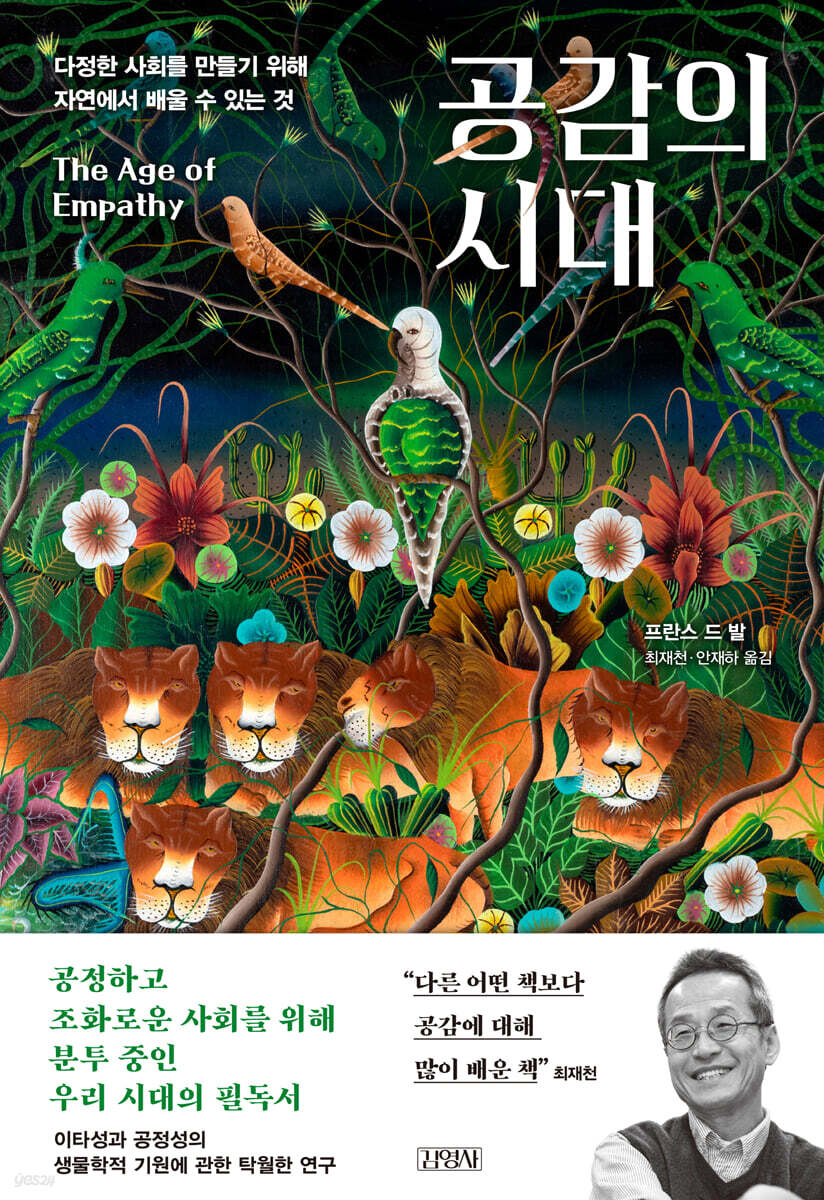
The Age of Empathy
 |
Description
Book Introduction
“This book taught me more about empathy than any other book.” _Choi Jae-cheon
A must-read for our times, as we strive for a just and harmonious society.
In March 2024, primatologist Frans de Waal, author of the international bestseller Chimpanzee Politics and widely loved as an exceptional storyteller, passed away. His other masterpiece, The Age of Empathy, will be reprinted with a new cover.
While "Chimpanzee Politics" meticulously analyzed political behaviors such as power struggles, leadership, and the acquisition and maintenance of status in chimpanzee society, "The Age of Empathy" focuses on the essence of cooperation and altruism that lie beyond the shadow of competition.
This was a hot topic that received a lot of attention from major media and scholars around the world, intertwined with the political situation at the time of the original book's publication in 2009. The Korean version was translated by Professor Choi Jae-cheon, a leading animal behaviorist in Korea, along with his student Ahn Jae-ha, adding depth to the book.
In The Age of Empathy, Frans de Waal explores the biological foundations of empathy, fairness, and morality, offering a path toward a more holistic and balanced understanding of human and animal behavior.
Empathic behaviors displayed by a wide range of animals, including primates like chimpanzees and gorillas, as well as cats, wolves, dolphins, and elephants, provide compelling evidence that empathy is a deeply evolutionary instinct and a product of natural selection for survival and prosperity.
De Waal argues that we must move beyond a view of human nature as simply driven by competition and greed, and recognize the cooperation, solidarity, and altruism that underlie it. He offers the insight that we must move beyond an age of greed and design a society centered on empathy and solidarity.
A must-read for our times, as we strive for a just and harmonious society.
In March 2024, primatologist Frans de Waal, author of the international bestseller Chimpanzee Politics and widely loved as an exceptional storyteller, passed away. His other masterpiece, The Age of Empathy, will be reprinted with a new cover.
While "Chimpanzee Politics" meticulously analyzed political behaviors such as power struggles, leadership, and the acquisition and maintenance of status in chimpanzee society, "The Age of Empathy" focuses on the essence of cooperation and altruism that lie beyond the shadow of competition.
This was a hot topic that received a lot of attention from major media and scholars around the world, intertwined with the political situation at the time of the original book's publication in 2009. The Korean version was translated by Professor Choi Jae-cheon, a leading animal behaviorist in Korea, along with his student Ahn Jae-ha, adding depth to the book.
In The Age of Empathy, Frans de Waal explores the biological foundations of empathy, fairness, and morality, offering a path toward a more holistic and balanced understanding of human and animal behavior.
Empathic behaviors displayed by a wide range of animals, including primates like chimpanzees and gorillas, as well as cats, wolves, dolphins, and elephants, provide compelling evidence that empathy is a deeply evolutionary instinct and a product of natural selection for survival and prosperity.
De Waal argues that we must move beyond a view of human nature as simply driven by competition and greed, and recognize the cooperation, solidarity, and altruism that underlie it. He offers the insight that we must move beyond an age of greed and design a society centered on empathy and solidarity.
- You can preview some of the book's contents.
Preview
index
Translator's Preface
introduction
Chapter 1: Biology of Left and Right
Evolutionary Mind | The Overloved Child | The Macho Origin Myth
Chapter 2: Other Darwinisms
Rethinking Self-Interest | Enron and the Selfish Gene
Chapter 3: What the Body Says to the Body
The Response Problem | The Art of Mimicry | The Emotional Brain | The Compassion of Rats | Oscar the Cat | Empathy Needs a Face
Chapter 4: Putting Yourself in Another's Shoes
Sympathy | Imagine the other person | Jump into the water | Little Red Riding Hood | Warm feeling
Chapter 5: The Elephant in the Room
Ontogeny and Phylogeny | Somersault Fools | Her Name is Happy | In Her Own Little Bubble | Yellow Eyes | Pointing Primates
Chapter 6 Let's be fair
Should I hunt rabbits or deer? | Eye-piercing trust | What have you done for me lately? | Evolution without animals | The last to come first | Monkey money
Chapter 7 The Crooked Tree
Russian Doll | The Dark Side of Empathy | The Invisible Helping Hand
annotation
References
Search
introduction
Chapter 1: Biology of Left and Right
Evolutionary Mind | The Overloved Child | The Macho Origin Myth
Chapter 2: Other Darwinisms
Rethinking Self-Interest | Enron and the Selfish Gene
Chapter 3: What the Body Says to the Body
The Response Problem | The Art of Mimicry | The Emotional Brain | The Compassion of Rats | Oscar the Cat | Empathy Needs a Face
Chapter 4: Putting Yourself in Another's Shoes
Sympathy | Imagine the other person | Jump into the water | Little Red Riding Hood | Warm feeling
Chapter 5: The Elephant in the Room
Ontogeny and Phylogeny | Somersault Fools | Her Name is Happy | In Her Own Little Bubble | Yellow Eyes | Pointing Primates
Chapter 6 Let's be fair
Should I hunt rabbits or deer? | Eye-piercing trust | What have you done for me lately? | Evolution without animals | The last to come first | Monkey money
Chapter 7 The Crooked Tree
Russian Doll | The Dark Side of Empathy | The Invisible Helping Hand
annotation
References
Search
Detailed image

Into the book
Like other mammals, all human life cycles include stages in which we depend on others (when we are young, old, or sick) or when others depend on us (when we care for someone who is young, old, or sick).
We depend a lot on other people to survive.
If we are to discuss human society, we must begin with this reality, not with the fantasy of a few centuries ago that our ancestors were as free as birds and had no social obligations.
We are descended from a long line of group-living primates and are highly interdependent.
--- p.40
Empathy is an automatic response that we have little control over.
We may suppress empathy, mentally block it, or fail to act on it, but with the exception of a very small number of people, such as psychopaths, none of us can avoid being emotionally affected by another person's situation.
A very basic question, though rarely asked, is this:
Why did natural selection design the human brain to allow us to align with others, to feel pain when others suffer and joy when others rejoice? If exploiting others was all that mattered, evolution wouldn't have ventured into the business of empathy.
--- p.69
While I rank humans as the most aggressive primates, I also believe that we are masters of relationships and that social bonds limit competition.
In other words, we don't necessarily have to be aggressive.
The important thing is balance.
Pure, unconditional trust and cooperation are too naive and harmful, while unbridled greed only leads to a world of cutthroat competition.
The world of Enron, which Skilling championed, but which collapsed due to its very meanness.
If biology is to inform government and society, we must at least grasp the full picture, discard the unrealistic explanation of social Darwinism, and examine what aspects of society evolution actually contributed to.
--- p.71
Empathy cannot be exactly called 'selfish'.
If you are completely selfish, you can simply ignore the feelings of others.
But if it is one's own emotional state that triggers the action, it seems inappropriate to call empathy "altruistic."
The act of dividing things into selfish/altruistic categories may obscure what is important.
Why do I insist on separating myself from others and others from myself? Could it be that the merging of these two is the secret behind our cooperative nature?
--- p.111
Full empathy seems to be layered like Russian dolls.
At the innermost layer are automated processes shared with multiple species, while outside of this are outer layers that fine-tune goals and scope.
Not all papers have all layers.
Only a few species can accept the perspective of others, and this is something we are very good at.
But even the most complex layers of a doll are firmly connected to its innermost core.
We depend a lot on other people to survive.
If we are to discuss human society, we must begin with this reality, not with the fantasy of a few centuries ago that our ancestors were as free as birds and had no social obligations.
We are descended from a long line of group-living primates and are highly interdependent.
--- p.40
Empathy is an automatic response that we have little control over.
We may suppress empathy, mentally block it, or fail to act on it, but with the exception of a very small number of people, such as psychopaths, none of us can avoid being emotionally affected by another person's situation.
A very basic question, though rarely asked, is this:
Why did natural selection design the human brain to allow us to align with others, to feel pain when others suffer and joy when others rejoice? If exploiting others was all that mattered, evolution wouldn't have ventured into the business of empathy.
--- p.69
While I rank humans as the most aggressive primates, I also believe that we are masters of relationships and that social bonds limit competition.
In other words, we don't necessarily have to be aggressive.
The important thing is balance.
Pure, unconditional trust and cooperation are too naive and harmful, while unbridled greed only leads to a world of cutthroat competition.
The world of Enron, which Skilling championed, but which collapsed due to its very meanness.
If biology is to inform government and society, we must at least grasp the full picture, discard the unrealistic explanation of social Darwinism, and examine what aspects of society evolution actually contributed to.
--- p.71
Empathy cannot be exactly called 'selfish'.
If you are completely selfish, you can simply ignore the feelings of others.
But if it is one's own emotional state that triggers the action, it seems inappropriate to call empathy "altruistic."
The act of dividing things into selfish/altruistic categories may obscure what is important.
Why do I insist on separating myself from others and others from myself? Could it be that the merging of these two is the secret behind our cooperative nature?
--- p.111
Full empathy seems to be layered like Russian dolls.
At the innermost layer are automated processes shared with multiple species, while outside of this are outer layers that fine-tune goals and scope.
Not all papers have all layers.
Only a few species can accept the perspective of others, and this is something we are very good at.
But even the most complex layers of a doll are firmly connected to its innermost core.
--- p.282
Publisher's Review
“This book taught me more about empathy than any other book.” _Choi Jae-cheon
A must-read for our times, as we strive for a just and harmonious society.
A book that signals the end of the paradigm that survival of the fittest is the essence of nature.
The most outstanding study on the biological origins of altruism and fairness!
The 20th century was dominated by the belief that humans are fundamentally selfish and that competition and struggle for survival are natural laws.
In particular, social Darwinism, which expanded Darwin's concept of natural selection to human society, created the ideology that "the inferior are eliminated and only the fittest survive," which had a great influence on neoliberals and racists.
They believed that the world operates on the principle of survival of the fittest, and that the resulting negative consequences were inevitable, as this was due to human animalistic instincts.
In reality, the world has been plagued by war, terrorism, and power struggles, and the phenomenon of the rich getting richer and the poor getting poorer has accelerated, leading many to accept this as our biological destiny.
However, Frans de Waal asserts that this paradigm is nothing more than a 'trick' with no scientific basis.
Through research on the social behavior of various animals, including primates, mammals, and birds, "The Age of Empathy" proves that animals and humans have an innate instinct for empathy, and that the resulting expression of altruism and fairness is ultimately the result of natural selection for the survival of the species.
How the Empathic Instinct Works and What It Evolved For
In 1992, the discovery of 'mirror neurons' proved that simply observing the actions of others causes us to exhibit the same neural responses as when we perform the actions ourselves.
This shows that we are beings with the ability to understand other people's actions with our whole body.
Frans de Waal reveals that 'empathy' is an evolutionarily deep-rooted instinct through empathic behaviors exhibited in various animals, including primates such as monkeys, chimpanzees, and gorillas, as well as cats, wolves, dolphins, birds, and elephants.
According to de Waal, empathy is linked to brain regions that are over 100 million years old, and the ability began through mimicking muscular movements and transferring emotions.
Through subsequent stages of evolution, it expanded into the ability to feel the emotions of others and understand what others want and need.
That is, evolution has created an empathy mechanism that operates regardless of interests, which means that in the long run, it has been advantageous to the survival of the species.
De Waal emphasizes that this point is essential for anyone seeking to structure human society.
I see a huge positive in the fact that empathy is evolutionarily ancient.
If so, then empathy is a well-established trait that develops in almost all humans, and so society can rely on it, embrace it, and nurture it.
Empathy is universal to all humanity.
(Page 283)
The age of greed is gone, the age of empathy has arrived.
A masterpiece by the great scientist and storyteller Frans de Waal.
Frans de Waal does not deny human selfishness or aggression.
While it is true that humans pursue profit and are concerned with status, territory, and securing food, we are also highly cooperative, sensitive to injustice, and generally peace-loving social animals.
De Waal argues that a society that overlooks either of these two tendencies can never be ideal.
However, he points out that a society formed purely by selfish motives and market forces may create wealth, but it fails to foster the unity and mutual trust that make life worth living.
Indeed, since the 2008 global financial crisis, many have realized that free market principles for wealth accumulation are unsafe, and cooperation and solidarity for coexistence have become more important than ever.
De Waal argues that understanding the evolutionary value of empathy in contributing to survival can provide a more accurate view of human nature, and that designing a society based on this understanding can help us bid farewell to the age of greed.
This is because the boundaries of society created when we view human nature as cold-blooded are clearly different from those created when we view it as rooted in cooperation, altruism, solidarity, and a sense of fairness.
When the original book was published in 2009, "The Age of Empathy" provided a strong inspiration to various academic fields, including biology, sociology, political science, psychology, and economics, and attracted the attention of major media outlets and readers around the world.
This may be because the message conveyed by de Waal's research was in line with the zeitgeist of the time.
This message still holds true in Korean society today, and it is a call of the times that we must heed.
Society actually relies on a second, invisible hand: the hand that reaches out to others.
If we are to form a true community, the feeling that one human being cannot be indifferent to another is another underlying force in how we treat one another.
Given that this power is evolutionarily so ancient, it's even more surprising how often it's ignored.
(Page 299)
A must-read for our times, as we strive for a just and harmonious society.
A book that signals the end of the paradigm that survival of the fittest is the essence of nature.
The most outstanding study on the biological origins of altruism and fairness!
The 20th century was dominated by the belief that humans are fundamentally selfish and that competition and struggle for survival are natural laws.
In particular, social Darwinism, which expanded Darwin's concept of natural selection to human society, created the ideology that "the inferior are eliminated and only the fittest survive," which had a great influence on neoliberals and racists.
They believed that the world operates on the principle of survival of the fittest, and that the resulting negative consequences were inevitable, as this was due to human animalistic instincts.
In reality, the world has been plagued by war, terrorism, and power struggles, and the phenomenon of the rich getting richer and the poor getting poorer has accelerated, leading many to accept this as our biological destiny.
However, Frans de Waal asserts that this paradigm is nothing more than a 'trick' with no scientific basis.
Through research on the social behavior of various animals, including primates, mammals, and birds, "The Age of Empathy" proves that animals and humans have an innate instinct for empathy, and that the resulting expression of altruism and fairness is ultimately the result of natural selection for the survival of the species.
How the Empathic Instinct Works and What It Evolved For
In 1992, the discovery of 'mirror neurons' proved that simply observing the actions of others causes us to exhibit the same neural responses as when we perform the actions ourselves.
This shows that we are beings with the ability to understand other people's actions with our whole body.
Frans de Waal reveals that 'empathy' is an evolutionarily deep-rooted instinct through empathic behaviors exhibited in various animals, including primates such as monkeys, chimpanzees, and gorillas, as well as cats, wolves, dolphins, birds, and elephants.
According to de Waal, empathy is linked to brain regions that are over 100 million years old, and the ability began through mimicking muscular movements and transferring emotions.
Through subsequent stages of evolution, it expanded into the ability to feel the emotions of others and understand what others want and need.
That is, evolution has created an empathy mechanism that operates regardless of interests, which means that in the long run, it has been advantageous to the survival of the species.
De Waal emphasizes that this point is essential for anyone seeking to structure human society.
I see a huge positive in the fact that empathy is evolutionarily ancient.
If so, then empathy is a well-established trait that develops in almost all humans, and so society can rely on it, embrace it, and nurture it.
Empathy is universal to all humanity.
(Page 283)
The age of greed is gone, the age of empathy has arrived.
A masterpiece by the great scientist and storyteller Frans de Waal.
Frans de Waal does not deny human selfishness or aggression.
While it is true that humans pursue profit and are concerned with status, territory, and securing food, we are also highly cooperative, sensitive to injustice, and generally peace-loving social animals.
De Waal argues that a society that overlooks either of these two tendencies can never be ideal.
However, he points out that a society formed purely by selfish motives and market forces may create wealth, but it fails to foster the unity and mutual trust that make life worth living.
Indeed, since the 2008 global financial crisis, many have realized that free market principles for wealth accumulation are unsafe, and cooperation and solidarity for coexistence have become more important than ever.
De Waal argues that understanding the evolutionary value of empathy in contributing to survival can provide a more accurate view of human nature, and that designing a society based on this understanding can help us bid farewell to the age of greed.
This is because the boundaries of society created when we view human nature as cold-blooded are clearly different from those created when we view it as rooted in cooperation, altruism, solidarity, and a sense of fairness.
When the original book was published in 2009, "The Age of Empathy" provided a strong inspiration to various academic fields, including biology, sociology, political science, psychology, and economics, and attracted the attention of major media outlets and readers around the world.
This may be because the message conveyed by de Waal's research was in line with the zeitgeist of the time.
This message still holds true in Korean society today, and it is a call of the times that we must heed.
Society actually relies on a second, invisible hand: the hand that reaches out to others.
If we are to form a true community, the feeling that one human being cannot be indifferent to another is another underlying force in how we treat one another.
Given that this power is evolutionarily so ancient, it's even more surprising how often it's ignored.
(Page 299)
GOODS SPECIFICS
- Date of issue: November 27, 2024
- Page count, weight, size: 364 pages | 148*215*30mm
- ISBN13: 9788934921608
- ISBN10: 8934921609
You may also like
카테고리
korean


korean

![GQ KOREA Mark (Monthly): December [2025]](http://librairie.coreenne.fr/cdn/shop/files/8ef265dbbfbf186523ed75ba7319009d.jpg?v=1765340328&width=3840)


