

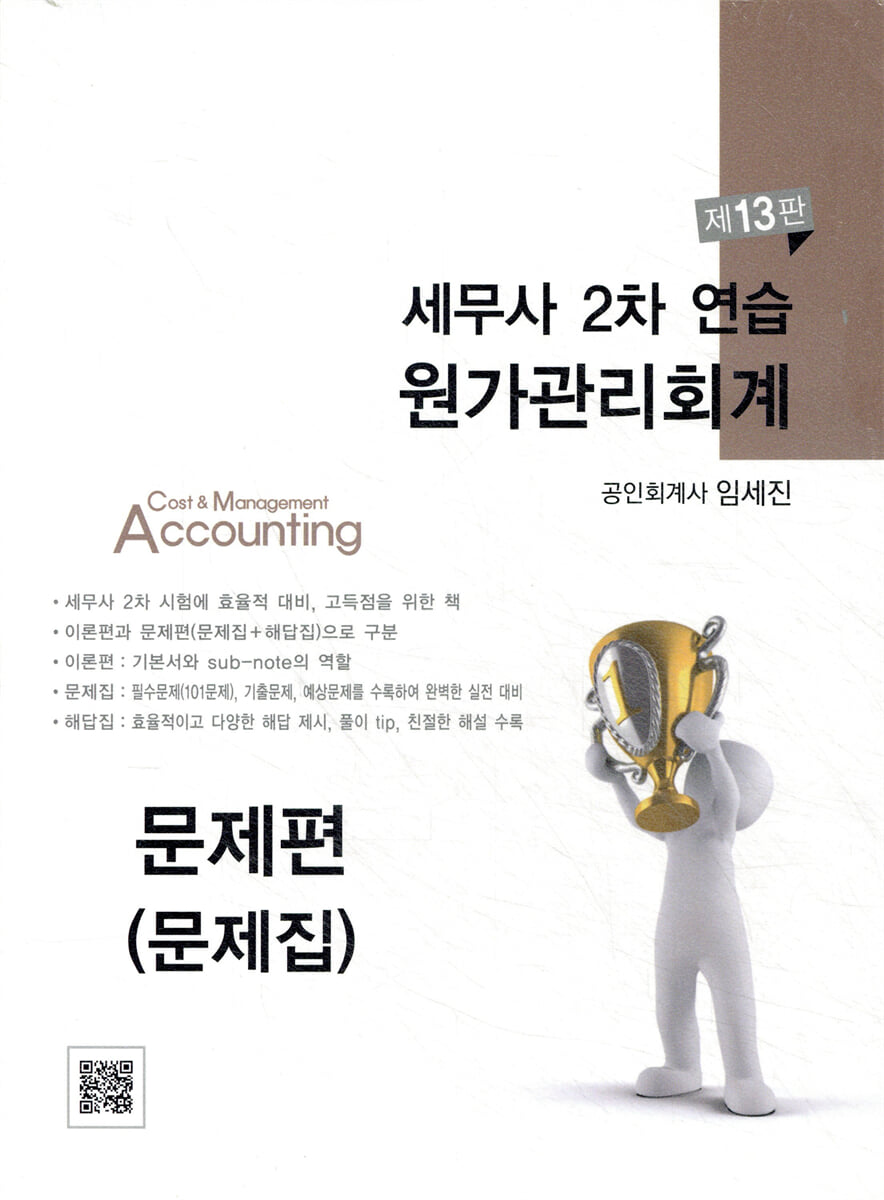
Certified Public Tax Accountant 2nd Practice Cost Management Accounting
 |
Description
Book Introduction
In the 13th edition, many problems have been added to reflect recent exam trends, and the theory section has been strengthened to make it easier to understand important content.
Publisher's Review
As I was preparing for the 13th edition, I looked back on my life as a test taker.
And I thought about what kind of books students would need.
A book that will help you prepare for the second tax accountant exam efficiently and most reliably.
In the 13th edition, many problems have been added to reflect recent exam trends, and the theory section has been strengthened to make it easier to understand important content.
The following are the key points that were highlighted in the 13th edition:
1.
Book structure: divided into theory and problem sections (problem book and answer book)
The theory section, which organizes the theory, and the problem section, which prepares for the actual exam through problem solving, are separate volumes. The problem section is divided into a problem book and an answer book.
2.
Theory
⑴ Theory Summary: Efficient organization of content required for the second exam and serving as a basic textbook
One of the reasons why you may not get a good score on the second test is because you studied the textbook too superficially.
The importance of the textbook cannot be overemphasized, but it is realistically very difficult to review it again when preparing for the second exam.
Considering the difficulties faced by test takers, all the theories required for the second exam were systematically and easily reflected in the theory section.
It will be sufficient preparation for both computational and descriptive problems.
⑵ Showing examples and related problems: Systematic approach to highlighting key content and practice problems
We have included various examples to help you grasp the important content and approach practice problems more easily.
In cases where examples cannot be included due to space limitations, the related problem numbers are listed next to the title. Solving the related problems will help you organize the important content.
⑶ Figures and tables: visualization of content
Numerous figures and tables were used to visually organize the theory.
⑷ Plus study: Associative learning and three-dimensional organization
Detailed information and other topics and problem solving related to the Plus study were included to enable related learning and to organize the content in a three-dimensional manner.
⑸ Exam trend: Understanding the importance of the exam
The characteristics of the previous exam questions, the year of the exam, and the questions are all listed on the first page of each chapter, allowing you to understand the importance of each chapter and the content emphasized in the previous exam questions.
3.
Problem section
⑴ Significantly improved practice problems: Includes a variety of problems that could appear on the exam.
In line with recent testing trends, we have significantly strengthened the variety of questions required for the second test.
Also, as in the previous version, the problem titles are written in the answer key rather than next to the problem to help you develop a sense of reality.
⑵ Previous Exam Questions: A guide to understanding exam trends and preparing for the exam
Since past exam questions are the most important guide for exam preparation, most of the important questions from past exam questions after 2000 are included.
⑶ Descriptive questions
Although descriptive questions are included in the practice problems, descriptive questions are also included separately to ensure thorough preparation for descriptive questions.
⑷ Separate answer book
To ensure that students feel like they are actually solving a problem and to prevent them from unconsciously referencing the answers, we have included a separate answer booklet.
⑸ Practical Answer: Efficient Answer
We have simplified the answers as much as possible so that they can be used as answers in actual exams.
Any parts not explained in the answer are explained in detail in the commentary.
⑹ Solution Tip
In practice, if you don't remember the points related to solving the problem after receiving the problem, it is difficult to write an accurate answer within the time limit.
We have included a solution tip in the answer so that you can think in advance about what the core of the problem is and how to write the answer.
⑺ Required questions and difficulty levels are indicated in the answer booklet.
Essential questions (important questions) are marked with ★, and the difficulty level is indicated as easy, medium, and easy.
4.
How to use this book
⑴ Essential questions
If you don't have much time during the study period, we recommend focusing on the examples and essential problems (there is a separate list at the front of the workbook, and the table of contents and answer book numbers are marked with a ★).
During the grace period, I hope to improve my application skills by solving various problems other than the required problems.
When you are unable to solve a problem and need to refer to the solution, it is recommended to first refer to the solution tips to plan out the answer in advance.
⑵ Summary of the relationship between theory and problem
After studying the theory, organize it with examples, solve practice problems, and then organize the theory again.
Your problem-solving skills and application skills will be greatly improved.
Test takers who are already familiar with the theory will be able to study more efficiently by using the problem section instead of looking at the theory section.
And I thought about what kind of books students would need.
A book that will help you prepare for the second tax accountant exam efficiently and most reliably.
In the 13th edition, many problems have been added to reflect recent exam trends, and the theory section has been strengthened to make it easier to understand important content.
The following are the key points that were highlighted in the 13th edition:
1.
Book structure: divided into theory and problem sections (problem book and answer book)
The theory section, which organizes the theory, and the problem section, which prepares for the actual exam through problem solving, are separate volumes. The problem section is divided into a problem book and an answer book.
2.
Theory
⑴ Theory Summary: Efficient organization of content required for the second exam and serving as a basic textbook
One of the reasons why you may not get a good score on the second test is because you studied the textbook too superficially.
The importance of the textbook cannot be overemphasized, but it is realistically very difficult to review it again when preparing for the second exam.
Considering the difficulties faced by test takers, all the theories required for the second exam were systematically and easily reflected in the theory section.
It will be sufficient preparation for both computational and descriptive problems.
⑵ Showing examples and related problems: Systematic approach to highlighting key content and practice problems
We have included various examples to help you grasp the important content and approach practice problems more easily.
In cases where examples cannot be included due to space limitations, the related problem numbers are listed next to the title. Solving the related problems will help you organize the important content.
⑶ Figures and tables: visualization of content
Numerous figures and tables were used to visually organize the theory.
⑷ Plus study: Associative learning and three-dimensional organization
Detailed information and other topics and problem solving related to the Plus study were included to enable related learning and to organize the content in a three-dimensional manner.
⑸ Exam trend: Understanding the importance of the exam
The characteristics of the previous exam questions, the year of the exam, and the questions are all listed on the first page of each chapter, allowing you to understand the importance of each chapter and the content emphasized in the previous exam questions.
3.
Problem section
⑴ Significantly improved practice problems: Includes a variety of problems that could appear on the exam.
In line with recent testing trends, we have significantly strengthened the variety of questions required for the second test.
Also, as in the previous version, the problem titles are written in the answer key rather than next to the problem to help you develop a sense of reality.
⑵ Previous Exam Questions: A guide to understanding exam trends and preparing for the exam
Since past exam questions are the most important guide for exam preparation, most of the important questions from past exam questions after 2000 are included.
⑶ Descriptive questions
Although descriptive questions are included in the practice problems, descriptive questions are also included separately to ensure thorough preparation for descriptive questions.
⑷ Separate answer book
To ensure that students feel like they are actually solving a problem and to prevent them from unconsciously referencing the answers, we have included a separate answer booklet.
⑸ Practical Answer: Efficient Answer
We have simplified the answers as much as possible so that they can be used as answers in actual exams.
Any parts not explained in the answer are explained in detail in the commentary.
⑹ Solution Tip
In practice, if you don't remember the points related to solving the problem after receiving the problem, it is difficult to write an accurate answer within the time limit.
We have included a solution tip in the answer so that you can think in advance about what the core of the problem is and how to write the answer.
⑺ Required questions and difficulty levels are indicated in the answer booklet.
Essential questions (important questions) are marked with ★, and the difficulty level is indicated as easy, medium, and easy.
4.
How to use this book
⑴ Essential questions
If you don't have much time during the study period, we recommend focusing on the examples and essential problems (there is a separate list at the front of the workbook, and the table of contents and answer book numbers are marked with a ★).
During the grace period, I hope to improve my application skills by solving various problems other than the required problems.
When you are unable to solve a problem and need to refer to the solution, it is recommended to first refer to the solution tips to plan out the answer in advance.
⑵ Summary of the relationship between theory and problem
After studying the theory, organize it with examples, solve practice problems, and then organize the theory again.
Your problem-solving skills and application skills will be greatly improved.
Test takers who are already familiar with the theory will be able to study more efficiently by using the problem section instead of looking at the theory section.
GOODS SPECIFICS
- Date of issue: October 30, 2024
- Page count, weight, size: 1,249 pages | 188*257*44mm
- ISBN13: 9791161220895
- ISBN10: 1161220895
You may also like
카테고리
korean


korean

![GQ KOREA Mark (Monthly): December [2025]](http://librairie.coreenne.fr/cdn/shop/files/8ef265dbbfbf186523ed75ba7319009d.jpg?v=1765340328&width=3840)


