

Principia
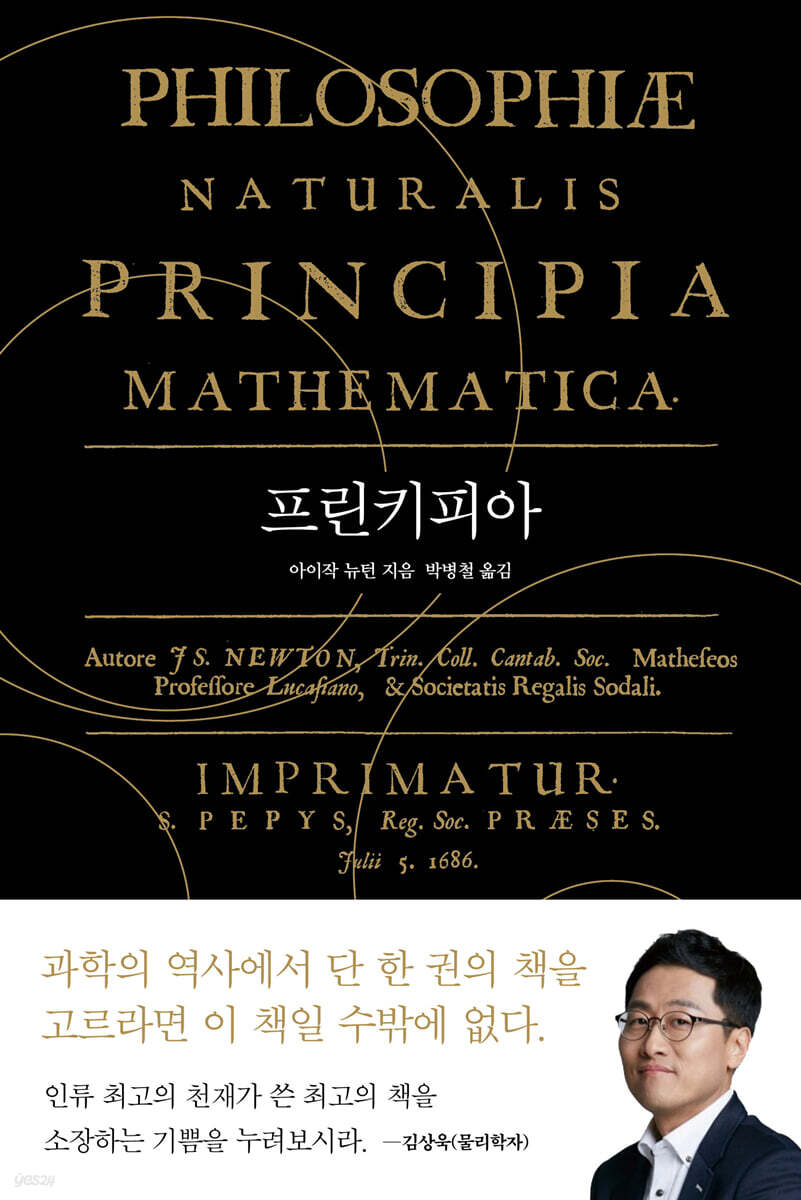 |
Description
Book Introduction
“If I had to choose just one book in the history of science, it would have to be this one.”
The science enthusiast's bible, Newton's Principia, has been published in Korean!
The great scientist Isaac Newton's Principia is a book that made an overwhelming contribution to the scientific revolution and the subsequent development of modern science.
Principia, which laid the foundation for classical mechanics, presented scientific research methods, and laid the cornerstone of modern civilization, can be said to be a book that literally changed the history of mankind.
This book is a complete translation of the original three-volume book, published in a modern design, and introduces the Principia through the accurate and fluent translation of theoretical physicist Park Byeong-cheol, who is trusted and loved by science readers.
The science enthusiast's bible, Newton's Principia, has been published in Korean!
The great scientist Isaac Newton's Principia is a book that made an overwhelming contribution to the scientific revolution and the subsequent development of modern science.
Principia, which laid the foundation for classical mechanics, presented scientific research methods, and laid the cornerstone of modern civilization, can be said to be a book that literally changed the history of mankind.
This book is a complete translation of the original three-volume book, published in a modern design, and introduces the Principia through the accurate and fluent translation of theoretical physicist Park Byeong-cheol, who is trusted and loved by science readers.
- You can preview some of the book's contents.
Preview
index
Preface to the first edition
Author's Preface to the 2nd Edition
Editor's Preface to the Second Edition
Author's Preface to the 3rd Edition
definition
Axioms: Laws of Motion
Book 1: Motion of Bodies
Chapter 1 Proving the theorem using the ratio of the beginning and the end
Chapter 2 Centripetal Force
Chapter 3 Objects that draw conic sections
Chapter 4: Calculating Elliptic, Parabolic, and Hyperbolic Orbits Corresponding to a Given Focus
Chapter 5: Finding the trajectory of an object when no focus is given
Chapter 6 Motion of an Object Following a Given Trajectory
Chapter 7 Objects that draw straight trajectories
Chapter 8: The trajectory of an object when centripetal force acts
Chapter 9: Motion of bodies in moving orbits and the movement of perihelion and aphelion
Chapter 10: Objects Moving in a Given Plane and Simple Pendulum Motion
Chapter 11: Motion of Objects Attracting Each Other
Chapter 12 The Gravitational Forces of Spherical Objects
Chapter 13: The Gravitational Forces of Non-Spherical Bodies
Chapter 14: Motion of small objects due to centripetal force exerted by various parts of large objects
Book 2: Motion of Bodies
Chapter 1 Motion of an object subject to resistance proportional to its speed
Chapter 2 Motion of an object subject to a force proportional to the square of its velocity
Chapter 3 Motion of an object subject to both a resistive force proportional to its velocity and a resistive force proportional to the square of its velocity.
Chapter 4 Circular motion in a resistive medium
Chapter 5 Fluid Statics: Density and Compressibility of Fluids
Chapter 6 Motion of a Simple Pendulum Subjected to Resistance
Chapter 7 Motion of Fluids and Resistance of Projectiles Moving in Fluids
Chapter 8 Motion Transmitted Through Fluids
Chapter 9 Rotational Motion of Fluids
Volume 3: The Structure of the Solar System
Chapter 1: Rules to be observed when developing logic in natural philosophy
Chapter 2 Natural Phenomena
Chapter 3 Proposition
Chapter 4 General Description
Translator's Note
Search
Author's Preface to the 2nd Edition
Editor's Preface to the Second Edition
Author's Preface to the 3rd Edition
definition
Axioms: Laws of Motion
Book 1: Motion of Bodies
Chapter 1 Proving the theorem using the ratio of the beginning and the end
Chapter 2 Centripetal Force
Chapter 3 Objects that draw conic sections
Chapter 4: Calculating Elliptic, Parabolic, and Hyperbolic Orbits Corresponding to a Given Focus
Chapter 5: Finding the trajectory of an object when no focus is given
Chapter 6 Motion of an Object Following a Given Trajectory
Chapter 7 Objects that draw straight trajectories
Chapter 8: The trajectory of an object when centripetal force acts
Chapter 9: Motion of bodies in moving orbits and the movement of perihelion and aphelion
Chapter 10: Objects Moving in a Given Plane and Simple Pendulum Motion
Chapter 11: Motion of Objects Attracting Each Other
Chapter 12 The Gravitational Forces of Spherical Objects
Chapter 13: The Gravitational Forces of Non-Spherical Bodies
Chapter 14: Motion of small objects due to centripetal force exerted by various parts of large objects
Book 2: Motion of Bodies
Chapter 1 Motion of an object subject to resistance proportional to its speed
Chapter 2 Motion of an object subject to a force proportional to the square of its velocity
Chapter 3 Motion of an object subject to both a resistive force proportional to its velocity and a resistive force proportional to the square of its velocity.
Chapter 4 Circular motion in a resistive medium
Chapter 5 Fluid Statics: Density and Compressibility of Fluids
Chapter 6 Motion of a Simple Pendulum Subjected to Resistance
Chapter 7 Motion of Fluids and Resistance of Projectiles Moving in Fluids
Chapter 8 Motion Transmitted Through Fluids
Chapter 9 Rotational Motion of Fluids
Volume 3: The Structure of the Solar System
Chapter 1: Rules to be observed when developing logic in natural philosophy
Chapter 2 Natural Phenomena
Chapter 3 Proposition
Chapter 4 General Description
Translator's Note
Search
Detailed image

Publisher's Review
1.
Meet the classics of science that shaped modern civilization.
- Newton's great idea that set the standard for modern science
In the 17th century, when Newton was active, there was no methodology called 'science' in the strict sense, and 'natural philosophy', which took its place, attempted to explore the principles of nature through only conjecture and assumption.
In this atmosphere, Newton used rigorous mathematical methodology to perfectly describe the movements of the natural world in formulas.
『Principia』 is a work that compiles Newtonian mechanics.
Newton's mathematical methodology, realized in the Principia, has cast a huge shadow over modern science as a 'standard' symbolizing science since the modern era.
Book 1 of the Principia describes the various motions that can occur in an inertial frame, Book 2 describes the motion of bodies moving in space or a medium with resistance, and Book 3 observes and interprets the motions of planets and satellites.
The laws that form the basis of classical mechanics, such as the laws of motion and the law of gravitation, as well as the mathematical proof of Kepler's laws of planetary motion and the proof of the inverse square law of gravity through astronomical observation, are all introduced in the Principia.
As is widely known, Newtonian mechanics forms the basis of classical physics and has contributed to the advancement of science.
Moreover, the law of gravitation became the basis for Einstein's general theory of relativity 250 years later, and it still maintains its noble form even after the advent of quantum mechanics, so Newton's theory is not an outdated science, but is still alive and breathing with us.
Logical mechanics can be said to be the science of expressing motion caused by arbitrary forces and the forces that cause arbitrary motion by precise propositions and proofs.
The ancients studied these dynamics by classifying them into the “five mechanical forces,” but since gravity was not an artificial force, they did not pay much attention to it except when moving heavy objects with the five forces.
However, since our current interest is not in artifacts or artificial forces, but in natural philosophy and the forces of nature, this book will mainly deal with attractive and repulsive forces such as gravity, buoyancy, elasticity, and fluid resistance.
In other words, this book can be said to be the starting point of “mathematical principles of natural philosophy.”
This is because the essence of natural philosophy is to discover power from natural phenomena (motion) and to explain other phenomena from that power.
So, in Volumes 1 and 2, we will prove general propositions, and in Volume 3, we will explain the system of the world using these propositions.
(Omitted) I hope readers will read this book with an open mind and perseverance.
If you find an error along the way, please don't scold me too harshly, but find the correct answer and let me know.
- From the author's preface to the first edition (pp. 9-11)
Natural philosophy based on experiment and observation is the best means of understanding nature.
And our outstanding author, Newton, shed the light of wisdom by capturing the essence of this natural philosophy in three books.
He is the greatest genius who has solved the most difficult problems by transcending human limitations, and he is also the greatest natural philosopher who is praised by experts in this field.
Now we can freely pass through the door that Newton opened wide and enjoy the beautiful and mysterious world of nature to our hearts' content.
- From the 〈Editor's Preface to the 2nd Edition〉 (pp. 34-35)
First Law: Every object tends to remain at rest or in uniform straight line motion unless acted upon by an external force.
Second Law: The amount by which a body changes its state of motion is proportional to the force applied to it, and the direction of the change is the same as the direction in which the force is applied.
Third Law: For every action (force), there is an equal and opposite reaction (reaction).
In other words, the forces exchanged between two objects are always equal in magnitude and opposite in direction.
- From "Axioms: The Laws of Motion" (pp. 67-78)
2.
Translator Park Byeong-cheol's bucket list, the Korean edition of "Principia"
- Achievements in Korean scientific publishing achieved after 30 years of preparation and 3 years of translation.
Theoretical physicist Dr. Park Byeong-cheol is renowned as the most trusted translator among science readers.
Numerous science books that shook the publishing world since the late 1990s, including 『End of Time』, 『The Elegant Universe』, 『Feynman Lectures on Physics』, 『Fermat's Last Theorem』, and 『The God Particle』, were published by him.
He has earned the deep trust and love of readers thanks to his discerning eye for good books, his precise and elegant writing style, and his diligence in consistently publishing over 100 translated works.
In bookstores, the phrase "Translated by Park Byeong-cheol" has become a brand symbolizing useful science books translated into understandable Korean.
Dr. Park Byeong-cheol, who encountered 『Principia』 during his school days, confesses that translating this book was on his ‘bucket list.’
More than 30 years later, he had become an experienced and skilled scientific translator, but even for him, translating the Principia was still incredibly difficult.
17th century mathematical notation was very different from today, and there were cases where there were no appropriate Korean terms to describe celestial movements.
The biggest problem, above all, was that there was a lot of information omitted from Newton's proof.
Because of this, I had to follow Newton's footsteps for over three years, digging into complex logic and boldly omitted proofs.
Having finally completed this difficult and important task, he says he earnestly hopes that science readers will feel the same sense of accomplishment as he did when reading the Principia.
I advise that if you calmly follow the main propositions and summaries, accompanied by the translator's note that guides the reading at the right time and place, you will soon be able to grasp the overall content of the book and Newton's thoughts contained within it.
When I was a student, I tried reading the English version of 『Principia』, but gave up after a few days.
It was partly because English was difficult, but the biggest reason was because it was so different from the classical mechanics I had learned in school.
It was a natural consequence of driving on a smooth paved road instead of a smooth paved road in my car, so I took an ox cart and entered a gravel road.
However, introducing the prototype of classical mechanics, which became the cornerstone of modern civilization, was as meaningful as translating scriptures for religious people, so translating the Principia was added to my bucket list, and I finally reached my destination after three changes in the world.
Most of the time, I had to write down complex logic in words without equations, and there were many parts where the mathematical notation was different from today, so it was a lot of work, but I feel so proud now that I don't want to express it with the obvious word 'rewarding'.
Since Newton, classical mechanics has been refined beyond recognition through the hands of countless physicists, so if you want to study classical mechanics, it would be much better to study from the textbooks they wrote rather than the Principia.
However, for readers who value the originality and antiquity of the original, it is worth a try.
It doesn't matter if you don't read it all.
Aren't there only a handful of people who have read the scriptures from beginning to end?
- A word from Park Byeong-cheol, translator of Principia
3.
A very special design that reinterprets a classic with a modern sensibility.
- A first edition design that perfectly matches the value of 『Principia』
The newly published 『Principia』 combines the original three-volume text into one book, providing a complete introduction to Newton's theory.
The 'Brick Book', which has a total of 960 pages, was produced with a sturdy four-season binding so that it can be kept by your side and read for a long time.
As physicist Professor Kim Sang-wook said, 『Principia』 arouses the desire of bibliophiles to own it, giving them “the joy of owning the best book written by the greatest genius of mankind.”
In addition, the unique design utilizing the first edition of the original book will provide readers of 『Principia』 with additional collection value.
Translator Interview
- “Unless the universe is rebooted, Newtonian physics will remain forever.”
(1) It seems that your name has appeared most frequently in major science books that have swept the publishing world since the late 1990s.
Park Byeong-cheol's translation was nothing short of a 'science book you must read now.'
That's why your translation of Principia is so special.
As a translator and a scientist, what does translating the Principia mean to you?
For me, 『Principia』 was not a book I ‘wanted to read at least once’, but rather a book I ‘wanted to understand.’
When I first encountered this book in my school days, I was overwhelmed by the 300-year-old English (the English translation of the Principia was published in the early 1700s) and Newton's fame, so I gave up after the first quarter, but it always stayed in my mind even after I graduated.
Perhaps a guitar enthusiast wants to master Paganini's 24 Caprices? They say the most profound way to understand a given piece of music is to "teach it to others."
Books are similar, so I thought the best way to understand the original text was to translate it.
However, 『Principia』 is full of mathematical logic, so it is not suitable for translators who are accustomed to essay-style sentences, and it is not easy for physicists to find time for it due to their busy research and lecture schedules.
Therefore, the most appropriate person to translate this book would be a 'retired physicist with translation experience.'
Someone just like me.
For me, translating 『Principia』 was a must-do and one of the top three things on my life bucket list.
(2) I was impressed by the fact that in the translator's note, the Principia was likened to the Bible.
As you said, this book could be called the 'Bible of the scientific world.'
What is the value of the Principia, and what influence has it had on science and human history?
It would not be an exaggeration to say that half of the modern civilization that emerged after the Middle Ages was born from the Principia.
Newton's message can be summarized in two points:
'The laws of nature apply equally throughout the universe' and 'the laws are expressed in mathematics'.
It clearly outlines the methods and limitations of inquiry across the sciences, not only in physics but also in chemistry, earth science, astronomy, and engineering.
The knowledge that NASA and the Korea Aerospace Research Institute need to launch space rockets is not quantum mechanics or relativity, but Newtonian mechanics.
No matter how mysterious and counterintuitive the microscopic world may be, the macroscopic world, made up of atoms and molecules, precisely follows Newton's laws.
Unless our universe reboots and is reborn anew, Newtonian physics will remain in its current state forever.
(3) This work was not easy, as it took you over three years to dedicate yourself to translation.
I'm curious as to what difficulties you faced during the translation process.
I had a really hard time putting together the scattered sentences in prose form to create a mathematical atmosphere.
Using modern mathematical notation, what would be a line or two would be explained in a somewhat lengthy, everyday language, and many presumptuous techniques were used to create a mathematical atmosphere.
Of course, I did not edit or forcibly abbreviate the original text.
Also, the 17th century mathematical notation was different from today's, and there were no appropriate terms in Korean for describing the movements of stars and planets, so I made some up as an improvisation.
But the most absurd thing of all was when I was so focused on translating a proposition that I reached 'QED (Proof Ended)', but I couldn't figure out what had been proven.
No matter how much I looked at the sentence, there was nothing missing in the translation, but to my eyes, it didn't look like proof at all.
In such cases, I had to stop translating and trace the omitted steps until I was convinced, which caused a lot of delay in the translation schedule.
(4) On the other hand, could you tell us about the most memorable moment during the translation process, the moment when you felt the greatest sense of accomplishment?
I felt the greatest sense of accomplishment when I recovered an intermediate step that had been omitted from a seemingly random proof.
Every time something like this happened, I would hit my knee and smile in satisfaction.
However, I stopped because I thought that if I had translated the intermediate processes one by one, the book would have been more than twice as long.
Although I felt a sense of accomplishment from this, I was actually secretly resenting Newton.
It was because I had a strong feeling that it was written in a difficult way on purpose, when it could have been written in a much easier and more friendly way.
When the Principia was first published, the Cambridge professors and students who read it must have felt similarly to me.
Bernard Cohen's English translation includes a translator's note at the beginning, which accounts for 40% of the total volume including the main text.
However, since my goal was to faithfully present the original, I only included a brief explanation in the translator's note.
Because I want my readers to feel a similar sense of accomplishment as I do.
(5) For three years, he wrestled with Newton's sentences and formulas, thoroughly examining his thoughts.
What kind of person is Newton as seen by the translator of the Principia?
As I wrote in the translator's note, before Newton was a great physicist, he was "a monster among monsters, who could effortlessly use mathematical logic so complex and dense that it was jaw-dropping."
The physicist I most admire and respect has always been Newton, but I felt a little awkward while translating the Principia.
It feels natural that he lived his entire life alone, without any close friends or a wife.
People often say, “Don’t be afraid of mistakes,” but geniuses who think carefully and meticulously rarely make mistakes.
To be more precise, a true genius can accurately foresee the future and avoid doing things he will regret.
I think Newton was just that kind of person.
It's about accurately understanding your own tendencies, abilities, and limitations, and not stepping into areas that fall outside of those boundaries.
And one more thing, geniuses become infinitely helpless in fields outside their specialty, but the geniuses among geniuses do not.
Newton, who made various achievements not only in physics but also in theology, alchemy, and politics (National Assembly, Mint), proves this fact.
(6) 『Principia』 is a very important book, but it is very difficult for general readers who are not researchers to read.
How can the general reader use this book?
As you all know, 『Principia』 is not a general textbook for the general reader.
At the time of its publication, it was the most difficult book even for physicists.
But now, 350 years later, specialized knowledge has become so widespread that it's become acceptable to publish such a formidable book as a textbook.
For science-loving readers, the Principia is certainly a book worth owning, but it is too good a book to be left as a mere decoration.
For readers who want to get the most out of their reading with the least effort, I recommend the "stepping stone reading" method.
Rather than trying to follow the intermediate steps one by one, just familiarize yourself with the results of each proposition/theorem and move on to the next step.
If we list the results of each proposition in order, we can see at a glance what Newton was trying to say and what conclusion he was moving toward.
If there are any propositions you are curious about, you can take some time later to defeat them one by one.
Please note that the difficulty of propositions varies greatly; some can be understood immediately, others take hours, and sometimes even days or weeks.
Good luck, readers!
Meet the classics of science that shaped modern civilization.
- Newton's great idea that set the standard for modern science
In the 17th century, when Newton was active, there was no methodology called 'science' in the strict sense, and 'natural philosophy', which took its place, attempted to explore the principles of nature through only conjecture and assumption.
In this atmosphere, Newton used rigorous mathematical methodology to perfectly describe the movements of the natural world in formulas.
『Principia』 is a work that compiles Newtonian mechanics.
Newton's mathematical methodology, realized in the Principia, has cast a huge shadow over modern science as a 'standard' symbolizing science since the modern era.
Book 1 of the Principia describes the various motions that can occur in an inertial frame, Book 2 describes the motion of bodies moving in space or a medium with resistance, and Book 3 observes and interprets the motions of planets and satellites.
The laws that form the basis of classical mechanics, such as the laws of motion and the law of gravitation, as well as the mathematical proof of Kepler's laws of planetary motion and the proof of the inverse square law of gravity through astronomical observation, are all introduced in the Principia.
As is widely known, Newtonian mechanics forms the basis of classical physics and has contributed to the advancement of science.
Moreover, the law of gravitation became the basis for Einstein's general theory of relativity 250 years later, and it still maintains its noble form even after the advent of quantum mechanics, so Newton's theory is not an outdated science, but is still alive and breathing with us.
Logical mechanics can be said to be the science of expressing motion caused by arbitrary forces and the forces that cause arbitrary motion by precise propositions and proofs.
The ancients studied these dynamics by classifying them into the “five mechanical forces,” but since gravity was not an artificial force, they did not pay much attention to it except when moving heavy objects with the five forces.
However, since our current interest is not in artifacts or artificial forces, but in natural philosophy and the forces of nature, this book will mainly deal with attractive and repulsive forces such as gravity, buoyancy, elasticity, and fluid resistance.
In other words, this book can be said to be the starting point of “mathematical principles of natural philosophy.”
This is because the essence of natural philosophy is to discover power from natural phenomena (motion) and to explain other phenomena from that power.
So, in Volumes 1 and 2, we will prove general propositions, and in Volume 3, we will explain the system of the world using these propositions.
(Omitted) I hope readers will read this book with an open mind and perseverance.
If you find an error along the way, please don't scold me too harshly, but find the correct answer and let me know.
- From the author's preface to the first edition (pp. 9-11)
Natural philosophy based on experiment and observation is the best means of understanding nature.
And our outstanding author, Newton, shed the light of wisdom by capturing the essence of this natural philosophy in three books.
He is the greatest genius who has solved the most difficult problems by transcending human limitations, and he is also the greatest natural philosopher who is praised by experts in this field.
Now we can freely pass through the door that Newton opened wide and enjoy the beautiful and mysterious world of nature to our hearts' content.
- From the 〈Editor's Preface to the 2nd Edition〉 (pp. 34-35)
First Law: Every object tends to remain at rest or in uniform straight line motion unless acted upon by an external force.
Second Law: The amount by which a body changes its state of motion is proportional to the force applied to it, and the direction of the change is the same as the direction in which the force is applied.
Third Law: For every action (force), there is an equal and opposite reaction (reaction).
In other words, the forces exchanged between two objects are always equal in magnitude and opposite in direction.
- From "Axioms: The Laws of Motion" (pp. 67-78)
2.
Translator Park Byeong-cheol's bucket list, the Korean edition of "Principia"
- Achievements in Korean scientific publishing achieved after 30 years of preparation and 3 years of translation.
Theoretical physicist Dr. Park Byeong-cheol is renowned as the most trusted translator among science readers.
Numerous science books that shook the publishing world since the late 1990s, including 『End of Time』, 『The Elegant Universe』, 『Feynman Lectures on Physics』, 『Fermat's Last Theorem』, and 『The God Particle』, were published by him.
He has earned the deep trust and love of readers thanks to his discerning eye for good books, his precise and elegant writing style, and his diligence in consistently publishing over 100 translated works.
In bookstores, the phrase "Translated by Park Byeong-cheol" has become a brand symbolizing useful science books translated into understandable Korean.
Dr. Park Byeong-cheol, who encountered 『Principia』 during his school days, confesses that translating this book was on his ‘bucket list.’
More than 30 years later, he had become an experienced and skilled scientific translator, but even for him, translating the Principia was still incredibly difficult.
17th century mathematical notation was very different from today, and there were cases where there were no appropriate Korean terms to describe celestial movements.
The biggest problem, above all, was that there was a lot of information omitted from Newton's proof.
Because of this, I had to follow Newton's footsteps for over three years, digging into complex logic and boldly omitted proofs.
Having finally completed this difficult and important task, he says he earnestly hopes that science readers will feel the same sense of accomplishment as he did when reading the Principia.
I advise that if you calmly follow the main propositions and summaries, accompanied by the translator's note that guides the reading at the right time and place, you will soon be able to grasp the overall content of the book and Newton's thoughts contained within it.
When I was a student, I tried reading the English version of 『Principia』, but gave up after a few days.
It was partly because English was difficult, but the biggest reason was because it was so different from the classical mechanics I had learned in school.
It was a natural consequence of driving on a smooth paved road instead of a smooth paved road in my car, so I took an ox cart and entered a gravel road.
However, introducing the prototype of classical mechanics, which became the cornerstone of modern civilization, was as meaningful as translating scriptures for religious people, so translating the Principia was added to my bucket list, and I finally reached my destination after three changes in the world.
Most of the time, I had to write down complex logic in words without equations, and there were many parts where the mathematical notation was different from today, so it was a lot of work, but I feel so proud now that I don't want to express it with the obvious word 'rewarding'.
Since Newton, classical mechanics has been refined beyond recognition through the hands of countless physicists, so if you want to study classical mechanics, it would be much better to study from the textbooks they wrote rather than the Principia.
However, for readers who value the originality and antiquity of the original, it is worth a try.
It doesn't matter if you don't read it all.
Aren't there only a handful of people who have read the scriptures from beginning to end?
- A word from Park Byeong-cheol, translator of Principia
3.
A very special design that reinterprets a classic with a modern sensibility.
- A first edition design that perfectly matches the value of 『Principia』
The newly published 『Principia』 combines the original three-volume text into one book, providing a complete introduction to Newton's theory.
The 'Brick Book', which has a total of 960 pages, was produced with a sturdy four-season binding so that it can be kept by your side and read for a long time.
As physicist Professor Kim Sang-wook said, 『Principia』 arouses the desire of bibliophiles to own it, giving them “the joy of owning the best book written by the greatest genius of mankind.”
In addition, the unique design utilizing the first edition of the original book will provide readers of 『Principia』 with additional collection value.
Translator Interview
- “Unless the universe is rebooted, Newtonian physics will remain forever.”
(1) It seems that your name has appeared most frequently in major science books that have swept the publishing world since the late 1990s.
Park Byeong-cheol's translation was nothing short of a 'science book you must read now.'
That's why your translation of Principia is so special.
As a translator and a scientist, what does translating the Principia mean to you?
For me, 『Principia』 was not a book I ‘wanted to read at least once’, but rather a book I ‘wanted to understand.’
When I first encountered this book in my school days, I was overwhelmed by the 300-year-old English (the English translation of the Principia was published in the early 1700s) and Newton's fame, so I gave up after the first quarter, but it always stayed in my mind even after I graduated.
Perhaps a guitar enthusiast wants to master Paganini's 24 Caprices? They say the most profound way to understand a given piece of music is to "teach it to others."
Books are similar, so I thought the best way to understand the original text was to translate it.
However, 『Principia』 is full of mathematical logic, so it is not suitable for translators who are accustomed to essay-style sentences, and it is not easy for physicists to find time for it due to their busy research and lecture schedules.
Therefore, the most appropriate person to translate this book would be a 'retired physicist with translation experience.'
Someone just like me.
For me, translating 『Principia』 was a must-do and one of the top three things on my life bucket list.
(2) I was impressed by the fact that in the translator's note, the Principia was likened to the Bible.
As you said, this book could be called the 'Bible of the scientific world.'
What is the value of the Principia, and what influence has it had on science and human history?
It would not be an exaggeration to say that half of the modern civilization that emerged after the Middle Ages was born from the Principia.
Newton's message can be summarized in two points:
'The laws of nature apply equally throughout the universe' and 'the laws are expressed in mathematics'.
It clearly outlines the methods and limitations of inquiry across the sciences, not only in physics but also in chemistry, earth science, astronomy, and engineering.
The knowledge that NASA and the Korea Aerospace Research Institute need to launch space rockets is not quantum mechanics or relativity, but Newtonian mechanics.
No matter how mysterious and counterintuitive the microscopic world may be, the macroscopic world, made up of atoms and molecules, precisely follows Newton's laws.
Unless our universe reboots and is reborn anew, Newtonian physics will remain in its current state forever.
(3) This work was not easy, as it took you over three years to dedicate yourself to translation.
I'm curious as to what difficulties you faced during the translation process.
I had a really hard time putting together the scattered sentences in prose form to create a mathematical atmosphere.
Using modern mathematical notation, what would be a line or two would be explained in a somewhat lengthy, everyday language, and many presumptuous techniques were used to create a mathematical atmosphere.
Of course, I did not edit or forcibly abbreviate the original text.
Also, the 17th century mathematical notation was different from today's, and there were no appropriate terms in Korean for describing the movements of stars and planets, so I made some up as an improvisation.
But the most absurd thing of all was when I was so focused on translating a proposition that I reached 'QED (Proof Ended)', but I couldn't figure out what had been proven.
No matter how much I looked at the sentence, there was nothing missing in the translation, but to my eyes, it didn't look like proof at all.
In such cases, I had to stop translating and trace the omitted steps until I was convinced, which caused a lot of delay in the translation schedule.
(4) On the other hand, could you tell us about the most memorable moment during the translation process, the moment when you felt the greatest sense of accomplishment?
I felt the greatest sense of accomplishment when I recovered an intermediate step that had been omitted from a seemingly random proof.
Every time something like this happened, I would hit my knee and smile in satisfaction.
However, I stopped because I thought that if I had translated the intermediate processes one by one, the book would have been more than twice as long.
Although I felt a sense of accomplishment from this, I was actually secretly resenting Newton.
It was because I had a strong feeling that it was written in a difficult way on purpose, when it could have been written in a much easier and more friendly way.
When the Principia was first published, the Cambridge professors and students who read it must have felt similarly to me.
Bernard Cohen's English translation includes a translator's note at the beginning, which accounts for 40% of the total volume including the main text.
However, since my goal was to faithfully present the original, I only included a brief explanation in the translator's note.
Because I want my readers to feel a similar sense of accomplishment as I do.
(5) For three years, he wrestled with Newton's sentences and formulas, thoroughly examining his thoughts.
What kind of person is Newton as seen by the translator of the Principia?
As I wrote in the translator's note, before Newton was a great physicist, he was "a monster among monsters, who could effortlessly use mathematical logic so complex and dense that it was jaw-dropping."
The physicist I most admire and respect has always been Newton, but I felt a little awkward while translating the Principia.
It feels natural that he lived his entire life alone, without any close friends or a wife.
People often say, “Don’t be afraid of mistakes,” but geniuses who think carefully and meticulously rarely make mistakes.
To be more precise, a true genius can accurately foresee the future and avoid doing things he will regret.
I think Newton was just that kind of person.
It's about accurately understanding your own tendencies, abilities, and limitations, and not stepping into areas that fall outside of those boundaries.
And one more thing, geniuses become infinitely helpless in fields outside their specialty, but the geniuses among geniuses do not.
Newton, who made various achievements not only in physics but also in theology, alchemy, and politics (National Assembly, Mint), proves this fact.
(6) 『Principia』 is a very important book, but it is very difficult for general readers who are not researchers to read.
How can the general reader use this book?
As you all know, 『Principia』 is not a general textbook for the general reader.
At the time of its publication, it was the most difficult book even for physicists.
But now, 350 years later, specialized knowledge has become so widespread that it's become acceptable to publish such a formidable book as a textbook.
For science-loving readers, the Principia is certainly a book worth owning, but it is too good a book to be left as a mere decoration.
For readers who want to get the most out of their reading with the least effort, I recommend the "stepping stone reading" method.
Rather than trying to follow the intermediate steps one by one, just familiarize yourself with the results of each proposition/theorem and move on to the next step.
If we list the results of each proposition in order, we can see at a glance what Newton was trying to say and what conclusion he was moving toward.
If there are any propositions you are curious about, you can take some time later to defeat them one by one.
Please note that the difficulty of propositions varies greatly; some can be understood immediately, others take hours, and sometimes even days or weeks.
Good luck, readers!
GOODS SPECIFICS
- Date of issue: June 19, 2023
- Page count, weight, size: 960 pages | 140*210*40mm
- ISBN13: 9791170870005
- ISBN10: 1170870007
You may also like
카테고리
korean


korean

![GQ KOREA Mark (Monthly): December [2025]](http://librairie.coreenne.fr/cdn/shop/files/8ef265dbbfbf186523ed75ba7319009d.jpg?v=1765340328&width=3840)


