

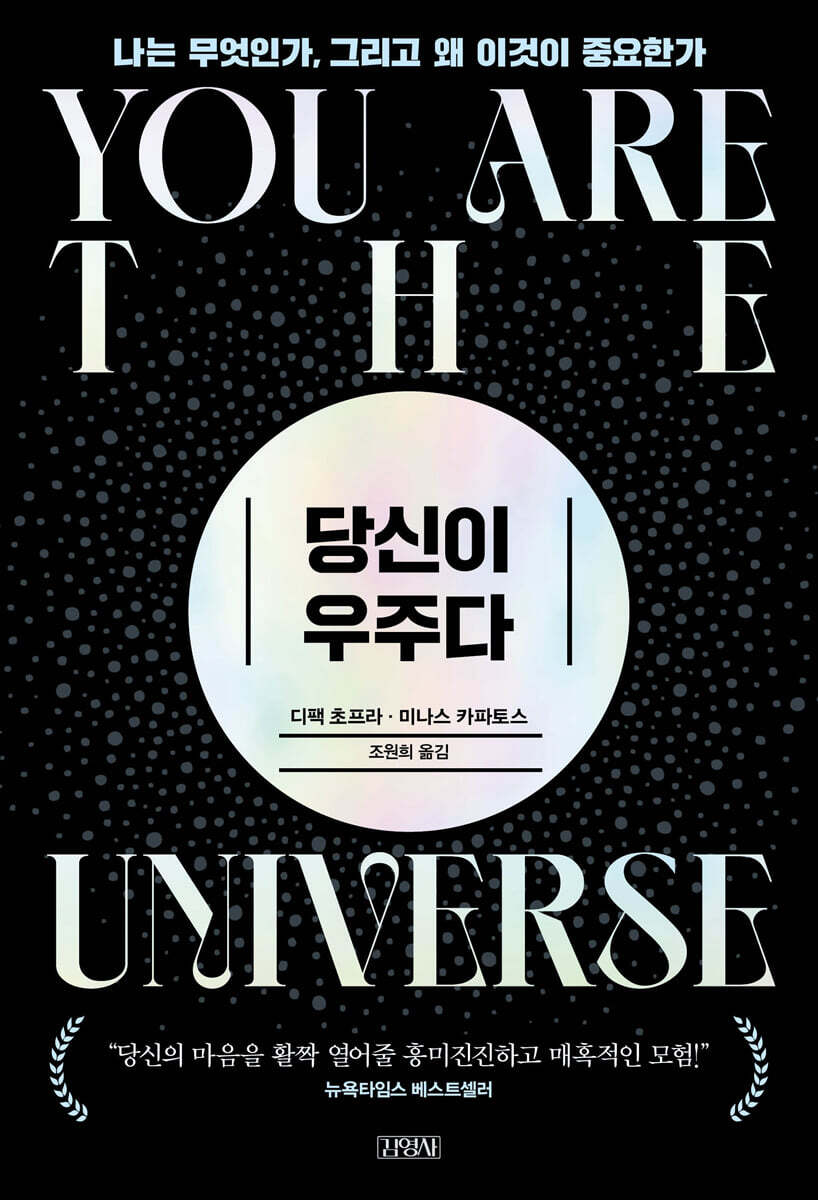
You are the universe
 |
Description
Book Introduction
A new book by [New York Times] bestseller and [Time] 100 Leading People, Deepak Chopra and Minas Karpathos!
Inspiring insights and profound questions and answers about nine discoveries in modern science.
“If you want to understand the worldview that is based entirely on human consciousness, and
“A must-read if you want to understand how science supports this view.”
- Michael Shermer, publisher of Skeptic, a magazine for scientific skeptics
Deepak Chopra, a Harvard Medical School doctor and world-renowned spiritual mentor, returns with a new book, this time with renowned physicist Minas Karpathos.
An instant New York Times bestseller, "You Are the Universe" delves into nine ultimate questions about the mysteries of human consciousness, the origins of the universe, time, space, matter, and the meaning of the observer.
Is consciousness merely a byproduct of matter? Why is the universe so perfectly aligned? Is there an invisible, absolute design? Or do probability and chance govern everything? Is the mind truly created in the brain? How does quantum mechanics relate to everyday life? Where does time come from, and what is the relationship between our minds and reality? This book explores these questions one by one, drawing on cutting-edge scientific evidence and logic from neuroscience, quantum physics, and cosmology, offering a new perspective on humanity and the universe.
By focusing on the identity and role of the 'observer (consciousness)', which has been overlooked in physics, it gradually reveals the possibility that the world surrounding us is not a cold and empty universe, but a 'human universe' that is alive, conscious, and responsive to the mind.
It is not the universe of creationism, mysticism, or quantum physics, nor is it a cartoonish multiverse, but rather the emergence of a 'participating universe' somewhat comically depicted in the movie [Everything Everywhere All at Once].
The messages of wisdom traditions that were once considered unrealistic concepts, such as Buddhism's theory of dependent origination, the Hindu proclamation of "I am Brahman," the Avatamsaka Sutra's Indra's net that "all things are connected," the Yogacara theory that "everything is mind (consciousness)," and Zhuangzi's dream of a butterfly, are being reinterpreted into realistic meanings through scientific discoveries.
Not only will it broaden our understanding of key issues currently being actively debated at the forefront of science and spirituality, it will also offer a bold new understanding of how we are connected to the world and how these connections can transform our lives.
Inspiring insights and profound questions and answers about nine discoveries in modern science.
“If you want to understand the worldview that is based entirely on human consciousness, and
“A must-read if you want to understand how science supports this view.”
- Michael Shermer, publisher of Skeptic, a magazine for scientific skeptics
Deepak Chopra, a Harvard Medical School doctor and world-renowned spiritual mentor, returns with a new book, this time with renowned physicist Minas Karpathos.
An instant New York Times bestseller, "You Are the Universe" delves into nine ultimate questions about the mysteries of human consciousness, the origins of the universe, time, space, matter, and the meaning of the observer.
Is consciousness merely a byproduct of matter? Why is the universe so perfectly aligned? Is there an invisible, absolute design? Or do probability and chance govern everything? Is the mind truly created in the brain? How does quantum mechanics relate to everyday life? Where does time come from, and what is the relationship between our minds and reality? This book explores these questions one by one, drawing on cutting-edge scientific evidence and logic from neuroscience, quantum physics, and cosmology, offering a new perspective on humanity and the universe.
By focusing on the identity and role of the 'observer (consciousness)', which has been overlooked in physics, it gradually reveals the possibility that the world surrounding us is not a cold and empty universe, but a 'human universe' that is alive, conscious, and responsive to the mind.
It is not the universe of creationism, mysticism, or quantum physics, nor is it a cartoonish multiverse, but rather the emergence of a 'participating universe' somewhat comically depicted in the movie [Everything Everywhere All at Once].
The messages of wisdom traditions that were once considered unrealistic concepts, such as Buddhism's theory of dependent origination, the Hindu proclamation of "I am Brahman," the Avatamsaka Sutra's Indra's net that "all things are connected," the Yogacara theory that "everything is mind (consciousness)," and Zhuangzi's dream of a butterfly, are being reinterpreted into realistic meanings through scientific discoveries.
Not only will it broaden our understanding of key issues currently being actively debated at the forefront of science and spirituality, it will also offer a bold new understanding of how we are connected to the world and how these connections can transform our lives.
- You can preview some of the book's contents.
Preview
index
Preface: You and the Universe Are One
Overview: The Dawn of a Human Universe
- Is everything relative?
- Quantum and observer effects
- Poet, find a way out
Part 1: The Ultimate Mystery
1.
What came before the Big Bang?
-Unraveling the mystery
- An embarrassing beginning
- The best answer I've gotten so far
- Is the Big Bang really necessary?
- Slipping into the multiverse
- Ingenious information theory
- Pull the string
- Where did everyone go?
2.
Why is the universe so perfectly aligned?
-Unraveling the mystery
- The best answer I've gotten so far
- Are humans that important?
- Cosmic body
- Another mystery: the flatness problem
- What if there had to be fine-tuning?
- Choose your perspective
3.
Where did time come from?
-Unraveling the mystery
- Space chicken? Or space egg?
- Maybe not
- Are quantum beings subject to time?
- Psychology emerges
4.
What is the universe made of?
-Unraveling the mystery
- Peeking into the black box
- What we see
- When darkness reigns
- Reality is a mind game
- The observer problem arises
5.
Was the universe designed?
-Unraveling the mystery
- Leave chance to chance
- When the coincidence disappears
- Beauty that transcends the world of noise and chaos
6.
Is the quantum world connected to everyday life?
-Unraveling the mystery
- Light acting strangely
- How does a photon determine its path?
- Can you trust your brain?
- Adapting to quantum
- The cat paradox
7.
Do we live in a conscious universe?
-Unraveling the mystery
- When atoms learned to think
- Easy problems and difficult problems
- Let reality speak for itself.
- Chasing moving arrows
8.
How did life begin?
-Unraveling the mystery
- Machine of life?
- A journey from little to nothing
- Are the two alive?
- From 'how' to 'why'
9.
Does the brain create the mind?
-Unraveling the mystery
5 Reasons Why Computers Have No Mind
- Why doesn't your brain like the Beatles?
Part 2: Embracing the Cosmic Self
10.
The power of personal reality
- There is no place for indifference.
- Qualia: Reality is ready to be revealed.
- but…
11.
Where are you really from?
- Is it my heart or the heart of the universe?
- Notify the universe of your departure
- What does separation feel like?
- What does it feel like to be real?
- The mind as a creator
- Duel of the Monists
12.
Where are we now?
- There is no problem with the starting point.
- Human touch
- Can reality set us free?
Appendix 1: Getting to Know Qualia
- Qualia Principles
Appendix 2: How Does Cosmic Consciousness Work?
- How every cell reflects the universe
Translator's Note
Search
Overview: The Dawn of a Human Universe
- Is everything relative?
- Quantum and observer effects
- Poet, find a way out
Part 1: The Ultimate Mystery
1.
What came before the Big Bang?
-Unraveling the mystery
- An embarrassing beginning
- The best answer I've gotten so far
- Is the Big Bang really necessary?
- Slipping into the multiverse
- Ingenious information theory
- Pull the string
- Where did everyone go?
2.
Why is the universe so perfectly aligned?
-Unraveling the mystery
- The best answer I've gotten so far
- Are humans that important?
- Cosmic body
- Another mystery: the flatness problem
- What if there had to be fine-tuning?
- Choose your perspective
3.
Where did time come from?
-Unraveling the mystery
- Space chicken? Or space egg?
- Maybe not
- Are quantum beings subject to time?
- Psychology emerges
4.
What is the universe made of?
-Unraveling the mystery
- Peeking into the black box
- What we see
- When darkness reigns
- Reality is a mind game
- The observer problem arises
5.
Was the universe designed?
-Unraveling the mystery
- Leave chance to chance
- When the coincidence disappears
- Beauty that transcends the world of noise and chaos
6.
Is the quantum world connected to everyday life?
-Unraveling the mystery
- Light acting strangely
- How does a photon determine its path?
- Can you trust your brain?
- Adapting to quantum
- The cat paradox
7.
Do we live in a conscious universe?
-Unraveling the mystery
- When atoms learned to think
- Easy problems and difficult problems
- Let reality speak for itself.
- Chasing moving arrows
8.
How did life begin?
-Unraveling the mystery
- Machine of life?
- A journey from little to nothing
- Are the two alive?
- From 'how' to 'why'
9.
Does the brain create the mind?
-Unraveling the mystery
5 Reasons Why Computers Have No Mind
- Why doesn't your brain like the Beatles?
Part 2: Embracing the Cosmic Self
10.
The power of personal reality
- There is no place for indifference.
- Qualia: Reality is ready to be revealed.
- but…
11.
Where are you really from?
- Is it my heart or the heart of the universe?
- Notify the universe of your departure
- What does separation feel like?
- What does it feel like to be real?
- The mind as a creator
- Duel of the Monists
12.
Where are we now?
- There is no problem with the starting point.
- Human touch
- Can reality set us free?
Appendix 1: Getting to Know Qualia
- Qualia Principles
Appendix 2: How Does Cosmic Consciousness Work?
- How every cell reflects the universe
Translator's Note
Search
Into the book
The purpose of this book is to demonstrate that this universe is a 'participating universe' whose very existence depends on human existence.
Today, cosmologists (people who study the origin and properties of the universe) are developing entirely new theories about a universe that is “alive, conscious, and self-evolving.”
A universe like this doesn't fit into any standard model that exists to date.
The universe described in Genesis as the work of Almighty God is not the universe of quantum physics, of course.
A 'conscious universe' is a universe that responds to the way we think and feel.
This universe gets its shape, color, sound, and texture from us.
"Human universe", this is the real universe, our only universe.
--- pp.7~8
The miracle of 'seeing' has to do with the way the brain processes sunlight.
But the most important process that converts light into images is a complete mystery.
Why 'seeing' is a complete mystery can be explained by the undeniable facts listed below.
· Photons are invisible to the eye.
Sunlight is bright, but the photons that make up sunlight are not bright at all.
· There is no light inside the brain.
Our brain is just an organ with a texture similar to oatmeal, surrounded by a liquid similar to seawater.
· Since there is no light in the brain, there can be no photographs or drawings.
When you think of the face of a loved one, there is no place in your brain where their face exists like a photograph.
No one can yet explain how invisible photons are transformed into chemical reactions, or how the faint electrical impulses in the brain create three-dimensional reality.
(Omitted) In this way, the working principle of vision is a complete mystery.
But one thing is certain.
In other words, it is ‘us’ who create ‘view’.
Without us, this whole world cannot exist.
--- pp.5~6
It's time to face the truth.
There is no material process that converts air vibrations into music.
There is no sound in the brain.
It's completely quiet.
The Beatles' "Let It Be," with its sweetness, its religious feeling, its joy, and all the rest, is not a product of brain circuitry.
This song is created from a mind with infinite potential and processed by our nervous system.
Music is not found in a radio, a piano, a violin, or a collection of nerve cells sending chemical and electrical signals to each other.
If we take these facts seriously, the mind becomes in a state that no machine can replicate.
This state is what we call 'consciousness'.
Consciousness cannot be created, but it makes the re-creation of the universe possible.
Here, 'universe' is not a place where consciousness is somehow haphazardly squeezed onto a lucky planet, Earth, about two-thirds of the way from the center of a galaxy we call the Milky Way, but rather a place where consciousness exists everywhere.
--- p.250
There is no separate observer.
The 'matter first' camp is stuck because it cannot report what the material system is doing when it moves.
The 'mind first' camp is unable to do this or that because it cannot create an independent observer.
The so-called 'observer effect' is only possible if the observer exists outside the system they are trying to observe.
The essence of the quantum Zeno effect is that the observer and the observed are connected to each other.
(Omitted) The observer has nowhere to stand except in ‘reality’.
The observer is like a fish trying to escape the sea.
When you go out of the water, you realize that there is only death.
The human way of being is to participate in the universe.
To exist is to be aware.
This is what human existence is all about.
Surprisingly, the same is true of space.
Without consciousness, everything would vanish like smoke.
It's like a dream, leaving nothing behind, so no one knows anything ever existed.
It is not enough to even say that the universe is conscious.
As we will prove, the universe is “consciousness itself.”
Unless we accept this conclusion, we fail to fully hear the message of reality.
--- p.207
Since we all create 'reality', the question is not whether you are creating reality or not.
The real question is, 'How deeply do we intervene?'
Could anything truly exist "out there," independent of us? Our answer is "no."
From a single particle to billions of galaxies, from the Big Bang to the end of the universe, everything known to be real is related to observation, and thus to human existence.
If there is something beyond our realm of experience, we will never know it.
We want to make it clear that we are not taking an unscientific or anti-scientific stance.
--- p.23
Einstein's theory of relativity destroyed the concepts of space and time, yet people live without knowing this fact.
But when relativity broke down time and space, something really happened.
The structure of the universe is destroyed and rebuilt into a new reality.
(Omitted) Einstein felt that there was something quite mysterious in light that had not yet been discovered.
What he wanted to know was not the 'physical properties of light' that physicists study, but 'the experience of riding light'.
--- pp.15~16
Everything we experience is an 'experience'.
Burning your tongue on hot coffee and taking pictures of the New Horizons probe as it flies past Pluto (and cheering at the results) are the same in that they are both "experiences."
If you do any kind of research, that is also an experience.
Planck argued that this fact was important.
If we could always and thoroughly treat distinct things like the scent of a rose, the sound of a volcanic eruption, a Shakespearean sonnet, and a space probe as the same thing, that is, as a single 'experience', then the 'matrix' of reality would no longer be material.
In this matrix, everything in the universe becomes 'mind-stuff', so including darkness is not a problem.
--- p.138
Our minds, including the everyday flow of thoughts that flow through our heads, may be influencing reality 'out there'.
When you picture cutting a lemon in half, does your mouth water? The reason is simple.
This is because the act of imagining a lemon and the act of actually seeing a lemon evoke the same reaction in our bodies.
This is one of those instances where an event that happened 'here' triggers an event 'somewhere out there'.
This series of events does not happen automatically.
It changes depending on how we experience the world.
This discovery that the act of observation, even of simply looking, is not passive, overturned the concept of 'mind dominating matter' in physics.
--- pp.28~29
Tagore did not indulge in his poetic fantasies during his conversation with Einstein, nor did he even mention mystical doctrines.
With the simple phrase 'human universe', Tagore raised the ultimate challenge to the materialistic worldview and undermined the cherished belief in a divine universe.
According to materialism, humans are nothing more than random creatures born on countless planets scattered like dots across trillions of galaxies, and if we interpret religious worldviews literally, the mind of God exists infinitely beyond the human mind.
But Tagore trusted neither, and Einstein was immediately captivated by the conversation.
--- p.37
The 'virtual state' exists beyond the revealed creation.
A wave transforms into a particle, a photon, an electron, or some other particle, entering our experiential world, leaving this virtual state behind.
In physics, calculations show that not every cubic centimeter of empty space is actually empty.
This is because of virtual states, which at the quantum level contain enormous amounts of virtual energy.
(Omitted) Subatomic particles also originate from non-material places, and there is no reason to believe that the place from which the word rose is taken is not where galaxies emerge.
--- p.115
The observer is only problematic when the very act of observation causes a change in things.
This kind of thing happens all the time in the human world.
If someone looks at you with loving eyes, you can easily change.
And if that gaze changes to one of indifference or hostility, you will change too.
(Omitted) The reason the observer problem has a unique position in quantum physics is because the actions of the observer cause particles to exist in time and space.
This is technically known as the 'collapse of the wave function', and means that an invisible probability wave that extends infinitely in all directions changes its state, suddenly making the particle visible.
--- p.140
Observers in a laboratory may be able to influence the behavior of photons, but this is far removed from everyday life.
If you look at the entire universe, its stars and galaxies, or even at trees, clouds, and mountains, will they actually change? It may sound absurd, but this is actually the core argument of the "human universe."
To do so, we must demonstrate that 'mind' is not just one of many elements in the universe, but rather the element that governs the functioning of all creation.
This challenge is being solved one by one as the puzzles are solved.
--- p.142
We all live in a multidimensional quantum world.
We do not simply observe, but participate in the reality that appears, projecting ourselves into everything we experience.
Are we making self-centered claims, imposing our human traits on the universe out of vanity? Or is it because the universe inherently possesses a "mind"?
--- p.187
Knowing what state you are in is the key to wholeness.
Finding our way through a universe where all the gears (physical properties such as space, time, matter, energy, charge, magnetic fields, etc.) are interchangeable is a difficult task.
If there were no organizer with an all-encompassing perspective, everything could dissolve into a quantum soup, and the 'cosmic mind' serves as that organizer.
Time, space, matter, and energy are all managed by the same gearbox, and the driver (consciousness) chooses what state they are in.
Reality is made up of many interchangeable states that come from a single source.
The source is consciousness.
--- p.280
The idea that we exist in a 'living universe' is fascinating.
If the universe has a mind, then it must be alive.
Whether you call it a "conscious universe," a "living universe," or a "human universe," does it make any difference in buying groceries, attending birthday parties, or chatting around the refrigerator in a conscious universe? The answer is yes.
The conscious universe has been completely transformed from the uncertain universe we now occupy, a transformation so profound that it calls into question every action.
As Peter Wilberg, one of the most perceptive and gifted qualia theorists, explains, we do not see because we have eyes.
The eyes are a human organ that evolved to satisfy the mind's desire to see something.
The heart comes first.
The mind seeks to experience reality through the qualia that embrace the five senses, along with sensations, images, feelings, and mental thoughts.
The spiritual rebirth promised by all the saints, sages, and mystics depends on a new reality, which means a new universe.
No, rather, it may be a new way of looking at the universe that already exists.
--- p.281
If you want to stop believing in the existence of the illusions you created, your limited mind must also receive an eviction notice.
Of course you have to do it yourself.
Only then can the mind of the universe enter in your stead.
It's like a cardiologist giving himself a heart transplant.
Spiritual teacher Rupert Spira called this “accepting something that is not a mental event.”
Death is one example.
Spira joked, “The mind wants to survive death and tell its post-death experiences.”
The mind is not an activity of thinking, feeling, sensing, or imagining.
Mind is awareness without waves.
This is the unchanging background of all that comes and goes.
Today, cosmologists (people who study the origin and properties of the universe) are developing entirely new theories about a universe that is “alive, conscious, and self-evolving.”
A universe like this doesn't fit into any standard model that exists to date.
The universe described in Genesis as the work of Almighty God is not the universe of quantum physics, of course.
A 'conscious universe' is a universe that responds to the way we think and feel.
This universe gets its shape, color, sound, and texture from us.
"Human universe", this is the real universe, our only universe.
--- pp.7~8
The miracle of 'seeing' has to do with the way the brain processes sunlight.
But the most important process that converts light into images is a complete mystery.
Why 'seeing' is a complete mystery can be explained by the undeniable facts listed below.
· Photons are invisible to the eye.
Sunlight is bright, but the photons that make up sunlight are not bright at all.
· There is no light inside the brain.
Our brain is just an organ with a texture similar to oatmeal, surrounded by a liquid similar to seawater.
· Since there is no light in the brain, there can be no photographs or drawings.
When you think of the face of a loved one, there is no place in your brain where their face exists like a photograph.
No one can yet explain how invisible photons are transformed into chemical reactions, or how the faint electrical impulses in the brain create three-dimensional reality.
(Omitted) In this way, the working principle of vision is a complete mystery.
But one thing is certain.
In other words, it is ‘us’ who create ‘view’.
Without us, this whole world cannot exist.
--- pp.5~6
It's time to face the truth.
There is no material process that converts air vibrations into music.
There is no sound in the brain.
It's completely quiet.
The Beatles' "Let It Be," with its sweetness, its religious feeling, its joy, and all the rest, is not a product of brain circuitry.
This song is created from a mind with infinite potential and processed by our nervous system.
Music is not found in a radio, a piano, a violin, or a collection of nerve cells sending chemical and electrical signals to each other.
If we take these facts seriously, the mind becomes in a state that no machine can replicate.
This state is what we call 'consciousness'.
Consciousness cannot be created, but it makes the re-creation of the universe possible.
Here, 'universe' is not a place where consciousness is somehow haphazardly squeezed onto a lucky planet, Earth, about two-thirds of the way from the center of a galaxy we call the Milky Way, but rather a place where consciousness exists everywhere.
--- p.250
There is no separate observer.
The 'matter first' camp is stuck because it cannot report what the material system is doing when it moves.
The 'mind first' camp is unable to do this or that because it cannot create an independent observer.
The so-called 'observer effect' is only possible if the observer exists outside the system they are trying to observe.
The essence of the quantum Zeno effect is that the observer and the observed are connected to each other.
(Omitted) The observer has nowhere to stand except in ‘reality’.
The observer is like a fish trying to escape the sea.
When you go out of the water, you realize that there is only death.
The human way of being is to participate in the universe.
To exist is to be aware.
This is what human existence is all about.
Surprisingly, the same is true of space.
Without consciousness, everything would vanish like smoke.
It's like a dream, leaving nothing behind, so no one knows anything ever existed.
It is not enough to even say that the universe is conscious.
As we will prove, the universe is “consciousness itself.”
Unless we accept this conclusion, we fail to fully hear the message of reality.
--- p.207
Since we all create 'reality', the question is not whether you are creating reality or not.
The real question is, 'How deeply do we intervene?'
Could anything truly exist "out there," independent of us? Our answer is "no."
From a single particle to billions of galaxies, from the Big Bang to the end of the universe, everything known to be real is related to observation, and thus to human existence.
If there is something beyond our realm of experience, we will never know it.
We want to make it clear that we are not taking an unscientific or anti-scientific stance.
--- p.23
Einstein's theory of relativity destroyed the concepts of space and time, yet people live without knowing this fact.
But when relativity broke down time and space, something really happened.
The structure of the universe is destroyed and rebuilt into a new reality.
(Omitted) Einstein felt that there was something quite mysterious in light that had not yet been discovered.
What he wanted to know was not the 'physical properties of light' that physicists study, but 'the experience of riding light'.
--- pp.15~16
Everything we experience is an 'experience'.
Burning your tongue on hot coffee and taking pictures of the New Horizons probe as it flies past Pluto (and cheering at the results) are the same in that they are both "experiences."
If you do any kind of research, that is also an experience.
Planck argued that this fact was important.
If we could always and thoroughly treat distinct things like the scent of a rose, the sound of a volcanic eruption, a Shakespearean sonnet, and a space probe as the same thing, that is, as a single 'experience', then the 'matrix' of reality would no longer be material.
In this matrix, everything in the universe becomes 'mind-stuff', so including darkness is not a problem.
--- p.138
Our minds, including the everyday flow of thoughts that flow through our heads, may be influencing reality 'out there'.
When you picture cutting a lemon in half, does your mouth water? The reason is simple.
This is because the act of imagining a lemon and the act of actually seeing a lemon evoke the same reaction in our bodies.
This is one of those instances where an event that happened 'here' triggers an event 'somewhere out there'.
This series of events does not happen automatically.
It changes depending on how we experience the world.
This discovery that the act of observation, even of simply looking, is not passive, overturned the concept of 'mind dominating matter' in physics.
--- pp.28~29
Tagore did not indulge in his poetic fantasies during his conversation with Einstein, nor did he even mention mystical doctrines.
With the simple phrase 'human universe', Tagore raised the ultimate challenge to the materialistic worldview and undermined the cherished belief in a divine universe.
According to materialism, humans are nothing more than random creatures born on countless planets scattered like dots across trillions of galaxies, and if we interpret religious worldviews literally, the mind of God exists infinitely beyond the human mind.
But Tagore trusted neither, and Einstein was immediately captivated by the conversation.
--- p.37
The 'virtual state' exists beyond the revealed creation.
A wave transforms into a particle, a photon, an electron, or some other particle, entering our experiential world, leaving this virtual state behind.
In physics, calculations show that not every cubic centimeter of empty space is actually empty.
This is because of virtual states, which at the quantum level contain enormous amounts of virtual energy.
(Omitted) Subatomic particles also originate from non-material places, and there is no reason to believe that the place from which the word rose is taken is not where galaxies emerge.
--- p.115
The observer is only problematic when the very act of observation causes a change in things.
This kind of thing happens all the time in the human world.
If someone looks at you with loving eyes, you can easily change.
And if that gaze changes to one of indifference or hostility, you will change too.
(Omitted) The reason the observer problem has a unique position in quantum physics is because the actions of the observer cause particles to exist in time and space.
This is technically known as the 'collapse of the wave function', and means that an invisible probability wave that extends infinitely in all directions changes its state, suddenly making the particle visible.
--- p.140
Observers in a laboratory may be able to influence the behavior of photons, but this is far removed from everyday life.
If you look at the entire universe, its stars and galaxies, or even at trees, clouds, and mountains, will they actually change? It may sound absurd, but this is actually the core argument of the "human universe."
To do so, we must demonstrate that 'mind' is not just one of many elements in the universe, but rather the element that governs the functioning of all creation.
This challenge is being solved one by one as the puzzles are solved.
--- p.142
We all live in a multidimensional quantum world.
We do not simply observe, but participate in the reality that appears, projecting ourselves into everything we experience.
Are we making self-centered claims, imposing our human traits on the universe out of vanity? Or is it because the universe inherently possesses a "mind"?
--- p.187
Knowing what state you are in is the key to wholeness.
Finding our way through a universe where all the gears (physical properties such as space, time, matter, energy, charge, magnetic fields, etc.) are interchangeable is a difficult task.
If there were no organizer with an all-encompassing perspective, everything could dissolve into a quantum soup, and the 'cosmic mind' serves as that organizer.
Time, space, matter, and energy are all managed by the same gearbox, and the driver (consciousness) chooses what state they are in.
Reality is made up of many interchangeable states that come from a single source.
The source is consciousness.
--- p.280
The idea that we exist in a 'living universe' is fascinating.
If the universe has a mind, then it must be alive.
Whether you call it a "conscious universe," a "living universe," or a "human universe," does it make any difference in buying groceries, attending birthday parties, or chatting around the refrigerator in a conscious universe? The answer is yes.
The conscious universe has been completely transformed from the uncertain universe we now occupy, a transformation so profound that it calls into question every action.
As Peter Wilberg, one of the most perceptive and gifted qualia theorists, explains, we do not see because we have eyes.
The eyes are a human organ that evolved to satisfy the mind's desire to see something.
The heart comes first.
The mind seeks to experience reality through the qualia that embrace the five senses, along with sensations, images, feelings, and mental thoughts.
The spiritual rebirth promised by all the saints, sages, and mystics depends on a new reality, which means a new universe.
No, rather, it may be a new way of looking at the universe that already exists.
--- p.281
If you want to stop believing in the existence of the illusions you created, your limited mind must also receive an eviction notice.
Of course you have to do it yourself.
Only then can the mind of the universe enter in your stead.
It's like a cardiologist giving himself a heart transplant.
Spiritual teacher Rupert Spira called this “accepting something that is not a mental event.”
Death is one example.
Spira joked, “The mind wants to survive death and tell its post-death experiences.”
The mind is not an activity of thinking, feeling, sensing, or imagining.
Mind is awareness without waves.
This is the unchanging background of all that comes and goes.
--- p.284
Publisher's Review
★★★ New York Times Bestseller
★★★ Amazon Bestseller - Cosmology, Philosophy, Spirituality, Self-Improvement
★★★ Deepak Chopra, one of Time's 100 Most Influential People in the World
★★★ Newsweek's 100 People Who Shaped the 20th Century - Deepak Chopra
“An exciting and captivating adventure that will open your heart!”
How do your mind and feelings really affect the world?
Inspiring insights and profound questions about the discoveries of modern science
Where do we come from and where are we going? What is consciousness? Does the brain create the mind? What existed before the Big Bang? Why is the universe so perfectly aligned? Do we live in a conscious universe? And ultimately, what am I? In You Are the Universe, world-renowned spiritual mentor Deepak Chopra, along with leading physicist Minas Karpathos, closely examine the most crucial and perplexing questions facing modern science.
What if we reach a critical turning point where science fundamentally changes our view of "reality"? Chopra and Karpathos argue that we have already reached that point.
As science and spirituality reach their extremes, they reveal anew that what surrounds us is not a cold, empty universe where the human world is but a speck of dust, but a living, conscious, and responsive "human universe."
It is not the universe of creationism, mysticism, or quantum physics, nor is it a cartoonish multiverse, but rather the emergence of a "participating universe" somewhat comically depicted in the movie "Everything Everywhere All at Once."
The discovery of a living, conscious, and self-evolving universe.
An instant New York Times bestseller, You Are the Universe begins with the historic conversation between Einstein and Rabindranath Tagore on July 14, 1930, and delves into nine ultimate mysteries about human consciousness, the origins of the universe, time, space, matter, and the meaning of the observer.
The nine questions addressed in this book are:
● What existed before the Big Bang?
● Why is the universe so perfectly aligned?
● Where does time come from?
● What is the universe made of?
● Was the universe designed?
● Is the quantum world connected to everyday life?
● Do we live in a conscious universe?
● How did life begin?
● Does the brain create the mind?
"You Are the Universe" answers these questions based on the latest scientific evidence and logic from neuroscience, quantum physics, and cosmology, while also helping us think deeply about our relationship with the universe and how it can change our lives.
It points out the blind spots of materialism, which holds that the mind is created in the brain and consciousness is merely a byproduct of matter, and it delves into the tendency of modern science to be dominated by probabilistic chance and the various aspects of quantum physics, which is preoccupied with studying the characteristics of the "observed" rather than the "observer."
While uncovering the nine mysteries one by one, you will gain an understanding of the main points of relativity, quantum mechanics, and neuroscience, which are the main characters of modern science, as well as the Hindu declaration, “I am the universe, I am Brahman,” the teaching of Indra’s net or “all things are connected” in the Avatamsaka Sutra, the Buddhist theory of dependent origination, the Yogacara theory that “all is mind (consciousness),” and Zhuangzi’s dream of a butterfly, “Did I dream that I was a butterfly, or was I dreaming that the butterfly was dreaming?” These important but obscure messages of the wisdom tradition will be reinterpreted with newly discovered scientific concepts and language.
Understanding 'what am I?', that is, 'the seer', is the key to understanding all mysteries.
By persistently delving into the identity and role of the 'observer (consciousness)', which has been overlooked even in quantum physics, it presents a new perspective: that the universe surrounding us is a human construct experienced through human 'consciousness', and that 'experience' through consciousness forms the basis of the material world.
Through this, the book discovers the connection between the universe and ourselves, and reflects on what this fact means for us, asking the question again.
If everything I see, hear, and feel interacts with the world, how would I live now? For those who, after a quest for scientific truth and a fervent spiritual exploration, ask, "So what?", this book offers a bold new understanding of how to change the world for the better.
What is similar and what is different
The idea that the universe and humans are interconnected, or the expression “we are the universe,” may at first glance seem similar to New Age, Hindu, or Buddhist ideas that emphasize spiritual power or mystical energy.
In its insistence that there is no clear boundary between the individual and the world, that the separation of self and world is an illusion, that everything is ultimately connected, in its emphasis on mindfulness and awareness of one's present state, in its emphasis on the power of the mind to shape reality, and in its assertion that our thoughts and intentions can influence our surroundings and our experiences, You Are the Universe shares many similarities with Buddhist and Hindu teachings.
However, this book does not deal with impermanence, suffering, and non-self, and does not emphasize enlightenment, liberation, and nirvana.
Unlike the seemingly similar concept of 'Atman-Brahman', which is associated with the law of karma, reincarnation, and various spiritual forces or gods, the 'you are the universe' discussed in this book is based on quantum physics and various scientific discoveries, and is not supported by or discussed at all by spiritual or religious concepts.
Unlike the Buddhist and idealistic views that say, "Everything is mind," the authors of this book emphasize the importance of consciousness and mind, but do not deny the existence of the external world, that is, the material universe.
It is also subtly different from the theory of consciousness.
Rather than simply dismissing it as 'everything is a product of the mind (consciousness),' it argues that consciousness and the universe are interdependent, and that even the observer and the act of observing cannot be understood separately from this universe.
That is, while the book is in some ways similar to the core doctrines of Buddhism and Hinduism, it emphasizes the importance of consciousness and mind in shaping our experience of reality, and combines these insights on a more realistic level through scientific experimentation and argumentation, without denying the objective reality of the external world.
Although mysticism and religious doctrines often omit the premises, processes, and verification processes of their claims, authors reach certain conclusions through a process of verifying various facts discovered by modern science from various perspectives.
The terms 'human universe', 'conscious universe', or 'participatory universe' are more precise than those used in traditional religions or New Age, and include complex concepts of the interaction between whole and individual, consciousness and object, observer and observed.
While existing religions presented grand metaphysical discourses that omitted the process, this book presents a new explanation of the universe and consciousness based on scientific evidence and logic.
While conventional quantum physics demonstrates that the state and motion of subatomic particles are affected by the act of observation, it does not necessarily support the idea that the existence or consciousness of the observer is a fundamental aspect of the universe.
"You Are the Universe" uses this idea as a starting point to argue that consciousness is not only an emergent property of complex biological systems, but also a fundamental aspect of the universe itself.
While the book uses concepts from quantum physics at a very deep level throughout, it also explores the connections between other scientific fields, such as neuroscience and cosmology, to provide a more comprehensive view of the universe and our place in it.
Beyond the materialistic and materialistic view that consciousness is a byproduct of matter, I propose considering the relationship between consciousness and reality, as well as the role of consciousness, which these viewpoints miss.
Like Deepak Chopra's previous works, You Are the Universe explores the connection between spirituality and science, drawing on Eastern spiritual traditions and principles of modern science.
This book goes further by introducing new scientific evidence and ideas through the collaboration of Minas Karpathos, a renowned scientist and spiritual practitioner.
It examines the sharp debates in quantum physics and cosmology in detail, and develops a discussion of interconnectedness at a more fundamental level.
Drawing on the expertise of two internationally recognized authors and their research in medicine, biology, neuroscience, quantum physics, and cosmology, this book presents a more comprehensive view of the universe and our place in it.
This teaches us that reality is a complex, interconnected system that emerges from the interaction of consciousness and the physical world, and that our understanding of this system itself is constantly evolving.
The authors argue that a deeper understanding of the mysteries of the universe can lead to personal growth and transformation, and that cultivating a sense of connection and purpose in our lives is essential.
This book awakens us to reexamine the nature of the 'reality' before our eyes, which we pass by without a second thought, saying 'we know it all,' and the role of 'consciousness' in recognizing it.
★★★ Amazon Bestseller - Cosmology, Philosophy, Spirituality, Self-Improvement
★★★ Deepak Chopra, one of Time's 100 Most Influential People in the World
★★★ Newsweek's 100 People Who Shaped the 20th Century - Deepak Chopra
“An exciting and captivating adventure that will open your heart!”
How do your mind and feelings really affect the world?
Inspiring insights and profound questions about the discoveries of modern science
Where do we come from and where are we going? What is consciousness? Does the brain create the mind? What existed before the Big Bang? Why is the universe so perfectly aligned? Do we live in a conscious universe? And ultimately, what am I? In You Are the Universe, world-renowned spiritual mentor Deepak Chopra, along with leading physicist Minas Karpathos, closely examine the most crucial and perplexing questions facing modern science.
What if we reach a critical turning point where science fundamentally changes our view of "reality"? Chopra and Karpathos argue that we have already reached that point.
As science and spirituality reach their extremes, they reveal anew that what surrounds us is not a cold, empty universe where the human world is but a speck of dust, but a living, conscious, and responsive "human universe."
It is not the universe of creationism, mysticism, or quantum physics, nor is it a cartoonish multiverse, but rather the emergence of a "participating universe" somewhat comically depicted in the movie "Everything Everywhere All at Once."
The discovery of a living, conscious, and self-evolving universe.
An instant New York Times bestseller, You Are the Universe begins with the historic conversation between Einstein and Rabindranath Tagore on July 14, 1930, and delves into nine ultimate mysteries about human consciousness, the origins of the universe, time, space, matter, and the meaning of the observer.
The nine questions addressed in this book are:
● What existed before the Big Bang?
● Why is the universe so perfectly aligned?
● Where does time come from?
● What is the universe made of?
● Was the universe designed?
● Is the quantum world connected to everyday life?
● Do we live in a conscious universe?
● How did life begin?
● Does the brain create the mind?
"You Are the Universe" answers these questions based on the latest scientific evidence and logic from neuroscience, quantum physics, and cosmology, while also helping us think deeply about our relationship with the universe and how it can change our lives.
It points out the blind spots of materialism, which holds that the mind is created in the brain and consciousness is merely a byproduct of matter, and it delves into the tendency of modern science to be dominated by probabilistic chance and the various aspects of quantum physics, which is preoccupied with studying the characteristics of the "observed" rather than the "observer."
While uncovering the nine mysteries one by one, you will gain an understanding of the main points of relativity, quantum mechanics, and neuroscience, which are the main characters of modern science, as well as the Hindu declaration, “I am the universe, I am Brahman,” the teaching of Indra’s net or “all things are connected” in the Avatamsaka Sutra, the Buddhist theory of dependent origination, the Yogacara theory that “all is mind (consciousness),” and Zhuangzi’s dream of a butterfly, “Did I dream that I was a butterfly, or was I dreaming that the butterfly was dreaming?” These important but obscure messages of the wisdom tradition will be reinterpreted with newly discovered scientific concepts and language.
Understanding 'what am I?', that is, 'the seer', is the key to understanding all mysteries.
By persistently delving into the identity and role of the 'observer (consciousness)', which has been overlooked even in quantum physics, it presents a new perspective: that the universe surrounding us is a human construct experienced through human 'consciousness', and that 'experience' through consciousness forms the basis of the material world.
Through this, the book discovers the connection between the universe and ourselves, and reflects on what this fact means for us, asking the question again.
If everything I see, hear, and feel interacts with the world, how would I live now? For those who, after a quest for scientific truth and a fervent spiritual exploration, ask, "So what?", this book offers a bold new understanding of how to change the world for the better.
What is similar and what is different
The idea that the universe and humans are interconnected, or the expression “we are the universe,” may at first glance seem similar to New Age, Hindu, or Buddhist ideas that emphasize spiritual power or mystical energy.
In its insistence that there is no clear boundary between the individual and the world, that the separation of self and world is an illusion, that everything is ultimately connected, in its emphasis on mindfulness and awareness of one's present state, in its emphasis on the power of the mind to shape reality, and in its assertion that our thoughts and intentions can influence our surroundings and our experiences, You Are the Universe shares many similarities with Buddhist and Hindu teachings.
However, this book does not deal with impermanence, suffering, and non-self, and does not emphasize enlightenment, liberation, and nirvana.
Unlike the seemingly similar concept of 'Atman-Brahman', which is associated with the law of karma, reincarnation, and various spiritual forces or gods, the 'you are the universe' discussed in this book is based on quantum physics and various scientific discoveries, and is not supported by or discussed at all by spiritual or religious concepts.
Unlike the Buddhist and idealistic views that say, "Everything is mind," the authors of this book emphasize the importance of consciousness and mind, but do not deny the existence of the external world, that is, the material universe.
It is also subtly different from the theory of consciousness.
Rather than simply dismissing it as 'everything is a product of the mind (consciousness),' it argues that consciousness and the universe are interdependent, and that even the observer and the act of observing cannot be understood separately from this universe.
That is, while the book is in some ways similar to the core doctrines of Buddhism and Hinduism, it emphasizes the importance of consciousness and mind in shaping our experience of reality, and combines these insights on a more realistic level through scientific experimentation and argumentation, without denying the objective reality of the external world.
Although mysticism and religious doctrines often omit the premises, processes, and verification processes of their claims, authors reach certain conclusions through a process of verifying various facts discovered by modern science from various perspectives.
The terms 'human universe', 'conscious universe', or 'participatory universe' are more precise than those used in traditional religions or New Age, and include complex concepts of the interaction between whole and individual, consciousness and object, observer and observed.
While existing religions presented grand metaphysical discourses that omitted the process, this book presents a new explanation of the universe and consciousness based on scientific evidence and logic.
While conventional quantum physics demonstrates that the state and motion of subatomic particles are affected by the act of observation, it does not necessarily support the idea that the existence or consciousness of the observer is a fundamental aspect of the universe.
"You Are the Universe" uses this idea as a starting point to argue that consciousness is not only an emergent property of complex biological systems, but also a fundamental aspect of the universe itself.
While the book uses concepts from quantum physics at a very deep level throughout, it also explores the connections between other scientific fields, such as neuroscience and cosmology, to provide a more comprehensive view of the universe and our place in it.
Beyond the materialistic and materialistic view that consciousness is a byproduct of matter, I propose considering the relationship between consciousness and reality, as well as the role of consciousness, which these viewpoints miss.
Like Deepak Chopra's previous works, You Are the Universe explores the connection between spirituality and science, drawing on Eastern spiritual traditions and principles of modern science.
This book goes further by introducing new scientific evidence and ideas through the collaboration of Minas Karpathos, a renowned scientist and spiritual practitioner.
It examines the sharp debates in quantum physics and cosmology in detail, and develops a discussion of interconnectedness at a more fundamental level.
Drawing on the expertise of two internationally recognized authors and their research in medicine, biology, neuroscience, quantum physics, and cosmology, this book presents a more comprehensive view of the universe and our place in it.
This teaches us that reality is a complex, interconnected system that emerges from the interaction of consciousness and the physical world, and that our understanding of this system itself is constantly evolving.
The authors argue that a deeper understanding of the mysteries of the universe can lead to personal growth and transformation, and that cultivating a sense of connection and purpose in our lives is essential.
This book awakens us to reexamine the nature of the 'reality' before our eyes, which we pass by without a second thought, saying 'we know it all,' and the role of 'consciousness' in recognizing it.
GOODS SPECIFICS
- Date of issue: March 10, 2023
- Page count, weight, size: 336 pages | 490g | 150*220*18mm
- ISBN13: 9788934942412
- ISBN10: 893494241X
You may also like
카테고리
korean


korean

![ELLE 엘르 스페셜 에디션 A형 : 12월 [2025]](http://librairie.coreenne.fr/cdn/shop/files/b8e27a3de6c9538896439686c6b0e8fb.jpg?v=1766436872&width=3840)


