

The Essentials of Physics: Classical Mechanics
 |
Description
Book Introduction
The Real Physics of the Great Physicist Who Beat Hawking
Complete collection of Stanford University's renowned lectures
(10 million cumulative views on YouTube)
Selected as a 'Best Book' by the Wall Street Journal
A 21st-century essential course, following Feynman's "Lectures on Physics"
A new particle was discovered in July this year through experiments at the Large Hadron Collider (LHC) at the European Organization for Nuclear Research.
Physicists hope that this particle will open new horizons in the study of the strong force, one of the four fundamental forces of the universe.
The Large Hadron Collider, which discovered a new key to unlocking the secrets of the universe five years after the Higgs boson, is a symbol of 'big science' with a circumference of 27 kilometers and a research staff of over 10,000.
In particular, the announcement of plans to build new particle accelerators indicates that physics research involving astronomical amounts of capital is rapidly becoming widespread.
Amidst these changes, physics is gradually becoming an essential subject for modern people.
This also affects the curriculum, and with the implementation of integrated science education in 2018, all students, regardless of whether they are in the humanities or sciences, must prepare for science subjects.
Moreover, the weight of science education will continue to increase as the College Scholastic Ability Test, which will be implemented starting in the 2021 academic year, will include "Integrated Social Studies and Integrated Science" as a separate test subject from the science inquiry area.
Among them, physics requires solid mathematical skills, and it also marks the first chapter of big history education that reflects the era of integration.
Therefore, it is time for an introductory physics book that can encompass not only science beginners and test takers, but also existing 'students who have given up on physics'.
Already in the 20th century, Western society experienced a boom in popular physics through public lectures by top physicists such as Richard Feynman, Carl Sagan, and Leonard Susskind.
In particular, Leonard Susskind, a string theory expert who refuted Stephen Hawking through the 'Black Hole War', continues to provide physics lectures for the general public on his YouTube channel SITP (Stanford Institute for Theoretical Physics).
His YouTube lecture "Theoretical Minimum," which has accumulated 10 million views, is receiving attention as a crystallization of only the essentials from all fields of physics, including classical mechanics, quantum mechanics, and special relativity.
In particular, the classical mechanics section was published in the United States as a liberal arts textbook, The Theoretical Minimum, and was selected as a 'Best Book' by the Wall Street Journal in 2013, receiving praise from numerous media outlets and love from readers.
Furthermore, the successive publications and success of subsequent volumes, including those on quantum mechanics and special relativity, demonstrate the steady increase in demand for Susskind's lectures.
This is no longer an exception in the domestic science publishing market, where physics education is booming as a liberal arts subject and as a subject for exam preparation.
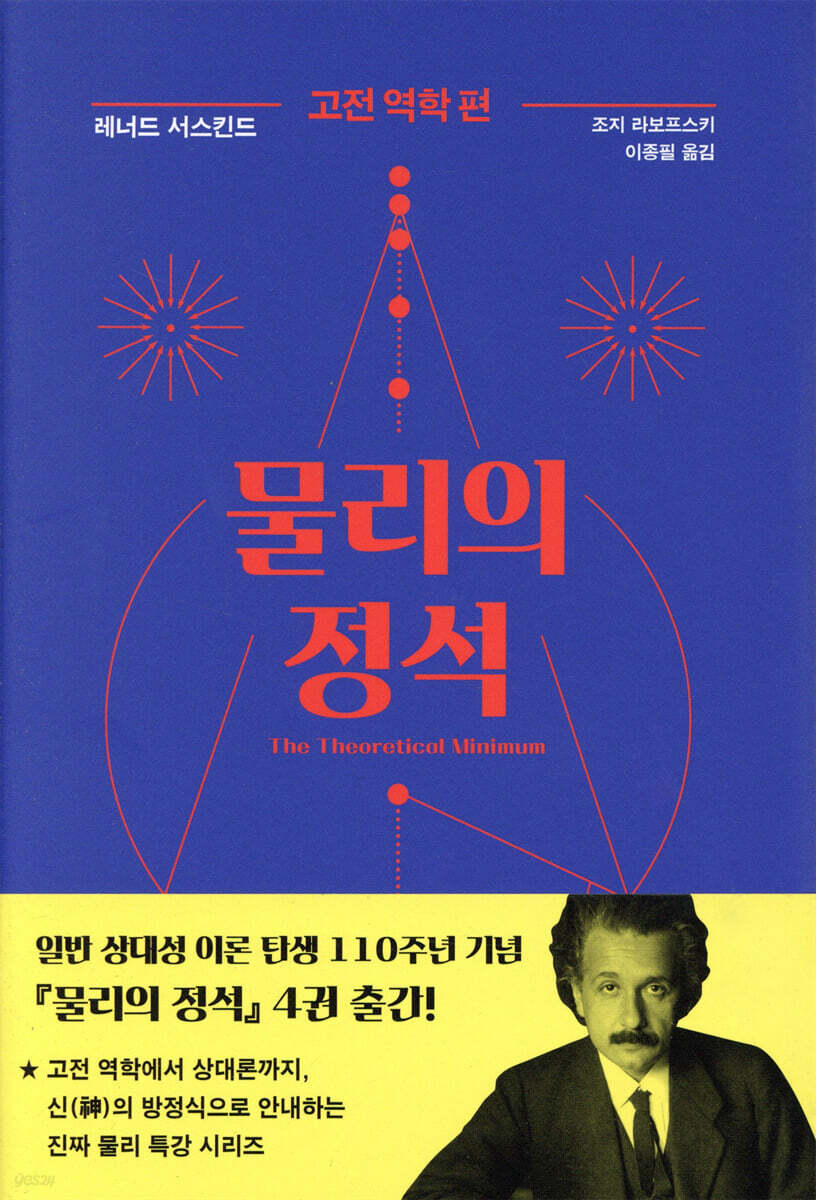
The newly published 『Physics Essentials: Classical Mechanics』 by Science Books Co., Ltd. is the only Korean translation of Susskind's 『Minimal Theory』.
The title of the Korean version is borrowed from the concept of Jeongseok (定石), which means the best move with a balance of offense and defense in Baduk, and is in line with Susskind's 'minimal theory'.
Furthermore, errors in the original text's formulas and graphs were corrected and supplemented.
This book has been highly praised by educational critic Lee Beom, a former star instructor at Megastudy Co., Ltd., and Professor Kim Sang-wook of Pusan National University, a science communicator loved by the public. It will be the best book for students, college students, and the general public who want to learn physics from the beginning or again.
Meanwhile, the fact that it was translated by Professor Jongpil Lee of Konkuk University, a renowned physicist and science writer, guarantees that the content is more accurate and of a higher quality than existing introductory physics books.
We can look forward to a new collaboration between Professor Lee Jong-pil and Susskind, who has already translated and published another book by Susskind, The Black Hole War.
[Download Solution]
http://sciencebooks.minumsa.com/?bcpattach=59e2841f77d37b7257844184f58bb176b57c5377
Complete collection of Stanford University's renowned lectures
(10 million cumulative views on YouTube)
Selected as a 'Best Book' by the Wall Street Journal
A 21st-century essential course, following Feynman's "Lectures on Physics"
A new particle was discovered in July this year through experiments at the Large Hadron Collider (LHC) at the European Organization for Nuclear Research.
Physicists hope that this particle will open new horizons in the study of the strong force, one of the four fundamental forces of the universe.
The Large Hadron Collider, which discovered a new key to unlocking the secrets of the universe five years after the Higgs boson, is a symbol of 'big science' with a circumference of 27 kilometers and a research staff of over 10,000.
In particular, the announcement of plans to build new particle accelerators indicates that physics research involving astronomical amounts of capital is rapidly becoming widespread.
Amidst these changes, physics is gradually becoming an essential subject for modern people.
This also affects the curriculum, and with the implementation of integrated science education in 2018, all students, regardless of whether they are in the humanities or sciences, must prepare for science subjects.
Moreover, the weight of science education will continue to increase as the College Scholastic Ability Test, which will be implemented starting in the 2021 academic year, will include "Integrated Social Studies and Integrated Science" as a separate test subject from the science inquiry area.
Among them, physics requires solid mathematical skills, and it also marks the first chapter of big history education that reflects the era of integration.
Therefore, it is time for an introductory physics book that can encompass not only science beginners and test takers, but also existing 'students who have given up on physics'.
Already in the 20th century, Western society experienced a boom in popular physics through public lectures by top physicists such as Richard Feynman, Carl Sagan, and Leonard Susskind.
In particular, Leonard Susskind, a string theory expert who refuted Stephen Hawking through the 'Black Hole War', continues to provide physics lectures for the general public on his YouTube channel SITP (Stanford Institute for Theoretical Physics).
His YouTube lecture "Theoretical Minimum," which has accumulated 10 million views, is receiving attention as a crystallization of only the essentials from all fields of physics, including classical mechanics, quantum mechanics, and special relativity.
In particular, the classical mechanics section was published in the United States as a liberal arts textbook, The Theoretical Minimum, and was selected as a 'Best Book' by the Wall Street Journal in 2013, receiving praise from numerous media outlets and love from readers.
Furthermore, the successive publications and success of subsequent volumes, including those on quantum mechanics and special relativity, demonstrate the steady increase in demand for Susskind's lectures.
This is no longer an exception in the domestic science publishing market, where physics education is booming as a liberal arts subject and as a subject for exam preparation.
The newly published 『Physics Essentials: Classical Mechanics』 by Science Books Co., Ltd. is the only Korean translation of Susskind's 『Minimal Theory』.
The title of the Korean version is borrowed from the concept of Jeongseok (定石), which means the best move with a balance of offense and defense in Baduk, and is in line with Susskind's 'minimal theory'.
Furthermore, errors in the original text's formulas and graphs were corrected and supplemented.
This book has been highly praised by educational critic Lee Beom, a former star instructor at Megastudy Co., Ltd., and Professor Kim Sang-wook of Pusan National University, a science communicator loved by the public. It will be the best book for students, college students, and the general public who want to learn physics from the beginning or again.
Meanwhile, the fact that it was translated by Professor Jongpil Lee of Konkuk University, a renowned physicist and science writer, guarantees that the content is more accurate and of a higher quality than existing introductory physics books.
We can look forward to a new collaboration between Professor Lee Jong-pil and Susskind, who has already translated and published another book by Susskind, The Black Hole War.
[Download Solution]
http://sciencebooks.minumsa.com/?bcpattach=59e2841f77d37b7257844184f58bb176b57c5377
- You can preview some of the book's contents.
Preview
index
Introduction: Minimal Theory 7
Beginners need help 11
Lecture 1: The Nature of Classical Physics 15
Interlude 1 Space, Trigonometry, Vectors 37
Exercise 2: 55
Interlude 2 Integration 79
Lecture 3: Dynamics 95
Intermission 3 Partial Differentiation 117
System 133 consisting of one or more particles of the fourth order
5th Energy 147
Lecture 6: Principle of Least Action 161
Lecture 7: Symmetry and Conservation Laws 191
Hamiltonian Dynamics and Time-Translation Invariance, Lecture 8, 213
Lecture 9: Topological Space Fluids and the Gibbs-Liouville Theorem 235
Lecture 10: Poisson Brackets, Angular Momentum, and Symmetry 253
Lesson 11 Electricity and Magnetism 277
Appendix Central Force and Planetary Orbits 305
Translator's Note: The Essentials of Understanding Natural Principles, Vol. 326
Search 330
Beginners need help 11
Lecture 1: The Nature of Classical Physics 15
Interlude 1 Space, Trigonometry, Vectors 37
Exercise 2: 55
Interlude 2 Integration 79
Lecture 3: Dynamics 95
Intermission 3 Partial Differentiation 117
System 133 consisting of one or more particles of the fourth order
5th Energy 147
Lecture 6: Principle of Least Action 161
Lecture 7: Symmetry and Conservation Laws 191
Hamiltonian Dynamics and Time-Translation Invariance, Lecture 8, 213
Lecture 9: Topological Space Fluids and the Gibbs-Liouville Theorem 235
Lecture 10: Poisson Brackets, Angular Momentum, and Symmetry 253
Lesson 11 Electricity and Magnetism 277
Appendix Central Force and Planetary Orbits 305
Translator's Note: The Essentials of Understanding Natural Principles, Vol. 326
Search 330
Publisher's Review
The first physics course chosen by Stanford University's brightest minds and science enthusiasts!
The bare minimum of theory means only what you absolutely must know to move on to the next step.
It is not a thick, encyclopedic textbook that explains everything, but a thin book that explains everything that is important. ―Leonard Susskind, from the “Preface”
In lectures aimed at the general public (especially in Korea), ‘making it as easy as possible’ is the most important virtue.
The same goes for popular science books.
But this book is full of all kinds of formulas.
Because Susskind taught physics to the general public 'properly, using mathematics.' - Lee Jong-pil, from "Translator's Note"
Leonard Susskind, a professor of physics at Stanford University, is a leading figure in modern theoretical physics.
He is considered the father of string theory, which attempts to unify quantum mechanics and general relativity by assuming that the basic unit of particles is a string rather than a point.
He also refuted Stephen Hawking through the principle of black hole complementarity and the theory of holography.
This book is the result of his continuous efforts to popularize physics while advancing steadily toward the ultimate theory.
This book is a guide sent by a physicist who is well-versed in both quantum mechanics and relativity, the two major fields of modern physics, to invite the public into his world.
Anyone can take their first step into the world of modern physics by learning the 'minimum theory' that they absolutely must know.
"The Essentials of Physics: Classical Mechanics" is the first book in the "The Essentials of Physics" series, which will eventually be published in six volumes, including quantum mechanics and special relativity.
Unlike quantum mechanics in the microscopic world, where the duality and uncertainty of matter are important, or the theory of relativity in the macroscopic world, where the simultaneity of time is broken, classical mechanics, which deals with our everyday world, is relatively accessible to readers.
Humanity's long-standing attempt to predict the future by making the state of motion of an object of observation, such as position or speed, into a function of time culminated in the laws of motion of the 18th-century British physicist Isaac Newton.
Unlike previous natural philosophers who explained natural phenomena by attributing intrinsic properties to substances such as water, fire, earth, and air, or by fundamentally distinguishing between the movements of the terrestrial and celestial worlds, Newton explained the movements of all things in the world through a single, concise equation, F = ma.
It was the moment when classical mechanics, which accurately interprets natural phenomena with mathematics, was born.
The subsequent rapid development of physics had a profound impact on human history, including giving birth to modern scientific civilization.
Although more accurate theories such as quantum mechanics and relativity were developed in the 20th century, classical mechanics is still considered the backbone of physics today, thanks to the discovery of the corresponding principle that if you approximate the Planck constant of quantum mechanics to 0 and the speed of light of relativity to infinity, you end up with classical mechanics.
This is why classical mechanics must be the starting point for understanding physics and the entire era of science and technology.
Learn the basics of physics directly from the founder of string theory!
In this book, we will primarily deal with how various quantities change over time.
Most of classical mechanics deals with things that change smoothly as time changes continuously.
To mathematically deal with continuous changes, we use a branch of mathematics called calculus. - From the text
The principle of least action is the most concise form of the classical laws of physics.
This simple rule sums it all up! Not only the principles of classical mechanics, but everything we know about electromagnetism, general relativity, quantum mechanics, chemistry, and even the fundamental particles that are the ultimate known constituents of matter. —From the text
For this reason, classical mechanics is the first unit of physics subjects such as high school physics, general physics at university, civil service exam, and PEET.
As the importance of physics education increases, this book provides a classical mechanics course for students preparing for college and university entrance exams in the era of integrated science education, as well as for those starting out in the workforce later in life.
Based on his teaching experience through Stanford University's general education program, Leonard Susskind has developed a systematic curriculum.
Consisting of 12 lectures, including appendices, and three interludes appropriately placed for mathematics, this book helps readers with no prior knowledge to naturally develop concepts of classical mechanics, a minimum of mathematical knowledge, and the ability to derive and apply equations of motion.
The first half of the text deals with Newton's equation F = ma.
In particular, since calculus is essential, the second lecture, "Exercise," and the intermission lecture, "Integral Calculus," are provided to help students build up knowledge of calculus in advance.
Before this, the interlude lecture "Space, Trigonometry, Vectors" from the first lecture "The Nature of Classical Physics" has been prepared to help you build the basic skills needed to study calculus, so you can follow along with Susskind's lecture without any worries.
If you have come to understand the concepts of force, mass, and acceleration based on calculus, Newton's equations will seem completely new to you.
We can experience aesthetic pleasure by fully understanding the powerful equations that explain the movement of all things in the world.
Of course, classical mechanics does not end with Newton's equations.
After you have a clear understanding of the concept of energy derived from force and mass through Chapter 5, “Energy,” another world of classical mechanics will unfold before your eyes.
Beginning with Gottfried Leibniz, who is considered to have created calculus at the same time as Newton or even before him, natural science developed in continental Europe in a way that was independent of Newton.
They developed the long-standing human insight that all things move in the direction that involves the least change or along the shortest path, and established the 'principle of least action'.
In Chapter 6, “The Principle of Least Action,” this powerful principle that explains nature is introduced.
And more importantly, Leonhard
This is the Euler-Lagrange equation, which was derived by Leonhard Euler and Joseph Lagrange by developing it mathematically.
Unlike Newton's equations that use vectors (forces), we can see a unique equation that tracks the motion of an object using only simple scalars (energy).
You can see interesting information that is equivalent to Newton's equations, but cannot be accessed without studying physics in college.
In the second half, we discuss the third equation of motion, Hamilton's equation, based on discussions of symmetry and conservation laws.
The lecture concludes by moving on to Poisson brackets, angular momentum, vector potentials, gauge transformations, and ultimately reaching the fundamental logic of quantum mechanics.
This section provides a solid link between classical and quantum mechanics for those wishing to enter the world of modern physics.
Meanwhile, the appendix, "Central Force and Planetary Orbits," is an extension of another part of "The Essentials of Physics" on cosmology.
Readers who complete this book will be ready to advance to the cutting edge of physics.
The core principles of physics that you, as a student, college student, or working professional, must know.
If you've followed along, you've learned the 'minimum theory'.
Everything you need to know about classical mechanics to move on to the next step. —From the text
This is not a book that can be understood by skimming through it.
But it is worth the challenge.
This is especially true because it is a scientific feast guided by the greatest physicist of our time.
I hope you will enjoy the thrill of experiencing the fundamental principles of nature through the language of mathematics, along with the breath of a master.
Good luck! - Lee Jong-pil
This book is the first one that busy people should turn to because it covers only the essentials across a wide range of physics, and it is also suitable as a study guide for exams because it contains concise and dense content.
Young people in the era of convergent science education can build a solid foundation in physics.
Especially these days, when major universities are increasingly asking essay questions that exceed the high school level, this book will help you proactively prepare for the college entrance exam by providing a comprehensive perspective on physics.
In addition, it can be a useful textbook for college students preparing for university entrance exams, PEET, or civil service exams.
Humanities students pursuing a double major in engineering can also benefit greatly from the growing demand for manufacturing and IT personnel.
Of course, it is not a book that can be easily understood.
It is necessary to closely examine the logical process by which equations explaining the laws of nature are derived and to savor their meaning in order to experience the flavor of physics.
An organic lecture system and practice problems are provided to help readers accomplish this on their own.
It is more effective to use Suskind's 'Minimum Theory' video lecture provided by the YouTube channel SITP.
Suskind's lectures are popular as educational content useful to busy modern people and students preparing for exams.
Supplementary explanations and practice problem solutions provided on co-author George Hrabovsky's website (www.madscitech.org/tm) will also be a useful study aid.
And immediately after publication, translator Professor Jongpil Lee plans to begin a series of solutions based on the practice problems in the text for readers and the general public, and these will be introduced weekly on the Science Books website and SNS.
Higgs, gravitational waves, AlphaGo, and nuclear energy have become keywords that define the present, but most of us do not truly understand them.
Despite the growing isolation of science from the public, physics continues to be accepted as a core subject and is actively popularizing, stemming from the collective curiosity of members of society who want to understand how the world works.
Physics, and classical mechanics in particular, is the key to understanding the world around us most intuitively.
I hope that through this book, you will experience the joy of experiencing the principles of the world through the language of mathematics.
The bare minimum of theory means only what you absolutely must know to move on to the next step.
It is not a thick, encyclopedic textbook that explains everything, but a thin book that explains everything that is important. ―Leonard Susskind, from the “Preface”
In lectures aimed at the general public (especially in Korea), ‘making it as easy as possible’ is the most important virtue.
The same goes for popular science books.
But this book is full of all kinds of formulas.
Because Susskind taught physics to the general public 'properly, using mathematics.' - Lee Jong-pil, from "Translator's Note"
Leonard Susskind, a professor of physics at Stanford University, is a leading figure in modern theoretical physics.
He is considered the father of string theory, which attempts to unify quantum mechanics and general relativity by assuming that the basic unit of particles is a string rather than a point.
He also refuted Stephen Hawking through the principle of black hole complementarity and the theory of holography.
This book is the result of his continuous efforts to popularize physics while advancing steadily toward the ultimate theory.
This book is a guide sent by a physicist who is well-versed in both quantum mechanics and relativity, the two major fields of modern physics, to invite the public into his world.
Anyone can take their first step into the world of modern physics by learning the 'minimum theory' that they absolutely must know.
"The Essentials of Physics: Classical Mechanics" is the first book in the "The Essentials of Physics" series, which will eventually be published in six volumes, including quantum mechanics and special relativity.
Unlike quantum mechanics in the microscopic world, where the duality and uncertainty of matter are important, or the theory of relativity in the macroscopic world, where the simultaneity of time is broken, classical mechanics, which deals with our everyday world, is relatively accessible to readers.
Humanity's long-standing attempt to predict the future by making the state of motion of an object of observation, such as position or speed, into a function of time culminated in the laws of motion of the 18th-century British physicist Isaac Newton.
Unlike previous natural philosophers who explained natural phenomena by attributing intrinsic properties to substances such as water, fire, earth, and air, or by fundamentally distinguishing between the movements of the terrestrial and celestial worlds, Newton explained the movements of all things in the world through a single, concise equation, F = ma.
It was the moment when classical mechanics, which accurately interprets natural phenomena with mathematics, was born.
The subsequent rapid development of physics had a profound impact on human history, including giving birth to modern scientific civilization.
Although more accurate theories such as quantum mechanics and relativity were developed in the 20th century, classical mechanics is still considered the backbone of physics today, thanks to the discovery of the corresponding principle that if you approximate the Planck constant of quantum mechanics to 0 and the speed of light of relativity to infinity, you end up with classical mechanics.
This is why classical mechanics must be the starting point for understanding physics and the entire era of science and technology.
Learn the basics of physics directly from the founder of string theory!
In this book, we will primarily deal with how various quantities change over time.
Most of classical mechanics deals with things that change smoothly as time changes continuously.
To mathematically deal with continuous changes, we use a branch of mathematics called calculus. - From the text
The principle of least action is the most concise form of the classical laws of physics.
This simple rule sums it all up! Not only the principles of classical mechanics, but everything we know about electromagnetism, general relativity, quantum mechanics, chemistry, and even the fundamental particles that are the ultimate known constituents of matter. —From the text
For this reason, classical mechanics is the first unit of physics subjects such as high school physics, general physics at university, civil service exam, and PEET.
As the importance of physics education increases, this book provides a classical mechanics course for students preparing for college and university entrance exams in the era of integrated science education, as well as for those starting out in the workforce later in life.
Based on his teaching experience through Stanford University's general education program, Leonard Susskind has developed a systematic curriculum.
Consisting of 12 lectures, including appendices, and three interludes appropriately placed for mathematics, this book helps readers with no prior knowledge to naturally develop concepts of classical mechanics, a minimum of mathematical knowledge, and the ability to derive and apply equations of motion.
The first half of the text deals with Newton's equation F = ma.
In particular, since calculus is essential, the second lecture, "Exercise," and the intermission lecture, "Integral Calculus," are provided to help students build up knowledge of calculus in advance.
Before this, the interlude lecture "Space, Trigonometry, Vectors" from the first lecture "The Nature of Classical Physics" has been prepared to help you build the basic skills needed to study calculus, so you can follow along with Susskind's lecture without any worries.
If you have come to understand the concepts of force, mass, and acceleration based on calculus, Newton's equations will seem completely new to you.
We can experience aesthetic pleasure by fully understanding the powerful equations that explain the movement of all things in the world.
Of course, classical mechanics does not end with Newton's equations.
After you have a clear understanding of the concept of energy derived from force and mass through Chapter 5, “Energy,” another world of classical mechanics will unfold before your eyes.
Beginning with Gottfried Leibniz, who is considered to have created calculus at the same time as Newton or even before him, natural science developed in continental Europe in a way that was independent of Newton.
They developed the long-standing human insight that all things move in the direction that involves the least change or along the shortest path, and established the 'principle of least action'.
In Chapter 6, “The Principle of Least Action,” this powerful principle that explains nature is introduced.
And more importantly, Leonhard
This is the Euler-Lagrange equation, which was derived by Leonhard Euler and Joseph Lagrange by developing it mathematically.
Unlike Newton's equations that use vectors (forces), we can see a unique equation that tracks the motion of an object using only simple scalars (energy).
You can see interesting information that is equivalent to Newton's equations, but cannot be accessed without studying physics in college.
In the second half, we discuss the third equation of motion, Hamilton's equation, based on discussions of symmetry and conservation laws.
The lecture concludes by moving on to Poisson brackets, angular momentum, vector potentials, gauge transformations, and ultimately reaching the fundamental logic of quantum mechanics.
This section provides a solid link between classical and quantum mechanics for those wishing to enter the world of modern physics.
Meanwhile, the appendix, "Central Force and Planetary Orbits," is an extension of another part of "The Essentials of Physics" on cosmology.
Readers who complete this book will be ready to advance to the cutting edge of physics.
The core principles of physics that you, as a student, college student, or working professional, must know.
If you've followed along, you've learned the 'minimum theory'.
Everything you need to know about classical mechanics to move on to the next step. —From the text
This is not a book that can be understood by skimming through it.
But it is worth the challenge.
This is especially true because it is a scientific feast guided by the greatest physicist of our time.
I hope you will enjoy the thrill of experiencing the fundamental principles of nature through the language of mathematics, along with the breath of a master.
Good luck! - Lee Jong-pil
This book is the first one that busy people should turn to because it covers only the essentials across a wide range of physics, and it is also suitable as a study guide for exams because it contains concise and dense content.
Young people in the era of convergent science education can build a solid foundation in physics.
Especially these days, when major universities are increasingly asking essay questions that exceed the high school level, this book will help you proactively prepare for the college entrance exam by providing a comprehensive perspective on physics.
In addition, it can be a useful textbook for college students preparing for university entrance exams, PEET, or civil service exams.
Humanities students pursuing a double major in engineering can also benefit greatly from the growing demand for manufacturing and IT personnel.
Of course, it is not a book that can be easily understood.
It is necessary to closely examine the logical process by which equations explaining the laws of nature are derived and to savor their meaning in order to experience the flavor of physics.
An organic lecture system and practice problems are provided to help readers accomplish this on their own.
It is more effective to use Suskind's 'Minimum Theory' video lecture provided by the YouTube channel SITP.
Suskind's lectures are popular as educational content useful to busy modern people and students preparing for exams.
Supplementary explanations and practice problem solutions provided on co-author George Hrabovsky's website (www.madscitech.org/tm) will also be a useful study aid.
And immediately after publication, translator Professor Jongpil Lee plans to begin a series of solutions based on the practice problems in the text for readers and the general public, and these will be introduced weekly on the Science Books website and SNS.
Higgs, gravitational waves, AlphaGo, and nuclear energy have become keywords that define the present, but most of us do not truly understand them.
Despite the growing isolation of science from the public, physics continues to be accepted as a core subject and is actively popularizing, stemming from the collective curiosity of members of society who want to understand how the world works.
Physics, and classical mechanics in particular, is the key to understanding the world around us most intuitively.
I hope that through this book, you will experience the joy of experiencing the principles of the world through the language of mathematics.
GOODS SPECIFICS
- Date of publication: August 18, 2017
- Format: Hardcover book binding method guide
- Page count, weight, size: 336 pages | 483g | 142*205*30mm
- ISBN13: 9788983718372
- ISBN10: 8983718374
You may also like
카테고리
korean


korean

![GQ KOREA Mark (Monthly): December [2025]](http://librairie.coreenne.fr/cdn/shop/files/8ef265dbbfbf186523ed75ba7319009d.jpg?v=1765340328&width=3840)


