

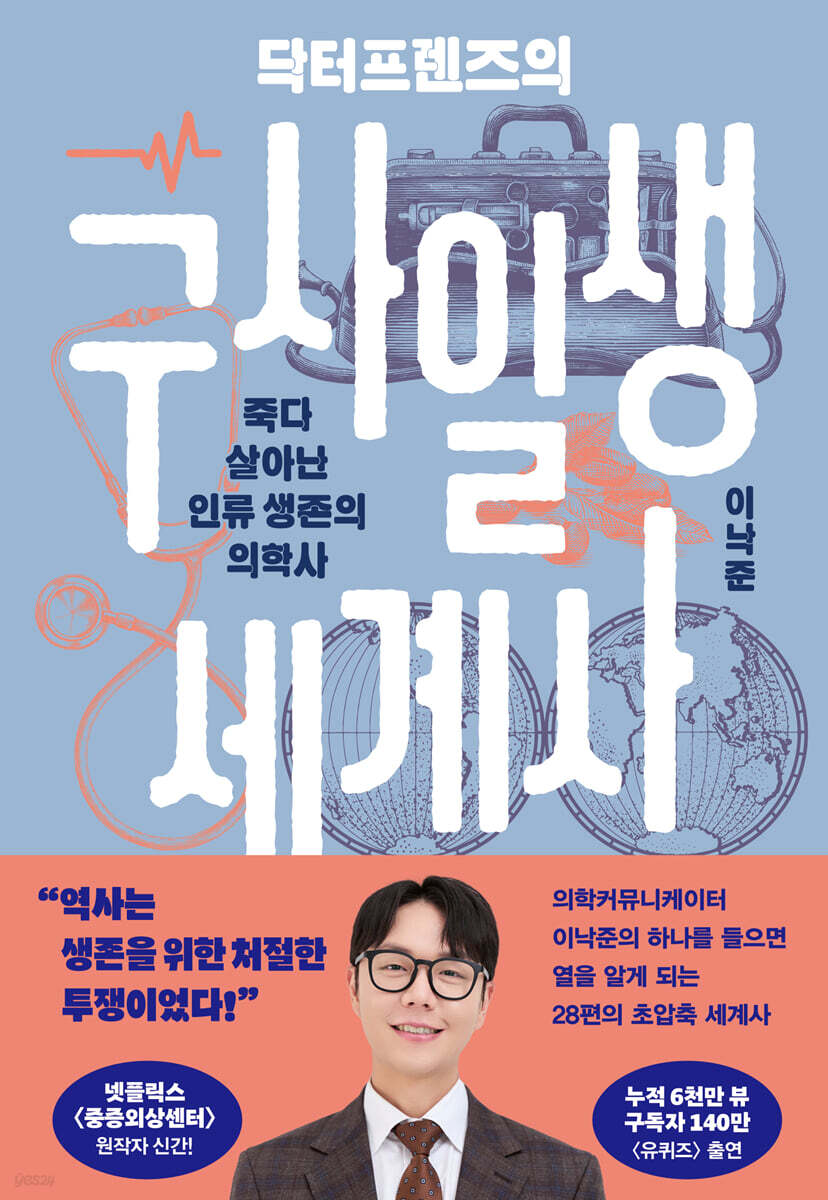
Doctor Friends' Near-Death World History
 |
Description
Book Introduction
Medical communicator Lee Nak-jun's
28 ultra-compressed world histories that will teach you ten things by listening to just one.
★★ New book from the original author of Netflix's "Trauma Center"! ★★
★★ Super popular content with 1.4 million subscribers and 60 million cumulative views ★★
The book "History of Medicine" by Lee Nak-jun, author of the YouTube channel "Doctor Friends" with 1.4 million subscribers, has surpassed 60 million cumulative views and received explosive love from the public. Following "Doctor Friends' Oh My God World History," it was published as "Doctor Friends' Narrow-Earth World History."
Even boring history is different when told by Lee Nak-jun.
He is also the original author of the Netflix hit "Trauma Center," and he uses his lively and vivid explanations to explain the difficult topic of "the history of medicine" in an easy and fun way.
Born from the author's expertise as a doctor, his captivating skills as a YouTuber, and his writing prowess as a web novelist, this book is a cultural resource with a depth and enjoyment rarely found in existing history or medical books.
"Doctor Friends' Near-Death World History" examines major turning points in world history from a medical perspective.
Diseases have ravaged the ages, shattered civilizations, and plagues have brought down empires.
Conversely, one small treatment, one accidental discovery, has saved countless lives.
Advances in disease and medicine have fundamentally changed the structure of politics, economy, and society beyond simple health issues.
It vividly revives the medical history of human survival, which once seemed like a dry and distant story, and provides readers with new insights.
28 ultra-compressed world histories that will teach you ten things by listening to just one.
★★ New book from the original author of Netflix's "Trauma Center"! ★★
★★ Super popular content with 1.4 million subscribers and 60 million cumulative views ★★
The book "History of Medicine" by Lee Nak-jun, author of the YouTube channel "Doctor Friends" with 1.4 million subscribers, has surpassed 60 million cumulative views and received explosive love from the public. Following "Doctor Friends' Oh My God World History," it was published as "Doctor Friends' Narrow-Earth World History."
Even boring history is different when told by Lee Nak-jun.
He is also the original author of the Netflix hit "Trauma Center," and he uses his lively and vivid explanations to explain the difficult topic of "the history of medicine" in an easy and fun way.
Born from the author's expertise as a doctor, his captivating skills as a YouTuber, and his writing prowess as a web novelist, this book is a cultural resource with a depth and enjoyment rarely found in existing history or medical books.
"Doctor Friends' Near-Death World History" examines major turning points in world history from a medical perspective.
Diseases have ravaged the ages, shattered civilizations, and plagues have brought down empires.
Conversely, one small treatment, one accidental discovery, has saved countless lives.
Advances in disease and medicine have fundamentally changed the structure of politics, economy, and society beyond simple health issues.
It vividly revives the medical history of human survival, which once seemed like a dry and distant story, and provides readers with new insights.
- You can preview some of the book's contents.
Preview
index
Introduction|A story of medical history that was initially bizarre, but eventually became awe-inspiring.
Chapter 1: What Have Humanity Learned from the Victims of the Plague?
Ebola | Nature's Warning or Human Disaster?
The Plague | The Invisible Enemy That Destroyed the Middle Ages
Typhoid Fever | An Infectious Disease That Tested Human Survival
Spanish Flu | A pandemic more powerful than COVID-19
Rabies | A deadly disease that threatens humans and animals
Tuberculosis | The Shadow of Death, Once Called a "Romantic Disease"
Polio | The process was brutal, but humanity ultimately defeated it.
Chapter 2: A History of Doing Our Best to Live One More Day
Hemophilia | A curse from God or a problem for humans to solve?
Hansen's Disease | Unraveling Thousands of Years of Misunderstanding and Revealing the Truth
Wisdom Teeth|A Blessing to the Ancients, a Curse to Modern People?
Gout | Why was it called 'the disease of kings'?
Circumcision | Unnecessary surgery or a necessary choice?
CPR | How Humanity Learned to Resuscitate the Heart
Autopsy | The Last Clue: In Search of the Truth Death Speaks
Chapter 3: Between Pleasure and Addiction: The Substances Humans Indulge in
OxyContin | People Who Traded Money for Their Conscience
Thalidomide | A pandemic of newborn birth defects, the worst drug disaster in history
Methamphetamine | The Secret of the German Army's Three-Day War Without Sleep
Alcohol 1 | Civilization Changed by Beer, Power Created by Wine
Alcohol 2 | Joseon's ever-increasing alcohol consumption
Coffee | The Fruit of Awakening, Captivating the World
Tobacco | How the Seeds of Addiction Spread
Chapter 4: Making the Impossible Possible: Medical Innovation and Surgical Challenges
Fracture Treatment | The Story of How Broken Bones Heal Properly
Heart Surgery | Humanity's Unstoppable Challenge to a Beating Heart
Cardiovascular Interventions|When did the heart become a problem?
Bone Marrow Transplant | The First Cell Therapy to Reverse Death
Kidney Transplant | From Imagination to Reality: Organ Sharing
Retinal Detachment | Stop the Path to Blindness!
Prayer Transplant | Sounding the Alarm on the Ethics of Medical Research and Surgery
References
Chapter 1: What Have Humanity Learned from the Victims of the Plague?
Ebola | Nature's Warning or Human Disaster?
The Plague | The Invisible Enemy That Destroyed the Middle Ages
Typhoid Fever | An Infectious Disease That Tested Human Survival
Spanish Flu | A pandemic more powerful than COVID-19
Rabies | A deadly disease that threatens humans and animals
Tuberculosis | The Shadow of Death, Once Called a "Romantic Disease"
Polio | The process was brutal, but humanity ultimately defeated it.
Chapter 2: A History of Doing Our Best to Live One More Day
Hemophilia | A curse from God or a problem for humans to solve?
Hansen's Disease | Unraveling Thousands of Years of Misunderstanding and Revealing the Truth
Wisdom Teeth|A Blessing to the Ancients, a Curse to Modern People?
Gout | Why was it called 'the disease of kings'?
Circumcision | Unnecessary surgery or a necessary choice?
CPR | How Humanity Learned to Resuscitate the Heart
Autopsy | The Last Clue: In Search of the Truth Death Speaks
Chapter 3: Between Pleasure and Addiction: The Substances Humans Indulge in
OxyContin | People Who Traded Money for Their Conscience
Thalidomide | A pandemic of newborn birth defects, the worst drug disaster in history
Methamphetamine | The Secret of the German Army's Three-Day War Without Sleep
Alcohol 1 | Civilization Changed by Beer, Power Created by Wine
Alcohol 2 | Joseon's ever-increasing alcohol consumption
Coffee | The Fruit of Awakening, Captivating the World
Tobacco | How the Seeds of Addiction Spread
Chapter 4: Making the Impossible Possible: Medical Innovation and Surgical Challenges
Fracture Treatment | The Story of How Broken Bones Heal Properly
Heart Surgery | Humanity's Unstoppable Challenge to a Beating Heart
Cardiovascular Interventions|When did the heart become a problem?
Bone Marrow Transplant | The First Cell Therapy to Reverse Death
Kidney Transplant | From Imagination to Reality: Organ Sharing
Retinal Detachment | Stop the Path to Blindness!
Prayer Transplant | Sounding the Alarm on the Ethics of Medical Research and Surgery
References
Detailed image

Into the book
But Pasteur thinks differently.
'What would happen if we injected a weakened strain into chickens?' Of course, this idea wasn't just a gut feeling.
Jenner's smallpox vaccination method existed about 100 years ago, so they would have had similar principles in mind.
Anyway, Pasteur, who was curious, injected weakened bacteria into chickens, and surprisingly, the chickens that received this vaccine did not get cholera.
Pasteur devised a method of infecting rabbits with rabies and then attenuating the disease by drying their spinal cords with potassium hydroxide for a long period of time.
And we confirmed that administering the vaccine made this way to dogs prevents rabies.
--- From "Rabies | A Deadly Disease Threatening Humans and Animals"
It was not easy to administer the vaccine at a time when distrust in vaccines was severe.
The movement that exerted its power at this time was the '10 Cent March'.
Thanks to this campaign, which Franklin Roosevelt led with the association during his lifetime, the polio vaccine was able to be administered relatively easily compared to other vaccines.
As a result, the number of polio cases, which had reached 35,000 in 1953, decreased rapidly to 5,600 in 1957 and 160 in 1961.
And finally, WHO declared the eradication of polio in Western Europe in 1994 and in the Western Pacific region, including our country, in 2000.
--- From "Polio|The process was brutal, but it was a disease that humanity eventually defeated"
In 2020, gene editing technology will bring groundbreaking changes.
Jennifer Doudna (professor at UC Berkeley, USA) and Emmanuelle Charpentier (director of the Max Planck Institute in Germany) won the Nobel Prize in Chemistry for their gene scissors technology.
A flood of genetic disease treatments are being developed using this technology, including a treatment for hemophilia.
It is a drug called 'Hemgenics'.
It's a one-shot treatment, and it's truly a revolutionary drug.
The problem is the price.
That's over 4.5 billion won in our money.
There is a phrase that comes to mind again.
“Who can straighten what God has made crooked?” It may cost a lot of money, but I think we have entered an era where we can truly straighten what God has made crooked.
--- From "Hemophilia | A curse from God or a problem for humans to solve?"
This advanced autopsy has been applied even to very famous people.
It is Napoleon Bonaparte.
Napoleon thought he would die from symptoms similar to those of his father.
So he instructed, “Do an autopsy on my body, get an accurate diagnosis, and tell my son about it so he can treat or prevent it.”
Francesco Antomarchi, who performed an autopsy on his body, stated that Napoleon's cause of death was most likely stomach cancer.
--- From "Autopsy | The Last Clue, In Search of the Truth Spoken by Death"
This meant the FDA declared OxyContin to be "low-addictive." This allowed the release of a narcotic painkiller that could be prescribed for even the most severe colds, even if the patient scored just above 4 on the NRS.
Later, the FDA reviewer who led the approval of OxyContin joined Purdue Pharma.
And all while earning a high salary.
Of course, there was strong opposition from doctors who had to prescribe this drug in the field.
'Prescribe drugs to my patients? That's too scary,' I thought.
In response, Purdue pursued a very aggressive marketing strategy.
--- From "OxyContin | People Who Traded Money for Conscience"
As time passed, in August 1960, Kelsey was appointed as the FDA's new drug inspector.
At this point, thalidomide was already widely available as an over-the-counter drug in Europe, and approval in the United States was almost certain.
However, after reviewing the documents submitted by Richardson-Merrell, Kelsey refused to approve them.
(…) Kelsey didn't give his approval easily, and thanks to him, the United States avoided the thalidomide disaster.
How does it compare to the OxyContin incident? This happened at the same agency, the FDA, and much earlier. Ultimately, the person in charge can determine whether a tragedy is prevented or provoked.
I think that when it comes to medical matters, we need to approach them as conservatively as possible.
--- From "Thalidomide | The Epidemic of Neonatal Deformities, the Worst Drug Disaster in History"
Andreas Gründzig, an East German internist, was deeply impressed by Daughter's lecture.
At the same time, I thought this:
'Well, I think I can do better than that guy.' Actually, Daughter's method had some drawbacks.
(…) Andreas Gründzig designed a balloon-tipped catheter to compensate for this.
But it wasn't that simple.
If the force of the balloon inflation is too strong, the blood vessels will burst, and conversely, if it is too weak, the narrowed areas will remain the same and only the wide areas will inflate.
But Germany is a country with a developed basic science, right? At that time, a chemistry professor suggested, "Hey, maybe you could do that with polyvinyl chloride?" Grundzig used this to successfully conduct an experiment on dogs.
And in 1974, it was finally attempted for the first time on a human and was successful.
--- From “Cardiovascular Intervention|When did the heart become a problem?”
But as colleagues look through the patients' medical records, they become suspicious.
The investigation revealed that there was absolutely no evidence of airway cells engrafting inside the artificial bronchial tubes Macchiarini had transplanted.
Actually, it was just plastic.
This caused a foreign body reaction and eventually an infection.
(…) Macchiarini’s research was found to be false.
It is revealed that his surgeries have caused the deaths of his patients.
What punishment was meted out for his actions? Surprisingly, the Karolinska Institute has consistently protected him.
(…) However, due to persistent accusations from other doctors, a new trial was held, and Macchiarini was finally sentenced to two years and six months in prison.
'What would happen if we injected a weakened strain into chickens?' Of course, this idea wasn't just a gut feeling.
Jenner's smallpox vaccination method existed about 100 years ago, so they would have had similar principles in mind.
Anyway, Pasteur, who was curious, injected weakened bacteria into chickens, and surprisingly, the chickens that received this vaccine did not get cholera.
Pasteur devised a method of infecting rabbits with rabies and then attenuating the disease by drying their spinal cords with potassium hydroxide for a long period of time.
And we confirmed that administering the vaccine made this way to dogs prevents rabies.
--- From "Rabies | A Deadly Disease Threatening Humans and Animals"
It was not easy to administer the vaccine at a time when distrust in vaccines was severe.
The movement that exerted its power at this time was the '10 Cent March'.
Thanks to this campaign, which Franklin Roosevelt led with the association during his lifetime, the polio vaccine was able to be administered relatively easily compared to other vaccines.
As a result, the number of polio cases, which had reached 35,000 in 1953, decreased rapidly to 5,600 in 1957 and 160 in 1961.
And finally, WHO declared the eradication of polio in Western Europe in 1994 and in the Western Pacific region, including our country, in 2000.
--- From "Polio|The process was brutal, but it was a disease that humanity eventually defeated"
In 2020, gene editing technology will bring groundbreaking changes.
Jennifer Doudna (professor at UC Berkeley, USA) and Emmanuelle Charpentier (director of the Max Planck Institute in Germany) won the Nobel Prize in Chemistry for their gene scissors technology.
A flood of genetic disease treatments are being developed using this technology, including a treatment for hemophilia.
It is a drug called 'Hemgenics'.
It's a one-shot treatment, and it's truly a revolutionary drug.
The problem is the price.
That's over 4.5 billion won in our money.
There is a phrase that comes to mind again.
“Who can straighten what God has made crooked?” It may cost a lot of money, but I think we have entered an era where we can truly straighten what God has made crooked.
--- From "Hemophilia | A curse from God or a problem for humans to solve?"
This advanced autopsy has been applied even to very famous people.
It is Napoleon Bonaparte.
Napoleon thought he would die from symptoms similar to those of his father.
So he instructed, “Do an autopsy on my body, get an accurate diagnosis, and tell my son about it so he can treat or prevent it.”
Francesco Antomarchi, who performed an autopsy on his body, stated that Napoleon's cause of death was most likely stomach cancer.
--- From "Autopsy | The Last Clue, In Search of the Truth Spoken by Death"
This meant the FDA declared OxyContin to be "low-addictive." This allowed the release of a narcotic painkiller that could be prescribed for even the most severe colds, even if the patient scored just above 4 on the NRS.
Later, the FDA reviewer who led the approval of OxyContin joined Purdue Pharma.
And all while earning a high salary.
Of course, there was strong opposition from doctors who had to prescribe this drug in the field.
'Prescribe drugs to my patients? That's too scary,' I thought.
In response, Purdue pursued a very aggressive marketing strategy.
--- From "OxyContin | People Who Traded Money for Conscience"
As time passed, in August 1960, Kelsey was appointed as the FDA's new drug inspector.
At this point, thalidomide was already widely available as an over-the-counter drug in Europe, and approval in the United States was almost certain.
However, after reviewing the documents submitted by Richardson-Merrell, Kelsey refused to approve them.
(…) Kelsey didn't give his approval easily, and thanks to him, the United States avoided the thalidomide disaster.
How does it compare to the OxyContin incident? This happened at the same agency, the FDA, and much earlier. Ultimately, the person in charge can determine whether a tragedy is prevented or provoked.
I think that when it comes to medical matters, we need to approach them as conservatively as possible.
--- From "Thalidomide | The Epidemic of Neonatal Deformities, the Worst Drug Disaster in History"
Andreas Gründzig, an East German internist, was deeply impressed by Daughter's lecture.
At the same time, I thought this:
'Well, I think I can do better than that guy.' Actually, Daughter's method had some drawbacks.
(…) Andreas Gründzig designed a balloon-tipped catheter to compensate for this.
But it wasn't that simple.
If the force of the balloon inflation is too strong, the blood vessels will burst, and conversely, if it is too weak, the narrowed areas will remain the same and only the wide areas will inflate.
But Germany is a country with a developed basic science, right? At that time, a chemistry professor suggested, "Hey, maybe you could do that with polyvinyl chloride?" Grundzig used this to successfully conduct an experiment on dogs.
And in 1974, it was finally attempted for the first time on a human and was successful.
--- From “Cardiovascular Intervention|When did the heart become a problem?”
But as colleagues look through the patients' medical records, they become suspicious.
The investigation revealed that there was absolutely no evidence of airway cells engrafting inside the artificial bronchial tubes Macchiarini had transplanted.
Actually, it was just plastic.
This caused a foreign body reaction and eventually an infection.
(…) Macchiarini’s research was found to be false.
It is revealed that his surgeries have caused the deaths of his patients.
What punishment was meted out for his actions? Surprisingly, the Karolinska Institute has consistently protected him.
(…) However, due to persistent accusations from other doctors, a new trial was held, and Macchiarini was finally sentenced to two years and six months in prison.
--- From "Prayer Transplantation | Sounding the Alarm on the Ethics of Medical Research and Surgery"
Publisher's Review
The desire to live one more day,
Raising humanity's survival potential
Decisive scenes in world history
The most popular medical communicator today tells us
28 ultra-compressed world histories that will teach you ten things by listening to just one.
The book "History of Medicine" by Lee Nak-jun, author of the YouTube channel "Doctor Friends" with 1.4 million subscribers, has surpassed 60 million cumulative views and received explosive love from the public. Following "Doctor Friends' Oh My God World History," it was published as "Doctor Friends' Narrow-Earth World History."
From stories and medical knowledge that couldn't be fully captured in the video, to rich historical materials and comprehensive general knowledge, it presents an exciting feast of knowledge that spans history, medicine, and the humanities.
Even boring history is different when told by Lee Nak-jun.
He is also the original author of the Netflix hit "Trauma Center," and he uses his lively and vivid explanations to explain the difficult topic of "the history of medicine" in an easy and fun way.
As a medical communicator, he has been at the forefront of connecting medicine with the humanities, and in this book, he has fully demonstrated his exceptional interpretive and communication skills.
Born from the author's expertise as a doctor, his captivating skills as a YouTuber, and his writing prowess as a web novelist, this book is a cultural resource with a depth and enjoyment rarely found in existing history or medical books.
"Doctor Friends' Near-Death World History" examines major turning points in world history from a medical perspective.
By reviewing a vast amount of data, including dozens of books and papers, we not only conducted accurate verification, but also selected crucial scenes that must be known in modern medicine.
Diseases have ravaged the ages, shattered civilizations, and plagues have brought down empires.
Conversely, one small treatment, one accidental discovery, has saved countless lives.
Advances in disease and medicine have fundamentally changed the structure of politics, economy, and society beyond simple health issues.
This book provides a profound and systematic guide to the evolution of human civilization, while also shedding light on humanity's fierce struggle for survival, powerfully demonstrating how humanity ultimately survived and reached the present day.
It vividly revives the medical history of human survival, which once seemed like a dry and distant story, and provides readers with new insights.
“History has been a desperate struggle for survival!”
From Mesopotamian civilization to the 21st century era of life sciences
History left behind by the disease, humanity strengthened by the pain.
How did the plague destabilize the politics and economy of medieval Europe? How did hemophilia trigger the fall of the Russian Empire and revolution? Why didn't ancient Greek men practice circumcision? What did President Roosevelt do to eradicate polio? Why did a mass epidemic of newborn deformities occur only in West Germany in the mid-20th century? How did coffee and tobacco poison the world with the discovery of the New World? How did Pasteur's "accidental mistake" lead to the development of the rabies vaccine? In this 28-part journey to the origins of modern medicine, there's not a single page to be bored.
Chapter 1 examines the historical impact of infectious diseases, from Ebola to polio, and the evolution of treatments. Chapter 2 examines how humanity has responded to everyday ailments such as wisdom teeth, circumcision, and gout.
Chapter 3 explores the historical roots of human addiction and thirst for addictive substances like coffee, cigarettes, and OxyContin, while Chapter 4 examines moments of surgical innovation that transformed the impossible into the possible.
So why should we, especially today, understand the history of medicine? It goes beyond simply acquiring knowledge; it deeply resonates with our lives and thoughts, offering numerous benefits.
First, it reminds us of the importance of life and health.
We learn that modern medicine was built on countless failures and sacrifices, and through the stories of medical professionals who risked their lives and patients who endured suffering for hundreds of years, we are left with a profound respect for human courage and perseverance.
Second, it can develop critical thinking.
We recognize that modern medicine is not perfect, and through its development, we gain the power to view its controversies and limitations in a balanced way.
We come to realize that even what was once considered the 'best knowledge' can be proven wrong over time, and that what we believe today may change in the future.
Ultimately, knowing the history of medicine changes your attitude towards life.
Instead of feeling ashamed of illness or a defeat, you learn to accept it as a part of life and become less preoccupied with minor pains or discomforts.
This gives us the luxury of thinking, 'Compared to the gloomy medical environment of medieval Europe, this is a drop in the bucket.'
The history of medicine is an epic story of technological advancement and human survival and dignity.
Just knowing this can make us a little stronger, a little warmer.
When I first studied the history of medicine, I thought, 'Are there really people like this?'
To me, who studied modern medicine in the 21st century, it was absurd.
But these days, when I look at medical history, I feel a sense of respect for my seniors.
It is also a tribute to the patients who survived that time.
Is it true that you see as much as you know?
Just looking back at the history of medicine will greatly change your perspective on life and the world around you.
_In 'Entering'
Between "Oh My God" and "Impressed," the Spectacular History of Medicine
A light book, but packed with medical and historical information.
_From reader reviews
Nowadays, if you're sick, you just have to go to the hospital, but when you realize how many botched treatments and outrageous attempts were required to make such a "normal daily life" possible, the true face of medicine unfolds, funny yet terrifying, absurd yet admirable.
This book makes us reexamine the 'normal' we believe in today amidst such absurd and surprising scenes from the history of medicine.
Adding to this the historical background surrounding human survival, the cultural context, and the behind-the-scenes stories of historical figures we know, it offers both the pleasure of reading and the joy of learning.
It is filled with dramatic histories that saved humanity from suffering and disease.
The British politician with gout who became the inspiration for the American Declaration of Independence!
The Stamp Act, one of the events in British political history that ignited the spark of the American Revolution.
But do you know why British Prime Minister William Pitt couldn't attend the crucial meeting on this law? It was because of gout.
He missed a meeting due to a gout attack, and the bill was passed during his absence, leading to the Boston Tea Party.
One man's sore toe shook American history.
Moreover, Benjamin Franklin, who was dispatched to France, also suffered from gout, and the fact that his counterpart, French Foreign Minister Charles Gravier, was also a gout sufferer! 'Hey, you too?' 'Me too!' This formed a common ground, and France came to support American independence.
It was not revolutionaries or kings, but quiet pain that changed world history.
What was the secret behind the German army's ability to fight for three days without sleeping?
During World War II, the German army advanced at an unprecedented rate.
Breaking through Belgium and advancing straight into France, Rommel's unit, known as the 'Desert Fox', ran 240 kilometers a day.
The secret to this incredible physical strength was not military discipline, but rather agility.
The Germans drugged their soldiers with methamphetamine, and General Guderian issued a sort of prescription: “I order you, my soldiers, not to sleep for at least three days!”
Her eyes sparkled with fearless confidence, and her heart pounded.
Although combat effectiveness soared, by the latter stages of the war the German army was showing a lethargic appearance, unlike the war machine it had shown in the early days.
This shows that bullets were not the only fuel for war.
Humanity's unceasing challenge toward a beating heart
In the 1940s, American surgeon Charles Bailey tackles a taboo in the medical world head-on.
The taboo was, "Never open the heart." At the time, heart surgery was a death sentence, and even doctors did not dare to attempt it.
But Bailey is determined.
Because there was no other way for a patient dying from valve disease than surgery.
The first surgery was a failure.
The patient died on the operating table, and hospital staff warned him never to return to the operating room.
But he didn't stop, and on his fifth attempt he finally succeeded.
It was the first time in human history that a life was saved by opening a heart and manually touching a valve.
From that day on, the heart was no longer a 'forbidden organ'.
Medicine, and humanity, have thus taken another step forward.
Raising humanity's survival potential
Decisive scenes in world history
The most popular medical communicator today tells us
28 ultra-compressed world histories that will teach you ten things by listening to just one.
The book "History of Medicine" by Lee Nak-jun, author of the YouTube channel "Doctor Friends" with 1.4 million subscribers, has surpassed 60 million cumulative views and received explosive love from the public. Following "Doctor Friends' Oh My God World History," it was published as "Doctor Friends' Narrow-Earth World History."
From stories and medical knowledge that couldn't be fully captured in the video, to rich historical materials and comprehensive general knowledge, it presents an exciting feast of knowledge that spans history, medicine, and the humanities.
Even boring history is different when told by Lee Nak-jun.
He is also the original author of the Netflix hit "Trauma Center," and he uses his lively and vivid explanations to explain the difficult topic of "the history of medicine" in an easy and fun way.
As a medical communicator, he has been at the forefront of connecting medicine with the humanities, and in this book, he has fully demonstrated his exceptional interpretive and communication skills.
Born from the author's expertise as a doctor, his captivating skills as a YouTuber, and his writing prowess as a web novelist, this book is a cultural resource with a depth and enjoyment rarely found in existing history or medical books.
"Doctor Friends' Near-Death World History" examines major turning points in world history from a medical perspective.
By reviewing a vast amount of data, including dozens of books and papers, we not only conducted accurate verification, but also selected crucial scenes that must be known in modern medicine.
Diseases have ravaged the ages, shattered civilizations, and plagues have brought down empires.
Conversely, one small treatment, one accidental discovery, has saved countless lives.
Advances in disease and medicine have fundamentally changed the structure of politics, economy, and society beyond simple health issues.
This book provides a profound and systematic guide to the evolution of human civilization, while also shedding light on humanity's fierce struggle for survival, powerfully demonstrating how humanity ultimately survived and reached the present day.
It vividly revives the medical history of human survival, which once seemed like a dry and distant story, and provides readers with new insights.
“History has been a desperate struggle for survival!”
From Mesopotamian civilization to the 21st century era of life sciences
History left behind by the disease, humanity strengthened by the pain.
How did the plague destabilize the politics and economy of medieval Europe? How did hemophilia trigger the fall of the Russian Empire and revolution? Why didn't ancient Greek men practice circumcision? What did President Roosevelt do to eradicate polio? Why did a mass epidemic of newborn deformities occur only in West Germany in the mid-20th century? How did coffee and tobacco poison the world with the discovery of the New World? How did Pasteur's "accidental mistake" lead to the development of the rabies vaccine? In this 28-part journey to the origins of modern medicine, there's not a single page to be bored.
Chapter 1 examines the historical impact of infectious diseases, from Ebola to polio, and the evolution of treatments. Chapter 2 examines how humanity has responded to everyday ailments such as wisdom teeth, circumcision, and gout.
Chapter 3 explores the historical roots of human addiction and thirst for addictive substances like coffee, cigarettes, and OxyContin, while Chapter 4 examines moments of surgical innovation that transformed the impossible into the possible.
So why should we, especially today, understand the history of medicine? It goes beyond simply acquiring knowledge; it deeply resonates with our lives and thoughts, offering numerous benefits.
First, it reminds us of the importance of life and health.
We learn that modern medicine was built on countless failures and sacrifices, and through the stories of medical professionals who risked their lives and patients who endured suffering for hundreds of years, we are left with a profound respect for human courage and perseverance.
Second, it can develop critical thinking.
We recognize that modern medicine is not perfect, and through its development, we gain the power to view its controversies and limitations in a balanced way.
We come to realize that even what was once considered the 'best knowledge' can be proven wrong over time, and that what we believe today may change in the future.
Ultimately, knowing the history of medicine changes your attitude towards life.
Instead of feeling ashamed of illness or a defeat, you learn to accept it as a part of life and become less preoccupied with minor pains or discomforts.
This gives us the luxury of thinking, 'Compared to the gloomy medical environment of medieval Europe, this is a drop in the bucket.'
The history of medicine is an epic story of technological advancement and human survival and dignity.
Just knowing this can make us a little stronger, a little warmer.
When I first studied the history of medicine, I thought, 'Are there really people like this?'
To me, who studied modern medicine in the 21st century, it was absurd.
But these days, when I look at medical history, I feel a sense of respect for my seniors.
It is also a tribute to the patients who survived that time.
Is it true that you see as much as you know?
Just looking back at the history of medicine will greatly change your perspective on life and the world around you.
_In 'Entering'
Between "Oh My God" and "Impressed," the Spectacular History of Medicine
A light book, but packed with medical and historical information.
_From reader reviews
Nowadays, if you're sick, you just have to go to the hospital, but when you realize how many botched treatments and outrageous attempts were required to make such a "normal daily life" possible, the true face of medicine unfolds, funny yet terrifying, absurd yet admirable.
This book makes us reexamine the 'normal' we believe in today amidst such absurd and surprising scenes from the history of medicine.
Adding to this the historical background surrounding human survival, the cultural context, and the behind-the-scenes stories of historical figures we know, it offers both the pleasure of reading and the joy of learning.
It is filled with dramatic histories that saved humanity from suffering and disease.
The British politician with gout who became the inspiration for the American Declaration of Independence!
The Stamp Act, one of the events in British political history that ignited the spark of the American Revolution.
But do you know why British Prime Minister William Pitt couldn't attend the crucial meeting on this law? It was because of gout.
He missed a meeting due to a gout attack, and the bill was passed during his absence, leading to the Boston Tea Party.
One man's sore toe shook American history.
Moreover, Benjamin Franklin, who was dispatched to France, also suffered from gout, and the fact that his counterpart, French Foreign Minister Charles Gravier, was also a gout sufferer! 'Hey, you too?' 'Me too!' This formed a common ground, and France came to support American independence.
It was not revolutionaries or kings, but quiet pain that changed world history.
What was the secret behind the German army's ability to fight for three days without sleeping?
During World War II, the German army advanced at an unprecedented rate.
Breaking through Belgium and advancing straight into France, Rommel's unit, known as the 'Desert Fox', ran 240 kilometers a day.
The secret to this incredible physical strength was not military discipline, but rather agility.
The Germans drugged their soldiers with methamphetamine, and General Guderian issued a sort of prescription: “I order you, my soldiers, not to sleep for at least three days!”
Her eyes sparkled with fearless confidence, and her heart pounded.
Although combat effectiveness soared, by the latter stages of the war the German army was showing a lethargic appearance, unlike the war machine it had shown in the early days.
This shows that bullets were not the only fuel for war.
Humanity's unceasing challenge toward a beating heart
In the 1940s, American surgeon Charles Bailey tackles a taboo in the medical world head-on.
The taboo was, "Never open the heart." At the time, heart surgery was a death sentence, and even doctors did not dare to attempt it.
But Bailey is determined.
Because there was no other way for a patient dying from valve disease than surgery.
The first surgery was a failure.
The patient died on the operating table, and hospital staff warned him never to return to the operating room.
But he didn't stop, and on his fifth attempt he finally succeeded.
It was the first time in human history that a life was saved by opening a heart and manually touching a valve.
From that day on, the heart was no longer a 'forbidden organ'.
Medicine, and humanity, have thus taken another step forward.
GOODS SPECIFICS
- Date of issue: May 10, 2025
- Page count, weight, size: 336 pages | 145*210*30mm
- ISBN13: 9791173321948
- ISBN10: 1173321942
You may also like
카테고리
korean


korean

![GQ KOREA Mark (Monthly): December [2025]](http://librairie.coreenne.fr/cdn/shop/files/8ef265dbbfbf186523ed75ba7319009d.jpg?v=1765340328&width=3840)


