

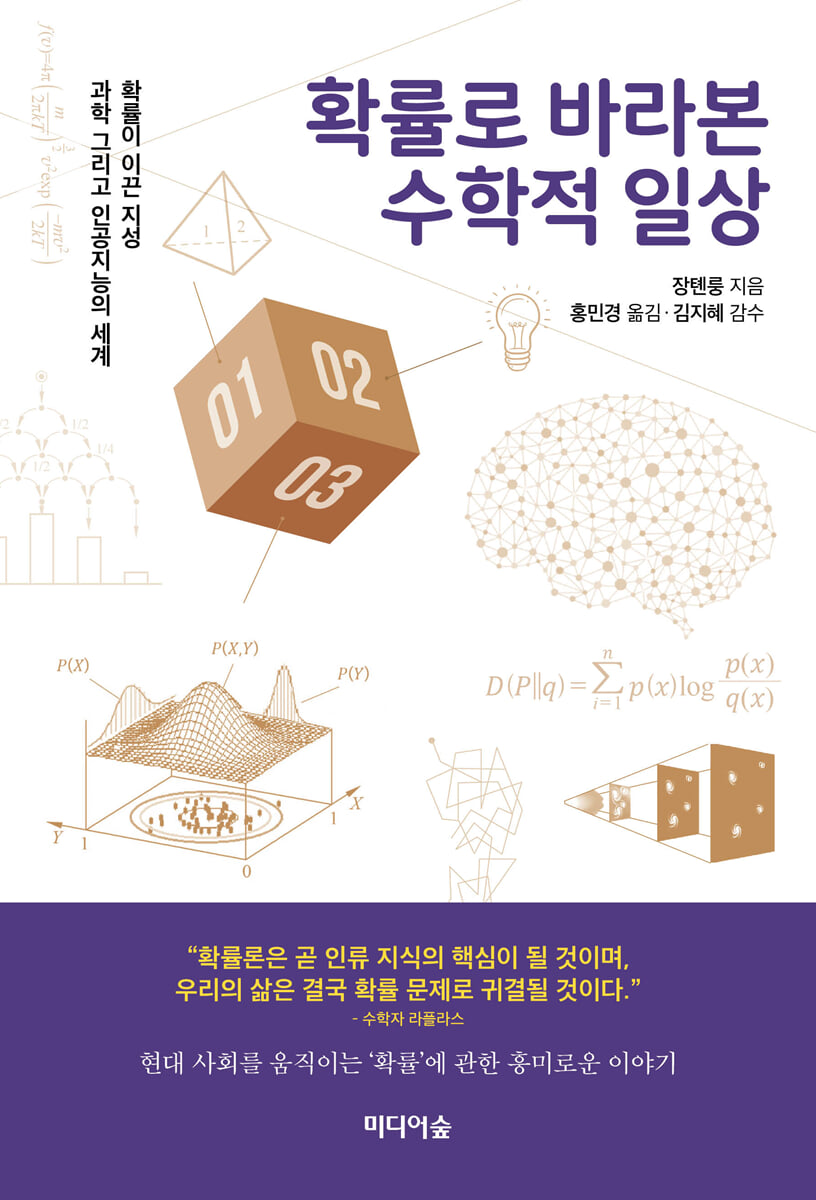
Mathematical everyday life viewed through probability
 |
Description
Book Introduction
"The Story of Probability, From Dice to the Heart of Artificial Intelligence"
Random walk, Bayes, information entropy, quantum mechanics
Understanding artificial intelligence
It's easy to believe that artificial intelligence is a being that calculates everything precisely.
However, Dr. Zhang Tianlong, the author of this book, does not subscribe to this belief.
This book compellingly demonstrates that the true workings of the artificial intelligence that dominates our daily lives are surprisingly rooted in the mathematical concept of probability.
The author received a Ph.D. in theoretical physics from the University of Texas at Austin, and is a science writer who has taught science for a long time at the University of Science and Technology of China, where he has conveyed cutting-edge topics such as quantum mechanics, cosmology, and artificial intelligence to the general public in an easy and interesting way.
Her writing is renowned for its ability to interpret the rigorous language of science in a story-like, entertaining way.
This book begins with a simple question.
“How can we predict what number will come up when we roll a die?” And the story soon expands to Bernoulli’s law, Bayesian inference, Markov chains, and information entropy.
Next, we will gradually unravel how these concepts are connected to AlphaGo, ChatGPT, recommendation algorithms, and language generation models.
In particular, interesting probability problems and thought experiments such as the 'rat and poison problem' and 'Bayes' billiard table' provide readers with a sense of immersion as if they are experiencing mathematical concepts with their whole body.
When readers reach the conclusion that “AI does not know the right answer, but rather predicts plausible answers probabilistically,” they will finally understand the power of probability.
As scientific civilization becomes more precise, probability becomes more important.
In a reality where we cannot know all the data, we have to choose the 'most plausible' among the possible ones.
The basis for that judgment is probability.
Interpreting the world through probability and finding order in uncertainty.
"Mathematical Everyday Life Seen Through Probability" explores the world of probability without complex formulas, and through real-life examples, clearly shows the principles within which the era we live operates.
For everyone living in uncertain times, this book will serve as an intellectual compass.
Random walk, Bayes, information entropy, quantum mechanics
Understanding artificial intelligence
It's easy to believe that artificial intelligence is a being that calculates everything precisely.
However, Dr. Zhang Tianlong, the author of this book, does not subscribe to this belief.
This book compellingly demonstrates that the true workings of the artificial intelligence that dominates our daily lives are surprisingly rooted in the mathematical concept of probability.
The author received a Ph.D. in theoretical physics from the University of Texas at Austin, and is a science writer who has taught science for a long time at the University of Science and Technology of China, where he has conveyed cutting-edge topics such as quantum mechanics, cosmology, and artificial intelligence to the general public in an easy and interesting way.
Her writing is renowned for its ability to interpret the rigorous language of science in a story-like, entertaining way.
This book begins with a simple question.
“How can we predict what number will come up when we roll a die?” And the story soon expands to Bernoulli’s law, Bayesian inference, Markov chains, and information entropy.
Next, we will gradually unravel how these concepts are connected to AlphaGo, ChatGPT, recommendation algorithms, and language generation models.
In particular, interesting probability problems and thought experiments such as the 'rat and poison problem' and 'Bayes' billiard table' provide readers with a sense of immersion as if they are experiencing mathematical concepts with their whole body.
When readers reach the conclusion that “AI does not know the right answer, but rather predicts plausible answers probabilistically,” they will finally understand the power of probability.
As scientific civilization becomes more precise, probability becomes more important.
In a reality where we cannot know all the data, we have to choose the 'most plausible' among the possible ones.
The basis for that judgment is probability.
Interpreting the world through probability and finding order in uncertainty.
"Mathematical Everyday Life Seen Through Probability" explores the world of probability without complex formulas, and through real-life examples, clearly shows the principles within which the era we live operates.
For everyone living in uncertain times, this book will serve as an intellectual compass.
- You can preview some of the book's contents.
Preview
index
Entering
1.
Probability, the fairest game in the world?
01) Pascal and French Mathematicians: The Birth of Probability Theory
02) Sounds plausible, but wrong! The paradox of probability theory
03) Geometric probability and Bertrand's paradox
04) Question Your Intuition: The Power of Probability to Uncover Accounting Fraud
05) Gambler's Fallacy: Probability and the Law of Large Numbers
06) The Bell-Shaped Curve Appears Everywhere: Central Limit Theorem
2.
What would Bayes think?
01) Monty Hall problem
02) What on Earth is Probability? A Philosophical Reflection Beginning with the Monty Hall Dilemma
03) Frequentist vs.
Bayesian school
04) Between Subjective and Objective, Where Does Probability Come From?
05) What can save quantum mechanics?
06) Bayes' billiard table problem
3.
Probability Dances: The Movement of a Random World
01) Markov chain
02) A drunken man's wanderings: A mathematical model of a random walk
03) The Gambler's Bankruptcy and the Bird's Return
04) Wandering of Microparticles: Brownian Motion
4.
Entropy: Order in Chaos
01) The story that began in Carnot: Nature envied talent
02) Entropy, which appeared like a comet on the stage of thermodynamics
03) That guy with an unfamiliar name and a difficult personality
04) The arrow of time penetrating the universe
05) Maxwell's Goblin
5.
How Messy Is Information?: The Story of Information Entropy
01) Entropy enters the world of information
02) The various faces of entropy
03) The rat and poison problem
04) Different ball shapes? Scale problem
05) Don't put all your eggs in one basket.
6.
When the Internet and Probability Meet
01) A small world within a huge network
02) Network and Graph Theory
03) How big is the network?
04) Interesting random big network
7.
Artificial Intelligence and Statistics: The Secrets of Thinking Machines
01) AlphaGo's match of the century
02) The Rise and Fall of Artificial Intelligence: Three Rise and Falls
03) Hidden Markov Model (HMM)
04) Support Vector Machine (SVM)
05) How do machines learn 'deeply'?
06) ChatGPT, Talking Statistics
1.
Probability, the fairest game in the world?
01) Pascal and French Mathematicians: The Birth of Probability Theory
02) Sounds plausible, but wrong! The paradox of probability theory
03) Geometric probability and Bertrand's paradox
04) Question Your Intuition: The Power of Probability to Uncover Accounting Fraud
05) Gambler's Fallacy: Probability and the Law of Large Numbers
06) The Bell-Shaped Curve Appears Everywhere: Central Limit Theorem
2.
What would Bayes think?
01) Monty Hall problem
02) What on Earth is Probability? A Philosophical Reflection Beginning with the Monty Hall Dilemma
03) Frequentist vs.
Bayesian school
04) Between Subjective and Objective, Where Does Probability Come From?
05) What can save quantum mechanics?
06) Bayes' billiard table problem
3.
Probability Dances: The Movement of a Random World
01) Markov chain
02) A drunken man's wanderings: A mathematical model of a random walk
03) The Gambler's Bankruptcy and the Bird's Return
04) Wandering of Microparticles: Brownian Motion
4.
Entropy: Order in Chaos
01) The story that began in Carnot: Nature envied talent
02) Entropy, which appeared like a comet on the stage of thermodynamics
03) That guy with an unfamiliar name and a difficult personality
04) The arrow of time penetrating the universe
05) Maxwell's Goblin
5.
How Messy Is Information?: The Story of Information Entropy
01) Entropy enters the world of information
02) The various faces of entropy
03) The rat and poison problem
04) Different ball shapes? Scale problem
05) Don't put all your eggs in one basket.
6.
When the Internet and Probability Meet
01) A small world within a huge network
02) Network and Graph Theory
03) How big is the network?
04) Interesting random big network
7.
Artificial Intelligence and Statistics: The Secrets of Thinking Machines
01) AlphaGo's match of the century
02) The Rise and Fall of Artificial Intelligence: Three Rise and Falls
03) Hidden Markov Model (HMM)
04) Support Vector Machine (SVM)
05) How do machines learn 'deeply'?
06) ChatGPT, Talking Statistics
Detailed image

Into the book
Dice have been used in gambling since ancient times, and it appears that humans have been using them for 5,000 years.
Although the Egyptians were the first to invent dice, similar items that were independently invented by several other ancient civilizations appear in the history of the world.
But even though humans have been playing with dice for thousands of years, shaking and throwing them, that doesn't mean we've fully grasped the profound mathematical secrets hidden within them.
-----------------------------------------------
Although the definition of 'probability' may seem easy to understand and accessible to everyone, we should not overlook the fact that the results of probability calculations often contradict our intuition.
This is because it is difficult to explain even with probability theory, and paradoxes that seem plausible but are not true exist everywhere.
However, that doesn't mean you should blindly trust your intuition.
Our brains can create errors and blind spots.
-----------------------------------------------
In 2001, Enron, the largest energy trading company in the United States, declared bankruptcy, and news broke that the company's top executives were accused of falsifying accounts.
Enron's top executives manipulated financial data, causing their published earnings per share data for 2000-2001 to not conform to Benford's Law.
Benford's law can also be used to analyze the stock market or monitor election manipulation.
-----------------------------------------------
The wonder of the central limit theorem cannot be denied.
Under certain conditions, when random variables generated from various types of probability distributions are combined, the overall effect follows a normal distribution.
This is particularly useful in statistical experiments, because real biological or physical stochastic processes do not arise from a single cause, but are influenced by many random factors.
-----------------------------------------------
While frequentists seek to explain the nature of things, Bayesians focus on explaining how an observer's state of knowledge is updated after a new observation occurs.
This can be seen as a difference in worldview affecting a difference in method.
For example, in the process of coin tossing, the frequentist school emphasizes 'multiple trials', while the Bayesian school emphasizes exploring ways to update the 'outcome of the trial'.
-----------------------------------------------
The winner's process is an extreme process of a random walk.
In general, a random walk is a process of moving one grid at a time within a grid space, and if the distance between grid points is ??, then the Wiener process is the limit of the random walk process when ?? approaches 0.
-----------------------------------------------
Maxwell initially studied the dynamical theory of gases and maintained the view that 'the absolute temperature of a gas is a measure of the kinetic energy of its particles', but at a constant temperature ?? he believed that the kinetic energy of all molecules was not a single fixed value but followed the law of statistical distribution, that is, a distribution curve.
The velocity of individual particles continually changes due to collisions with other particles, but in the case of a large number of particles, the proportion of particles within a particular velocity range remains almost constant.
-----------------------------------------------
1928 RVH
Harley RVH
Harley once suggested that information be expressed in terms of ??log??.
In 1949, Wiener, the founder of cybernetics, introduced the concept of quantitative information to thermodynamics.
In 1948, Shannon viewed information as a concept that describes the uncertainty of the state of motion or existence of an object, and derived a formula for the amount of information by extending Halley's formula to cases where each probability ???? is different.
In this way, he gave birth to information theory for us, defined the scientific meaning of 'information', and became the 'father of information'.
-----------------------------------------------
In the case of a human relationship network, each individual can be considered a vertex in the graph.
For example, the relationships between people, whether they know each other or not, are represented by edges connecting the vertices of the graph.
Using a 'graph' as a network model is not the only way, and its choice depends on the subject of research.
For example, a human relationship network may have individuals or groups as vertices.
-----------------------------------------------
To better understand the role of convolution, we can compare it to the Fourier analysis of an audio signal.
Sound signals exhibit very complex curves in the time domain, and a large amount of data is required to represent them.
If converted to the frequency domain through Fourier, it can be displayed with only a small amount of spectrum, fundamental frequency, and a few harmonic overtone data.
In other words, Fourier analysis can effectively extract and store the main components in a sound signal and reduce the number of dimensions describing the data.
Although the Egyptians were the first to invent dice, similar items that were independently invented by several other ancient civilizations appear in the history of the world.
But even though humans have been playing with dice for thousands of years, shaking and throwing them, that doesn't mean we've fully grasped the profound mathematical secrets hidden within them.
-----------------------------------------------
Although the definition of 'probability' may seem easy to understand and accessible to everyone, we should not overlook the fact that the results of probability calculations often contradict our intuition.
This is because it is difficult to explain even with probability theory, and paradoxes that seem plausible but are not true exist everywhere.
However, that doesn't mean you should blindly trust your intuition.
Our brains can create errors and blind spots.
-----------------------------------------------
In 2001, Enron, the largest energy trading company in the United States, declared bankruptcy, and news broke that the company's top executives were accused of falsifying accounts.
Enron's top executives manipulated financial data, causing their published earnings per share data for 2000-2001 to not conform to Benford's Law.
Benford's law can also be used to analyze the stock market or monitor election manipulation.
-----------------------------------------------
The wonder of the central limit theorem cannot be denied.
Under certain conditions, when random variables generated from various types of probability distributions are combined, the overall effect follows a normal distribution.
This is particularly useful in statistical experiments, because real biological or physical stochastic processes do not arise from a single cause, but are influenced by many random factors.
-----------------------------------------------
While frequentists seek to explain the nature of things, Bayesians focus on explaining how an observer's state of knowledge is updated after a new observation occurs.
This can be seen as a difference in worldview affecting a difference in method.
For example, in the process of coin tossing, the frequentist school emphasizes 'multiple trials', while the Bayesian school emphasizes exploring ways to update the 'outcome of the trial'.
-----------------------------------------------
The winner's process is an extreme process of a random walk.
In general, a random walk is a process of moving one grid at a time within a grid space, and if the distance between grid points is ??, then the Wiener process is the limit of the random walk process when ?? approaches 0.
-----------------------------------------------
Maxwell initially studied the dynamical theory of gases and maintained the view that 'the absolute temperature of a gas is a measure of the kinetic energy of its particles', but at a constant temperature ?? he believed that the kinetic energy of all molecules was not a single fixed value but followed the law of statistical distribution, that is, a distribution curve.
The velocity of individual particles continually changes due to collisions with other particles, but in the case of a large number of particles, the proportion of particles within a particular velocity range remains almost constant.
-----------------------------------------------
1928 RVH
Harley RVH
Harley once suggested that information be expressed in terms of ??log??.
In 1949, Wiener, the founder of cybernetics, introduced the concept of quantitative information to thermodynamics.
In 1948, Shannon viewed information as a concept that describes the uncertainty of the state of motion or existence of an object, and derived a formula for the amount of information by extending Halley's formula to cases where each probability ???? is different.
In this way, he gave birth to information theory for us, defined the scientific meaning of 'information', and became the 'father of information'.
-----------------------------------------------
In the case of a human relationship network, each individual can be considered a vertex in the graph.
For example, the relationships between people, whether they know each other or not, are represented by edges connecting the vertices of the graph.
Using a 'graph' as a network model is not the only way, and its choice depends on the subject of research.
For example, a human relationship network may have individuals or groups as vertices.
-----------------------------------------------
To better understand the role of convolution, we can compare it to the Fourier analysis of an audio signal.
Sound signals exhibit very complex curves in the time domain, and a large amount of data is required to represent them.
If converted to the frequency domain through Fourier, it can be displayed with only a small amount of spectrum, fundamental frequency, and a few harmonic overtone data.
In other words, Fourier analysis can effectively extract and store the main components in a sound signal and reduce the number of dimensions describing the data.
--- From the text
Publisher's Review
From lotteries, big data, autonomous driving, and ChatGPT.
A Journey Through Modern Science: Learning Through Probability
“Are probabilities vague and uncertain?”
Probability is not a vague concept,
It's the smartest way to understand the world.
“Probability is just a guess.”
Many people say this.
When we guess on an unknown question on a test or buy a lottery ticket, we tend to think of probability as 'luck'.
But this book provides an interesting explanation of how wrong this thinking is.
The author of this book argues that probability is not just used in dice or gambling, but also plays a very important role in the artificial intelligence we use every day.
For example, when AlphaGo plays Go, it doesn't calculate a move and choose the 'correct answer'.
Instead, choose by calculating the probability that “if you make this number, you have a high chance of winning.”
The same goes for music recommendations on smartphones and YouTube videos.
It's about choosing the 'most plausible' one from among numerous possibilities.
This is the power of probability.
We often think, 'We've had five heads, so now it's time for tails.'
But this is a huge misconception.
Since the outcome of a coin flip is independent each time, the number of heads that come up does not affect the next outcome.
If you don't know the odds accurately, you can lose money because of this illusion.
Some people say that probability is a rough and unreliable field.
But surprisingly, probability is how artificial intelligence understands and moves in the world.
Probability is not a way to 'make smarter choices because you don't know', but rather a way to 'make smarter choices because you don't know'.
"Mathematical Everyday Life Seen Through Probability" provides an exciting glimpse into the world of probability, revealing that the concept of probability is not confined to mathematics textbooks, but is active everywhere around us.
Finding patterns in seemingly random events and making the best choices in uncertainty—that's the true role of probability.
After reading this book, you will probably say the same thing.
“I never knew probability could be such a fun and useful subject!”
The core principles that drive modern society
An interesting story about 'probability'
These days, the news is flooded with articles like "Failure of zero-sum investment," "Coin crash," and "Lost entire fortune in futures options."
From 20-somethings addicted to internet gambling sites, to young people who are saddled with debt from short-term stock trading, to young adults just starting out in society who can't even close their eyes at night due to derivatives, people constantly appear in this uncertain world, hoping for a single "jackpot."
However, 『Mathematical Everyday Life Viewed Through Probability』 offers mathematical insights to those who are riding this dangerous wave.
This book is not just a simple math textbook.
This survival guide examines human error through the lens of probability and teaches us how to view the world more wisely, like AI.
The "Gambler's Ruin" problem in the book provides surprising insights into understanding real-world investment failures.
The story begins like this.
There is a gambler.
He plays a fair game, with a 50% chance of winning or losing on each hand.
The initial capital is $10 and the goal is to have $20.
But once he starts losing, he's left with only one choice.
“You can’t stop until you pick it up again.” In theory, it seems fair, but mathematically, the outcome is predetermined.
He eventually goes bankrupt.
Why is that?
Statistically speaking, each hand may be a close match, but if someone with infinite funds continues to bet, they will eventually run out of money.
As the probability of losing increases, the probability of going bankrupt gets closer to 1 (100%).
There is a chance to win in every round, but the possibility of losing also continues to accumulate, and if enough time passes, you will eventually reach a point where your funds become zero.
In the end, 'bankruptcy' becomes, mathematically speaking, an 'almost certain fate'.
This is not just a simple math puzzle.
The self-suggestion that “you’ll get it eventually” is actually a choice that probabilistically guarantees ruin.
This principle is still repeated throughout our society today.
The act of "throwing a wedge" in high-return, high-risk investment products dozens or hundreds of times, betting all your money and shouting "just this once", is based on a misunderstanding or ignorance of probability.
『Mathematical Everyday Life Viewed Through Probability』 helps us escape from this kind of ignorance.
This book shows how AI deals with probability, such as AlphaGo, ChatGPT, spam filters, and recommendation algorithms, while also showing how the ability to think probabilistically is a powerful survival tool.
Because our work and daily life are closely related to probability.
As you read this book, you will realize:
We live in a world of constant uncertainty, and what we need to win in it is not 'feeling', but the power to understand and utilize probability.
Probability is not just a mathematical discipline.
It's a tool that helps you reduce risk, improve judgment, and learn how to survive.
That is the message of this book.
And it is also the most necessary survival skill for us living today.
A Journey Through Modern Science: Learning Through Probability
“Are probabilities vague and uncertain?”
Probability is not a vague concept,
It's the smartest way to understand the world.
“Probability is just a guess.”
Many people say this.
When we guess on an unknown question on a test or buy a lottery ticket, we tend to think of probability as 'luck'.
But this book provides an interesting explanation of how wrong this thinking is.
The author of this book argues that probability is not just used in dice or gambling, but also plays a very important role in the artificial intelligence we use every day.
For example, when AlphaGo plays Go, it doesn't calculate a move and choose the 'correct answer'.
Instead, choose by calculating the probability that “if you make this number, you have a high chance of winning.”
The same goes for music recommendations on smartphones and YouTube videos.
It's about choosing the 'most plausible' one from among numerous possibilities.
This is the power of probability.
We often think, 'We've had five heads, so now it's time for tails.'
But this is a huge misconception.
Since the outcome of a coin flip is independent each time, the number of heads that come up does not affect the next outcome.
If you don't know the odds accurately, you can lose money because of this illusion.
Some people say that probability is a rough and unreliable field.
But surprisingly, probability is how artificial intelligence understands and moves in the world.
Probability is not a way to 'make smarter choices because you don't know', but rather a way to 'make smarter choices because you don't know'.
"Mathematical Everyday Life Seen Through Probability" provides an exciting glimpse into the world of probability, revealing that the concept of probability is not confined to mathematics textbooks, but is active everywhere around us.
Finding patterns in seemingly random events and making the best choices in uncertainty—that's the true role of probability.
After reading this book, you will probably say the same thing.
“I never knew probability could be such a fun and useful subject!”
The core principles that drive modern society
An interesting story about 'probability'
These days, the news is flooded with articles like "Failure of zero-sum investment," "Coin crash," and "Lost entire fortune in futures options."
From 20-somethings addicted to internet gambling sites, to young people who are saddled with debt from short-term stock trading, to young adults just starting out in society who can't even close their eyes at night due to derivatives, people constantly appear in this uncertain world, hoping for a single "jackpot."
However, 『Mathematical Everyday Life Viewed Through Probability』 offers mathematical insights to those who are riding this dangerous wave.
This book is not just a simple math textbook.
This survival guide examines human error through the lens of probability and teaches us how to view the world more wisely, like AI.
The "Gambler's Ruin" problem in the book provides surprising insights into understanding real-world investment failures.
The story begins like this.
There is a gambler.
He plays a fair game, with a 50% chance of winning or losing on each hand.
The initial capital is $10 and the goal is to have $20.
But once he starts losing, he's left with only one choice.
“You can’t stop until you pick it up again.” In theory, it seems fair, but mathematically, the outcome is predetermined.
He eventually goes bankrupt.
Why is that?
Statistically speaking, each hand may be a close match, but if someone with infinite funds continues to bet, they will eventually run out of money.
As the probability of losing increases, the probability of going bankrupt gets closer to 1 (100%).
There is a chance to win in every round, but the possibility of losing also continues to accumulate, and if enough time passes, you will eventually reach a point where your funds become zero.
In the end, 'bankruptcy' becomes, mathematically speaking, an 'almost certain fate'.
This is not just a simple math puzzle.
The self-suggestion that “you’ll get it eventually” is actually a choice that probabilistically guarantees ruin.
This principle is still repeated throughout our society today.
The act of "throwing a wedge" in high-return, high-risk investment products dozens or hundreds of times, betting all your money and shouting "just this once", is based on a misunderstanding or ignorance of probability.
『Mathematical Everyday Life Viewed Through Probability』 helps us escape from this kind of ignorance.
This book shows how AI deals with probability, such as AlphaGo, ChatGPT, spam filters, and recommendation algorithms, while also showing how the ability to think probabilistically is a powerful survival tool.
Because our work and daily life are closely related to probability.
As you read this book, you will realize:
We live in a world of constant uncertainty, and what we need to win in it is not 'feeling', but the power to understand and utilize probability.
Probability is not just a mathematical discipline.
It's a tool that helps you reduce risk, improve judgment, and learn how to survive.
That is the message of this book.
And it is also the most necessary survival skill for us living today.
GOODS SPECIFICS
- Date of issue: August 10, 2025
- Page count, weight, size: 320 pages | 153*225*30mm
- ISBN13: 9791158742553
- ISBN10: 115874255X
You may also like
카테고리
korean


korean

![GQ KOREA Mark (Monthly): December [2025]](http://librairie.coreenne.fr/cdn/shop/files/8ef265dbbfbf186523ed75ba7319009d.jpg?v=1765340328&width=3840)


