

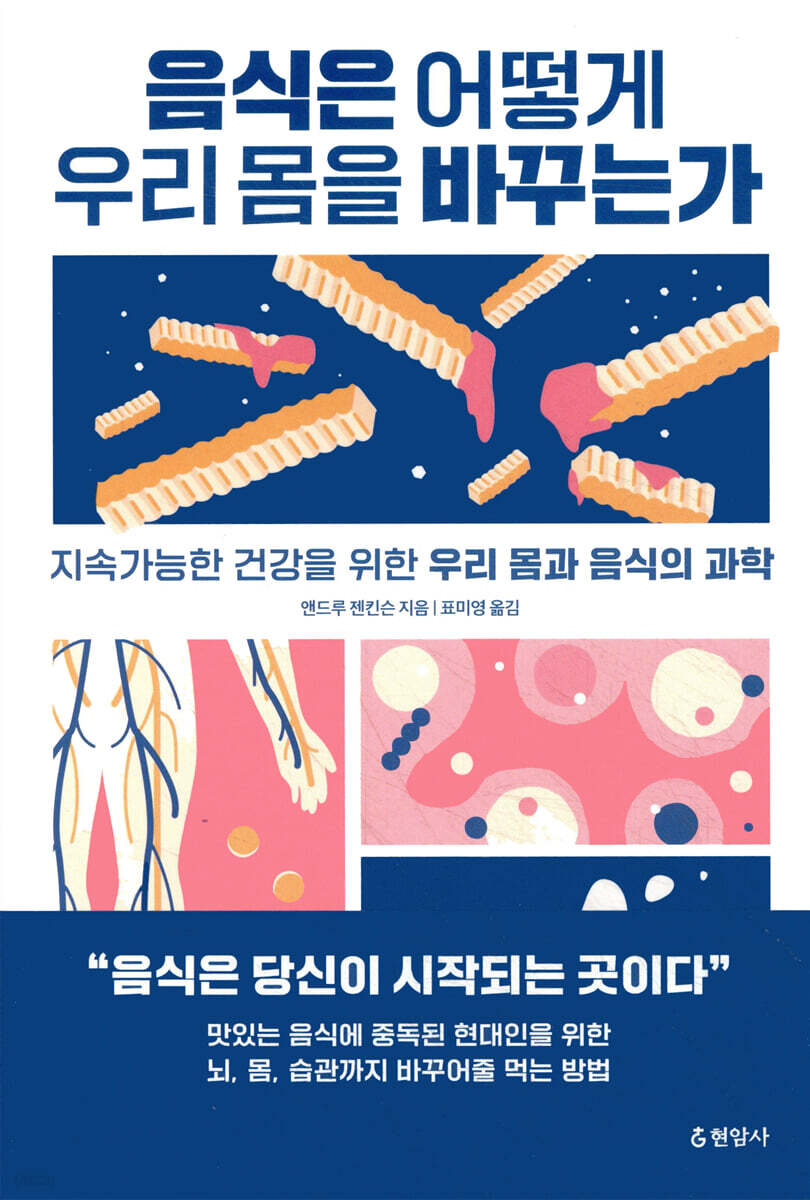
How Food Changes Our Body
 |
Description
Book Introduction
Food is where you begin.
For those of us who struggle between delicious food and a healthy diet.
The Science of Body and Food
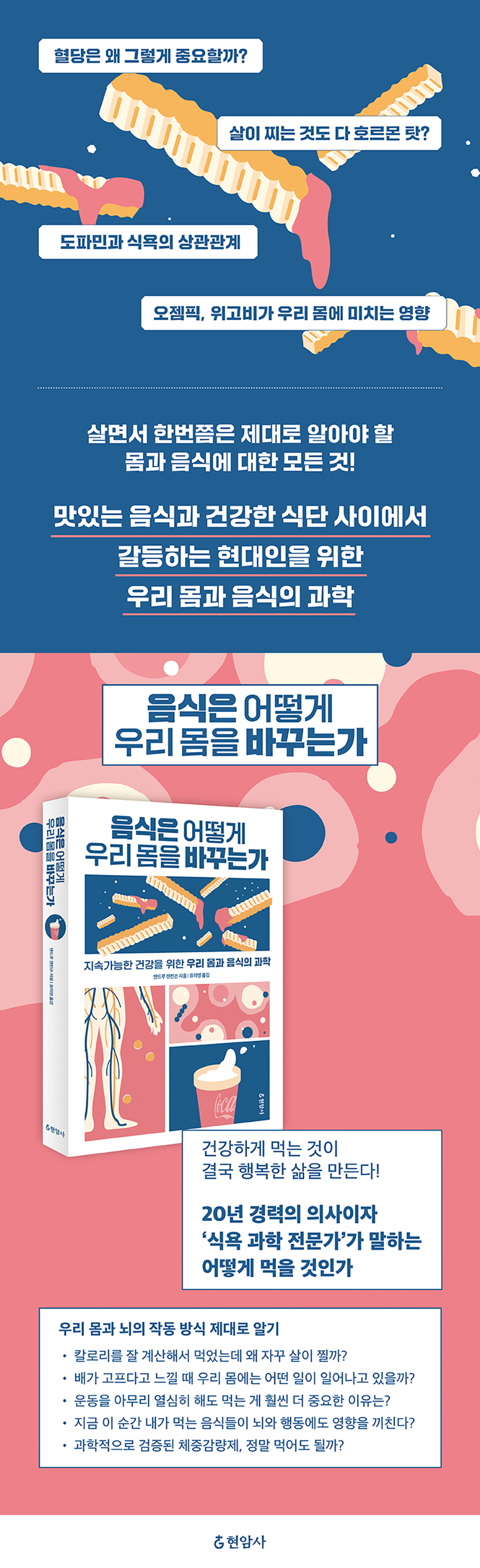
Weight loss supplements are probably the hottest topic among people interested in health and diet these days.
It is not uncommon to see broadcasts where not only foreign actors but also Korean celebrities talk about taking Ozempic, Wigobi, and even the recently released Maunjaro.
There is a perception that it will not cause health problems because it is a 'medicine' used to treat diabetes, but there are also doubts about whether a hormone regulator with such a powerful effect can actually be harmful.
How do weight loss supplements work? And how long do their effects last?
Andrew Jenkinson, author of How Food Changes Your Body and a metabolism expert, says in his book on the science of the body and food that a closer look at this supposedly miracle weight-loss injection reveals it's not as miraculous as it first appears.
Even if you take weight loss supplements, unresolved issues remain, and ultimately, the relationship between a healthy body and food can only be resolved through proper awareness and will.
It may sound like a very theoretical story, but the scientific stories about the body and food covered in this book are interesting knowledge that anyone interested in health can apply in their daily lives.
It faithfully and kindly explains a wide range of scientific knowledge and solutions for those who are curious about how to eat well and stay healthy for a long time.
For those of us who struggle between delicious food and a healthy diet.
The Science of Body and Food
Weight loss supplements are probably the hottest topic among people interested in health and diet these days.
It is not uncommon to see broadcasts where not only foreign actors but also Korean celebrities talk about taking Ozempic, Wigobi, and even the recently released Maunjaro.
There is a perception that it will not cause health problems because it is a 'medicine' used to treat diabetes, but there are also doubts about whether a hormone regulator with such a powerful effect can actually be harmful.
How do weight loss supplements work? And how long do their effects last?
Andrew Jenkinson, author of How Food Changes Your Body and a metabolism expert, says in his book on the science of the body and food that a closer look at this supposedly miracle weight-loss injection reveals it's not as miraculous as it first appears.
Even if you take weight loss supplements, unresolved issues remain, and ultimately, the relationship between a healthy body and food can only be resolved through proper awareness and will.
It may sound like a very theoretical story, but the scientific stories about the body and food covered in this book are interesting knowledge that anyone interested in health can apply in their daily lives.
It faithfully and kindly explains a wide range of scientific knowledge and solutions for those who are curious about how to eat well and stay healthy for a long time.
index
preface
To begin with
Part 1: The Body: How is the food we eat absorbed?
1.
Diet School: Understanding Appetite
2.
Modern Kitchen: Better, Longer
3.
Ultra-processed foods: what are they made of?
4.
The problem isn't the calories themselves, but the components that make up those calories: the weight gain signals foods send.
5.
Natural Foods: What Plants Give Us
6.
About Exercise: Does Exercise Help You Lose Weight?
Part 2: The Mind: How Does Our Brain Process Food?
7.
Who Am I: Understanding Unconscious Behavior
8.
Perceiving Our Surroundings: How Does Our Environment Shape Our Identity?
Part 3: Balance: How to Eat Healthy and Delicious Foods
9.
Change and Adjustment: Good Habits vs.
bad habit
10.
Cooking School: What to Eat?
11.
Last Order: Why Food Matters
12.
A variety of recipes: Enjoy cooking and eating deliciously!
finally
13.
Should You Take Weight Loss Pills?: The Pros and Cons of Weight Loss Pills, Back to the Pros
Acknowledgements
To begin with
Part 1: The Body: How is the food we eat absorbed?
1.
Diet School: Understanding Appetite
2.
Modern Kitchen: Better, Longer
3.
Ultra-processed foods: what are they made of?
4.
The problem isn't the calories themselves, but the components that make up those calories: the weight gain signals foods send.
5.
Natural Foods: What Plants Give Us
6.
About Exercise: Does Exercise Help You Lose Weight?
Part 2: The Mind: How Does Our Brain Process Food?
7.
Who Am I: Understanding Unconscious Behavior
8.
Perceiving Our Surroundings: How Does Our Environment Shape Our Identity?
Part 3: Balance: How to Eat Healthy and Delicious Foods
9.
Change and Adjustment: Good Habits vs.
bad habit
10.
Cooking School: What to Eat?
11.
Last Order: Why Food Matters
12.
A variety of recipes: Enjoy cooking and eating deliciously!
finally
13.
Should You Take Weight Loss Pills?: The Pros and Cons of Weight Loss Pills, Back to the Pros
Acknowledgements
preface
To begin with
Part 1: The Body: How is the food we eat absorbed?
1.
Diet School: Understanding Appetite
2.
Modern Kitchen: Better, Longer
3.
Ultra-processed foods: what are they made of?
4.
The problem isn't the calories themselves, but the components that make up those calories: the weight gain signals foods send.
5.
Natural Foods: What Plants Give Us
6.
About Exercise: Does Exercise Help You Lose Weight?
Part 2: The Mind: How Does Our Brain Process Food?
7.
Who Am I: Understanding Unconscious Behavior
8.
Perceiving Our Surroundings: How Does Our Environment Shape Our Identity?
Part 3: Balance: How to Eat Healthy and Delicious Foods
9.
Change and Adjustment: Good Habits vs.
bad habit
10.
Cooking School: What to Eat?
11.
Last Order: Why Food Matters
12.
A variety of recipes: Enjoy cooking and eating deliciously!
finally
13.
Should You Take Weight Loss Pills?: The Pros and Cons of Weight Loss Pills, Back to the Pros
Acknowledgements
preface
To begin with
Part 1: The Body: How is the food we eat absorbed?
1.
Diet School: Understanding Appetite
2.
Modern Kitchen: Better, Longer
3.
Ultra-processed foods: what are they made of?
4.
The problem isn't the calories themselves, but the components that make up those calories: the weight gain signals foods send.
5.
Natural Foods: What Plants Give Us
6.
About Exercise: Does Exercise Help You Lose Weight?
Part 2: The Mind: How Does Our Brain Process Food?
7.
Who Am I: Understanding Unconscious Behavior
8.
Perceiving Our Surroundings: How Does Our Environment Shape Our Identity?
Part 3: Balance: How to Eat Healthy and Delicious Foods
9.
Change and Adjustment: Good Habits vs.
bad habit
10.
Cooking School: What to Eat?
11.
Last Order: Why Food Matters
12.
A variety of recipes: Enjoy cooking and eating deliciously!
finally
13.
Should You Take Weight Loss Pills?: The Pros and Cons of Weight Loss Pills, Back to the Pros
Acknowledgements
To begin with
Part 1: The Body: How is the food we eat absorbed?
1.
Diet School: Understanding Appetite
2.
Modern Kitchen: Better, Longer
3.
Ultra-processed foods: what are they made of?
4.
The problem isn't the calories themselves, but the components that make up those calories: the weight gain signals foods send.
5.
Natural Foods: What Plants Give Us
6.
About Exercise: Does Exercise Help You Lose Weight?
Part 2: The Mind: How Does Our Brain Process Food?
7.
Who Am I: Understanding Unconscious Behavior
8.
Perceiving Our Surroundings: How Does Our Environment Shape Our Identity?
Part 3: Balance: How to Eat Healthy and Delicious Foods
9.
Change and Adjustment: Good Habits vs.
bad habit
10.
Cooking School: What to Eat?
11.
Last Order: Why Food Matters
12.
A variety of recipes: Enjoy cooking and eating deliciously!
finally
13.
Should You Take Weight Loss Pills?: The Pros and Cons of Weight Loss Pills, Back to the Pros
Acknowledgements
preface
To begin with
Part 1: The Body: How is the food we eat absorbed?
1.
Diet School: Understanding Appetite
2.
Modern Kitchen: Better, Longer
3.
Ultra-processed foods: what are they made of?
4.
The problem isn't the calories themselves, but the components that make up those calories: the weight gain signals foods send.
5.
Natural Foods: What Plants Give Us
6.
About Exercise: Does Exercise Help You Lose Weight?
Part 2: The Mind: How Does Our Brain Process Food?
7.
Who Am I: Understanding Unconscious Behavior
8.
Perceiving Our Surroundings: How Does Our Environment Shape Our Identity?
Part 3: Balance: How to Eat Healthy and Delicious Foods
9.
Change and Adjustment: Good Habits vs.
bad habit
10.
Cooking School: What to Eat?
11.
Last Order: Why Food Matters
12.
A variety of recipes: Enjoy cooking and eating deliciously!
finally
13.
Should You Take Weight Loss Pills?: The Pros and Cons of Weight Loss Pills, Back to the Pros
Acknowledgements
Detailed image
Into the book
This book will lift the hood of the human body and explain how the delicious and addictive foods around us are destroying our bodies and minds.
We will learn why the human body is not designed to use such foods for fuel, how it interferes with the body's normal functioning and causes miscalculations in the brain.
Novel foods may make us feel unnaturally good, but they often increase our fat-based fuel reserves, contributing to oxidation, corrosion, and modern Western diseases.
In other words, it makes us die early.
- From the preface
I explained that leptin acts like a fuel gauge signal in a car.
Imagine you're driving down the road and you see your low fuel warning light flashing.
You might immediately start looking for gas (feeling hungry when you're leptin resistant), and you might start driving slowly to save fuel because you're so worried that your car will stall before you can fill up (feeling tired when you're leptin resistant).
When you arrive at the gas station to fill up, you realize that the fuel tank is already full and that the problem is a faulty fuel gauge.
--- From "Chapter 1 Diet School"
Thanks to years of research and thousands of tasting experiments involving volunteers, food scientists have been able to measure the level of pleasure we experience from different foods.
This is our hedonic taste code.
After painstaking research, they figured out exactly how taste codes work.
We've figured out which foods we crave, crave, and keep coming back for.
It's as if our precious and secret flavor code has been hacked, leaving us vulnerable to anyone who possesses this valuable data.
--- From "Chapter 2 Modern Kitchen"
It certainly seems that 'stopping' regular exercise leads to weight gain.
I have seen many patients in my clinic who are retired elite athletes, especially swimmers.
They say they are unable to train due to injury or have gained significant weight after ending their elite athletic careers and are having difficulty losing the weight they have gained.
So, what's the importance of exercise in weight management? Is it more or less important than a healthy diet? What type of exercise is best?
--- From “Chapter 6: On Exercise”
In Chapter 7, we learned that our brain never forgets any kind of habit.
When you stop a habit, the neural pathways may become covered and weakened over time, but they never go away.
The most successful way to overcome bad habits is to replace them with good habits that align with your identity.
To do this, you need to make your bad habits less noticeable.
That is, we need to remove the clues to make it more difficult to obtain the reward.
To break the habit of eating fast food on the way home from work, you can change the route you take home so that you're not tempted to indulge in the bad habit.
Alternatively, eating a healthy snack 30 minutes before leaving work can help curb hunger pangs on your way home.
If your bad habit is spending too much time watching Netflix in the evenings and your trigger is coming home from work and turning on the television, it can make it physically difficult to perform the behavior.
We will learn why the human body is not designed to use such foods for fuel, how it interferes with the body's normal functioning and causes miscalculations in the brain.
Novel foods may make us feel unnaturally good, but they often increase our fat-based fuel reserves, contributing to oxidation, corrosion, and modern Western diseases.
In other words, it makes us die early.
- From the preface
I explained that leptin acts like a fuel gauge signal in a car.
Imagine you're driving down the road and you see your low fuel warning light flashing.
You might immediately start looking for gas (feeling hungry when you're leptin resistant), and you might start driving slowly to save fuel because you're so worried that your car will stall before you can fill up (feeling tired when you're leptin resistant).
When you arrive at the gas station to fill up, you realize that the fuel tank is already full and that the problem is a faulty fuel gauge.
--- From "Chapter 1 Diet School"
Thanks to years of research and thousands of tasting experiments involving volunteers, food scientists have been able to measure the level of pleasure we experience from different foods.
This is our hedonic taste code.
After painstaking research, they figured out exactly how taste codes work.
We've figured out which foods we crave, crave, and keep coming back for.
It's as if our precious and secret flavor code has been hacked, leaving us vulnerable to anyone who possesses this valuable data.
--- From "Chapter 2 Modern Kitchen"
It certainly seems that 'stopping' regular exercise leads to weight gain.
I have seen many patients in my clinic who are retired elite athletes, especially swimmers.
They say they are unable to train due to injury or have gained significant weight after ending their elite athletic careers and are having difficulty losing the weight they have gained.
So, what's the importance of exercise in weight management? Is it more or less important than a healthy diet? What type of exercise is best?
--- From “Chapter 6: On Exercise”
In Chapter 7, we learned that our brain never forgets any kind of habit.
When you stop a habit, the neural pathways may become covered and weakened over time, but they never go away.
The most successful way to overcome bad habits is to replace them with good habits that align with your identity.
To do this, you need to make your bad habits less noticeable.
That is, we need to remove the clues to make it more difficult to obtain the reward.
To break the habit of eating fast food on the way home from work, you can change the route you take home so that you're not tempted to indulge in the bad habit.
Alternatively, eating a healthy snack 30 minutes before leaving work can help curb hunger pangs on your way home.
If your bad habit is spending too much time watching Netflix in the evenings and your trigger is coming home from work and turning on the television, it can make it physically difficult to perform the behavior.
--- From “Chapter 9 Change and Control”
Publisher's Review
Andrew Jenkinson, known as an "appetite science expert" through his previous work, "The Science of Appetite," which was a British bestseller and a steady seller for Korean readers, has been researching obesity for the past 20 years, caring for over 3,000 patients.
While the previous work focused on the "science of the body" that comes with eating food, this book, "How Food Changes Our Bodies," explores how food, our bodies, and our brains are interconnected and function, how these changes impact people's habits and daily lives, and presents specific, practical ways to protect our bodies from the harmful effects of food marketing and processed foods.
Drawing on cutting-edge science related to metabolism, we explore sustainable health across the brain, body, and diverse food cultures.
Basal metabolic rate, blood sugar, leptin hormone, dopamine, processed foods, weight loss supplements…
Something you should know at least once in your life
All about body and food
This book is divided into three main parts: Part 1 is about the body, Part 2 is about the brain, and Part 3 is about balance.
Part 1 covers how the food we eat is absorbed into our bodies, and Part 2 covers how the brain processes food.
These chapters cover the basics of how the body and brain work, from metabolic rate and blood sugar to hormones, processed foods, and weight loss supplements.
And in Part 3, we present realistic alternatives for how to balance eating delicious food with a healthy lifestyle in modern society.
The methods are diverse and practical, ranging from principles for creating real habits and methods for meal planning to recipes for healthy meals from around the world.
Furthermore, since this book places a significant emphasis on the topic of food in modern society, it goes beyond simply discussing the science of food and the body, allowing readers to read the vast flow of civilization that is food culture.
Even ultra-processed foods, which are currently the biggest topic of debate when it comes to health, are in line with the flow of human culture that has been processing food.
Humanity has explored various ways to make natural foods more delicious, fragrant, and preserve them for longer. This led to drying, salting, and smoking, which we are familiar with, and canning and freezing, and finally to today's ultra-processed foods with added antioxidants.
The author says that these foods are not only easy to store, but also reflect everything humans prefer, from flavors and textures to colors and central nervous system-stimulating hedonistic tastes, making it difficult for modern people to avoid eating them.
However, this development has been linked to a number of conditions that have become prevalent over the past 30 to 40 years, including not only obesity but also neurological disorders such as attention deficit disorder, hyperactivity disorder, autism, and Alzheimer's disease.
Rather than simply discussing the effects of food, this book explores how food, a crucial part of human civilization, has formed and its impact on our daily lives, from a physician's perspective, based on metabolic knowledge.
Eating healthy ultimately leads to a happy life.
A doctor with 20 years of experience and an 'appetite science expert' says:
How to eat
“If you eat it deliciously, it’s 0 calories.” This is a mantra that modern people who are conflicted between delicious food and a healthy diet often recite.
I can't give up delicious food, but I also want to know and eat healthy foods.
This book is about the foods that destroy us, the foods that save us, and the bodies that run on that food.
It provides scientifically-based, easy-to-understand, and specific information about how delicious and addictive foods can destroy our bodies, and conversely, which foods are designed to save our bodies.
If you want to live a long, healthy life, and eat well, this book contains everything you need to know about your body and food.
While the previous work focused on the "science of the body" that comes with eating food, this book, "How Food Changes Our Bodies," explores how food, our bodies, and our brains are interconnected and function, how these changes impact people's habits and daily lives, and presents specific, practical ways to protect our bodies from the harmful effects of food marketing and processed foods.
Drawing on cutting-edge science related to metabolism, we explore sustainable health across the brain, body, and diverse food cultures.
Basal metabolic rate, blood sugar, leptin hormone, dopamine, processed foods, weight loss supplements…
Something you should know at least once in your life
All about body and food
This book is divided into three main parts: Part 1 is about the body, Part 2 is about the brain, and Part 3 is about balance.
Part 1 covers how the food we eat is absorbed into our bodies, and Part 2 covers how the brain processes food.
These chapters cover the basics of how the body and brain work, from metabolic rate and blood sugar to hormones, processed foods, and weight loss supplements.
And in Part 3, we present realistic alternatives for how to balance eating delicious food with a healthy lifestyle in modern society.
The methods are diverse and practical, ranging from principles for creating real habits and methods for meal planning to recipes for healthy meals from around the world.
Furthermore, since this book places a significant emphasis on the topic of food in modern society, it goes beyond simply discussing the science of food and the body, allowing readers to read the vast flow of civilization that is food culture.
Even ultra-processed foods, which are currently the biggest topic of debate when it comes to health, are in line with the flow of human culture that has been processing food.
Humanity has explored various ways to make natural foods more delicious, fragrant, and preserve them for longer. This led to drying, salting, and smoking, which we are familiar with, and canning and freezing, and finally to today's ultra-processed foods with added antioxidants.
The author says that these foods are not only easy to store, but also reflect everything humans prefer, from flavors and textures to colors and central nervous system-stimulating hedonistic tastes, making it difficult for modern people to avoid eating them.
However, this development has been linked to a number of conditions that have become prevalent over the past 30 to 40 years, including not only obesity but also neurological disorders such as attention deficit disorder, hyperactivity disorder, autism, and Alzheimer's disease.
Rather than simply discussing the effects of food, this book explores how food, a crucial part of human civilization, has formed and its impact on our daily lives, from a physician's perspective, based on metabolic knowledge.
Eating healthy ultimately leads to a happy life.
A doctor with 20 years of experience and an 'appetite science expert' says:
How to eat
“If you eat it deliciously, it’s 0 calories.” This is a mantra that modern people who are conflicted between delicious food and a healthy diet often recite.
I can't give up delicious food, but I also want to know and eat healthy foods.
This book is about the foods that destroy us, the foods that save us, and the bodies that run on that food.
It provides scientifically-based, easy-to-understand, and specific information about how delicious and addictive foods can destroy our bodies, and conversely, which foods are designed to save our bodies.
If you want to live a long, healthy life, and eat well, this book contains everything you need to know about your body and food.
GOODS SPECIFICS
- Date of issue: June 20, 2025
- Page count, weight, size: 308 pages | 426g | 143*210*19mm
- ISBN13: 9788932324319
- ISBN10: 893232431X
You may also like
카테고리
korean


korean

![GQ KOREA Mark (Monthly): December [2025]](http://librairie.coreenne.fr/cdn/shop/files/8ef265dbbfbf186523ed75ba7319009d.jpg?v=1765340328&width=3840)


