

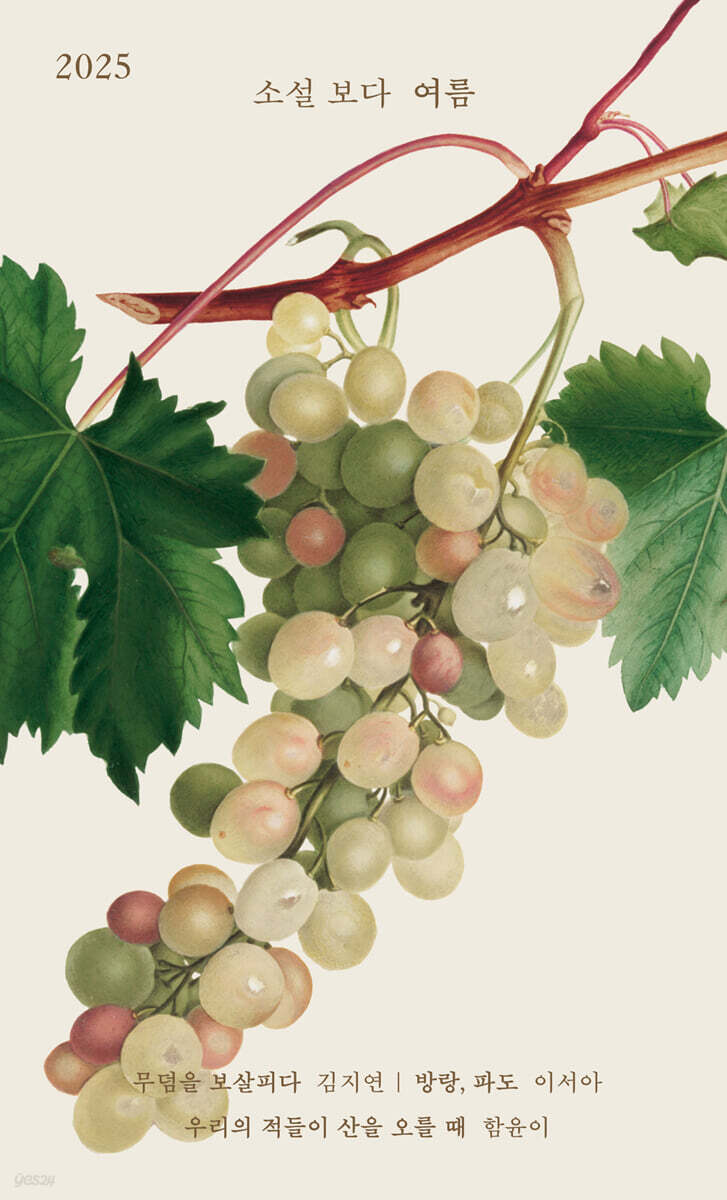
More Than a Novel: Summer 2025
 |
Description
Book Introduction
A novel summer landscape drawn by a new generation
A special project that always delivers value beyond readers' expectations, 『Novels: Summer 2025』, has been published.
"Novels" is a project that began in 2018 where Munhak-kwa-Jiseongsa selects a "novel of the season" every quarter, publishes the results on its website, and compiles and publishes a book of the results each season.
The selected works will be nominated for the Munji Literary Award.
The "Novels" series has been receiving great responses from readers for eight years, featuring novels by young writers as well as interviews with authors directly participated by the selection committee.
Going forward, "Novels" will continue to faithfully fulfill its role as a bridge between promising young writers and readers, most quickly and closely.
『Novels: Summer 2025』 contains three novels selected for the 2025 summer ‘Novel of the Season’: Kim Ji-yeon’s “Caring for the Grave,” Lee Seo-ah’s “Wandering, Waves,” and Ham Yun-i’s “When Our Enemies Climb the Mountain,” along with interviews with the authors.
This work is a candidate for the 15th Munji Literary Award.
The reviews of the works selected through free discussion by the selection committee (Kang Dong-ho, So Yoo-jeong, Lee So, Lee Hee-woo, Jo Yeon-jeong, Hong Seong-hee) can be found on the Munhak-kwa-Jiseongsa website.
A special project that always delivers value beyond readers' expectations, 『Novels: Summer 2025』, has been published.
"Novels" is a project that began in 2018 where Munhak-kwa-Jiseongsa selects a "novel of the season" every quarter, publishes the results on its website, and compiles and publishes a book of the results each season.
The selected works will be nominated for the Munji Literary Award.
The "Novels" series has been receiving great responses from readers for eight years, featuring novels by young writers as well as interviews with authors directly participated by the selection committee.
Going forward, "Novels" will continue to faithfully fulfill its role as a bridge between promising young writers and readers, most quickly and closely.
『Novels: Summer 2025』 contains three novels selected for the 2025 summer ‘Novel of the Season’: Kim Ji-yeon’s “Caring for the Grave,” Lee Seo-ah’s “Wandering, Waves,” and Ham Yun-i’s “When Our Enemies Climb the Mountain,” along with interviews with the authors.
This work is a candidate for the 15th Munji Literary Award.
The reviews of the works selected through free discussion by the selection committee (Kang Dong-ho, So Yoo-jeong, Lee So, Lee Hee-woo, Jo Yeon-jeong, Hong Seong-hee) can be found on the Munhak-kwa-Jiseongsa website.
- You can preview some of the book's contents.
Preview
index
Kim Ji-yeon, looking after the grave
Interview with Kim Ji-yeon and Lee So
Wandering, Waves, Lee Seo-ah
Interview with Lee Seo-ah and Hong Sung-hee
When our enemies climb the mountain, Hamyun
Interview with Ham Yoon-i and So Yoo-jung
Interview with Kim Ji-yeon and Lee So
Wandering, Waves, Lee Seo-ah
Interview with Lee Seo-ah and Hong Sung-hee
When our enemies climb the mountain, Hamyun
Interview with Ham Yoon-i and So Yoo-jung
Into the book
The angry man's voice reverberated and resonated.
He fidgeted as if he couldn't contain his anger and kicked the bucket with his foot.
The bucket fell straight into the water.
As the bucket full of feed submerged in the water, the fish rushed towards it.
It wasn't that deep, but perhaps because it was dark, the water looked black.
Hwasoo could no longer bear the sound of fish sloshing, the damp air, the fishy smell clinging to her skin, the man's mouths gaping madly, and the veins on his forehead starting to bulge out.
I couldn't even figure out why the man was angry.
“Where are you going!”
A man grabbed Hwasoo's arm as she was about to go out the door.
“Where are you touching!”
--- From "Kim Ji-yeon, Caring for the Grave"
This is God's point of view.
From God's perspective, we may seem like little birds.
But to follow God's point of view is an irreverent and lonely thing.
I thought it would be nice to just close my eyes and fall asleep.
It's about riding a board and floating across the vast ocean in the sunlight.
Then, wouldn't it be possible to meet many people again?
“Okay, let’s go now.
“Out of the sea.”
Before I knew it, the board was drifting close to the beach.
--- From "Lee Seo-ah, Wandering, Waves"
Seonhwa said.
Sometimes it felt more important than any teaching.
In all the books, salvation came after an enemy air raid.
The arrival of the enemies also meant the end of a long, painful wait, a wait that had become a world in itself.
Therefore, Seonhwa carefully observed the people who came every day.
They climbed the mountain and waited for someone who would end their arduous wait.
“So I think it was a great fate that we met.
Isn't that right?"
He fidgeted as if he couldn't contain his anger and kicked the bucket with his foot.
The bucket fell straight into the water.
As the bucket full of feed submerged in the water, the fish rushed towards it.
It wasn't that deep, but perhaps because it was dark, the water looked black.
Hwasoo could no longer bear the sound of fish sloshing, the damp air, the fishy smell clinging to her skin, the man's mouths gaping madly, and the veins on his forehead starting to bulge out.
I couldn't even figure out why the man was angry.
“Where are you going!”
A man grabbed Hwasoo's arm as she was about to go out the door.
“Where are you touching!”
--- From "Kim Ji-yeon, Caring for the Grave"
This is God's point of view.
From God's perspective, we may seem like little birds.
But to follow God's point of view is an irreverent and lonely thing.
I thought it would be nice to just close my eyes and fall asleep.
It's about riding a board and floating across the vast ocean in the sunlight.
Then, wouldn't it be possible to meet many people again?
“Okay, let’s go now.
“Out of the sea.”
Before I knew it, the board was drifting close to the beach.
--- From "Lee Seo-ah, Wandering, Waves"
Seonhwa said.
Sometimes it felt more important than any teaching.
In all the books, salvation came after an enemy air raid.
The arrival of the enemies also meant the end of a long, painful wait, a wait that had become a world in itself.
Therefore, Seonhwa carefully observed the people who came every day.
They climbed the mountain and waited for someone who would end their arduous wait.
“So I think it was a great fate that we met.
Isn't that right?"
--- From "Ham Yun-i, When Our Enemies Climb the Mountain"
Publisher's Review
Summer, the novel of this season
The beginning of summer, when the sun is rising and new green leaves are sprouting.
The secret hidden in an invisible place is revealed in an instant by the wind that blows.
"More Than Novels: Summer 2025" presents three novels that reshape the world while enduring the weight of a strange presence that intrudes into the tranquility of everyday life.
The intrusion of others, who share today with 'me' and are determined by their faith but carry a separate past, creates new anxiety.
After spending a long time staring at the truth that has surfaced above the water, the future of the characters who once again face the storms of life unfolds more clearly and broadly than before.
Kim Ji-yeon, "Caring for the Grave"
"The more Hwasoo paid attention to the world, the more he felt the world he once believed in crumbling."
Kim Ji-yeon, who began her career as a writer through the 2018 Munhakdongne New Writer's Award and went on to win the 12th, 13th, and 15th Young Writer's Awards, the 14th Kim Man-jung Literary Award New Writer's Award, and the 70th Hyundai Literature Award, will be meeting with us for the third time in 'This Season's Novel' following the summer of 2022 and the fall of 2023.
In his previous works, "Give Up" and "Companion Debt," the author depicted the reality of the young generation facing economic and psychological isolation and explored the slender hope behind it. In this selected work, "Caring for the Grave," the author looks into the horrific scenes of the past legacy and conveys the contemporary voice yearning for new choices for the future with sharp satire.
Hwasu, who got lost in a remote mountain while searching for his grandfather's grave with his cousin Sudong, arrives at a cliff near the coast and discovers a suspicious vinyl house and container.
And there, he encounters a man who looks to be in his fifties or sixties.
Hwasu tries to hide her wariness and asks for directions, but the man suddenly hands her a bucket and gloves and asks her to help him with the work.
While trapped in a building that resembles an indoor fishing spot and busy scooping fish food into the water, Su-dong, who was wandering around looking for a fish, enters the building.
During a brief conversation, the man's true identity is revealed to be their youngest uncle, who has cut ties with the family. The man refuses to comply with their request to take him to the village and makes threats out of the blue.
After a commotion that escalated into a physical fight, the man who locked Hwasu and Sudong in a container disappears from the scene.
Hwasu keeps thinking about his grandfather, who is already dead.
A man who loved his granddaughter dearly, a Vietnam War veteran who could not be buried in a national cemetery, a drug user, a Park Geun-hye supporter, and a grandfather who asked for his help in committing suicide at the end of his life.
Unable to ignore that earnest last wish, Hwasu hugged her grandfather tightly on the sickbed and acknowledged that “the world that had been good to her had been defeated.”
While locked up, he becomes consumed by hostility towards men and even plots murder, but soon notices the door is open and quickly gets into his car and escapes.
But when he arrives at his parents' house, he is greeted by a man sitting calmly on the living room sofa.
The novel maintains a consistently eerie atmosphere, asking the reader questions about life and choices after the entity's self-perceived defeat.
With her characteristically astute sense, Kim Ji-yeon traces the connection between the past and present, pursues the truth, and confirms an unwavering will to move toward the future.
Through this novel, “what we clearly see is that the more we know about the world and the more we live life, the more we may waver between the sorrow of being a loser and the shame of being a perpetrator.
[… … ] No one can easily give up on their life even in the midst of continuous misfortune and insoluble hardship” (Literary critic Jo Yeon-jeong).
If peace is maintained because we don't know, we should be suspicious.
Hwasu is a person who grew up like a greenhouse flower, so he doesn't know much.
I also thought that maybe he didn't hurt me under the pretext of protecting me.
I also feel like such protections don't really protect anything.
People tend to believe what they want to believe as truth, but truth shouldn't be compromised for that simple reason.
In "Interview Kim Ji-yeon x Lee So"
Lee Seo-ah, "Wandering, Waves"
“But to follow God’s point of view is blasphemous and lonely.”
Lee Seo-ah, who began her career through the 2021 Munhak-kwa-sa New Writer's Award and was praised as "the return of the 'Running Child' and 'Scary Child' who had disappeared from Korean literature for a while" (Judge Kang Dong-ho), and has since published her first short story collection, 'Young Heart Training' (Munhak-kwa-jiseongsa, 2024), receiving much love from readers, is now met for the first time in 'Novels of This Season' with 'Wandering, Waves'.
'I', who stays in a seaside village for a while and works as a cleaner at a nursing home, maintains a special relationship with Grandma Hyangja, a resident of the nursing home.
My grandmother gives me a ring and a book with underlined lines, and spends her days with me, letting me push her wheelchair or playing cards with her.
Meanwhile, at the home of a brother and sister who run a restaurant called Baek and Ban, I am “provided with lodging and meals” and learn how to surf when I have time.
The villagers do not look kindly on the siblings because of the “rumor that they are doing drugs.”
As I, who belonged to this random village community and witnessed several deaths and occasionally visited an empty lot to draw souls, the death of Grandma Hyangja came to me.
'I' decide to give the ring and book I received from my grandmother to the bereaved family.
Then one day, an unfamiliar van enters the village, and I mistake the people in the van for the bereaved family. I remember the ring that is kept in the nursing home, and I ask them to take me there too, and I ride with them.
They were the ones who organized the remains, not the bereaved family, and told 'me' to keep the book and ring, and then made 'me' get off along the way.
'I' once again encounters a car that is about to leave town and thinks I see someone in the backseat, but I later confirm with my caregiver, Hye-ran, that there was no van that stopped by the nursing home that day.
Not long after that, 'I' spent time at the tree farm with the siblings at the restaurant mourning the death of their young child, their nephew.
As I return to my daily life and practice surfing, I see a giant 'god' fighting through the waves.
Lee Seo-ah's novel intersects the 'death' of an object of attachment with the physical act of 'surfing', comforting the loneliness and sadness of those enduring the waves of life.
By depicting a character who lives in a vacant lot where “I made a contract with the sky” at the border between reality and fantasy, embracing the pain of loss with longing, the work poignantly illuminates the “pilgrimage” that follows, while measuring the size of a being as small as a microbe but so desperately needed by someone.
The narrative of learning, which can also be defined as the “subjectification of meaninglessness” embodied in this novel, is also a process of learning how to discover the indescribable beauty of life without avoiding the meaninglessness of life.
[… … ] It is a beautiful and moving tribute to the fundamental tragedy and nobility of human life, in which we must learn how to live as if wandering on a sea of meaninglessness” (literary critic Kang Dong-ho).
As I think about it now, it seems like longing mainly just takes away strength and drive.
It just leaves us heartbroken.
But one day, out of longing, I might read a book along the lines drawn, or drag my board out to the sea.
Just as a bird driven to the edge of a cliff finally takes flight, this yearning, this yearning emotion, can somehow become the driving force that pushes us to take action.
In "Interview Lee Seo-ah x Hong Seong-hee"
Ham Yun-i, "When Our Enemies Climb the Mountain"
“They did not move toward one place, but flew in circles, facing different directions.”
We meet Ham Yun-i, who began her career through the 2022 Seoul Shinmun New Year's Literary Contest and won the 14th Young Writer's Award and the 14th Munji Literary Award, for the third time in 'This Season's Novel' following her previous appearances in the summer of 2022 and the summer of 2024.
In his previous works, “Ganga” and “Angels (tentative title),” the author depicted characters who are drawn by an invisible force, form connections with others, grow, and leap into a new world. In this selected work, “When Our Enemies Climb the Mountain,” the author draws on mystical and cult-based materials to vividly portray the fascinations we encounter in life, while also capturing moments of revelation that touch on enduring beliefs.
Noah, the novel's protagonist, is a new civil servant working at a small town's county office.
On his first field trip with his boss, Nokwon, he heads to the isolated living quarters of the 'Observatory People' in the mountains, a place he had only heard of through rumors.
Noah is asked by the Green Garden to hide his real name, which has religious connotations.
At the observatory, Noah encounters a woman who is the leader of a religious group of unknown identity. She introduces herself as 'Jeong Seon-hwa', her mother's name, but surprisingly, the woman's name is also 'Seon-hwa'.
They report complaints about the observatory staff, such as noise, the smell of burning coal, light pollution, and fear-inducing behavior, but Seonhwa responds that she will be leaving in two weeks.
Seonhwa invites Noah to the last event they hold before leaving.
With the words, “It will be fun, and it will be very beautiful.”
Overwhelmed by the strange atmosphere, Noah, unable to overcome his curiosity, climbs the mountain again two weeks later.
Noah, Nokwon, and the police, who gathered at a higher place than the observatory to confirm the illegality of the event, see that the observatory's dome is open.
A spectacle of people gathered around a black-furred Seonhwa, lighting a fire, burning meat, and dancing enthusiastically, and a flock of large eagles flying over their heads.
Noah is overcome with the feeling that “the fire lit in the observatory has kindled something inside him.”
Just before being arrested for arson, Seonhwa says something meaningful to Noah.
The story of how they had been waiting for the 'enemy' all along, and how Noah's presence came as fate, and that it was the end of the wait and a sign of salvation.
Noah cannot live up to Seonhwa's expectations or accept his beliefs, but he feels as if he has passed through an incomprehensible world.
The world that unfolds before Noah's eyes, left alone, is a "new world" different from before.
As the gestures of the giant birds flying “looking in different directions” and “moving to new lands every autumn” metaphorically suggest, life, lacking certainty, moves to find another place.
Curiosity toward an object becomes the driving force of life, and some beings are reborn from something that suddenly becomes meaningful to others, whether they are enemies or not.
“Ham Yun-i is testing the norms subtly, naturally, sometimes evasively, sometimes quickly, and overall delicately, without overturning or destroying them in the name of experimentation.
“The sensibility of this test is as refined as it is delicate, current, and also symptomatic” (Literary critic Lee Hee-woo).
For Noah, too, gazing is an act of both communication and risk.
So there will be more attractive aspects.
Just like a horror movie where you can't take your eyes off something even though you know something terrible is about to happen, or a face of someone you don't want to see but can't stop looking at, there are moments in life where you just can't look away.
Even if you expect that you will be hurt when you see that scene.
For Noah, the scenery he encountered at the observatory must have been a moment he couldn't help but stare at.
In "Interview Ham Yoon-i x So Yu-jeong"
The beginning of summer, when the sun is rising and new green leaves are sprouting.
The secret hidden in an invisible place is revealed in an instant by the wind that blows.
"More Than Novels: Summer 2025" presents three novels that reshape the world while enduring the weight of a strange presence that intrudes into the tranquility of everyday life.
The intrusion of others, who share today with 'me' and are determined by their faith but carry a separate past, creates new anxiety.
After spending a long time staring at the truth that has surfaced above the water, the future of the characters who once again face the storms of life unfolds more clearly and broadly than before.
Kim Ji-yeon, "Caring for the Grave"
"The more Hwasoo paid attention to the world, the more he felt the world he once believed in crumbling."
Kim Ji-yeon, who began her career as a writer through the 2018 Munhakdongne New Writer's Award and went on to win the 12th, 13th, and 15th Young Writer's Awards, the 14th Kim Man-jung Literary Award New Writer's Award, and the 70th Hyundai Literature Award, will be meeting with us for the third time in 'This Season's Novel' following the summer of 2022 and the fall of 2023.
In his previous works, "Give Up" and "Companion Debt," the author depicted the reality of the young generation facing economic and psychological isolation and explored the slender hope behind it. In this selected work, "Caring for the Grave," the author looks into the horrific scenes of the past legacy and conveys the contemporary voice yearning for new choices for the future with sharp satire.
Hwasu, who got lost in a remote mountain while searching for his grandfather's grave with his cousin Sudong, arrives at a cliff near the coast and discovers a suspicious vinyl house and container.
And there, he encounters a man who looks to be in his fifties or sixties.
Hwasu tries to hide her wariness and asks for directions, but the man suddenly hands her a bucket and gloves and asks her to help him with the work.
While trapped in a building that resembles an indoor fishing spot and busy scooping fish food into the water, Su-dong, who was wandering around looking for a fish, enters the building.
During a brief conversation, the man's true identity is revealed to be their youngest uncle, who has cut ties with the family. The man refuses to comply with their request to take him to the village and makes threats out of the blue.
After a commotion that escalated into a physical fight, the man who locked Hwasu and Sudong in a container disappears from the scene.
Hwasu keeps thinking about his grandfather, who is already dead.
A man who loved his granddaughter dearly, a Vietnam War veteran who could not be buried in a national cemetery, a drug user, a Park Geun-hye supporter, and a grandfather who asked for his help in committing suicide at the end of his life.
Unable to ignore that earnest last wish, Hwasu hugged her grandfather tightly on the sickbed and acknowledged that “the world that had been good to her had been defeated.”
While locked up, he becomes consumed by hostility towards men and even plots murder, but soon notices the door is open and quickly gets into his car and escapes.
But when he arrives at his parents' house, he is greeted by a man sitting calmly on the living room sofa.
The novel maintains a consistently eerie atmosphere, asking the reader questions about life and choices after the entity's self-perceived defeat.
With her characteristically astute sense, Kim Ji-yeon traces the connection between the past and present, pursues the truth, and confirms an unwavering will to move toward the future.
Through this novel, “what we clearly see is that the more we know about the world and the more we live life, the more we may waver between the sorrow of being a loser and the shame of being a perpetrator.
[… … ] No one can easily give up on their life even in the midst of continuous misfortune and insoluble hardship” (Literary critic Jo Yeon-jeong).
If peace is maintained because we don't know, we should be suspicious.
Hwasu is a person who grew up like a greenhouse flower, so he doesn't know much.
I also thought that maybe he didn't hurt me under the pretext of protecting me.
I also feel like such protections don't really protect anything.
People tend to believe what they want to believe as truth, but truth shouldn't be compromised for that simple reason.
In "Interview Kim Ji-yeon x Lee So"
Lee Seo-ah, "Wandering, Waves"
“But to follow God’s point of view is blasphemous and lonely.”
Lee Seo-ah, who began her career through the 2021 Munhak-kwa-sa New Writer's Award and was praised as "the return of the 'Running Child' and 'Scary Child' who had disappeared from Korean literature for a while" (Judge Kang Dong-ho), and has since published her first short story collection, 'Young Heart Training' (Munhak-kwa-jiseongsa, 2024), receiving much love from readers, is now met for the first time in 'Novels of This Season' with 'Wandering, Waves'.
'I', who stays in a seaside village for a while and works as a cleaner at a nursing home, maintains a special relationship with Grandma Hyangja, a resident of the nursing home.
My grandmother gives me a ring and a book with underlined lines, and spends her days with me, letting me push her wheelchair or playing cards with her.
Meanwhile, at the home of a brother and sister who run a restaurant called Baek and Ban, I am “provided with lodging and meals” and learn how to surf when I have time.
The villagers do not look kindly on the siblings because of the “rumor that they are doing drugs.”
As I, who belonged to this random village community and witnessed several deaths and occasionally visited an empty lot to draw souls, the death of Grandma Hyangja came to me.
'I' decide to give the ring and book I received from my grandmother to the bereaved family.
Then one day, an unfamiliar van enters the village, and I mistake the people in the van for the bereaved family. I remember the ring that is kept in the nursing home, and I ask them to take me there too, and I ride with them.
They were the ones who organized the remains, not the bereaved family, and told 'me' to keep the book and ring, and then made 'me' get off along the way.
'I' once again encounters a car that is about to leave town and thinks I see someone in the backseat, but I later confirm with my caregiver, Hye-ran, that there was no van that stopped by the nursing home that day.
Not long after that, 'I' spent time at the tree farm with the siblings at the restaurant mourning the death of their young child, their nephew.
As I return to my daily life and practice surfing, I see a giant 'god' fighting through the waves.
Lee Seo-ah's novel intersects the 'death' of an object of attachment with the physical act of 'surfing', comforting the loneliness and sadness of those enduring the waves of life.
By depicting a character who lives in a vacant lot where “I made a contract with the sky” at the border between reality and fantasy, embracing the pain of loss with longing, the work poignantly illuminates the “pilgrimage” that follows, while measuring the size of a being as small as a microbe but so desperately needed by someone.
The narrative of learning, which can also be defined as the “subjectification of meaninglessness” embodied in this novel, is also a process of learning how to discover the indescribable beauty of life without avoiding the meaninglessness of life.
[… … ] It is a beautiful and moving tribute to the fundamental tragedy and nobility of human life, in which we must learn how to live as if wandering on a sea of meaninglessness” (literary critic Kang Dong-ho).
As I think about it now, it seems like longing mainly just takes away strength and drive.
It just leaves us heartbroken.
But one day, out of longing, I might read a book along the lines drawn, or drag my board out to the sea.
Just as a bird driven to the edge of a cliff finally takes flight, this yearning, this yearning emotion, can somehow become the driving force that pushes us to take action.
In "Interview Lee Seo-ah x Hong Seong-hee"
Ham Yun-i, "When Our Enemies Climb the Mountain"
“They did not move toward one place, but flew in circles, facing different directions.”
We meet Ham Yun-i, who began her career through the 2022 Seoul Shinmun New Year's Literary Contest and won the 14th Young Writer's Award and the 14th Munji Literary Award, for the third time in 'This Season's Novel' following her previous appearances in the summer of 2022 and the summer of 2024.
In his previous works, “Ganga” and “Angels (tentative title),” the author depicted characters who are drawn by an invisible force, form connections with others, grow, and leap into a new world. In this selected work, “When Our Enemies Climb the Mountain,” the author draws on mystical and cult-based materials to vividly portray the fascinations we encounter in life, while also capturing moments of revelation that touch on enduring beliefs.
Noah, the novel's protagonist, is a new civil servant working at a small town's county office.
On his first field trip with his boss, Nokwon, he heads to the isolated living quarters of the 'Observatory People' in the mountains, a place he had only heard of through rumors.
Noah is asked by the Green Garden to hide his real name, which has religious connotations.
At the observatory, Noah encounters a woman who is the leader of a religious group of unknown identity. She introduces herself as 'Jeong Seon-hwa', her mother's name, but surprisingly, the woman's name is also 'Seon-hwa'.
They report complaints about the observatory staff, such as noise, the smell of burning coal, light pollution, and fear-inducing behavior, but Seonhwa responds that she will be leaving in two weeks.
Seonhwa invites Noah to the last event they hold before leaving.
With the words, “It will be fun, and it will be very beautiful.”
Overwhelmed by the strange atmosphere, Noah, unable to overcome his curiosity, climbs the mountain again two weeks later.
Noah, Nokwon, and the police, who gathered at a higher place than the observatory to confirm the illegality of the event, see that the observatory's dome is open.
A spectacle of people gathered around a black-furred Seonhwa, lighting a fire, burning meat, and dancing enthusiastically, and a flock of large eagles flying over their heads.
Noah is overcome with the feeling that “the fire lit in the observatory has kindled something inside him.”
Just before being arrested for arson, Seonhwa says something meaningful to Noah.
The story of how they had been waiting for the 'enemy' all along, and how Noah's presence came as fate, and that it was the end of the wait and a sign of salvation.
Noah cannot live up to Seonhwa's expectations or accept his beliefs, but he feels as if he has passed through an incomprehensible world.
The world that unfolds before Noah's eyes, left alone, is a "new world" different from before.
As the gestures of the giant birds flying “looking in different directions” and “moving to new lands every autumn” metaphorically suggest, life, lacking certainty, moves to find another place.
Curiosity toward an object becomes the driving force of life, and some beings are reborn from something that suddenly becomes meaningful to others, whether they are enemies or not.
“Ham Yun-i is testing the norms subtly, naturally, sometimes evasively, sometimes quickly, and overall delicately, without overturning or destroying them in the name of experimentation.
“The sensibility of this test is as refined as it is delicate, current, and also symptomatic” (Literary critic Lee Hee-woo).
For Noah, too, gazing is an act of both communication and risk.
So there will be more attractive aspects.
Just like a horror movie where you can't take your eyes off something even though you know something terrible is about to happen, or a face of someone you don't want to see but can't stop looking at, there are moments in life where you just can't look away.
Even if you expect that you will be hurt when you see that scene.
For Noah, the scenery he encountered at the observatory must have been a moment he couldn't help but stare at.
In "Interview Ham Yoon-i x So Yu-jeong"
GOODS SPECIFICS
- Date of issue: June 10, 2025
- Page count, weight, size: 180 pages | 178g | 114*188*20mm
- ISBN13: 9788932044057
- ISBN10: 8932044058
You may also like
카테고리
korean


korean

![GQ KOREA Mark (Monthly): December [2025]](http://librairie.coreenne.fr/cdn/shop/files/8ef265dbbfbf186523ed75ba7319009d.jpg?v=1765340328&width=3840)


