

Transcending Brain
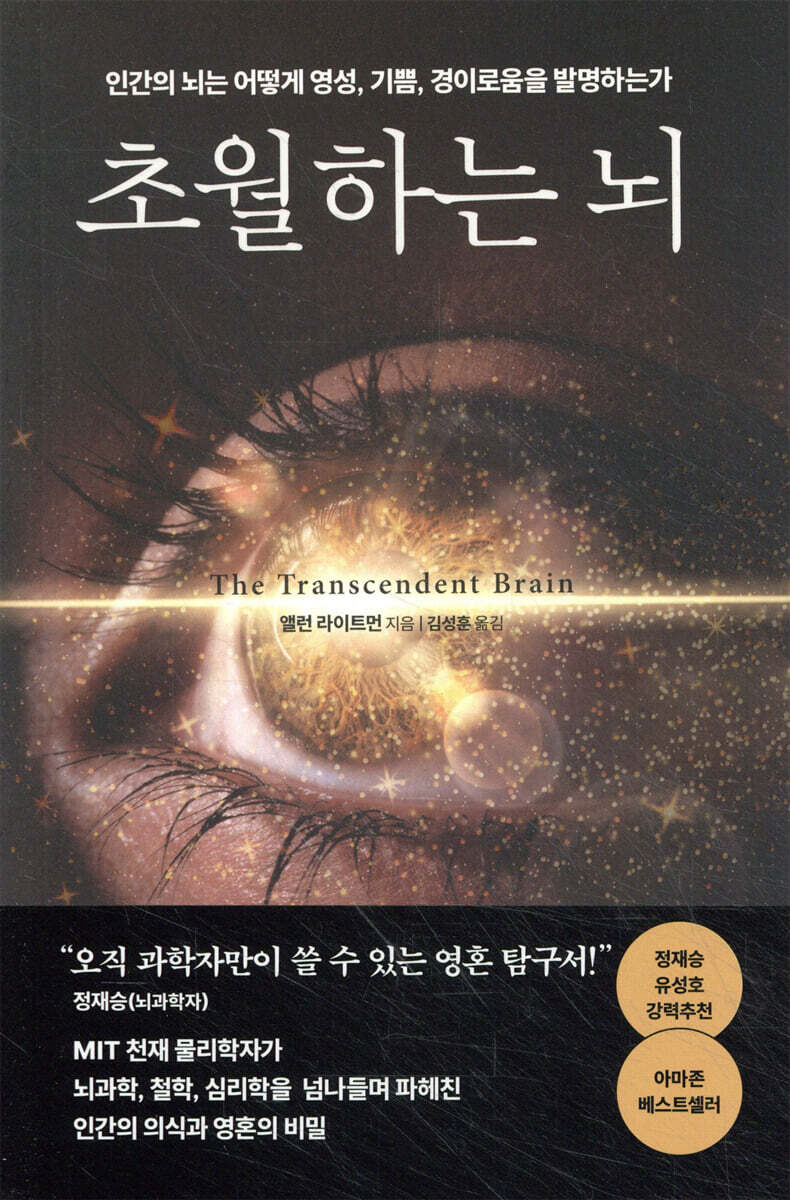 |
Description
Book Introduction
"A Soul-Exploring Book Only a Scientist Could Write"
Jaeseung Jeong (neuroscientist, professor of brain and cognitive sciences at KAIST)
★ Highly recommended by neuroscientist Jaeseung Jeong and forensic scientist Seongho Yoo!
★ Amazon Bestseller!
★ Recommended by Jon Kabat-Zinn, David Kaiser (MIT Physics Professor), and Peter Galison (Harvard University Professor)!
★ A book that has received praise from numerous media outlets, including the Washington Post, the Wall Street Journal, and Publisher's Weekly!
The wonder felt when gazing at the stars that fill the dark night sky, the thrill of happiness when seeing the joyful face of a loved one, the ecstasy felt when encountering sweet music or a beautiful work of art, and even the fascination felt when experiencing the mystery of a crimson sky and a spiraling seashell.
We sometimes feel an indescribable sense of being connected to others, to the nature that surrounds us, and to the universe itself, transcending our own existence.
Science claims that all of these experiences can be explained by the chemical reactions of atoms and molecules, but many people, while nodding in agreement with the validity of the claim, cannot truly accept this fact.
How can a brain composed of mere atoms and molecules give rise to a sense of "self," such vivid thoughts and emotions, such unique sensations that are difficult to express in words? How can we reconcile our scientific worldview with the wondrous experiences we encounter as we live?
In his new book, The Transcendent Brain, physicist, humanist, and novelist Alan Lightman delves into how the physical brain creates our unique experiences and consciousness.
This book is Lightman's response to the challenging question: "How does the material brain create immaterial, transcendent experiences like self and soul?"
In this book, he explores the thinking of humanity's greatest minds on consciousness and experience, from Aristotle to Descartes and Einstein, across the fields of science, philosophy, and psychology.
It also creates a new space where the world of particles and forces and the wondrous human experience can coexist, drawing on conversations with contemporary scientists who are developing cutting-edge theories at the forefront of science.
This book offers a new perspective on human consciousness, senses, and experiences, enabling readers to rediscover the wonders of life around them and live more fulfilling lives.
Jaeseung Jeong (neuroscientist, professor of brain and cognitive sciences at KAIST)
★ Highly recommended by neuroscientist Jaeseung Jeong and forensic scientist Seongho Yoo!
★ Amazon Bestseller!
★ Recommended by Jon Kabat-Zinn, David Kaiser (MIT Physics Professor), and Peter Galison (Harvard University Professor)!
★ A book that has received praise from numerous media outlets, including the Washington Post, the Wall Street Journal, and Publisher's Weekly!
The wonder felt when gazing at the stars that fill the dark night sky, the thrill of happiness when seeing the joyful face of a loved one, the ecstasy felt when encountering sweet music or a beautiful work of art, and even the fascination felt when experiencing the mystery of a crimson sky and a spiraling seashell.
We sometimes feel an indescribable sense of being connected to others, to the nature that surrounds us, and to the universe itself, transcending our own existence.
Science claims that all of these experiences can be explained by the chemical reactions of atoms and molecules, but many people, while nodding in agreement with the validity of the claim, cannot truly accept this fact.
How can a brain composed of mere atoms and molecules give rise to a sense of "self," such vivid thoughts and emotions, such unique sensations that are difficult to express in words? How can we reconcile our scientific worldview with the wondrous experiences we encounter as we live?
In his new book, The Transcendent Brain, physicist, humanist, and novelist Alan Lightman delves into how the physical brain creates our unique experiences and consciousness.
This book is Lightman's response to the challenging question: "How does the material brain create immaterial, transcendent experiences like self and soul?"
In this book, he explores the thinking of humanity's greatest minds on consciousness and experience, from Aristotle to Descartes and Einstein, across the fields of science, philosophy, and psychology.
It also creates a new space where the world of particles and forces and the wondrous human experience can coexist, drawing on conversations with contemporary scientists who are developing cutting-edge theories at the forefront of science.
This book offers a new perspective on human consciousness, senses, and experiences, enabling readers to rediscover the wonders of life around them and live more fulfilling lives.
- You can preview some of the book's contents.
Preview
index
introduction
Chapter 1: The Old Belief in the Immaterial Soul
Pure, eternal, immortal and unchanging soul
Chapter 2: Body and Soul Made of Matter
The world is made of atoms, the smallest units in the world.
Chapter 3: The Unique and Unique Sense of "I"
Love, hate, ecstasy, and bonding created by the brain
Chapter 4: Moments of Wonder Created by the Brain
Seeing the world in a grain of sand
Chapter 5: The Most Beautiful Experience Humans Can Have: Mystery
The strange and beautiful universe we live in
Acknowledgements
Americas
Chapter 1: The Old Belief in the Immaterial Soul
Pure, eternal, immortal and unchanging soul
Chapter 2: Body and Soul Made of Matter
The world is made of atoms, the smallest units in the world.
Chapter 3: The Unique and Unique Sense of "I"
Love, hate, ecstasy, and bonding created by the brain
Chapter 4: Moments of Wonder Created by the Brain
Seeing the world in a grain of sand
Chapter 5: The Most Beautiful Experience Humans Can Have: Mystery
The strange and beautiful universe we live in
Acknowledgements
Americas
Detailed image

Into the book
I believe that the spiritual experiences we have can originate from atoms and molecules.
But on the other hand, I believe that some of these experiences, and their highly personal and subjective nature, cannot be fully understood in terms of atoms and molecules.
I believe in the laws of chemistry, biology, and physics.
In fact, as a scientist, I respect such laws.
But I don't think such laws can capture the first-person experience of making eye contact with a wild animal or any similar transcendental moment.
We have uniquely human experiences that cannot be reduced to 0s and 1s.
--- From the "Preface"
In my view, the existence of the soul, like the existence of God, cannot be proven by any rational argument.
Those who believe in a soul or God must accept such beliefs as a matter of faith.
Still, I respect Mendelssohn's reasoning.
I want to understand the various forces that shaped his thinking, forces that have persisted for millennia as he sought to find meaning and solace in this strange universe in which we live.
I want to understand how and why the soul exists.
In fact, I want to understand everything immaterial.
The most important point is that the belief in the soul, shared by Mendelssohn and other philosophers and theologians, has the same psychological and evolutionary basis as the other emotions I associate with spirituality.
--- From "Chapter 1: The Old Belief in the Immaterial Soul"
I find it interesting that materialists and non-materialists are both motivated by the same facts, yet they propose very different psychological strategies to counter them.
Non-materialists like Socrates and Augustine argued that death should not be feared but rather welcomed.
Because (if you lived a good life) your immortal, immaterial soul will enjoy an eternally blessed afterlife.
In Plato's Pedo, Socrates, just before drinking poison, tells his followers:
“In the past, I might have mourned death, but not now.
For even for the dead there is still something left, and as the old people said, there is hope that much better things await the good.” ...
In contrast, materialists like Epicurus and Lucretius argue that there is no need to fear death, because after death we will all disintegrate and disappear.
Because after we die, we no longer exist in any form.
There is nothing left to fear, for we are left alone.
--- From "Chapter 2: The Universe Continues to Exist from the Infinite Past"
The largest computer brain simulations have about 2 million 'digital neurons'.
It's a number worse than a mouse's brain.
It's not just about numbers.
In this simulation, each neuron is represented by a single dot.
It can only represent a state that is basically on or off, without any structure or internal state.
In contrast, real neurons exhibit diverse inputs and outputs in the form of potential fluctuations inside and outside the cell membrane.
And each neuron is connected to 1,000 other neurons.
We still have a long way to go before we can simulate the brain on a computer.
--- From "Chapter 3: The Unique and Unique Sense of 'I'"
My argument is that the desire to connect with and belong to nature and other people, the feeling of being part of something larger than oneself, the appreciation of beauty, the experience of awe, and the experience of creative transcendence are all byproducts of other traits that have evolutionary advantages.
The first four experiences I mentioned need no further explanation.
Creative transcendence is the name given to the thrilling and overwhelming sensation we feel when we create something new or discover something new, when we are in a state of pure witnessing.
Painters, musicians, dancers, novelists, scientists, and we all experience creative transcendence.
I would like to suggest that the psychological driving force behind the entire field of science is the desire to find truth that extends beyond the individual's life.
Of course, such power will work at an unconscious level.
Newton's laws of motion will continue for thousands of years.
Darwin's natural selection would be the same.
Physicist Kip Thorne (who won the 2017 Nobel Prize for his work on the detection of gravitational waves) recently explained his personal motivation as a scientist:
“If we look back at the Renaissance and ask what legacy our ancestors of that era left us, most would say great art, great architecture, great music, and scientific methodology.
Similarly, if we were to ask our descendants a similar question about the legacy we leave behind in a few centuries, I believe a large part of the answer would be about our understanding of the universe and the physical laws that govern it.”
Explaining in this way the reasons why I admire beautiful objects, or the concept of beauty, does not in the least diminish the pleasure and delight I feel when I see a red cloud, a spiral shell, or the reflection of stars in water.
In fact, this understanding actually doubles my joy by emphasizing my connection with nature.
For me, the mathematical elegance of the Fibonacci sequence, the particular beauty in seashells and plants, and my biological affinity for such beauty are all pieces of a whole, a profound connection to all living things.
These are all part of the chain of connections.
--- From "Chapter 4: Reflections on the Beginning and End of Everything"
There's a quote from Einstein in 1931 that I really like.
“The most beautiful experience we can have is mystery.
This is the fundamental emotion that represents the cradle of true art and true science.”3 What did Einstein mean by “mystery”? I don’t think it means something supernatural or eternally unknowable.
I think it refers to the magical realm that exists between what we know and what we don't yet know.
It is a place that provokes us, stimulates our creativity, and fills us with surprises.
Scientists and artists, believers and non-believers alike, can stand on the precipice between the known and the unknown, without fear or anxiety, but with awe and wonder at this strange and beautiful universe in which we live.
If, at this very moment, each atom that makes up my body could be labeled and engraved with a social security number, someone could trace the journey of that atom as it floats through the air for the next 1,000 years, merging with the soil to become part of specific plants and trees, dissolving into the ocean, and then floating back into the air.
And some atoms will obviously become part of other people, some specific person.
So, we are literally connected to the stars, and to future generations.
From this perspective, even in the material universe, we are connected to everything, past and future.
But on the other hand, I believe that some of these experiences, and their highly personal and subjective nature, cannot be fully understood in terms of atoms and molecules.
I believe in the laws of chemistry, biology, and physics.
In fact, as a scientist, I respect such laws.
But I don't think such laws can capture the first-person experience of making eye contact with a wild animal or any similar transcendental moment.
We have uniquely human experiences that cannot be reduced to 0s and 1s.
--- From the "Preface"
In my view, the existence of the soul, like the existence of God, cannot be proven by any rational argument.
Those who believe in a soul or God must accept such beliefs as a matter of faith.
Still, I respect Mendelssohn's reasoning.
I want to understand the various forces that shaped his thinking, forces that have persisted for millennia as he sought to find meaning and solace in this strange universe in which we live.
I want to understand how and why the soul exists.
In fact, I want to understand everything immaterial.
The most important point is that the belief in the soul, shared by Mendelssohn and other philosophers and theologians, has the same psychological and evolutionary basis as the other emotions I associate with spirituality.
--- From "Chapter 1: The Old Belief in the Immaterial Soul"
I find it interesting that materialists and non-materialists are both motivated by the same facts, yet they propose very different psychological strategies to counter them.
Non-materialists like Socrates and Augustine argued that death should not be feared but rather welcomed.
Because (if you lived a good life) your immortal, immaterial soul will enjoy an eternally blessed afterlife.
In Plato's Pedo, Socrates, just before drinking poison, tells his followers:
“In the past, I might have mourned death, but not now.
For even for the dead there is still something left, and as the old people said, there is hope that much better things await the good.” ...
In contrast, materialists like Epicurus and Lucretius argue that there is no need to fear death, because after death we will all disintegrate and disappear.
Because after we die, we no longer exist in any form.
There is nothing left to fear, for we are left alone.
--- From "Chapter 2: The Universe Continues to Exist from the Infinite Past"
The largest computer brain simulations have about 2 million 'digital neurons'.
It's a number worse than a mouse's brain.
It's not just about numbers.
In this simulation, each neuron is represented by a single dot.
It can only represent a state that is basically on or off, without any structure or internal state.
In contrast, real neurons exhibit diverse inputs and outputs in the form of potential fluctuations inside and outside the cell membrane.
And each neuron is connected to 1,000 other neurons.
We still have a long way to go before we can simulate the brain on a computer.
--- From "Chapter 3: The Unique and Unique Sense of 'I'"
My argument is that the desire to connect with and belong to nature and other people, the feeling of being part of something larger than oneself, the appreciation of beauty, the experience of awe, and the experience of creative transcendence are all byproducts of other traits that have evolutionary advantages.
The first four experiences I mentioned need no further explanation.
Creative transcendence is the name given to the thrilling and overwhelming sensation we feel when we create something new or discover something new, when we are in a state of pure witnessing.
Painters, musicians, dancers, novelists, scientists, and we all experience creative transcendence.
I would like to suggest that the psychological driving force behind the entire field of science is the desire to find truth that extends beyond the individual's life.
Of course, such power will work at an unconscious level.
Newton's laws of motion will continue for thousands of years.
Darwin's natural selection would be the same.
Physicist Kip Thorne (who won the 2017 Nobel Prize for his work on the detection of gravitational waves) recently explained his personal motivation as a scientist:
“If we look back at the Renaissance and ask what legacy our ancestors of that era left us, most would say great art, great architecture, great music, and scientific methodology.
Similarly, if we were to ask our descendants a similar question about the legacy we leave behind in a few centuries, I believe a large part of the answer would be about our understanding of the universe and the physical laws that govern it.”
Explaining in this way the reasons why I admire beautiful objects, or the concept of beauty, does not in the least diminish the pleasure and delight I feel when I see a red cloud, a spiral shell, or the reflection of stars in water.
In fact, this understanding actually doubles my joy by emphasizing my connection with nature.
For me, the mathematical elegance of the Fibonacci sequence, the particular beauty in seashells and plants, and my biological affinity for such beauty are all pieces of a whole, a profound connection to all living things.
These are all part of the chain of connections.
--- From "Chapter 4: Reflections on the Beginning and End of Everything"
There's a quote from Einstein in 1931 that I really like.
“The most beautiful experience we can have is mystery.
This is the fundamental emotion that represents the cradle of true art and true science.”3 What did Einstein mean by “mystery”? I don’t think it means something supernatural or eternally unknowable.
I think it refers to the magical realm that exists between what we know and what we don't yet know.
It is a place that provokes us, stimulates our creativity, and fills us with surprises.
Scientists and artists, believers and non-believers alike, can stand on the precipice between the known and the unknown, without fear or anxiety, but with awe and wonder at this strange and beautiful universe in which we live.
If, at this very moment, each atom that makes up my body could be labeled and engraved with a social security number, someone could trace the journey of that atom as it floats through the air for the next 1,000 years, merging with the soil to become part of specific plants and trees, dissolving into the ocean, and then floating back into the air.
And some atoms will obviously become part of other people, some specific person.
So, we are literally connected to the stars, and to future generations.
From this perspective, even in the material universe, we are connected to everything, past and future.
--- From "Chapter 5: The Most Beautiful Experience Humans Can Have, Mystery"
Publisher's Review
MIT genius scientist crosses the boundaries of brain science, philosophy, and psychology
Uncovering the secrets of human consciousness and soul
Alan Lightman has been observing the osprey family that lives near his home for several years.
Then one day, he witnesses the first flight of a baby osprey born that year.
Even though he is young, he is gripped by fear as he sees a large bird with strong, sharp talons flying towards him at incredible speed.
He wanted to run away right away, but something held him back.
And at the last moment, the baby ospreys turn and soar magnificently into the sky.
Just as the osprey takes off in a vertical flight, its eyes meet the baby osprey's.
At that moment, he feels a profound bond with nature that cannot be described in words.
A bond of connection that acknowledges that we live together on this earth, a trust and respect for one another, and a wonderful feeling of being part of something much larger than ourselves.
He is a scientist.
We view the world from a scientific perspective and believe that the world is governed by several fundamental scientific laws.
Yet, he connects with the osprey, and at times, he forgets himself and feels part of something larger than himself, having transcendent experiences.
We find beauty and awe in the small pieces of nature we discover in our ordinary lives, and we also experience moments of creative ecstasy.
In this book, he gives the name 'spirituality' to these unique and wondrous human experiences.
Here, ‘spirituality’ does not refer to something religious in the general sense.
It is a much broader concept that encompasses the majestic and uniquely human experience of a sense of self and a connection with nature that transcends the self.
In "The Transcendent Brain," he explores how the human brain, made up of mere atoms and molecules, can create such a transcendent sense of spirituality, drawing on a scientific worldview and crossing over neuroscience, philosophy, and psychology.
Following in the footsteps of Oliver Sacks,
A precious science author who sparks a spark of wonder within us _ The Wall Street Journal
Alan Lightman delves into how the physical brain creates unique human experiences and consciousness.
We are not afraid of difficult questions like, “When we die, does our soul disappear forever?” “Where does our sense of ‘self’ come from?” “How can a brain made of atoms enable such wondrous experiences that are uniquely human?” “How can individual neurons create a sense of spirituality and consciousness?”
What drives him forward is his ever-boiling curiosity and his burning desire to understand this strange universe.
Through these questions and explorations, he plants the seeds of profound questions in his readers about how science and mystical experience can coexist.
In this book, the MIT humanities professor and bestselling author explains the human experience of wonder and beauty in various philosophical and psychological contexts, offering new insights that can help us redefine our relationships with science, art, and nature.
Chapters 1 and 2 examine the ancient Egyptian view of the soul, the immaterialist view of the world held by Socrates and Plato, and the materialist view held by Mendelssohn and Lucretius.
A prime example of a non-materialist perspective is God, but he goes further to explore how the entire spiritual world, including the immortal soul, heaven, hell, immaterial spirits that exist separately from the body, ghosts, and so on, came into being and what the motivations behind them are.
Chapter 3 delves into the eternally enigmatic question of how consciousness can arise in a brain and nervous system made of atoms and molecules.
We explore the work of psychologists, philosophers, and neuroscientists on this topic, drawing on the latest research to provide a comprehensive view of the mysterious phenomenon of consciousness.
Chapter 4 takes consciousness as a given and argues that emotions such as spirituality, transcendental experiences, and wonder emerge spontaneously and creatively from a brain and mind with high levels of consciousness and intellectual capacity.
Finally, Chapter 5 discusses how to embrace the immaterial phenomenon of the soul while maintaining a scientific perspective and how to strike a balance between the comprehensible and the incomprehensible.
Lightman explores the rich world of consciousness without ever departing from a scientific worldview.
People mistakenly believe that science attempts to reduce our transcendent experiences and emotions, and even our very existence, to the chemical reactions of atoms and molecules.
But he argues that this scientific approach doesn't detract from our lives and experiences, and that understanding it can actually amplify the wonder of our lives.
He presents a logical, evolutionary approach to understanding the wondrous universe and our existence, ultimately proving that the foundation of our wondrous experiences is rooted in our material existence.
Go beyond the limits of science and encounter the breathtaking wonders your brain creates!
Alan Lightman explores the transcendental moments he personally experienced, as well as the wide range of transcendental experiences we encounter as humans, and seeks to understand them as a humanist and scientist.
This book is not a dry and difficult science book, but rather a broad insight into what it means to exist and live as a human being, presented in lyrical and beautiful language.
This journey is not filled with one hundred percent certainty or black-and-white logic.
Through fascinating historical facts and cutting-edge scientific theories, The Transcendent Brain reveals how the physical brain gives rise to a uniquely human consciousness and experience. Whether you're a scientist or an artist, a believer in God or not, it offers a path to a deeper understanding of our uniquely human senses and experiences, offering a glimpse into awe and wonder within this beautiful universe.
Inspired to explore uncharted territory and embrace the wonders of life everywhere, this book will inspire awe and wonder at the strange and beautiful universe that surrounds us, and deepen our understanding of our own existence.
This will allow us to enrich our daily lives and welcome the mystery of life more joyfully.
Uncovering the secrets of human consciousness and soul
Alan Lightman has been observing the osprey family that lives near his home for several years.
Then one day, he witnesses the first flight of a baby osprey born that year.
Even though he is young, he is gripped by fear as he sees a large bird with strong, sharp talons flying towards him at incredible speed.
He wanted to run away right away, but something held him back.
And at the last moment, the baby ospreys turn and soar magnificently into the sky.
Just as the osprey takes off in a vertical flight, its eyes meet the baby osprey's.
At that moment, he feels a profound bond with nature that cannot be described in words.
A bond of connection that acknowledges that we live together on this earth, a trust and respect for one another, and a wonderful feeling of being part of something much larger than ourselves.
He is a scientist.
We view the world from a scientific perspective and believe that the world is governed by several fundamental scientific laws.
Yet, he connects with the osprey, and at times, he forgets himself and feels part of something larger than himself, having transcendent experiences.
We find beauty and awe in the small pieces of nature we discover in our ordinary lives, and we also experience moments of creative ecstasy.
In this book, he gives the name 'spirituality' to these unique and wondrous human experiences.
Here, ‘spirituality’ does not refer to something religious in the general sense.
It is a much broader concept that encompasses the majestic and uniquely human experience of a sense of self and a connection with nature that transcends the self.
In "The Transcendent Brain," he explores how the human brain, made up of mere atoms and molecules, can create such a transcendent sense of spirituality, drawing on a scientific worldview and crossing over neuroscience, philosophy, and psychology.
Following in the footsteps of Oliver Sacks,
A precious science author who sparks a spark of wonder within us _ The Wall Street Journal
Alan Lightman delves into how the physical brain creates unique human experiences and consciousness.
We are not afraid of difficult questions like, “When we die, does our soul disappear forever?” “Where does our sense of ‘self’ come from?” “How can a brain made of atoms enable such wondrous experiences that are uniquely human?” “How can individual neurons create a sense of spirituality and consciousness?”
What drives him forward is his ever-boiling curiosity and his burning desire to understand this strange universe.
Through these questions and explorations, he plants the seeds of profound questions in his readers about how science and mystical experience can coexist.
In this book, the MIT humanities professor and bestselling author explains the human experience of wonder and beauty in various philosophical and psychological contexts, offering new insights that can help us redefine our relationships with science, art, and nature.
Chapters 1 and 2 examine the ancient Egyptian view of the soul, the immaterialist view of the world held by Socrates and Plato, and the materialist view held by Mendelssohn and Lucretius.
A prime example of a non-materialist perspective is God, but he goes further to explore how the entire spiritual world, including the immortal soul, heaven, hell, immaterial spirits that exist separately from the body, ghosts, and so on, came into being and what the motivations behind them are.
Chapter 3 delves into the eternally enigmatic question of how consciousness can arise in a brain and nervous system made of atoms and molecules.
We explore the work of psychologists, philosophers, and neuroscientists on this topic, drawing on the latest research to provide a comprehensive view of the mysterious phenomenon of consciousness.
Chapter 4 takes consciousness as a given and argues that emotions such as spirituality, transcendental experiences, and wonder emerge spontaneously and creatively from a brain and mind with high levels of consciousness and intellectual capacity.
Finally, Chapter 5 discusses how to embrace the immaterial phenomenon of the soul while maintaining a scientific perspective and how to strike a balance between the comprehensible and the incomprehensible.
Lightman explores the rich world of consciousness without ever departing from a scientific worldview.
People mistakenly believe that science attempts to reduce our transcendent experiences and emotions, and even our very existence, to the chemical reactions of atoms and molecules.
But he argues that this scientific approach doesn't detract from our lives and experiences, and that understanding it can actually amplify the wonder of our lives.
He presents a logical, evolutionary approach to understanding the wondrous universe and our existence, ultimately proving that the foundation of our wondrous experiences is rooted in our material existence.
Go beyond the limits of science and encounter the breathtaking wonders your brain creates!
Alan Lightman explores the transcendental moments he personally experienced, as well as the wide range of transcendental experiences we encounter as humans, and seeks to understand them as a humanist and scientist.
This book is not a dry and difficult science book, but rather a broad insight into what it means to exist and live as a human being, presented in lyrical and beautiful language.
This journey is not filled with one hundred percent certainty or black-and-white logic.
Through fascinating historical facts and cutting-edge scientific theories, The Transcendent Brain reveals how the physical brain gives rise to a uniquely human consciousness and experience. Whether you're a scientist or an artist, a believer in God or not, it offers a path to a deeper understanding of our uniquely human senses and experiences, offering a glimpse into awe and wonder within this beautiful universe.
Inspired to explore uncharted territory and embrace the wonders of life everywhere, this book will inspire awe and wonder at the strange and beautiful universe that surrounds us, and deepen our understanding of our own existence.
This will allow us to enrich our daily lives and welcome the mystery of life more joyfully.
GOODS SPECIFICS
- Date of issue: January 10, 2025
- Page count, weight, size: 248 pages | 302g | 130*200*20mm
- ISBN13: 9791130662381
- ISBN10: 1130662381
You may also like
카테고리
korean


korean

![GQ KOREA Mark (Monthly): December [2025]](http://librairie.coreenne.fr/cdn/shop/files/8ef265dbbfbf186523ed75ba7319009d.jpg?v=1765340328&width=3840)


