

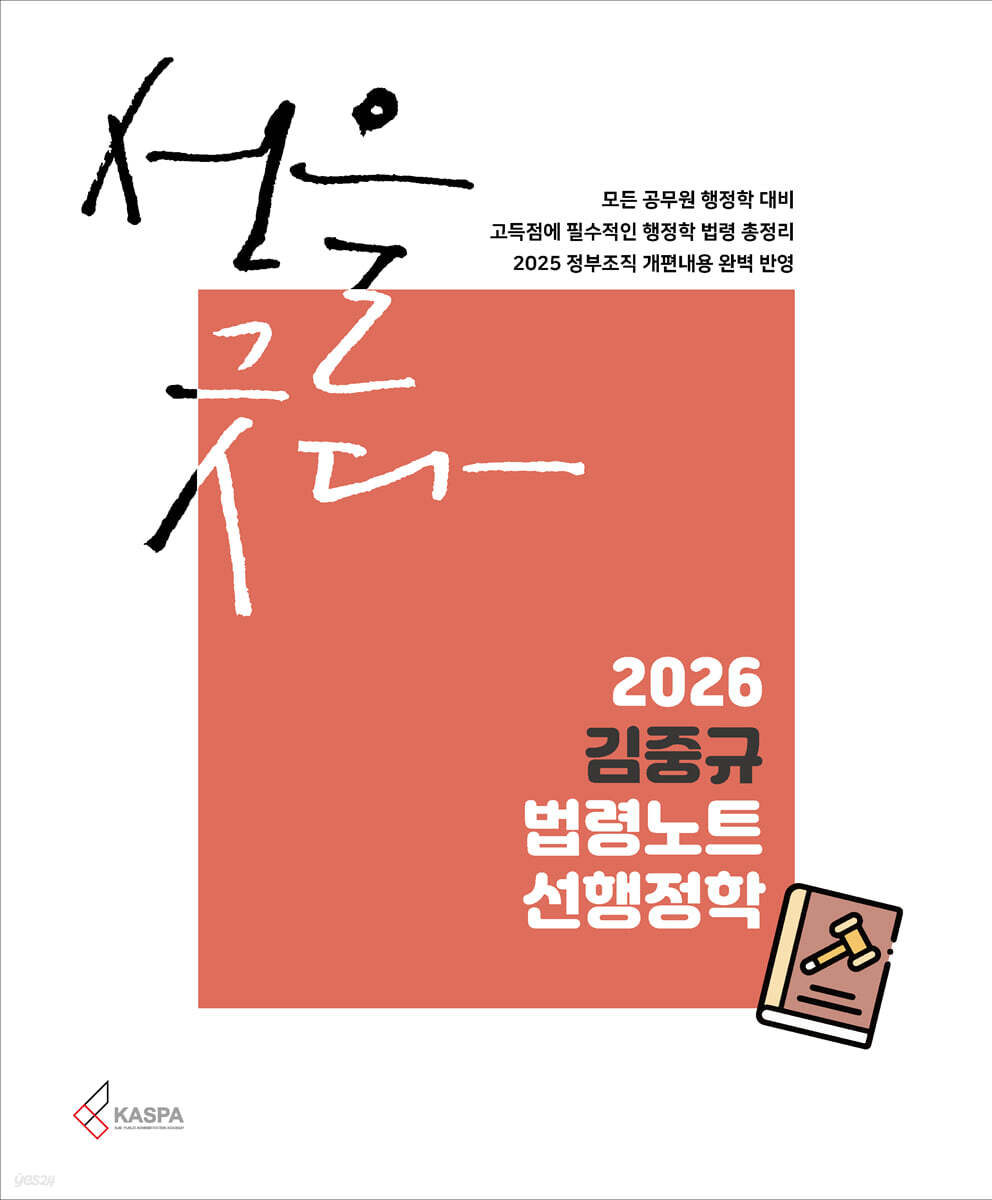
2026 Kim Jung-gyu's Legal Notes Preemptive Suspension
 |
Description
Book Introduction
Over the past decade, the difficulty of civil service administration has been increasing as the “students’ abilities” and the “test examiners’ test-writing techniques” have been co-evolving with each other, showing a mutual causal relationship.
For the 7th grade, public administration has already become a major subject among the secondary subjects since the introduction of the PSAT, and for the 9th grade, public administration has also become a key subject that determines whether or not one passes after it was converted to a required subject.
As a result, you have studied harder and your overall administrative skills have improved. The examiners are also aware of your improved skills and are continuously increasing the difficulty level.
One of the most important reasons for the increasing difficulty of public administration is the increasing proportion of legal questions on the exam. The proportion of legal questions on the exam in public administration has increased by a whopping 2-3 times compared to 10 years ago.
The average rate, which was 7.5% 10 years ago, has increased to 23% in 2024.
In particular, as many as 5 questions (25%) will be included in the 2025 National 9th Grade Public Administration Exam, 5 questions (25%) in the 2024 Local 9th Grade Exam, and 8 questions (32%) in the 2023 National 7th Grade Exam, making these questions killer problems, increasing the perceived difficulty level for test takers.
Legal questions are mainly concentrated in the practical fields of personnel administration (the National Civil Service Act and personnel-related presidential decrees), financial administration (the National Finance Act, etc.), and local autonomy (the Local Autonomy Act, etc.). Recently, many questions have been asked even in the lower-level provisions of laws, such as presidential decrees.
Moreover, as the Government Organization Act has been comprehensively revised in accordance with the Lee Jae-myung administration's representative reorganization, related laws (such as the Act on the Establishment of Responsible Management Agencies, the Public Institutions Management Act, the National Finance Act, and the National Accounting Act) have been significantly revised, so special preparation for these legal questions is necessary for next year's exam.
Therefore, it is no longer possible to achieve high scores in public administration with a passive attitude of "it's okay to get the legal issues wrong." It is time to prepare to actively address legal issues.
This is why “Kim Jung-gyu’s Legal Notes on Preemptive Suspension” was published.
2026 Kim Jung-gyu's Law Notes, Preliminary Suspension, aims to alleviate test takers' anxiety about legal issues by compiling a clear and comprehensive summary of the key provisions of approximately 80 laws related to public administration, arranged in the order of various preliminary suspense textbooks.
However, rather than simply listing the legal provisions, in order to reduce confusion caused by the gap between the “legal concept” and the “theoretical concept” when they are different, the theoretical concept is also indicated in the margins on the left and right of the legal provisions to enable three-dimensional learning where the law and theory are interconnected.
In addition, past exam questions related to the relevant provisions of the law were also included to increase the connection between the content of the law and past exam questions.
This 2026 pre-release legal notes were published to fully reflect the 2025 exam trends and related laws and regulations following the Lee Jae-myung administration's reorganization.
It is expected that this textbook will function as a multi-purpose, three-dimensional textbook that can check not only administrative theory but also past exam questions through laws and regulations. We hope that this textbook will be of great help to students who are taking the exam in completing their studies in administrative studies and achieving high scores.
For the 7th grade, public administration has already become a major subject among the secondary subjects since the introduction of the PSAT, and for the 9th grade, public administration has also become a key subject that determines whether or not one passes after it was converted to a required subject.
As a result, you have studied harder and your overall administrative skills have improved. The examiners are also aware of your improved skills and are continuously increasing the difficulty level.
One of the most important reasons for the increasing difficulty of public administration is the increasing proportion of legal questions on the exam. The proportion of legal questions on the exam in public administration has increased by a whopping 2-3 times compared to 10 years ago.
The average rate, which was 7.5% 10 years ago, has increased to 23% in 2024.
In particular, as many as 5 questions (25%) will be included in the 2025 National 9th Grade Public Administration Exam, 5 questions (25%) in the 2024 Local 9th Grade Exam, and 8 questions (32%) in the 2023 National 7th Grade Exam, making these questions killer problems, increasing the perceived difficulty level for test takers.
Legal questions are mainly concentrated in the practical fields of personnel administration (the National Civil Service Act and personnel-related presidential decrees), financial administration (the National Finance Act, etc.), and local autonomy (the Local Autonomy Act, etc.). Recently, many questions have been asked even in the lower-level provisions of laws, such as presidential decrees.
Moreover, as the Government Organization Act has been comprehensively revised in accordance with the Lee Jae-myung administration's representative reorganization, related laws (such as the Act on the Establishment of Responsible Management Agencies, the Public Institutions Management Act, the National Finance Act, and the National Accounting Act) have been significantly revised, so special preparation for these legal questions is necessary for next year's exam.
Therefore, it is no longer possible to achieve high scores in public administration with a passive attitude of "it's okay to get the legal issues wrong." It is time to prepare to actively address legal issues.
This is why “Kim Jung-gyu’s Legal Notes on Preemptive Suspension” was published.
2026 Kim Jung-gyu's Law Notes, Preliminary Suspension, aims to alleviate test takers' anxiety about legal issues by compiling a clear and comprehensive summary of the key provisions of approximately 80 laws related to public administration, arranged in the order of various preliminary suspense textbooks.
However, rather than simply listing the legal provisions, in order to reduce confusion caused by the gap between the “legal concept” and the “theoretical concept” when they are different, the theoretical concept is also indicated in the margins on the left and right of the legal provisions to enable three-dimensional learning where the law and theory are interconnected.
In addition, past exam questions related to the relevant provisions of the law were also included to increase the connection between the content of the law and past exam questions.
This 2026 pre-release legal notes were published to fully reflect the 2025 exam trends and related laws and regulations following the Lee Jae-myung administration's reorganization.
It is expected that this textbook will function as a multi-purpose, three-dimensional textbook that can check not only administrative theory but also past exam questions through laws and regulations. We hope that this textbook will be of great help to students who are taking the exam in completing their studies in administrative studies and achieving high scores.
- You can preview some of the book's contents.
Preview
index
Chapter 1│Basic Theory of Public Administration and Related Laws
01 Constitution of the Republic of Korea 11
02 Non-profit Private Organization Support Act 15
03 Social Enterprise Promotion Act 16
04 Basic Administrative Regulations Act 17
05 Private Investment in Social Infrastructure Act 19
Chapter 2│Policy Theory and Related Laws
01 Government Performance Evaluation Basic Act 23
Chapter 3│Laws Related to Organizational Theory
· Regulation 29 on Conflict Prevention and Resolution in Public Institutions
01 Government Organization Act 31
· General Rules on the Organization and Staffing of Administrative Agencies 35
02 Act on the Operation of Public Institutions 37
Enforcement Decree of the Act on the Operation of Public Institutions Article 40
03 Act on the Establishment and Operation of Responsible Management Organizations Article 41
04 Act on the Establishment and Operation of Committees Affiliated with Administrative Agencies Article 44
05 Act on Disclosure of Public Institution Information 46
Chapter 4│Laws Related to Personnel Administration
01 National Civil Service Act 51
· Civil Service Appointment Ordinance 61
Civil Service Examination Regulation 64
· Professional Career Regulation 65
· Personnel Regulations for Special Civil Servants 66
· Regulation 67 on Civil Servant Performance Evaluation
· Regulations on the Operation of Open Positions and Public Offering Positions, etc. 69
· Senior Civil Service Personnel Regulations 72
· Civil Service Regulations 74
· Civil Servant Disciplinary Ordinance 76
· Petition Procedure Rule 77
· Proactive Administrative Operation Regulation 78
· Civil Servant Grievance Handling Regulations 80
· Civil Servant Compensation Regulations 81
· Regulations on Civil Servant Allowances, etc. 83
02 Foreign Service Act 84
03 Police Officers Act 85
04 Fire Service Act 86
05 Educational Public Officials Act 87
06 Local Government Officials Act 88
07 Act on the Establishment and Operation of Civil Servants' Labor Unions 91
08 Act on the Establishment and Operation of Civil Servant Workplace Councils Article 93
09 Civil Servants Pension Act 94
Public Official Ethics Act 97
11. Public Officials' Conflict of Interest Prevention Act 101
12. Act on the Establishment and Operation of the Anti-Corruption and Civil Rights Commission 104
· Civil Servant Code of Conduct 107
13 Public Interest Whistleblower Protection Act 109
14. Act on the Prohibition of Improper Solicitation and Receipt of Money or Goods, Article 111
15 Act on the Establishment and Operation of the Senior Public Officials' Corruption Investigation Office Article 114
Chapter 5 Financial Administration Theory and Related Laws
01 National Finance Act 117
Enforcement Decree of the National Finance Act 130
02 Government Enterprise Budget Act 133
03 National Tax Basic Act 134
04 National Treasury Management Act 135
05 National Accounting Act 137
· Rules on National Accounting Standards (Ministry of Strategy and Finance Decree) 139
06 Special Tax Exceptions and Restrictions Act 142
07 Local Tax Special Exceptions and Limitations Act 143
08 National Debt Act 144
Chapter 6 Laws and Regulations Related to Administrative Reflux
01 National Assembly Act 147
02 Personnel Hearing Act 151
03 National Assembly Secretariat Act 153
04 Constitutional Court Act 154
05 Civil Complaints Handling Act 155
06 Board of Audit and Inspection Act 157
07 Electronic Government Act 160
08 Act on the Promotion of Cloud Computing and User Protection 163
Article 164 of the Basic Act on Intelligent Information Technology
10. Act on the Promotion of Provision and Use of Public Data 165
11. Act on Activation of Data-Based Administration 166
12 Personal Information Protection Act 167
13 Act on the Promotion of Smart Cities and Industries, etc. Article 168
Chapter 7 Local Autonomy Theory and Related Laws
01 Local Autonomy Act 171
· Regulations on the administrative organization and staffing standards of local governments, etc. 190
02 Special Act on Local Autonomy and Balanced Regional Development 191
03 Act on the Composition and Operation of the Central-Local Cooperation Council 193
04 Local Education Autonomy Act 194
05 Act on the Organization and Operation of the National Police and Autonomous Police 195
06 Local Finance Act 198
Enforcement Decree of the Local Finance Act 205
07 Basic Act on Local Government Fund Management 206
08 Local Accounting Act 208
· Rules on Accounting Standards for Local Governments (Ordinance of the Ministry of Public Administration and Security) 209
09 Local Tax Basic Act 210
10 Local Tax Act 213
11 Transportation, Energy, and Environment Tax Act 215
12. Subsidy Management Act 216
13 Local Tax Allocation Act 218
14 Local Education Finance Grants Act 220
15 Basic Act on Contribution Management 221
16 Local Public Enterprise Act 222
17. Hometown Love Donation Act 225
18 Public Official Election Act 226
19. Referendum Act 227
20. Act on the Proposal of Resident Ordinances 231
21. Act on the Recall of Residents 233
22 Seoul Metropolitan Government Administrative Special Act 235
23 Special Act on the Establishment of Jeju Special Self-Governing Province and the Creation of an International Free City 236
24 Special Act on the Establishment of Sejong Special Self-Governing City, etc. Article 238
25 Special Act on the Establishment of Gangwon Special Self-Governing Province and the Creation of a Global City for Future Industries 239
26 Special Act on the Establishment of Jeonbuk Special Self-Governing Province and the Creation of a Global Life Economy City 240
01 Constitution of the Republic of Korea 11
02 Non-profit Private Organization Support Act 15
03 Social Enterprise Promotion Act 16
04 Basic Administrative Regulations Act 17
05 Private Investment in Social Infrastructure Act 19
Chapter 2│Policy Theory and Related Laws
01 Government Performance Evaluation Basic Act 23
Chapter 3│Laws Related to Organizational Theory
· Regulation 29 on Conflict Prevention and Resolution in Public Institutions
01 Government Organization Act 31
· General Rules on the Organization and Staffing of Administrative Agencies 35
02 Act on the Operation of Public Institutions 37
Enforcement Decree of the Act on the Operation of Public Institutions Article 40
03 Act on the Establishment and Operation of Responsible Management Organizations Article 41
04 Act on the Establishment and Operation of Committees Affiliated with Administrative Agencies Article 44
05 Act on Disclosure of Public Institution Information 46
Chapter 4│Laws Related to Personnel Administration
01 National Civil Service Act 51
· Civil Service Appointment Ordinance 61
Civil Service Examination Regulation 64
· Professional Career Regulation 65
· Personnel Regulations for Special Civil Servants 66
· Regulation 67 on Civil Servant Performance Evaluation
· Regulations on the Operation of Open Positions and Public Offering Positions, etc. 69
· Senior Civil Service Personnel Regulations 72
· Civil Service Regulations 74
· Civil Servant Disciplinary Ordinance 76
· Petition Procedure Rule 77
· Proactive Administrative Operation Regulation 78
· Civil Servant Grievance Handling Regulations 80
· Civil Servant Compensation Regulations 81
· Regulations on Civil Servant Allowances, etc. 83
02 Foreign Service Act 84
03 Police Officers Act 85
04 Fire Service Act 86
05 Educational Public Officials Act 87
06 Local Government Officials Act 88
07 Act on the Establishment and Operation of Civil Servants' Labor Unions 91
08 Act on the Establishment and Operation of Civil Servant Workplace Councils Article 93
09 Civil Servants Pension Act 94
Public Official Ethics Act 97
11. Public Officials' Conflict of Interest Prevention Act 101
12. Act on the Establishment and Operation of the Anti-Corruption and Civil Rights Commission 104
· Civil Servant Code of Conduct 107
13 Public Interest Whistleblower Protection Act 109
14. Act on the Prohibition of Improper Solicitation and Receipt of Money or Goods, Article 111
15 Act on the Establishment and Operation of the Senior Public Officials' Corruption Investigation Office Article 114
Chapter 5 Financial Administration Theory and Related Laws
01 National Finance Act 117
Enforcement Decree of the National Finance Act 130
02 Government Enterprise Budget Act 133
03 National Tax Basic Act 134
04 National Treasury Management Act 135
05 National Accounting Act 137
· Rules on National Accounting Standards (Ministry of Strategy and Finance Decree) 139
06 Special Tax Exceptions and Restrictions Act 142
07 Local Tax Special Exceptions and Limitations Act 143
08 National Debt Act 144
Chapter 6 Laws and Regulations Related to Administrative Reflux
01 National Assembly Act 147
02 Personnel Hearing Act 151
03 National Assembly Secretariat Act 153
04 Constitutional Court Act 154
05 Civil Complaints Handling Act 155
06 Board of Audit and Inspection Act 157
07 Electronic Government Act 160
08 Act on the Promotion of Cloud Computing and User Protection 163
Article 164 of the Basic Act on Intelligent Information Technology
10. Act on the Promotion of Provision and Use of Public Data 165
11. Act on Activation of Data-Based Administration 166
12 Personal Information Protection Act 167
13 Act on the Promotion of Smart Cities and Industries, etc. Article 168
Chapter 7 Local Autonomy Theory and Related Laws
01 Local Autonomy Act 171
· Regulations on the administrative organization and staffing standards of local governments, etc. 190
02 Special Act on Local Autonomy and Balanced Regional Development 191
03 Act on the Composition and Operation of the Central-Local Cooperation Council 193
04 Local Education Autonomy Act 194
05 Act on the Organization and Operation of the National Police and Autonomous Police 195
06 Local Finance Act 198
Enforcement Decree of the Local Finance Act 205
07 Basic Act on Local Government Fund Management 206
08 Local Accounting Act 208
· Rules on Accounting Standards for Local Governments (Ordinance of the Ministry of Public Administration and Security) 209
09 Local Tax Basic Act 210
10 Local Tax Act 213
11 Transportation, Energy, and Environment Tax Act 215
12. Subsidy Management Act 216
13 Local Tax Allocation Act 218
14 Local Education Finance Grants Act 220
15 Basic Act on Contribution Management 221
16 Local Public Enterprise Act 222
17. Hometown Love Donation Act 225
18 Public Official Election Act 226
19. Referendum Act 227
20. Act on the Proposal of Resident Ordinances 231
21. Act on the Recall of Residents 233
22 Seoul Metropolitan Government Administrative Special Act 235
23 Special Act on the Establishment of Jeju Special Self-Governing Province and the Creation of an International Free City 236
24 Special Act on the Establishment of Sejong Special Self-Governing City, etc. Article 238
25 Special Act on the Establishment of Gangwon Special Self-Governing Province and the Creation of a Global City for Future Industries 239
26 Special Act on the Establishment of Jeonbuk Special Self-Governing Province and the Creation of a Global Life Economy City 240
Into the book
1.
Recently, many difficult legal questions have been appearing in the administrative examination (6 questions for the 2025 National Grade 9, 5 questions for the 2024 National Grade 9, 5 questions for the 2024 Local Grade 9, 8 questions for the 2023 National Grade 7, etc.).
This book is a response to this trend.
2.
Recently, many difficult and unfamiliar questions that at first glance appear to be legal problems are actually citing legal provisions that are not found in textbooks.
3.
In preparation for the difficult legal questions that may appear on the administrative studies exam, we have carefully analyzed approximately 80 laws related to administrative studies and organized them in a way that is suitable for the exam.
4.
To reduce the burden on test takers and prevent confusion and inconvenience, we have not included the entire text, but have selectively included only the important articles deeply related to public administration.
5.
I have highlighted the parts that are particularly important for the exam.
6.
Any content that has been recently revised or will be implemented in the future is marked with green text on the right wing.
7.
In cases where it has been delegated (cited) to other laws or presidential decrees, the content is additionally indicated in red letters on the right wing.
8.
Some administrative theories and systems corresponding to the contents of the statutes and regulations are written in academic terms for easy understanding.
9.
For all laws, the relevant ministry and year of enactment are indicated.
10.
We have compiled past exam questions related to the relevant laws into the pages to maximize learning effectiveness.
11.
The importance of each law is classified into ABCD levels.
12.
We have increased the connection with basic textbook learning by indicating the basic textbook pages by law.
13.
To make it easier to find statutory titles and key terms, we have included an "Index" at the back of the textbook.
14.
This textbook is merely a supplementary textbook for difficult legal questions, not a primary textbook. Therefore, we do not recommend reading it as a basic textbook.
15.
Short-term special lectures on the law are scheduled for January and March 2026 at the Industrial Complex, so taking these lectures while studying will further enhance your learning effectiveness.
16.
In addition to laws, necessary provisions from related enforcement decrees, presidential decrees, instructions, and regulations have been included to ensure interoperability and completeness between laws.
17.
I believe the most efficient way to quickly and effectively learn this book is to solve the Wings' previous exam questions and check the relevant legal provisions.
Recently, many difficult legal questions have been appearing in the administrative examination (6 questions for the 2025 National Grade 9, 5 questions for the 2024 National Grade 9, 5 questions for the 2024 Local Grade 9, 8 questions for the 2023 National Grade 7, etc.).
This book is a response to this trend.
2.
Recently, many difficult and unfamiliar questions that at first glance appear to be legal problems are actually citing legal provisions that are not found in textbooks.
3.
In preparation for the difficult legal questions that may appear on the administrative studies exam, we have carefully analyzed approximately 80 laws related to administrative studies and organized them in a way that is suitable for the exam.
4.
To reduce the burden on test takers and prevent confusion and inconvenience, we have not included the entire text, but have selectively included only the important articles deeply related to public administration.
5.
I have highlighted the parts that are particularly important for the exam.
6.
Any content that has been recently revised or will be implemented in the future is marked with green text on the right wing.
7.
In cases where it has been delegated (cited) to other laws or presidential decrees, the content is additionally indicated in red letters on the right wing.
8.
Some administrative theories and systems corresponding to the contents of the statutes and regulations are written in academic terms for easy understanding.
9.
For all laws, the relevant ministry and year of enactment are indicated.
10.
We have compiled past exam questions related to the relevant laws into the pages to maximize learning effectiveness.
11.
The importance of each law is classified into ABCD levels.
12.
We have increased the connection with basic textbook learning by indicating the basic textbook pages by law.
13.
To make it easier to find statutory titles and key terms, we have included an "Index" at the back of the textbook.
14.
This textbook is merely a supplementary textbook for difficult legal questions, not a primary textbook. Therefore, we do not recommend reading it as a basic textbook.
15.
Short-term special lectures on the law are scheduled for January and March 2026 at the Industrial Complex, so taking these lectures while studying will further enhance your learning effectiveness.
16.
In addition to laws, necessary provisions from related enforcement decrees, presidential decrees, instructions, and regulations have been included to ensure interoperability and completeness between laws.
17.
I believe the most efficient way to quickly and effectively learn this book is to solve the Wings' previous exam questions and check the relevant legal provisions.
--- From the text
GOODS SPECIFICS
- Date of issue: November 7, 2025
- Page count, weight, size: 244 pages | 215*260*20mm
- ISBN13: 9791192405803
- ISBN10: 1192405803
You may also like
카테고리
korean


korean

![GQ KOREA Mark (Monthly): December [2025]](http://librairie.coreenne.fr/cdn/shop/files/8ef265dbbfbf186523ed75ba7319009d.jpg?v=1765340328&width=3840)


