

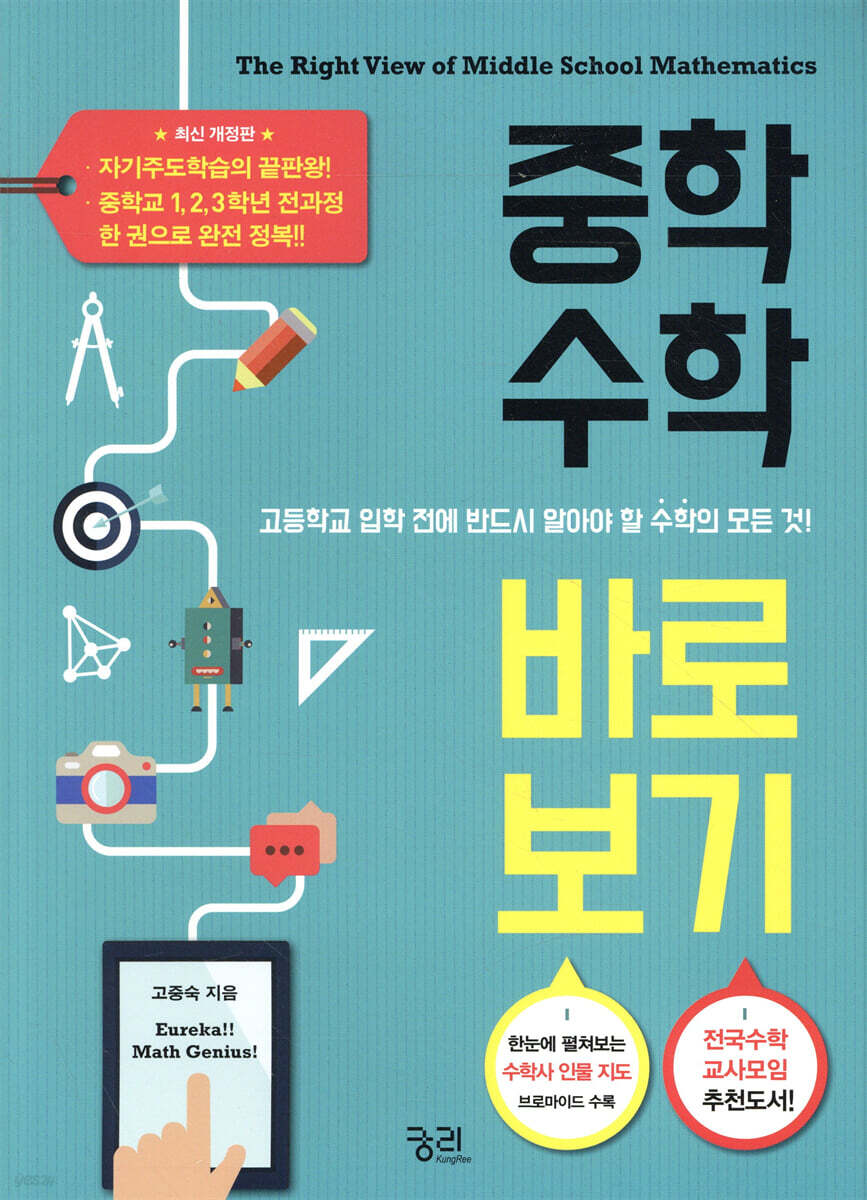
Middle School Math Quick Look
 |
Description
Book Introduction
“‘What is a function?’ ‘Hmm… well?’ Even though we have learned about sets and functions, it is not easy to readily say what a set is or what a function is.
To better understand mathematics, you must have a solid understanding of its basic concepts.
You should be able to go through the connected concepts of mathematics one by one, like crossing a stone bridge.
"Middle School Math: A Quick Look" neatly organizes the basic concepts that middle school math students need to know.
This book will be of great help to students struggling to understand the true meaning of mathematics.” - National Association of Mathematics Teachers
A math book you can trust and keep by your side from elementary school through college entrance!
Reflecting the optimal middle school mathematics curriculum! Recommended by the National Association of Mathematics Teachers!
“Look far ahead, but conquer what’s nearby first!”
“This book, ‘Middle School Math: A Look at It Straight’, is, as the title suggests, ‘a book written to help you study middle school math by looking at it straight.’
Although the basic content is of course about middle school mathematics, the scope is actually broader than you might think.
Therefore, if you are a capable student, you can read it from the upper grades of elementary school, and conversely, even high school students or higher can get a lot of help if they want to look at the true face of mathematics in a new way and re-establish the correct view of mathematics.” - From the author’s words
You can only find it in "Middle School Math at a Glance"! Eureka!! Math Genius!
A comprehensive overview of essential middle school math concepts and types, with detailed explanations and secret tips!
Complete preparation for advanced courses and descriptive math problems!
Tips for an integrated math story that encompasses history and science!
Includes a map of the history of mathematics and a bromide of figures at a glance!
Laying the foundation + building the foundation in math = building solid math skills!
To better understand mathematics, you must have a solid understanding of its basic concepts.
You should be able to go through the connected concepts of mathematics one by one, like crossing a stone bridge.
"Middle School Math: A Quick Look" neatly organizes the basic concepts that middle school math students need to know.
This book will be of great help to students struggling to understand the true meaning of mathematics.” - National Association of Mathematics Teachers
A math book you can trust and keep by your side from elementary school through college entrance!
Reflecting the optimal middle school mathematics curriculum! Recommended by the National Association of Mathematics Teachers!
“Look far ahead, but conquer what’s nearby first!”
“This book, ‘Middle School Math: A Look at It Straight’, is, as the title suggests, ‘a book written to help you study middle school math by looking at it straight.’
Although the basic content is of course about middle school mathematics, the scope is actually broader than you might think.
Therefore, if you are a capable student, you can read it from the upper grades of elementary school, and conversely, even high school students or higher can get a lot of help if they want to look at the true face of mathematics in a new way and re-establish the correct view of mathematics.” - From the author’s words
You can only find it in "Middle School Math at a Glance"! Eureka!! Math Genius!
A comprehensive overview of essential middle school math concepts and types, with detailed explanations and secret tips!
Complete preparation for advanced courses and descriptive math problems!
Tips for an integrated math story that encompasses history and science!
Includes a map of the history of mathematics and a bromide of figures at a glance!
Laying the foundation + building the foundation in math = building solid math skills!
- You can preview some of the book's contents.
Preview
index
preface
Part 1.
Laying the foundation
Chapter 0 Preliminary Matters
1.
The meaning of justice
2.
Use of characters
Chapter 1.
set theory
1.
The meaning of the set
2.
Terminology and expressions in set theory
3.
Set operations
* Math Story | Cantor, the Genius of Freedom
* Math Stories | The Nobel Prize, the Fields Medal, and the Abel Prize
Chapter 2.
Numbers and Operations
1.
natural numbers
(1) The meaning of natural numbers
(2) Factorization
(3) Common divisor and common multiple
(4) Decimal and binary
2.
integer
(1) The meaning of integer
(2) Size of integer
(3) Four arithmetic operations on integers
3.
rational number
(1) The meaning of rational numbers
(2) Representation of decimal numbers as rational numbers
4.
surd
(1) The meaning of irrational numbers
(2) Square roots and their properties
(3) How to use the square root table
(4) Rationalization of the denominator
(5) Classification of errors
5.
Approximate value
(1) True value and estimated value
(2) Errors and limits of error
(3) Approximation
* Math Story | Gauss, the Prince of Mathematicians
* Math Story | The Infinity of Prime Numbers
* Math Stories | The Target Parable: Accuracy and Precision
Chapter 3.
Formulas and operations
1.
The meaning of the formula
2.
Classification of formulas
3.
Properties of equations
4.
identity
(1) Properties of identities
(2) Multiplication formula
(3) Factorization
5.
equation
(1) Linear equation
(2) First-order simultaneous equations
(3) Quadratic equation
6.
Inequality
(1) Properties of inequalities
(2) First-order inequality
(3) First-order simultaneous inequalities
* Math Stories | Speed and Velocity
* Math Stories | The Strange Lives of the Equation's Protagonists
* Math Story | Geometric Understanding of the Opening Method
Part 2.
Raising a building
Chapter 4.
function
1.
The meaning of functions
(1) Background of the function
(2) Basic example of function
(3) Meaning of function
(4) The analogy of the movie and the box
2.
linear function
(1) Linear functions and graphs
(2) Determination of straight line
(3) Application of linear functions
3.
Quadratic function
(1) The significance of quadratic functions
(2) Graph of a quadratic function
(3) Other matters regarding quadratic functions
* Math Stories | The History of Functions
Chapter 5.
Geometry
1.
Geometric background
2.
Basic shapes and proof
(1) Significance of basic shapes
(2) Axioms and proof
(3) Properties of parallel lines
(4) Decision and positional relationship
(5) Construction of shapes
(6) Classification of shapes
3.
polygon
(1) Determination and formation of triangles
(2) Congruence of triangles
(3) Similarity of triangles
(4) Pythagorean theorem
(5) Properties of triangles
(6) Properties of a square
(7) Properties of polygons
4.
one
(1) Basics of the circle
(2) Circles and lines
(3) Central angle
5.
three-dimensional figures
(1) Polyhedron
(2) Rotating body
(3) Surface area and volume of three-dimensional figures
6.
Trigonometric ratios
(1) Basics of trigonometry
(2) Application of trigonometric functions
* Math Stories | Heroes of the Mathematical Apocalypse
Chapter 6.
Statistics and Probability
1.
statistics
(1) Distribution
(2) Correlation
2.
probability
(1) Number of cases
(2) Probability
* Math Story | Pioneer of Probability Theory
* Math Story | Public Relations Problem
supplement
Science and Mathematics (1)
Science and Mathematics (2)
Greek letters
square root table
trigonometric table
Search
Part 1.
Laying the foundation
Chapter 0 Preliminary Matters
1.
The meaning of justice
2.
Use of characters
Chapter 1.
set theory
1.
The meaning of the set
2.
Terminology and expressions in set theory
3.
Set operations
* Math Story | Cantor, the Genius of Freedom
* Math Stories | The Nobel Prize, the Fields Medal, and the Abel Prize
Chapter 2.
Numbers and Operations
1.
natural numbers
(1) The meaning of natural numbers
(2) Factorization
(3) Common divisor and common multiple
(4) Decimal and binary
2.
integer
(1) The meaning of integer
(2) Size of integer
(3) Four arithmetic operations on integers
3.
rational number
(1) The meaning of rational numbers
(2) Representation of decimal numbers as rational numbers
4.
surd
(1) The meaning of irrational numbers
(2) Square roots and their properties
(3) How to use the square root table
(4) Rationalization of the denominator
(5) Classification of errors
5.
Approximate value
(1) True value and estimated value
(2) Errors and limits of error
(3) Approximation
* Math Story | Gauss, the Prince of Mathematicians
* Math Story | The Infinity of Prime Numbers
* Math Stories | The Target Parable: Accuracy and Precision
Chapter 3.
Formulas and operations
1.
The meaning of the formula
2.
Classification of formulas
3.
Properties of equations
4.
identity
(1) Properties of identities
(2) Multiplication formula
(3) Factorization
5.
equation
(1) Linear equation
(2) First-order simultaneous equations
(3) Quadratic equation
6.
Inequality
(1) Properties of inequalities
(2) First-order inequality
(3) First-order simultaneous inequalities
* Math Stories | Speed and Velocity
* Math Stories | The Strange Lives of the Equation's Protagonists
* Math Story | Geometric Understanding of the Opening Method
Part 2.
Raising a building
Chapter 4.
function
1.
The meaning of functions
(1) Background of the function
(2) Basic example of function
(3) Meaning of function
(4) The analogy of the movie and the box
2.
linear function
(1) Linear functions and graphs
(2) Determination of straight line
(3) Application of linear functions
3.
Quadratic function
(1) The significance of quadratic functions
(2) Graph of a quadratic function
(3) Other matters regarding quadratic functions
* Math Stories | The History of Functions
Chapter 5.
Geometry
1.
Geometric background
2.
Basic shapes and proof
(1) Significance of basic shapes
(2) Axioms and proof
(3) Properties of parallel lines
(4) Decision and positional relationship
(5) Construction of shapes
(6) Classification of shapes
3.
polygon
(1) Determination and formation of triangles
(2) Congruence of triangles
(3) Similarity of triangles
(4) Pythagorean theorem
(5) Properties of triangles
(6) Properties of a square
(7) Properties of polygons
4.
one
(1) Basics of the circle
(2) Circles and lines
(3) Central angle
5.
three-dimensional figures
(1) Polyhedron
(2) Rotating body
(3) Surface area and volume of three-dimensional figures
6.
Trigonometric ratios
(1) Basics of trigonometry
(2) Application of trigonometric functions
* Math Stories | Heroes of the Mathematical Apocalypse
Chapter 6.
Statistics and Probability
1.
statistics
(1) Distribution
(2) Correlation
2.
probability
(1) Number of cases
(2) Probability
* Math Story | Pioneer of Probability Theory
* Math Story | Public Relations Problem
supplement
Science and Mathematics (1)
Science and Mathematics (2)
Greek letters
square root table
trigonometric table
Search
Into the book
“Middle school mathematics is important because it is the first step in formally learning the subject of mathematics.
Elementary mathematics is closer to 'arithmetic' than 'mathematics' because its primary goal is to cultivate the 'minimum calculation ability' necessary to live without facing great difficulties in daily life.
However, in middle school mathematics, it goes beyond simple calculations and enters the serious theoretical realm that can be called the essence of mathematics.
The subsequent high school and college mathematics courses repeat many of the topics first covered in middle school mathematics at a level one or two higher.
For this reason, middle school mathematics has the significance of being the prototype of an individual's mathematical thinking system, and therefore, it is necessary to proceed according to a systematic methodology to have the correct framework when first constructing it.
Numerous geniuses throughout history, including Pascal, Newton, Gauss, and Einstein, began to demonstrate their genius in a practical and concrete way in their early teens, around the age of middle school.
Although not geniuses, most ordinary people also develop logical, abstract, and systematic thinking skills from middle school onward.
Therefore, learning math properly during this period can have the greatest effect.”
“This book, ‘Middle School Math: A Look at It Straight’, is, as the title suggests, ‘a book written to help you study middle school math by looking at it straight.’
Although the basic content is of course about middle school mathematics, the scope is actually broader than you might think.
Therefore, students with the ability can take it from the upper grades of elementary school, and conversely, even high school students and above can find great help if they want to gain a new perspective on the true face of mathematics and re-establish a proper view of mathematics.”
“I recommend that students read this book three times, and the most important reason is not the ‘difficulty of the content,’ but the ‘systematic structure.’
In all studies, not just mathematics, it is important to distinguish between understanding individual topics and insight into the overall system.
While individual topics are sometimes like that, multiple readings and deep reflection are essential to building a satisfactory overall system.
In reality, our students are relatively good at 'micro-solving' individual problems due to the influence of rote learning, rote memorization, and rote learning, but their 'macro-thinking' ability for mathematics in general is quite weak.
However, from a fair standpoint, to be good at math, you need to have both 'function' and 'thinking', and the sum of them is 'true math skills'.
However, it is difficult to say exactly when during the three years of middle school it is best to do this three-time reading.
Because the timing can vary considerably depending on each individual’s abilities and circumstances.”
Elementary mathematics is closer to 'arithmetic' than 'mathematics' because its primary goal is to cultivate the 'minimum calculation ability' necessary to live without facing great difficulties in daily life.
However, in middle school mathematics, it goes beyond simple calculations and enters the serious theoretical realm that can be called the essence of mathematics.
The subsequent high school and college mathematics courses repeat many of the topics first covered in middle school mathematics at a level one or two higher.
For this reason, middle school mathematics has the significance of being the prototype of an individual's mathematical thinking system, and therefore, it is necessary to proceed according to a systematic methodology to have the correct framework when first constructing it.
Numerous geniuses throughout history, including Pascal, Newton, Gauss, and Einstein, began to demonstrate their genius in a practical and concrete way in their early teens, around the age of middle school.
Although not geniuses, most ordinary people also develop logical, abstract, and systematic thinking skills from middle school onward.
Therefore, learning math properly during this period can have the greatest effect.”
“This book, ‘Middle School Math: A Look at It Straight’, is, as the title suggests, ‘a book written to help you study middle school math by looking at it straight.’
Although the basic content is of course about middle school mathematics, the scope is actually broader than you might think.
Therefore, students with the ability can take it from the upper grades of elementary school, and conversely, even high school students and above can find great help if they want to gain a new perspective on the true face of mathematics and re-establish a proper view of mathematics.”
“I recommend that students read this book three times, and the most important reason is not the ‘difficulty of the content,’ but the ‘systematic structure.’
In all studies, not just mathematics, it is important to distinguish between understanding individual topics and insight into the overall system.
While individual topics are sometimes like that, multiple readings and deep reflection are essential to building a satisfactory overall system.
In reality, our students are relatively good at 'micro-solving' individual problems due to the influence of rote learning, rote memorization, and rote learning, but their 'macro-thinking' ability for mathematics in general is quite weak.
However, from a fair standpoint, to be good at math, you need to have both 'function' and 'thinking', and the sum of them is 'true math skills'.
However, it is difficult to say exactly when during the three years of middle school it is best to do this three-time reading.
Because the timing can vary considerably depending on each individual’s abilities and circumstances.”
--- From the text
Publisher's Review
Dr. Koh Jung-sook's Middle School Mathematics: A Quick Look! Latest Revised Edition!
What do we need now? "A sound perspective on mathematics!"
Develop mathematical thinking and creativity to understand the broader context of middle school mathematics!
The ultimate self-directed math learning method! Discover math with rich, detailed explanations of the secrets!
This book was written to help readers understand mathematics in a broader context and establish a correct view of mathematics by systematically explaining things like "what is being learned now," "where the topic currently being studied stands in the overall context," and "what direction should we take going forward" in the process of studying mathematics.
It presents a variety of example problems based on familiar everyday situations such as baseball, shopping, computers, music, mountaineering, and cars, and the author's detailed and informative explanations based on his math study know-how help students develop the ability to solve descriptive math problems.
Additionally, the text also contains tips on interesting and entertaining math stories that will help you gauge the overall flow of the history of mathematics.
Additionally, a separate volume contains 400 carefully selected and essential core problems across all areas of middle school mathematics.
Author Koh Jung-sook graduated from the Department of Chemistry, College of Natural Sciences, Seoul National University, received a doctorate in laser spectroscopy from the University of Akron, and completed a postdoctoral fellowship at the University of Pittsburgh. After that, she served as a professor in the Department of Chemistry Education at Suncheon National University.
The author has spent over ten years revising this book, "Middle School Math: A Look at It," to fully capture the effective know-how on "studying middle school math," which he has personally discovered through his long experience in gifted education, lectures, and writing.
The book was written with careful attention to the problems of current mathematics education and the use of mathematical concepts and terminology, and the focus was on reflecting the optimal middle school mathematics curriculum to help students more easily find their way to studying mathematics.
“Middle school mathematics is important because it is the first step in formally learning the subject of mathematics.
Elementary mathematics is closer to 'arithmetic' than 'mathematics' because its primary goal is to cultivate the 'minimum calculation ability' necessary to live without facing great difficulties in daily life.
However, in middle school mathematics, it goes beyond simple calculations and enters the serious theoretical realm that can be called the essence of mathematics.
The subsequent high school and college mathematics courses repeat many of the topics first covered in middle school mathematics at a level one or two higher.
For this reason, middle school mathematics has the significance of being the prototype of an individual's mathematical thinking system, and therefore, it is necessary to proceed according to a systematic methodology to have the correct framework when first constructing it.
Numerous geniuses throughout history, including Pascal, Newton, Gauss, and Einstein, began to demonstrate their genius in a practical and concrete way in their early teens, around the age of middle school.
Although not geniuses, most ordinary people also develop logical, abstract, and systematic thinking skills from middle school onward.
Therefore, learning math properly during this period can have the greatest effect.” - From the author’s words
Complete the entire curriculum for 1st, 2nd, and 3rd year middle school in one book!
A comprehensive overview of essential middle school math concepts and types, with detailed explanations and secret tips!
Complete preparation for advanced courses and descriptive math problems!
This book is divided into two major parts to cover the three-year course of middle school mathematics.
Part 1 is ‘Laying the Foundation’ and Part 2 is ‘Building the Building’.
Part 1, 'Laying the Foundations', consists of 'Chapter 0 Preliminaries', 'Chapter 1 Set Theory', 'Chapter 2 Numbers and Operations', and 'Chapter 3 Expressions and Operations'. Part 2, 'Building a Building', consists of 'Chapter 4 Functions', 'Chapter 5 Geometry', and 'Chapter 6 Statistics and Probability'.
The very first chapter, 'Chapter 0 Preliminaries', explains two topics: definition, one of the most important concepts in mathematics, and the use of letters, which makes mathematics very convenient.
Chapter 1 deals with ‘set theory’, which plays a more fundamental role in mathematics than ‘numbers’ and ‘formulas’.
Looking at the history of mathematics, set theory was not established until the very late 19th century by the German mathematician Cantor.
And as the 20th century approached, it gradually gained widespread acceptance, eventually forming the most fundamental foundation for all fields of mathematics, and has since been considered “one of the greatest products of the human mind.”
Accordingly, almost all textbooks on mathematics today typically begin with set theory, and this book follows suit and begins with set theory (after reviewing some brief preliminaries in Chapter 0).
In Chapter 2, we learn about numbers and operations, which serve as the foundation for learning mathematics and are also important in everyday life.
We will look at numbers and operations from a new perspective, going beyond the simple arithmetic operations learned in elementary school.
This topic later led to the field of number theory in university courses, which serves as one of the cornerstones of mathematics as a whole.
In this sense, the words of the great German mathematician Gauss, “Mathematics is the queen of sciences and number theory is the queen of mathematics,” will never lose their meaning as long as mathematics continues.
In Chapter 3, Formulas and Operations, we learn about ‘formulas combining numbers and letters.’
Preliminary information about this is introduced in Chapter 0, so here we will cover the subsequent contents.
This 'invention of formulas' is one of the monumental events in the history of mathematics, and it was through formulas that mathematics first took on its most characteristic form.
‘Operation of formulas’ means doing calculations that were previously done with ‘words and numbers’ using formulas, and in this sense, it can be said that “formulas are the language of mathematics.”
Functions, the topic of Chapter 4, are the most frequently appearing concept in mathematics and can be said to be the most fundamental concept.
The concept of a function began in ancient mathematics as a discipline that primarily studied static objects, but at some point, it became more concrete as people began to realize that the relationships between changing objects were more important.
Among these, the middle school course covers the basic 'functional relationship between two objects', and among them, first- and second-order functions are examined in particular.
Chapter 5 covers geometry, which is very helpful in understanding the overall structure of mathematics.
Since ancient mathematics began with the need to measure the length, area, and volume of real objects, and since geometry was considered the prototype of all other disciplines until the Greek era, geometry is the first subject to be learned in historical order.
However, as mathematics developed, geometry became a part of mathematics and grew into a field with its own unique characteristics.
From a modern perspective, it is recommended that you study after acquiring a certain level of mathematical knowledge.
In Chapter 6, we learn about statistics and probability.
Although its historical origins are old, the full-scale treatment of statistics and probability in mathematics is relatively recent in the long history of mathematics.
This is because probability theory only gained a systematic foundation in the mid-17th century, and statistics only in the 19th century.
But in today's world, each component is becoming increasingly intertwined.
Accordingly, the role of statistics and probability in running modern society has increased day by day, establishing itself as one of the major fields of modern mathematics.
★ Includes a bromide poster of the "Mathematics History Figure Map" at a glance! ★
Knowing the history of mathematics deepens your understanding.
The text includes a bromide chronology summarizing the research achievements and significance of approximately 60 Eastern and Western mathematicians who shaped the history of mathematics from ancient times to the present.
It will further help you to truly understand mathematical concepts.
What do we need now? "A sound perspective on mathematics!"
Develop mathematical thinking and creativity to understand the broader context of middle school mathematics!
The ultimate self-directed math learning method! Discover math with rich, detailed explanations of the secrets!
This book was written to help readers understand mathematics in a broader context and establish a correct view of mathematics by systematically explaining things like "what is being learned now," "where the topic currently being studied stands in the overall context," and "what direction should we take going forward" in the process of studying mathematics.
It presents a variety of example problems based on familiar everyday situations such as baseball, shopping, computers, music, mountaineering, and cars, and the author's detailed and informative explanations based on his math study know-how help students develop the ability to solve descriptive math problems.
Additionally, the text also contains tips on interesting and entertaining math stories that will help you gauge the overall flow of the history of mathematics.
Additionally, a separate volume contains 400 carefully selected and essential core problems across all areas of middle school mathematics.
Author Koh Jung-sook graduated from the Department of Chemistry, College of Natural Sciences, Seoul National University, received a doctorate in laser spectroscopy from the University of Akron, and completed a postdoctoral fellowship at the University of Pittsburgh. After that, she served as a professor in the Department of Chemistry Education at Suncheon National University.
The author has spent over ten years revising this book, "Middle School Math: A Look at It," to fully capture the effective know-how on "studying middle school math," which he has personally discovered through his long experience in gifted education, lectures, and writing.
The book was written with careful attention to the problems of current mathematics education and the use of mathematical concepts and terminology, and the focus was on reflecting the optimal middle school mathematics curriculum to help students more easily find their way to studying mathematics.
“Middle school mathematics is important because it is the first step in formally learning the subject of mathematics.
Elementary mathematics is closer to 'arithmetic' than 'mathematics' because its primary goal is to cultivate the 'minimum calculation ability' necessary to live without facing great difficulties in daily life.
However, in middle school mathematics, it goes beyond simple calculations and enters the serious theoretical realm that can be called the essence of mathematics.
The subsequent high school and college mathematics courses repeat many of the topics first covered in middle school mathematics at a level one or two higher.
For this reason, middle school mathematics has the significance of being the prototype of an individual's mathematical thinking system, and therefore, it is necessary to proceed according to a systematic methodology to have the correct framework when first constructing it.
Numerous geniuses throughout history, including Pascal, Newton, Gauss, and Einstein, began to demonstrate their genius in a practical and concrete way in their early teens, around the age of middle school.
Although not geniuses, most ordinary people also develop logical, abstract, and systematic thinking skills from middle school onward.
Therefore, learning math properly during this period can have the greatest effect.” - From the author’s words
Complete the entire curriculum for 1st, 2nd, and 3rd year middle school in one book!
A comprehensive overview of essential middle school math concepts and types, with detailed explanations and secret tips!
Complete preparation for advanced courses and descriptive math problems!
This book is divided into two major parts to cover the three-year course of middle school mathematics.
Part 1 is ‘Laying the Foundation’ and Part 2 is ‘Building the Building’.
Part 1, 'Laying the Foundations', consists of 'Chapter 0 Preliminaries', 'Chapter 1 Set Theory', 'Chapter 2 Numbers and Operations', and 'Chapter 3 Expressions and Operations'. Part 2, 'Building a Building', consists of 'Chapter 4 Functions', 'Chapter 5 Geometry', and 'Chapter 6 Statistics and Probability'.
The very first chapter, 'Chapter 0 Preliminaries', explains two topics: definition, one of the most important concepts in mathematics, and the use of letters, which makes mathematics very convenient.
Chapter 1 deals with ‘set theory’, which plays a more fundamental role in mathematics than ‘numbers’ and ‘formulas’.
Looking at the history of mathematics, set theory was not established until the very late 19th century by the German mathematician Cantor.
And as the 20th century approached, it gradually gained widespread acceptance, eventually forming the most fundamental foundation for all fields of mathematics, and has since been considered “one of the greatest products of the human mind.”
Accordingly, almost all textbooks on mathematics today typically begin with set theory, and this book follows suit and begins with set theory (after reviewing some brief preliminaries in Chapter 0).
In Chapter 2, we learn about numbers and operations, which serve as the foundation for learning mathematics and are also important in everyday life.
We will look at numbers and operations from a new perspective, going beyond the simple arithmetic operations learned in elementary school.
This topic later led to the field of number theory in university courses, which serves as one of the cornerstones of mathematics as a whole.
In this sense, the words of the great German mathematician Gauss, “Mathematics is the queen of sciences and number theory is the queen of mathematics,” will never lose their meaning as long as mathematics continues.
In Chapter 3, Formulas and Operations, we learn about ‘formulas combining numbers and letters.’
Preliminary information about this is introduced in Chapter 0, so here we will cover the subsequent contents.
This 'invention of formulas' is one of the monumental events in the history of mathematics, and it was through formulas that mathematics first took on its most characteristic form.
‘Operation of formulas’ means doing calculations that were previously done with ‘words and numbers’ using formulas, and in this sense, it can be said that “formulas are the language of mathematics.”
Functions, the topic of Chapter 4, are the most frequently appearing concept in mathematics and can be said to be the most fundamental concept.
The concept of a function began in ancient mathematics as a discipline that primarily studied static objects, but at some point, it became more concrete as people began to realize that the relationships between changing objects were more important.
Among these, the middle school course covers the basic 'functional relationship between two objects', and among them, first- and second-order functions are examined in particular.
Chapter 5 covers geometry, which is very helpful in understanding the overall structure of mathematics.
Since ancient mathematics began with the need to measure the length, area, and volume of real objects, and since geometry was considered the prototype of all other disciplines until the Greek era, geometry is the first subject to be learned in historical order.
However, as mathematics developed, geometry became a part of mathematics and grew into a field with its own unique characteristics.
From a modern perspective, it is recommended that you study after acquiring a certain level of mathematical knowledge.
In Chapter 6, we learn about statistics and probability.
Although its historical origins are old, the full-scale treatment of statistics and probability in mathematics is relatively recent in the long history of mathematics.
This is because probability theory only gained a systematic foundation in the mid-17th century, and statistics only in the 19th century.
But in today's world, each component is becoming increasingly intertwined.
Accordingly, the role of statistics and probability in running modern society has increased day by day, establishing itself as one of the major fields of modern mathematics.
★ Includes a bromide poster of the "Mathematics History Figure Map" at a glance! ★
Knowing the history of mathematics deepens your understanding.
The text includes a bromide chronology summarizing the research achievements and significance of approximately 60 Eastern and Western mathematicians who shaped the history of mathematics from ancient times to the present.
It will further help you to truly understand mathematical concepts.
GOODS SPECIFICS
- Date of publication: August 30, 2017
- Page count, weight, size: 620 pages | 1,181g | 180*250*35mm
- ISBN13: 9788958204312
- ISBN10: 8958204311
You may also like
카테고리
korean


korean

![GQ KOREA Mark (Monthly): December [2025]](http://librairie.coreenne.fr/cdn/shop/files/8ef265dbbfbf186523ed75ba7319009d.jpg?v=1765340328&width=3840)


