

Feynman's Physics Lecture 3: Quantum Mechanics
 |
Description
Book Introduction
Complete publication of the Feynman Lectures on Physics series
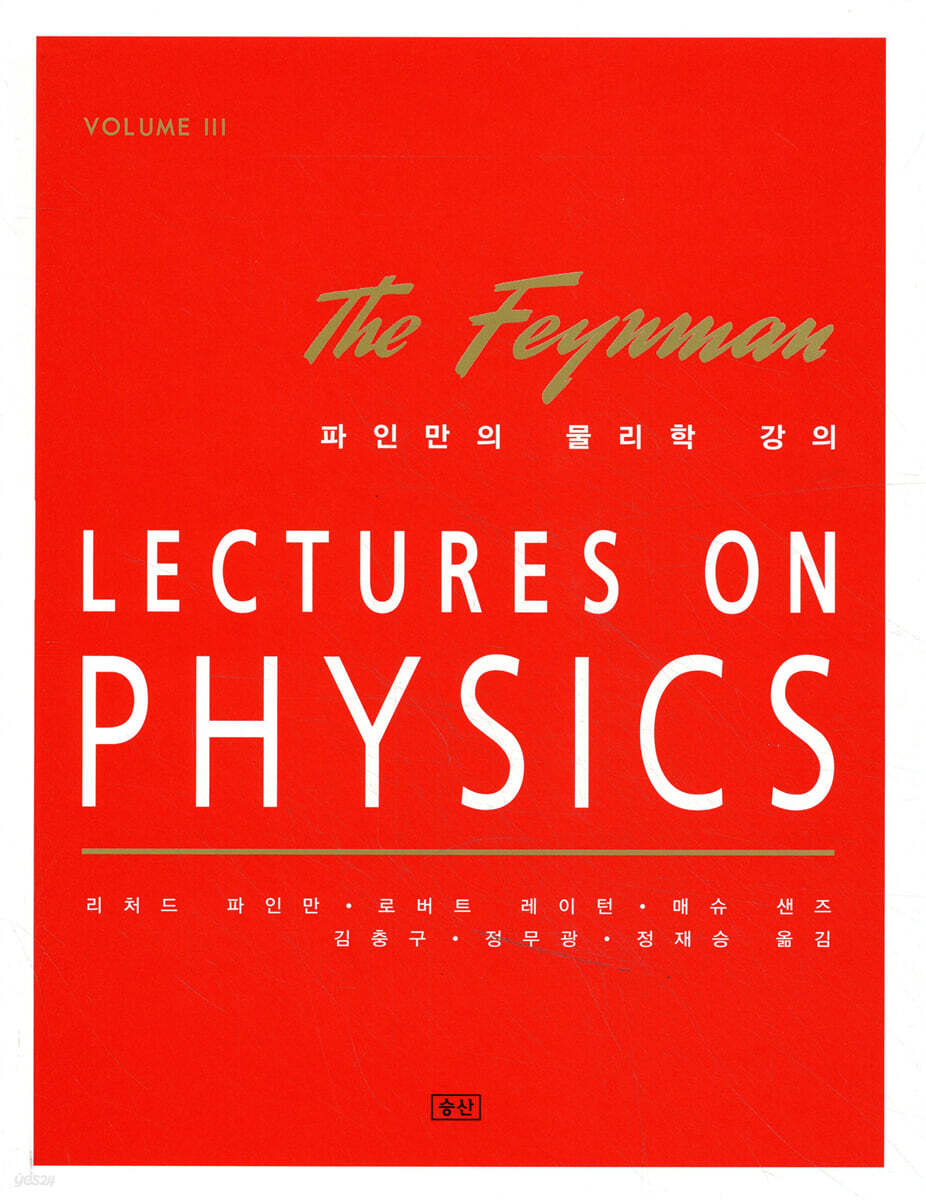
Volume 3 of the "Feynman Lectures on Physics" series, covering quantum mechanics. The "Feynman Lectures on Physics" series is a compilation of lectures given by Richard Feynman at the California Institute of Technology from the fall of 1961 to May 1963, edited and transcribed by Robert Leighton and Matthew Sands.
Following the first volume of the series on general physics and the second volume on electromagnetism and the properties of matter, this book deals with quantum mechanics, which can be considered Feynman's specialty, and presents the core of quantum mechanics with an original explanation that no one can imitate.
Richard Feynman was a pioneer in the field of quantum mechanics, receiving the Nobel Prize in Physics in 1965 along with Julian Schwinger and Shinichiro Tomonaga for their contributions to quantum electrodynamics.
With a firm determination to "show how fun physics can be," he brought quantum mechanics, a field usually covered in graduate school, into an introductory course for undergraduates, and he developed the logic in the opposite order of the traditional teaching method of finding solutions to a few simple cases after learning the Schrödinger equation.
He first uses the slit experiment apparatus, which clearly demonstrates the peculiar behavior of the microscopic world, to guide us through a conceptual understanding of quantum mechanics.
After explaining several important features through the path sum idea that all possible paths for a particle should be added up (this was also Feynman's major contribution to quantum electrodynamics), the book only shows the Schrödinger equation and explores its meaning in the middle part.
And in the latter part, we look at the application of quantum mechanics through examples closely related to our lives, such as semiconductors, transistors, and superconductivity.
Through the "Feynman Lectures on Physics" series, which has enjoyed the steady support of countless students, teachers, and physicists for the past 40 years, you will learn about Feynman's unique physical insights and teaching methods, such as the power of solid reasoning that penetrates the principles of things and his unique problem-solving methods that no one can imitate.
Volume 3 of the "Feynman Lectures on Physics" series, covering quantum mechanics. The "Feynman Lectures on Physics" series is a compilation of lectures given by Richard Feynman at the California Institute of Technology from the fall of 1961 to May 1963, edited and transcribed by Robert Leighton and Matthew Sands.
Following the first volume of the series on general physics and the second volume on electromagnetism and the properties of matter, this book deals with quantum mechanics, which can be considered Feynman's specialty, and presents the core of quantum mechanics with an original explanation that no one can imitate.
Richard Feynman was a pioneer in the field of quantum mechanics, receiving the Nobel Prize in Physics in 1965 along with Julian Schwinger and Shinichiro Tomonaga for their contributions to quantum electrodynamics.
With a firm determination to "show how fun physics can be," he brought quantum mechanics, a field usually covered in graduate school, into an introductory course for undergraduates, and he developed the logic in the opposite order of the traditional teaching method of finding solutions to a few simple cases after learning the Schrödinger equation.
He first uses the slit experiment apparatus, which clearly demonstrates the peculiar behavior of the microscopic world, to guide us through a conceptual understanding of quantum mechanics.
After explaining several important features through the path sum idea that all possible paths for a particle should be added up (this was also Feynman's major contribution to quantum electrodynamics), the book only shows the Schrödinger equation and explores its meaning in the middle part.
And in the latter part, we look at the application of quantum mechanics through examples closely related to our lives, such as semiconductors, transistors, and superconductivity.
Through the "Feynman Lectures on Physics" series, which has enjoyed the steady support of countless students, teachers, and physicists for the past 40 years, you will learn about Feynman's unique physical insights and teaching methods, such as the power of solid reasoning that penetrates the principles of things and his unique problem-solving methods that no one can imitate.
index
About Richard Feynman
Preface to the Revised Edition
Special Preface
Foreword by Richard Feynman
introduction
CHAPTER 1.
quantum behavior
1-1 Atomic dynamics
1-2 bullet experiment
1-3 wave experiment
1-4 Electronic Experiment
1-5 Interference of electromagnetic waves
1-6 Seeing electrons with your eyes
1-7 First principles of quantum mechanics
1-8 Uncertainty Principle
CHAPTER 2.
The relationship between waves and particles
2-1 Probability amplitude of wave
2-2 Measurement of position and momentum
Diffraction by 2-3 decision
Size of 2-4 atoms
2-5 energy levels
2-6 Philosophical meaning
CHAPTER 3.
probability amplitude
3-1 How to calculate amplitude
3-2 Interference pattern due to two slits
Scattering in the 3-3 decision
3-4 identical particles
CHAPTER 4.
identical particles
4-1 Bose particles and Fermion particles
4-2 State when there are two Bose particles
4-3 State when there are n Bose particles
4-4 Emission and absorption of photons
4-5 Blackbody radiation
4-6 liquid helium
4-7 Exclusion Principle
CHAPTER 5.
Spin 1
5-1 Filtering atoms using the Stern-Gerlach apparatus
5-2 Experiment using filtered atoms
5-3 Series-connected Stern-Gerlach filters
5-4 Base State
5-5 amplitude interference
5-6 How to use quantum mechanics
5-7 Conversion to other bases
5-8 Other cases
CHAPTER 6.
Spin 1/2
6-1 Amplitude Conversion
6-2 Transformation to a rotated coordinate system
6-3 Rotation about the z-axis
6-4 180° and 90° rotation about the y-axis
6-5 Rotation about the x-axis
6-6 Random rotation
CHAPTER 7.
Time-dependent change in amplitude
7-1 Atoms at rest: steady state
7-2 Uniform motion
7-3 Potential Energy: Conservation of Energy
7-4 Strength: Classical Limit
Precession of a spin 1/2 particle
CHAPTER 8.
Hamiltonian matrix
8-1 Amplitude and Vectors
8-2 Decomposing the state vector
8-3 What is the foundational state of this world?
How the status changes over 8-4 hours
8-5 Hamiltonian matrix
8-6 ammonia molecules
CHAPTER 9.
Ammonia Major
9-1 States of ammonia molecules
9-2 Molecules placed in a static electric field
9-3 Transition in a time-varying electric field
9-4 Transition under resonance conditions
9-5 Transition when resonance conditions are not satisfied
9-6 Absorption of light
CHAPTER 10.
Another example of a two-state system
10-1 hydrogen molecular ion
10-2 nuclear power
10-3 hydrogen molecules
10-4 benzene molecules
10-5 dye
Hamiltonian of a spin 1/2 particle in a 10-6 magnetic field
Electrons rotating in a 10-7 magnetic field
CHAPTER 11.
Let's take a closer look at the two state systems.
11-1 Pauli spin matrix
11-2 Spin matrices as operators
11-3 Solution of two state equations
11-4 Polarization state of photons
11-5 Neutral K-meson
Generalization to the 11-6 N state system
CHAPTER 12.
Ultra-fine splitting of hydrogen
Ground states of a system with two spin 1/2 particles
12-2 Hamiltonian for the ground state of hydrogen
12-3 Energy levels
12-4 Only the split
12-5 State in a magnetic field
12-6 Projection matrix of spin 1
CHAPTER 13.
Propagation within a crystal lattice
13-1 Electron states in a one-dimensional lattice
13-2 States with fixed energy
13-3 States that change over time
13-4 Electrons in a three-dimensional lattice
Other states within the 13-5 decision
13-6 Scattering due to defects in the lattice
Trapped in a 13-7 grid defect
13-8 Scattering amplitude and bound states
CHAPTER 14.
semiconductor
14-1 Electrons and holes in semiconductors
14-2 Impurity semiconductor
14-3 Hall effect
14-4 Semiconductor Junction
14-5 Rectification in semiconductor junctions
14-6 transistor
CHAPTER 15.
independent particle approximation
15-1 Spin Wave
15-2 Two-spin wave
15-3 Independent particles
15-4 Benzene molecule
15-5 Further Exploration of Organic Chemistry
Other uses of the 15-6 approximation
CHAPTER 16.
Variation of probability amplitude with location
Probability amplitude above line 16-1
16-2 Wavefunction
16-3 When the momentum is fixed
Normalization of states in the 16-4 coordinate system
16-5 Schrödinger equation
16-6 Quantized energy levels
CHAPTER 17.
Symmetry and conservation laws
17-1 Symmetry
17-2 Symmetry and Conservation
17-3 Conservation Law
17-4 Polarized light
17-5 Decay of the Λ particle
Summary of the 17-6 rotation matrix
CHAPTER 18.
angular momentum
18-1 Electric Dipole Radiation
18-2 Scattering of light
18-3 The extinction of positronium
18-4 Rotation matrix for arbitrary spin
18-5 Measurement of nuclear spin
18-6 Synthesis of angular momentum
CHAPTER 19.
Hydrogen atom and the periodic table
19-1 Schrödinger equation for hydrogen atom
19-2 Spherically symmetric solution
19-3 State with angular distribution
19-4 General solution for hydrogen
19-5 Hydrogen wave function
19-6 Periodic Table
CHAPTER 20.
operator
20-1 Operations and Operators
20-2 average energy
20-3 Average energy of atoms
20-4 Positional Operator
20-5 momentum operator
20-6 Angular momentum
Time-dependent change in the 20-7 mean
CHAPTER 21.
Schrödinger's Equation in Classical Context: Seminar on Superconductivity
21-1 Schrödinger equation in the presence of a magnetic field
21-2 Continuity equation of probability
21-3 Two types of momentum
21-4 Interpretation of wave functions
21-5 Superconductivity
21-6 Meissner effect
21-7 Quantization of Flux
21-8 Dynamics of Superconductivity
21-9 Josephson junction
Feynman's review
supplement
CHAPTER 34.
Magnetism of matter
34-1 Diamagnetism and Paramagnetism
34-2 Magnetic Moment and Angular Momentum
34-3 Precession of atomic magnets
34-4 Diamagnetism
34-5 Larmore's Theorem
34-6 Why diamagnetism and paramagnetism cannot be explained by classical mechanics
34-7 Angular momentum in quantum mechanics
34-8 Magnetic energy of atoms
CHAPTER 35.
Paramagnetic and magnetic resonance
35-1 Quantized magnetic states
35-2 Stern-Gerlach experiment
35-3 Rabi's molecular beam method
35-4 Paramagnetism of bulk materials
35-5 Insulated element cooling
35-6 Nuclear Magnetic Resonance
Preface to the Revised Edition
Special Preface
Foreword by Richard Feynman
introduction
CHAPTER 1.
quantum behavior
1-1 Atomic dynamics
1-2 bullet experiment
1-3 wave experiment
1-4 Electronic Experiment
1-5 Interference of electromagnetic waves
1-6 Seeing electrons with your eyes
1-7 First principles of quantum mechanics
1-8 Uncertainty Principle
CHAPTER 2.
The relationship between waves and particles
2-1 Probability amplitude of wave
2-2 Measurement of position and momentum
Diffraction by 2-3 decision
Size of 2-4 atoms
2-5 energy levels
2-6 Philosophical meaning
CHAPTER 3.
probability amplitude
3-1 How to calculate amplitude
3-2 Interference pattern due to two slits
Scattering in the 3-3 decision
3-4 identical particles
CHAPTER 4.
identical particles
4-1 Bose particles and Fermion particles
4-2 State when there are two Bose particles
4-3 State when there are n Bose particles
4-4 Emission and absorption of photons
4-5 Blackbody radiation
4-6 liquid helium
4-7 Exclusion Principle
CHAPTER 5.
Spin 1
5-1 Filtering atoms using the Stern-Gerlach apparatus
5-2 Experiment using filtered atoms
5-3 Series-connected Stern-Gerlach filters
5-4 Base State
5-5 amplitude interference
5-6 How to use quantum mechanics
5-7 Conversion to other bases
5-8 Other cases
CHAPTER 6.
Spin 1/2
6-1 Amplitude Conversion
6-2 Transformation to a rotated coordinate system
6-3 Rotation about the z-axis
6-4 180° and 90° rotation about the y-axis
6-5 Rotation about the x-axis
6-6 Random rotation
CHAPTER 7.
Time-dependent change in amplitude
7-1 Atoms at rest: steady state
7-2 Uniform motion
7-3 Potential Energy: Conservation of Energy
7-4 Strength: Classical Limit
Precession of a spin 1/2 particle
CHAPTER 8.
Hamiltonian matrix
8-1 Amplitude and Vectors
8-2 Decomposing the state vector
8-3 What is the foundational state of this world?
How the status changes over 8-4 hours
8-5 Hamiltonian matrix
8-6 ammonia molecules
CHAPTER 9.
Ammonia Major
9-1 States of ammonia molecules
9-2 Molecules placed in a static electric field
9-3 Transition in a time-varying electric field
9-4 Transition under resonance conditions
9-5 Transition when resonance conditions are not satisfied
9-6 Absorption of light
CHAPTER 10.
Another example of a two-state system
10-1 hydrogen molecular ion
10-2 nuclear power
10-3 hydrogen molecules
10-4 benzene molecules
10-5 dye
Hamiltonian of a spin 1/2 particle in a 10-6 magnetic field
Electrons rotating in a 10-7 magnetic field
CHAPTER 11.
Let's take a closer look at the two state systems.
11-1 Pauli spin matrix
11-2 Spin matrices as operators
11-3 Solution of two state equations
11-4 Polarization state of photons
11-5 Neutral K-meson
Generalization to the 11-6 N state system
CHAPTER 12.
Ultra-fine splitting of hydrogen
Ground states of a system with two spin 1/2 particles
12-2 Hamiltonian for the ground state of hydrogen
12-3 Energy levels
12-4 Only the split
12-5 State in a magnetic field
12-6 Projection matrix of spin 1
CHAPTER 13.
Propagation within a crystal lattice
13-1 Electron states in a one-dimensional lattice
13-2 States with fixed energy
13-3 States that change over time
13-4 Electrons in a three-dimensional lattice
Other states within the 13-5 decision
13-6 Scattering due to defects in the lattice
Trapped in a 13-7 grid defect
13-8 Scattering amplitude and bound states
CHAPTER 14.
semiconductor
14-1 Electrons and holes in semiconductors
14-2 Impurity semiconductor
14-3 Hall effect
14-4 Semiconductor Junction
14-5 Rectification in semiconductor junctions
14-6 transistor
CHAPTER 15.
independent particle approximation
15-1 Spin Wave
15-2 Two-spin wave
15-3 Independent particles
15-4 Benzene molecule
15-5 Further Exploration of Organic Chemistry
Other uses of the 15-6 approximation
CHAPTER 16.
Variation of probability amplitude with location
Probability amplitude above line 16-1
16-2 Wavefunction
16-3 When the momentum is fixed
Normalization of states in the 16-4 coordinate system
16-5 Schrödinger equation
16-6 Quantized energy levels
CHAPTER 17.
Symmetry and conservation laws
17-1 Symmetry
17-2 Symmetry and Conservation
17-3 Conservation Law
17-4 Polarized light
17-5 Decay of the Λ particle
Summary of the 17-6 rotation matrix
CHAPTER 18.
angular momentum
18-1 Electric Dipole Radiation
18-2 Scattering of light
18-3 The extinction of positronium
18-4 Rotation matrix for arbitrary spin
18-5 Measurement of nuclear spin
18-6 Synthesis of angular momentum
CHAPTER 19.
Hydrogen atom and the periodic table
19-1 Schrödinger equation for hydrogen atom
19-2 Spherically symmetric solution
19-3 State with angular distribution
19-4 General solution for hydrogen
19-5 Hydrogen wave function
19-6 Periodic Table
CHAPTER 20.
operator
20-1 Operations and Operators
20-2 average energy
20-3 Average energy of atoms
20-4 Positional Operator
20-5 momentum operator
20-6 Angular momentum
Time-dependent change in the 20-7 mean
CHAPTER 21.
Schrödinger's Equation in Classical Context: Seminar on Superconductivity
21-1 Schrödinger equation in the presence of a magnetic field
21-2 Continuity equation of probability
21-3 Two types of momentum
21-4 Interpretation of wave functions
21-5 Superconductivity
21-6 Meissner effect
21-7 Quantization of Flux
21-8 Dynamics of Superconductivity
21-9 Josephson junction
Feynman's review
supplement
CHAPTER 34.
Magnetism of matter
34-1 Diamagnetism and Paramagnetism
34-2 Magnetic Moment and Angular Momentum
34-3 Precession of atomic magnets
34-4 Diamagnetism
34-5 Larmore's Theorem
34-6 Why diamagnetism and paramagnetism cannot be explained by classical mechanics
34-7 Angular momentum in quantum mechanics
34-8 Magnetic energy of atoms
CHAPTER 35.
Paramagnetic and magnetic resonance
35-1 Quantized magnetic states
35-2 Stern-Gerlach experiment
35-3 Rabi's molecular beam method
35-4 Paramagnetism of bulk materials
35-5 Insulated element cooling
35-6 Nuclear Magnetic Resonance
Into the book
What does it truly mean to "understand" something? Let's compare the way the universe works to a game of chess.
So then, the rules of this chess game are set by God, and we are merely spectators watching the game.
It is also a pity that the audience has no choice but to watch without properly understanding the rules.
Of course, if you watch for enough time, you can figure out some rules.
The basic rules that are absolutely necessary for a game of chess to be established - this is basic physics.
However, because the movements of the pieces used in chess are so complex and human intelligence has obvious limitations, even if you know all the rules, you may not be able to understand why a particular move was made.
The situation is the same in nature.
The difficulty level is just much higher.
If we try hard, we might be able to figure out all those complex and difficult rules.
It is a problem to discover all the rules, but another major obstacle is that the phenomena that can be explained by the discovered rules are extremely limited.
Almost every situation is terribly complex, making it difficult to follow the game's progression and difficult to predict what will happen next.
Therefore, we have no choice but to focus on the extremely basic question of 'the rules of the game'.
If you understand all the rules, you will soon understand this world.
This is what we mean by 'the true meaning of understanding'.
- From the text explaining the meaning of 'understand'
The general public does not fully understand the meaning of scientific imagination.
They try to test the imagination of scientists by asking questions like:
“Here is a picture of a person in a specific situation.
Look at this picture and imagine what will happen in a moment.” But if I answer, “I can’t imagine it with just this,” they will think that our imagination is poor.
They overlook the fact that scientific imagination is “allowed only to the extent that it does not conflict with the established laws of physics.”
Electric fields and electromagnetic waves are not concepts that can be created by arbitrary imagination.
The hypothesis must not contradict other known laws of physics.
If it goes against the established laws of nature, no matter how much you push yourself to “imagine it scientifically,” it’s useless.
The imagination of physicists is quite different in nature from what is commonly called imagination.
They have to imagine things they have never heard of or seen.
Moreover, scientific imagination must undergo very rigorous verification.
No matter how wonderful and plausible an imaginary world may be, it is of no use if it does not conform to the known laws of nature.
Creating something new while harmonizing with so many rules is never easy.
- From the text explaining scientific imagination
So then, the rules of this chess game are set by God, and we are merely spectators watching the game.
It is also a pity that the audience has no choice but to watch without properly understanding the rules.
Of course, if you watch for enough time, you can figure out some rules.
The basic rules that are absolutely necessary for a game of chess to be established - this is basic physics.
However, because the movements of the pieces used in chess are so complex and human intelligence has obvious limitations, even if you know all the rules, you may not be able to understand why a particular move was made.
The situation is the same in nature.
The difficulty level is just much higher.
If we try hard, we might be able to figure out all those complex and difficult rules.
It is a problem to discover all the rules, but another major obstacle is that the phenomena that can be explained by the discovered rules are extremely limited.
Almost every situation is terribly complex, making it difficult to follow the game's progression and difficult to predict what will happen next.
Therefore, we have no choice but to focus on the extremely basic question of 'the rules of the game'.
If you understand all the rules, you will soon understand this world.
This is what we mean by 'the true meaning of understanding'.
- From the text explaining the meaning of 'understand'
The general public does not fully understand the meaning of scientific imagination.
They try to test the imagination of scientists by asking questions like:
“Here is a picture of a person in a specific situation.
Look at this picture and imagine what will happen in a moment.” But if I answer, “I can’t imagine it with just this,” they will think that our imagination is poor.
They overlook the fact that scientific imagination is “allowed only to the extent that it does not conflict with the established laws of physics.”
Electric fields and electromagnetic waves are not concepts that can be created by arbitrary imagination.
The hypothesis must not contradict other known laws of physics.
If it goes against the established laws of nature, no matter how much you push yourself to “imagine it scientifically,” it’s useless.
The imagination of physicists is quite different in nature from what is commonly called imagination.
They have to imagine things they have never heard of or seen.
Moreover, scientific imagination must undergo very rigorous verification.
No matter how wonderful and plausible an imaginary world may be, it is of no use if it does not conform to the known laws of nature.
Creating something new while harmonizing with so many rules is never easy.
- From the text explaining scientific imagination
--- From the text
Publisher's Review
About Feynman's Lectures on Physics
On October 4, 1957, the Soviet Union successfully launched Sputnik 1, the world's first artificial satellite.
This shocked the United States, which was far ahead in economy and science and technology.
The United States, which failed to secure an advantageous position in launching artificial satellites, a symbol of advanced science, realized the need to foster basic science and embarked on a large-scale educational reform.
In response, President Eisenhower issued a statement to the nation, established NASA, and devoted all his efforts to reforming the math and science education system.
As educational reforms are actively underway across the United States, the California Institute of Technology (Caltech) is experimenting with a new curriculum and a new way of teaching physics.
This lecture was recorded and recorded from the beginning at the university level, and the book that compiled and published it is 『Feynman Lectures on Physics』.
Professor Feynman had his own reasons for starting a basic physics course for first- and second-year students at Caltech.
Students who were known to be smart before entering college were becoming 'stupid' after taking boring and rigid physics classes.
Feynman, feeling sorry for this, rolled up his sleeves to “rescue the students” and began his now legendary physics lectures.
The key point of the lecture was “How to attract students’ attention to physics?” and the solution Feynman chose was “I will show you how fun physics can be!”
For the past 40 years, Feynman's Lectures on Physics have never been out of print, inspiring countless students, teachers, and physicists alike, providing a forum for ideas and discussion.
Even Feynman himself was inspired by this.
Feynman's great achievement goes beyond seeing everything from a new and fresh perspective.
Feynman was not just a great teacher, he was a great teacher of teachers.
Feynman himself said that his contribution to physics would be his lectures, not quantum electrodynamics or other theories that might drift away.
"Feynman's Lectures on Physics" is a book that allows you to fully experience the "hidden charm of physics" because it begins with the recognition that physics is essential as a tool for understanding natural phenomena.
For readers who have only been able to enjoy Feynman's lectures in the original English version, for those who wish to truly experience the essence of his lectures, and for the many young talents who love physics but are hesitant about pursuing a career in physics, I would like to share Feynman's confident voice, saying, "Science is a fun game."
I hope that the physics boom will be rekindled once again through "The Feynman Lectures on Physics," which continues to inspire not only students but also professors who have already achieved academic success in their fields.
The Structure of Feynman's Lectures on Physics
More than 40 years have passed since Feynman's legendary lectures were published as a book, and our understanding of the physical world has changed significantly, but "Feynman's Lectures on Physics" has withstood those changes.
It is no exaggeration to say that the true nature of physicist Feynman is revealed in these lecture notes.
This book finally shines with the power of solid reasoning that penetrates the principles of things and an ingenious problem-solving method that no one can imitate.
Thanks to Feynman's signature physical insights and teaching methods, it remains as powerful today as it was when it was first published.
Perhaps no other physics book has had such a long and widespread influence.
The Feynman Lectures on Physics series consists of four volumes.
Among them, Volumes I, II, and III are lectures Feynman gave at the California Institute of Technology from the fall of 1961 to May 1963, which were organized and transcribed by Robert Leighton and Matthew Sands.
This was published in 1963 under the title Feynman Lectures on Physics.
Volume I is a reconstruction of 'general physics' with Feynman's characteristic explanations, and covers mechanics, radiation, and heat.
Volume II, which deals with electromagnetism and physical properties, stands out for its depth of content not found in other electromagnetism books, and Feynman himself expresses considerable pride in his lecture notes throughout.
And the newly published Volume III deals with quantum mechanics, which can be said to be Feynman's specialty, and is evaluated as a gem of a book that shows the core of quantum mechanics with an original explanation that no one can imitate.
"Feynman's Guide to Physics" is an appendix to the lectures, consisting of three lectures on Feynman's problem solving, one lecture on inertial derivation, and problems and solutions prepared by Feynman's colleagues Robert Leighton and Locus Vogt.
This book was created by Michael Gottlieb and Ralph Leighton, who were fascinated by Feynman's lectures, and successfully restored four lectures, audio recordings, and photographs that were missing from the lecture notes. It is an excellent reference book that is more than enough to supplement the existing legendary lecture notes.
On October 4, 1957, the Soviet Union successfully launched Sputnik 1, the world's first artificial satellite.
This shocked the United States, which was far ahead in economy and science and technology.
The United States, which failed to secure an advantageous position in launching artificial satellites, a symbol of advanced science, realized the need to foster basic science and embarked on a large-scale educational reform.
In response, President Eisenhower issued a statement to the nation, established NASA, and devoted all his efforts to reforming the math and science education system.
As educational reforms are actively underway across the United States, the California Institute of Technology (Caltech) is experimenting with a new curriculum and a new way of teaching physics.
This lecture was recorded and recorded from the beginning at the university level, and the book that compiled and published it is 『Feynman Lectures on Physics』.
Professor Feynman had his own reasons for starting a basic physics course for first- and second-year students at Caltech.
Students who were known to be smart before entering college were becoming 'stupid' after taking boring and rigid physics classes.
Feynman, feeling sorry for this, rolled up his sleeves to “rescue the students” and began his now legendary physics lectures.
The key point of the lecture was “How to attract students’ attention to physics?” and the solution Feynman chose was “I will show you how fun physics can be!”
For the past 40 years, Feynman's Lectures on Physics have never been out of print, inspiring countless students, teachers, and physicists alike, providing a forum for ideas and discussion.
Even Feynman himself was inspired by this.
Feynman's great achievement goes beyond seeing everything from a new and fresh perspective.
Feynman was not just a great teacher, he was a great teacher of teachers.
Feynman himself said that his contribution to physics would be his lectures, not quantum electrodynamics or other theories that might drift away.
"Feynman's Lectures on Physics" is a book that allows you to fully experience the "hidden charm of physics" because it begins with the recognition that physics is essential as a tool for understanding natural phenomena.
For readers who have only been able to enjoy Feynman's lectures in the original English version, for those who wish to truly experience the essence of his lectures, and for the many young talents who love physics but are hesitant about pursuing a career in physics, I would like to share Feynman's confident voice, saying, "Science is a fun game."
I hope that the physics boom will be rekindled once again through "The Feynman Lectures on Physics," which continues to inspire not only students but also professors who have already achieved academic success in their fields.
The Structure of Feynman's Lectures on Physics
More than 40 years have passed since Feynman's legendary lectures were published as a book, and our understanding of the physical world has changed significantly, but "Feynman's Lectures on Physics" has withstood those changes.
It is no exaggeration to say that the true nature of physicist Feynman is revealed in these lecture notes.
This book finally shines with the power of solid reasoning that penetrates the principles of things and an ingenious problem-solving method that no one can imitate.
Thanks to Feynman's signature physical insights and teaching methods, it remains as powerful today as it was when it was first published.
Perhaps no other physics book has had such a long and widespread influence.
The Feynman Lectures on Physics series consists of four volumes.
Among them, Volumes I, II, and III are lectures Feynman gave at the California Institute of Technology from the fall of 1961 to May 1963, which were organized and transcribed by Robert Leighton and Matthew Sands.
This was published in 1963 under the title Feynman Lectures on Physics.
Volume I is a reconstruction of 'general physics' with Feynman's characteristic explanations, and covers mechanics, radiation, and heat.
Volume II, which deals with electromagnetism and physical properties, stands out for its depth of content not found in other electromagnetism books, and Feynman himself expresses considerable pride in his lecture notes throughout.
And the newly published Volume III deals with quantum mechanics, which can be said to be Feynman's specialty, and is evaluated as a gem of a book that shows the core of quantum mechanics with an original explanation that no one can imitate.
"Feynman's Guide to Physics" is an appendix to the lectures, consisting of three lectures on Feynman's problem solving, one lecture on inertial derivation, and problems and solutions prepared by Feynman's colleagues Robert Leighton and Locus Vogt.
This book was created by Michael Gottlieb and Ralph Leighton, who were fascinated by Feynman's lectures, and successfully restored four lectures, audio recordings, and photographs that were missing from the lecture notes. It is an excellent reference book that is more than enough to supplement the existing legendary lecture notes.
GOODS SPECIFICS
- Date of issue: May 12, 2009
- Format: Hardcover book binding method guide
- Page count, weight, size: 512 pages | 1,560g | 210*270*35mm
- ISBN13: 9788961390248
- ISBN10: 8961390244
You may also like
카테고리
korean


korean

![GQ KOREA Mark (Monthly): December [2025]](http://librairie.coreenne.fr/cdn/shop/files/8ef265dbbfbf186523ed75ba7319009d.jpg?v=1765340328&width=3840)


