

Reading the sky
 |
Description
Book Introduction
Waterstones Science Book of the Year
In the age of climate crisis, essential knowledge we need to know
Thousands of years of scientific history in the sky, unraveled by a world-renowned atmospheric physicist.
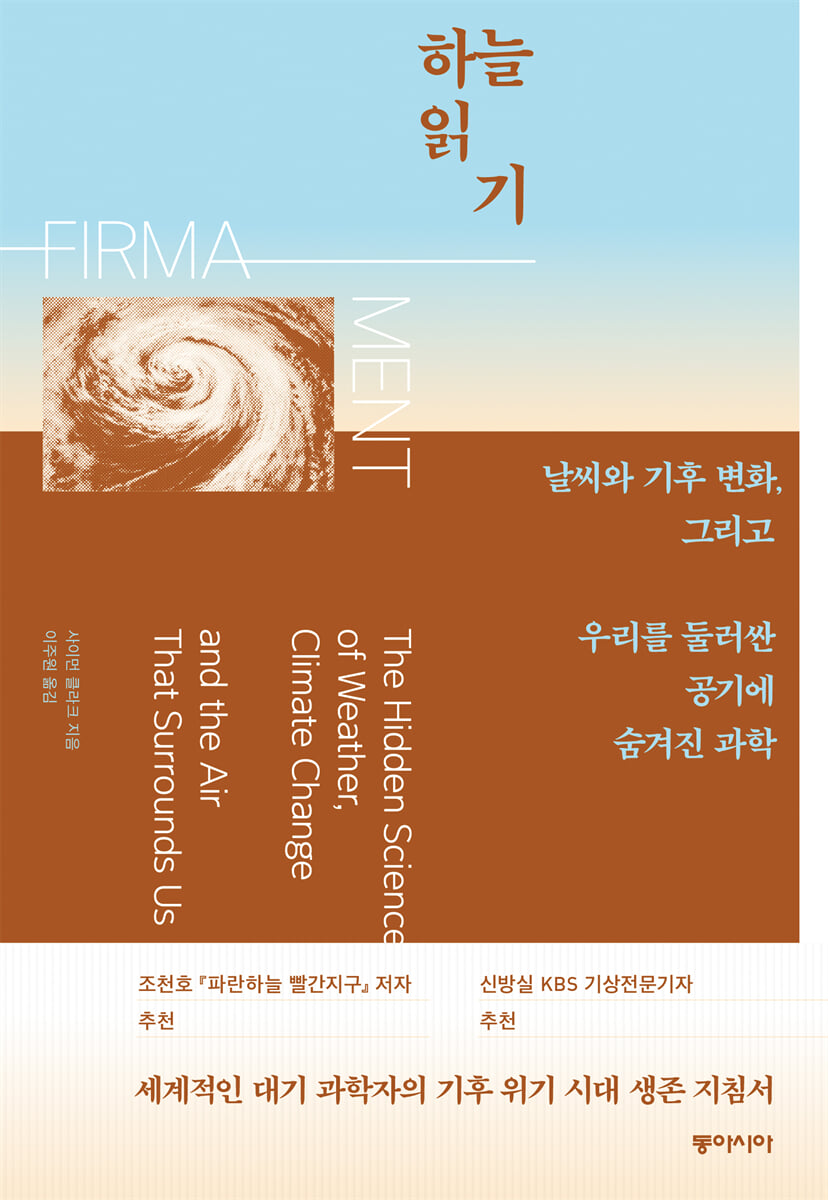
Firmament: The Hidden Science of Weather, Climate Change and the Air That Surrounds Us reveals the scientific principles of how the atmosphere works.
Simon Clarke, an atmospheric physicist and science communicator with a YouTube channel with 700,000 subscribers, explains in a clear and accessible way everything from the birth of atmospheric science to the reality of the climate crisis.
Covering the layers, flow, and history of the atmosphere, it thoroughly explains key concepts using physical laws and cutting-edge modeling.
Readers will learn about extreme phenomena such as heavy rain and cold waves, as well as long-term changes, all through a single principle.
For a long time, there were few truly popular books that viewed the atmosphere as a single system, and "Reading the Sky" persuasively fills that void.
Finally, the 'proper' atmospheric science book that readers have been waiting for has been published.
This book does not separate weather and climate, but presents the atmosphere as a single organic system, presenting the atmosphere as the "breath of giants" and the sky as the "physiology of the planet."
The author argues that the climate crisis "ultimately begins and ends with atmospheric science," and proposes a holistic understanding of the atmosphere surrounding our planet.
Scientifically rigorous yet original, it explains core concepts such as the troposphere, stratosphere, jet stream, El Niño Southern Oscillation, and polar vortex, vividly weaving together thousands of years of history of meteorology and atmospheric science and the challenges faced by scientists.
By following the author's interpretation of the sky, readers will gain a contextual understanding of everything from the fundamentals of meteorology to physics concepts such as equations of state, primitive equations, and chaos theory.
Moreover, the book provides a starting point for thinking about where we stand in the climate crisis of our time through rigorous data and what we should do about it.
In the age of climate crisis, essential knowledge we need to know
Thousands of years of scientific history in the sky, unraveled by a world-renowned atmospheric physicist.
Firmament: The Hidden Science of Weather, Climate Change and the Air That Surrounds Us reveals the scientific principles of how the atmosphere works.
Simon Clarke, an atmospheric physicist and science communicator with a YouTube channel with 700,000 subscribers, explains in a clear and accessible way everything from the birth of atmospheric science to the reality of the climate crisis.
Covering the layers, flow, and history of the atmosphere, it thoroughly explains key concepts using physical laws and cutting-edge modeling.
Readers will learn about extreme phenomena such as heavy rain and cold waves, as well as long-term changes, all through a single principle.
For a long time, there were few truly popular books that viewed the atmosphere as a single system, and "Reading the Sky" persuasively fills that void.
Finally, the 'proper' atmospheric science book that readers have been waiting for has been published.
This book does not separate weather and climate, but presents the atmosphere as a single organic system, presenting the atmosphere as the "breath of giants" and the sky as the "physiology of the planet."
The author argues that the climate crisis "ultimately begins and ends with atmospheric science," and proposes a holistic understanding of the atmosphere surrounding our planet.
Scientifically rigorous yet original, it explains core concepts such as the troposphere, stratosphere, jet stream, El Niño Southern Oscillation, and polar vortex, vividly weaving together thousands of years of history of meteorology and atmospheric science and the challenges faced by scientists.
By following the author's interpretation of the sky, readers will gain a contextual understanding of everything from the fundamentals of meteorology to physics concepts such as equations of state, primitive equations, and chaos theory.
Moreover, the book provides a starting point for thinking about where we stand in the climate crisis of our time through rigorous data and what we should do about it.
- You can preview some of the book's contents.
Preview
index
Recommendationㆍ006
Prologue - Giantㆍ010
Chapter 1 - Ideasㆍ018
Chapter 2 - Birthㆍ042
Chapter 3 - Windㆍ069
Chapter 4 - Field 085
Chapter 5 - Trade Windsㆍ109
Chapter 6 - Distanceㆍ135
Chapter 7 - Forecastㆍ156
Chapter 8 - The Whirlpoolㆍ186
Chapter 9 - Changeㆍ208
Epilogue - Familyㆍ264
Acknowledgmentsㆍ274
Glossary of Termsㆍ278
Week 282
Referencesㆍ294
Searchㆍ305
Prologue - Giantㆍ010
Chapter 1 - Ideasㆍ018
Chapter 2 - Birthㆍ042
Chapter 3 - Windㆍ069
Chapter 4 - Field 085
Chapter 5 - Trade Windsㆍ109
Chapter 6 - Distanceㆍ135
Chapter 7 - Forecastㆍ156
Chapter 8 - The Whirlpoolㆍ186
Chapter 9 - Changeㆍ208
Epilogue - Familyㆍ264
Acknowledgmentsㆍ274
Glossary of Termsㆍ278
Week 282
Referencesㆍ294
Searchㆍ305
Into the book
The main reason I wrote this book was to show that climate change is part of what we know about the atmosphere, a topic that has grown and developed over hundreds of years of thought and experimentation.
Climate change is just one tree planted in the forest of knowledge.
Thousands of years of observations have revealed how carbon dioxide warms the Earth's surface since a century ago, and how it mixes in the atmosphere since decades ago.
Climate change is still a subject of active research, but its roots lie in the tree of atmospheric science.
--- p.15~16 "Prologue: Giant"
Coxwell and Glacier didn't realize it, but they had achieved a world first.
They were almost certainly the first people to leave the lower atmosphere.
Had Glacier remained alert and watched the device, he would have discovered something that would have shocked the world.
That the Earth's atmosphere is more complex and multi-layered than previously thought.
--- p.23~24 "Chapter 1: Ideas"
The most important fact now is this:
The atmosphere is not heated directly by the sun above it, but by the Earth below it.
To use a cooking analogy, the atmosphere is not heated from above like water in a pot under an oven grill, but rather from below like water in a pot on a gas stove.
--- p.96~97 Chapter 4 "Field"
The Southern Oscillation refers to the seesaw-like oscillation of air masses between the Pacific and Indian Oceans.
This phenomenon is typically measured by the difference in pressure between the eastern and western Pacific Oceans (Tahiti and Darwin, Australia, respectively).
The expression seesaw or sway means that when the pressure in one area is relatively high, the pressure in another area is relatively low.
As we have seen, this imbalance in pressure inevitably causes atmospheric circulation.
The airflow that occurs in this case is called Walker circulation.
This circulation carries air across the Pacific Ocean, and a number called the Southern Oscillation Index describes the direction (east to west or west to east) and strength of the flow (higher numbers indicate stronger circulation, whether positive or negative).
Through rigorous statistical analysis, Walker found that the Southern Oscillation index's values influence the Indian monsoon.
--- p.149~150 "Chapter 6: Distance"
Building on the work of pioneers like Perel, Björknes integrated the work of several theoretical physicists, including Newton, Coriolis, and Euler, to present a concise system of equations to describe atmospheric flow.
These equations would later be called, somewhat harshly, primitive equations, to borrow an expression from undergraduates.
It may seem complicated to someone without a mathematical background, but its essence is very intuitive and simple.
--- p.170~171 "Chapter 7 Forecast"
Could it be that humans were polluting the entire planet's air? At the time, it seemed like a preposterous idea.
The atmosphere was so vast that it seemed unrelated to human activity.
But since the essence of science is asking questions, some scientists have begun to seriously explore those questions.
Swedish geologist Arvid Hogbom (1857–1940) outlined how carbon cycles through natural processes such as volcanic activity, uptake by the oceans, and release by acid rain.
Then, in 1896, he came to the idea that anthropogenic carbon emissions from factories, railways, and other sources should also be included.
After a long and arduous calculation, he was astonished by the results.
This is because the amount of CO₂ added to the atmosphere by human activities is almost equal to the amount emitted by natural processes.
--- p.238~239 "Chapter 9 Change"
Ultimately, we are in the palm of a giant's hand.
But that giant is never our enemy.
Just as bacteria do not consider humans as enemies, the atmosphere is also indifferent to our existence.
If the atmosphere were to write an autobiography spanning billions of years, humanity would probably appear only as a minor footnote.
It would be just a fleeting trace of what would otherwise be a millennia-long surge in carbon dioxide followed by a long, slow decline.
Perhaps even this is an overestimation of our importance.
The atmosphere doesn't need us.
But we need to wait.
--- p.261~262 "Chapter 9 Change"
The atmosphere is changing, and we are responsible for it.
Science has revealed that Earth was very different in the distant past, and warns that if we continue to emit carbon dioxide, the climate will be thrown out of the delicate balance that humanity has evolved to survive.
How to avoid devastating climate change is not just a question of atmospheric science.
Economics, sociology, political science, and many other fields must be considered together.
But this question ultimately begins and ends in atmospheric science.
Without a clear understanding of how the Earth will react to changes in its atmospheric composition, it is impossible to devise a course of action to escape our current predicament.
Climate change is just one tree planted in the forest of knowledge.
Thousands of years of observations have revealed how carbon dioxide warms the Earth's surface since a century ago, and how it mixes in the atmosphere since decades ago.
Climate change is still a subject of active research, but its roots lie in the tree of atmospheric science.
--- p.15~16 "Prologue: Giant"
Coxwell and Glacier didn't realize it, but they had achieved a world first.
They were almost certainly the first people to leave the lower atmosphere.
Had Glacier remained alert and watched the device, he would have discovered something that would have shocked the world.
That the Earth's atmosphere is more complex and multi-layered than previously thought.
--- p.23~24 "Chapter 1: Ideas"
The most important fact now is this:
The atmosphere is not heated directly by the sun above it, but by the Earth below it.
To use a cooking analogy, the atmosphere is not heated from above like water in a pot under an oven grill, but rather from below like water in a pot on a gas stove.
--- p.96~97 Chapter 4 "Field"
The Southern Oscillation refers to the seesaw-like oscillation of air masses between the Pacific and Indian Oceans.
This phenomenon is typically measured by the difference in pressure between the eastern and western Pacific Oceans (Tahiti and Darwin, Australia, respectively).
The expression seesaw or sway means that when the pressure in one area is relatively high, the pressure in another area is relatively low.
As we have seen, this imbalance in pressure inevitably causes atmospheric circulation.
The airflow that occurs in this case is called Walker circulation.
This circulation carries air across the Pacific Ocean, and a number called the Southern Oscillation Index describes the direction (east to west or west to east) and strength of the flow (higher numbers indicate stronger circulation, whether positive or negative).
Through rigorous statistical analysis, Walker found that the Southern Oscillation index's values influence the Indian monsoon.
--- p.149~150 "Chapter 6: Distance"
Building on the work of pioneers like Perel, Björknes integrated the work of several theoretical physicists, including Newton, Coriolis, and Euler, to present a concise system of equations to describe atmospheric flow.
These equations would later be called, somewhat harshly, primitive equations, to borrow an expression from undergraduates.
It may seem complicated to someone without a mathematical background, but its essence is very intuitive and simple.
--- p.170~171 "Chapter 7 Forecast"
Could it be that humans were polluting the entire planet's air? At the time, it seemed like a preposterous idea.
The atmosphere was so vast that it seemed unrelated to human activity.
But since the essence of science is asking questions, some scientists have begun to seriously explore those questions.
Swedish geologist Arvid Hogbom (1857–1940) outlined how carbon cycles through natural processes such as volcanic activity, uptake by the oceans, and release by acid rain.
Then, in 1896, he came to the idea that anthropogenic carbon emissions from factories, railways, and other sources should also be included.
After a long and arduous calculation, he was astonished by the results.
This is because the amount of CO₂ added to the atmosphere by human activities is almost equal to the amount emitted by natural processes.
--- p.238~239 "Chapter 9 Change"
Ultimately, we are in the palm of a giant's hand.
But that giant is never our enemy.
Just as bacteria do not consider humans as enemies, the atmosphere is also indifferent to our existence.
If the atmosphere were to write an autobiography spanning billions of years, humanity would probably appear only as a minor footnote.
It would be just a fleeting trace of what would otherwise be a millennia-long surge in carbon dioxide followed by a long, slow decline.
Perhaps even this is an overestimation of our importance.
The atmosphere doesn't need us.
But we need to wait.
--- p.261~262 "Chapter 9 Change"
The atmosphere is changing, and we are responsible for it.
Science has revealed that Earth was very different in the distant past, and warns that if we continue to emit carbon dioxide, the climate will be thrown out of the delicate balance that humanity has evolved to survive.
How to avoid devastating climate change is not just a question of atmospheric science.
Economics, sociology, political science, and many other fields must be considered together.
But this question ultimately begins and ends in atmospheric science.
Without a clear understanding of how the Earth will react to changes in its atmospheric composition, it is impossible to devise a course of action to escape our current predicament.
--- p.272 "Epilogue Family"
Publisher's Review
★Waterstones Science Book of the Year★
★BBC, Guardian, and New Scientist Recommended Books★
In the age of climate crisis,
General knowledge we must know
“Climate change is the greatest hoax ever perpetrated on the world.” This is a claim that US President Donald Trump has consistently made at various official events.
Despite the abundance of scientific data, climate crisis conspiracy theories continue to spread.
Nobel Prize winner in physics Dr. John Clauser even claimed that in 2023, “there will be no climate crisis on Earth.”
Content creators who monetize sensational videos are also joining in, fueling the conspiracy theory.
Is there really no climate crisis?
President Trump repeated the same claim at the 80th UN General Assembly, raising the climate crisis conspiracy theory.
This isn't the first time.
In 2017, he withdrew from the Paris Agreement on climate change and publicly declared that “global warming is a total hoax,” and during his re-election campaign, he openly used the slogan “Drill, baby, drill.”
Meanwhile, the United Nations World Meteorological Organization clearly warned in 2023 that there was a 66% chance that the 1.5 degree Celsius temperature rise limit, the upper limit for preventing a climate crisis, would be breached within five years.
Despite the clear link between the climate crisis and recent extreme weather events, the claims of some "climate crisis skeptics" and the aforementioned sensational media are leading more and more people to believe "climate crisis conspiracy theories."
Are climate conspiracy theories truly grounded? How should those unfamiliar with scientific data navigate the confusing information? Is there no way to gain easy, accurate knowledge about the climate and the Earth's atmosphere?
Simon Clark, an atmospheric physicist and science communicator with a YouTube channel with 700,000 subscribers, has written a popular science book called "Reading the Sky: The Science Hidden in Weather, Climate Change, and the Air We Live In." It is a popular science book that explains the atmosphere, which we must know in the era of climate crisis, in an easy and fun way.
The book presents clear data on the climate crisis, offers a scientifically grounded explanation, and offers a compelling, holistic view of the climate system that makes life possible.
Upon its initial publication in 2022, "Reading the Sky" received widespread praise for its exceptional storytelling and the originality of its scientific knowledge that blurred academic boundaries.
Waterstones of the UK selected it as the Science Book of the Year, saying, “It is a rare comprehensive textbook that covers everything from the birth of atmospheric science to the climate crisis in one breath,” and the Irish Independent said, “It explains what is happening in the sky so that it doesn’t just pass over our heads.”
In addition, it has received favorable reviews from numerous media outlets and is still a steady seller, having been recommended by the BBC, The Guardian, and New Scientist.
Unraveled in popular language
Thousands of years of scientific history above the sky
The author states that the climate crisis of our time 'ultimately begins and ends with atmospheric science.'
However, many people only understand the climate crisis abstractly and do not fully understand the atmospheric system.
To give readers a clearer picture of what's happening in Earth's skies, the book treats "the entire atmosphere as one giant," delving into its scientific underpinnings: pressure, temperature, atmosphere, jet streams, polar vortices, and more.
The greatest strength of 『Reading the Sky』 lies in its scientifically rigorous yet original development of knowledge.
As author Simon Clarke himself points out, atmospheric science and meteorology are “closely connected to many disciplines, including chemistry, physics, and geology,” and are a global science that is “woven like a thread in the vast fabric of human knowledge.”
So, in order to chase the giants, the author sometimes searches for the most crucial and greatest scenes of thousands of years of science and atmospheric science, like the wind or the air, and gives access to the comprehensive knowledge of atmospheric science that is not easily understood.
It traces the birth of meteorology in BC and examines Aristotle's view of the universe, and to explain the principles of trade winds, it takes readers to the battlefield of Philip II of Macedon, father of Alexander the Great.
The discovery and principles of the jet stream also lead to the monsoon climate of the Indian subcontinent via the abnormal temperature phenomena of El Niño and La Niña in the eastern Pacific.
In this way, the author has fully incorporated his experience as a science communicator and the operation of a YouTube channel with over 70 million cumulative views into the book.
By following the author's friendly explanations that read the sky, even readers unfamiliar with science can easily understand the Earth's atmosphere system.
In addition, it becomes possible to understand the concepts of theories that are likely to appear in college textbooks, such as equations of state, primitive equations, chaos theory, and black body radiation.
Korean readers will now be able to experience firsthand the impressive evaluation of this book: “A reader who couldn’t even tell the difference between the stratosphere and the troposphere will be able to draw a big picture of atmospheric dynamics in the last chapter.”
Until humanity understands the sky,
Meet the great intellectual adventures of scientists
The atmospheric science story in "Reading the Sky" begins with the balloonists James Glaisher and Henry Coxwell who took to the skies in 1862.
They took to the sky carrying various measuring instruments such as barometers, thermometers, and anemometers in a giant hot air balloon called Mammoth, but were unable to control their altitude due to equipment problems, putting them at risk of suffocation and barely returning to the ground.
This journey, which was considered a failed experience, was later re-evaluated.
Although they did not realize it at the time, the balloon is believed to have reached an altitude of 37,000 feet (11.3 kilometers).
This is the first time that humans have entered the tropopause.
The book guides readers through the most important phenomena and concepts in atmospheric science, while also depicting the challenges faced by scientists throughout history who made today's atmospheric science possible.
The scientists featured in the story are not limited to the field of atmospheric science.
It is also not limited to elite scientists who have completed formal education.
The author sometimes addresses their great challenges, and sometimes traces the backstories of unacknowledged, honest losers.
The journey of mankind to understand the sky is filled with countless stories of science and countless scientists, including Galileo Galilei, who introduced the first thermometer and changed atmospheric science forever; William Ferrell, who opened the door to geophysical fluid dynamics with a paper that did not contain a single equation; James Kroll, who worked as a university janitor and laid the foundation for the theory of albedo feedback during the Ice Age; and Eunice Foote, who proved that the Earth's atmosphere absorbs infrared but was overshadowed because she was a female scientist.
"Reading the Sky" invites us to breathe together into the long, great, and unexpected history of science.
The Earth doesn't need us
But we need the Earth
Simon Clarke concludes his book with a precise analysis of global warming.
There is no conspiracy, no deception, in the data on the increase in atmospheric CO₂ to 414 ppm and the changes expected to follow.
The author states that all the content in this book is “thoroughly data-based, published in academic journals after rigorous peer review, and continuously verified and revised.”
However, it also emphasizes that ignoring this information and data is not dangerous for the Earth.
The giant that is Earth and its atmosphere will still survive, and in the history of billions of Earths, “humanity may be nothing more than a small footnote.”
As the author argues, if we do not understand how the Earth responds to changes in its atmospheric composition, we will be unable to devise a course of action that will enable us to escape the crisis.
And much has already been revealed.
Thousands of years of science, countless scientists, and the author of this book, "Reading the Sky," have done their job.
It is now up to the readers of this book to decide how we will overcome the climate crisis and what story humanity will write about the giant that is the atmosphere and the Earth.
“It vividly portrays the atmosphere, which is essential to life on Earth but is unknown to most people.
Even if you can't tell the difference between the stratosphere and the troposphere, you'll understand by the time you finish this book.
The final chapter, in particular, is a powerful reminder of how the atmosphere is changing and what that means for humanity's future.” -Financial Times
“The author’s passion sparkles on every page.
“Through high-stakes field dramas like hot air balloon experiments and Antarctic ice core drilling, the seemingly chaotic patterns and science within the weather are clearly and vividly depicted.” -Sunday Times
“It is described in a light and passionate tone so that what is happening in the sky does not pass over our heads.”
-Irish Independent
★BBC, Guardian, and New Scientist Recommended Books★
In the age of climate crisis,
General knowledge we must know
“Climate change is the greatest hoax ever perpetrated on the world.” This is a claim that US President Donald Trump has consistently made at various official events.
Despite the abundance of scientific data, climate crisis conspiracy theories continue to spread.
Nobel Prize winner in physics Dr. John Clauser even claimed that in 2023, “there will be no climate crisis on Earth.”
Content creators who monetize sensational videos are also joining in, fueling the conspiracy theory.
Is there really no climate crisis?
President Trump repeated the same claim at the 80th UN General Assembly, raising the climate crisis conspiracy theory.
This isn't the first time.
In 2017, he withdrew from the Paris Agreement on climate change and publicly declared that “global warming is a total hoax,” and during his re-election campaign, he openly used the slogan “Drill, baby, drill.”
Meanwhile, the United Nations World Meteorological Organization clearly warned in 2023 that there was a 66% chance that the 1.5 degree Celsius temperature rise limit, the upper limit for preventing a climate crisis, would be breached within five years.
Despite the clear link between the climate crisis and recent extreme weather events, the claims of some "climate crisis skeptics" and the aforementioned sensational media are leading more and more people to believe "climate crisis conspiracy theories."
Are climate conspiracy theories truly grounded? How should those unfamiliar with scientific data navigate the confusing information? Is there no way to gain easy, accurate knowledge about the climate and the Earth's atmosphere?
Simon Clark, an atmospheric physicist and science communicator with a YouTube channel with 700,000 subscribers, has written a popular science book called "Reading the Sky: The Science Hidden in Weather, Climate Change, and the Air We Live In." It is a popular science book that explains the atmosphere, which we must know in the era of climate crisis, in an easy and fun way.
The book presents clear data on the climate crisis, offers a scientifically grounded explanation, and offers a compelling, holistic view of the climate system that makes life possible.
Upon its initial publication in 2022, "Reading the Sky" received widespread praise for its exceptional storytelling and the originality of its scientific knowledge that blurred academic boundaries.
Waterstones of the UK selected it as the Science Book of the Year, saying, “It is a rare comprehensive textbook that covers everything from the birth of atmospheric science to the climate crisis in one breath,” and the Irish Independent said, “It explains what is happening in the sky so that it doesn’t just pass over our heads.”
In addition, it has received favorable reviews from numerous media outlets and is still a steady seller, having been recommended by the BBC, The Guardian, and New Scientist.
Unraveled in popular language
Thousands of years of scientific history above the sky
The author states that the climate crisis of our time 'ultimately begins and ends with atmospheric science.'
However, many people only understand the climate crisis abstractly and do not fully understand the atmospheric system.
To give readers a clearer picture of what's happening in Earth's skies, the book treats "the entire atmosphere as one giant," delving into its scientific underpinnings: pressure, temperature, atmosphere, jet streams, polar vortices, and more.
The greatest strength of 『Reading the Sky』 lies in its scientifically rigorous yet original development of knowledge.
As author Simon Clarke himself points out, atmospheric science and meteorology are “closely connected to many disciplines, including chemistry, physics, and geology,” and are a global science that is “woven like a thread in the vast fabric of human knowledge.”
So, in order to chase the giants, the author sometimes searches for the most crucial and greatest scenes of thousands of years of science and atmospheric science, like the wind or the air, and gives access to the comprehensive knowledge of atmospheric science that is not easily understood.
It traces the birth of meteorology in BC and examines Aristotle's view of the universe, and to explain the principles of trade winds, it takes readers to the battlefield of Philip II of Macedon, father of Alexander the Great.
The discovery and principles of the jet stream also lead to the monsoon climate of the Indian subcontinent via the abnormal temperature phenomena of El Niño and La Niña in the eastern Pacific.
In this way, the author has fully incorporated his experience as a science communicator and the operation of a YouTube channel with over 70 million cumulative views into the book.
By following the author's friendly explanations that read the sky, even readers unfamiliar with science can easily understand the Earth's atmosphere system.
In addition, it becomes possible to understand the concepts of theories that are likely to appear in college textbooks, such as equations of state, primitive equations, chaos theory, and black body radiation.
Korean readers will now be able to experience firsthand the impressive evaluation of this book: “A reader who couldn’t even tell the difference between the stratosphere and the troposphere will be able to draw a big picture of atmospheric dynamics in the last chapter.”
Until humanity understands the sky,
Meet the great intellectual adventures of scientists
The atmospheric science story in "Reading the Sky" begins with the balloonists James Glaisher and Henry Coxwell who took to the skies in 1862.
They took to the sky carrying various measuring instruments such as barometers, thermometers, and anemometers in a giant hot air balloon called Mammoth, but were unable to control their altitude due to equipment problems, putting them at risk of suffocation and barely returning to the ground.
This journey, which was considered a failed experience, was later re-evaluated.
Although they did not realize it at the time, the balloon is believed to have reached an altitude of 37,000 feet (11.3 kilometers).
This is the first time that humans have entered the tropopause.
The book guides readers through the most important phenomena and concepts in atmospheric science, while also depicting the challenges faced by scientists throughout history who made today's atmospheric science possible.
The scientists featured in the story are not limited to the field of atmospheric science.
It is also not limited to elite scientists who have completed formal education.
The author sometimes addresses their great challenges, and sometimes traces the backstories of unacknowledged, honest losers.
The journey of mankind to understand the sky is filled with countless stories of science and countless scientists, including Galileo Galilei, who introduced the first thermometer and changed atmospheric science forever; William Ferrell, who opened the door to geophysical fluid dynamics with a paper that did not contain a single equation; James Kroll, who worked as a university janitor and laid the foundation for the theory of albedo feedback during the Ice Age; and Eunice Foote, who proved that the Earth's atmosphere absorbs infrared but was overshadowed because she was a female scientist.
"Reading the Sky" invites us to breathe together into the long, great, and unexpected history of science.
The Earth doesn't need us
But we need the Earth
Simon Clarke concludes his book with a precise analysis of global warming.
There is no conspiracy, no deception, in the data on the increase in atmospheric CO₂ to 414 ppm and the changes expected to follow.
The author states that all the content in this book is “thoroughly data-based, published in academic journals after rigorous peer review, and continuously verified and revised.”
However, it also emphasizes that ignoring this information and data is not dangerous for the Earth.
The giant that is Earth and its atmosphere will still survive, and in the history of billions of Earths, “humanity may be nothing more than a small footnote.”
As the author argues, if we do not understand how the Earth responds to changes in its atmospheric composition, we will be unable to devise a course of action that will enable us to escape the crisis.
And much has already been revealed.
Thousands of years of science, countless scientists, and the author of this book, "Reading the Sky," have done their job.
It is now up to the readers of this book to decide how we will overcome the climate crisis and what story humanity will write about the giant that is the atmosphere and the Earth.
“It vividly portrays the atmosphere, which is essential to life on Earth but is unknown to most people.
Even if you can't tell the difference between the stratosphere and the troposphere, you'll understand by the time you finish this book.
The final chapter, in particular, is a powerful reminder of how the atmosphere is changing and what that means for humanity's future.” -Financial Times
“The author’s passion sparkles on every page.
“Through high-stakes field dramas like hot air balloon experiments and Antarctic ice core drilling, the seemingly chaotic patterns and science within the weather are clearly and vividly depicted.” -Sunday Times
“It is described in a light and passionate tone so that what is happening in the sky does not pass over our heads.”
-Irish Independent
GOODS SPECIFICS
- Date of issue: November 20, 2025
- Page count, weight, size: 320 pages | 530g | 145*210*20mm
- ISBN13: 9788962626803
You may also like
카테고리
korean


korean

![GQ KOREA Mark (Monthly): December [2025]](http://librairie.coreenne.fr/cdn/shop/files/8ef265dbbfbf186523ed75ba7319009d.jpg?v=1765340328&width=3840)


