

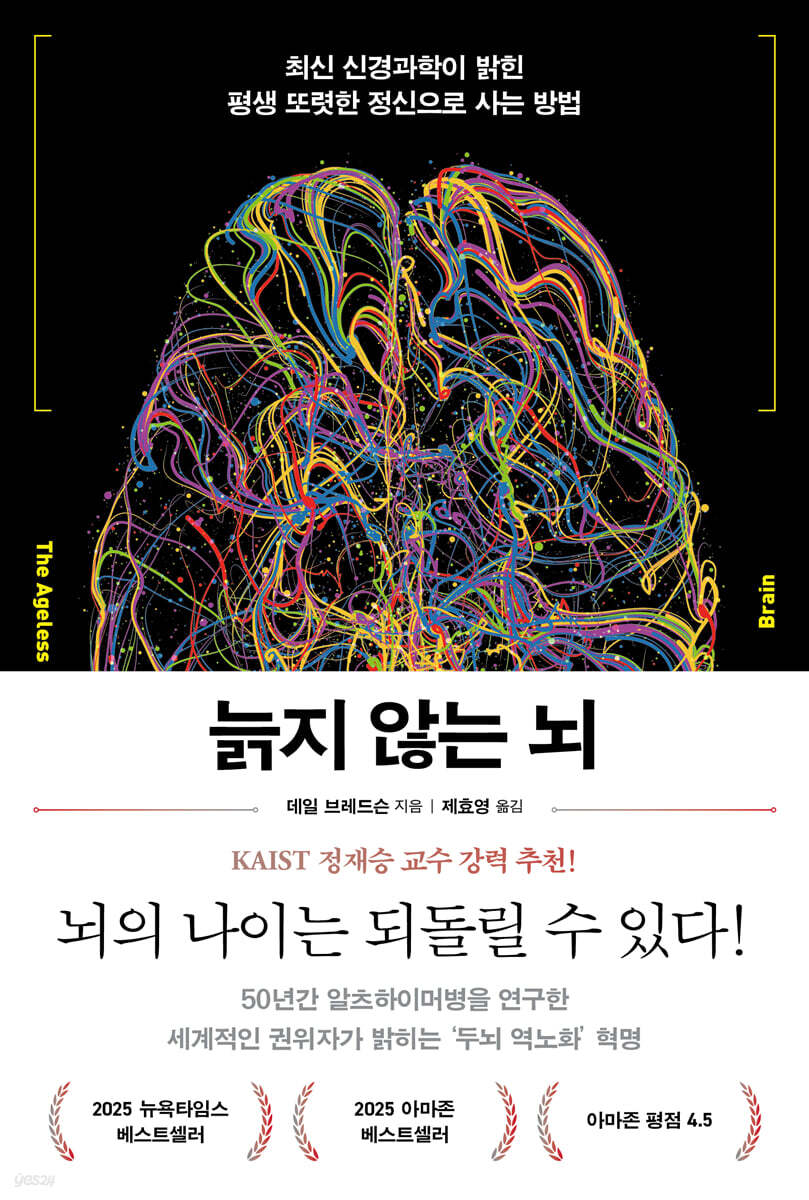
The brain that never ages
 |
Description
Book Introduction
A prescription for creating an ageless brain from a world-renowned Alzheimer's researcher.
“Aging is not a fearful end, but a treatable option!”
- Jaeseung Jeong, Professor of Brain and Cognitive Sciences, KAIST
Dementia is the disease that modern people fear most.
As life expectancy increases and more people aim to live a long and healthy life, neurodegenerative diseases like dementia, which impair cognitive abilities and make daily life difficult, are diseases that everyone wants to avoid.
But they are just vaguely afraid and do not try to prevent it properly.
Have you ever found yourself constantly forgetting things, forgetting the words you were trying to say, or losing focus? Have you ever dismissed it as nothing serious, saying, "I'm just tired from the last few days," or "I'm getting older, so there's nothing I can do about it?" If you ignore these small signs, you might end up regretting it.
Dale Bredesen, author of the 2025 New York Times bestseller and Amazon bestseller The Ageless Brain: How to Sharpen and Protect Your Mind for a Lifetime, declares that the saying “it’s because you’re old” is wrong.
Dale Bredesen is a world-renowned authority on neurodegenerative diseases such as dementia and Alzheimer's disease, having studied them for over 50 years.
In this book, he refutes the common belief that aging is not a natural phenomenon and that cognitive abilities decline with age, based on the latest neuroscience research.
Neurodegenerative diseases, including Alzheimer's disease, can be prevented even before they occur.
If the disease has already progressed, it is possible to slow down its progression or overcome it and return it to its original state.
Furthermore, it can even extend the lifespan of the brain.
This book, consisting of 14 chapters, covers the secrets of the 'ageless brain'.
First, we'll look at six key elements of brain function and seven characteristics of healthy, long-lived older adults to learn what to consider for a healthy, long-lived brain.
And it suggests ways that individuals can practice to have a 'younger and wiser brain', broadly divided into diet, exercise, sleep, and brain training.
At the same time, we also organize toxic substances and microorganisms that we must be wary of in our daily lives.
This book covers a wide range of topics, from why you should change your lifestyle before health problems arise, to focusing on specific factors directly related to brain health, and more, covering a wide range of topics for a healthy lifestyle overall, beyond brain aging.
"The Ageless Brain" is a must-read for anyone who knows someone suffering from a degenerative neurological disease, is concerned about their own brain health, or wants to live a life with a sharp and clear mind.
“Aging is not a fearful end, but a treatable option!”
- Jaeseung Jeong, Professor of Brain and Cognitive Sciences, KAIST
Dementia is the disease that modern people fear most.
As life expectancy increases and more people aim to live a long and healthy life, neurodegenerative diseases like dementia, which impair cognitive abilities and make daily life difficult, are diseases that everyone wants to avoid.
But they are just vaguely afraid and do not try to prevent it properly.
Have you ever found yourself constantly forgetting things, forgetting the words you were trying to say, or losing focus? Have you ever dismissed it as nothing serious, saying, "I'm just tired from the last few days," or "I'm getting older, so there's nothing I can do about it?" If you ignore these small signs, you might end up regretting it.
Dale Bredesen, author of the 2025 New York Times bestseller and Amazon bestseller The Ageless Brain: How to Sharpen and Protect Your Mind for a Lifetime, declares that the saying “it’s because you’re old” is wrong.
Dale Bredesen is a world-renowned authority on neurodegenerative diseases such as dementia and Alzheimer's disease, having studied them for over 50 years.
In this book, he refutes the common belief that aging is not a natural phenomenon and that cognitive abilities decline with age, based on the latest neuroscience research.
Neurodegenerative diseases, including Alzheimer's disease, can be prevented even before they occur.
If the disease has already progressed, it is possible to slow down its progression or overcome it and return it to its original state.
Furthermore, it can even extend the lifespan of the brain.
This book, consisting of 14 chapters, covers the secrets of the 'ageless brain'.
First, we'll look at six key elements of brain function and seven characteristics of healthy, long-lived older adults to learn what to consider for a healthy, long-lived brain.
And it suggests ways that individuals can practice to have a 'younger and wiser brain', broadly divided into diet, exercise, sleep, and brain training.
At the same time, we also organize toxic substances and microorganisms that we must be wary of in our daily lives.
This book covers a wide range of topics, from why you should change your lifestyle before health problems arise, to focusing on specific factors directly related to brain health, and more, covering a wide range of topics for a healthy lifestyle overall, beyond brain aging.
"The Ageless Brain" is a must-read for anyone who knows someone suffering from a degenerative neurological disease, is concerned about their own brain health, or wants to live a life with a sharp and clear mind.
- You can preview some of the book's contents.
Preview
index
Introduction: The Secret to a Young and Healthy Brain for Life
Chapter 1: The Young and Wise Brain
The illusion that aging is a universal experience | Scientific discoveries combating cognitive decline | The sharp rise in dementia cases | The evolution of the nervous system that has pushed its capabilities to their limits | Three essential resources for neural networks | The path to extending brain lifespan
Chapter 2: Things That Age Your Brain
The Sweetest Poison: Sugar | The Avengers of Dementia-Causing Toxins | Infectious Agents That Accelerate Biological Aging | Four Key Energy Sources for Brain Function | Genes Born in the Wrong Time | Nutrients and Under-Evolved Cells | Cortisol's Rush | Eliminating Targets One by One
Chapter 3: Characteristics of the Ageless Brain
The North Star of Cognitive Function | Staying Clear-Minded Until the Day You Close Your Eyes | Characteristics of a Healthy Brain Even at 100 | How to Make Our Brains Ageless
Chapter 4: The Threat of a Profit-Rule World
Blocking Information | People Exploiting Desperation | Glimpses of Potential in Diabetes Treatment | Toward a Better System | Efforts to Change the Status Quo
Chapter 5: You Must Have Your Own Reason
Where there's a will, there's a way | Find a reason to do it | Together, we go faster and further | What's your purpose in life?
Chapter 6: How to accurately determine your condition
Indicators of physical condition | Indicators of brain health | The more boring the test results, the better.
Chapter 7: The Brain's Favorite Diet
Why a Plant-Based Diet is Good for Your Brain | How to Get Your Protein | Getting Essential Nutrients | Supplements Are Just Supplements | The Trap of Processed and Ultra-Processed Foods | The Importance of Gut Microbiota | The Sugar Revenge | A Healthy Ketone Diet | Is a Gastric Bypass a Miracle? | The Change That Little Efforts Make
Chapter 8: Exercises Your Brain Loves
Aerobic Exercise for Brain Preservation | Strength Training for Cognitive Function | High-Intensity Interval Training | Blood Flow Restriction Exercise | Exercise Oxygen Therapy | The Best Exercise for Brain Health Right Now
Chapter 9 Rest for Recovery
The Glymphatic System: How the Brain Disposes of Waste | Conditions for a Good Night's Sleep | Quick Stress Management | Rest and Recovery
Chapter 10: Attempts to Stimulate Brain Flexibility
Breaking Routines: Small Changes in Daily Life | Sensory Stimulation Boosts Neuroplasticity | The Power of Relationships | The Social Brain and Cognitive Function | Experiencing a Variety of Emotions | Developing Emotional Flexibility | Disappointment and Regret
Chapter 11: Surviving Among Toxins
Fighting Mold | Heavy Metals Accumulating Everywhere | Microplastics That Are Not So Fine | Uprooting VOCs | In a World Filled with Harmful Substances
Chapter 12: Coexistence and Confrontation with Microorganisms
Gut Microbiome and a Healthy Diet | Oral Health and Brain Health | The Aftermath of Infectious Diseases | Sexually Transmitted Infections That Accelerate Brain Aging | Tick Infections | What We Can Do in a World Vulnerable to Infection
Chapter 13: A Preview of the Future of Brain Health
Bioidentical hormones | Destruction of senescent cells | Hundreds of peptides | Lifelong brain health and growth factors | The dream of reverse aging | Reprogramming the human body to reverse aging
Chapter 14: A Prescription for Creating an Ageless Brain
Table 1: Noninvasive tests for early detection of neurodegeneration | Table 2: Biochemical and physiological tests and criteria for assessment related to cognitive function | Table 3: Seven basic rules for keeping your brain young | Table 4: Examples of detailed strategies for keeping your brain young | Keeping your brain young
Acknowledgements
Huzhou
Chapter 1: The Young and Wise Brain
The illusion that aging is a universal experience | Scientific discoveries combating cognitive decline | The sharp rise in dementia cases | The evolution of the nervous system that has pushed its capabilities to their limits | Three essential resources for neural networks | The path to extending brain lifespan
Chapter 2: Things That Age Your Brain
The Sweetest Poison: Sugar | The Avengers of Dementia-Causing Toxins | Infectious Agents That Accelerate Biological Aging | Four Key Energy Sources for Brain Function | Genes Born in the Wrong Time | Nutrients and Under-Evolved Cells | Cortisol's Rush | Eliminating Targets One by One
Chapter 3: Characteristics of the Ageless Brain
The North Star of Cognitive Function | Staying Clear-Minded Until the Day You Close Your Eyes | Characteristics of a Healthy Brain Even at 100 | How to Make Our Brains Ageless
Chapter 4: The Threat of a Profit-Rule World
Blocking Information | People Exploiting Desperation | Glimpses of Potential in Diabetes Treatment | Toward a Better System | Efforts to Change the Status Quo
Chapter 5: You Must Have Your Own Reason
Where there's a will, there's a way | Find a reason to do it | Together, we go faster and further | What's your purpose in life?
Chapter 6: How to accurately determine your condition
Indicators of physical condition | Indicators of brain health | The more boring the test results, the better.
Chapter 7: The Brain's Favorite Diet
Why a Plant-Based Diet is Good for Your Brain | How to Get Your Protein | Getting Essential Nutrients | Supplements Are Just Supplements | The Trap of Processed and Ultra-Processed Foods | The Importance of Gut Microbiota | The Sugar Revenge | A Healthy Ketone Diet | Is a Gastric Bypass a Miracle? | The Change That Little Efforts Make
Chapter 8: Exercises Your Brain Loves
Aerobic Exercise for Brain Preservation | Strength Training for Cognitive Function | High-Intensity Interval Training | Blood Flow Restriction Exercise | Exercise Oxygen Therapy | The Best Exercise for Brain Health Right Now
Chapter 9 Rest for Recovery
The Glymphatic System: How the Brain Disposes of Waste | Conditions for a Good Night's Sleep | Quick Stress Management | Rest and Recovery
Chapter 10: Attempts to Stimulate Brain Flexibility
Breaking Routines: Small Changes in Daily Life | Sensory Stimulation Boosts Neuroplasticity | The Power of Relationships | The Social Brain and Cognitive Function | Experiencing a Variety of Emotions | Developing Emotional Flexibility | Disappointment and Regret
Chapter 11: Surviving Among Toxins
Fighting Mold | Heavy Metals Accumulating Everywhere | Microplastics That Are Not So Fine | Uprooting VOCs | In a World Filled with Harmful Substances
Chapter 12: Coexistence and Confrontation with Microorganisms
Gut Microbiome and a Healthy Diet | Oral Health and Brain Health | The Aftermath of Infectious Diseases | Sexually Transmitted Infections That Accelerate Brain Aging | Tick Infections | What We Can Do in a World Vulnerable to Infection
Chapter 13: A Preview of the Future of Brain Health
Bioidentical hormones | Destruction of senescent cells | Hundreds of peptides | Lifelong brain health and growth factors | The dream of reverse aging | Reprogramming the human body to reverse aging
Chapter 14: A Prescription for Creating an Ageless Brain
Table 1: Noninvasive tests for early detection of neurodegeneration | Table 2: Biochemical and physiological tests and criteria for assessment related to cognitive function | Table 3: Seven basic rules for keeping your brain young | Table 4: Examples of detailed strategies for keeping your brain young | Keeping your brain young
Acknowledgements
Huzhou
Detailed image

Into the book
But when it comes to brain problems like heart disease, cancer, and diabetes, there's a lot we can do.
Some methods should be started as early as possible, some are effective even if applied a little later, and some are a last resort.
There are many ways to prevent, slow down, and even help patients recover from neurodegenerative diseases.
--- p.12
Despite these tremendous advances, many people still allow their disease to progress for decades, sometimes even decades, before seeking treatment.
I have good news and bad news to tell those people.
The good news is that many people achieve amazing results with the RECODE program, even if they start treatment late.
You may regain your memory, recognize loved ones, socialize again, and regain the ability to speak, take care of yourself, and engage meaningfully with the world around you.
--- p.14
I wrote this book to tell that very story.
We can and will prevent cognitive decline, but to do so, we must dispel the terrible misconception that aging naturally leads to mental instability.
--- p.36
All subsystems of the nervous system have evolved since time immemorial to prioritize functional enhancement over functional preservation, and their functions have been finely tuned down to the smallest detail.
So, as we get older, our risk of developing problems increases.
Deterioration of the subsystems involved in neuroplasticity can lead to Alzheimer's disease, while degeneration of the subsystems controlling movement can lead to Parkinson's disease and Parkinson's-related disorders such as progressive supranuclear palsy.
When the neural network that generates the force needed for movement degenerates, Lou Gehrig's disease occurs, and when the neural network responsible for precise central vision is damaged, macular degeneration occurs.
Each of these neural networks has different demand and supply characteristics for its functions, and the biggest causes of its function failure are also different.
This common weakness of the lower neural networks, which is like an Achilles' heel, can be a good starting point for effectively preventing and treating diseases.
--- p.47
The key takeaway is that if we can prevent brain aging and the accumulation of factors that are detrimental to brain function long before a healthy state transitions to a diseased state, we may be able to prevent the disease from progressing to the point where symptoms become apparent.
This is a completely different perspective from the current situation where people only find a solution when the disease has progressed to a point where it is difficult to treat (a conclusion that is often reached by people who do not believe that there is much that can be done before it reaches this point).
--- p.53
No matter how long you think you want to live, if you want to live long enough to stay sane, you have to live well beyond the maximum lifespan that has already been proven feasible.
Therefore, in this chapter and the remainder of this book, we will explain things based on the age of one hundred.
Our goal is to have a hundred years of life without any loss of mental capacity, and for the brain to remain remarkably healthy for a hundred years.
--- p.92
“It helps older people like me keep using their brains.
“If there is a secret to longevity, I believe it is a positive mindset and a constant active mindset.” --- p.105
In this situation, maintaining a sharp mind until the age of 100 requires greater effort to avoid being pushed around by the 'big industry'.
This is also why I wrote this book.
I want to help you move beyond the current medical approach of treating illnesses only after they occur, and help you learn and practice ways to maintain brain health and function for a long time.
--- p.122
I want to make one thing clear.
I am not against drug therapy, and I believe that the best treatment is the one that helps the patient the most.
Future disease treatment will be a combination of personalized precision medicine and targeted drug therapy.
Limiting treatment options to a single, minimally effective treatment when there are treatments that can achieve far better outcomes prioritizes profits over the ultimate patient outcome.
--- p.134~135
I've witnessed the entire process unfold, brick by brick, as neurodegenerative diseases, once considered incomprehensible, become rationally explained, identified, predictable, and now treatable, preventable, and not inevitable.
Based on our research findings and clinical experience, it is clear that neurodegenerative diseases and brain aging are now ripe for complete eradication.
Just as we eliminated smallpox and polio, we must work globally to ensure that everyone can maintain good brain function throughout their lives.
--- p.167
Ironically, the energy deficiency that promotes brain aging and Alzheimer's disease comes from excess energy.
The problem is that simple carbohydrates are broken down too quickly in the body, causing a sudden surge of energy, which leads to insulin resistance, ketone formation stops, and the body is unable to evenly utilize glucose and ketones as energy sources.
--- p.238
A goal that applies to most people, regardless of age, is to do aerobic exercise at your maximum intensity for up to 10 minutes once a week, getting your heart rate up as much as possible, and then exercise for 30 minutes the other six days of the week at an intensity that gets your heart rate around 70 percent of your maximum.
--- p.256
“Alzheimer’s disease has no cure and no survivors.” Patients and their families are left bewildered and discouraged when they hear such despairing words.
It becomes even more confusing when you realize that there are hundreds of doctors who disagree with this anachronistic claim, and that thousands of patients are already being treated.
The confusion deepens when you hear that research results showing that cognitive function can be improved have been reviewed by experts and published in academic journals.
--- p.321
We are amazingly resilient creatures.
Our brains are also surprisingly resilient.
Additionally, brain aging can be prevented in various ways, and even cognitive functions that have already deteriorated can be restored.
So, there is no need to be too afraid of living in a world full of harmful substances.
However, we need to face reality and remember how much effort it takes to actually control what we can control.
--- p.383
By consistently making changes, adjusting, and planning optimization based on the best scientific knowledge available at the time, we can keep our brains very healthy until we are 100 years old, or until the very end of our lives, whichever comes first.
You will be a role model for brain health to those around you.
--- p.419
So, I emphasize again, we just have to do what we can do now.
We must continue to strive to achieve our goal of extending brain lifespan to over 100 years, and we must not stop along the way.
There are so many things we can do now, and even more will emerge in the coming years! Furthermore, tools to help us achieve our goals will proliferate, some already vaguely apparent, others still unimaginable.
Some methods should be started as early as possible, some are effective even if applied a little later, and some are a last resort.
There are many ways to prevent, slow down, and even help patients recover from neurodegenerative diseases.
--- p.12
Despite these tremendous advances, many people still allow their disease to progress for decades, sometimes even decades, before seeking treatment.
I have good news and bad news to tell those people.
The good news is that many people achieve amazing results with the RECODE program, even if they start treatment late.
You may regain your memory, recognize loved ones, socialize again, and regain the ability to speak, take care of yourself, and engage meaningfully with the world around you.
--- p.14
I wrote this book to tell that very story.
We can and will prevent cognitive decline, but to do so, we must dispel the terrible misconception that aging naturally leads to mental instability.
--- p.36
All subsystems of the nervous system have evolved since time immemorial to prioritize functional enhancement over functional preservation, and their functions have been finely tuned down to the smallest detail.
So, as we get older, our risk of developing problems increases.
Deterioration of the subsystems involved in neuroplasticity can lead to Alzheimer's disease, while degeneration of the subsystems controlling movement can lead to Parkinson's disease and Parkinson's-related disorders such as progressive supranuclear palsy.
When the neural network that generates the force needed for movement degenerates, Lou Gehrig's disease occurs, and when the neural network responsible for precise central vision is damaged, macular degeneration occurs.
Each of these neural networks has different demand and supply characteristics for its functions, and the biggest causes of its function failure are also different.
This common weakness of the lower neural networks, which is like an Achilles' heel, can be a good starting point for effectively preventing and treating diseases.
--- p.47
The key takeaway is that if we can prevent brain aging and the accumulation of factors that are detrimental to brain function long before a healthy state transitions to a diseased state, we may be able to prevent the disease from progressing to the point where symptoms become apparent.
This is a completely different perspective from the current situation where people only find a solution when the disease has progressed to a point where it is difficult to treat (a conclusion that is often reached by people who do not believe that there is much that can be done before it reaches this point).
--- p.53
No matter how long you think you want to live, if you want to live long enough to stay sane, you have to live well beyond the maximum lifespan that has already been proven feasible.
Therefore, in this chapter and the remainder of this book, we will explain things based on the age of one hundred.
Our goal is to have a hundred years of life without any loss of mental capacity, and for the brain to remain remarkably healthy for a hundred years.
--- p.92
“It helps older people like me keep using their brains.
“If there is a secret to longevity, I believe it is a positive mindset and a constant active mindset.” --- p.105
In this situation, maintaining a sharp mind until the age of 100 requires greater effort to avoid being pushed around by the 'big industry'.
This is also why I wrote this book.
I want to help you move beyond the current medical approach of treating illnesses only after they occur, and help you learn and practice ways to maintain brain health and function for a long time.
--- p.122
I want to make one thing clear.
I am not against drug therapy, and I believe that the best treatment is the one that helps the patient the most.
Future disease treatment will be a combination of personalized precision medicine and targeted drug therapy.
Limiting treatment options to a single, minimally effective treatment when there are treatments that can achieve far better outcomes prioritizes profits over the ultimate patient outcome.
--- p.134~135
I've witnessed the entire process unfold, brick by brick, as neurodegenerative diseases, once considered incomprehensible, become rationally explained, identified, predictable, and now treatable, preventable, and not inevitable.
Based on our research findings and clinical experience, it is clear that neurodegenerative diseases and brain aging are now ripe for complete eradication.
Just as we eliminated smallpox and polio, we must work globally to ensure that everyone can maintain good brain function throughout their lives.
--- p.167
Ironically, the energy deficiency that promotes brain aging and Alzheimer's disease comes from excess energy.
The problem is that simple carbohydrates are broken down too quickly in the body, causing a sudden surge of energy, which leads to insulin resistance, ketone formation stops, and the body is unable to evenly utilize glucose and ketones as energy sources.
--- p.238
A goal that applies to most people, regardless of age, is to do aerobic exercise at your maximum intensity for up to 10 minutes once a week, getting your heart rate up as much as possible, and then exercise for 30 minutes the other six days of the week at an intensity that gets your heart rate around 70 percent of your maximum.
--- p.256
“Alzheimer’s disease has no cure and no survivors.” Patients and their families are left bewildered and discouraged when they hear such despairing words.
It becomes even more confusing when you realize that there are hundreds of doctors who disagree with this anachronistic claim, and that thousands of patients are already being treated.
The confusion deepens when you hear that research results showing that cognitive function can be improved have been reviewed by experts and published in academic journals.
--- p.321
We are amazingly resilient creatures.
Our brains are also surprisingly resilient.
Additionally, brain aging can be prevented in various ways, and even cognitive functions that have already deteriorated can be restored.
So, there is no need to be too afraid of living in a world full of harmful substances.
However, we need to face reality and remember how much effort it takes to actually control what we can control.
--- p.383
By consistently making changes, adjusting, and planning optimization based on the best scientific knowledge available at the time, we can keep our brains very healthy until we are 100 years old, or until the very end of our lives, whichever comes first.
You will be a role model for brain health to those around you.
--- p.419
So, I emphasize again, we just have to do what we can do now.
We must continue to strive to achieve our goal of extending brain lifespan to over 100 years, and we must not stop along the way.
There are so many things we can do now, and even more will emerge in the coming years! Furthermore, tools to help us achieve our goals will proliferate, some already vaguely apparent, others still unimaginable.
--- p.447
Publisher's Review
The saying, “You can’t help it when you get older” is wrong.
Aging is never a natural phenomenon!
“It’s natural for cognitive function to decline as we age.” This belief, long ingrained in the medical community and society at large, has driven countless people into pessimism and resignation.
But Dale Bredesen, a world authority on Alzheimer's disease research, declares that this common belief is scientifically incorrect.
The introduction to "The Ageless Brain" refutes the idea that "aging is an incurable natural phenomenon" and why it is wrong.
He says brain decline is not an automatic decline that occurs with age, but a "predictable and intervenable process" that occurs when certain biological stressors accumulate.
The author has been studying Alzheimer's disease and neurodegenerative diseases for over 50 years, and has shown through clinical research that changes such as memory loss, decreased concentration, and decline in cognitive function are already 'controllable warning signs.'
Even if you are old and your brain is already aging, a significant portion of your brain function can be restored.
In fact, this is proven by the cases of symptom relief or overcoming through the 'ReCODE program', which was created based on the results of his research.
However, the problem with the structure of the medical industry is also the reason why this information has not yet been widely known to the public.
Traditional healthcare systems typically begin prescribing medication only after the disease has progressed significantly, prioritizing a comprehensive approach aimed at prevention and recovery.
The authors criticize this structure as prioritizing profits over patients' health.
'Personalized precision medicine', which comprehensively addresses lifestyle habits, nutritional status, hormones, toxic substances, and various infectious factors, is much more complex than prescribing a single drug, making it difficult to accept within the existing framework.
This is precisely why “The Brain That Never Ages” was created.
The authors argue that until the misconception that "mental decline is natural with age" is dispelled, no one can begin to take appropriate interventions to extend the golden years of brain health.
Aging is not an inevitable catastrophe, but a process that can be fully controlled and reversed.
This book thoroughly analyzes the process, drawing on the latest research, and guides readers who are "at the beginning of a steep cognitive decline" to avoid that dangerous path before it's too late.
A hundred-year-old man tells us
Conditions for an 'ageless brain'
A question may arise.
Can we truly maintain mental clarity as we age? The author answers this question with examples of long-lived seniors.
There are certainly people who have lived to be over a hundred years old and have maintained their clarity of thought and memory.
They have something in common.
They have high cognitive flexibility, advanced reasoning skills, emotional resilience, and mental and physical creativity.
We recommend that you consider these as the “North Star of cognitive function” and set practical goals to create a brain that never ages.
To complete the long race toward the goal of an "ageless brain," you need a specific reason for achieving the goal and a clear starting point.
The author says that you have to find your own strong reason.
The process of maintaining brain health in the long term is not a short-term solution that will yield results.
Therefore, we need to be aware of why we are on this path and what kind of life we want to live by changing our current lifestyle habits.
It's not just about motivation; it's about creating an internal foundation for the brain to sustain change.
If you have a firm will to carry out your plan, the next step is to know where the race begins.
The author believes that the starting point is ‘accurately understanding one’s own condition.’
In reality, most patients only seek medical attention when their disease has progressed considerably.
But the golden time is several years before the disease becomes serious.
Regularly assessing your own condition is a fundamental strategy for maintaining brain health, and Chapter 6 provides detailed guidance on which indicators are important and how to manage them.
《The Ageless Brain》 presents 'a brain that remains damage-free until the age of 100' as a realistic goal.
This is because the cases of long-lived elderly people are not simply viewed as a result of blessings, but are scientifically analyzed and reconstructed so that they can be applied to anyone.
The days of giving up on brain health because of age are over.
The important thing is to know 'why I need to start now' and 'what state is my brain in right now'.
This is the beginning of the journey towards an ageless brain.
Rather than obsessing over perfection, let's each take it one step at a time, using our own excellent examples as mirrors.
Just take one step, and if it goes well, take another step.
By taking small steps to improve cognitive health, you can help others do the same.
As those practices accumulate, the next step you take will usually be a little easier than the previous one.
I have reaffirmed this truth by observing my parents' lives and by living my own.
It's not something that can be done without effort.
However, if you keep doing it, you will soon feel the rewards for your efforts and it will soon become natural (page 113).
How to Keep Your Brain Healthy in Everyday Life
The power of small but powerful change
What can we do to create a brain that truly doesn't age? The latter part of the book presents specific, actionable strategies to prevent or reverse brain aging.
Brain health is determined by the small habits we repeat every day, rather than by grand treatments or extreme therapies.
The author explains how brain-protecting practices across our daily lives—including diet, exercise, sleep, cognitive stimulation, avoidance of toxins, and microbiome management—interwork to create a "lifelong youthful brain."
It consists of actions that readers can apply starting today, helping them naturally incorporate slowing down brain aging into their daily lives.
Among the many practical suggestions the author makes, one that is particularly interesting is 'breaking the routine.'
Our typical day consists of the same house, the same commute, and similar scenery.
The brain has neural connections that are formed to perform specific functions, and if new connections are not created, only old connections remain.
This is why we feel the limits of our cognitive functions when our living environment suddenly changes.
To avoid this situation, it is a good idea to make small changes to your lifestyle and routine to increase neuroplasticity and allow new neural pathways to form in your brain.
What needs to change? The author explains, "Stimulate your cognitive function by giving yourself a small, new task every day. Once a month, challenge yourself with a slightly more challenging task. Once a year, challenge yourself with a very challenging task."
A small, novel task you can tackle every day is anything that engages your brain's various cognitive abilities—memory, attention, language, perception, problem-solving, decision-making—in a different way than usual.
It's like ordering a drink you don't usually drink at a different cafe than the one you go to every morning, or working in a different space than where you usually work.
The key is “to break out of familiar patterns and give your brain a chance to make new connections.”
Some moderate challenges to try each month include trying a new exercise, cooking a dish you've never made before, or reading a book in a genre you don't usually read.
The key is to diversify the types of activities rather than changing the specific activities.
If you tried making Mexican food this month, next month you'll learn how to play mahjong.
The cognitive stimulation you try to achieve throughout the year should be things that require more effort.
This could include studying a new language for a year or taking chess seriously by analyzing the games of famous players.
However, when choosing activities, keep in mind that tasks required for professional purposes or tasks requiring a certain level of expertise may not stimulate cognitive functions.
《The Ageless Brain》 completely overturns the view that brain aging is fate.
Regardless of age, the brain can recover and transition to a younger, more intelligent state at any time.
As the author emphasizes, what matters is not perfection, but “taking one step today.”
The brain reacts to small daily actions, and those reactions accumulate to change the future of your life.
This book is not just a health guide, but a scientific declaration that “the future of the brain can be redesigned with today’s decisions.”
Whether you fear dementia, are concerned about your parents' health, or dream of living an independent and fulfilling life, this book will be the clearest and most reliable guide you can start right now.
Aging is never a natural phenomenon!
“It’s natural for cognitive function to decline as we age.” This belief, long ingrained in the medical community and society at large, has driven countless people into pessimism and resignation.
But Dale Bredesen, a world authority on Alzheimer's disease research, declares that this common belief is scientifically incorrect.
The introduction to "The Ageless Brain" refutes the idea that "aging is an incurable natural phenomenon" and why it is wrong.
He says brain decline is not an automatic decline that occurs with age, but a "predictable and intervenable process" that occurs when certain biological stressors accumulate.
The author has been studying Alzheimer's disease and neurodegenerative diseases for over 50 years, and has shown through clinical research that changes such as memory loss, decreased concentration, and decline in cognitive function are already 'controllable warning signs.'
Even if you are old and your brain is already aging, a significant portion of your brain function can be restored.
In fact, this is proven by the cases of symptom relief or overcoming through the 'ReCODE program', which was created based on the results of his research.
However, the problem with the structure of the medical industry is also the reason why this information has not yet been widely known to the public.
Traditional healthcare systems typically begin prescribing medication only after the disease has progressed significantly, prioritizing a comprehensive approach aimed at prevention and recovery.
The authors criticize this structure as prioritizing profits over patients' health.
'Personalized precision medicine', which comprehensively addresses lifestyle habits, nutritional status, hormones, toxic substances, and various infectious factors, is much more complex than prescribing a single drug, making it difficult to accept within the existing framework.
This is precisely why “The Brain That Never Ages” was created.
The authors argue that until the misconception that "mental decline is natural with age" is dispelled, no one can begin to take appropriate interventions to extend the golden years of brain health.
Aging is not an inevitable catastrophe, but a process that can be fully controlled and reversed.
This book thoroughly analyzes the process, drawing on the latest research, and guides readers who are "at the beginning of a steep cognitive decline" to avoid that dangerous path before it's too late.
A hundred-year-old man tells us
Conditions for an 'ageless brain'
A question may arise.
Can we truly maintain mental clarity as we age? The author answers this question with examples of long-lived seniors.
There are certainly people who have lived to be over a hundred years old and have maintained their clarity of thought and memory.
They have something in common.
They have high cognitive flexibility, advanced reasoning skills, emotional resilience, and mental and physical creativity.
We recommend that you consider these as the “North Star of cognitive function” and set practical goals to create a brain that never ages.
To complete the long race toward the goal of an "ageless brain," you need a specific reason for achieving the goal and a clear starting point.
The author says that you have to find your own strong reason.
The process of maintaining brain health in the long term is not a short-term solution that will yield results.
Therefore, we need to be aware of why we are on this path and what kind of life we want to live by changing our current lifestyle habits.
It's not just about motivation; it's about creating an internal foundation for the brain to sustain change.
If you have a firm will to carry out your plan, the next step is to know where the race begins.
The author believes that the starting point is ‘accurately understanding one’s own condition.’
In reality, most patients only seek medical attention when their disease has progressed considerably.
But the golden time is several years before the disease becomes serious.
Regularly assessing your own condition is a fundamental strategy for maintaining brain health, and Chapter 6 provides detailed guidance on which indicators are important and how to manage them.
《The Ageless Brain》 presents 'a brain that remains damage-free until the age of 100' as a realistic goal.
This is because the cases of long-lived elderly people are not simply viewed as a result of blessings, but are scientifically analyzed and reconstructed so that they can be applied to anyone.
The days of giving up on brain health because of age are over.
The important thing is to know 'why I need to start now' and 'what state is my brain in right now'.
This is the beginning of the journey towards an ageless brain.
Rather than obsessing over perfection, let's each take it one step at a time, using our own excellent examples as mirrors.
Just take one step, and if it goes well, take another step.
By taking small steps to improve cognitive health, you can help others do the same.
As those practices accumulate, the next step you take will usually be a little easier than the previous one.
I have reaffirmed this truth by observing my parents' lives and by living my own.
It's not something that can be done without effort.
However, if you keep doing it, you will soon feel the rewards for your efforts and it will soon become natural (page 113).
How to Keep Your Brain Healthy in Everyday Life
The power of small but powerful change
What can we do to create a brain that truly doesn't age? The latter part of the book presents specific, actionable strategies to prevent or reverse brain aging.
Brain health is determined by the small habits we repeat every day, rather than by grand treatments or extreme therapies.
The author explains how brain-protecting practices across our daily lives—including diet, exercise, sleep, cognitive stimulation, avoidance of toxins, and microbiome management—interwork to create a "lifelong youthful brain."
It consists of actions that readers can apply starting today, helping them naturally incorporate slowing down brain aging into their daily lives.
Among the many practical suggestions the author makes, one that is particularly interesting is 'breaking the routine.'
Our typical day consists of the same house, the same commute, and similar scenery.
The brain has neural connections that are formed to perform specific functions, and if new connections are not created, only old connections remain.
This is why we feel the limits of our cognitive functions when our living environment suddenly changes.
To avoid this situation, it is a good idea to make small changes to your lifestyle and routine to increase neuroplasticity and allow new neural pathways to form in your brain.
What needs to change? The author explains, "Stimulate your cognitive function by giving yourself a small, new task every day. Once a month, challenge yourself with a slightly more challenging task. Once a year, challenge yourself with a very challenging task."
A small, novel task you can tackle every day is anything that engages your brain's various cognitive abilities—memory, attention, language, perception, problem-solving, decision-making—in a different way than usual.
It's like ordering a drink you don't usually drink at a different cafe than the one you go to every morning, or working in a different space than where you usually work.
The key is “to break out of familiar patterns and give your brain a chance to make new connections.”
Some moderate challenges to try each month include trying a new exercise, cooking a dish you've never made before, or reading a book in a genre you don't usually read.
The key is to diversify the types of activities rather than changing the specific activities.
If you tried making Mexican food this month, next month you'll learn how to play mahjong.
The cognitive stimulation you try to achieve throughout the year should be things that require more effort.
This could include studying a new language for a year or taking chess seriously by analyzing the games of famous players.
However, when choosing activities, keep in mind that tasks required for professional purposes or tasks requiring a certain level of expertise may not stimulate cognitive functions.
《The Ageless Brain》 completely overturns the view that brain aging is fate.
Regardless of age, the brain can recover and transition to a younger, more intelligent state at any time.
As the author emphasizes, what matters is not perfection, but “taking one step today.”
The brain reacts to small daily actions, and those reactions accumulate to change the future of your life.
This book is not just a health guide, but a scientific declaration that “the future of the brain can be redesigned with today’s decisions.”
Whether you fear dementia, are concerned about your parents' health, or dream of living an independent and fulfilling life, this book will be the clearest and most reliable guide you can start right now.
GOODS SPECIFICS
- Date of issue: November 19, 2025
- Page count, weight, size: 548 pages | 760g | 145*215*36mm
- ISBN13: 9791172540883
- ISBN10: 1172540888
You may also like
카테고리
korean


korean

![GQ KOREA Mark (Monthly): December [2025]](http://librairie.coreenne.fr/cdn/shop/files/8ef265dbbfbf186523ed75ba7319009d.jpg?v=1765340328&width=3840)


