

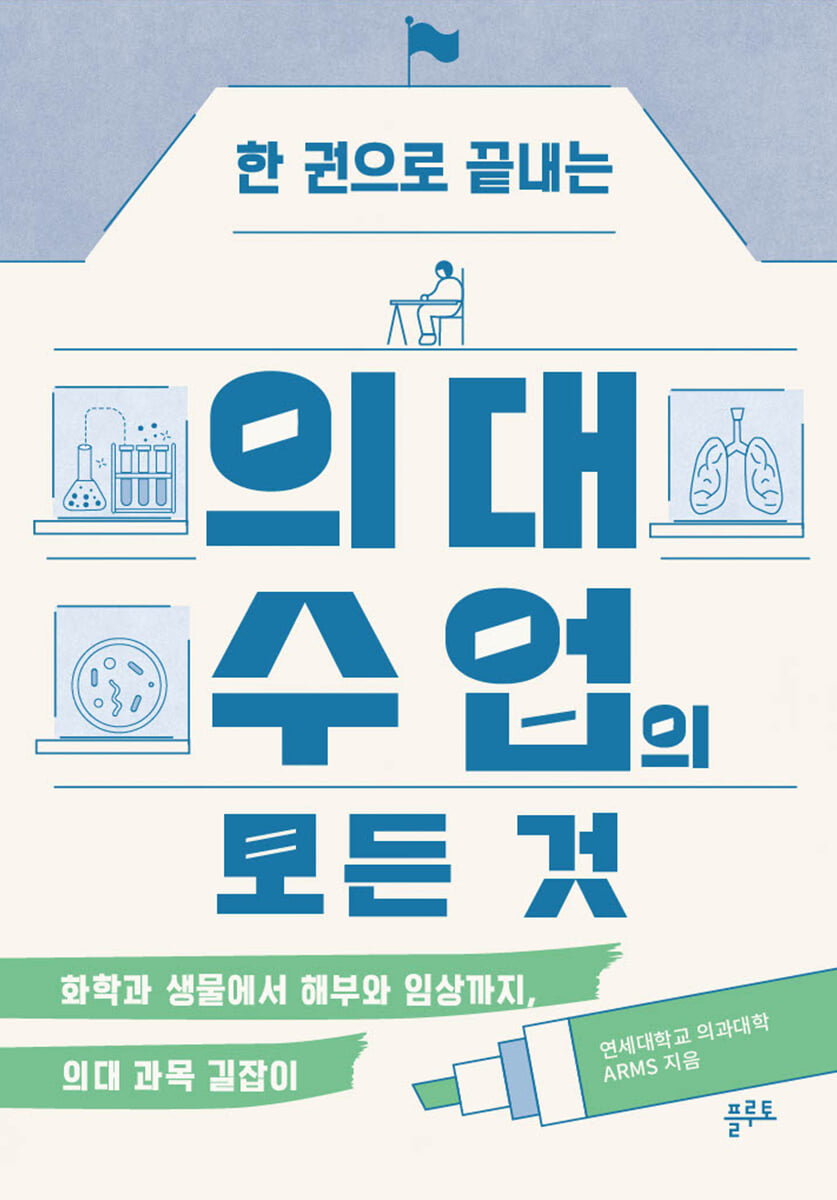
Everything you need to know about medical school in one book
 |
Description
Book Introduction
Many young people dream of becoming doctors and study with the goal of entering medical school.
But how many people actually know what subjects they study, why, and how they study them once they enter medical school? Is it true that medical students simply memorize medical textbooks, do well on exams, and excel at anatomy?
"Everything About Medical School in One Book" was designed to answer these questions and provide practical help to students preparing for medical school entrance exams.
The authors are all medical students of various grades currently enrolled at Yonsei University.
I tried to capture the subjects learned in each grade and my feelings while studying as vividly as possible.
Although I focused on the curriculum of Yonsei University College of Medicine, the perspective on medicine, values regarding medical education, and the macro-level framework of the curriculum will not differ significantly from any other medical school.
Medical students must understand the theories of chemistry, biology, statistics, and physics that are essential to understanding medicine.
After learning basic medical science such as biochemistry, histology, physiology, anatomy, pharmacology, pathology, and immunology, you learn about 20 types of clinical medicine such as gastroenterology, circulation, and respiratory medicine.
After learning the theory, you will practice at the hospital, such as making rounds and observing surgeries.
That's not all.
We also offer classes to improve leadership, communication skills with patients, and the ability to understand and empathize with patients, all of which are essential for doctors.
Nowadays, medical students are required to have the ability to conduct medical research on their own.
《Everything About Medical School in One Volume》 contains detailed information on the six-year curriculum and course content.
It will motivate future medical students and aspiring doctors to learn, and will assist them with middle and high school academics, record keeping, medical school essays, and interviews.
But how many people actually know what subjects they study, why, and how they study them once they enter medical school? Is it true that medical students simply memorize medical textbooks, do well on exams, and excel at anatomy?
"Everything About Medical School in One Book" was designed to answer these questions and provide practical help to students preparing for medical school entrance exams.
The authors are all medical students of various grades currently enrolled at Yonsei University.
I tried to capture the subjects learned in each grade and my feelings while studying as vividly as possible.
Although I focused on the curriculum of Yonsei University College of Medicine, the perspective on medicine, values regarding medical education, and the macro-level framework of the curriculum will not differ significantly from any other medical school.
Medical students must understand the theories of chemistry, biology, statistics, and physics that are essential to understanding medicine.
After learning basic medical science such as biochemistry, histology, physiology, anatomy, pharmacology, pathology, and immunology, you learn about 20 types of clinical medicine such as gastroenterology, circulation, and respiratory medicine.
After learning the theory, you will practice at the hospital, such as making rounds and observing surgeries.
That's not all.
We also offer classes to improve leadership, communication skills with patients, and the ability to understand and empathize with patients, all of which are essential for doctors.
Nowadays, medical students are required to have the ability to conduct medical research on their own.
《Everything About Medical School in One Volume》 contains detailed information on the six-year curriculum and course content.
It will motivate future medical students and aspiring doctors to learn, and will assist them with middle and high school academics, record keeping, medical school essays, and interviews.
- You can preview some of the book's contents.
Preview
index
A word to future juniors
Author's Note
Introduction - Life and Career Roadmap after Medical School
Chapter 1: Preparing to Become a Doctor, Pre-medical School
1 Building basic competencies for medical students
Chemistry and Biology
english
2. Developing the competencies that doctors must possess
Humanities and Social Medicine
Introduction to Statistics and Medical Statistics
Human genetics and organic chemistry
3 Elective subjects to get a taste of majors in our department and other departments
Medical school major selection
Other majors and minors
4. Pre-medical school life with diverse experiences
Clubs and Leisure Activities
Chapter 2: Basic Courses for Becoming a Doctor, 1st and 2nd Year Medical School Students
1. Basic subjects to learn basic medical knowledge
biochemistry
Histology and Physiology
Anatomy
The Foundations of Understanding Disease
2 Clinical subjects to learn practical knowledge
Gastroenterology
Circulatory science
Respiratory medicine
Nephrology and Urology
Clinical Immunology
hematology
endocrinology
Reproductive Medicine and Gynecological Diseases
Clinical Neuroscience
Psychiatry
emergency medicine
musculoskeletal medicine
Dermatology
Sensorimotor
preventive medicine
3 Basic Skills a Doctor-to-Be Should Have
DMH
PBL
CTCR
Chapter 3: Direct Experience in Clinical Practice, 3rd and 4th Year Medical School Students
1 A busy day for an intern
Let's make rounds
Outpatient and surgical
assignment
2. Get a medical license and prepare for the national exam.
3. Specialized selection process to improve individual abilities
Chapter 4: Medical Students Do Research
1 How do medical students conduct research?
2 Physician Scientists
Chapter 5: Will All Medical Students Become Doctors? Career Paths After Graduation
1 Doctor in the hospital
2 Doctors in the research lab
3 Doctors working at companies
Author's Note
Introduction - Life and Career Roadmap after Medical School
Chapter 1: Preparing to Become a Doctor, Pre-medical School
1 Building basic competencies for medical students
Chemistry and Biology
english
2. Developing the competencies that doctors must possess
Humanities and Social Medicine
Introduction to Statistics and Medical Statistics
Human genetics and organic chemistry
3 Elective subjects to get a taste of majors in our department and other departments
Medical school major selection
Other majors and minors
4. Pre-medical school life with diverse experiences
Clubs and Leisure Activities
Chapter 2: Basic Courses for Becoming a Doctor, 1st and 2nd Year Medical School Students
1. Basic subjects to learn basic medical knowledge
biochemistry
Histology and Physiology
Anatomy
The Foundations of Understanding Disease
2 Clinical subjects to learn practical knowledge
Gastroenterology
Circulatory science
Respiratory medicine
Nephrology and Urology
Clinical Immunology
hematology
endocrinology
Reproductive Medicine and Gynecological Diseases
Clinical Neuroscience
Psychiatry
emergency medicine
musculoskeletal medicine
Dermatology
Sensorimotor
preventive medicine
3 Basic Skills a Doctor-to-Be Should Have
DMH
PBL
CTCR
Chapter 3: Direct Experience in Clinical Practice, 3rd and 4th Year Medical School Students
1 A busy day for an intern
Let's make rounds
Outpatient and surgical
assignment
2. Get a medical license and prepare for the national exam.
3. Specialized selection process to improve individual abilities
Chapter 4: Medical Students Do Research
1 How do medical students conduct research?
2 Physician Scientists
Chapter 5: Will All Medical Students Become Doctors? Career Paths After Graduation
1 Doctor in the hospital
2 Doctors in the research lab
3 Doctors working at companies
Detailed image

Into the book
The required and elective subjects taken at medical school during the preparatory course are structured as a systematic process to prepare medical students before they begin their full-scale studies of medicine in the main department.
First, we learn chemistry, biology, statistics, and physics, which are essential for understanding medicine, from a medical perspective.
In biology, you learn about various diseases and the biology related to them, and in statistics, you study statistics used in medical research.
In English classes, you will learn medical terminology and English expressions needed when treating foreign patients.
I also take courses that include humanities elements, such as what mindset a doctor should have when practicing medicine and what methods and approaches should be used when treating patients.
---p.
29
In the beginning of the English for Medicine class, you will learn various medical terms, but it is not that difficult because you will learn mainly everyday terms that patients can easily understand and use.
The first terms you learn are those that refer to doctors in each specialty, such as pediatrician, dermatologist, orthopedic surgeon, and psychiatrist.
This is a term used to explain to patients how to collaborate with other departments, or to refer patients who have received primary care to a specialist.
---p.
36
Medical students learn the basics of probability and statistics in introductory statistics and medical statistics classes, as well as briefly about survival analysis, which is more relevant to medical research.
Medical research involves following patients over a period of time to determine whether an event of interest (a specific, significant event) actually occurs.
In cancer research, death might be the event of interest, and in heart disease research, the occurrence of a myocardial infarction might be the event of interest.
The survival function is the probability that the event has not yet occurred, that is, the probability that we are doing well until a certain point in time.
A statistical technique called Kaplan-Meier estimation is often used to calculate this survival function.
It is used to draw a survival curve showing how many people remain at each point in time.
---p.
48
If we learned about the structure and function of our body at the molecular and cellular level in biochemistry, histology, and physiology, then we learn anatomy, which involves observing the human body with our own eyes.
Anatomy is the study of living things by dissecting them.
It is a symbolic subject that all medical students encounter at least once, as it is a discipline that studies structure.
There are slight differences between schools, but at Yonsei University College of Medicine, students learn it starting in the second quarter of their first year.
For the anatomy training, 6-7 people are assigned to a group and a cadaver (corpse) to perform dissections for about a year.
It has been said that our body is composed of several functionally divided systems.
Anatomy classes focus on this system.
Anatomy is not simply a subject about memorizing the structure of the human body, but rather focuses on understanding the human body in an integrated manner by connecting the previously learned histology and physiology.
---p.
81
Clinical neuroscience is a subject that comprehensively studies the nervous system of our body.
It is a continuation of the basic neuroscience course learned in the first year of the course.
If the first year focused on the normal structure of the nervous system, clinical neuroscience focuses on understanding, diagnosing, and treating nervous system diseases.
In other words, you will learn how to approach neurological diseases clinically and analyze images based on anatomical and physiological information, and how to use pathological understanding and examination techniques to establish diagnosis and treatment plans for actual patients.
Through this, you will build comprehensive clinical capabilities, from the mechanisms and clinical aspects of neurological diseases to the use of diagnostic tools, therapeutic approaches, and rehabilitation.
---p.
121~122
The process of actually applying examination and interview techniques is standardized patient practice.
A standardized patient is not a real patient, but an actor trained to act like a real patient.
The training is conducted in a simulation format, and each training room is equipped with standardized patients with various cases.
The student must confirm the patient's name, age, and brief description of the situation at the front of the room, then enter the room and complete the entire treatment process, including taking the patient's medical history, performing a physical examination, and educating the patient, within a limited 12 minutes.
After the treatment is over, the standardized patient evaluates the treatment content, then returns to the room to receive feedback from the standardized patient or the professor or resident who evaluated the treatment outside the room.
---p.
152
Rounds are an activity in which a doctor walks around the wards of hospitalized patients and examines them.
Rounds times vary from professor to professor, but are usually early, such as 7 or 7:30 AM.
This is the schedule that starts the trainee's day.
Before making rounds, a BSP Bed Side Presentation is performed.
This is the time when the resident doctor supervised by the professor interviews and understands the patients who will be making rounds that day in advance, establishes a future treatment plan, and reports it to the professor.
In the past, this process was called bedside surgery (BSP) because it was done at the patient's bedside.
Nowadays, all of the patient's test results and progress records can be viewed on a computer, so this is mainly done at the station in the ward.
When there are many patients, the BSP time can exceed 30 to 40 minutes.
---p.
166~167
If you have successfully donned a gown and gloves in a sterile environment, it is time to begin the surgery.
Rather than directly participating in the surgical process, they mostly act as human support or human conduits.
For the surgeon to perform the surgery well, securing a clear field of vision is important.
This requires pulling and pushing the patient's skin, organs, and blood vessels.
It is done by residents, interns, or trainees because it requires pulling and pushing with appropriate force and direction.
Securing a field of vision is not as easy as it sounds.
First, you will need to stand still for several hours and make sure that the surgeon is in a position that is as comfortable as possible.
There are many times when you have to twist your body and hold the surgical tool in an awkward position for tens of minutes.
Moreover, you must have the skill to pull in the appropriate direction and with the appropriate strength.
This is probably the part that trainees get the most criticism for.
---p.
173
Yonsei University College of Medicine offers various research mentoring courses.
This is to encourage medical students to forge their own paths by planning and conducting their own research.
In the preparatory elective course 'Research Mentoring for Beginners' and the required course 'Research Mentoring', students choose a research topic under the guidance of a professor, conduct a literature review, and then present their findings.
And the research background, hypothesis, research method, etc. are organized in the form of a research plan.
In the 'In-depth Research Mentoring' elective course, students conduct research based on the research plan written during the research mentoring course and complete a report on the results.
You can also participate in an in-depth research program with the goal of writing a paper based on your research results or presenting it at an academic conference.
First, we learn chemistry, biology, statistics, and physics, which are essential for understanding medicine, from a medical perspective.
In biology, you learn about various diseases and the biology related to them, and in statistics, you study statistics used in medical research.
In English classes, you will learn medical terminology and English expressions needed when treating foreign patients.
I also take courses that include humanities elements, such as what mindset a doctor should have when practicing medicine and what methods and approaches should be used when treating patients.
---p.
29
In the beginning of the English for Medicine class, you will learn various medical terms, but it is not that difficult because you will learn mainly everyday terms that patients can easily understand and use.
The first terms you learn are those that refer to doctors in each specialty, such as pediatrician, dermatologist, orthopedic surgeon, and psychiatrist.
This is a term used to explain to patients how to collaborate with other departments, or to refer patients who have received primary care to a specialist.
---p.
36
Medical students learn the basics of probability and statistics in introductory statistics and medical statistics classes, as well as briefly about survival analysis, which is more relevant to medical research.
Medical research involves following patients over a period of time to determine whether an event of interest (a specific, significant event) actually occurs.
In cancer research, death might be the event of interest, and in heart disease research, the occurrence of a myocardial infarction might be the event of interest.
The survival function is the probability that the event has not yet occurred, that is, the probability that we are doing well until a certain point in time.
A statistical technique called Kaplan-Meier estimation is often used to calculate this survival function.
It is used to draw a survival curve showing how many people remain at each point in time.
---p.
48
If we learned about the structure and function of our body at the molecular and cellular level in biochemistry, histology, and physiology, then we learn anatomy, which involves observing the human body with our own eyes.
Anatomy is the study of living things by dissecting them.
It is a symbolic subject that all medical students encounter at least once, as it is a discipline that studies structure.
There are slight differences between schools, but at Yonsei University College of Medicine, students learn it starting in the second quarter of their first year.
For the anatomy training, 6-7 people are assigned to a group and a cadaver (corpse) to perform dissections for about a year.
It has been said that our body is composed of several functionally divided systems.
Anatomy classes focus on this system.
Anatomy is not simply a subject about memorizing the structure of the human body, but rather focuses on understanding the human body in an integrated manner by connecting the previously learned histology and physiology.
---p.
81
Clinical neuroscience is a subject that comprehensively studies the nervous system of our body.
It is a continuation of the basic neuroscience course learned in the first year of the course.
If the first year focused on the normal structure of the nervous system, clinical neuroscience focuses on understanding, diagnosing, and treating nervous system diseases.
In other words, you will learn how to approach neurological diseases clinically and analyze images based on anatomical and physiological information, and how to use pathological understanding and examination techniques to establish diagnosis and treatment plans for actual patients.
Through this, you will build comprehensive clinical capabilities, from the mechanisms and clinical aspects of neurological diseases to the use of diagnostic tools, therapeutic approaches, and rehabilitation.
---p.
121~122
The process of actually applying examination and interview techniques is standardized patient practice.
A standardized patient is not a real patient, but an actor trained to act like a real patient.
The training is conducted in a simulation format, and each training room is equipped with standardized patients with various cases.
The student must confirm the patient's name, age, and brief description of the situation at the front of the room, then enter the room and complete the entire treatment process, including taking the patient's medical history, performing a physical examination, and educating the patient, within a limited 12 minutes.
After the treatment is over, the standardized patient evaluates the treatment content, then returns to the room to receive feedback from the standardized patient or the professor or resident who evaluated the treatment outside the room.
---p.
152
Rounds are an activity in which a doctor walks around the wards of hospitalized patients and examines them.
Rounds times vary from professor to professor, but are usually early, such as 7 or 7:30 AM.
This is the schedule that starts the trainee's day.
Before making rounds, a BSP Bed Side Presentation is performed.
This is the time when the resident doctor supervised by the professor interviews and understands the patients who will be making rounds that day in advance, establishes a future treatment plan, and reports it to the professor.
In the past, this process was called bedside surgery (BSP) because it was done at the patient's bedside.
Nowadays, all of the patient's test results and progress records can be viewed on a computer, so this is mainly done at the station in the ward.
When there are many patients, the BSP time can exceed 30 to 40 minutes.
---p.
166~167
If you have successfully donned a gown and gloves in a sterile environment, it is time to begin the surgery.
Rather than directly participating in the surgical process, they mostly act as human support or human conduits.
For the surgeon to perform the surgery well, securing a clear field of vision is important.
This requires pulling and pushing the patient's skin, organs, and blood vessels.
It is done by residents, interns, or trainees because it requires pulling and pushing with appropriate force and direction.
Securing a field of vision is not as easy as it sounds.
First, you will need to stand still for several hours and make sure that the surgeon is in a position that is as comfortable as possible.
There are many times when you have to twist your body and hold the surgical tool in an awkward position for tens of minutes.
Moreover, you must have the skill to pull in the appropriate direction and with the appropriate strength.
This is probably the part that trainees get the most criticism for.
---p.
173
Yonsei University College of Medicine offers various research mentoring courses.
This is to encourage medical students to forge their own paths by planning and conducting their own research.
In the preparatory elective course 'Research Mentoring for Beginners' and the required course 'Research Mentoring', students choose a research topic under the guidance of a professor, conduct a literature review, and then present their findings.
And the research background, hypothesis, research method, etc. are organized in the form of a research plan.
In the 'In-depth Research Mentoring' elective course, students conduct research based on the research plan written during the research mentoring course and complete a report on the results.
You can also participate in an in-depth research program with the goal of writing a paper based on your research results or presenting it at an academic conference.
---p.
197
197
Publisher's Review
What seniors at Yonsei University College of Medicine tell us
A real medical school story
The status of medical schools in our country is unique.
Even now, many young people are studying with the goal of entering medical school.
However, once you enter medical school, there are very few people who know why and how to study which subjects.
When you think of medical school, you think of the enormous amount of studying, tests, memorization, and anatomy labs.
Can anyone become a doctor simply by diligently memorizing theory and doing well on the exam? What process do interns and residents at university hospitals go through to get there?
"Everything About Medical School in One Book" was designed to answer these questions and provide practical help to students preparing for medical school entrance exams.
The authors are medical students of various grades who are active in the ARMS (Health and Exercise Society) at Yonsei University College of Medicine.
I tried to convey the content of the subjects learned in each grade and my feelings while studying as vividly as possible.
The book contains the authors' desire to teach future doctors about real medical school classes and the life of a medical student.
Since both authors are medical students at Yonsei University College of Medicine, the book focuses on the six-year curriculum at Yonsei University College of Medicine. However, the perspectives on medicine, values regarding medical education, and the macroscopic framework of the curriculum do not differ significantly across medical schools.
Therefore, it will be of great help to any student aiming to enter medical school.
What do medical students do during their six years of medical school?
How to learn
Medical school is a six-year program consisting of two years of preparatory courses and four years of undergraduate courses, and each year provides significantly different education.
As the title suggests, “Everything About Medical School Classes in One Book” introduces everything about medical school classes, as well as the lives and career paths of medical students.
It will motivate future medical students and aspiring doctors to learn, and will assist them with middle and high school academics, record keeping, medical school essays, and interviews.
Chapter 1 introduces the preparatory course of medical school.
Pre-medical school is the golden age for almost all medical students, and it is a time to learn about various aspects of medicine before starting to study medicine in earnest.
Chapter 2 covers the first and second year of the course.
First-year students study basic medicine, which is the study of the normal state of the human body, and second-year students study clinical medicine, which is the study of diseases that cause the human body to become abnormal and their treatments.
To learn basic medicine, you learn basic subjects such as biochemistry, histology, physiology, anatomy, pharmacology, pathology, and immunology.
Next, based on basic medical science, you will learn more than 20 clinical subjects, including gastroenterology, circulation, and respiratory science.
And that's not all.
We also offer classes to improve leadership, communication skills with patients, and the ability to understand and empathize with patients, all of which are essential for doctors.
Chapter 3 introduces third- and fourth-year students who primarily perform clinical practice in hospital gowns.
This is the time to do assignments such as making rounds with hospital professors, observing outpatients and surgeries, and presenting cases and journal articles.
It also explains how to prepare for the national medical licensing exam to obtain a medical license and the exam format.
To increase the reliability of medicine and further develop it, doctors must also conduct research.
Chapter 4 discusses research competency education, another major pillar of medical school instruction.
Finally, Chapter 5 introduces the various career paths available to doctors who have graduated from medical school.
The latest curriculum of Yonsei University College of Medicine is included in the front of the book.
It provides a comprehensive overview of the six-year curriculum, making it a good reference when looking for a comprehensive overview of medical school subjects or when making a study plan for medical school admissions.
All medical students become doctors
It's not possible
The career paths for doctors who graduate from medical school and obtain a license are more diverse than you might think.
Most medical students undergo training at university hospitals to become specialists.
On the other hand, there are people who open a hospital right after obtaining a medical license.
However, you can prune your path as much as you like according to your own judgment.
Hospitals are not the only career path that medical students can choose.
After graduating from medical school, some professors focus on basic research rather than providing clinical care, while others run clinical laboratories while interacting with patients.
Physicians working in research institutes can collaborate with researchers from various fields to conduct original and useful research.
Although rare, some doctors leave the hospital or laboratory and enter the business world.
You can use your original major, medicine, to work at a pharmaceutical company or create and run a medical company.
Some people go to law school and become lawyers, others become medical journalists, and some enter consulting firms and become consultants.
While reading "Everything About Medical School in One Book," I asked myself what kind of doctor I want to be in the future and what kind of work I enjoy doing. This will definitely motivate me as I prepare to enter medical school.
A real medical school story
The status of medical schools in our country is unique.
Even now, many young people are studying with the goal of entering medical school.
However, once you enter medical school, there are very few people who know why and how to study which subjects.
When you think of medical school, you think of the enormous amount of studying, tests, memorization, and anatomy labs.
Can anyone become a doctor simply by diligently memorizing theory and doing well on the exam? What process do interns and residents at university hospitals go through to get there?
"Everything About Medical School in One Book" was designed to answer these questions and provide practical help to students preparing for medical school entrance exams.
The authors are medical students of various grades who are active in the ARMS (Health and Exercise Society) at Yonsei University College of Medicine.
I tried to convey the content of the subjects learned in each grade and my feelings while studying as vividly as possible.
The book contains the authors' desire to teach future doctors about real medical school classes and the life of a medical student.
Since both authors are medical students at Yonsei University College of Medicine, the book focuses on the six-year curriculum at Yonsei University College of Medicine. However, the perspectives on medicine, values regarding medical education, and the macroscopic framework of the curriculum do not differ significantly across medical schools.
Therefore, it will be of great help to any student aiming to enter medical school.
What do medical students do during their six years of medical school?
How to learn
Medical school is a six-year program consisting of two years of preparatory courses and four years of undergraduate courses, and each year provides significantly different education.
As the title suggests, “Everything About Medical School Classes in One Book” introduces everything about medical school classes, as well as the lives and career paths of medical students.
It will motivate future medical students and aspiring doctors to learn, and will assist them with middle and high school academics, record keeping, medical school essays, and interviews.
Chapter 1 introduces the preparatory course of medical school.
Pre-medical school is the golden age for almost all medical students, and it is a time to learn about various aspects of medicine before starting to study medicine in earnest.
Chapter 2 covers the first and second year of the course.
First-year students study basic medicine, which is the study of the normal state of the human body, and second-year students study clinical medicine, which is the study of diseases that cause the human body to become abnormal and their treatments.
To learn basic medicine, you learn basic subjects such as biochemistry, histology, physiology, anatomy, pharmacology, pathology, and immunology.
Next, based on basic medical science, you will learn more than 20 clinical subjects, including gastroenterology, circulation, and respiratory science.
And that's not all.
We also offer classes to improve leadership, communication skills with patients, and the ability to understand and empathize with patients, all of which are essential for doctors.
Chapter 3 introduces third- and fourth-year students who primarily perform clinical practice in hospital gowns.
This is the time to do assignments such as making rounds with hospital professors, observing outpatients and surgeries, and presenting cases and journal articles.
It also explains how to prepare for the national medical licensing exam to obtain a medical license and the exam format.
To increase the reliability of medicine and further develop it, doctors must also conduct research.
Chapter 4 discusses research competency education, another major pillar of medical school instruction.
Finally, Chapter 5 introduces the various career paths available to doctors who have graduated from medical school.
The latest curriculum of Yonsei University College of Medicine is included in the front of the book.
It provides a comprehensive overview of the six-year curriculum, making it a good reference when looking for a comprehensive overview of medical school subjects or when making a study plan for medical school admissions.
All medical students become doctors
It's not possible
The career paths for doctors who graduate from medical school and obtain a license are more diverse than you might think.
Most medical students undergo training at university hospitals to become specialists.
On the other hand, there are people who open a hospital right after obtaining a medical license.
However, you can prune your path as much as you like according to your own judgment.
Hospitals are not the only career path that medical students can choose.
After graduating from medical school, some professors focus on basic research rather than providing clinical care, while others run clinical laboratories while interacting with patients.
Physicians working in research institutes can collaborate with researchers from various fields to conduct original and useful research.
Although rare, some doctors leave the hospital or laboratory and enter the business world.
You can use your original major, medicine, to work at a pharmaceutical company or create and run a medical company.
Some people go to law school and become lawyers, others become medical journalists, and some enter consulting firms and become consultants.
While reading "Everything About Medical School in One Book," I asked myself what kind of doctor I want to be in the future and what kind of work I enjoy doing. This will definitely motivate me as I prepare to enter medical school.
GOODS SPECIFICS
- Date of issue: November 24, 2025
- Page count, weight, size: 216 pages | 304g | 147*210*13mm
- ISBN13: 9791188569939
You may also like
카테고리
korean


korean

![GQ KOREA Mark (Monthly): December [2025]](http://librairie.coreenne.fr/cdn/shop/files/8ef265dbbfbf186523ed75ba7319009d.jpg?v=1765340328&width=3840)


