

The first step in AI drug development
 |
Description
Book Introduction
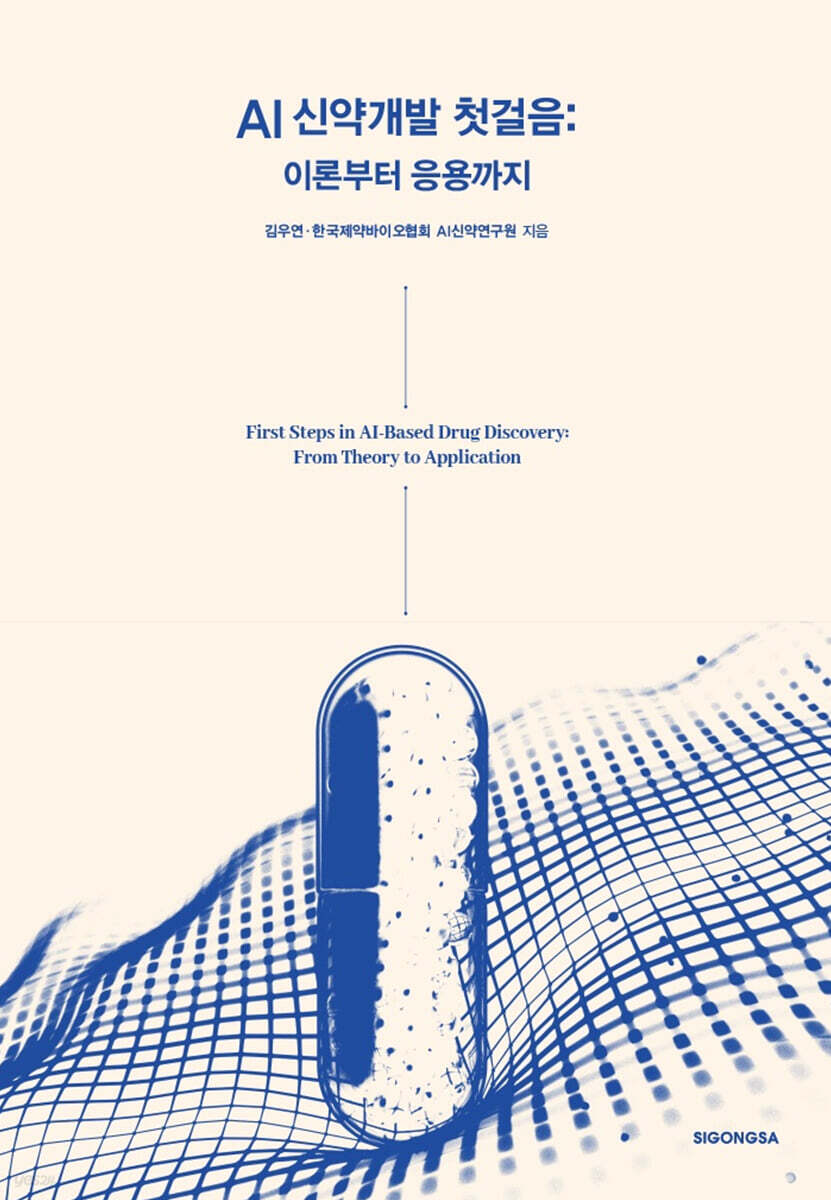
"First Steps in AI Drug Development" is an introductory book that explains how artificial intelligence is changing the paradigm of the pharmaceutical and biotechnology industries.
Traditionally, developing new drugs takes more than a decade, is associated with enormous costs, and numerous failures. However, AI is gaining attention as an innovative tool that analyzes massive amounts of data to discover candidate substances, predict protein structures and drug actions, and increase clinical success rates.
This book covers the basic concepts of new drug development, the interactions between proteins, diseases, and drugs, and the process of drug discovery, optimization, and clinical trials.
It also connects deep learning principles and neural network structures such as CNN, RNN, and GNN, and even new drug design using generative AI, helping readers understand the overall flow in three dimensions.
This book serves as a guide covering both fundamentals and practical applications for students, researchers, and industry professionals, and serves as a starting point for AI-based pharmaceutical and biotechnology innovation.
Traditionally, developing new drugs takes more than a decade, is associated with enormous costs, and numerous failures. However, AI is gaining attention as an innovative tool that analyzes massive amounts of data to discover candidate substances, predict protein structures and drug actions, and increase clinical success rates.
This book covers the basic concepts of new drug development, the interactions between proteins, diseases, and drugs, and the process of drug discovery, optimization, and clinical trials.
It also connects deep learning principles and neural network structures such as CNN, RNN, and GNN, and even new drug design using generative AI, helping readers understand the overall flow in three dimensions.
This book serves as a guide covering both fundamentals and practical applications for students, researchers, and industry professionals, and serves as a starting point for AI-based pharmaceutical and biotechnology innovation.
index
In publishing the book
preface
Recommendation
Chapter 1.
Basic concepts of new drug development
1.
Disease and new drug development
1-1.
Protein and disease
1-2.
Mechanism of action
1-3.
Drug discovery and development process
1-4.
Bioassay
1-5.
Continued decline in drug development efficiency
2.
Computer-based drug development and artificial intelligence
2-1.
Computer-Aided Drug Design (CADD)
2-2.
Structure-Based Virtual Screening (SBVS)
2-3.
Binding pose prediction
2-4. Advantages and Disadvantages of the CADD Method
2-5. Accelerating AI-based New Drug Development
2-6. Advances in CADD Technology and the Emergence of Generative AI
3.
summation
Chapter 2.
Introduction to Deep Learning
1.
outline
2.
Linear regression method
2-1.
linear regression
2-2.
Cost function
2-3.
gradient descent
2-4.
Convex function
2-5.
Gradient descent algorithm
2-6.
Gaussian noise
2-7.
Maximum likelihood
3.
Linear classification
3-1.
Classification
3-2.
Decision boundary
3-3.
Logistic regression
3-4.
Cost function of the logistic function
3-5.
Multiclassification and softmax function
4.
Concept of deep learning
4-1.
The concept of deep learning
4-2.
Why Deep Learning?
4-3.
Artificial neural network
4-4.
Perceptron
4-5.
Logic gate
5.
multilayer perceptron
5-1.
The concept of multilayer perceptron
5-2.
Nonlinearity and activation function
5-3.
Universal approximation theorem
5-4.
Why do we need deeper artificial neural networks?
6.
Prediction via forward propagation
7.
Backpropagation-based learning
7-1.
Basic concepts of backpropagation
7-2.
Stochastic gradient descent
7-3.
Backpropagation process
Chapter 3.
Regularization method
1.
Generalization
1-1.
Basic concepts of generalization
1-2.
Underfitting and overfitting
1-3.
Variance and bias
2.
Model capacity
2-1.
Model capacity and underfitting/overfitting
2-2.
Representational capacity
2-3.
Optimal model selection
3.
Regularization techniques
3-1.
Data augmentation
3-2.
Cross validation
3-3.
L1/L2 regularization
3-4.
Dropout
Chapter 4.
Deep learning models 1
1.
Molecular representation
1-1.
molecular fingerprinting
1-2. SMILES
2.
Convolutional Neural Network (CNN)
2-1.
Disadvantages of deep neural networks
2-2.
Basic concepts of convolutional neural networks
2-3.
convolution operation
2-4.
Multiple Channel
2-5.
Pooling
2-6.
Comparison of deep neural networks and convolutional neural networks
2-7.
Padding
2-8.
convolutional neural network
2-9.
3D convolutional neural networks and their applications in drug development
2-10.
A case study on new drug development based on a 3D convolutional neural network
3.
Recurrent Neural Network (RNN)
3-1.
Why do we need recurrent neural networks?
3-2.
Recurrent Neural Network Principles
3-3.
Recurrent neural network operations
3-4.
Weight sharing method in recurrent neural networks
3-5.
Autoregressive Structures and Probabilistic Sequence Modeling
3-6.
Recurrent Neural Network Operation Example
3-7.
Vanishing gradient problem in recurrent neural networks
3-8. LSTM (Long Short-Term Memory)
3-8. LSTM structural complexity and the emergence of GRUs
Chapter 5.
Deep learning models 2
1.
The concept and role of inductive bias
1-1.
Inductive bias
1-2.
Relational reasoning
1-3.
Fully connected neural networks and weight sharing
1-4.
Weight sharing in convolutional and recurrent neural networks
1-5.
The role of inductive bias
2.
Graph Neural Network (GNN)
2-1.
Social network example
2-2.
Graph representations
2-3.
Molecular representation
2-4.
molecular graph
2-5.
Atom feature matrix
2-6.
Adjacency matrix
2-7.
Graph Convolutional Network (GCN)
2-8.
Updating the hidden state in graph convolutional neural networks
2-9.
A generalized update method for graph convolutional neural networks
2-10.
Comparison of Convolutional Neural Networks and Graph Neural Networks
2-11.
Readout process
2-12.
Characteristics and implementation of leadout
2-13.
Overall structure of a graph convolutional neural network
2-14.
Summary of inductive bias
2-15.
Virtual Navigation Application Cases
2-16.
Example study using a graph convolutional neural network model
2-17.
Distance-aware Graph Attention Network
2-18.
Interaction Effects of Distance-Aware Graph Attention Neural Networks
2-19.
Deduction reflecting interaction effects
2-20.
Dataset composition
2-21.
Combined pose prediction results
2-22. DUD-E dataset results
2-23.
Generalization problem
Chapter 6.
Generative AI for drug design
1.
The concept of generative AI
1-1.
What is generative AI?
1-2.
Impact on drug discovery
2.
Supervised and Unsupervised Learning
3.
Core concepts of generative AI
4.
Classification of generative models
5.
Kullback-Leibler (KL) divergence
6.
Autoencoders (AE) and variational autoencoders (VAE)
6-1.
Autoencoder (AE)
6-2.
Variational AutoEncoder (VAE)
7.
Generative Adversarial Network (GAN)
8.
A Case Study of Generative AI-Based Molecular Design
Chapter 7.
Future outlook
1.
Rapid advancements in deep learning in the bio field
2.
The Emergence of Multimodal AI
3.
The emergence of synthetic and experimental automation robots
4.
Autonomous drug design
5. AI Agent
6. The Promise and Limitations of AI-Based Drug Development
References
Supplementary Materials
preface
Recommendation
Chapter 1.
Basic concepts of new drug development
1.
Disease and new drug development
1-1.
Protein and disease
1-2.
Mechanism of action
1-3.
Drug discovery and development process
1-4.
Bioassay
1-5.
Continued decline in drug development efficiency
2.
Computer-based drug development and artificial intelligence
2-1.
Computer-Aided Drug Design (CADD)
2-2.
Structure-Based Virtual Screening (SBVS)
2-3.
Binding pose prediction
2-4. Advantages and Disadvantages of the CADD Method
2-5. Accelerating AI-based New Drug Development
2-6. Advances in CADD Technology and the Emergence of Generative AI
3.
summation
Chapter 2.
Introduction to Deep Learning
1.
outline
2.
Linear regression method
2-1.
linear regression
2-2.
Cost function
2-3.
gradient descent
2-4.
Convex function
2-5.
Gradient descent algorithm
2-6.
Gaussian noise
2-7.
Maximum likelihood
3.
Linear classification
3-1.
Classification
3-2.
Decision boundary
3-3.
Logistic regression
3-4.
Cost function of the logistic function
3-5.
Multiclassification and softmax function
4.
Concept of deep learning
4-1.
The concept of deep learning
4-2.
Why Deep Learning?
4-3.
Artificial neural network
4-4.
Perceptron
4-5.
Logic gate
5.
multilayer perceptron
5-1.
The concept of multilayer perceptron
5-2.
Nonlinearity and activation function
5-3.
Universal approximation theorem
5-4.
Why do we need deeper artificial neural networks?
6.
Prediction via forward propagation
7.
Backpropagation-based learning
7-1.
Basic concepts of backpropagation
7-2.
Stochastic gradient descent
7-3.
Backpropagation process
Chapter 3.
Regularization method
1.
Generalization
1-1.
Basic concepts of generalization
1-2.
Underfitting and overfitting
1-3.
Variance and bias
2.
Model capacity
2-1.
Model capacity and underfitting/overfitting
2-2.
Representational capacity
2-3.
Optimal model selection
3.
Regularization techniques
3-1.
Data augmentation
3-2.
Cross validation
3-3.
L1/L2 regularization
3-4.
Dropout
Chapter 4.
Deep learning models 1
1.
Molecular representation
1-1.
molecular fingerprinting
1-2. SMILES
2.
Convolutional Neural Network (CNN)
2-1.
Disadvantages of deep neural networks
2-2.
Basic concepts of convolutional neural networks
2-3.
convolution operation
2-4.
Multiple Channel
2-5.
Pooling
2-6.
Comparison of deep neural networks and convolutional neural networks
2-7.
Padding
2-8.
convolutional neural network
2-9.
3D convolutional neural networks and their applications in drug development
2-10.
A case study on new drug development based on a 3D convolutional neural network
3.
Recurrent Neural Network (RNN)
3-1.
Why do we need recurrent neural networks?
3-2.
Recurrent Neural Network Principles
3-3.
Recurrent neural network operations
3-4.
Weight sharing method in recurrent neural networks
3-5.
Autoregressive Structures and Probabilistic Sequence Modeling
3-6.
Recurrent Neural Network Operation Example
3-7.
Vanishing gradient problem in recurrent neural networks
3-8. LSTM (Long Short-Term Memory)
3-8. LSTM structural complexity and the emergence of GRUs
Chapter 5.
Deep learning models 2
1.
The concept and role of inductive bias
1-1.
Inductive bias
1-2.
Relational reasoning
1-3.
Fully connected neural networks and weight sharing
1-4.
Weight sharing in convolutional and recurrent neural networks
1-5.
The role of inductive bias
2.
Graph Neural Network (GNN)
2-1.
Social network example
2-2.
Graph representations
2-3.
Molecular representation
2-4.
molecular graph
2-5.
Atom feature matrix
2-6.
Adjacency matrix
2-7.
Graph Convolutional Network (GCN)
2-8.
Updating the hidden state in graph convolutional neural networks
2-9.
A generalized update method for graph convolutional neural networks
2-10.
Comparison of Convolutional Neural Networks and Graph Neural Networks
2-11.
Readout process
2-12.
Characteristics and implementation of leadout
2-13.
Overall structure of a graph convolutional neural network
2-14.
Summary of inductive bias
2-15.
Virtual Navigation Application Cases
2-16.
Example study using a graph convolutional neural network model
2-17.
Distance-aware Graph Attention Network
2-18.
Interaction Effects of Distance-Aware Graph Attention Neural Networks
2-19.
Deduction reflecting interaction effects
2-20.
Dataset composition
2-21.
Combined pose prediction results
2-22. DUD-E dataset results
2-23.
Generalization problem
Chapter 6.
Generative AI for drug design
1.
The concept of generative AI
1-1.
What is generative AI?
1-2.
Impact on drug discovery
2.
Supervised and Unsupervised Learning
3.
Core concepts of generative AI
4.
Classification of generative models
5.
Kullback-Leibler (KL) divergence
6.
Autoencoders (AE) and variational autoencoders (VAE)
6-1.
Autoencoder (AE)
6-2.
Variational AutoEncoder (VAE)
7.
Generative Adversarial Network (GAN)
8.
A Case Study of Generative AI-Based Molecular Design
Chapter 7.
Future outlook
1.
Rapid advancements in deep learning in the bio field
2.
The Emergence of Multimodal AI
3.
The emergence of synthetic and experimental automation robots
4.
Autonomous drug design
5. AI Agent
6. The Promise and Limitations of AI-Based Drug Development
References
Supplementary Materials
Detailed image

Into the book
I hope that through this book, readers will achieve two key goals.
First, it's about understanding the new drug development process, and second, it's about experiencing the potential of AI technology to revolutionize new drug development.
[...] In the middle part (Chapters 4-5), we explore in earnest how to apply AI models to new drug development problems.
Learn how to handle various data types, from SMILES representing molecular structures to 3D structures, using representative deep learning models.
Through this, you will learn the principles and practice of 'virtual exploration', which predicts drug properties and efficiently finds effective substances in vast databases.
In the latter part (Chapters 6-7), we move on to ‘generative model-based drug design,’ which can be considered the pinnacle of AI drug development.
You'll gain cutting-edge experience in this field by learning how to design novel molecules using relatively simple generative models and optimize them for desired properties.
Finally, we present our vision of an autonomous laboratory that will further accelerate new drug development by automating the so-called design-synthesis-test-analysis cycle through the combination of AI and robotics.
--- From the "Preface"
Eroom's Law is a concept that explains the phenomenon in which, despite advances in science and technology, the efficiency of new drug development is continuously decreasing.
The term is derived from Moore's Law spelled backwards, and refers to the fact that, contrary to the prediction that processing power would double as technology advances, the number of new drugs approved per billion dollars invested in drug development halves roughly every nine years.
One reason for this decline in effectiveness is the drastic tightening of drug regulations following the thalidomide incident in the 1960s.
The incident involved a pregnant woman taking a sedative that resulted in fetal malformation, and since then, regulatory agencies, including the FDA, have been demanding thorough clinical evidence and safety verification during the drug approval process.
This has made new drug development more time-consuming and costly.
--- 「Chapter 1.
From “Basic Concepts of New Drug Development”
In AI drug discovery, deep learning models are commonly used to analyze and predict various biological data, such as drug-target prediction, drug activity prediction, and toxicity prediction.
These predictive tasks involve complex, nonlinear relationships and require modeling the relationship between a drug's chemical properties and the resulting biological responses.
[...] Increasing the depth of neural networks in high-dimensional problems such as AI drug discovery is essential for modeling complex biological and chemical interactions.
Deep neural networks can more accurately predict complex relationships between drugs and biological targets, significantly increasing the likelihood of successful drug discovery.
--- 「Chapter 2.
From "Introduction to deep learning"
Regularization refers to a constraint or auxiliary technique added to a learning algorithm to reduce the generalization error of the model.
When a model overfits its training data, regularization can improve generalization performance and enhance predictive power on new data.
Regularization aims to reduce the generalization error without significantly increasing the training error.
--- 「Chapter 3.
Among the “Regularization Methods”
To understand the structure and principles of deep learning application models (CNN, RNN, etc.) used in new drug development, we must first understand how molecular structures are expressed in a form that computers can process.
Accordingly, this chapter first covers molecular representations before discussing the model in earnest.
A significant portion of modern new drugs are composed of 'small molecules', which are the core substances with pharmacological activity and occupy the center of new drug development.
Small molecule compounds generally have relatively simple structures with a molecular weight of 500 Da or less, and exhibit therapeutic effects by selectively binding to specific biological targets (e.g., proteins, enzymes, etc.).
--- 「Chapter 4.
From "Deep learning models 1"
The central goal of this chapter is to explore the role of graph neural networks and inductive bias in improving the efficiency of deep learning models.
These two topics are crucial for designing models that can effectively analyze complex data structures, thereby improving learning speed and accuracy.
In this course, you will understand how deep learning models recognize relationships and patterns in data, for each topic.
This will provide you with the foundational knowledge needed to solve complex tasks such as molecular structure prediction.
--- 「Chapter 5.
From "Deep learning models 2"
Generative adversarial networks (GANs) are a powerful tool for generating novel molecules in drug design, capable of generating entirely new molecular structures not found in existing data. GANs are generative models that utilize two neural networks to compete to generate data. Instead of explicitly estimating the probability density function of the data, GANs implicitly model the data using neural networks.
The two main components are the generator (G) and the discriminator (D), which learn by competing with each other.
--- 「Chapter 6.
From “Generative AI for drug design”
For AI-based drug development to be truly successful, highly accurate predictive models, high-quality experimental data, and a validation-focused research environment must be organically combined.
For AI to comprehensively support the entire new drug development process in the future, not only technological precision but also integration with biological and clinical interpretations are essential. When a well-established collaborative structure between AI and humans is established, the productivity and success rate of new drug development can be dramatically improved.
In the future, the technologies mentioned above are expected to converge and revolutionize the entire new drug development process.
This will lead to tangible results, such as increasing the success rate of developing treatments for intractable diseases and shortening the development period.
First, it's about understanding the new drug development process, and second, it's about experiencing the potential of AI technology to revolutionize new drug development.
[...] In the middle part (Chapters 4-5), we explore in earnest how to apply AI models to new drug development problems.
Learn how to handle various data types, from SMILES representing molecular structures to 3D structures, using representative deep learning models.
Through this, you will learn the principles and practice of 'virtual exploration', which predicts drug properties and efficiently finds effective substances in vast databases.
In the latter part (Chapters 6-7), we move on to ‘generative model-based drug design,’ which can be considered the pinnacle of AI drug development.
You'll gain cutting-edge experience in this field by learning how to design novel molecules using relatively simple generative models and optimize them for desired properties.
Finally, we present our vision of an autonomous laboratory that will further accelerate new drug development by automating the so-called design-synthesis-test-analysis cycle through the combination of AI and robotics.
--- From the "Preface"
Eroom's Law is a concept that explains the phenomenon in which, despite advances in science and technology, the efficiency of new drug development is continuously decreasing.
The term is derived from Moore's Law spelled backwards, and refers to the fact that, contrary to the prediction that processing power would double as technology advances, the number of new drugs approved per billion dollars invested in drug development halves roughly every nine years.
One reason for this decline in effectiveness is the drastic tightening of drug regulations following the thalidomide incident in the 1960s.
The incident involved a pregnant woman taking a sedative that resulted in fetal malformation, and since then, regulatory agencies, including the FDA, have been demanding thorough clinical evidence and safety verification during the drug approval process.
This has made new drug development more time-consuming and costly.
--- 「Chapter 1.
From “Basic Concepts of New Drug Development”
In AI drug discovery, deep learning models are commonly used to analyze and predict various biological data, such as drug-target prediction, drug activity prediction, and toxicity prediction.
These predictive tasks involve complex, nonlinear relationships and require modeling the relationship between a drug's chemical properties and the resulting biological responses.
[...] Increasing the depth of neural networks in high-dimensional problems such as AI drug discovery is essential for modeling complex biological and chemical interactions.
Deep neural networks can more accurately predict complex relationships between drugs and biological targets, significantly increasing the likelihood of successful drug discovery.
--- 「Chapter 2.
From "Introduction to deep learning"
Regularization refers to a constraint or auxiliary technique added to a learning algorithm to reduce the generalization error of the model.
When a model overfits its training data, regularization can improve generalization performance and enhance predictive power on new data.
Regularization aims to reduce the generalization error without significantly increasing the training error.
--- 「Chapter 3.
Among the “Regularization Methods”
To understand the structure and principles of deep learning application models (CNN, RNN, etc.) used in new drug development, we must first understand how molecular structures are expressed in a form that computers can process.
Accordingly, this chapter first covers molecular representations before discussing the model in earnest.
A significant portion of modern new drugs are composed of 'small molecules', which are the core substances with pharmacological activity and occupy the center of new drug development.
Small molecule compounds generally have relatively simple structures with a molecular weight of 500 Da or less, and exhibit therapeutic effects by selectively binding to specific biological targets (e.g., proteins, enzymes, etc.).
--- 「Chapter 4.
From "Deep learning models 1"
The central goal of this chapter is to explore the role of graph neural networks and inductive bias in improving the efficiency of deep learning models.
These two topics are crucial for designing models that can effectively analyze complex data structures, thereby improving learning speed and accuracy.
In this course, you will understand how deep learning models recognize relationships and patterns in data, for each topic.
This will provide you with the foundational knowledge needed to solve complex tasks such as molecular structure prediction.
--- 「Chapter 5.
From "Deep learning models 2"
Generative adversarial networks (GANs) are a powerful tool for generating novel molecules in drug design, capable of generating entirely new molecular structures not found in existing data. GANs are generative models that utilize two neural networks to compete to generate data. Instead of explicitly estimating the probability density function of the data, GANs implicitly model the data using neural networks.
The two main components are the generator (G) and the discriminator (D), which learn by competing with each other.
--- 「Chapter 6.
From “Generative AI for drug design”
For AI-based drug development to be truly successful, highly accurate predictive models, high-quality experimental data, and a validation-focused research environment must be organically combined.
For AI to comprehensively support the entire new drug development process in the future, not only technological precision but also integration with biological and clinical interpretations are essential. When a well-established collaborative structure between AI and humans is established, the productivity and success rate of new drug development can be dramatically improved.
In the future, the technologies mentioned above are expected to converge and revolutionize the entire new drug development process.
This will lead to tangible results, such as increasing the success rate of developing treatments for intractable diseases and shortening the development period.
--- 「Chapter 7.
From “Future Outlook”
From “Future Outlook”
Publisher's Review
The Future of New Drug Development: Opened by Artificial Intelligence
Complex processes are now navigated by data and AI.
New drug development is a key field at the forefront of human health medicine, but it is also the most challenging.
It takes an average of more than 10 years and trillions of won to bring a new drug to market, and the probability of ultimate success is less than 10%.
This inefficiency has long been identified as a chronic problem in the pharmaceutical industry.
The phenomenon known as 'Eroom's Law', or 'the paradoxical situation where science and technology advance but the efficiency of new drug development actually declines', is still valid today.
Artificial intelligence (AI) has emerged as a solution to overcome these challenges. AI analyzes vast biological and chemical data to select drug candidates, precisely predicts interactions between proteins and compounds, and contributes to increasing the likelihood of successful clinical trials.
"First Steps in AI Drug Development" is an introductory textbook that comprehensively introduces AI technology, which is changing the paradigm of new drug development.
The author first explains the basic concepts of new drug development and the mechanisms of drug action, and then provides a friendly explanation of key processes such as protein structure prediction, virtual screening, and ligand design.
Next, we present how AI can shorten this traditional process, reduce costs, and increase the probability of success, along with practical research flows.
AI is revolutionizing the pharmaceutical industry.
The first intersection between life science and data science
The greatest strength of this book is that it is “easy and systematic, as expected from an introductory book.”
Even if you're not a life sciences or pharmaceuticals major or unfamiliar with AI, readers can follow the step-by-step content to understand the intersection of new drug development and AI.
Chapter 1 introduces the low success rate and high cost of new drug development and presents AI as an innovation to address these issues.
Chapter 2 examines the basic structure of deep learning and its core principles, such as backpropagation and gradient descent, establishing a connection between life sciences and AI.
Chapter 3 explains how to increase model reliability by preventing overfitting using techniques such as regularization and dropout.
Chapter 4 covers the characteristics of modern neural network structures such as CNN, RNN, and GNN, as well as methods for processing new drug development data.
Chapter 5 explores how generative AI is transforming drug design and introduces innovations in molecular design and protein structure prediction through AlphaFold.
Chapter 6 covers AI applications throughout the entire drug development cycle, including candidate substance exploration, toxicity prediction, and ADME-T analysis.
Chapter 7 presents future prospects for multimodal AI, autonomous laboratories, and quantum computing, emphasizing that AI is a driving force for changing the paradigm of new drug development.
Beyond simple technical explanations, "First Steps in AI Drug Development" provides concrete examples of how AI can be applied in the real-world industrial field of new drug development.
Therefore, it will be an essential guide not only for pharmaceutical and bio researchers, but also for graduate students, AI researchers, and investors.
Complex processes are now navigated by data and AI.
New drug development is a key field at the forefront of human health medicine, but it is also the most challenging.
It takes an average of more than 10 years and trillions of won to bring a new drug to market, and the probability of ultimate success is less than 10%.
This inefficiency has long been identified as a chronic problem in the pharmaceutical industry.
The phenomenon known as 'Eroom's Law', or 'the paradoxical situation where science and technology advance but the efficiency of new drug development actually declines', is still valid today.
Artificial intelligence (AI) has emerged as a solution to overcome these challenges. AI analyzes vast biological and chemical data to select drug candidates, precisely predicts interactions between proteins and compounds, and contributes to increasing the likelihood of successful clinical trials.
"First Steps in AI Drug Development" is an introductory textbook that comprehensively introduces AI technology, which is changing the paradigm of new drug development.
The author first explains the basic concepts of new drug development and the mechanisms of drug action, and then provides a friendly explanation of key processes such as protein structure prediction, virtual screening, and ligand design.
Next, we present how AI can shorten this traditional process, reduce costs, and increase the probability of success, along with practical research flows.
AI is revolutionizing the pharmaceutical industry.
The first intersection between life science and data science
The greatest strength of this book is that it is “easy and systematic, as expected from an introductory book.”
Even if you're not a life sciences or pharmaceuticals major or unfamiliar with AI, readers can follow the step-by-step content to understand the intersection of new drug development and AI.
Chapter 1 introduces the low success rate and high cost of new drug development and presents AI as an innovation to address these issues.
Chapter 2 examines the basic structure of deep learning and its core principles, such as backpropagation and gradient descent, establishing a connection between life sciences and AI.
Chapter 3 explains how to increase model reliability by preventing overfitting using techniques such as regularization and dropout.
Chapter 4 covers the characteristics of modern neural network structures such as CNN, RNN, and GNN, as well as methods for processing new drug development data.
Chapter 5 explores how generative AI is transforming drug design and introduces innovations in molecular design and protein structure prediction through AlphaFold.
Chapter 6 covers AI applications throughout the entire drug development cycle, including candidate substance exploration, toxicity prediction, and ADME-T analysis.
Chapter 7 presents future prospects for multimodal AI, autonomous laboratories, and quantum computing, emphasizing that AI is a driving force for changing the paradigm of new drug development.
Beyond simple technical explanations, "First Steps in AI Drug Development" provides concrete examples of how AI can be applied in the real-world industrial field of new drug development.
Therefore, it will be an essential guide not only for pharmaceutical and bio researchers, but also for graduate students, AI researchers, and investors.
GOODS SPECIFICS
- Date of issue: October 17, 2025
- Page count, weight, size: 280 pages | 670g | 182*257*17mm
- ISBN13: 9791171256587
You may also like
카테고리
korean


korean

![GQ KOREA Mark (Monthly): December [2025]](http://librairie.coreenne.fr/cdn/shop/files/8ef265dbbfbf186523ed75ba7319009d.jpg?v=1765340328&width=3840)


