

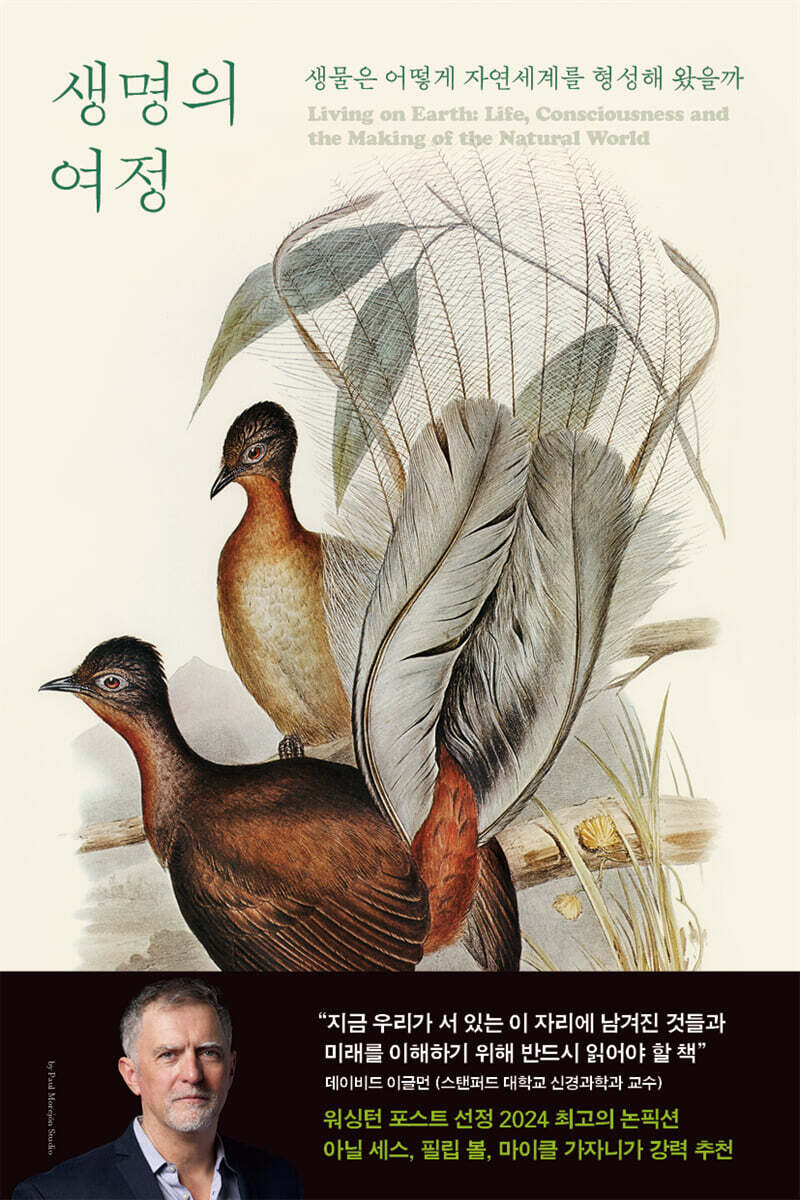
The Journey of Life
 |
Description
Book Introduction
The Earth is a masterpiece created by life.
3.8 billion years ago, tiny photosynthetic bacteria released oxygen that transformed the planet's atmosphere, plant roots reshaped the landscape, and animals transformed the world through their consciousness.
From the air we breathe to the ground we stand on, everything is the traces of countless living things.
Peter Godfreysmith, whom the New York Times called "one of the few philosophers who moves his body in search of clues," contains this surprising truth in his book, The Journey of Life.
He overturns the conventional view that 'the environment created life' and answers the fundamental question, 'How did life create this planet?'
From octopuses to beavers, all living things are 'fellow engineers' who have worked together to create the stage called Earth.
After reading the book, you will see even a tree in the park and ants on the roadside with different eyes.
Humans, too, are part of this vast creative project, and we are left to ask what kind of planet we will create.
3.8 billion years ago, tiny photosynthetic bacteria released oxygen that transformed the planet's atmosphere, plant roots reshaped the landscape, and animals transformed the world through their consciousness.
From the air we breathe to the ground we stand on, everything is the traces of countless living things.
Peter Godfreysmith, whom the New York Times called "one of the few philosophers who moves his body in search of clues," contains this surprising truth in his book, The Journey of Life.
He overturns the conventional view that 'the environment created life' and answers the fundamental question, 'How did life create this planet?'
From octopuses to beavers, all living things are 'fellow engineers' who have worked together to create the stage called Earth.
After reading the book, you will see even a tree in the park and ants on the roadside with different eyes.
Humans, too, are part of this vast creative project, and we are left to ask what kind of planet we will create.
- You can preview some of the book's contents.
Preview
index
1.
Shark Bay
Part 1.
TRANSFORMATION
2.
Earth full of life
3.
forest
4.
Orpheus
Part 2.
Who We Are
5.
The existence of humans
6.
consciousness
Part 3.
LIVING ON EARTH
7.
Other lives
8.
wild nature
9.
dissolution
Americas
Acknowledgements
Translator's Note
Search
Shark Bay
Part 1.
TRANSFORMATION
2.
Earth full of life
3.
forest
4.
Orpheus
Part 2.
Who We Are
5.
The existence of humans
6.
consciousness
Part 3.
LIVING ON EARTH
7.
Other lives
8.
wild nature
9.
dissolution
Americas
Acknowledgements
Translator's Note
Search
Detailed image

Into the book
As our car runs, gasoline from the fuel tank reacts with oxygen in the air and ignites.
This fuel was created from the sediments of plankton and all kinds of marine life that sank in still waters millions of years ago.
The steel that makes up the body is a material made by combining iron and carbon, which is created by the tremendous heat generated by burning other fuels in a distant furnace.
(Chapter 1) --- p.14, from "Shark Bay" In the history of life, new organisms with new bodies, minds, and new ways of life have continuously appeared.
At the same time, new actions and their consequences followed, new ways in which life reshaped the world.
The history of life is not simply a story of new creatures appearing one after another on a stage.
The new beings that appear change the stage itself.
--- p.15, According to Hume's words from "Shark Bay", perhaps this world is "the first experiment of some infant god, who, ashamed of his own poor craftsmanship, was finally abandoned."
Or perhaps it is “just the work of some inferior god, a mockery to his superiors.”
Or finally, perhaps it is “a product of the senility of some god who is old and has become a ghost.”
The creator is now dead, and his world has since run wild, “rushing into adventure.”
--- p.69, from “Earth Full of Life” ‘Cognitive technology’ brings about changes not only in our social life but also in our minds.
Literacy, in particular, has a significant impact on the brain.
Literacy increases the size of the corpus callosum, the main connecting area between the left and right hemispheres of the brain.
This change is not genetic, but rather occurs through individual experience.
It also changes the way non-letter objects—faces and houses—are visually processed, allowing literate people to shift from a more holistic approach to tracking specific features.
The brains of scanned literate people look different from those of non-literate people.
When literate people look at letters, one area of the brain is activated so consistently that it has been called the "visual word form area."
--- p.189, from “The Existence of Humanity” When imagining alternative paths for human evolution, people often ask from the perspective of intelligence.
Could any other animal have become so intelligent, or could they have achieved such a level after humanity's disappearance? However, as I've emphasized in this chapter, we must remember that human expertise is a cultural trait, rather than intelligence per se.
--- p.192, from “The Existence of Humans” The way I argue for the end of factory farming is a little different from the two familiar theories mentioned above.
I will approach this question through the concept of a “life worth living”—a life better lived than not lived at all.
Imagine that you can't directly choose what animal you become after you die, but you can choose between being reincarnated as an animal or not being reincarnated at all.
…if I do this thought experiment, it doesn't matter what conditions I assume.
I would rather not return to factory farms than return to being an animal farmer.
There can be no other answer.
--- p.260, from “Other Lives” If the scale of animal testing is reduced as much as I think, scientific progress will slow down.
We have to accept this.
New information will continue to accumulate through studies that do not involve this type of harm.
The only difference is the speed.
Opponents will say, “The delay will leave some people worse off.”
That could be the case.
But that argument is hardly convincing.
Because if we use prisoners, things will go faster than if we use animals.
--- p.280, From "Other Lives" If you prevent an animal from dying in one way, it will eventually be replaced by another way of death.
If we eliminate forms of predation that we consider cruel, the animals that survive will eventually die in other ways.
--- p.313, from “Wild Nature” The boundaries of our human lives are relatively clear.
It's pretty clear where each of our bodies begins and ends in space (of course, the bacterial communities in our gut are in some ways part of our bodies, and in others they are independent entities).
The same is true in time.
We all begin as a fertilized egg.
New organisms grow and develop, age, and die while maintaining a relatively constant form.
This fuel was created from the sediments of plankton and all kinds of marine life that sank in still waters millions of years ago.
The steel that makes up the body is a material made by combining iron and carbon, which is created by the tremendous heat generated by burning other fuels in a distant furnace.
(Chapter 1) --- p.14, from "Shark Bay" In the history of life, new organisms with new bodies, minds, and new ways of life have continuously appeared.
At the same time, new actions and their consequences followed, new ways in which life reshaped the world.
The history of life is not simply a story of new creatures appearing one after another on a stage.
The new beings that appear change the stage itself.
--- p.15, According to Hume's words from "Shark Bay", perhaps this world is "the first experiment of some infant god, who, ashamed of his own poor craftsmanship, was finally abandoned."
Or perhaps it is “just the work of some inferior god, a mockery to his superiors.”
Or finally, perhaps it is “a product of the senility of some god who is old and has become a ghost.”
The creator is now dead, and his world has since run wild, “rushing into adventure.”
--- p.69, from “Earth Full of Life” ‘Cognitive technology’ brings about changes not only in our social life but also in our minds.
Literacy, in particular, has a significant impact on the brain.
Literacy increases the size of the corpus callosum, the main connecting area between the left and right hemispheres of the brain.
This change is not genetic, but rather occurs through individual experience.
It also changes the way non-letter objects—faces and houses—are visually processed, allowing literate people to shift from a more holistic approach to tracking specific features.
The brains of scanned literate people look different from those of non-literate people.
When literate people look at letters, one area of the brain is activated so consistently that it has been called the "visual word form area."
--- p.189, from “The Existence of Humanity” When imagining alternative paths for human evolution, people often ask from the perspective of intelligence.
Could any other animal have become so intelligent, or could they have achieved such a level after humanity's disappearance? However, as I've emphasized in this chapter, we must remember that human expertise is a cultural trait, rather than intelligence per se.
--- p.192, from “The Existence of Humans” The way I argue for the end of factory farming is a little different from the two familiar theories mentioned above.
I will approach this question through the concept of a “life worth living”—a life better lived than not lived at all.
Imagine that you can't directly choose what animal you become after you die, but you can choose between being reincarnated as an animal or not being reincarnated at all.
…if I do this thought experiment, it doesn't matter what conditions I assume.
I would rather not return to factory farms than return to being an animal farmer.
There can be no other answer.
--- p.260, from “Other Lives” If the scale of animal testing is reduced as much as I think, scientific progress will slow down.
We have to accept this.
New information will continue to accumulate through studies that do not involve this type of harm.
The only difference is the speed.
Opponents will say, “The delay will leave some people worse off.”
That could be the case.
But that argument is hardly convincing.
Because if we use prisoners, things will go faster than if we use animals.
--- p.280, From "Other Lives" If you prevent an animal from dying in one way, it will eventually be replaced by another way of death.
If we eliminate forms of predation that we consider cruel, the animals that survive will eventually die in other ways.
--- p.313, from “Wild Nature” The boundaries of our human lives are relatively clear.
It's pretty clear where each of our bodies begins and ends in space (of course, the bacterial communities in our gut are in some ways part of our bodies, and in others they are independent entities).
The same is true in time.
We all begin as a fertilized egg.
New organisms grow and develop, age, and die while maintaining a relatively constant form.
--- p.338, from "Dissolution"
Publisher's Review
If life created the Earth, what should humans do?
Presented by dedicated natural world observer Peter Gofresmith
A New Interpretation of Life, Consciousness, and Earth's History
A must-read book to understand what remains and the future where we stand now.
─ David Eagleman, Professor of Neuroscience, Stanford University
The experience of seeing Australia's nature is special.
Faced with the dazzling vitality of the Great Barrier Reef, the vast desert, and the lush primeval forest, people feel a mixture of fear and admiration.
That is awe.
It is an intuitive realization that nature is much larger and older than humans.
Philosopher Peter Godfrey-Smith was one such Australian.
But there was something different about him.
While philosophy as a discipline was traditionally based on the study of literature and theoretical thinking, he jumped directly into the sea.
While exploring the ocean wearing scuba diving gear, he has a fateful encounter.
It was an encounter with an octopus.
This mysterious creature he encountered underwater changed his life. As the octopus tentacles curiously examined him, Gofrismith realized something.
This creature is clearly 'thinking' something, and its thoughts may be completely different from those of humans.
This discovery gave him a glimpse into a larger story unfolding on Earth.
The author, who encountered an octopus while diving and deeply explored its mind and consciousness, argues in his world-wide bestseller, "Octopuses and humans are ultimately creatures that share the same tree of life," claiming that they are the most different but have equal status.
In 『Metazoa』, the subject is expanded to explore that all metazoans on Earth also live and develop their own thoughts.
Now, Gofresmith has turned his gaze outward and released the final volume of his "Consciousness Trilogy," "The Journey of Life."
This book traces the history of geology and biology over 3.8 billion years, proving that life is not simply a "result" of evolution, but a "cause" of environmental change.
And it makes you realize whose work this land you are standing on is and what mark you will leave on that work.
During the course of his Consciousness Trilogy, Peter Godfreysmith also achieved intellectual achievement and fame.
His first book, "Arthur Minds," shocked the scientific and philosophical communities immediately after its publication and was shortlisted for the 2017 Royal Society Science Book Award.
Having expanded the scope of his exploration of consciousness through his follow-up work, Metazoa, he was finally elected to the American Philosophical Association, an organization of America's leading intellectuals, in 2022, around the time he completed his trilogy.
This means that his research is recognized as one of the most important intellectual achievements of his time.
In other words, 『The Journey of Life』 is a masterpiece that compiles all of a philosopher's thoughts, born from the process of pushing forward his intellectual exploration and reaching the pinnacle of his academic knowledge.
Bacteria that produce oxygen
The most dramatic changes in Earth's history began with microorganisms.
3.8 billion years ago, cyanobacteria performed photosynthesis to produce energy and release oxygen as a byproduct.
Oxygen gradually fundamentally changed the composition of Earth's atmosphere.
The so-called 'mass oxygenation event' was not simply a chemical change.
It was the first instance of a single life activity remodeling an entire planet, an act of creative destruction that destroyed existing ecosystems and opened up the possibility of new ones.
We are already living in a world they have created.
The oxygen in the air we breathe today is a legacy of a massive project started by these tiny creatures 3.8 billion years ago.
Nam Se-gyun not only achieved chemical change, but also achieved the first engineering.
The massive limestone structures they built throughout the ocean, called stromatolites, can be said to be the first buildings on Earth.
Plants that redesign the terrain
As life expanded onto land, its influence became more evident.
Plants came onto land along with arthropods.
Plants didn't simply colonize the land; they redesigned the landscape itself.
Plant roots stabilized soil, altered river flow, and actively modified their surroundings through the chemicals they secreted.
The natural landscapes we consider beautiful are actually the result of plants' fierce survival strategies and territorial competition over hundreds of millions of years.
Architect Animals with Intentions and Their World Umwelt
Animals changed their environment with consciousness.
The octopus, which the author has studied for a long time, builds elaborate shelters out of shells and stones and cultivates the surrounding area like a garden.
Bowerbirds, which live mainly in Australia, build complex structures for display and arrange decorations by color.
Beaver dams are massive engineering projects that alter the ecosystem of an entire river.
So how should we understand these remarkable animal behaviors? To answer this question, Gofresmith invites us to the philosophical concept of "Umwelt."
This concept, proposed by biologist Jakob von Uexküll, means that all living things live in their own unique 'perceptual world'.
To a tick, the world is a world of mammalian body heat and the scent of blood, while to a bee, it is a world of maps of flowers visible in ultraviolet light.
That is, animals do not react to the physical world as we see it, but rather act within a subjective Umwelt composed of things that are meaningful to them.
With this concept, Gofresmith argues that animal behavior “can best be understood not as a response to external stimuli, but by trying to get inside the animal’s mind.”
That is, animal behavior is a creative act that arises from each animal's unique perspective.
This allows us to view animals not as mere machines, but as subjects with their own worlds.
Humans and Our Responsibilities
The emergence of Homo sapiens expanded the planet's transformations through action to unprecedented levels.
Through agriculture, we have directly manipulated the evolution of plant and animal species, transformed the Earth's surface through urbanization and architecture, and since the Industrial Revolution, have even influenced the atmosphere and climate.
For the first time in the 3.8 billion years of life, a single species has the power to consciously shape the future of an entire planet.
Peter Godfreysmith questions the view that humans are 'destroyers' or 'intruders' of nature.
Instead, it is said that humans are also beings that are part of the natural continuation of the history of life on Earth.
He asserts that we are living parts of a vast system.
The enormous influence of humanity is not an exceptional phenomenon disconnected from nature, but rather a radical extension of a very old story.
This shift in perception provides a new ethical basis for environmental protection.
The air we breathe is a gift from bacteria, the soil we stand on is stabilized by plants, and the ecosystem we live in is created by countless living things.
We, the creatures living today, are the heirs of all this, and at the same time, the creators of the future.
So how should we use this immense power and heritage?
The author's ethical inquiry does not stop at mere enlightenment or declaration.
Rather than providing answers, he leads us into uncomfortable and complex questions.
His willingness to look at our world from unexpected angles makes the discussion startling.
He even addresses taboo questions like whether we should intervene in wildlife to reduce predator-induced suffering and whether we should welcome human extinction for the greater good of the planet.
Building on this intellectual honesty, he proposes a much more fundamental ethics that goes beyond the guilt or fear that conventional environmental discourse suggests.
It's about gratitude and connection.
We argue that we should not be stewards of nature, standing back from it, but rather identify with it itself, with gratitude and connection to all the processes that brought our species into existence.
Octopuses, sea squirrels, beavers, and bacteria are all 'fellow architects' who have worked together to create the stage called Earth.
This perspective changes how we look at problems like factory farming, animal testing, and habitat destruction.
Instead of a complex ethical theory, he proposes a concept of his own: 'a life worth living.'
Considering an animal's entire lifespan, this simple yet powerful litmus test—whether I would want to be reborn as that animal—reminds us that other creatures have the right to experience and transform the world in their own ways.
After reading this book, you will see the world around you with different eyes.
You will come to realize that even a single tree in the park is the result of environmental transformation that has continued for millions of years, and that even the ants on the roadside are 'fellow engineers' who are changing the world in their own way.
At the end, Peter Godfreysmith asks us a fundamental question:
How will humans use their powerful abilities? What kind of relationships will we forge with other life forms? And ultimately, what kind of planet will we create?
『The Journey of Life』 is more than just a science book.
It is a deep philosophical reflection on life, consciousness, and the world we live in.
The evolution of consciousness is not yet complete, and it is up to us to write the next chapter of this grand journey.
Reading this book is about realizing whose work the ground you stand on is and what mark you will leave on it.
Presented by dedicated natural world observer Peter Gofresmith
A New Interpretation of Life, Consciousness, and Earth's History
A must-read book to understand what remains and the future where we stand now.
─ David Eagleman, Professor of Neuroscience, Stanford University
The experience of seeing Australia's nature is special.
Faced with the dazzling vitality of the Great Barrier Reef, the vast desert, and the lush primeval forest, people feel a mixture of fear and admiration.
That is awe.
It is an intuitive realization that nature is much larger and older than humans.
Philosopher Peter Godfrey-Smith was one such Australian.
But there was something different about him.
While philosophy as a discipline was traditionally based on the study of literature and theoretical thinking, he jumped directly into the sea.
While exploring the ocean wearing scuba diving gear, he has a fateful encounter.
It was an encounter with an octopus.
This mysterious creature he encountered underwater changed his life. As the octopus tentacles curiously examined him, Gofrismith realized something.
This creature is clearly 'thinking' something, and its thoughts may be completely different from those of humans.
This discovery gave him a glimpse into a larger story unfolding on Earth.
The author, who encountered an octopus while diving and deeply explored its mind and consciousness, argues in his world-wide bestseller, "Octopuses and humans are ultimately creatures that share the same tree of life," claiming that they are the most different but have equal status.
In 『Metazoa』, the subject is expanded to explore that all metazoans on Earth also live and develop their own thoughts.
Now, Gofresmith has turned his gaze outward and released the final volume of his "Consciousness Trilogy," "The Journey of Life."
This book traces the history of geology and biology over 3.8 billion years, proving that life is not simply a "result" of evolution, but a "cause" of environmental change.
And it makes you realize whose work this land you are standing on is and what mark you will leave on that work.
During the course of his Consciousness Trilogy, Peter Godfreysmith also achieved intellectual achievement and fame.
His first book, "Arthur Minds," shocked the scientific and philosophical communities immediately after its publication and was shortlisted for the 2017 Royal Society Science Book Award.
Having expanded the scope of his exploration of consciousness through his follow-up work, Metazoa, he was finally elected to the American Philosophical Association, an organization of America's leading intellectuals, in 2022, around the time he completed his trilogy.
This means that his research is recognized as one of the most important intellectual achievements of his time.
In other words, 『The Journey of Life』 is a masterpiece that compiles all of a philosopher's thoughts, born from the process of pushing forward his intellectual exploration and reaching the pinnacle of his academic knowledge.
Bacteria that produce oxygen
The most dramatic changes in Earth's history began with microorganisms.
3.8 billion years ago, cyanobacteria performed photosynthesis to produce energy and release oxygen as a byproduct.
Oxygen gradually fundamentally changed the composition of Earth's atmosphere.
The so-called 'mass oxygenation event' was not simply a chemical change.
It was the first instance of a single life activity remodeling an entire planet, an act of creative destruction that destroyed existing ecosystems and opened up the possibility of new ones.
We are already living in a world they have created.
The oxygen in the air we breathe today is a legacy of a massive project started by these tiny creatures 3.8 billion years ago.
Nam Se-gyun not only achieved chemical change, but also achieved the first engineering.
The massive limestone structures they built throughout the ocean, called stromatolites, can be said to be the first buildings on Earth.
Plants that redesign the terrain
As life expanded onto land, its influence became more evident.
Plants came onto land along with arthropods.
Plants didn't simply colonize the land; they redesigned the landscape itself.
Plant roots stabilized soil, altered river flow, and actively modified their surroundings through the chemicals they secreted.
The natural landscapes we consider beautiful are actually the result of plants' fierce survival strategies and territorial competition over hundreds of millions of years.
Architect Animals with Intentions and Their World Umwelt
Animals changed their environment with consciousness.
The octopus, which the author has studied for a long time, builds elaborate shelters out of shells and stones and cultivates the surrounding area like a garden.
Bowerbirds, which live mainly in Australia, build complex structures for display and arrange decorations by color.
Beaver dams are massive engineering projects that alter the ecosystem of an entire river.
So how should we understand these remarkable animal behaviors? To answer this question, Gofresmith invites us to the philosophical concept of "Umwelt."
This concept, proposed by biologist Jakob von Uexküll, means that all living things live in their own unique 'perceptual world'.
To a tick, the world is a world of mammalian body heat and the scent of blood, while to a bee, it is a world of maps of flowers visible in ultraviolet light.
That is, animals do not react to the physical world as we see it, but rather act within a subjective Umwelt composed of things that are meaningful to them.
With this concept, Gofresmith argues that animal behavior “can best be understood not as a response to external stimuli, but by trying to get inside the animal’s mind.”
That is, animal behavior is a creative act that arises from each animal's unique perspective.
This allows us to view animals not as mere machines, but as subjects with their own worlds.
Humans and Our Responsibilities
The emergence of Homo sapiens expanded the planet's transformations through action to unprecedented levels.
Through agriculture, we have directly manipulated the evolution of plant and animal species, transformed the Earth's surface through urbanization and architecture, and since the Industrial Revolution, have even influenced the atmosphere and climate.
For the first time in the 3.8 billion years of life, a single species has the power to consciously shape the future of an entire planet.
Peter Godfreysmith questions the view that humans are 'destroyers' or 'intruders' of nature.
Instead, it is said that humans are also beings that are part of the natural continuation of the history of life on Earth.
He asserts that we are living parts of a vast system.
The enormous influence of humanity is not an exceptional phenomenon disconnected from nature, but rather a radical extension of a very old story.
This shift in perception provides a new ethical basis for environmental protection.
The air we breathe is a gift from bacteria, the soil we stand on is stabilized by plants, and the ecosystem we live in is created by countless living things.
We, the creatures living today, are the heirs of all this, and at the same time, the creators of the future.
So how should we use this immense power and heritage?
The author's ethical inquiry does not stop at mere enlightenment or declaration.
Rather than providing answers, he leads us into uncomfortable and complex questions.
His willingness to look at our world from unexpected angles makes the discussion startling.
He even addresses taboo questions like whether we should intervene in wildlife to reduce predator-induced suffering and whether we should welcome human extinction for the greater good of the planet.
Building on this intellectual honesty, he proposes a much more fundamental ethics that goes beyond the guilt or fear that conventional environmental discourse suggests.
It's about gratitude and connection.
We argue that we should not be stewards of nature, standing back from it, but rather identify with it itself, with gratitude and connection to all the processes that brought our species into existence.
Octopuses, sea squirrels, beavers, and bacteria are all 'fellow architects' who have worked together to create the stage called Earth.
This perspective changes how we look at problems like factory farming, animal testing, and habitat destruction.
Instead of a complex ethical theory, he proposes a concept of his own: 'a life worth living.'
Considering an animal's entire lifespan, this simple yet powerful litmus test—whether I would want to be reborn as that animal—reminds us that other creatures have the right to experience and transform the world in their own ways.
After reading this book, you will see the world around you with different eyes.
You will come to realize that even a single tree in the park is the result of environmental transformation that has continued for millions of years, and that even the ants on the roadside are 'fellow engineers' who are changing the world in their own way.
At the end, Peter Godfreysmith asks us a fundamental question:
How will humans use their powerful abilities? What kind of relationships will we forge with other life forms? And ultimately, what kind of planet will we create?
『The Journey of Life』 is more than just a science book.
It is a deep philosophical reflection on life, consciousness, and the world we live in.
The evolution of consciousness is not yet complete, and it is up to us to write the next chapter of this grand journey.
Reading this book is about realizing whose work the ground you stand on is and what mark you will leave on it.
GOODS SPECIFICS
- Date of issue: October 1, 2025
- Page count, weight, size: 432 pages | 582g | 140*210*27mm
- ISBN13: 9791189680589
You may also like
카테고리
korean


korean

![GQ KOREA Mark (Monthly): December [2025]](http://librairie.coreenne.fr/cdn/shop/files/8ef265dbbfbf186523ed75ba7319009d.jpg?v=1765340328&width=3840)


