

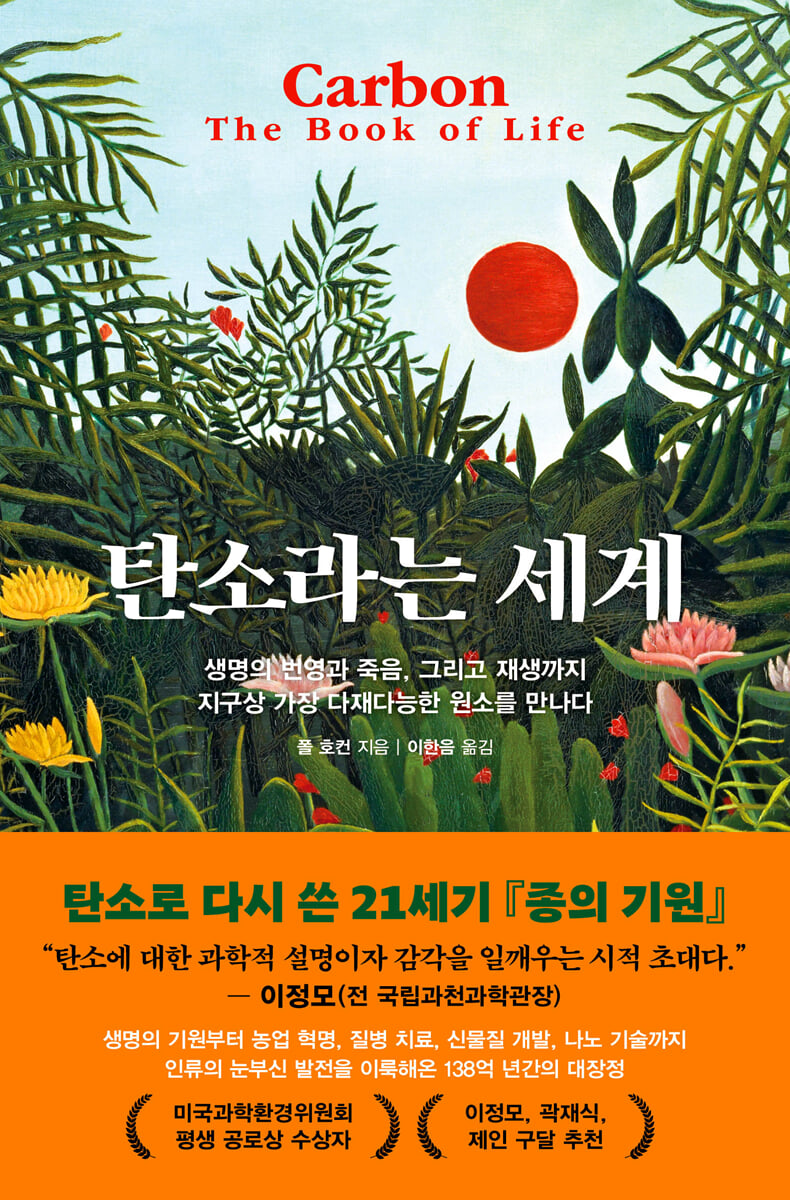
The world of carbon
 |
Description
Book Introduction
The 21st Century Origin of Species Rewritten with Carbon!
From the origin of life, the agricultural revolution, disease treatment, development of new materials, and even nanotechnology.
Discover the 13.8 billion-year journey of carbon in this one volume.
“It is a scientific explanation of carbon and a poetic invitation to awaken the senses.”
- Lee Jeong-mo (former director of the National Science Museum in Gwacheon)
World-renowned environmental activist Paul Hawken's new book, "Carbon World," has been published.
This book fundamentally challenges the common sense that carbon is the cause of the climate crisis, presenting a subversive perspective that sees carbon no longer as a "criminal," but as the "creator of life" and "guide to a new world."
In this book, Paul Hawken explores the flow of life through the lens of carbon, the most versatile element on Earth.
He traverses the history of our planet—plants and animals, insects and fungi, food and agriculture—and unfolds, in a prose poem, how intricately intertwined life is with carbon.
Furthermore, it leads us into a new world that carbon will bring to humanity, from the advent of nanotechnology to new solutions to global warming.
The fact that we are all made of carbon, and that carbon enabled a dazzling civilization to blossom on a planet that was once nothing more than a dead lump of rock, will allow us to envision a new future possibility.
From the origin of life, the agricultural revolution, disease treatment, development of new materials, and even nanotechnology.
Discover the 13.8 billion-year journey of carbon in this one volume.
“It is a scientific explanation of carbon and a poetic invitation to awaken the senses.”
- Lee Jeong-mo (former director of the National Science Museum in Gwacheon)
World-renowned environmental activist Paul Hawken's new book, "Carbon World," has been published.
This book fundamentally challenges the common sense that carbon is the cause of the climate crisis, presenting a subversive perspective that sees carbon no longer as a "criminal," but as the "creator of life" and "guide to a new world."
In this book, Paul Hawken explores the flow of life through the lens of carbon, the most versatile element on Earth.
He traverses the history of our planet—plants and animals, insects and fungi, food and agriculture—and unfolds, in a prose poem, how intricately intertwined life is with carbon.
Furthermore, it leads us into a new world that carbon will bring to humanity, from the advent of nanotechnology to new solutions to global warming.
The fact that we are all made of carbon, and that carbon enabled a dazzling civilization to blossom on a planet that was once nothing more than a dead lump of rock, will allow us to envision a new future possibility.
- You can preview some of the book's contents.
Preview
index
Recommendation
Chapter 1.
The Dance of Life: Old Misconceptions About Carbon
The Illusion of Taming the Earth | The Dance of Carbon's Regeneration | The Quixote Delusion
Chapter 2.
Carbon Flows: The Birth, Death, and Regeneration of Life
The Glass Bottle Experiment That Predicted Global Warming | Indifferent or Give Up | From Microbes to Cells, from Farm to Kitchen
Chapter 3.
The Birth of Carbon: We Are Descendants of Dead Stars
Steady State Cosmology and the Big Bang Theory | Where Did Carbon Come From? | The Orchestra of Life: Fine-Tuning
Chapter 4.
What is Life?: The Scientific Debate on the Definition of Life
Distinguishing between Living and Inanimate Things | In Search of the Essence of Life | Mars Exploration and the Gaia Hypothesis | Light as a Pollutant | The Enormous Noise That Covered the Earth
Chapter 5.
Eating Starlight: Carbon, Filling Humanity's Table
Baby Food Experiment | Ultra-processed Food Dominates Society | Humans' Sense of Smell Is Better Than Dogs' | In Search of Lost Taste Buds
Chapter 6.
Pseudofoods: The World of Ultra-Processed Foods Disguised as Food
The Age of Food as a Disease | Salads with More Calories than Burgers | The Pseudofood Industry | The Lost Wisdom of the Mayan Civilization | The Table Ruled by Experts
Chapter 7.
The Age of Nanotechnology: Humanity Tames the Atom
The Discovery of Fullerenes | The Steering Wheel-Free Car | The Light and Dark Side of Nanotubes | The Answer Found in Cellulose
Chapter 8.
Green Networks: How Plants Communicate
The Tragedy of Carbon Fertilizers | Plant Movements Have Intention | The Illusion That Only Humans Use Language | The Language of Plants | Who's More Important on This Planet?
Chapter 9.
The Fungal Kingdom: The Grave and Womb of Life
Symbiosis between Plants and Fungi | Nature's Carbon Capture System | The 'Fungal Blindness': Homo sapiens
Chapter 10.
Vanishing Languages: Language and Biodiversity
The Extinction of the Yamaná Language | The Link Between Language and Biodiversity | The Mi'kmaq Tree Naming | The Climate Crisis and Nominalism
Chapter 11.
Insect Collapse: How Small Things Move the World
The Insect Brain | If Insects Disappear, So Will We | Mao Zedong's Sparrow Extermination Campaign | 'Amateurs' Saving the World
Chapter 12.
Green Ark: The Forest, the Largest Sanctuary on Earth
The Future Revealed by Ice 130,000 Years Ago | Megaforests and Ecodiversity | Carbon Sequestration in the Boreal Forest
Chapter 13.
Black Soil: The Green Revolution and the Death of Soil
Earthworms, Dung Beetles, and Ants | Pesticides and Monoculture | The Green Revolution's Aftereffects | Microbes' Soil Resilience | The 'Shattered' Agriculture
Chapter 14.
Lost Wilds: Can Humans Restore Nature?
Rewilding Experiment | Untranslatable World | Orca Mass Slaughter
Chapter 15.
A Shift in Perception: The Earth Will Save Itself
Law for Seven Generations | Dignity Revealed by Brown Chapel | The Path of the Midwife, Not God
Acknowledgements
Translator's Note
main
Chapter 1.
The Dance of Life: Old Misconceptions About Carbon
The Illusion of Taming the Earth | The Dance of Carbon's Regeneration | The Quixote Delusion
Chapter 2.
Carbon Flows: The Birth, Death, and Regeneration of Life
The Glass Bottle Experiment That Predicted Global Warming | Indifferent or Give Up | From Microbes to Cells, from Farm to Kitchen
Chapter 3.
The Birth of Carbon: We Are Descendants of Dead Stars
Steady State Cosmology and the Big Bang Theory | Where Did Carbon Come From? | The Orchestra of Life: Fine-Tuning
Chapter 4.
What is Life?: The Scientific Debate on the Definition of Life
Distinguishing between Living and Inanimate Things | In Search of the Essence of Life | Mars Exploration and the Gaia Hypothesis | Light as a Pollutant | The Enormous Noise That Covered the Earth
Chapter 5.
Eating Starlight: Carbon, Filling Humanity's Table
Baby Food Experiment | Ultra-processed Food Dominates Society | Humans' Sense of Smell Is Better Than Dogs' | In Search of Lost Taste Buds
Chapter 6.
Pseudofoods: The World of Ultra-Processed Foods Disguised as Food
The Age of Food as a Disease | Salads with More Calories than Burgers | The Pseudofood Industry | The Lost Wisdom of the Mayan Civilization | The Table Ruled by Experts
Chapter 7.
The Age of Nanotechnology: Humanity Tames the Atom
The Discovery of Fullerenes | The Steering Wheel-Free Car | The Light and Dark Side of Nanotubes | The Answer Found in Cellulose
Chapter 8.
Green Networks: How Plants Communicate
The Tragedy of Carbon Fertilizers | Plant Movements Have Intention | The Illusion That Only Humans Use Language | The Language of Plants | Who's More Important on This Planet?
Chapter 9.
The Fungal Kingdom: The Grave and Womb of Life
Symbiosis between Plants and Fungi | Nature's Carbon Capture System | The 'Fungal Blindness': Homo sapiens
Chapter 10.
Vanishing Languages: Language and Biodiversity
The Extinction of the Yamaná Language | The Link Between Language and Biodiversity | The Mi'kmaq Tree Naming | The Climate Crisis and Nominalism
Chapter 11.
Insect Collapse: How Small Things Move the World
The Insect Brain | If Insects Disappear, So Will We | Mao Zedong's Sparrow Extermination Campaign | 'Amateurs' Saving the World
Chapter 12.
Green Ark: The Forest, the Largest Sanctuary on Earth
The Future Revealed by Ice 130,000 Years Ago | Megaforests and Ecodiversity | Carbon Sequestration in the Boreal Forest
Chapter 13.
Black Soil: The Green Revolution and the Death of Soil
Earthworms, Dung Beetles, and Ants | Pesticides and Monoculture | The Green Revolution's Aftereffects | Microbes' Soil Resilience | The 'Shattered' Agriculture
Chapter 14.
Lost Wilds: Can Humans Restore Nature?
Rewilding Experiment | Untranslatable World | Orca Mass Slaughter
Chapter 15.
A Shift in Perception: The Earth Will Save Itself
Law for Seven Generations | Dignity Revealed by Brown Chapel | The Path of the Midwife, Not God
Acknowledgements
Translator's Note
main
Detailed image

Into the book
Carbon forms chains of molecules that capture energy and store memories.
Only this element in the universe can do that.
Carbon also provides the structural framework for trees, cells, shells, hormones, organelles, eyebrows, bones, and bat wings.
Carbon is the engineer, the creator, the molecular actor that animates all traces of life.
Carbon organizes, assembles, and builds everything, from coral reefs to rhinoceroses, from plants to the planet.
The skin, scales, and membranes that surround and protect life are made of carbon.
--- Chapter 2.
From "Carbon Flows"
These vast dust clouds, hundreds of light-years across, protect the atomic nurseries from intense ultraviolet light and, over hundreds of millions of years, form molecules by combining scattered elements.
Eventually, the interstellar cloud, under the influence of gravity, forms a complex vortex of gas, dust, and pebbles.
As the compressive gravitational force of rotation increases, a flat disk is formed that will become the new sun, and the mixture of various debris that orbits around it will eventually coalesce to form planets.
We are the descendants of dead stars, “bundles of empty space and ancient electricity, inconceivable numbers of atoms, with protons and neutrons and somersaulting electrons.”
A star gives birth to another star.
And us too.
--- 「Chapter 3.
From “The Birth of Carbon”
Cells contain trillions of molecules that constantly interact with each other.
The cells of all living things, whether microbes or sea cucumbers, are hotbeds of carbon.
The molecules inside cells are not lifeless, but metabolic tools that make up a complex, tangled world.
How can trillions of inanimate molecules contained within a single cell become animate? None of these molecules are alive, yet the cell is a living organism—a phenomenon that remains unexplained.
--- 「Chapter 4.
From "What is Life"
NASA wanted a clear and practical definition of extraterrestrial life. NASA assembled a team of leading biologists and studied this question more intensely than any other agency.
Eventually, scientists reached a broad consensus.
Life extracts energy from its environment, replicates itself, has membranes, reacts and copes with the outside world, metabolizes matter and excretes waste, requires water, and is based on carbon.
--- 「Chapter 4.
From "What is Life"
Our hunger and appetite, the taste, smell, color and texture of food are all variations on the dance of carbon.
The moment you smell freshly baked bread wafting from the oven, your mouth secretes saliva, which converts carbohydrates into alcohol and carbon dioxide.
Your blood speaks to your tongue and nose.
More than 99 percent of the human body is made up of hydrogen, carbon, oxygen, and nitrogen.
The atmosphere is also made up of the same ingredients.
The same goes for food.
Depending on the arrangement of these four elements, natural and artificial fragrances are determined.
(Omitted) Everything we eat is made of carbon.
We taste the nutrients that plants make from carbon, water, and stars.
--- Chapter 5.
From "Eat the Starlight"
Chris Van Tulleken writes that our food “has become a mixture of molecules that our senses have never before seen.”
“Synthetic emulsifiers, low-calorie sweeteners, stabilizers, humectants, flavor enhancers, colors, color stabilizers, carbonating agents, solidifying agents, bulking agents, and reducing agents.” But now, foods are more than just “composed,” they are designed.
Our bodies today contain chemicals that haven't been present in the human body for 2 million years.
--- Chapter 6.
Among the “similar foods”
With extensive research, many variants of fullerene have been discovered, ranging from those with 28 to 108 carbon atoms.
Also in 1991, a Japanese scientist discovered nanotubes.
It was a carbon plate rolled into a long, tubular shape, with both ends closed like a gelatin capsule, and had a diameter of 1 nanometer.
The average human hair is 80,000 nanometers thick.
Structurally, nanotubes are 100 times stronger than steel, yet one-sixth the weight.
--- Chapter 7.
From "The Age of Nanotechnology"
In 1913, German scientist Fritz Haber was struggling with nitrogen to create mustard gas for war.
He accidentally discovered a way to synthesize nitrates by splitting atmospheric nitrogen.
Next, Carl Bosch, together with Haber, developed a high-pressure manufacturing method that could mass-produce ammonia fertilizer inexpensively.
This made it possible, for the first time in history, to apply soluble nitrogen to the topsoil.
By using the Haber-Bosch process, crop yields doubled and tripled.
The soil was gradually reduced to a chemical medium supporting crops.
The belief that plants were sacred and should be revered and respected has given way to a trend favoring their wealth-generating abilities.
Plants can now be manipulated like any other industrial material.
--- Chapter 8.
From "Green Network"
Kears conducted an experiment where he placed phosphorus-poor roots not far from phosphorus-rich roots.
When the mycelium noticed that one group of roots was lacking phosphorus, it transported phosphorus to that area in exchange for more carbon.
If the plants were rich in phosphorus, the fungi exchanged phosphorus for relatively little carbon.
The exchange rate varies depending on the situation and is calculated by both the plant and the fungus.
It's no different from farmers selling their leftover tomatoes at a discount at a farmers' market around the time of the harvest so they don't have to take them back home.
--- Chapter 9.
From "The Kingdom of Fungi"
The climate movement uses words and phrases that have little or no meaning to the vast majority of humanity.
Terms like net zero, direct air capture, enteric fermentation, carbon removal, teragrams, tipping points, planetary boundaries, and sequestration.
The strangest term might be 'carbon neutral'.
It is a biophysically impossible term.
This way of using terms is called 'nominalism'.
It is a way of separating oneself from the world, and an attitude that considers divisibility to be knowledge.
--- 「Chapter 10.
From “Disappearing Languages”
The relative climate stability we enjoy today is due to forests, wetlands, meadows, swamps, grasslands, deltas, steppes, scrublands, taiga, coral reefs, mangrove swamps, salt marshes, and tundra.
These ecosystems absorb and store billions of tons of carbon from the atmosphere each year.
Insects depend on this ecosystem, and conversely, the ecosystem depends on insects.
Ecosystems are buffer zones, biological reservoirs that store 3.5 trillion tons of carbon above and below ground, five times more than is in the atmosphere.
--- 「Chapter 11.
From "The Collapse of Insects"
No company can achieve 'climate virginity' by planting pine seedlings in the ground.
There are wiser voices in the scientific community.
Nature does not plant trees.
What nature fosters is a forest, a resilient community of trees, plants, and animals.
Humanity's total annual carbon emissions are approximately 11 billion tons.
However, the net annual increase in carbon in the atmosphere is about 5.4 billion tons.
Because land, plants, and oceans sequester 5.8 billion tons.
Forests trap most of the carbon dioxide in the ground, and existing mature primary forests account for a large proportion of this.
Only this element in the universe can do that.
Carbon also provides the structural framework for trees, cells, shells, hormones, organelles, eyebrows, bones, and bat wings.
Carbon is the engineer, the creator, the molecular actor that animates all traces of life.
Carbon organizes, assembles, and builds everything, from coral reefs to rhinoceroses, from plants to the planet.
The skin, scales, and membranes that surround and protect life are made of carbon.
--- Chapter 2.
From "Carbon Flows"
These vast dust clouds, hundreds of light-years across, protect the atomic nurseries from intense ultraviolet light and, over hundreds of millions of years, form molecules by combining scattered elements.
Eventually, the interstellar cloud, under the influence of gravity, forms a complex vortex of gas, dust, and pebbles.
As the compressive gravitational force of rotation increases, a flat disk is formed that will become the new sun, and the mixture of various debris that orbits around it will eventually coalesce to form planets.
We are the descendants of dead stars, “bundles of empty space and ancient electricity, inconceivable numbers of atoms, with protons and neutrons and somersaulting electrons.”
A star gives birth to another star.
And us too.
--- 「Chapter 3.
From “The Birth of Carbon”
Cells contain trillions of molecules that constantly interact with each other.
The cells of all living things, whether microbes or sea cucumbers, are hotbeds of carbon.
The molecules inside cells are not lifeless, but metabolic tools that make up a complex, tangled world.
How can trillions of inanimate molecules contained within a single cell become animate? None of these molecules are alive, yet the cell is a living organism—a phenomenon that remains unexplained.
--- 「Chapter 4.
From "What is Life"
NASA wanted a clear and practical definition of extraterrestrial life. NASA assembled a team of leading biologists and studied this question more intensely than any other agency.
Eventually, scientists reached a broad consensus.
Life extracts energy from its environment, replicates itself, has membranes, reacts and copes with the outside world, metabolizes matter and excretes waste, requires water, and is based on carbon.
--- 「Chapter 4.
From "What is Life"
Our hunger and appetite, the taste, smell, color and texture of food are all variations on the dance of carbon.
The moment you smell freshly baked bread wafting from the oven, your mouth secretes saliva, which converts carbohydrates into alcohol and carbon dioxide.
Your blood speaks to your tongue and nose.
More than 99 percent of the human body is made up of hydrogen, carbon, oxygen, and nitrogen.
The atmosphere is also made up of the same ingredients.
The same goes for food.
Depending on the arrangement of these four elements, natural and artificial fragrances are determined.
(Omitted) Everything we eat is made of carbon.
We taste the nutrients that plants make from carbon, water, and stars.
--- Chapter 5.
From "Eat the Starlight"
Chris Van Tulleken writes that our food “has become a mixture of molecules that our senses have never before seen.”
“Synthetic emulsifiers, low-calorie sweeteners, stabilizers, humectants, flavor enhancers, colors, color stabilizers, carbonating agents, solidifying agents, bulking agents, and reducing agents.” But now, foods are more than just “composed,” they are designed.
Our bodies today contain chemicals that haven't been present in the human body for 2 million years.
--- Chapter 6.
Among the “similar foods”
With extensive research, many variants of fullerene have been discovered, ranging from those with 28 to 108 carbon atoms.
Also in 1991, a Japanese scientist discovered nanotubes.
It was a carbon plate rolled into a long, tubular shape, with both ends closed like a gelatin capsule, and had a diameter of 1 nanometer.
The average human hair is 80,000 nanometers thick.
Structurally, nanotubes are 100 times stronger than steel, yet one-sixth the weight.
--- Chapter 7.
From "The Age of Nanotechnology"
In 1913, German scientist Fritz Haber was struggling with nitrogen to create mustard gas for war.
He accidentally discovered a way to synthesize nitrates by splitting atmospheric nitrogen.
Next, Carl Bosch, together with Haber, developed a high-pressure manufacturing method that could mass-produce ammonia fertilizer inexpensively.
This made it possible, for the first time in history, to apply soluble nitrogen to the topsoil.
By using the Haber-Bosch process, crop yields doubled and tripled.
The soil was gradually reduced to a chemical medium supporting crops.
The belief that plants were sacred and should be revered and respected has given way to a trend favoring their wealth-generating abilities.
Plants can now be manipulated like any other industrial material.
--- Chapter 8.
From "Green Network"
Kears conducted an experiment where he placed phosphorus-poor roots not far from phosphorus-rich roots.
When the mycelium noticed that one group of roots was lacking phosphorus, it transported phosphorus to that area in exchange for more carbon.
If the plants were rich in phosphorus, the fungi exchanged phosphorus for relatively little carbon.
The exchange rate varies depending on the situation and is calculated by both the plant and the fungus.
It's no different from farmers selling their leftover tomatoes at a discount at a farmers' market around the time of the harvest so they don't have to take them back home.
--- Chapter 9.
From "The Kingdom of Fungi"
The climate movement uses words and phrases that have little or no meaning to the vast majority of humanity.
Terms like net zero, direct air capture, enteric fermentation, carbon removal, teragrams, tipping points, planetary boundaries, and sequestration.
The strangest term might be 'carbon neutral'.
It is a biophysically impossible term.
This way of using terms is called 'nominalism'.
It is a way of separating oneself from the world, and an attitude that considers divisibility to be knowledge.
--- 「Chapter 10.
From “Disappearing Languages”
The relative climate stability we enjoy today is due to forests, wetlands, meadows, swamps, grasslands, deltas, steppes, scrublands, taiga, coral reefs, mangrove swamps, salt marshes, and tundra.
These ecosystems absorb and store billions of tons of carbon from the atmosphere each year.
Insects depend on this ecosystem, and conversely, the ecosystem depends on insects.
Ecosystems are buffer zones, biological reservoirs that store 3.5 trillion tons of carbon above and below ground, five times more than is in the atmosphere.
--- 「Chapter 11.
From "The Collapse of Insects"
No company can achieve 'climate virginity' by planting pine seedlings in the ground.
There are wiser voices in the scientific community.
Nature does not plant trees.
What nature fosters is a forest, a resilient community of trees, plants, and animals.
Humanity's total annual carbon emissions are approximately 11 billion tons.
However, the net annual increase in carbon in the atmosphere is about 5.4 billion tons.
Because land, plants, and oceans sequester 5.8 billion tons.
Forests trap most of the carbon dioxide in the ground, and existing mature primary forests account for a large proportion of this.
--- 「Chapter 12.
From "Green Ark"
From "Green Ark"
Publisher's Review
Recommended by Lee Jeong-mo, Kwak Jae-sik, and Jane Goodall
★Amazon Category Bestseller★
★National Council on Science and the Environment Lifetime Achievement Award Recipient★
"The solution to the climate crisis begins with completely dismantling common sense about carbon."
― Hidden behind the discussions on carbon neutrality, decarbonization, and RE100
Discover the true nature of carbon, the most versatile element on Earth.
Carbon has long been known as the main culprit of the climate crisis.
Modern society is stuck in the long-held framework that carbon is a harmful element, with the government promoting carbon neutrality as a key national policy and companies viewing decarbonization as a vision for a new world.
Paul Hawken, author of "Carbon World," directly refutes this misunderstanding about carbon, saying:
“Carbon is the engineer and creator who breathes life into all traces of life.” Called a “green guru” at the forefront of the environmental movement for the past 60 years, he points out that all living things, without exception, were born from carbon, and unfolds the process by which carbon created the Earth full of vitality, like an epic.
"The World Called Carbon" is a book that dispels misunderstandings about carbon and examines its role as a key substance in the creation and prosperity of life.
The author examines the latest research from experts in various fields, including ecologists, physicists, mycologists, and bioethicists.
It tells the true story of carbon, from the origins of life to nanotechnology and the climate crisis.
This book, which encompasses chemistry, biology, physics, earth science, and environmental engineering, compiles virtually everything about carbon into a single volume. It completely shatters our common sense about carbon and rebuilds it from scratch, and even presents a completely new perspective on the climate crisis.
“It all started with a handful of carbon.”
From the origin of life to the agricultural revolution, disease treatment, new material development, and nanotechnology.
The 21st Century Origin of Species Rewritten in Carbon
The author guides readers sometimes to the primordial Earth and forests, and other times to cutting-edge scientific laboratories, weaving together a world made of the infinite possibilities of carbon.
Just as 『The Origin of Species』 is rewritten with carbon, what we encounter in the place the author leads us to is the true nature of carbon as the creator of all life on Earth and the guide to a new world.
Carbon itself is a lifeless inorganic substance, but paradoxically, all life began from that handful of inorganic substances.
The carbon fragments scattered as a supernova when a star collapsed after its nuclear reaction ended were compressed with other elements by high heat for hundreds of millions of years, creating the Earth, and soon gave birth to bacteria and archaea, the precursors of all living cells.
Bacteria and archaea fused to form eukaryotes with a cell nucleus, and eukaryotes eventually evolved into all plants and animals, including Homo sapiens.
Paul Hocan reminds us that all living things today are carbon-based, from their hormones and DNA to their fingernails and organs, suggesting that all life has a common root: carbon.
The mystery of carbon lies in the fact that it governs not only the birth of life but also its prosperity.
The author tells the story of carbon, which has played a crucial role at every turning point in human development, and raises expectations about the potential it holds.
Carbon fertilizer, developed by German scientists Fritz Haber and Carl Bosch to replace ammonia fertilizer, dramatically increased agricultural production by two to three times its previous level.
For the first time in human history, we have entered an era of food surplus. (Chapter 8) It is also important to note that nanotechnology, which is praised as a technology reminiscent of the future, originated from a carbon molecule called "fullerene."
Fullerene, composed of 60 carbon atoms, can release drugs only to the desired area in the body, and is used as an antiviral agent for AIDS and other diseases. Nanotubes derived from fullerene are 100 times stronger than steel but weigh only one-sixth of it, making them indispensable materials in dozens of industrial fields, including medicine, aerospace, and electronics. (Chapter 7)
"Homo sapiens, the only species that has interrupted the flow of carbon."
―A biodiversity crisis and rapidly declining carbon absorption rates are hastening the sixth mass extinction.
The biggest problem facing humanity today is undoubtedly the climate crisis.
Carbon is identified as the most representative cause, and international organizations and governments are prioritizing reducing carbon emissions.
But will this alone be enough to solve the climate crisis? Paul Hocan argues that the absolute amount of carbon in the Earth, a closed material system, has not changed significantly since the past, and argues that increased carbon emissions are not the sole cause of the climate crisis.
He then points out the 'carbon flow'.
Carbon does not stay in one place, it flows.
Carbon in the air moves to plants, the ocean, and then back into the soil.
It circulates throughout the Earth and transmits energy.
The ocean absorbs 2 billion tons of carbon annually, and giant forests, including the Amazon and boreal forests, absorb hundreds of thousands of tons annually.
According to a recent study by mycorrhizologists, fungi absorb 13.2 billion tons of carbon dioxide annually, which is similar to the combined annual emissions of China and the United States, the world's largest carbon dioxide emitters.
But the flow of carbon that has sustained the Earth for billions of years is being interrupted by humans.
Through interviews with botanists, the author exposes the reality that one in six tree species is endangered due to indiscriminate logging, and that the insect world is collapsing due to pesticides and herbicides, leading to a decline in pollination.
Carbon that is not absorbed remains in the air and covers the Earth.
This is why today's discussion about the climate crisis must begin with reconnecting the carbon flow that humans have interrupted.
Carbon is a double-edged sword for humans.
Carbon enabled microbes to evolve into Homo sapiens, gave hunter-gatherers the agricultural revolution and nanotechnology, but it is also accelerating the sixth mass extinction.
The author reveals that nature has reached its limits and that now is the time to ask the right questions.
"Humanity, seeking to restore nature, must become midwives, not gods."
― Carbon capture technology, life credit market, not UN agreements
The true solution to the climate crisis found in nature's regenerative power.
Paul Hawken quotes bioethicist Melanie Challenger:
“We try to design life to suit our tastes, while killing life that is well-off on its own.” Homo sapiens have lived under the illusion that they can control the Earth and its flora and fauna as they please, like gods.
When the concentration of carbon in the air increased, instead of reducing fossil fuel use, we developed carbon capture devices, and when forests were devastated, instead of stopping logging, we planted more trees.
Technological advancements have made us arrogant, and what we're left with is a more ruined planet.
The author mentions the 'carbon dance' (the constant regeneration inherent in life), and argues that the true solution to the climate crisis is not artificial human intervention, but maximizing nature's regenerative capacity.
As Haakon says in this book, nature does not plant trees.
If the soil is fertile, trees will grow on their own.
Only when we break free from the attitude of trying to intervene in nature as if we were gods and become midwives who create an environment where life can flourish can we truly live as part of nature.
This book, which covers everything about carbon, will broaden your perspective beyond knowledge about carbon and help humans and nature live in connection.
It is a passionate message calling for a return to traditional environmental management.
Even in the current political climate, Hocken sees hope that we can reverse destructive habits.
Cultural insights further enrich his brilliant scientific writing.
─ 《Kirkus Reviews》
★Amazon Category Bestseller★
★National Council on Science and the Environment Lifetime Achievement Award Recipient★
"The solution to the climate crisis begins with completely dismantling common sense about carbon."
― Hidden behind the discussions on carbon neutrality, decarbonization, and RE100
Discover the true nature of carbon, the most versatile element on Earth.
Carbon has long been known as the main culprit of the climate crisis.
Modern society is stuck in the long-held framework that carbon is a harmful element, with the government promoting carbon neutrality as a key national policy and companies viewing decarbonization as a vision for a new world.
Paul Hawken, author of "Carbon World," directly refutes this misunderstanding about carbon, saying:
“Carbon is the engineer and creator who breathes life into all traces of life.” Called a “green guru” at the forefront of the environmental movement for the past 60 years, he points out that all living things, without exception, were born from carbon, and unfolds the process by which carbon created the Earth full of vitality, like an epic.
"The World Called Carbon" is a book that dispels misunderstandings about carbon and examines its role as a key substance in the creation and prosperity of life.
The author examines the latest research from experts in various fields, including ecologists, physicists, mycologists, and bioethicists.
It tells the true story of carbon, from the origins of life to nanotechnology and the climate crisis.
This book, which encompasses chemistry, biology, physics, earth science, and environmental engineering, compiles virtually everything about carbon into a single volume. It completely shatters our common sense about carbon and rebuilds it from scratch, and even presents a completely new perspective on the climate crisis.
“It all started with a handful of carbon.”
From the origin of life to the agricultural revolution, disease treatment, new material development, and nanotechnology.
The 21st Century Origin of Species Rewritten in Carbon
The author guides readers sometimes to the primordial Earth and forests, and other times to cutting-edge scientific laboratories, weaving together a world made of the infinite possibilities of carbon.
Just as 『The Origin of Species』 is rewritten with carbon, what we encounter in the place the author leads us to is the true nature of carbon as the creator of all life on Earth and the guide to a new world.
Carbon itself is a lifeless inorganic substance, but paradoxically, all life began from that handful of inorganic substances.
The carbon fragments scattered as a supernova when a star collapsed after its nuclear reaction ended were compressed with other elements by high heat for hundreds of millions of years, creating the Earth, and soon gave birth to bacteria and archaea, the precursors of all living cells.
Bacteria and archaea fused to form eukaryotes with a cell nucleus, and eukaryotes eventually evolved into all plants and animals, including Homo sapiens.
Paul Hocan reminds us that all living things today are carbon-based, from their hormones and DNA to their fingernails and organs, suggesting that all life has a common root: carbon.
The mystery of carbon lies in the fact that it governs not only the birth of life but also its prosperity.
The author tells the story of carbon, which has played a crucial role at every turning point in human development, and raises expectations about the potential it holds.
Carbon fertilizer, developed by German scientists Fritz Haber and Carl Bosch to replace ammonia fertilizer, dramatically increased agricultural production by two to three times its previous level.
For the first time in human history, we have entered an era of food surplus. (Chapter 8) It is also important to note that nanotechnology, which is praised as a technology reminiscent of the future, originated from a carbon molecule called "fullerene."
Fullerene, composed of 60 carbon atoms, can release drugs only to the desired area in the body, and is used as an antiviral agent for AIDS and other diseases. Nanotubes derived from fullerene are 100 times stronger than steel but weigh only one-sixth of it, making them indispensable materials in dozens of industrial fields, including medicine, aerospace, and electronics. (Chapter 7)
"Homo sapiens, the only species that has interrupted the flow of carbon."
―A biodiversity crisis and rapidly declining carbon absorption rates are hastening the sixth mass extinction.
The biggest problem facing humanity today is undoubtedly the climate crisis.
Carbon is identified as the most representative cause, and international organizations and governments are prioritizing reducing carbon emissions.
But will this alone be enough to solve the climate crisis? Paul Hocan argues that the absolute amount of carbon in the Earth, a closed material system, has not changed significantly since the past, and argues that increased carbon emissions are not the sole cause of the climate crisis.
He then points out the 'carbon flow'.
Carbon does not stay in one place, it flows.
Carbon in the air moves to plants, the ocean, and then back into the soil.
It circulates throughout the Earth and transmits energy.
The ocean absorbs 2 billion tons of carbon annually, and giant forests, including the Amazon and boreal forests, absorb hundreds of thousands of tons annually.
According to a recent study by mycorrhizologists, fungi absorb 13.2 billion tons of carbon dioxide annually, which is similar to the combined annual emissions of China and the United States, the world's largest carbon dioxide emitters.
But the flow of carbon that has sustained the Earth for billions of years is being interrupted by humans.
Through interviews with botanists, the author exposes the reality that one in six tree species is endangered due to indiscriminate logging, and that the insect world is collapsing due to pesticides and herbicides, leading to a decline in pollination.
Carbon that is not absorbed remains in the air and covers the Earth.
This is why today's discussion about the climate crisis must begin with reconnecting the carbon flow that humans have interrupted.
Carbon is a double-edged sword for humans.
Carbon enabled microbes to evolve into Homo sapiens, gave hunter-gatherers the agricultural revolution and nanotechnology, but it is also accelerating the sixth mass extinction.
The author reveals that nature has reached its limits and that now is the time to ask the right questions.
"Humanity, seeking to restore nature, must become midwives, not gods."
― Carbon capture technology, life credit market, not UN agreements
The true solution to the climate crisis found in nature's regenerative power.
Paul Hawken quotes bioethicist Melanie Challenger:
“We try to design life to suit our tastes, while killing life that is well-off on its own.” Homo sapiens have lived under the illusion that they can control the Earth and its flora and fauna as they please, like gods.
When the concentration of carbon in the air increased, instead of reducing fossil fuel use, we developed carbon capture devices, and when forests were devastated, instead of stopping logging, we planted more trees.
Technological advancements have made us arrogant, and what we're left with is a more ruined planet.
The author mentions the 'carbon dance' (the constant regeneration inherent in life), and argues that the true solution to the climate crisis is not artificial human intervention, but maximizing nature's regenerative capacity.
As Haakon says in this book, nature does not plant trees.
If the soil is fertile, trees will grow on their own.
Only when we break free from the attitude of trying to intervene in nature as if we were gods and become midwives who create an environment where life can flourish can we truly live as part of nature.
This book, which covers everything about carbon, will broaden your perspective beyond knowledge about carbon and help humans and nature live in connection.
It is a passionate message calling for a return to traditional environmental management.
Even in the current political climate, Hocken sees hope that we can reverse destructive habits.
Cultural insights further enrich his brilliant scientific writing.
─ 《Kirkus Reviews》
GOODS SPECIFICS
- Date of issue: September 2, 2025
- Page count, weight, size: 356 pages | 452g | 135*205*21mm
- ISBN13: 9788901296890
- ISBN10: 8901296896
You may also like
카테고리
korean


korean

![GQ KOREA Mark (Monthly): December [2025]](http://librairie.coreenne.fr/cdn/shop/files/8ef265dbbfbf186523ed75ba7319009d.jpg?v=1765340328&width=3840)


