

The Essential Osamu Dazai
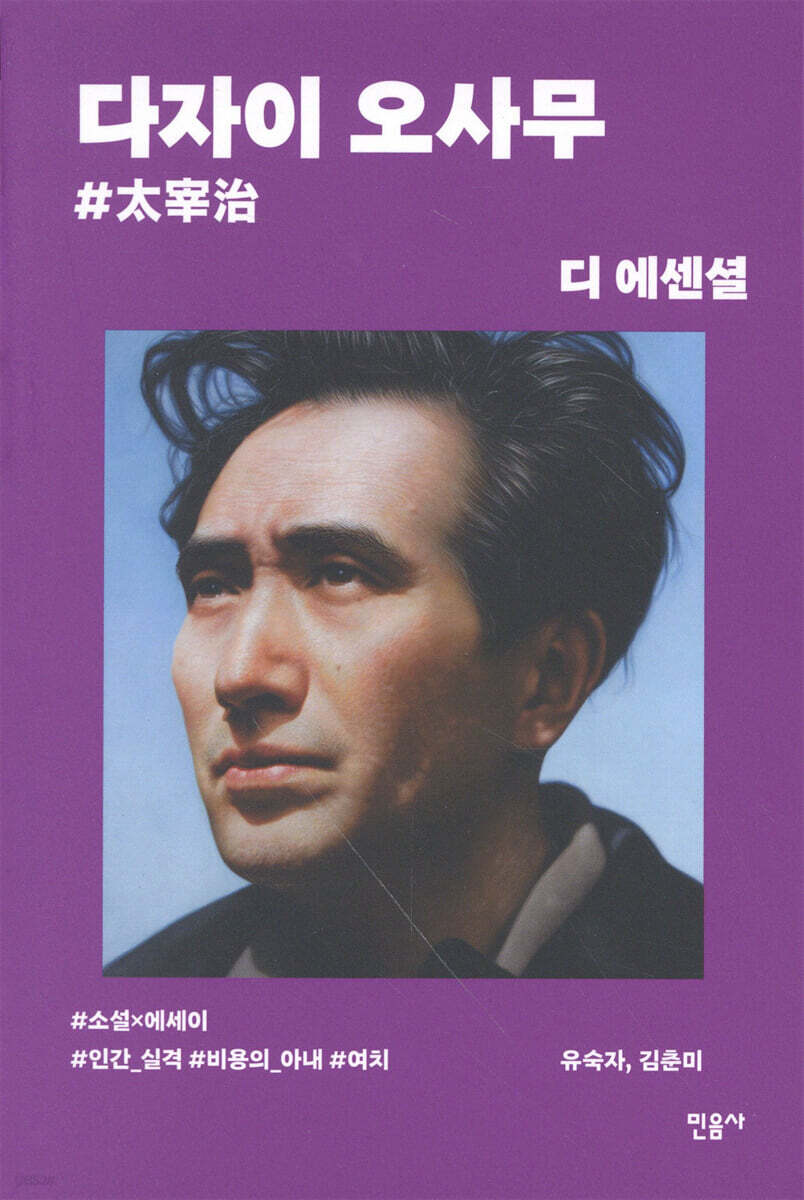 |
Description
Book Introduction
A world-renowned author's 'novel x essay' in just one volume!
It's a rite of passage that you have to meet during your youth.
A representative writer of Japanese decadence literature,
Encountering Osamu Dazai's most honest self-portrait.
The [Essential] series, which curates the representative novels and essays of world-renowned authors into a single volume, has been published with four volumes (George Orwell, Osamu Dazai, Virginia Woolf, and Ernest Hemingway) so that any reader can define the author's characteristics in a single sentence.
The third author in the The Essential series is Osamu Dazai, a representative author of Japanese decadence literature.
In addition to his representative work, "No Longer Human," "The Essential Dazai Osamu" introduces a total of nine works, including the essay "June 19th," written on his birthday reflecting on his past life, and the short story "Villon's Wife," which is based on his autobiographical experiences and is inspired by the medieval poet François Villon.
Dazai's masterpieces from his later years, characterized by themes such as "shame" and "self-reflection," are characterized by their stark portrayal of the social and moral turmoil that swept through postwar Japan and the anxiety of young people living in the storm and stress era.
Today's readers will experience a unique reading experience, as if someone is "crying on their behalf," rather than offering clumsy consolation or formal sympathy, through Osamu Dazai's sharp writing that captures the despair of the younger generation.
[The Essential Edition] features novels and essays together, but due to Osamu Dazai's unique characteristics as a writer, it is not bound by the traditional boundaries between novels and essays and selects masterpieces from his mid-to-late years that reveal the honest face of the author in his middle years.
Excluding “No Longer Human,” which is included in the latest renewal edition of Minumsa World Literature Collection, the remaining eight works, including “The Wife of the Cost,” were all newly translated by translator Yoo Suk-ja.
It's a rite of passage that you have to meet during your youth.
A representative writer of Japanese decadence literature,
Encountering Osamu Dazai's most honest self-portrait.
The [Essential] series, which curates the representative novels and essays of world-renowned authors into a single volume, has been published with four volumes (George Orwell, Osamu Dazai, Virginia Woolf, and Ernest Hemingway) so that any reader can define the author's characteristics in a single sentence.
The third author in the The Essential series is Osamu Dazai, a representative author of Japanese decadence literature.
In addition to his representative work, "No Longer Human," "The Essential Dazai Osamu" introduces a total of nine works, including the essay "June 19th," written on his birthday reflecting on his past life, and the short story "Villon's Wife," which is based on his autobiographical experiences and is inspired by the medieval poet François Villon.
Dazai's masterpieces from his later years, characterized by themes such as "shame" and "self-reflection," are characterized by their stark portrayal of the social and moral turmoil that swept through postwar Japan and the anxiety of young people living in the storm and stress era.
Today's readers will experience a unique reading experience, as if someone is "crying on their behalf," rather than offering clumsy consolation or formal sympathy, through Osamu Dazai's sharp writing that captures the despair of the younger generation.
[The Essential Edition] features novels and essays together, but due to Osamu Dazai's unique characteristics as a writer, it is not bound by the traditional boundaries between novels and essays and selects masterpieces from his mid-to-late years that reveal the honest face of the author in his middle years.
Excluding “No Longer Human,” which is included in the latest renewal edition of Minumsa World Literature Collection, the remaining eight works, including “The Wife of the Cost,” were all newly translated by translator Yoo Suk-ja.
- You can preview some of the book's contents.
Preview
index
June 19th 7
Yeochi 13
Manwon (Full Wish) 39
Ah, Fall 47
Wait 55
Phosphorescent 63
Handsome Man and Cigarettes 77
Wife of the Cost 91
No Longer Human 135
Dazai Osamu Chronology 287
Yeochi 13
Manwon (Full Wish) 39
Ah, Fall 47
Wait 55
Phosphorescent 63
Handsome Man and Cigarettes 77
Wife of the Cost 91
No Longer Human 135
Dazai Osamu Chronology 287
Detailed image

Publisher's Review
“I think I’m going to lose.”
It's a rite of passage that you have to meet during your youth.
A representative writer of Japanese decadence literature,
Encountering Osamu Dazai's most honest self-portrait.
■ A world-renowned author's 'novel x essay' in just one volume!
Simultaneous publication of four books in the "The Essential" series (Orwell, Dazai, Woolf, and Hemingway).
Osamu Dazai, the man you must meet now
Minumsa has published four volumes of the "The Essential" series (George Orwell, Osamu Dazai, Virginia Woolf, and Ernest Hemingway), which curate the representative novels and essays of world-renowned authors into a single volume so that any reader can define the author's characteristics in just one sentence.
These four volumes of The Essential Series were published simultaneously with the publication of the 400-volume World Literature Collection, as they selected authors representing Minumsa's World Literature Collection. The cover design is stylish and sensuous, featuring a portrait photo of author Jeong Jung-won.
The inner cover of the book covers the cover, and features a portrait of author Jeong Jung-won on the front, allowing readers to appreciate the author's unique characteristics and individuality more closely.
The third author in the The Essential series is Osamu Dazai, a representative author of Japanese decadence literature.
In addition to his representative work, "No Longer Human," "The Essential Dazai Osamu" introduces a total of nine works, including the essay "June 19th," written on his birthday reflecting on his past life, and the short story "Villon's Wife," which is based on his autobiographical experiences and is inspired by the medieval poet François Villon.
Dazai's masterpieces from his later years, characterized by themes such as "shame" and "self-reflection," are characterized by their stark portrayal of the social and moral turmoil that swept through postwar Japan and the anxiety of young people living in the storm and stress era.
Today's readers will experience a unique reading experience, as if someone is "crying on their behalf," rather than offering clumsy consolation or formal sympathy, through Osamu Dazai's sharp writing that captures the despair of the younger generation.
■ The world's only curation
―Capturing the swaying self-portrait of humanity
“I have lived a life full of shame.
“I just can’t understand human life.”
―「No Longer Human」
Born in 1909 into a wealthy landowner family in Aomori Prefecture, Japan, Osamu Dazai felt ashamed throughout his life of the fact that his family was part of the nouveau riche, a nouveau riche that had become wealthy through usury.
Due to this influence, he participated in leftist movements for a while while attending Tokyo Imperial University, but eventually gave up on the movement after his eldest brother threatened to cut off all financial support if he did not quit the movement, and he was once again overcome with deep self-loathing.
The life of Osamu Dazai, who battled drug addiction throughout his life and ended his life by suicide at the age of thirty-nine, shows the depth of the agony and pain of living.
However, we cannot know the true nature of author Osamu Dazai through these autobiographical elements alone.
This is because, although autobiographical facts and real experiences are frequently incorporated and depicted in the work, they are not fictionalized.
So, there are many works that fall somewhere between traditional novels and essays, and a representative example is “A Handsome Man and a Cigarette,” which features the name of the author, “Osamu Dazai,” and gives a warm and leisurely look at urban homeless people.
'The Essential Edition' is characterized by introducing novels and essays together, but due to Osamu Dazai's unique characteristics as a writer, it is not bound by the traditional boundaries between novels and essays and selects masterpieces from his mid-to-late years that reveal the honest face of the author in his middle years.
Excluding “No Longer Human” (translated by Kim Chun-mi), which is included in the latest renewal edition of Minumsa World Literature Collection, the remaining eight works, including “The Wife of the Cost,” were all newly translated by translator Yoo Suk-ja.
"Yeochi" is a short story that Osamu Dazai wrote out of caution that he might end up becoming a so-called "manuscript merchant" as he gained fame as a writer and began earning income.
The monologue of a strong-willed woman who marries a poor, innocent painter, but is disappointed by her husband's materialism after his great success, and declares, "I will break up with him," is eye-catching.
Meanwhile, "The Wife of the Expenses," also known as the film of the same name, is the story of "Otani," who lives a decadent life, unable to adapt to the changing times after the war, and "Satchan," his wife who supports her incompetent husband.
This is a masterpiece that gives a glimpse into the chaotic social situation of Japan at the time and the anguish of the author Dazai through the figure of 'Otani' who wanders around without finding his way in a situation where the existing order and ethics have all collapsed.
■ #Fairness #VoluntaryIsolation #SelfPity
Keywords for the Young Generation: Reading Osamu Dazai
“I was extremely afraid of humans, but I couldn’t seem to give up on them.
“That’s how I was able to connect with humans through a thin thread called wit.”
―「No Longer Human」
"No Longer Human" included in this book is a representative work of Osamu Dazai, who, along with Oda Sakunosuke and Sakaguchi Ango, represents the Japanese "rogue group."
Based on the author's autobiographical experiences, this work depicts the process by which a young man who yearns only for purity is destroyed by the hypocrisy and cruelty of others. It is the last completed work published by Osamu Dazai and is considered to be the work that best displays the nihilism and decadence that encapsulate his artistic world.
"No Longer Human" is a record of defeat in which the protagonist, who struggles to somehow blend into society and attempts to woo humanity while entrusting his dreams to the pure and untainted, is ultimately betrayed by everything and becomes a disqualified human being. It is consistently loved by young readers today.
“I was a nineteen-year-old high school student.
In my class, I was the only one who stood out by wearing extravagant clothes.
“I thought I had no choice but to die.”
―「Almanac of Anguish」
Especially for young readers in their 20s and 30s, they discover the social sensitivity of the younger generation that is sensitive to 'fairness' and 'equality' in the attitude of Osamu Dazai, who felt ashamed of his social privilege all his life, and through 'Yozo', the main character of 'No Longer Human', they encounter the familiar human relationship of choosing 'voluntary isolation' out of fear of deep relationships.
Meanwhile, Osamu Dazai's self-pity, which even his contemporary writer Yukio Mishima cynically remarked, "If only he had done some calisthenics, his depression would have been cured," is also another face of the strong self-image we have today.
Osamu Dazai's exquisite writing, which exposes the hypocrisy of society while also shamelessly revealing the most vulnerable aspects of humanity, explains why he is still a 'readable writer.'
■ Cover Story
The 'Essential' series, featuring hyperrealistic portraits by artist Jeong Jung-won.
The 'The Essential' series attempted to present a modern interpretation of classic artists through hyperrealistic portraits rather than photographs.
For example, 'Virginia Woolf' emphasized the challenging professional aspect through the combination of a portrait of a mature appearance and the intense color red, and 'Osamu Dazai' highlighted the dangerous loneliness by capturing the author's gaze looking into the distance in a soft light.
'Ernest Hemingway', wearing the refreshing color of aquamarine, is wearing a striped shirt with sky blue, white, and black colors that evokes the image of rippling blue waves. Hemingway creates an image as if he is looking inward with a Poseidon-like appearance.
The cover design of the semi-folded book is sophisticated and sensual, featuring a portrait photograph of artist Jeong Jung-won.
The inner cover of the booklet that wraps around the cover also features a portrait of author Jeong Jung-won, allowing readers to appreciate the author's unique characteristics and individuality in greater detail.
Special attention was also paid to the design of the main text.
We chose a font that harmoniously combines Korean and English to ensure readability even when the original text is included.
Additionally, when aligning sentences, it will provide a reading experience that feels like following the tip of the author's pen by naturally flowing the lines rather than aligning them evenly.
■ Dazai's representative novels x essays included in this book
*The explanation below is included in the actual text to help readers understand.
June 19th
Published in 1940.
There are quite a few short stories in Dazai's works that have an essay-like character.
“June 19th” is an essay included in the collection of Prime Minister Dazai’s works.
Although he was disappointed by the ordinary nature of his birth, the writer's life was anything but ordinary.
"Yeochi"
Published in 1940.
The author later revealed that he wrote this work as a warning to himself, as he was worried that he might become a so-called "manuscript merchant," even though he had some income at the time and quickly used it all up.
He said that it was a lesson in the materialism of the mind.
The first sentence, “We’re breaking up,” catches the eye.
But the speaker is not the writer.
It is worth savoring the female confession that Dazai tells.
"10,000 won"
Published in 1938.
"Manwon" is a novel published around the time when I was once again focusing on writing after going through a difficult tunnel-like period, including a suicide attempt and a hiatus from writing.
The long ban is finally lifted, and the joy fills the air above the woman's spinning parasol.
The hope for the future is seen in the freedom found after being freed from the taboos prescribed by the doctor.
"Ah, autumn"
Published in 1939.
“Summer is a chandelier.
“Autumn is a lantern.” This is a line of poetry that is even better when read aloud.
I'm really curious about the poet Dazai's secret notebook, which contains spring, summer, and winter.
"wait"
Published in 1942.
A woman waits for someone or something at a tram station.
The more desperate and precarious life becomes every moment of every day, the more desperate and anxious the waiting becomes.
The pleasant excitement of waiting and the anxious tension are palpable.
Phosphorescent
It was first included in the Dazai Prize Collection after its publication in 1947.
Dreams are more real than reality.
There are times like that.
Another real world that goes back and forth between reality and fantasy is depicted.
'Phosphorescence' means glowing blue.
"Handsome Man and Cigarettes"
Published in 1948.
A photograph taken with a vagrant boy in Ueno in the winter of 1947 became the subject of this work.
The author's name, Dazai, is used in the work.
There is a sense of loneliness in the sentence that begins with “I have fought alone until today.”
It reminds me of what the writer struggled with until the end of his life.
Still, Dazai's leisurely gaze is warm.
"The Wife of Expenses"
Published in 1947.
In the work, 'Otani' is a character based on the French poet François Villon and is read as Dazai's alter ego.
Otani, who lives a decadent life, unable to adapt to the changing times after the war, is forced to constantly struggle with his inner morality and his crumbling family.
On the other hand, his wife, Satchang, shows her enterprising nature by overcoming the harsh reality that lies before her and protecting her family in place of her incompetent husband.
The unique atmosphere created by the conversation between the two people and the detailed descriptions are the charm of this work.
It is considered a masterpiece among Dazai's later short stories.
No Longer Human
This work, in which Dazai first breaks away from his 'other-oriented' attitude and attempts his own artistic autobiography, reveals a self-portrait as a "gloomy goblin" as described in the text.
This novel, about a young man who yearns only for purity but is eventually betrayed by everything and becomes a lost human being, can be said to be a sharp indictment of human affairs that are run by calculation and appearances.
1948, the last completed work published in his life.
It's a rite of passage that you have to meet during your youth.
A representative writer of Japanese decadence literature,
Encountering Osamu Dazai's most honest self-portrait.
■ A world-renowned author's 'novel x essay' in just one volume!
Simultaneous publication of four books in the "The Essential" series (Orwell, Dazai, Woolf, and Hemingway).
Osamu Dazai, the man you must meet now
Minumsa has published four volumes of the "The Essential" series (George Orwell, Osamu Dazai, Virginia Woolf, and Ernest Hemingway), which curate the representative novels and essays of world-renowned authors into a single volume so that any reader can define the author's characteristics in just one sentence.
These four volumes of The Essential Series were published simultaneously with the publication of the 400-volume World Literature Collection, as they selected authors representing Minumsa's World Literature Collection. The cover design is stylish and sensuous, featuring a portrait photo of author Jeong Jung-won.
The inner cover of the book covers the cover, and features a portrait of author Jeong Jung-won on the front, allowing readers to appreciate the author's unique characteristics and individuality more closely.
The third author in the The Essential series is Osamu Dazai, a representative author of Japanese decadence literature.
In addition to his representative work, "No Longer Human," "The Essential Dazai Osamu" introduces a total of nine works, including the essay "June 19th," written on his birthday reflecting on his past life, and the short story "Villon's Wife," which is based on his autobiographical experiences and is inspired by the medieval poet François Villon.
Dazai's masterpieces from his later years, characterized by themes such as "shame" and "self-reflection," are characterized by their stark portrayal of the social and moral turmoil that swept through postwar Japan and the anxiety of young people living in the storm and stress era.
Today's readers will experience a unique reading experience, as if someone is "crying on their behalf," rather than offering clumsy consolation or formal sympathy, through Osamu Dazai's sharp writing that captures the despair of the younger generation.
■ The world's only curation
―Capturing the swaying self-portrait of humanity
“I have lived a life full of shame.
“I just can’t understand human life.”
―「No Longer Human」
Born in 1909 into a wealthy landowner family in Aomori Prefecture, Japan, Osamu Dazai felt ashamed throughout his life of the fact that his family was part of the nouveau riche, a nouveau riche that had become wealthy through usury.
Due to this influence, he participated in leftist movements for a while while attending Tokyo Imperial University, but eventually gave up on the movement after his eldest brother threatened to cut off all financial support if he did not quit the movement, and he was once again overcome with deep self-loathing.
The life of Osamu Dazai, who battled drug addiction throughout his life and ended his life by suicide at the age of thirty-nine, shows the depth of the agony and pain of living.
However, we cannot know the true nature of author Osamu Dazai through these autobiographical elements alone.
This is because, although autobiographical facts and real experiences are frequently incorporated and depicted in the work, they are not fictionalized.
So, there are many works that fall somewhere between traditional novels and essays, and a representative example is “A Handsome Man and a Cigarette,” which features the name of the author, “Osamu Dazai,” and gives a warm and leisurely look at urban homeless people.
'The Essential Edition' is characterized by introducing novels and essays together, but due to Osamu Dazai's unique characteristics as a writer, it is not bound by the traditional boundaries between novels and essays and selects masterpieces from his mid-to-late years that reveal the honest face of the author in his middle years.
Excluding “No Longer Human” (translated by Kim Chun-mi), which is included in the latest renewal edition of Minumsa World Literature Collection, the remaining eight works, including “The Wife of the Cost,” were all newly translated by translator Yoo Suk-ja.
"Yeochi" is a short story that Osamu Dazai wrote out of caution that he might end up becoming a so-called "manuscript merchant" as he gained fame as a writer and began earning income.
The monologue of a strong-willed woman who marries a poor, innocent painter, but is disappointed by her husband's materialism after his great success, and declares, "I will break up with him," is eye-catching.
Meanwhile, "The Wife of the Expenses," also known as the film of the same name, is the story of "Otani," who lives a decadent life, unable to adapt to the changing times after the war, and "Satchan," his wife who supports her incompetent husband.
This is a masterpiece that gives a glimpse into the chaotic social situation of Japan at the time and the anguish of the author Dazai through the figure of 'Otani' who wanders around without finding his way in a situation where the existing order and ethics have all collapsed.
■ #Fairness #VoluntaryIsolation #SelfPity
Keywords for the Young Generation: Reading Osamu Dazai
“I was extremely afraid of humans, but I couldn’t seem to give up on them.
“That’s how I was able to connect with humans through a thin thread called wit.”
―「No Longer Human」
"No Longer Human" included in this book is a representative work of Osamu Dazai, who, along with Oda Sakunosuke and Sakaguchi Ango, represents the Japanese "rogue group."
Based on the author's autobiographical experiences, this work depicts the process by which a young man who yearns only for purity is destroyed by the hypocrisy and cruelty of others. It is the last completed work published by Osamu Dazai and is considered to be the work that best displays the nihilism and decadence that encapsulate his artistic world.
"No Longer Human" is a record of defeat in which the protagonist, who struggles to somehow blend into society and attempts to woo humanity while entrusting his dreams to the pure and untainted, is ultimately betrayed by everything and becomes a disqualified human being. It is consistently loved by young readers today.
“I was a nineteen-year-old high school student.
In my class, I was the only one who stood out by wearing extravagant clothes.
“I thought I had no choice but to die.”
―「Almanac of Anguish」
Especially for young readers in their 20s and 30s, they discover the social sensitivity of the younger generation that is sensitive to 'fairness' and 'equality' in the attitude of Osamu Dazai, who felt ashamed of his social privilege all his life, and through 'Yozo', the main character of 'No Longer Human', they encounter the familiar human relationship of choosing 'voluntary isolation' out of fear of deep relationships.
Meanwhile, Osamu Dazai's self-pity, which even his contemporary writer Yukio Mishima cynically remarked, "If only he had done some calisthenics, his depression would have been cured," is also another face of the strong self-image we have today.
Osamu Dazai's exquisite writing, which exposes the hypocrisy of society while also shamelessly revealing the most vulnerable aspects of humanity, explains why he is still a 'readable writer.'
■ Cover Story
The 'Essential' series, featuring hyperrealistic portraits by artist Jeong Jung-won.
The 'The Essential' series attempted to present a modern interpretation of classic artists through hyperrealistic portraits rather than photographs.
For example, 'Virginia Woolf' emphasized the challenging professional aspect through the combination of a portrait of a mature appearance and the intense color red, and 'Osamu Dazai' highlighted the dangerous loneliness by capturing the author's gaze looking into the distance in a soft light.
'Ernest Hemingway', wearing the refreshing color of aquamarine, is wearing a striped shirt with sky blue, white, and black colors that evokes the image of rippling blue waves. Hemingway creates an image as if he is looking inward with a Poseidon-like appearance.
The cover design of the semi-folded book is sophisticated and sensual, featuring a portrait photograph of artist Jeong Jung-won.
The inner cover of the booklet that wraps around the cover also features a portrait of author Jeong Jung-won, allowing readers to appreciate the author's unique characteristics and individuality in greater detail.
Special attention was also paid to the design of the main text.
We chose a font that harmoniously combines Korean and English to ensure readability even when the original text is included.
Additionally, when aligning sentences, it will provide a reading experience that feels like following the tip of the author's pen by naturally flowing the lines rather than aligning them evenly.
■ Dazai's representative novels x essays included in this book
*The explanation below is included in the actual text to help readers understand.
June 19th
Published in 1940.
There are quite a few short stories in Dazai's works that have an essay-like character.
“June 19th” is an essay included in the collection of Prime Minister Dazai’s works.
Although he was disappointed by the ordinary nature of his birth, the writer's life was anything but ordinary.
"Yeochi"
Published in 1940.
The author later revealed that he wrote this work as a warning to himself, as he was worried that he might become a so-called "manuscript merchant," even though he had some income at the time and quickly used it all up.
He said that it was a lesson in the materialism of the mind.
The first sentence, “We’re breaking up,” catches the eye.
But the speaker is not the writer.
It is worth savoring the female confession that Dazai tells.
"10,000 won"
Published in 1938.
"Manwon" is a novel published around the time when I was once again focusing on writing after going through a difficult tunnel-like period, including a suicide attempt and a hiatus from writing.
The long ban is finally lifted, and the joy fills the air above the woman's spinning parasol.
The hope for the future is seen in the freedom found after being freed from the taboos prescribed by the doctor.
"Ah, autumn"
Published in 1939.
“Summer is a chandelier.
“Autumn is a lantern.” This is a line of poetry that is even better when read aloud.
I'm really curious about the poet Dazai's secret notebook, which contains spring, summer, and winter.
"wait"
Published in 1942.
A woman waits for someone or something at a tram station.
The more desperate and precarious life becomes every moment of every day, the more desperate and anxious the waiting becomes.
The pleasant excitement of waiting and the anxious tension are palpable.
Phosphorescent
It was first included in the Dazai Prize Collection after its publication in 1947.
Dreams are more real than reality.
There are times like that.
Another real world that goes back and forth between reality and fantasy is depicted.
'Phosphorescence' means glowing blue.
"Handsome Man and Cigarettes"
Published in 1948.
A photograph taken with a vagrant boy in Ueno in the winter of 1947 became the subject of this work.
The author's name, Dazai, is used in the work.
There is a sense of loneliness in the sentence that begins with “I have fought alone until today.”
It reminds me of what the writer struggled with until the end of his life.
Still, Dazai's leisurely gaze is warm.
"The Wife of Expenses"
Published in 1947.
In the work, 'Otani' is a character based on the French poet François Villon and is read as Dazai's alter ego.
Otani, who lives a decadent life, unable to adapt to the changing times after the war, is forced to constantly struggle with his inner morality and his crumbling family.
On the other hand, his wife, Satchang, shows her enterprising nature by overcoming the harsh reality that lies before her and protecting her family in place of her incompetent husband.
The unique atmosphere created by the conversation between the two people and the detailed descriptions are the charm of this work.
It is considered a masterpiece among Dazai's later short stories.
No Longer Human
This work, in which Dazai first breaks away from his 'other-oriented' attitude and attempts his own artistic autobiography, reveals a self-portrait as a "gloomy goblin" as described in the text.
This novel, about a young man who yearns only for purity but is eventually betrayed by everything and becomes a lost human being, can be said to be a sharp indictment of human affairs that are run by calculation and appearances.
1948, the last completed work published in his life.
GOODS SPECIFICS
- Publication date: January 21, 2022
- Format: Paperback book binding method guide
- Page count, weight, size: 296 pages | 384g | 128*188*17mm
- ISBN13: 9788937472930
- ISBN10: 8937472937
You may also like
카테고리
korean


korean

![GQ KOREA Mark (Monthly): December [2025]](http://librairie.coreenne.fr/cdn/shop/files/8ef265dbbfbf186523ed75ba7319009d.jpg?v=1765340328&width=3840)


