

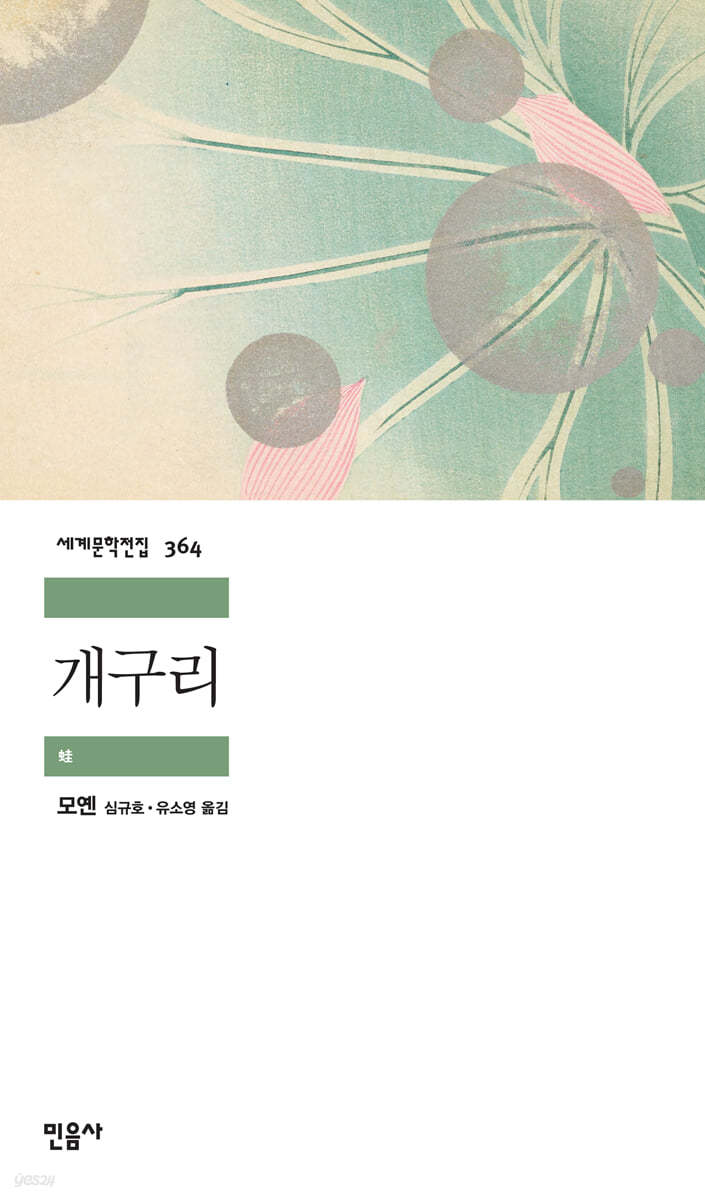
frog
 |
Description
Book Introduction
Just as you can't stop rain from falling from the sky, you can never stop a woman from giving birth. To what extent can individual sacrifice for the nation be justified? Mo Yan, a master of modern literature comparable to Faulkner and Marquez, has a masterpiece. This work, which caused a huge stir by directly addressing China's one-child policy, 'family planning', begins with the narrator, Ke Dou, reminiscing about his aunt, who is in her seventies. My aunt, Wanxin, an obstetrician and gynecologist, is a legendary figure in Gaomi Dongbei Township, who delivered over 10,000 babies over 50 years. In her youth, my aunt was a promising new woman who was born the daughter of a revolutionary martyr and had even learned modern medicine. But when her fiancé, an Air Force pilot, defects to Taiwan, a dark shadow casts a shadow over her future. To make matters worse, the government enforces a family planning policy, forcing the aunt to undergo a vasectomy and an abortion, and she suffers from the criticism and curses of the people, along with the nickname "the living King of Hell." Mo Yan's work "Frog" caused a huge stir by raising the issue of family planning, a hot potato in modern China. Mo Yan, who won the 2012 Nobel Prize in Literature and was praised for creating “hallucinatory realism” based on Chinese folk culture, uses the frog totem, a symbol of fertility, as a motif in “Frog,” praising the vitality of the people who live and breathe tenaciously even in the historical currents that legally restrict the birth of life in the name of economic development. The unchanging theme of Mo Yan's novels is 'humanity'. In the preface to the Korean edition, he stated, “The most important thing in writing a novel is to write about people,” and “I decided to ‘write by looking straight at people.’” Although it deals with the specific event of family planning, Mo Yan's interest lies in the human being caught up in the historical storm. Mo Yan focuses on the various side effects of violent population policies, meticulously depicting the conflicts and reconciliations between characters in complex situations where it is difficult to distinguish between perpetrators and victims. |
- You can preview some of the book's contents.
Preview
index
Preface to the Korean Edition 7
Part 1, Chapter 13
Part 2 145
Part 3 261
Part 4, 315
Part 5 481
Commentary on the work 582
Author's Chronology 593
Part 1, Chapter 13
Part 2 145
Part 3 261
Part 4, 315
Part 5 481
Commentary on the work 582
Author's Chronology 593
Detailed image

Into the book
Whenever I heard about these 'old midwives', my aunt would tremble.
He cursed, saying he didn't know how many children and mothers had died at the hands of these old monsters.
(…) My aunt said that they would press down on the mother's belly with a squeegee and then cover her mouth with an old piece of cloth as if the baby were going to pop out.
You said that they had absolutely no knowledge of anatomy, so there was no way they could know the physiological structure of a pregnant woman.
--- p.31
At the time, my aunt was only seventeen years old, but even at a young age, she had a lot of experience.
Moreover, because he was from a noble family, he was already a very influential figure in our Dongbei Gaomi region, and was looked up to by many.
Of course, my aunt was also the owner of outstanding beauty.
--- p.40
The person who gave my aunt the Enica wristwatch was an Air Force pilot.
Back then, an Air Force pilot! When the news spread, my brothers and sister croaked like frogs, and I did a backflip.
--- p.64
My mother asked my aunt.
Is the family planning movement that my aunt is promoting something she's working hard to push forward on her own, or is it something she's forced to do because someone above her orders her to do it? "Something she's working hard to push forward?" my aunt said, grumbling.
This is the party's call, Chairman Mao's directive, and the country's policy.
What did Chairman Mao say? He said humanity must control itself and grow in a planned way.
--- p.112
People have given me the nickname "Living King Yeomra." This aunt is truly honored by that nickname! If a child is born under the family planning policy, I will burn incense, bathe, and receive it.
But if the pregnancy is in violation of the policy… … .
My aunt concluded her words by waving her hands in the air.
I can never leave it like that.
--- p.166
Your aunt is not a human being, she is a monster! My mother-in-law came out and said.
How many lives have you trampled over over the years? Your hands are covered in blood, so King Yeomra will probably tear you to pieces after you die.
--- p.232
I kicked open the operating room door and went in.
A white cloth covered Runmei, Runmei's body, Runmei's face.
My aunt was sitting listlessly on a folding chair, blood all over her body.
Xiao Zi and the others were completely shocked.
(…) Aunt… … So… … Aunt said nothing would happen, right?
--- p.252
History focuses only on results, not on the means.
Just as when people look at great structures like the Great Wall of China or the pyramids of Egypt, they fail to see the countless bones that lie behind them.
--- p.264
I need to have a son who will leave me a lot of money, I don't want to pay fines.
So, they find a surrogate mother, make excuses, and avoid fines.
Besides, most rich and high-ranking people these days are of middle-aged age.
Men are still full of energy, but most wives are no good at that.
--- p.398
Teacher, I originally thought that creation could be a form of atonement.
However, after the script was completed, the guilt in my heart seemed to have grown rather than diminished.
(…) Every child is unique and cannot be replaced by anything else.
Is it possible to never wash the blood from our hands? Is there no way to free our souls from the guilt that binds them?
--- p.484
A person who has sinned cannot die, and has no right to die.
Unable to die, they must live in pain, enduring all kinds of hardships while trying to survive.
We must live a life of atonement, tossing and turning like a fish pancake and stirring like a bubbling medicine.
He cursed, saying he didn't know how many children and mothers had died at the hands of these old monsters.
(…) My aunt said that they would press down on the mother's belly with a squeegee and then cover her mouth with an old piece of cloth as if the baby were going to pop out.
You said that they had absolutely no knowledge of anatomy, so there was no way they could know the physiological structure of a pregnant woman.
--- p.31
At the time, my aunt was only seventeen years old, but even at a young age, she had a lot of experience.
Moreover, because he was from a noble family, he was already a very influential figure in our Dongbei Gaomi region, and was looked up to by many.
Of course, my aunt was also the owner of outstanding beauty.
--- p.40
The person who gave my aunt the Enica wristwatch was an Air Force pilot.
Back then, an Air Force pilot! When the news spread, my brothers and sister croaked like frogs, and I did a backflip.
--- p.64
My mother asked my aunt.
Is the family planning movement that my aunt is promoting something she's working hard to push forward on her own, or is it something she's forced to do because someone above her orders her to do it? "Something she's working hard to push forward?" my aunt said, grumbling.
This is the party's call, Chairman Mao's directive, and the country's policy.
What did Chairman Mao say? He said humanity must control itself and grow in a planned way.
--- p.112
People have given me the nickname "Living King Yeomra." This aunt is truly honored by that nickname! If a child is born under the family planning policy, I will burn incense, bathe, and receive it.
But if the pregnancy is in violation of the policy… … .
My aunt concluded her words by waving her hands in the air.
I can never leave it like that.
--- p.166
Your aunt is not a human being, she is a monster! My mother-in-law came out and said.
How many lives have you trampled over over the years? Your hands are covered in blood, so King Yeomra will probably tear you to pieces after you die.
--- p.232
I kicked open the operating room door and went in.
A white cloth covered Runmei, Runmei's body, Runmei's face.
My aunt was sitting listlessly on a folding chair, blood all over her body.
Xiao Zi and the others were completely shocked.
(…) Aunt… … So… … Aunt said nothing would happen, right?
--- p.252
History focuses only on results, not on the means.
Just as when people look at great structures like the Great Wall of China or the pyramids of Egypt, they fail to see the countless bones that lie behind them.
--- p.264
I need to have a son who will leave me a lot of money, I don't want to pay fines.
So, they find a surrogate mother, make excuses, and avoid fines.
Besides, most rich and high-ranking people these days are of middle-aged age.
Men are still full of energy, but most wives are no good at that.
--- p.398
Teacher, I originally thought that creation could be a form of atonement.
However, after the script was completed, the guilt in my heart seemed to have grown rather than diminished.
(…) Every child is unique and cannot be replaced by anything else.
Is it possible to never wash the blood from our hands? Is there no way to free our souls from the guilt that binds them?
--- p.484
A person who has sinned cannot die, and has no right to die.
Unable to die, they must live in pain, enduring all kinds of hardships while trying to survive.
We must live a life of atonement, tossing and turning like a fish pancake and stirring like a bubbling medicine.
--- p.579
Publisher's Review
“History focuses only on the results, not on the means.
Just like when people see great structures like the Great Wall of China or the pyramids of Egypt,
It's like you can't see the countless bones that lie behind the architecture.
▶ “It fuses hallucinatory realism with folk oral literature, history, and the contemporary era.”
―Reasons for selection for the Nobel Prize in Literature
▶ 『Frog』 shows a passionate love for humanity while pursuing the essence of life.
―Mao Dun Literature Award Selection Committee
▶ A bold novel that deals with the most sensitive topic for Chinese people.
China Daily
The most pressing issue in modern China: childbirth.
Mo Yan's work "Frog" caused a huge stir by raising the issue of family planning, a hot potato in modern China.
When the population, which was approximately 541 million around the time of the founding of the People's Republic of China in 1949, exceeded 800 million in 1969, the anxious Chinese government began to pressure local officials to lower the "birth index" unconditionally, with radical slogans such as "Even if blood flows like a river, excess births cannot be permitted." As a result of this forced enforcement, side effects began to appear all over China.
In particular, issues related to bioethics have arisen, such as forcibly performing abortions on pregnant women who violated their family planning.
Many girls were left as 'children of darkness' without being registered in the family register, which became a social problem.
Mo Yan, who won the 2012 Nobel Prize in Literature and was praised for creating “hallucinatory realism” based on Chinese folk culture, uses the frog totem, a symbol of fertility, as a motif in “Frog,” praising the vitality of the people who live and breathe tenaciously even in the historical currents that legally restrict the birth of life in the name of economic development.
“I decided to look straight at people and write.”
―Mo Yan, the first Chinese writer to win the Nobel Prize in Literature
Mo Yan, whose pen name means "I only write, I don't speak," emerged as a world-renowned writer when Zhang Yimou's film "Red Sorghum," adapted from his 1986 novel "Red Sorghum," won the Golden Bear at the 1988 Berlin International Film Festival.
Since his debut, he has written novels mainly based on his hometown of Gaomi County, Shandong Province, and is therefore sometimes categorized as a local novelist or a novelist who delves into his roots. However, he is well known as a writer of the avant-garde literary movement, influenced by Western modernism, which began to resurface in 1985.
His masterpiece, "Frog," also maximized its literary effect by incorporating the issues of planned family planning into a unique format that combines letters, a novel, and a play.
The unchanging theme of Mo Yan's novels is 'humanity'.
In the preface to the Korean edition, he stated, “The most important thing in writing a novel is to write about people,” and “I decided to ‘write by looking straight at people.’”
Although it deals with the specific event of family planning, Mo Yan's interest lies in the human being caught up in the historical storm.
Mo Yan focuses on the various side effects of violent population policies, meticulously depicting the conflicts and reconciliations between characters in complex situations where it is difficult to distinguish between perpetrators and victims.
/“I don’t blame my aunt.
I don't think it's my aunt's fault.
These days, my aunt often repents that she has blood on her hands.
But that was history.
History focuses only on results, not on the means.
Just as when people look at great structures like the Great Wall of China or the pyramids of Egypt, they fail to see the countless skeletons that lie behind them.” - From the text/
A novel that combines novels, letters, and plays
"Frog" is formally an autobiographical first-person novel, but the actual protagonist is his aunt. Although it is a novel, it consists of five long letters sent by Kedo to the recipient, Yoshito Sugitani.
Also, the last fifth letter contains a nine-act script.
Although it is clearly a letter in form, the content reads like a novel, and although it may be considered a novel, it is clearly a letter, as the author himself has stated.
If it's a letter, there would naturally be a sender and a recipient, but even if the sender is the author himself, it is not clear who Yoshihito Sugiya, who is listed as the recipient, is.
Since the author mentions Japanese Nobel Prize-winning writer Kenzaburo Oe in the preface, it is possible to speculate that the recipient may be him, but Mo Yan denies this.
In the letter, he promises to write a play based on his aunt's life.
However, the script contains the ending of the entire novel instead of the aunt's story, and the script for the television series appears in Act 8.
The author said this about why he chose this new format:
/“I created a new form that combined epistolary and dramatic elements in the composition of the novel.
(Omitted) At the same time, the way fiction and truth alternate and the kind of alienating effect of ‘a play within a play’ will greatly expand the narrative space of the novel, making it richer and more ambiguous.” /
In other words, through this avant-garde attempt, Mo Yan prevented "Frog" from becoming a reportage or non-fiction, even though it was based on actual history. He combined the realism of letters with the fictionality of a novel to create three-dimensional, living, breathing characters within it.
His literary motto of "facing social reality head-on and writing while looking straight at people" can be seen as embodied in the form of his writing.
Just like when people see great structures like the Great Wall of China or the pyramids of Egypt,
It's like you can't see the countless bones that lie behind the architecture.
▶ “It fuses hallucinatory realism with folk oral literature, history, and the contemporary era.”
―Reasons for selection for the Nobel Prize in Literature
▶ 『Frog』 shows a passionate love for humanity while pursuing the essence of life.
―Mao Dun Literature Award Selection Committee
▶ A bold novel that deals with the most sensitive topic for Chinese people.
China Daily
The most pressing issue in modern China: childbirth.
Mo Yan's work "Frog" caused a huge stir by raising the issue of family planning, a hot potato in modern China.
When the population, which was approximately 541 million around the time of the founding of the People's Republic of China in 1949, exceeded 800 million in 1969, the anxious Chinese government began to pressure local officials to lower the "birth index" unconditionally, with radical slogans such as "Even if blood flows like a river, excess births cannot be permitted." As a result of this forced enforcement, side effects began to appear all over China.
In particular, issues related to bioethics have arisen, such as forcibly performing abortions on pregnant women who violated their family planning.
Many girls were left as 'children of darkness' without being registered in the family register, which became a social problem.
Mo Yan, who won the 2012 Nobel Prize in Literature and was praised for creating “hallucinatory realism” based on Chinese folk culture, uses the frog totem, a symbol of fertility, as a motif in “Frog,” praising the vitality of the people who live and breathe tenaciously even in the historical currents that legally restrict the birth of life in the name of economic development.
“I decided to look straight at people and write.”
―Mo Yan, the first Chinese writer to win the Nobel Prize in Literature
Mo Yan, whose pen name means "I only write, I don't speak," emerged as a world-renowned writer when Zhang Yimou's film "Red Sorghum," adapted from his 1986 novel "Red Sorghum," won the Golden Bear at the 1988 Berlin International Film Festival.
Since his debut, he has written novels mainly based on his hometown of Gaomi County, Shandong Province, and is therefore sometimes categorized as a local novelist or a novelist who delves into his roots. However, he is well known as a writer of the avant-garde literary movement, influenced by Western modernism, which began to resurface in 1985.
His masterpiece, "Frog," also maximized its literary effect by incorporating the issues of planned family planning into a unique format that combines letters, a novel, and a play.
The unchanging theme of Mo Yan's novels is 'humanity'.
In the preface to the Korean edition, he stated, “The most important thing in writing a novel is to write about people,” and “I decided to ‘write by looking straight at people.’”
Although it deals with the specific event of family planning, Mo Yan's interest lies in the human being caught up in the historical storm.
Mo Yan focuses on the various side effects of violent population policies, meticulously depicting the conflicts and reconciliations between characters in complex situations where it is difficult to distinguish between perpetrators and victims.
/“I don’t blame my aunt.
I don't think it's my aunt's fault.
These days, my aunt often repents that she has blood on her hands.
But that was history.
History focuses only on results, not on the means.
Just as when people look at great structures like the Great Wall of China or the pyramids of Egypt, they fail to see the countless skeletons that lie behind them.” - From the text/
A novel that combines novels, letters, and plays
"Frog" is formally an autobiographical first-person novel, but the actual protagonist is his aunt. Although it is a novel, it consists of five long letters sent by Kedo to the recipient, Yoshito Sugitani.
Also, the last fifth letter contains a nine-act script.
Although it is clearly a letter in form, the content reads like a novel, and although it may be considered a novel, it is clearly a letter, as the author himself has stated.
If it's a letter, there would naturally be a sender and a recipient, but even if the sender is the author himself, it is not clear who Yoshihito Sugiya, who is listed as the recipient, is.
Since the author mentions Japanese Nobel Prize-winning writer Kenzaburo Oe in the preface, it is possible to speculate that the recipient may be him, but Mo Yan denies this.
In the letter, he promises to write a play based on his aunt's life.
However, the script contains the ending of the entire novel instead of the aunt's story, and the script for the television series appears in Act 8.
The author said this about why he chose this new format:
/“I created a new form that combined epistolary and dramatic elements in the composition of the novel.
(Omitted) At the same time, the way fiction and truth alternate and the kind of alienating effect of ‘a play within a play’ will greatly expand the narrative space of the novel, making it richer and more ambiguous.” /
In other words, through this avant-garde attempt, Mo Yan prevented "Frog" from becoming a reportage or non-fiction, even though it was based on actual history. He combined the realism of letters with the fictionality of a novel to create three-dimensional, living, breathing characters within it.
His literary motto of "facing social reality head-on and writing while looking straight at people" can be seen as embodied in the form of his writing.
GOODS SPECIFICS
- Publication date: June 18, 2021
- Page count, weight, size: 604 pages | 668g | 132*225*29mm
- ISBN13: 9788937463648
- ISBN10: 8937463644
You may also like
카테고리
korean


korean

![GQ KOREA Mark (Monthly): December [2025]](http://librairie.coreenne.fr/cdn/shop/files/8ef265dbbfbf186523ed75ba7319009d.jpg?v=1765340328&width=3840)


