

The science of usefulness, new materials
 |
Description
Book Introduction
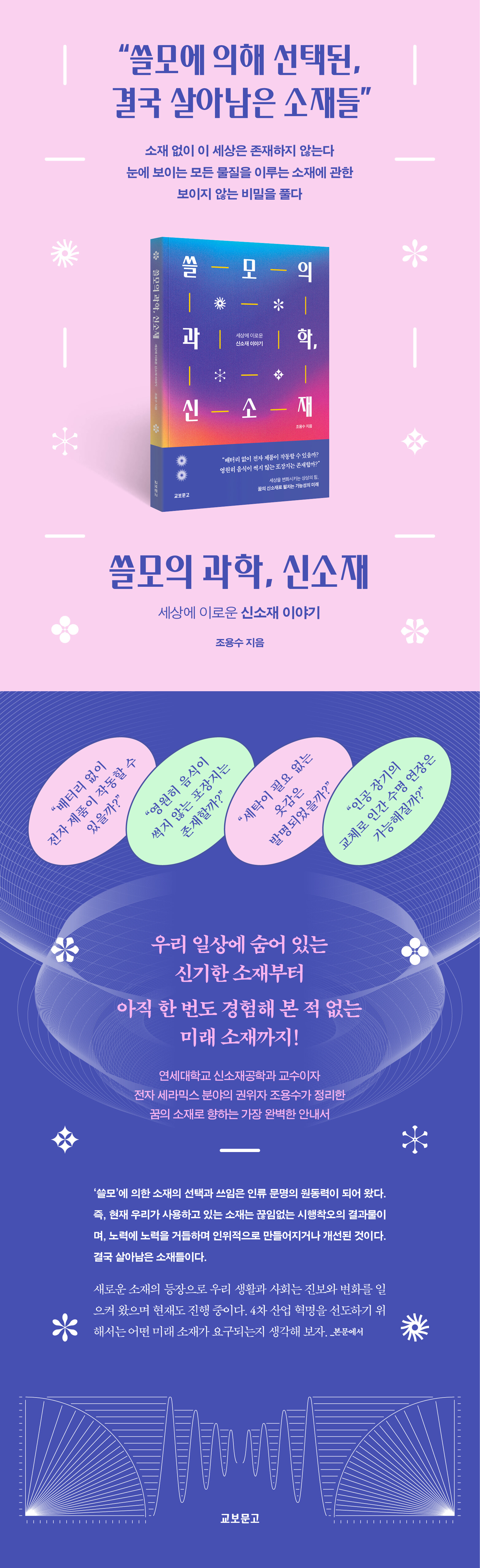
“Materials selected for their usefulness, ultimately surviving.”
About the material that makes up all visible matter
Unraveling the Invisible Secret
Every moment of groundbreaking advancement in human civilization was accompanied by the creation of novel materials.
Synthetic rubber, nylon, semiconductors, graphene, quantum dots… … .
The discovery and invention of new materials has been the driving force behind changing the world.
In other words, the materials that are still being used today are those that survived and were selected for their ‘usefulness.’
The reason the importance of new materials is being emphasized more than ever recently is because the infinite possibilities of life that will unfold in future society are closely related to the emergence of novel materials that transcend limitations.
In other words, examining the past, present, and future of materials is essential not only for predicting the society to come, but also for securing future competitiveness.
It is not a choice, but a necessity for survival.
Therefore, 『The Science of Usefulness, New Materials: Stories of New Materials Beneficial to the World』 presented by Yongsu Cho, a professor of materials science and engineering at Yonsei University and an authority in the field of electronic ceramics, can be said to be the most perfect guidebook for predicting the ever-changing future society.
This book, which aims to cover scientific principles at a common-sense level without using complex formulas as much as possible, is written so that anyone interested in new materials, even those who are not familiar with it, can easily access it.
Especially for middle and high school students, I hope that this will be an important opportunity to discover their potential and choose a career path.
I hope that intellectual curiosity about new materials for usefulness continues.
About the material that makes up all visible matter
Unraveling the Invisible Secret
Every moment of groundbreaking advancement in human civilization was accompanied by the creation of novel materials.
Synthetic rubber, nylon, semiconductors, graphene, quantum dots… … .
The discovery and invention of new materials has been the driving force behind changing the world.
In other words, the materials that are still being used today are those that survived and were selected for their ‘usefulness.’
The reason the importance of new materials is being emphasized more than ever recently is because the infinite possibilities of life that will unfold in future society are closely related to the emergence of novel materials that transcend limitations.
In other words, examining the past, present, and future of materials is essential not only for predicting the society to come, but also for securing future competitiveness.
It is not a choice, but a necessity for survival.
Therefore, 『The Science of Usefulness, New Materials: Stories of New Materials Beneficial to the World』 presented by Yongsu Cho, a professor of materials science and engineering at Yonsei University and an authority in the field of electronic ceramics, can be said to be the most perfect guidebook for predicting the ever-changing future society.
This book, which aims to cover scientific principles at a common-sense level without using complex formulas as much as possible, is written so that anyone interested in new materials, even those who are not familiar with it, can easily access it.
Especially for middle and high school students, I hope that this will be an important opportunity to discover their potential and choose a career path.
I hope that intellectual curiosity about new materials for usefulness continues.
- You can preview some of the book's contents.
Preview
index
Continuing Human Civilization Through Prologue Materials
The beginning of understanding the material
1.
What is material?
Where do materials come from?
Moment of change
Material options
New materials that add value
2.
The story of surviving material
The inevitable choice of materials
The wonders of life
Material characteristics and selection criteria
3.
The material that led human history
The first artificial material, clay
The first metal, copper
The Beginning of Money, the Discovery of Gold and Silver
The advent of iron, the iron age
Yuri's accidental discovery
The origins of plastic
Stories about the surrounding materials
4.
How do materials exist?
The smallest unit of the world, the atom
Interatomic bonds, the beginning of materials
A regular arrangement of atoms, a crystal
mass transfer in solids
Where electrons are located, energy bands
5.
The Science of Reversal: Improved Materials
imperfect material
Intentional flaws, the beginning of new discoveries
Living with flaws
6.
Useful materials: ceramics, metals, and polymers
Ceramics, a material with infinite applications
Material of value, metal
The versatility of lightness, polymers
7.
Discovery of materials that transcend limitations
Artificial materials, composite materials
Semiconductor materials, the core of the information age
Invisible Science, Nanomaterials
Various transformations, carbon materials
The world of reactive materials
8.
Materials that react to electricity
When electricity flows
The flow of electricity in semiconductors
Devices using semiconductor materials
Utilization of static electricity
9.
Materials that become magnets
Materials that respond to magnetic fields
Utilization of magnetic phenomena
10.
Materials that utilize light
Interaction between light and matter
Utilization of emitted light energy
11.
heat-sensitive materials
When the material is heated
Detection and utilization of thermal energy
12.
Material that responds to force
Physical changes in response to force
Leveraging external pressure
13.
Energy contributed by materials
Solar cells, the hope of renewable energy
Batteries, a means of energy storage
Fuel cells, green hydrogen energy conversion
14.
Evolution into future materials
Hope for better products, materials on the rise
The beginning of social change, the material to come
Epilogue
The beginning of understanding the material
1.
What is material?
Where do materials come from?
Moment of change
Material options
New materials that add value
2.
The story of surviving material
The inevitable choice of materials
The wonders of life
Material characteristics and selection criteria
3.
The material that led human history
The first artificial material, clay
The first metal, copper
The Beginning of Money, the Discovery of Gold and Silver
The advent of iron, the iron age
Yuri's accidental discovery
The origins of plastic
Stories about the surrounding materials
4.
How do materials exist?
The smallest unit of the world, the atom
Interatomic bonds, the beginning of materials
A regular arrangement of atoms, a crystal
mass transfer in solids
Where electrons are located, energy bands
5.
The Science of Reversal: Improved Materials
imperfect material
Intentional flaws, the beginning of new discoveries
Living with flaws
6.
Useful materials: ceramics, metals, and polymers
Ceramics, a material with infinite applications
Material of value, metal
The versatility of lightness, polymers
7.
Discovery of materials that transcend limitations
Artificial materials, composite materials
Semiconductor materials, the core of the information age
Invisible Science, Nanomaterials
Various transformations, carbon materials
The world of reactive materials
8.
Materials that react to electricity
When electricity flows
The flow of electricity in semiconductors
Devices using semiconductor materials
Utilization of static electricity
9.
Materials that become magnets
Materials that respond to magnetic fields
Utilization of magnetic phenomena
10.
Materials that utilize light
Interaction between light and matter
Utilization of emitted light energy
11.
heat-sensitive materials
When the material is heated
Detection and utilization of thermal energy
12.
Material that responds to force
Physical changes in response to force
Leveraging external pressure
13.
Energy contributed by materials
Solar cells, the hope of renewable energy
Batteries, a means of energy storage
Fuel cells, green hydrogen energy conversion
14.
Evolution into future materials
Hope for better products, materials on the rise
The beginning of social change, the material to come
Epilogue
Detailed image
Into the book
We often come across articles and reports suggesting that our lives will change, but it is not easy to gauge the hidden reality and possibilities.
This book is designed for the general public and middle and high school students who are interested in science, even if they are not experts in new materials science or engineering.
Starting with the definition of new materials, we will cover the importance and limitations of the field of new materials, as well as scientific principles at a common-sense level without using formulas.
--- p.5
As you can imagine by imagining how pottery was made in the Stone Age, this is something that humans have learned over the long history of human existence.
In other words, the materials we currently use are the result of continuous development and have been artificially created or improved through continuous advancement.
These are the materials that survived in the end.
--- p.8
The reason new materials are important is because they are the starting point of advanced products as we know them.
We have reached an era where securing the best materials is directly linked to competitiveness, as the selection of the right materials is directly related to the performance of the final product.
(……) Therefore, the limitations of materials are also the limitations of parts and finished products.
This is also the reason why we are dedicated to developing original materials.
--- p.30
The discovery of new materials is closely related to the development of human civilization.
Human civilization has gone through the Stone Age, Bronze Age, and Iron Age.
Interestingly, the fact that the periods were divided by material shows that the changes in human history are deeply connected to the discovery of materials.
--- p.51
There is no such thing as perfect material.
Therefore, the inherent unstable structure or defects that develop over time degrade the properties of the material.
But academically, flaws aren't always a bad thing.
Sometimes, defects are intentionally exploited to improve the properties of a material.
Let's take a look at what scientists and developers are doing to understand and exploit flaws.
--- p.92
Every year, new electronic products are introduced, adding features and capabilities we never imagined before.
If existing materials cannot be made on a smaller scale, it will be difficult to make electronic products lighter or thinner.
New semiconductors are also related to the performance and power consumption of electronic products.
(……) Most of the new materials recently discovered are new materials that have been artificially synthesized.
--- p.130
I would like to introduce in more detail how materials react when given constant external stimuli, such as electricity, light, heat, and force.
This specific reaction is being used to develop a variety of advanced products, and the materials with the best reactions are the most novel materials and may become materials with great future utility.
--- p.146
We often come across the words energy crisis and depletion.
While we are concerned about oil reserves, we also need to address the serious environmental problem of carbon dioxide emissions.
Is it possible to develop energy technologies that can replace existing fossil fuels? Energy production based on scientific technology, known as renewable energy, depends entirely on the selection and improvement of materials.
--- p.208
Why can't cell phones use solar cells? If solar cells were used instead of batteries, there would be no need for external power sources for charging.
Due to limitations in the semiconductor materials currently used in solar cells, it is difficult to provide sufficient power to charge the batteries.
Why haven't rollable or foldable displays been developed yet? The technology is there, but there are still clear material limitations to overcome before widespread adoption.
(……) There are countless future materials that are receiving ongoing attention, such as research on metals that automatically recover from scratches, research on polymers that can be made lighter while maintaining the strength of metals, and the development of biodegradable plastics.
--- p.232
The intention behind planning this book is to introduce past, present, and future materials based on a more common-sense understanding of science.
Beyond knowing the existence and background of famous materials from the past, I also want to consider their value as a product and why they were chosen.
Because it is a prerequisite for the material to survive in the future.
This book is designed for the general public and middle and high school students who are interested in science, even if they are not experts in new materials science or engineering.
Starting with the definition of new materials, we will cover the importance and limitations of the field of new materials, as well as scientific principles at a common-sense level without using formulas.
--- p.5
As you can imagine by imagining how pottery was made in the Stone Age, this is something that humans have learned over the long history of human existence.
In other words, the materials we currently use are the result of continuous development and have been artificially created or improved through continuous advancement.
These are the materials that survived in the end.
--- p.8
The reason new materials are important is because they are the starting point of advanced products as we know them.
We have reached an era where securing the best materials is directly linked to competitiveness, as the selection of the right materials is directly related to the performance of the final product.
(……) Therefore, the limitations of materials are also the limitations of parts and finished products.
This is also the reason why we are dedicated to developing original materials.
--- p.30
The discovery of new materials is closely related to the development of human civilization.
Human civilization has gone through the Stone Age, Bronze Age, and Iron Age.
Interestingly, the fact that the periods were divided by material shows that the changes in human history are deeply connected to the discovery of materials.
--- p.51
There is no such thing as perfect material.
Therefore, the inherent unstable structure or defects that develop over time degrade the properties of the material.
But academically, flaws aren't always a bad thing.
Sometimes, defects are intentionally exploited to improve the properties of a material.
Let's take a look at what scientists and developers are doing to understand and exploit flaws.
--- p.92
Every year, new electronic products are introduced, adding features and capabilities we never imagined before.
If existing materials cannot be made on a smaller scale, it will be difficult to make electronic products lighter or thinner.
New semiconductors are also related to the performance and power consumption of electronic products.
(……) Most of the new materials recently discovered are new materials that have been artificially synthesized.
--- p.130
I would like to introduce in more detail how materials react when given constant external stimuli, such as electricity, light, heat, and force.
This specific reaction is being used to develop a variety of advanced products, and the materials with the best reactions are the most novel materials and may become materials with great future utility.
--- p.146
We often come across the words energy crisis and depletion.
While we are concerned about oil reserves, we also need to address the serious environmental problem of carbon dioxide emissions.
Is it possible to develop energy technologies that can replace existing fossil fuels? Energy production based on scientific technology, known as renewable energy, depends entirely on the selection and improvement of materials.
--- p.208
Why can't cell phones use solar cells? If solar cells were used instead of batteries, there would be no need for external power sources for charging.
Due to limitations in the semiconductor materials currently used in solar cells, it is difficult to provide sufficient power to charge the batteries.
Why haven't rollable or foldable displays been developed yet? The technology is there, but there are still clear material limitations to overcome before widespread adoption.
(……) There are countless future materials that are receiving ongoing attention, such as research on metals that automatically recover from scratches, research on polymers that can be made lighter while maintaining the strength of metals, and the development of biodegradable plastics.
--- p.232
The intention behind planning this book is to introduce past, present, and future materials based on a more common-sense understanding of science.
Beyond knowing the existence and background of famous materials from the past, I also want to consider their value as a product and why they were chosen.
Because it is a prerequisite for the material to survive in the future.
--- p.241
Publisher's Review
“Can electronic devices operate without batteries?”
“Is there a packaging material that never spoils?”
From the curious materials hidden in our daily lives
Even future materials you've never experienced before!
Until now, books on new materials have been limited to describing the history of new materials that have greatly contributed to changing the world or focusing on important materials that have had a tremendous impact on our lives, which has been disappointing.
This book covers a wide range of topics, from the definition of new materials to the mysterious secrets hidden in their formation process, how closely the emergence of new materials is connected to our lives, and what value they will bring to the future society. However, it is composed of content that allows us to get closer to the true nature of new materials.
In other words, it can be said that it covers almost everything you need to know about new materials, from A to Z.
Part 1, "The Beginning of Understanding Materials," defines the materials that make up all visible matter, and examines how their emergence ushered in a groundbreaking moment of development for human civilization, as well as the "first materials" that led to this transformation.
The fact that the early human civilizations are all named after materials—the Stone Age, Bronze Age, and Iron Age—gives us an idea of how much materials contributed to their change and development.
It also talks about the hidden materials that are 'selected' based on 'usefulness' and have been continuously improved through trial and error, and where and how they are used in our daily lives.
In Part 2, 'Stories of Materials Around Us,' we learn about the secrets of the invisible world of what materials are made of and through what process they are formed.
It must be a fascinating experience to know that the entire world we see is composed of atoms, the smallest units of matter, combined and moved together.
Furthermore, in 'The Science of Reversal, Improved Materials', it is said that no material is perfect, and that acknowledging 'defects' and improving them or intentionally exploiting them can open up new possibilities in material development.
In "Useful Materials: Ceramics? Metals? Polymers," we delve into the properties of materials, categorized into three main categories. We also explore the artificial materials that overcome their inherent shortcomings and limitations: composites, semiconductors, nanomaterials, and carbon materials, all of which are driving cutting-edge industries.
Part 3, 'The World of Responsive Materials', examines how materials react when exposed to external stimuli such as electricity, light, heat, and force, which can be considered the basic characteristics of materials.
The reason these responses are important is because they provide important scientific evidence for 'selecting' the optimal materials to create advanced products.
We also examine solar cells, batteries, and fuel cells to see how the development of new materials is a key to solving the current urgent energy and environmental problems.
Finally, we will examine the key materials and scientific theories that won the Nobel Prize and explore what future materials we should focus on and what scientific and technological advancements are necessary to lead the Fourth Industrial Revolution, which has already arrived and is approaching.
“Imagination that changes the world”
A future of possibilities unfolding with dream new materials
Among the amazing materials around us, many began as imaginations and were realized through research.
Research is still underway that defies common sense, including metal that automatically heals scratches, paper that doesn't tear or burn, and fabric that creates an invisibility cloak.
Therefore, it is quite possible for anyone, not just a scientist, to come up with new ideas about materials through their creative imagination.
So, what materials will survive in the future? What future possibilities will unfold with these dream new materials? As the phrase on a poster on the wall of the DuPont Research Institute, where the author of this book worked as a researcher, "There's only a thin line between success and failure," suggests, if we maintain our curiosity about new materials and never cease challenging the impossible, we can dream of a future of infinite possibilities.
Author's Note
The emergence of new materials has brought about progress and change in our lives and society, and this is still ongoing.
Let's think about what future materials are needed to lead the Fourth Industrial Revolution.
“Is there a packaging material that never spoils?”
From the curious materials hidden in our daily lives
Even future materials you've never experienced before!
Until now, books on new materials have been limited to describing the history of new materials that have greatly contributed to changing the world or focusing on important materials that have had a tremendous impact on our lives, which has been disappointing.
This book covers a wide range of topics, from the definition of new materials to the mysterious secrets hidden in their formation process, how closely the emergence of new materials is connected to our lives, and what value they will bring to the future society. However, it is composed of content that allows us to get closer to the true nature of new materials.
In other words, it can be said that it covers almost everything you need to know about new materials, from A to Z.
Part 1, "The Beginning of Understanding Materials," defines the materials that make up all visible matter, and examines how their emergence ushered in a groundbreaking moment of development for human civilization, as well as the "first materials" that led to this transformation.
The fact that the early human civilizations are all named after materials—the Stone Age, Bronze Age, and Iron Age—gives us an idea of how much materials contributed to their change and development.
It also talks about the hidden materials that are 'selected' based on 'usefulness' and have been continuously improved through trial and error, and where and how they are used in our daily lives.
In Part 2, 'Stories of Materials Around Us,' we learn about the secrets of the invisible world of what materials are made of and through what process they are formed.
It must be a fascinating experience to know that the entire world we see is composed of atoms, the smallest units of matter, combined and moved together.
Furthermore, in 'The Science of Reversal, Improved Materials', it is said that no material is perfect, and that acknowledging 'defects' and improving them or intentionally exploiting them can open up new possibilities in material development.
In "Useful Materials: Ceramics? Metals? Polymers," we delve into the properties of materials, categorized into three main categories. We also explore the artificial materials that overcome their inherent shortcomings and limitations: composites, semiconductors, nanomaterials, and carbon materials, all of which are driving cutting-edge industries.
Part 3, 'The World of Responsive Materials', examines how materials react when exposed to external stimuli such as electricity, light, heat, and force, which can be considered the basic characteristics of materials.
The reason these responses are important is because they provide important scientific evidence for 'selecting' the optimal materials to create advanced products.
We also examine solar cells, batteries, and fuel cells to see how the development of new materials is a key to solving the current urgent energy and environmental problems.
Finally, we will examine the key materials and scientific theories that won the Nobel Prize and explore what future materials we should focus on and what scientific and technological advancements are necessary to lead the Fourth Industrial Revolution, which has already arrived and is approaching.
“Imagination that changes the world”
A future of possibilities unfolding with dream new materials
Among the amazing materials around us, many began as imaginations and were realized through research.
Research is still underway that defies common sense, including metal that automatically heals scratches, paper that doesn't tear or burn, and fabric that creates an invisibility cloak.
Therefore, it is quite possible for anyone, not just a scientist, to come up with new ideas about materials through their creative imagination.
So, what materials will survive in the future? What future possibilities will unfold with these dream new materials? As the phrase on a poster on the wall of the DuPont Research Institute, where the author of this book worked as a researcher, "There's only a thin line between success and failure," suggests, if we maintain our curiosity about new materials and never cease challenging the impossible, we can dream of a future of infinite possibilities.
Author's Note
The emergence of new materials has brought about progress and change in our lives and society, and this is still ongoing.
Let's think about what future materials are needed to lead the Fourth Industrial Revolution.
GOODS SPECIFICS
- Date of issue: April 17, 2024
- Page count, weight, size: 244 pages | 420g | 148*210*20mm
- ISBN13: 9791170611219
- ISBN10: 1170611214
You may also like
카테고리
korean


korean

![GQ KOREA Mark (Monthly): December [2025]](http://librairie.coreenne.fr/cdn/shop/files/8ef265dbbfbf186523ed75ba7319009d.jpg?v=1765340328&width=3840)


