

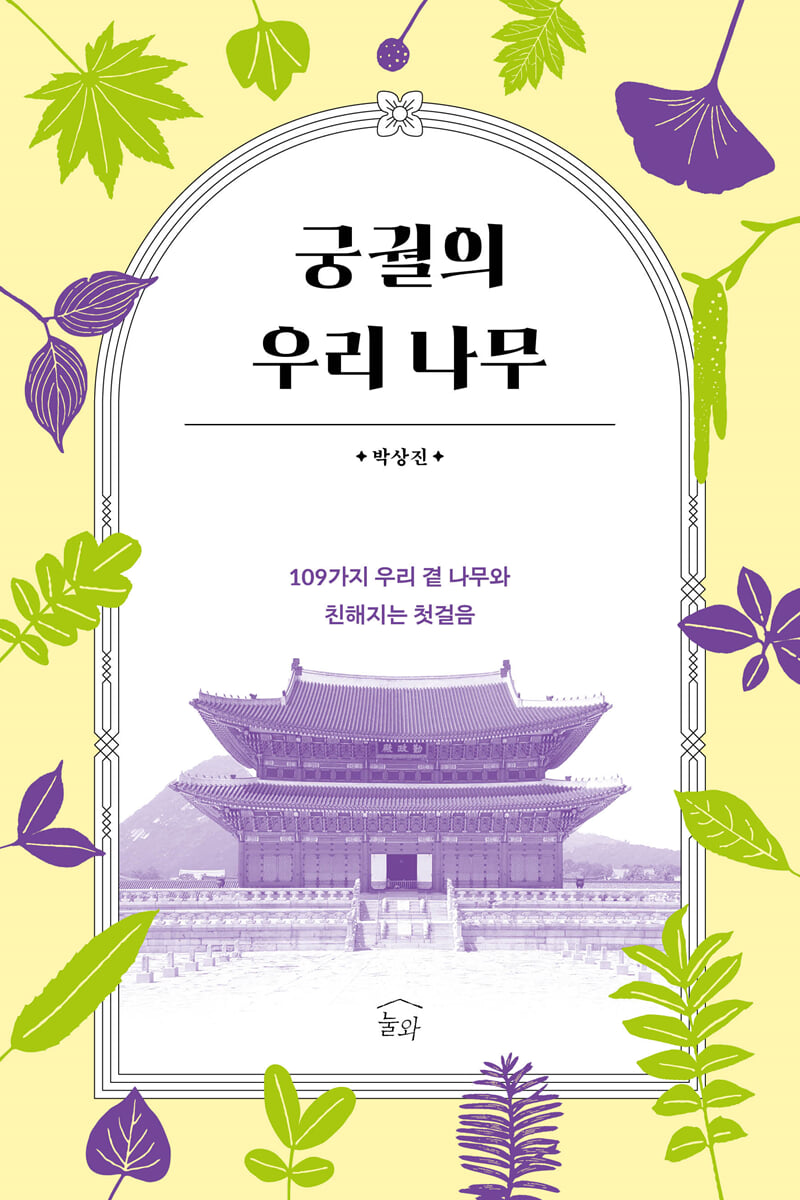
Our tree in the palace
 |
Description
Book Introduction
'The tree called Pyeongnamu
'Will I be able to see it in Seoul?'
Walking through the four major palaces of Joseon
Face our tree
A book that guides you to meet our trees in the palace in the heart of Seoul.
The 'Palace Tree Map' carefully marks the names of the major trees around the palace buildings and viewing paths, and vivid photos allow you to encounter 109 representative Korean trees growing throughout the palace grounds, while introducing the ecology of trees as well as their history and culture in one volume.
It also features easy Korean language for difficult plant terms and interesting stories that help you become familiar with trees.
It has returned as a completely revised edition to mark its 22nd anniversary.
The palace is a place where our history is realized and where you can easily find various beautiful trees.
The author, who has dedicated his life to the study of wooden cultural assets, pays attention to the interesting botanical characteristics of each tree and shares stories about trees he has personally discovered from numerous ancient books.
It also contains plenty of photos that accurately convey the appearance and botanical characteristics of trees, so it can be used as a tree guide.
This revised third edition focuses on faithfully reflecting the changes in the palace situation over the past nine years and improving convenience.
For species where the original real tree has disappeared, we selected a new real tree and photographed it.
The 'Palace Tree Map' was completely surveyed and the letters on the map were enlarged to increase accuracy and convenience.
The contents of the book also reflect newly discovered material and changes over time.
Keep this book by your side and take it out whenever you think of trees.
'Will I be able to see it in Seoul?'
Walking through the four major palaces of Joseon
Face our tree
A book that guides you to meet our trees in the palace in the heart of Seoul.
The 'Palace Tree Map' carefully marks the names of the major trees around the palace buildings and viewing paths, and vivid photos allow you to encounter 109 representative Korean trees growing throughout the palace grounds, while introducing the ecology of trees as well as their history and culture in one volume.
It also features easy Korean language for difficult plant terms and interesting stories that help you become familiar with trees.
It has returned as a completely revised edition to mark its 22nd anniversary.
The palace is a place where our history is realized and where you can easily find various beautiful trees.
The author, who has dedicated his life to the study of wooden cultural assets, pays attention to the interesting botanical characteristics of each tree and shares stories about trees he has personally discovered from numerous ancient books.
It also contains plenty of photos that accurately convey the appearance and botanical characteristics of trees, so it can be used as a tree guide.
This revised third edition focuses on faithfully reflecting the changes in the palace situation over the past nine years and improving convenience.
For species where the original real tree has disappeared, we selected a new real tree and photographed it.
The 'Palace Tree Map' was completely surveyed and the letters on the map were enlarged to increase accuracy and convenience.
The contents of the book also reflect newly discovered material and changes over time.
Keep this book by your side and take it out whenever you think of trees.
- You can preview some of the book's contents.
Preview
index
Preface to the 3rd Revised Edition
4. While publishing a revised edition again
Note 10
Chapter 1
Our Trees of Gyeongbokgung Palace
Gyeongbokgung Palace Map 14
A feast of red-purple flowers unfolding in the mist | Park Tae-gi Tree 18
If you pick bright yellow flowers without care | Prunus mume 22
No Leaf Is Bigger Than This | The Great Odontodon Tree 26
What you couldn't eat while alive, eat your fill even after death | Poplar Tree 32
Is this the cinnamon tree on the moon? | cinnamon tree 36
A fresh flower, yet resilient to pollution | Bamboo 40
King Sejong's favorite cherry tree | 44
A Thousand-Year-Old Ginkgo Tree | 48
Bodybuilder in the Forest | Seonamu 56
Cornus officinalis, good for men. Did the king eat it too? | Cornus officinalis 60
You Can't Eat Me | Arrow Tree 64
The House Where the Goblin Lives | Willow Tree 68
People dance at the sight of the sagging willow tree | Willow Tree 72
The most common and widely used | Willow 76
The surprised captain leaps into the pine chest | Pine Tree 82
Sweeter and more savory than chestnuts | Haeamnamu 86
The first tree the star master encountered | Poplar 90
Enjoying the Sound of the Sea Breeze: "Peng~" Tree | Peng Tree 94
The real tree is me, the oak tree | Oak 98
Oak Trees | Oak Tree 102
The roof of a hut is covered with this | Oak 106
It doesn't grow as small as its name suggests | Quercus japonica 108
Real Autumn Oak | Oak 110
Oak Trees at the Top of a Hard-Climbed Mountain | Oak Tree 112
Useful for making rice cakes | Oak Tree 114
Shining the Night | Shining Tree 116
Growing on a sandy beach, overlooking the sea | Rose of Sharon 120
Standing in autumn, dangling purple beads | Azalea 124
"The Great Dwarf Flower": Abandoned by Bees and Butterflies | Fireweed 128
A Traveler's Faithful Guide | Shimunamu 132
From Zelkova to the Millennium Tree | Zelkova 136
Korean native lacquer tree | Japanese lacquer tree 142
The thorns growing on the stem are more precious | Japonicus 146
Beautiful flowers like silk | Bottlebrush 150
More beautiful because they bloom in clusters | Forsythia 154
Fir trees, growing in clusters of thousands, boast even greater majesty | 158
As cute as a delicate chick | Chickpea Flower Tree 164
Sacred Tree of the Manchurian Plains | Bishulnamu 168
Just three are enough for one meal | Jujube Tree 172
The Phoenix Nest | Wall Odong 178
Not only beautiful but also useful | Birch 182
Making Hanji with the bark of the mulberry tree | Kujina 188
With golden flowers like the adorning crown of a magnificent golden crown | Mogamju tree 192
A relative tree that closely resembles the dogwood tree | Flower dogwood 196
Chapter 2
Our Trees of Changdeokgung Palace
Changdeokgung Palace Map 202
The Pillar of the Heart that Protects a Scholar's Integrity | Conversation Tree 206
The spirit of a gentleman is like a pine tree | Thuja 212
Buried in the ground to obtain a more intense fragrance | Incense Tree 216
Edible Real Flowers: Azaleas | Azalea 222
Flowers bring the spring breeze, and fruit wards off disease | Plum Tree 226
Only in Korea | Misennamu 232
Persimmon Tree 236, so abundant that it was enough to make magpie food
Live a Thousand Years, Die a Thousand Years | Note 242
Silkworms eat mulberry leaves, and lovers make love | Mulberry 246
I can't imagine an autumn without chestnuts | Chestnut Tree 252
Water Bluer | Water Lily 258
Flowers shine in the moonlight, and the fruit falls on King Taejo's arrows | Pear Tree 262
Chapter 3
Our Trees of Changgyeonggung Palace
Changgyeonggung Palace Map 270
There's no way I can resist being intoxicated by those pink flowers | Copy Tree 274
I wish for eternity in the name of Mugung | Rose of Sharon 282
The Fateful Encounter Between Princess Pyeonggang and General Ondal | Elm Tree 286
A Traveler's Guide, Meet Every Ori | Ori Tree 290
Beautiful even on the mountaintop | Maga Tree 294
The noble tree used in the king's coffin | Acacia 298
Now a beautiful tree, succeeded by a successor tree | Hwangcheolnamu 302
Spring in the Forest Comes from Me | Ginger Tree 306
White flowers in spring and red berries in fall are a sight to behold | Hawthorn 310
Don't Call It a Red Pine | Pine Tree 314
As the days of starvation multiply, noodles begin to appear | Noodle Tree 324
My skin is most sensitive to the spring breeze | Magnolia 328
The Outlaw in the Forest, Named "Bokmok" | Layered Tree 332
A Hermit in the Forest, But a King of Sculptures | Darupamu 336
From the Nine Dragons to the Cloud Tree | Guirung Tree 340
The bright yellow inner bark is medicinal and has antibacterial and insect repellent properties. | Phellodendron amurense 344
Slow-growing but valuable | Boxwood 348
Lock the sinner in a cedar fence | 354
The Wide Uses Turned Out to Be a Disaster | Bija Tree 358
Sometimes with an arrow, sometimes with a shovel | Reed 364
Shinto-flavored bananas that melt like cotton candy | Eoreum 368
Don't get me wrong, this isn't Buddha's Bodhi tree | Bodhi Tree 372
My name is pure Korean | Heeri 376
The pepper tree that grew for thousands of years without a name | 380
More precious than a cart full of gold | Ogalpi tree 384
A persimmon is a persimmon, a kiwi is a kiwi | Persimmon 388
See the red berries in autumn | Red bean tree 394
White Spotted Pine | White Pine 398
Drives away ghosts and brings good luck | Eumnamu 402
The bark peels off like paper | Water birch 406
Oh, the maple leaves are falling | Maple Tree 410
The pure-hearted, almost sacred, blueberry tree | 416
North Korea's national flower is me | 420
Chapter 4
Our Trees of Deoksugung Palace
Deoksugung Palace Map 426
Korea's specialty tree, known for its delicious pine nuts | Pine Tree 428
Symbolizing a happy marriage | 434
Lilac 438: A sweet scent reminiscent of first love
The King Cherry Blossom, which blooms brilliantly and then falls in an instant | 442
Pretty, but not plum blossoms | Yellow Plum Blossom 448
Born to be used as a hedge | Rat's Tongue 452
"I wish it were so, people who are tired of living..." | Sacheolnamu 456
More like a squirrel than a squirrel | Clown Squirrel 460
I wish you continued prosperity | Malchae Tree 464
Don't be too harsh on scholars, we have to make a living too... | Deungnamu 468
The Lee family's tree, called Oyat | Plum Tree 472
Don't get me wrong, it doesn't bloom alone for a hundred days | Baerongnamu 478
A gift from the Netherlands to King Gojong? | Marronnier 482
Anything can be made and used anywhere | Sari 486
"Let's try apricots first" | Apricot Tree 490
A symbol of a beautiful woman presented to the queen | Peony 494
The Lady's Flower | 500 Mingja Flowers
A Subtle Fragrance Overcomes Ugliness | Apple Tree 504
Azalea 508, which Lady Suro, the most beautiful woman in Silla, asked to be picked for her.
The Passion of the Biseonhwa in front of the Josadang Hall at Bulguksa Temple | Goldamcho 514
Search 518
4. While publishing a revised edition again
Note 10
Chapter 1
Our Trees of Gyeongbokgung Palace
Gyeongbokgung Palace Map 14
A feast of red-purple flowers unfolding in the mist | Park Tae-gi Tree 18
If you pick bright yellow flowers without care | Prunus mume 22
No Leaf Is Bigger Than This | The Great Odontodon Tree 26
What you couldn't eat while alive, eat your fill even after death | Poplar Tree 32
Is this the cinnamon tree on the moon? | cinnamon tree 36
A fresh flower, yet resilient to pollution | Bamboo 40
King Sejong's favorite cherry tree | 44
A Thousand-Year-Old Ginkgo Tree | 48
Bodybuilder in the Forest | Seonamu 56
Cornus officinalis, good for men. Did the king eat it too? | Cornus officinalis 60
You Can't Eat Me | Arrow Tree 64
The House Where the Goblin Lives | Willow Tree 68
People dance at the sight of the sagging willow tree | Willow Tree 72
The most common and widely used | Willow 76
The surprised captain leaps into the pine chest | Pine Tree 82
Sweeter and more savory than chestnuts | Haeamnamu 86
The first tree the star master encountered | Poplar 90
Enjoying the Sound of the Sea Breeze: "Peng~" Tree | Peng Tree 94
The real tree is me, the oak tree | Oak 98
Oak Trees | Oak Tree 102
The roof of a hut is covered with this | Oak 106
It doesn't grow as small as its name suggests | Quercus japonica 108
Real Autumn Oak | Oak 110
Oak Trees at the Top of a Hard-Climbed Mountain | Oak Tree 112
Useful for making rice cakes | Oak Tree 114
Shining the Night | Shining Tree 116
Growing on a sandy beach, overlooking the sea | Rose of Sharon 120
Standing in autumn, dangling purple beads | Azalea 124
"The Great Dwarf Flower": Abandoned by Bees and Butterflies | Fireweed 128
A Traveler's Faithful Guide | Shimunamu 132
From Zelkova to the Millennium Tree | Zelkova 136
Korean native lacquer tree | Japanese lacquer tree 142
The thorns growing on the stem are more precious | Japonicus 146
Beautiful flowers like silk | Bottlebrush 150
More beautiful because they bloom in clusters | Forsythia 154
Fir trees, growing in clusters of thousands, boast even greater majesty | 158
As cute as a delicate chick | Chickpea Flower Tree 164
Sacred Tree of the Manchurian Plains | Bishulnamu 168
Just three are enough for one meal | Jujube Tree 172
The Phoenix Nest | Wall Odong 178
Not only beautiful but also useful | Birch 182
Making Hanji with the bark of the mulberry tree | Kujina 188
With golden flowers like the adorning crown of a magnificent golden crown | Mogamju tree 192
A relative tree that closely resembles the dogwood tree | Flower dogwood 196
Chapter 2
Our Trees of Changdeokgung Palace
Changdeokgung Palace Map 202
The Pillar of the Heart that Protects a Scholar's Integrity | Conversation Tree 206
The spirit of a gentleman is like a pine tree | Thuja 212
Buried in the ground to obtain a more intense fragrance | Incense Tree 216
Edible Real Flowers: Azaleas | Azalea 222
Flowers bring the spring breeze, and fruit wards off disease | Plum Tree 226
Only in Korea | Misennamu 232
Persimmon Tree 236, so abundant that it was enough to make magpie food
Live a Thousand Years, Die a Thousand Years | Note 242
Silkworms eat mulberry leaves, and lovers make love | Mulberry 246
I can't imagine an autumn without chestnuts | Chestnut Tree 252
Water Bluer | Water Lily 258
Flowers shine in the moonlight, and the fruit falls on King Taejo's arrows | Pear Tree 262
Chapter 3
Our Trees of Changgyeonggung Palace
Changgyeonggung Palace Map 270
There's no way I can resist being intoxicated by those pink flowers | Copy Tree 274
I wish for eternity in the name of Mugung | Rose of Sharon 282
The Fateful Encounter Between Princess Pyeonggang and General Ondal | Elm Tree 286
A Traveler's Guide, Meet Every Ori | Ori Tree 290
Beautiful even on the mountaintop | Maga Tree 294
The noble tree used in the king's coffin | Acacia 298
Now a beautiful tree, succeeded by a successor tree | Hwangcheolnamu 302
Spring in the Forest Comes from Me | Ginger Tree 306
White flowers in spring and red berries in fall are a sight to behold | Hawthorn 310
Don't Call It a Red Pine | Pine Tree 314
As the days of starvation multiply, noodles begin to appear | Noodle Tree 324
My skin is most sensitive to the spring breeze | Magnolia 328
The Outlaw in the Forest, Named "Bokmok" | Layered Tree 332
A Hermit in the Forest, But a King of Sculptures | Darupamu 336
From the Nine Dragons to the Cloud Tree | Guirung Tree 340
The bright yellow inner bark is medicinal and has antibacterial and insect repellent properties. | Phellodendron amurense 344
Slow-growing but valuable | Boxwood 348
Lock the sinner in a cedar fence | 354
The Wide Uses Turned Out to Be a Disaster | Bija Tree 358
Sometimes with an arrow, sometimes with a shovel | Reed 364
Shinto-flavored bananas that melt like cotton candy | Eoreum 368
Don't get me wrong, this isn't Buddha's Bodhi tree | Bodhi Tree 372
My name is pure Korean | Heeri 376
The pepper tree that grew for thousands of years without a name | 380
More precious than a cart full of gold | Ogalpi tree 384
A persimmon is a persimmon, a kiwi is a kiwi | Persimmon 388
See the red berries in autumn | Red bean tree 394
White Spotted Pine | White Pine 398
Drives away ghosts and brings good luck | Eumnamu 402
The bark peels off like paper | Water birch 406
Oh, the maple leaves are falling | Maple Tree 410
The pure-hearted, almost sacred, blueberry tree | 416
North Korea's national flower is me | 420
Chapter 4
Our Trees of Deoksugung Palace
Deoksugung Palace Map 426
Korea's specialty tree, known for its delicious pine nuts | Pine Tree 428
Symbolizing a happy marriage | 434
Lilac 438: A sweet scent reminiscent of first love
The King Cherry Blossom, which blooms brilliantly and then falls in an instant | 442
Pretty, but not plum blossoms | Yellow Plum Blossom 448
Born to be used as a hedge | Rat's Tongue 452
"I wish it were so, people who are tired of living..." | Sacheolnamu 456
More like a squirrel than a squirrel | Clown Squirrel 460
I wish you continued prosperity | Malchae Tree 464
Don't be too harsh on scholars, we have to make a living too... | Deungnamu 468
The Lee family's tree, called Oyat | Plum Tree 472
Don't get me wrong, it doesn't bloom alone for a hundred days | Baerongnamu 478
A gift from the Netherlands to King Gojong? | Marronnier 482
Anything can be made and used anywhere | Sari 486
"Let's try apricots first" | Apricot Tree 490
A symbol of a beautiful woman presented to the queen | Peony 494
The Lady's Flower | 500 Mingja Flowers
A Subtle Fragrance Overcomes Ugliness | Apple Tree 504
Azalea 508, which Lady Suro, the most beautiful woman in Silla, asked to be picked for her.
The Passion of the Biseonhwa in front of the Josadang Hall at Bulguksa Temple | Goldamcho 514
Search 518
Detailed image

Publisher's Review
Palace, an urban forest with 109 species of trees
Come face-to-face with trees in the heart of the city.
Many people will have heard the unfamiliar name of the tree, Pine Tree, for the first time through the drama “The Strange Lawyer Woo Young-woo.”
The old pine tree introduced in the drama is located in Changwon, Gyeongnam, and pine trees are difficult to find in the city.
However, in the metropolitan area, there is a space where you can see 109 species of representative Korean trees, including not only the Korean pine tree but also the Korean endemic tree, the Misennamu, all in one place.
This is the Joseon Palace.
《Our Trees in the Palace》 was published after much thought on how to help beginners become familiar with trees without having to go through the trouble of finding them or traveling deep into the mountains or distant arboretums.
The palace, the king's residence, is a place where our ancestors planted countless trees, and even today, it is a place where many old trees and ornamental trees are gathered together, making it an unchanging place.
With this book, you don't have to wander aimlessly in search of real trees.
This is because the map shows in detail which trees grow where in the Joseon palaces, such as Gyeongbokgung and Changdeokgung.
In addition, the entire tree, which shows the characteristics of the species well, was photographed, as well as each part, such as the flowers, leaves, and stem.
Just by reading a book and strolling through the palace grounds, you can naturally encounter most of the trees that represent our country.
For beginners, technical terms such as 'evergreen coniferous tree' have been refined to 'evergreen needle-leafed large tree', and 'pinnate compound leaf' has been refined to 'pinnate compound leaf'.
The author's commentary, which tells various stories about each tree, including its unique corners, the origin of its name, its uses, intertwined anecdotes, and historical records, enriches the palace tree walk.
It feels closer and more meaningful
Our trees, encountered through history and culture
The palace is also a great place to hear about how trees have been with us until today.
It is a place where the Joseon kings' extraordinary love for trees is evident, and it is a good place to quietly think about the lives of people in the past who lived with trees.
When we hear that King Yeonsangun took special care of peonies, we are drawn to their beauty even more, and when we realize that our long-standing printing culture would not have existed without the bark of the humble zelkova and mulberry trees, which are the raw material for hanji, we feel even more precious.
The origin of the name of the poplar tree, originally called 'Ibap (rice) tree', instantly changes the appreciation of its numerous white flowers.
As a bonus, it makes it easier to remember and recall trees.
Professor Sangjin Park, who has been studying trees for over 60 years, is Korea's leading authority in the field of tree archaeology.
We have been researching wooden cultural assets such as the Tripitaka Koreana woodblocks of Haeinsa Temple and the royal tomb of King Muryeong, and have been studying and introducing how our ancestors lived with trees.
In “Our Trees in the Palace,” the author also compiled stories about the origins, history, and culture of trees found in ancient documents, including historical books such as the Annals of the Joseon Dynasty, Ilseongnok, and Samguk Sagi, as well as poetry collections, medical books, agricultural books, ancient Chinese books, and literary tales.
When you learn about the cherry tree that King Munjong planted in his residence to offer its fruit to King Sejong, the alder tree and the cypress tree that served as guides for travelers on long journeys, the zelkova tree that gave its entire body as a pillar to become the pillar of the Muryangsujeon Hall of Buseoksa Temple, and the elm tree that saved the common people from starvation with its flesh, you will think again about the trees that you have just passed by.
Special trees found only in palaces
The story of the beautiful old tree that has shared history
Meanwhile, you can also see a named tree called ‘○○ Palace’s ○○ Tree’ in a specific location in the palace along with ‘Our Tree in the Palace.’
Although not many, there are still several trees in the palace that have lived for hundreds of years and witnessed the scenes of history.
Among the many trees in the palace today, the oldest is the 'Bongmodang Fragrant Tree of Changdeokgung Palace (Natural Monument No. 194)'.
This tree, which stands in front of the Bongmodang courtyard behind the Gyujanggak of the Royal Archives, is estimated to be about 750 years old, and is also depicted in the “Donggwoldo” painted during the reign of King Sunjo of the Joseon Dynasty.
In Changdeokgung Palace, there are four trees (or groups) that are natural monuments recognized for their historical significance.
In Changgyeonggung Palace, there are still two weeping willow trees that were probably standing right around the spot where Crown Prince Sado was locked up and died.
‘The painting tree in front of Seoninmun Gate’ and ‘The painting tree in front of the south wing of Myeongjeongjeon Hall.’
These two trees are also depicted in large size in the Donggwoldo, so we can see that they witnessed the scene of the tragedy.
Other than the ginkgo trees in the palaces, there are also the ginkgo trees at Jondeokjeong Pavilion in Changdeokgung Palace, which are the largest and oldest; the apricot tree at Seogeodang in Deoksugung Palace, which is only about 70 years old but has grown to a beautiful height and is covered with flowers in the spring; and the horse chestnut tree (a thorny horse chestnut) that was planted when the Seokjojeon Hall in Deoksugung Palace was completed and is over 100 years old. This shows that cultural heritage is not the only thing that can be seen in the palaces.
Study Seller celebrates its 22nd anniversary
A revised edition with improved accuracy and convenience!
○ The 'Palace Tree Map' was comprehensively re-examined and the text was significantly enlarged.
○ Re-selection of representative real trees reflecting the palace's changes
○ New photos containing the current appearance are included.
First introduced in 2001, “Our Trees in the Palace” was loved by many readers as it guided them to encounter trees in the palace in the heart of Seoul.
Over the course of 22 years, new facts have come to light and even the trees in the palace have changed.
The second edition, revised in 2014, included alien species that were excluded from the first edition if they were already familiar to us or had their own story, and described their botanical characteristics in detail so that it could be used as a simple tree guide.
The third revised edition, published in 2023, focuses on faithfully reflecting the changes in the palace tree situation over the past nine years and newly discovered facts.
The decoration has been updated to increase convenience and suit today's sensibilities.
First, the current status of the palace trees was comprehensively re-examined.
Reflecting the results of the survey, we improved the accuracy of the Palace Tree Map, and significantly increased the font size of the Palace Tree Map to take into account the aging readership.
The maps of Gyeongbokgung and Changdeokgung Palaces are aligned with actual directions, making them more convenient to visit.
Also, the real tree, whose appearance has changed a lot, was photographed anew.
Meanwhile, as a result of the re-investigation of the palace tree status, some of the actual trees that were introduced with full-length photos in the palace, worth visiting in person, have disappeared or are in decline.
In this case, we selected another possible beautiful real tree and photographed it again.
Although the number of species has been reduced from 114 to 109 due to the inclusion of some unlisted species, the fact remains that virtually all the trees growing in the palace can be viewed in this one volume.
In addition to the trees directly introduced, including those briefly introduced, there are over 300 species of trees mentioned, so you can encounter almost all the trees around us in this book.
Come face-to-face with trees in the heart of the city.
Many people will have heard the unfamiliar name of the tree, Pine Tree, for the first time through the drama “The Strange Lawyer Woo Young-woo.”
The old pine tree introduced in the drama is located in Changwon, Gyeongnam, and pine trees are difficult to find in the city.
However, in the metropolitan area, there is a space where you can see 109 species of representative Korean trees, including not only the Korean pine tree but also the Korean endemic tree, the Misennamu, all in one place.
This is the Joseon Palace.
《Our Trees in the Palace》 was published after much thought on how to help beginners become familiar with trees without having to go through the trouble of finding them or traveling deep into the mountains or distant arboretums.
The palace, the king's residence, is a place where our ancestors planted countless trees, and even today, it is a place where many old trees and ornamental trees are gathered together, making it an unchanging place.
With this book, you don't have to wander aimlessly in search of real trees.
This is because the map shows in detail which trees grow where in the Joseon palaces, such as Gyeongbokgung and Changdeokgung.
In addition, the entire tree, which shows the characteristics of the species well, was photographed, as well as each part, such as the flowers, leaves, and stem.
Just by reading a book and strolling through the palace grounds, you can naturally encounter most of the trees that represent our country.
For beginners, technical terms such as 'evergreen coniferous tree' have been refined to 'evergreen needle-leafed large tree', and 'pinnate compound leaf' has been refined to 'pinnate compound leaf'.
The author's commentary, which tells various stories about each tree, including its unique corners, the origin of its name, its uses, intertwined anecdotes, and historical records, enriches the palace tree walk.
It feels closer and more meaningful
Our trees, encountered through history and culture
The palace is also a great place to hear about how trees have been with us until today.
It is a place where the Joseon kings' extraordinary love for trees is evident, and it is a good place to quietly think about the lives of people in the past who lived with trees.
When we hear that King Yeonsangun took special care of peonies, we are drawn to their beauty even more, and when we realize that our long-standing printing culture would not have existed without the bark of the humble zelkova and mulberry trees, which are the raw material for hanji, we feel even more precious.
The origin of the name of the poplar tree, originally called 'Ibap (rice) tree', instantly changes the appreciation of its numerous white flowers.
As a bonus, it makes it easier to remember and recall trees.
Professor Sangjin Park, who has been studying trees for over 60 years, is Korea's leading authority in the field of tree archaeology.
We have been researching wooden cultural assets such as the Tripitaka Koreana woodblocks of Haeinsa Temple and the royal tomb of King Muryeong, and have been studying and introducing how our ancestors lived with trees.
In “Our Trees in the Palace,” the author also compiled stories about the origins, history, and culture of trees found in ancient documents, including historical books such as the Annals of the Joseon Dynasty, Ilseongnok, and Samguk Sagi, as well as poetry collections, medical books, agricultural books, ancient Chinese books, and literary tales.
When you learn about the cherry tree that King Munjong planted in his residence to offer its fruit to King Sejong, the alder tree and the cypress tree that served as guides for travelers on long journeys, the zelkova tree that gave its entire body as a pillar to become the pillar of the Muryangsujeon Hall of Buseoksa Temple, and the elm tree that saved the common people from starvation with its flesh, you will think again about the trees that you have just passed by.
Special trees found only in palaces
The story of the beautiful old tree that has shared history
Meanwhile, you can also see a named tree called ‘○○ Palace’s ○○ Tree’ in a specific location in the palace along with ‘Our Tree in the Palace.’
Although not many, there are still several trees in the palace that have lived for hundreds of years and witnessed the scenes of history.
Among the many trees in the palace today, the oldest is the 'Bongmodang Fragrant Tree of Changdeokgung Palace (Natural Monument No. 194)'.
This tree, which stands in front of the Bongmodang courtyard behind the Gyujanggak of the Royal Archives, is estimated to be about 750 years old, and is also depicted in the “Donggwoldo” painted during the reign of King Sunjo of the Joseon Dynasty.
In Changdeokgung Palace, there are four trees (or groups) that are natural monuments recognized for their historical significance.
In Changgyeonggung Palace, there are still two weeping willow trees that were probably standing right around the spot where Crown Prince Sado was locked up and died.
‘The painting tree in front of Seoninmun Gate’ and ‘The painting tree in front of the south wing of Myeongjeongjeon Hall.’
These two trees are also depicted in large size in the Donggwoldo, so we can see that they witnessed the scene of the tragedy.
Other than the ginkgo trees in the palaces, there are also the ginkgo trees at Jondeokjeong Pavilion in Changdeokgung Palace, which are the largest and oldest; the apricot tree at Seogeodang in Deoksugung Palace, which is only about 70 years old but has grown to a beautiful height and is covered with flowers in the spring; and the horse chestnut tree (a thorny horse chestnut) that was planted when the Seokjojeon Hall in Deoksugung Palace was completed and is over 100 years old. This shows that cultural heritage is not the only thing that can be seen in the palaces.
Study Seller celebrates its 22nd anniversary
A revised edition with improved accuracy and convenience!
○ The 'Palace Tree Map' was comprehensively re-examined and the text was significantly enlarged.
○ Re-selection of representative real trees reflecting the palace's changes
○ New photos containing the current appearance are included.
First introduced in 2001, “Our Trees in the Palace” was loved by many readers as it guided them to encounter trees in the palace in the heart of Seoul.
Over the course of 22 years, new facts have come to light and even the trees in the palace have changed.
The second edition, revised in 2014, included alien species that were excluded from the first edition if they were already familiar to us or had their own story, and described their botanical characteristics in detail so that it could be used as a simple tree guide.
The third revised edition, published in 2023, focuses on faithfully reflecting the changes in the palace tree situation over the past nine years and newly discovered facts.
The decoration has been updated to increase convenience and suit today's sensibilities.
First, the current status of the palace trees was comprehensively re-examined.
Reflecting the results of the survey, we improved the accuracy of the Palace Tree Map, and significantly increased the font size of the Palace Tree Map to take into account the aging readership.
The maps of Gyeongbokgung and Changdeokgung Palaces are aligned with actual directions, making them more convenient to visit.
Also, the real tree, whose appearance has changed a lot, was photographed anew.
Meanwhile, as a result of the re-investigation of the palace tree status, some of the actual trees that were introduced with full-length photos in the palace, worth visiting in person, have disappeared or are in decline.
In this case, we selected another possible beautiful real tree and photographed it again.
Although the number of species has been reduced from 114 to 109 due to the inclusion of some unlisted species, the fact remains that virtually all the trees growing in the palace can be viewed in this one volume.
In addition to the trees directly introduced, including those briefly introduced, there are over 300 species of trees mentioned, so you can encounter almost all the trees around us in this book.
GOODS SPECIFICS
- Publication date: November 27, 2023
- Page count, weight, size: 520 pages | 970g | 150*225*23mm
- ISBN13: 9791189074678
- ISBN10: 1189074672
You may also like
카테고리
korean


korean

![GQ KOREA Mark (Monthly): December [2025]](http://librairie.coreenne.fr/cdn/shop/files/8ef265dbbfbf186523ed75ba7319009d.jpg?v=1765340328&width=3840)


