

Biomedical ethics
 |
Description
Book Introduction
In an age where life is manipulated and controlled, what kind of medical ethics do we need?
A comprehensively revised edition of a best-selling bioethics book that has been loved for over 20 years has been published.
In February 2023, a bioethicist's paper advocating the use of brain-dead women as surrogate mothers sparked a global uproar.
Should we, as scholars argue, view this as akin to uterine organ donation, no different from kidney or cornea donation? Or should we see it as a cutting-edge form of surrogacy, a practice that has existed for years, albeit in slightly different forms? Or should we understand it as the culmination of a culture of disregard for life, unnaturally prolonging the lives of brain-dead individuals and using them as instruments for birth? To reach an ethical judgment on this matter, we must understand the numerous discussions and intersections of ethical issues in biomedical ethics, including organ donation, surrogate pregnancy and childbirth, decisions on life-sustaining treatment for brain-dead individuals, and a utilitarian approach to life.
This is also true when understanding the growing discussion of 'assisted euthanasia' and hospice care in our society, as well as the issue of genetic testing and screening at the fetal or embryonic level.
Today, with the remarkable advancement of medical technology, medicine is moving beyond simply saving dying lives to actively intervening in human life and death, that is, to 'manipulating' and 'controlling' life.
Accordingly, new ethical tensions surrounding the handling of life have emerged throughout Korean society.
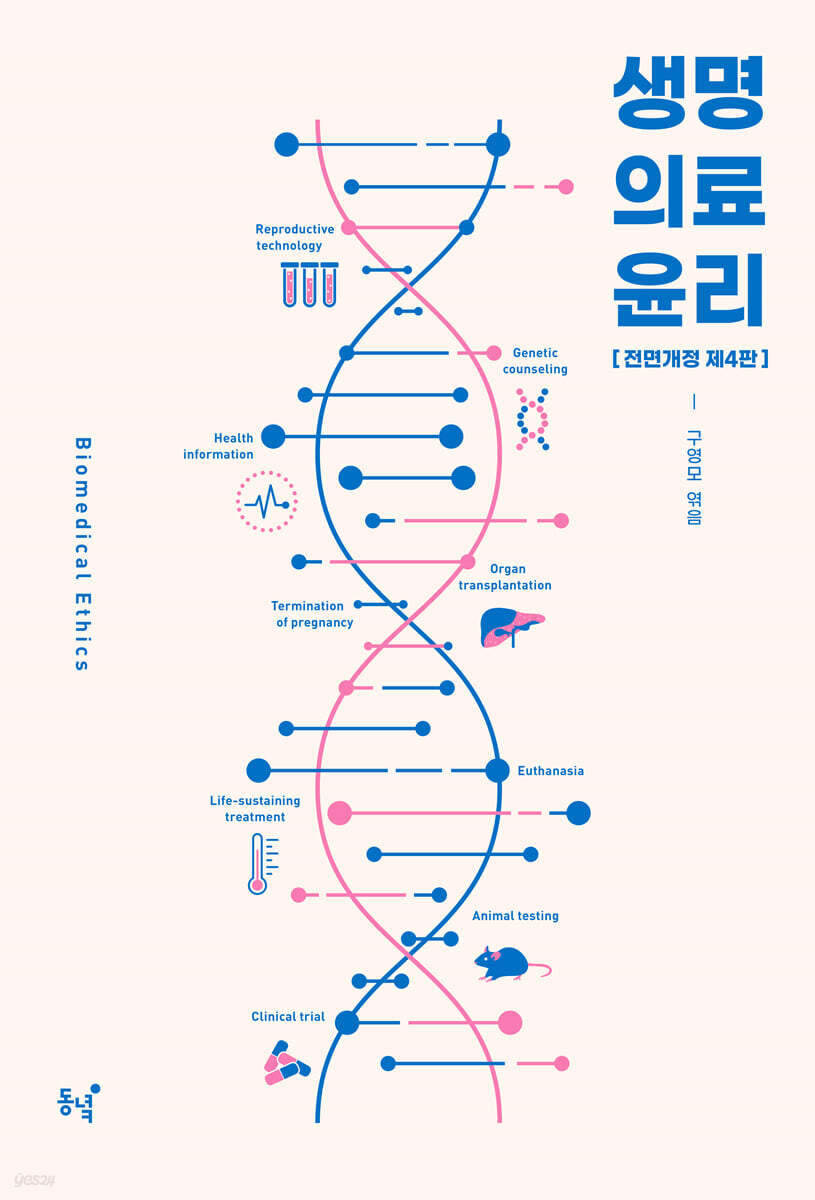
Reflecting these changes, 『Biomedical Ethics』, which has been a beloved textbook on biomedical ethics for over 20 years, presents a fully revised 4th edition that includes new topics and discussions.
In this revised edition, authors who are not only researchers but also leading experts in their respective fields, including physicians, veterinarians, genetic counselors, and lawyers, cover a wide range of topics in bioethics in vivid language reflecting the field.
On traditional issues such as abortion, euthanasia, organ transplantation, and animal testing, it effectively organizes and conveys accumulated discussions while simultaneously demonstrating new approaches and thematic awareness.
In addition, it introduces the latest issues and ethical controversies surrounding genetic counseling, health information big data, and other topics, enabling ethical reflection on upcoming changes.
The introductory articles that were included in the previous edition have also been revised and expanded to reflect the latest information and add new topics.
Through the complex and sharp questions addressed in this book, readers will be able to understand the overall current debate in bioethics and grasp the ethical issues, social debate, institutional status, and future direction of each issue.
Furthermore, in an era of rapid advancement in biomedical engineering and medical technology, this will provide an opportunity to once again reflect on and establish the value and meaning of life.
A comprehensively revised edition of a best-selling bioethics book that has been loved for over 20 years has been published.
In February 2023, a bioethicist's paper advocating the use of brain-dead women as surrogate mothers sparked a global uproar.
Should we, as scholars argue, view this as akin to uterine organ donation, no different from kidney or cornea donation? Or should we see it as a cutting-edge form of surrogacy, a practice that has existed for years, albeit in slightly different forms? Or should we understand it as the culmination of a culture of disregard for life, unnaturally prolonging the lives of brain-dead individuals and using them as instruments for birth? To reach an ethical judgment on this matter, we must understand the numerous discussions and intersections of ethical issues in biomedical ethics, including organ donation, surrogate pregnancy and childbirth, decisions on life-sustaining treatment for brain-dead individuals, and a utilitarian approach to life.
This is also true when understanding the growing discussion of 'assisted euthanasia' and hospice care in our society, as well as the issue of genetic testing and screening at the fetal or embryonic level.
Today, with the remarkable advancement of medical technology, medicine is moving beyond simply saving dying lives to actively intervening in human life and death, that is, to 'manipulating' and 'controlling' life.
Accordingly, new ethical tensions surrounding the handling of life have emerged throughout Korean society.
Reflecting these changes, 『Biomedical Ethics』, which has been a beloved textbook on biomedical ethics for over 20 years, presents a fully revised 4th edition that includes new topics and discussions.
In this revised edition, authors who are not only researchers but also leading experts in their respective fields, including physicians, veterinarians, genetic counselors, and lawyers, cover a wide range of topics in bioethics in vivid language reflecting the field.
On traditional issues such as abortion, euthanasia, organ transplantation, and animal testing, it effectively organizes and conveys accumulated discussions while simultaneously demonstrating new approaches and thematic awareness.
In addition, it introduces the latest issues and ethical controversies surrounding genetic counseling, health information big data, and other topics, enabling ethical reflection on upcoming changes.
The introductory articles that were included in the previous edition have also been revised and expanded to reflect the latest information and add new topics.
Through the complex and sharp questions addressed in this book, readers will be able to understand the overall current debate in bioethics and grasp the ethical issues, social debate, institutional status, and future direction of each issue.
Furthermore, in an era of rapid advancement in biomedical engineering and medical technology, this will provide an opportunity to once again reflect on and establish the value and meaning of life.
- You can preview some of the book's contents.
Preview
index
Editor's Note
Part 1: Why Bioethics?
Chapter 1: What is Biomedical Ethics? _ Youngmo Koo
Science and Ethics, Customs, and Law | Customs and Ethics | Law and Ethics | What is Biomedical Ethics? | Examples of Biomedical Ethics Reasoning | Four Principles of Biomedical Ethics
Part 2: Bioethics Surrounding Reproduction
Chapter 2: When Does Human Life Begin? _ Peter Singer
An American Couple's Worries | Fetal Life or the Woman's Choice? | Until Abortion Became a Legal Medical Procedure | When Does Human Life Begin? | Unlocking the Deadlock of Abortion
Chapter 3: The Abortion Debate in the Age of Assisted Reproductive Technology _ Kim Seon-hye
In Vitro Fertilization and Elective Abortion | Embryo Selection and Preimplantation Genetic Testing | Abortion in Surrogacy | The Call for a New Reproductive Ethics
Chapter 4: Issues in Korean Society Revealed by Unwed Births Through Assisted Reproductive Technology _ Jiyoung Yoon
The legal and medical realities of unmarried mothers' access to assisted reproductive technology | International examples of unmarried women and same-sex couples accessing assisted reproductive technology | Arguments against issues surrounding unmarried mothers' childbirth | Arguments for issues surrounding unmarried mothers' childbirth | Directions for social, institutional, and cognitive change to support unmarried mothers' childbirth
Part 3: Biomedical Ethics Surrounding Death
Chapter 5: Ethical Issues in Organ Transplantation _ Eun-kyung Choi
What is Organ Transplantation? | Issues Concerned About Organ Transplantation | Domestic and International Laws Regarding Organ Transplantation | Ethical Issues Concerned With Organ Transplantation
Chapter 6: How to View Euthanasia _ Koo Young-mo
The Concept of Euthanasia | Classic Cases of Euthanasia | Euthanasia Cases in Foreign Countries | Cases in Korea: Grandmother Kim's Case at Severance Hospital | Debate on Euthanasia | Misconceptions and Truths Surrounding the Term "Death with Dignity" | Hospice: An Alternative to Euthanasia
Chapter 7: "Life-Sustaining Treatment Decisions Act" (Kim Myeong-hee)
What is life-sustaining treatment? | Legislative Purpose of the Act on Decisions on Life-Sustaining Treatment | Background to the Act on Decisions on Life-Sustaining Treatment | The Process of Reaching Social Consensus on Life-Sustaining Treatment | The Process of Reaching Social Consensus on Life-Sustaining Treatment | Key Contents of the Act on Decisions on Life-Sustaining Treatment | Limitations of the Act on Decisions on Life-Sustaining Treatment | Future Tasks
Part 4: Bioethics in Medical Research
Chapter 8: Thinking About the Ethics of Clinical Trials _ Youngmo Koo
Medical Research and Clinical Trials | International Normative Documents | Korean Clinical Trial Laws
Chapter 9: How is ethical animal testing possible? _ Lee Byeong-han
The Light and Shadow of Animal Testing | The Limitations and Significance of Animal Testing | Principles for Ethical Animal Testing | Understanding the Animal Protection Act | Social Consensus and Ethical Efforts in Animal Testing
Part 5: Biomedical Ethics in a New Era
Chapter 10: What is Genetic Counseling? _ Choi In-hee
History of Genetic Counseling | Definition of Genetic Counseling | Certification System for Genetic Counselor Certification | Genetic Counseling in the Healthcare Field | The Future and Prospects of Genetic Counseling
Chapter 11: The Present and Future of Health Information-Related Legislation in the Big Data Era _ Lee Seo-hyung
Introduction of the Concept of Pseudonymization: The Personal Information Protection Act and the Guidelines for the Use of Healthcare Data | Recommendations for Reestablishing the Legal Framework Regarding Health Information
main
About the Author
Part 1: Why Bioethics?
Chapter 1: What is Biomedical Ethics? _ Youngmo Koo
Science and Ethics, Customs, and Law | Customs and Ethics | Law and Ethics | What is Biomedical Ethics? | Examples of Biomedical Ethics Reasoning | Four Principles of Biomedical Ethics
Part 2: Bioethics Surrounding Reproduction
Chapter 2: When Does Human Life Begin? _ Peter Singer
An American Couple's Worries | Fetal Life or the Woman's Choice? | Until Abortion Became a Legal Medical Procedure | When Does Human Life Begin? | Unlocking the Deadlock of Abortion
Chapter 3: The Abortion Debate in the Age of Assisted Reproductive Technology _ Kim Seon-hye
In Vitro Fertilization and Elective Abortion | Embryo Selection and Preimplantation Genetic Testing | Abortion in Surrogacy | The Call for a New Reproductive Ethics
Chapter 4: Issues in Korean Society Revealed by Unwed Births Through Assisted Reproductive Technology _ Jiyoung Yoon
The legal and medical realities of unmarried mothers' access to assisted reproductive technology | International examples of unmarried women and same-sex couples accessing assisted reproductive technology | Arguments against issues surrounding unmarried mothers' childbirth | Arguments for issues surrounding unmarried mothers' childbirth | Directions for social, institutional, and cognitive change to support unmarried mothers' childbirth
Part 3: Biomedical Ethics Surrounding Death
Chapter 5: Ethical Issues in Organ Transplantation _ Eun-kyung Choi
What is Organ Transplantation? | Issues Concerned About Organ Transplantation | Domestic and International Laws Regarding Organ Transplantation | Ethical Issues Concerned With Organ Transplantation
Chapter 6: How to View Euthanasia _ Koo Young-mo
The Concept of Euthanasia | Classic Cases of Euthanasia | Euthanasia Cases in Foreign Countries | Cases in Korea: Grandmother Kim's Case at Severance Hospital | Debate on Euthanasia | Misconceptions and Truths Surrounding the Term "Death with Dignity" | Hospice: An Alternative to Euthanasia
Chapter 7: "Life-Sustaining Treatment Decisions Act" (Kim Myeong-hee)
What is life-sustaining treatment? | Legislative Purpose of the Act on Decisions on Life-Sustaining Treatment | Background to the Act on Decisions on Life-Sustaining Treatment | The Process of Reaching Social Consensus on Life-Sustaining Treatment | The Process of Reaching Social Consensus on Life-Sustaining Treatment | Key Contents of the Act on Decisions on Life-Sustaining Treatment | Limitations of the Act on Decisions on Life-Sustaining Treatment | Future Tasks
Part 4: Bioethics in Medical Research
Chapter 8: Thinking About the Ethics of Clinical Trials _ Youngmo Koo
Medical Research and Clinical Trials | International Normative Documents | Korean Clinical Trial Laws
Chapter 9: How is ethical animal testing possible? _ Lee Byeong-han
The Light and Shadow of Animal Testing | The Limitations and Significance of Animal Testing | Principles for Ethical Animal Testing | Understanding the Animal Protection Act | Social Consensus and Ethical Efforts in Animal Testing
Part 5: Biomedical Ethics in a New Era
Chapter 10: What is Genetic Counseling? _ Choi In-hee
History of Genetic Counseling | Definition of Genetic Counseling | Certification System for Genetic Counselor Certification | Genetic Counseling in the Healthcare Field | The Future and Prospects of Genetic Counseling
Chapter 11: The Present and Future of Health Information-Related Legislation in the Big Data Era _ Lee Seo-hyung
Introduction of the Concept of Pseudonymization: The Personal Information Protection Act and the Guidelines for the Use of Healthcare Data | Recommendations for Reestablishing the Legal Framework Regarding Health Information
main
About the Author
Into the book
Even Roman Catholic theologians are not clear on whether the early embryo before implantation is an individual human being or not.
Father Norman Ford, dean of Melbourne Catholic College in Australia, was troubled by the fact that after fertilization, an embryo could split into identical twins.
(…) If we consider an embryo as a human individual from the moment of conception—let's call it Marion, for example—what happens to Marion when the embryo splits? Are the new twins created Marion and Ruth, or are they entirely different twins, Ruth and Esther? Either answer raises a paradox.
---From page 70, “When Does Human Life Begin?”
Are those who support surrogacy, which rejects elective abortions or selective abortions for disabled children, truly supporting the woman's right to choose or the fetus's right to life? Furthermore, the question of who has the power to decide on abortion in surrogacy becomes as complex as the number of actors involved in the pregnancy and birth process.
Should the surrogate's decision regarding what happens inside the pregnant woman's body be respected (given that the fetus and the woman cannot be considered separately)? Or should the decision of the client (the biological and social mother), who is responsible for the actual care and upbringing of the child, be respected?
---From "Page 99, The Abortion Debate in the Age of Assisted Reproductive Technology"
The need for organ transplantation creates pressure to remove organs as early as possible in the process leading to death.
In other words, there are cases where a death declaration is made for organ transplantation even though the death declaration has not yet been made according to the standards.
In this context, some question whether accepting organs only from deceased (or declared deceased) donors (the deceased donor rule) can function as an ethical principle.
This is a criticism of the fact that the donor's rights to his or her body are taken away from the moment of death declaration, even though it is difficult to determine the exact time of death.
---From page 131, “Ethical Issues in Organ Transplantation”
Animal rights activists who argue that animal testing is useless raise questions about the reliability of the results of animal testing.
In other words, the argument is that animals and humans are physiologically different, so the results obtained from animal experiments cannot always be applied to humans.
Rodents, the most commonly used animals in animal experiments, do not have the physiological ability to vomit and, unlike humans, breathe only through their noses.
This means that it can have a decisive impact on the absorption rate of toxic substances into the body.
Also, while the human lifespan is around 70 years, rodents only live for about 2 to 3 years.
(…) Because of these differences, it is very difficult to correctly interpret the results of animal experiments related to cancer.
---From page 260, “How is ethical animal testing possible?”
Reed, who was the director of the Dite Institute for Human Genetics at the University of Minnesota, proposed the term "genetic counseling" to describe the process of thinking about genetic disorders as medical problems and helping patients and their families come to terms with the medical and psychological impact of their illness.
Although he never completely broke away from eugenics, Reed called himself a first-generation genetic counselor and explained that the goal of human genetics should be not to pursue the economic and racial interests of society, but to provide medical and psychological help to patients and their families.
Additionally, genetic counseling was described as a psychological approach, i.e., a process of helping clients and clients, rather than a process of treating patients.
---From "What is Genetic Counseling?" on page 282
In 1990, the Human Genome Project was launched with the goal of completely sequencing the human genome, and as the project progressed, expectations grew that analyzing genetic information could help conquer disease.
However, these expectations have gradually changed to the recognition that genetic information alone has limitations in preventing, diagnosing, and treating diseases.
This led to the idea that it was necessary to analyze all disease-causing factors, including not only the human genome but also eating and lifestyle habits.
Accordingly, there has been an active movement in academia and industry to collect and analyze as much information about an individual's health as possible, including genetic information, dietary information, and lifestyle information.
The development of information and communication technology makes it possible to collect and analyze information on such a large scale.
Father Norman Ford, dean of Melbourne Catholic College in Australia, was troubled by the fact that after fertilization, an embryo could split into identical twins.
(…) If we consider an embryo as a human individual from the moment of conception—let's call it Marion, for example—what happens to Marion when the embryo splits? Are the new twins created Marion and Ruth, or are they entirely different twins, Ruth and Esther? Either answer raises a paradox.
---From page 70, “When Does Human Life Begin?”
Are those who support surrogacy, which rejects elective abortions or selective abortions for disabled children, truly supporting the woman's right to choose or the fetus's right to life? Furthermore, the question of who has the power to decide on abortion in surrogacy becomes as complex as the number of actors involved in the pregnancy and birth process.
Should the surrogate's decision regarding what happens inside the pregnant woman's body be respected (given that the fetus and the woman cannot be considered separately)? Or should the decision of the client (the biological and social mother), who is responsible for the actual care and upbringing of the child, be respected?
---From "Page 99, The Abortion Debate in the Age of Assisted Reproductive Technology"
The need for organ transplantation creates pressure to remove organs as early as possible in the process leading to death.
In other words, there are cases where a death declaration is made for organ transplantation even though the death declaration has not yet been made according to the standards.
In this context, some question whether accepting organs only from deceased (or declared deceased) donors (the deceased donor rule) can function as an ethical principle.
This is a criticism of the fact that the donor's rights to his or her body are taken away from the moment of death declaration, even though it is difficult to determine the exact time of death.
---From page 131, “Ethical Issues in Organ Transplantation”
Animal rights activists who argue that animal testing is useless raise questions about the reliability of the results of animal testing.
In other words, the argument is that animals and humans are physiologically different, so the results obtained from animal experiments cannot always be applied to humans.
Rodents, the most commonly used animals in animal experiments, do not have the physiological ability to vomit and, unlike humans, breathe only through their noses.
This means that it can have a decisive impact on the absorption rate of toxic substances into the body.
Also, while the human lifespan is around 70 years, rodents only live for about 2 to 3 years.
(…) Because of these differences, it is very difficult to correctly interpret the results of animal experiments related to cancer.
---From page 260, “How is ethical animal testing possible?”
Reed, who was the director of the Dite Institute for Human Genetics at the University of Minnesota, proposed the term "genetic counseling" to describe the process of thinking about genetic disorders as medical problems and helping patients and their families come to terms with the medical and psychological impact of their illness.
Although he never completely broke away from eugenics, Reed called himself a first-generation genetic counselor and explained that the goal of human genetics should be not to pursue the economic and racial interests of society, but to provide medical and psychological help to patients and their families.
Additionally, genetic counseling was described as a psychological approach, i.e., a process of helping clients and clients, rather than a process of treating patients.
---From "What is Genetic Counseling?" on page 282
In 1990, the Human Genome Project was launched with the goal of completely sequencing the human genome, and as the project progressed, expectations grew that analyzing genetic information could help conquer disease.
However, these expectations have gradually changed to the recognition that genetic information alone has limitations in preventing, diagnosing, and treating diseases.
This led to the idea that it was necessary to analyze all disease-causing factors, including not only the human genome but also eating and lifestyle habits.
Accordingly, there has been an active movement in academia and industry to collect and analyze as much information about an individual's health as possible, including genetic information, dietary information, and lifestyle information.
The development of information and communication technology makes it possible to collect and analyze information on such a large scale.
---From "The Present and Future of Health Information-Related Legislation in the Big Data Era," pp. 307-308
Publisher's Review
From medical, nursing, and ethics majors to general readers
A leading steady seller that has become the introductory textbook for biomedical ethics in Korea.
『Biomedical Ethics』 was first published in the late 1990s, when Korean society's perception and discussion of life were rapidly changing due to changes such as the birth of somatic cell-cloned calves, the ruling on the constitutionality of brain-dead organ transplants, and the rapid development of assisted reproductive technology.
Professor Koo Young-mo, who compiled this book, took the lead in introducing the unfamiliar discussion of biomedical ethics to domestic readers by addressing the most heated debates in the field of bioethics at the time of the first edition's publication.
At a time when public interest in bioethics and medical ethics was growing, there were few domestic books on the subject that readers could easily read. This book became the only introductory book in Korea that was accessible not only to specialists in the field but also to general readers interested in the subject.
Since then, 『Biomedical Ethics』 has been revised in two editions: the second edition in 2004 and the third edition in 2010, consistently providing readers with new discussions in response to changes in our society and the field of biomedical ethics.
Through these efforts, this book has been widely loved as a solid introductory text that provides a comprehensive understanding of various topics in bioethics discussions for over 20 years since its first publication in 1999.
The fourth edition, fully revised in 2023, covers the accumulated discussions on traditional topics in this field, such as abortion and euthanasia, while also introducing readers to new topics that keep pace with societal changes, such as genetic counseling and health information.
Abortion, organ transplants, euthanasia, animal testing, genetic counseling, health information big data…
The essence of biomedical ethics written by experts in each field
This book is written by leading experts in various fields, including philosophers, feminists, doctors, veterinarians, genetic counselors, and lawyers, providing expert discussions that accurately reflect the current medical landscape.
It also covers major topics in the field of biomedical ethics, including abortion, organ transplantation, euthanasia, animal testing, genetic counseling, and health information big data, through eleven chapters.
Chapter 1, "What is Biomedical Ethics?" (Koo Young-mo), before addressing specific issues, provides a theoretical overview of ethics, the academic roots of biomedical ethics, and what biomedical ethics is in relation to that ethics.
Chapter 2, "When Does Human Life Begin?" (Peter Singer), introduces the history of abortion rights in Western societies and the social debate surrounding them, and analyzes the discourse on the right to life and the right to choose, which are the main frames of the debate for and against abortion.
It also introduces various discussions from the Middle Ages to the present that answer the main point of contention in the abortion debate, namely, "When should we consider the beginning of fetal life?" and shows a persistent intellectual journey that explores the abortion debate from an empirical and philosophical perspective.
Chapter 3, “The Abortion Debate in the Age of Assisted Reproductive Technology” (Kim Seon-hye), examines how the development of assisted reproductive technology has led to the emergence of cases of abortion that cannot be encompassed by the existing discourse on the right to life and the right to choose.
It addresses the ethical issues surrounding abortion through in vitro fertilization, embryo selection and preimplantation genetic testing, and pregnancy and childbirth through surrogacy, while also demonstrating the need for a new reproductive ethic that goes beyond the right to life and the right to choose in our society.
Chapter 4, "Issues in Korean Society Revealed by Unwed Mothers' Births Through Assisted Reproductive Technology" (Jiyoung Yoon), addresses the issue of unwed mothers' births through assisted reproductive technology, which has heated up Korean society in recent years, from the perspective of women's reproductive rights, and examines the domestic and international legal and medical realities related to this issue.
In addition to the domestic social discussions surrounding this, it also points out its rich significance for our society and suggests directions for change to guarantee reproductive rights.
Chapter 5, “Ethical Issues in Organ Transplantation” (Eun-Kyung Choi), provides a thorough explanation of the ethical issues surrounding organ transplantation and the concepts, history, and discussions surrounding each issue.
It specifically addresses the issues of death declaration and time of death when donating organs from deceased persons, the validity of consent to organ acquisition, the altruism and voluntariness of consent and the possibility of organ trading when donating organs from living persons, and the method of fairly distributing donated organs.
It also reviews domestic and international laws regarding organ transplantation and points out ethical issues that need to be addressed in the future.
Chapter 6, "How to View Euthanasia" (by Ku Young-mo), introduces the concept of euthanasia and historical cases from home and abroad, and provides a detailed explanation of the complex pros and cons of euthanasia, including involuntary euthanasia of disabled infants and the slippery slope argument.
In addition, we briefly discuss the terms euthanasia and 'death with dignity', as well as the history and concept of hospice, which is considered an alternative to euthanasia.
Chapter 7, “A Closer Look at the Act on Decisions on Life-Sustaining Treatment” (by Myunghee Kim), explains the concept of life-sustaining treatment, which is widely known in Korea as hospice care, and then provides a detailed account of the background, enactment process, and main contents of the Act on Decisions on Life-Sustaining Treatment currently in effect.
In addition, it sharply points out the problems of this law and suggests the direction in which it should proceed.
Chapter 8, "Considering the Ethics of Clinical Trials" (Koo Young-mo), explains the classification of medical research involving human subjects and the concept of clinical trials within it. It also examines the major international norms related to clinical trials and examines specific ethical values related to clinical trials.
We also look into domestic laws related to clinical trials and explain what research ethics we should consider in Korea today.
Chapter 9, “How is Ethical Animal Testing Possible?” (Byeong-Han Lee) examines the history of animal testing and experimental cases in various fields, demonstrating the necessity of ethical animal testing.
This article then introduces several principles that researchers must adhere to, explains the process and content of the enactment of relevant domestic and international laws, and urges social efforts to promote animal experimentation ethics.
Chapter 10, “What is Genetic Counseling?” (Choi In-hee), introduces the field of genetic counseling, which is still not widely known in Korea.
After examining the history and concept of genetic counseling, as well as domestic and international systems, we introduce examples of genetic counseling used in various medical settings and provide a general overview of the ethical considerations that arise.
Chapter 11, "The Present and Future of Health Information-Related Legislation in the Big Data Era" (by Seohyung Lee), addresses the legislation related to the processing of big data health information, including personal medical records.
We will carefully review the recently revised Personal Information Protection Act and other relevant regulations to identify problems and suggest areas for improvement to ensure the proper handling of health information.
These discussions do not provide simple and clear answers to the ethical issues surrounding life, but they do provide readers with various perspectives, topics for discussion, and seeds of thought from which to think about them.
Through this, readers will be able to more actively consider and establish the changing values and meaning of life in modern society.
A leading steady seller that has become the introductory textbook for biomedical ethics in Korea.
『Biomedical Ethics』 was first published in the late 1990s, when Korean society's perception and discussion of life were rapidly changing due to changes such as the birth of somatic cell-cloned calves, the ruling on the constitutionality of brain-dead organ transplants, and the rapid development of assisted reproductive technology.
Professor Koo Young-mo, who compiled this book, took the lead in introducing the unfamiliar discussion of biomedical ethics to domestic readers by addressing the most heated debates in the field of bioethics at the time of the first edition's publication.
At a time when public interest in bioethics and medical ethics was growing, there were few domestic books on the subject that readers could easily read. This book became the only introductory book in Korea that was accessible not only to specialists in the field but also to general readers interested in the subject.
Since then, 『Biomedical Ethics』 has been revised in two editions: the second edition in 2004 and the third edition in 2010, consistently providing readers with new discussions in response to changes in our society and the field of biomedical ethics.
Through these efforts, this book has been widely loved as a solid introductory text that provides a comprehensive understanding of various topics in bioethics discussions for over 20 years since its first publication in 1999.
The fourth edition, fully revised in 2023, covers the accumulated discussions on traditional topics in this field, such as abortion and euthanasia, while also introducing readers to new topics that keep pace with societal changes, such as genetic counseling and health information.
Abortion, organ transplants, euthanasia, animal testing, genetic counseling, health information big data…
The essence of biomedical ethics written by experts in each field
This book is written by leading experts in various fields, including philosophers, feminists, doctors, veterinarians, genetic counselors, and lawyers, providing expert discussions that accurately reflect the current medical landscape.
It also covers major topics in the field of biomedical ethics, including abortion, organ transplantation, euthanasia, animal testing, genetic counseling, and health information big data, through eleven chapters.
Chapter 1, "What is Biomedical Ethics?" (Koo Young-mo), before addressing specific issues, provides a theoretical overview of ethics, the academic roots of biomedical ethics, and what biomedical ethics is in relation to that ethics.
Chapter 2, "When Does Human Life Begin?" (Peter Singer), introduces the history of abortion rights in Western societies and the social debate surrounding them, and analyzes the discourse on the right to life and the right to choose, which are the main frames of the debate for and against abortion.
It also introduces various discussions from the Middle Ages to the present that answer the main point of contention in the abortion debate, namely, "When should we consider the beginning of fetal life?" and shows a persistent intellectual journey that explores the abortion debate from an empirical and philosophical perspective.
Chapter 3, “The Abortion Debate in the Age of Assisted Reproductive Technology” (Kim Seon-hye), examines how the development of assisted reproductive technology has led to the emergence of cases of abortion that cannot be encompassed by the existing discourse on the right to life and the right to choose.
It addresses the ethical issues surrounding abortion through in vitro fertilization, embryo selection and preimplantation genetic testing, and pregnancy and childbirth through surrogacy, while also demonstrating the need for a new reproductive ethic that goes beyond the right to life and the right to choose in our society.
Chapter 4, "Issues in Korean Society Revealed by Unwed Mothers' Births Through Assisted Reproductive Technology" (Jiyoung Yoon), addresses the issue of unwed mothers' births through assisted reproductive technology, which has heated up Korean society in recent years, from the perspective of women's reproductive rights, and examines the domestic and international legal and medical realities related to this issue.
In addition to the domestic social discussions surrounding this, it also points out its rich significance for our society and suggests directions for change to guarantee reproductive rights.
Chapter 5, “Ethical Issues in Organ Transplantation” (Eun-Kyung Choi), provides a thorough explanation of the ethical issues surrounding organ transplantation and the concepts, history, and discussions surrounding each issue.
It specifically addresses the issues of death declaration and time of death when donating organs from deceased persons, the validity of consent to organ acquisition, the altruism and voluntariness of consent and the possibility of organ trading when donating organs from living persons, and the method of fairly distributing donated organs.
It also reviews domestic and international laws regarding organ transplantation and points out ethical issues that need to be addressed in the future.
Chapter 6, "How to View Euthanasia" (by Ku Young-mo), introduces the concept of euthanasia and historical cases from home and abroad, and provides a detailed explanation of the complex pros and cons of euthanasia, including involuntary euthanasia of disabled infants and the slippery slope argument.
In addition, we briefly discuss the terms euthanasia and 'death with dignity', as well as the history and concept of hospice, which is considered an alternative to euthanasia.
Chapter 7, “A Closer Look at the Act on Decisions on Life-Sustaining Treatment” (by Myunghee Kim), explains the concept of life-sustaining treatment, which is widely known in Korea as hospice care, and then provides a detailed account of the background, enactment process, and main contents of the Act on Decisions on Life-Sustaining Treatment currently in effect.
In addition, it sharply points out the problems of this law and suggests the direction in which it should proceed.
Chapter 8, "Considering the Ethics of Clinical Trials" (Koo Young-mo), explains the classification of medical research involving human subjects and the concept of clinical trials within it. It also examines the major international norms related to clinical trials and examines specific ethical values related to clinical trials.
We also look into domestic laws related to clinical trials and explain what research ethics we should consider in Korea today.
Chapter 9, “How is Ethical Animal Testing Possible?” (Byeong-Han Lee) examines the history of animal testing and experimental cases in various fields, demonstrating the necessity of ethical animal testing.
This article then introduces several principles that researchers must adhere to, explains the process and content of the enactment of relevant domestic and international laws, and urges social efforts to promote animal experimentation ethics.
Chapter 10, “What is Genetic Counseling?” (Choi In-hee), introduces the field of genetic counseling, which is still not widely known in Korea.
After examining the history and concept of genetic counseling, as well as domestic and international systems, we introduce examples of genetic counseling used in various medical settings and provide a general overview of the ethical considerations that arise.
Chapter 11, "The Present and Future of Health Information-Related Legislation in the Big Data Era" (by Seohyung Lee), addresses the legislation related to the processing of big data health information, including personal medical records.
We will carefully review the recently revised Personal Information Protection Act and other relevant regulations to identify problems and suggest areas for improvement to ensure the proper handling of health information.
These discussions do not provide simple and clear answers to the ethical issues surrounding life, but they do provide readers with various perspectives, topics for discussion, and seeds of thought from which to think about them.
Through this, readers will be able to more actively consider and establish the changing values and meaning of life in modern society.
GOODS SPECIFICS
- Date of issue: February 28, 2023
- Page count, weight, size: 362 pages | 476g | 152*224*17mm
- ISBN13: 9788972970767
- ISBN10: 897297076X
You may also like
카테고리
korean


korean

![GQ KOREA Mark (Monthly): December [2025]](http://librairie.coreenne.fr/cdn/shop/files/8ef265dbbfbf186523ed75ba7319009d.jpg?v=1765340328&width=3840)


