

Quantum mechanics story
 |
Description
Book Introduction
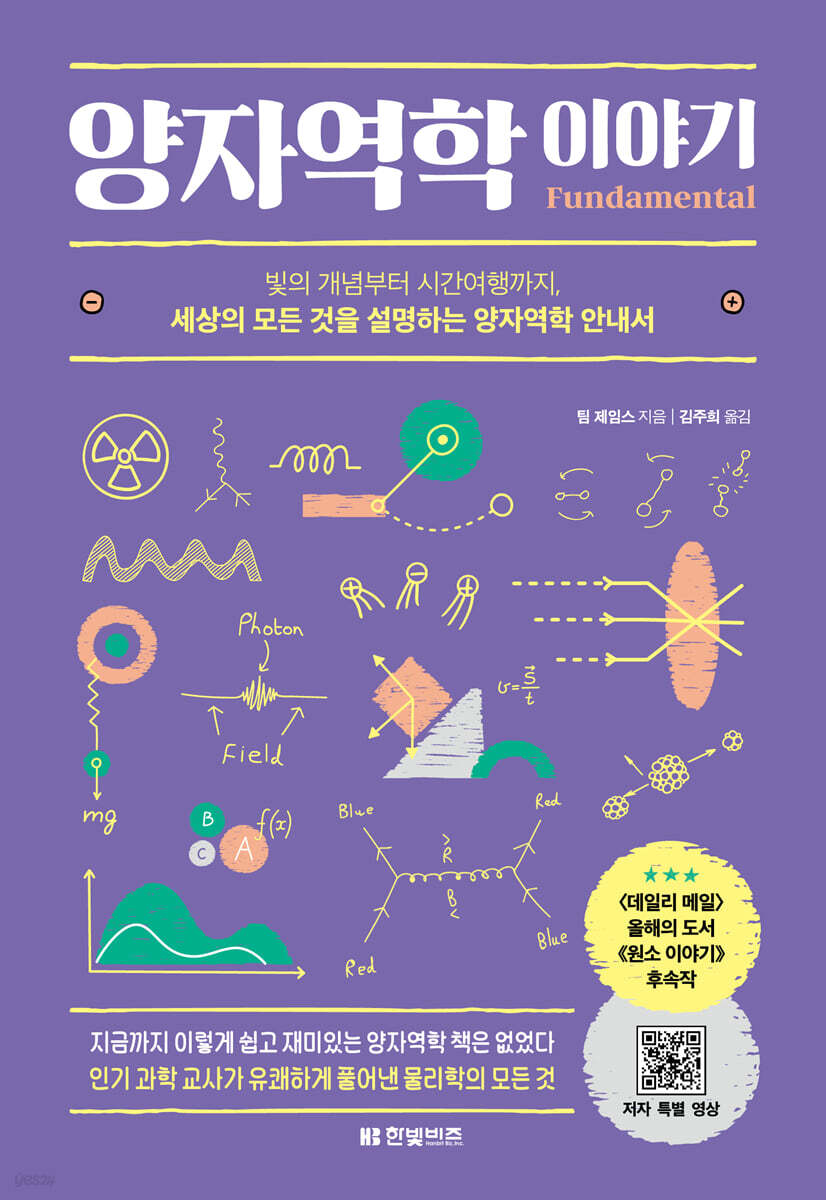
“There has never been a quantum mechanics book this easy and fun!” From the concept of light to time travel, from Einstein to Feynman A Guide to Quantum Mechanics: Explaining Everything in the World Everyone has probably heard vaguely about things like the Higgs boson or quantum computers at least once in their lives. But how many people truly understand their existence? Tim James, a renowned British science teacher and author of "Quantum Mechanics," uses his signature wit and humor to guide anyone through the bizarre yet fascinating world of quantum mechanics and particle physics. It introduces everything from the fascinating stories of familiar yet somewhat unfamiliar scientists such as Einstein, Bohr, Schrödinger, and Feynman to the history of various experiments designed to verify theories that seemed impossible. Moreover, instead of complicated mathematical formulas or endless numbers, the author's hand-drawn illustrations and funny jokes related to scientific theories not only help readers understand quantum mechanics concepts, but also make reading the book more enjoyable. What's more noteworthy is that it doesn't miss out on both information and entertainment. At the end of the book, the author introduces a chronology that allows readers to understand the development of quantum physics and particle physics at a glance, from Descartes' theory that light is a wave in 1618 to the development of the 'quantum book' by Michael Banner in 2018. In addition, it introduces the latest theories and various formulas related to quantum mechanics that were not introduced in the main text, satisfying the thirst of readers thirsty for intellectual curiosity. Let's explore the exciting world of physics that you never knew before with 『Quantum Mechanics Story』. |
- You can preview some of the book's contents.
Preview
index
Preface_End
Chapter 1: Inflated with Confidence
Chapter 2: Fragmented Light
Chapter 3: Nobles, Bombs, and Pollen
Chapter 4: Taming the Freak
Chapter 5: Things Get Even Stranger
Chapter 6: The Box and the Cat
Chapter 7: The World is a Mirage
Chapter 8: The Quantum Must Disappear
Chapter 9: Teletransmission, Time Machines, and Vortexes
Chapter 10: Proving I'm Batman with Quantum Mechanics
Chapter 11 In that distant field
Chapter 12 Straight and Wavy Lines
Chapter 13: Particle Physics Grows
Chapter 14: Honey, Where's My Higgs Boson?
Chapter 15 The Problem Caused by G
Quantum Physics & Particle Physics Chronology
supplement
Acknowledgements
main
Chapter 1: Inflated with Confidence
Chapter 2: Fragmented Light
Chapter 3: Nobles, Bombs, and Pollen
Chapter 4: Taming the Freak
Chapter 5: Things Get Even Stranger
Chapter 6: The Box and the Cat
Chapter 7: The World is a Mirage
Chapter 8: The Quantum Must Disappear
Chapter 9: Teletransmission, Time Machines, and Vortexes
Chapter 10: Proving I'm Batman with Quantum Mechanics
Chapter 11 In that distant field
Chapter 12 Straight and Wavy Lines
Chapter 13: Particle Physics Grows
Chapter 14: Honey, Where's My Higgs Boson?
Chapter 15 The Problem Caused by G
Quantum Physics & Particle Physics Chronology
supplement
Acknowledgements
main
Detailed image
Into the book
Imagine someone asking you to draw a triangle with four sides, or to think of a number less than 10 but greater than 1 billion.
Although such requirements are not complex, they are absurd and therefore difficult to comply with.
The path to quantum physics is similar.
Quantum physics is a world of four-sided triangles and numbers that don't follow the usual rules.
Parallel universes and contradictions lurk everywhere, and things don't need to care about space or time.
---From the "Preface"
This strange phenomenon was called the "ultraviolet catastrophe" by physicist Paul Ehrenfest, and has since become famous as it is referred to in many physics books.
(…)UV radiation breakdown is the result of a misconception about how light energy works.
No one could have predicted that by gradually correcting this misconception, humanity would eventually enter the path of a quantum revolution.
Even the person who came up with the answer to the UV-induced breakdown problem wasn't trying to do something that revolutionary.
I just wanted to make a cheap light bulb.
---From "Chapter 1_Blooming with Confidence"
Before 1926, there were only a few loosely connected threads to quantum theory.
But Schrödinger brought those strands together and wove them together.
He showed that wave-particle duality is connected with the energy levels of electron shells, and explained all chemical phenomena related to the shape of atomic orbitals with it, and showed that particles can be predicted using probability.
---From "Chapter 4: Taming the Freak"
I think by now you've probably noticed that it won't be long before all the theories of quantum mechanics are proven wrong.
To those who don't know much about science, this situation may seem unsettling, as if scientists are constantly in a state of uncertainty (anyone like Heisenberg-style puns?), but in fact, this whole situation is normal.
---From "Chapter 5_The situation becomes even stranger"
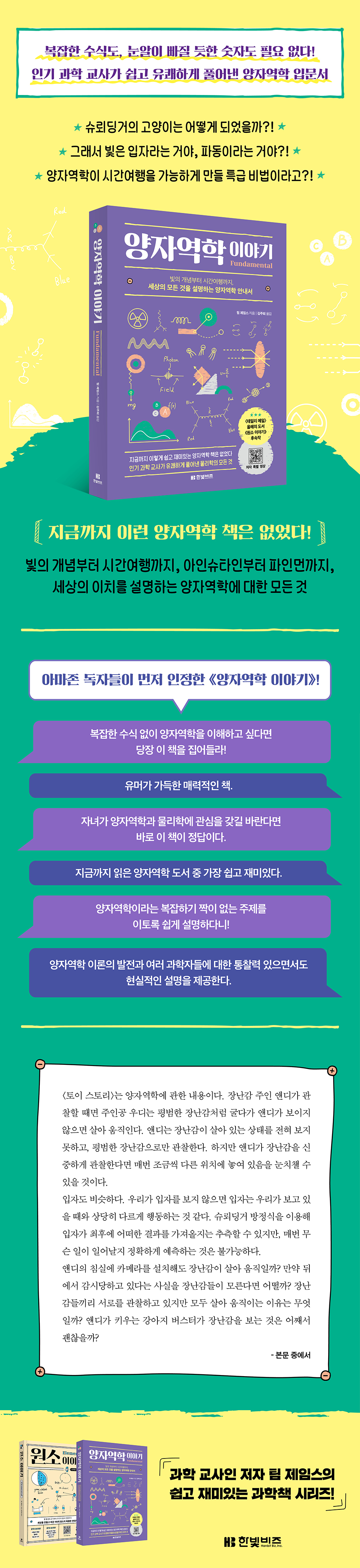
Toy Story is about quantum mechanics.
When Andy, the toy's owner, observes, Woody acts like an ordinary toy, but when Andy is not looking, he comes to life and moves.
Andy never sees the toys as alive, and treats them as just ordinary toys.
But if Andy observes his toys carefully, he will notice that they are placed in slightly different positions each time.
The particles are similar.
When we don't see a particle, it seems to behave quite differently than when we do.
Although the Schrödinger equation can be used to infer what the final outcome of a particle will be, it is impossible to accurately predict what will happen every time.
---From "Chapter 7_The World is a Mirage"
They are all put into boxes and sent to opposite ends of the solar system.
When you open the box at one end and find a red cat, you can simultaneously find out what is inside the other box.
While we could use the analogy that the information about the 'green cat' traveled across the universe to reach us, there is no need for anything to actually move between the two boxes, so there is no violation of relativity here.
From a quantum perspective, cats do not pre-determine their properties, but rather exchange randomly determined state information at the moment of measurement via telepathy at faster than the speed of light.
On the other hand, from Einstein's perspective, the cat's characteristics are always fixed.
It's just that you can't determine the cat's characteristics before measuring them.
---From "Chapter 8_Quantum Must Disappear"
The question that always arises when trying to understand quantum mechanics is whether there is a better interpretation than the Copenhagen interpretation, which simply dismisses it as "just what happens."
Most physics textbooks teach the Copenhagen interpretation.
Because Bohr was a giant in the academic world, and for decades his interpretation was the only one.
But today, the Copenhagen interpretation is no longer the only one.
While it is clear that classical concepts will eventually have to be abandoned, there are still some incomprehensible parts in any interpretation of quantum mechanics.
As the Copenhagen interpretation of the past passed its sanctuary, approaches to replace it developed in a variety of ways, much like the Scandinavian table setting.
---From "Chapter 10: Proving I'm Batman with Quantum Mechanics"
Feynman diagrams are elegant.
But beautiful pictures alone don't win you a Nobel Prize.
However, the Feynman diagram is better than my illustration in that it is not just a sketch drawn from imagination.
Anyway, Feynman diagrams are surprisingly powerful in prediction.
(…) The coupling constant of the two sheets they calculated was 0.00729735256.
The experimentally measured value is 0.00729735257.
There is a 10-digit difference between the theoretical and experimental values.
Feynman described this accuracy as having an error in measuring the distance from New York to Los Angeles smaller than the width of a human hair.
Until now, there has been no prediction this accurate in science.
---From "Chapter 12_Straight Lines and Wavy Lines"
We don't know everything about the world, and incredibly exciting questions still remain, but quantum field theory is guiding humanity in the right direction.
In this new realm, we are still taking our first steps.
It's true.
But I no longer feel ahead with my eyes closed.
Every event in history is the result of particles interacting with fields, and today we have a framework that can explain all of those phenomena.
Except for one problem.
Quantum field theory cannot yet handle this.
gravitation.
---From "Chapter 15_The Problem Caused by G"
Although such requirements are not complex, they are absurd and therefore difficult to comply with.
The path to quantum physics is similar.
Quantum physics is a world of four-sided triangles and numbers that don't follow the usual rules.
Parallel universes and contradictions lurk everywhere, and things don't need to care about space or time.
---From the "Preface"
This strange phenomenon was called the "ultraviolet catastrophe" by physicist Paul Ehrenfest, and has since become famous as it is referred to in many physics books.
(…)UV radiation breakdown is the result of a misconception about how light energy works.
No one could have predicted that by gradually correcting this misconception, humanity would eventually enter the path of a quantum revolution.
Even the person who came up with the answer to the UV-induced breakdown problem wasn't trying to do something that revolutionary.
I just wanted to make a cheap light bulb.
---From "Chapter 1_Blooming with Confidence"
Before 1926, there were only a few loosely connected threads to quantum theory.
But Schrödinger brought those strands together and wove them together.
He showed that wave-particle duality is connected with the energy levels of electron shells, and explained all chemical phenomena related to the shape of atomic orbitals with it, and showed that particles can be predicted using probability.
---From "Chapter 4: Taming the Freak"
I think by now you've probably noticed that it won't be long before all the theories of quantum mechanics are proven wrong.
To those who don't know much about science, this situation may seem unsettling, as if scientists are constantly in a state of uncertainty (anyone like Heisenberg-style puns?), but in fact, this whole situation is normal.
---From "Chapter 5_The situation becomes even stranger"
Toy Story is about quantum mechanics.
When Andy, the toy's owner, observes, Woody acts like an ordinary toy, but when Andy is not looking, he comes to life and moves.
Andy never sees the toys as alive, and treats them as just ordinary toys.
But if Andy observes his toys carefully, he will notice that they are placed in slightly different positions each time.
The particles are similar.
When we don't see a particle, it seems to behave quite differently than when we do.
Although the Schrödinger equation can be used to infer what the final outcome of a particle will be, it is impossible to accurately predict what will happen every time.
---From "Chapter 7_The World is a Mirage"
They are all put into boxes and sent to opposite ends of the solar system.
When you open the box at one end and find a red cat, you can simultaneously find out what is inside the other box.
While we could use the analogy that the information about the 'green cat' traveled across the universe to reach us, there is no need for anything to actually move between the two boxes, so there is no violation of relativity here.
From a quantum perspective, cats do not pre-determine their properties, but rather exchange randomly determined state information at the moment of measurement via telepathy at faster than the speed of light.
On the other hand, from Einstein's perspective, the cat's characteristics are always fixed.
It's just that you can't determine the cat's characteristics before measuring them.
---From "Chapter 8_Quantum Must Disappear"
The question that always arises when trying to understand quantum mechanics is whether there is a better interpretation than the Copenhagen interpretation, which simply dismisses it as "just what happens."
Most physics textbooks teach the Copenhagen interpretation.
Because Bohr was a giant in the academic world, and for decades his interpretation was the only one.
But today, the Copenhagen interpretation is no longer the only one.
While it is clear that classical concepts will eventually have to be abandoned, there are still some incomprehensible parts in any interpretation of quantum mechanics.
As the Copenhagen interpretation of the past passed its sanctuary, approaches to replace it developed in a variety of ways, much like the Scandinavian table setting.
---From "Chapter 10: Proving I'm Batman with Quantum Mechanics"
Feynman diagrams are elegant.
But beautiful pictures alone don't win you a Nobel Prize.
However, the Feynman diagram is better than my illustration in that it is not just a sketch drawn from imagination.
Anyway, Feynman diagrams are surprisingly powerful in prediction.
(…) The coupling constant of the two sheets they calculated was 0.00729735256.
The experimentally measured value is 0.00729735257.
There is a 10-digit difference between the theoretical and experimental values.
Feynman described this accuracy as having an error in measuring the distance from New York to Los Angeles smaller than the width of a human hair.
Until now, there has been no prediction this accurate in science.
---From "Chapter 12_Straight Lines and Wavy Lines"
We don't know everything about the world, and incredibly exciting questions still remain, but quantum field theory is guiding humanity in the right direction.
In this new realm, we are still taking our first steps.
It's true.
But I no longer feel ahead with my eyes closed.
Every event in history is the result of particles interacting with fields, and today we have a framework that can explain all of those phenomena.
Except for one problem.
Quantum field theory cannot yet handle this.
gravitation.
---From "Chapter 15_The Problem Caused by G"
---From "Chapter 15_The Problem Caused by G"
Publisher's Review
What happened to Schrödinger's cat?
So is light a particle or a wave?
An introductory book to quantum mechanics for those who find it increasingly difficult and confusing the more they learn.
Since I first learned about the concept of quantum mechanics, it seemed like a very difficult and at the same time impossible task to fully understand the complex theory of quantum mechanics.
Even Nobel laureate Richard Feynman is said to have said, “Nobody understands quantum physics,” so it seems unlikely that ordinary people like us will ever understand quantum physics.
Fortunately, the reason Feynman said he didn't understand it wasn't because quantum physics was too difficult.
Feynman explained the reason as being that quantum mechanics is so annoyingly weird.
Quantum mechanics is like a triangle with four sides that don't follow the usual rules, or a number less than 10 but greater than a billion, or something absurd.
So what exactly are the fundamental concepts of quantum mechanics, which, the more you learn about them, the more baffling and incomprehensible new stories constantly emerge, and who are these eccentric scientists who dedicate their lives to understanding this "annoying" subject?
From the concept of light to time travel, from Einstein to Feynman
A popular science teacher explains it without any difficult formulas or complicated numbers.
A unique story about quantum mechanics, explained in a fun way.
《Quantum Mechanics Story》 begins with humanity's first efforts to understand light.
Beginning with the Greek philosopher Empedocles, who developed the theory of light around the 5th century BC, to the appearance of René Descartes, who first argued for the wave theory of light, to the grumpy Isaac Newton, who proposed the theory of corpuscles in opposition to this, and finally to Thomas Young, who formulated the theory of light through the famous double-slit experiment 70 years after Newton's death, the author tells various stories related to light in a vivid and interesting way, as if he were living in that era.
As we follow his story, we will soon realize that we have taken the first step toward conquering the complex field of quantum mechanics.
The story continues over time.
The story continues with the discovery of various quantum mechanical theories such as teleportation and general relativity, and experiments to prove them, from the moment Albert Einstein submitted a paper to Planck arguing that light is made up of particles, to Bohr's quantum theory, Heisenberg's uncertainty principle, to the moment Schrödinger calculated the wave function with equations and achieved a perfect explanation of electrons, and the moment his cat (!) appeared in a box.
Are you feeling confused just hearing their names? Don't worry.
Without giving readers a chance to lose interest in unfamiliar concepts, author Tim James constantly livens up the atmosphere with his signature wit and unique sense of humor.
And what about his hand-drawn illustrations? They help readers understand the complex theory of quantum mechanics without the need for complex formulas or mind-boggling numbers.
The author's kindness and affection do not end here.
At the end of the book, a chronology is included that provides an overview of the development of quantum physics and particle physics.
Readers who have been absorbed in the pleasure of reading the text will be able to review the concepts of quantum mechanics once more through this page.
"Quantum Mechanics" is an excellent introductory book that introduces the world of quantum mechanics, which was once difficult to approach, in an easy and fun way.
Readers who have been too scared to get close to quantum mechanics until now, let's begin an enjoyable journey into physics with "The Story of Quantum Mechanics."
▶ Praise from readers who first encountered “Quantum Mechanics Story”!
-If you want to understand quantum mechanics without complicated formulas, pick up this book right now!
-A charming book full of humor.
If you want your child to be interested in quantum mechanics and physics, this is the book for you.
-This is the easiest and most interesting quantum mechanics book I've ever read.
-How can you explain such a complex subject like quantum mechanics so easily?
-Provides insightful yet realistic explanations of the development of quantum mechanics theory and the contributions of various scientists.
So is light a particle or a wave?
An introductory book to quantum mechanics for those who find it increasingly difficult and confusing the more they learn.
Since I first learned about the concept of quantum mechanics, it seemed like a very difficult and at the same time impossible task to fully understand the complex theory of quantum mechanics.
Even Nobel laureate Richard Feynman is said to have said, “Nobody understands quantum physics,” so it seems unlikely that ordinary people like us will ever understand quantum physics.
Fortunately, the reason Feynman said he didn't understand it wasn't because quantum physics was too difficult.
Feynman explained the reason as being that quantum mechanics is so annoyingly weird.
Quantum mechanics is like a triangle with four sides that don't follow the usual rules, or a number less than 10 but greater than a billion, or something absurd.
So what exactly are the fundamental concepts of quantum mechanics, which, the more you learn about them, the more baffling and incomprehensible new stories constantly emerge, and who are these eccentric scientists who dedicate their lives to understanding this "annoying" subject?
From the concept of light to time travel, from Einstein to Feynman
A popular science teacher explains it without any difficult formulas or complicated numbers.
A unique story about quantum mechanics, explained in a fun way.
《Quantum Mechanics Story》 begins with humanity's first efforts to understand light.
Beginning with the Greek philosopher Empedocles, who developed the theory of light around the 5th century BC, to the appearance of René Descartes, who first argued for the wave theory of light, to the grumpy Isaac Newton, who proposed the theory of corpuscles in opposition to this, and finally to Thomas Young, who formulated the theory of light through the famous double-slit experiment 70 years after Newton's death, the author tells various stories related to light in a vivid and interesting way, as if he were living in that era.
As we follow his story, we will soon realize that we have taken the first step toward conquering the complex field of quantum mechanics.
The story continues over time.
The story continues with the discovery of various quantum mechanical theories such as teleportation and general relativity, and experiments to prove them, from the moment Albert Einstein submitted a paper to Planck arguing that light is made up of particles, to Bohr's quantum theory, Heisenberg's uncertainty principle, to the moment Schrödinger calculated the wave function with equations and achieved a perfect explanation of electrons, and the moment his cat (!) appeared in a box.
Are you feeling confused just hearing their names? Don't worry.
Without giving readers a chance to lose interest in unfamiliar concepts, author Tim James constantly livens up the atmosphere with his signature wit and unique sense of humor.
And what about his hand-drawn illustrations? They help readers understand the complex theory of quantum mechanics without the need for complex formulas or mind-boggling numbers.
The author's kindness and affection do not end here.
At the end of the book, a chronology is included that provides an overview of the development of quantum physics and particle physics.
Readers who have been absorbed in the pleasure of reading the text will be able to review the concepts of quantum mechanics once more through this page.
"Quantum Mechanics" is an excellent introductory book that introduces the world of quantum mechanics, which was once difficult to approach, in an easy and fun way.
Readers who have been too scared to get close to quantum mechanics until now, let's begin an enjoyable journey into physics with "The Story of Quantum Mechanics."
▶ Praise from readers who first encountered “Quantum Mechanics Story”!
-If you want to understand quantum mechanics without complicated formulas, pick up this book right now!
-A charming book full of humor.
If you want your child to be interested in quantum mechanics and physics, this is the book for you.
-This is the easiest and most interesting quantum mechanics book I've ever read.
-How can you explain such a complex subject like quantum mechanics so easily?
-Provides insightful yet realistic explanations of the development of quantum mechanics theory and the contributions of various scientists.
GOODS SPECIFICS
- Publication date: November 28, 2022
- Page count, weight, size: 308 pages | 462g | 148*215*20mm
- ISBN13: 9791157846313
- ISBN10: 1157846319
You may also like
카테고리
korean


korean

![ELLE 엘르 스페셜 에디션 A형 : 12월 [2025]](http://librairie.coreenne.fr/cdn/shop/files/b8e27a3de6c9538896439686c6b0e8fb.jpg?v=1766436872&width=3840)


